



Abstract
This paper compares conditional and unconditional cost-of-living indexes (COLI) when tastes change, focusing on the Constant Elasticity of Substitution model. A consumer price index typically targets a conditional COLI, which evaluates price change given set of preferences. An unconditional COLI aims to also capture the welfare effects of changing tastes, but it requires stronger assumptions. Using retail scanner data for food and beverage products, I find COLIs conditioning on current period tastes exceed those conditioning on prior period tastes. Consistent with previous studies, I find an unconditional COLI tends to reflect negative direct contributions from taste change.
Introduction
A cost-of-living index (COLI) is based on the expenditure function from classical consumer theory. The evolution of expenditures over time may reflect changes in many factors in addition to prices. Preferences (which may also be referred to as tastes) may themselves be influenced by climate, crime, or fashion, to name a few. Index users may wish to account for preferences in different ways. Users of a consumer price index (CPI), for instance, may not want to adjust payments (for example) in response to non-price factors. For reasons like this, the target of a CPI is commonly (though not universally) agreed to be a conditional COLI, which holds preferences fixed [1, 2]. For example, the Tornqvist formula used by the Bureau of Labor Statistics (BLS) for the U.S. Chained Consumer Price Index for All Urban Consumers (C-CPI-U) approximates the conditional COLI pertaining to the set of average tastes [3]. On the other hand, researchers may be interested in how changing prices and changing preferences combine to impact an unconditional COLI. Notably, Redding and Weinstein [4] (henceforth RW), find using household scanner data that changing preferences lower costs of living significantly.
This paper reviews the literature on COLI measurement in the presence of taste change and compares the conditional and unconditional COLI approaches theoretically and empirically. The empirical analysis focuses on the Constant Elasticity of Substitution (CES) model. The CES model is widely used in cost-of-living analysis, including studies of preference change. It allows for price-related substitution effects, and traditional price index formulas like the Laspeyres, Paasche, and Cobb-Douglas correspond to special or limiting cases [2]. A CES index is also used for initial estimates of the C-CPI-U [5]. The indexes I consider are for the most part well-known in the literature, though some, like the Lloyd [6] and Moulton [7] variants, have not been widely discussed in the context of conditional COLIs nor estimated alongside unconditional COLIs. While there has been a recent literature on taste change exemplified by RW, it focuses primarily on unconditional COLIs. Among others, Hottman and Monarch [8] and Ueda et al. [9] also explore indexes of the unconditional type. Many earlier studies of taste change (e.g. Phlips and Sanz-Ferrer [10]; Heien and Dunn [11]) either use a model other than CES, a specific parameterization of the taste change, or allow taste changes for a small subset of products.
A few key themes emerge from the analysis which may be of use to practitioners. First, conditional COLIs generally depend on the indifference surface at which they are measured, and average tastes might not be the only interesting reference point for price-level comparisons, particularly if tastes are changing rapidly. Using retail scanner data for food and beverage products, I estimate that COLIs conditioning on current period tastes exceed those conditioning on past tastes by an average of 0.6 to 3.0 percentage points per year, depending on the product category, with COLIs conditioning on intermediate tastes falling roughly in the middle. Faced with different conditional COLIs, a researcher may desire a single estimate that does not give primacy to one period’s tastes. Notably, I find it matters little whether they condition on intermediate tastes (an interpretation of the index of Sato [12] and Vartia [13]) or simply average the past and current taste conditional COLIs. Accounting for tastes at the individual product level is infeasible within current data constraints at the BLS. However, in Appendix A.2, I find that aggregates of U.S. CPI data that similarly account for broader item-stratum level tastes are affected to a lesser extent by the choice of taste vector than are the detailed product group indexes formed using the retail data.
Unconditional COLIs deliver a potentially more comprehensive measure, though at a cost of imposing stronger assumptions on preferences. The latter point has not been widely discussed in the recent literature. Incorporating the direct effects of preference change necessarily treats utility as cardinal [14] and requires a restriction on the taste change process. Under these assumptions and using RW’s method, I find the unconditional COLI is, on average, within 0.05 percentage points per year of a COLI that conditions on past preferences. I also find the unconditional COLI averages 1.1 percentage points lower than a COLI that conditions on average tastes. This is qualitatively similar to concurrent findings in Ehrlich et al [15] and is of the same sign, though of a larger magnitude than RW. RW interpret this wedge as a “taste-shock bias” which afflicts indexes like the Tornqvist or Sato-Vartia which do include direct taste effects. However, it might validly be interpreted as reflecting the distinct theoretical targets of the indexes in question. With available items tending to change over time, the unconditional COLI estimate is more sensitive (relative to the conditional COLIs) to which items are considered to be “common” to the periods being compared.
Existing literature
The economic approach to consumer price indexes, dating to Konüs [16], is based on the expenditure function of an optimizing agent. The final version of the C-CPI-U, for example, uses the Tornqvist formula for upper-level aggregation [17]. The Tornqvist is an example of a “superlative” index [18], meaning it approximates an arbitrary expenditure function. The seminal work of Fisher and Shell [19] analyzes conditional and unconditional COLIs in an environment with changing preferences. Follow-up studies by Muellbauer [20], Phlips and Sanz-Ferrer [10], Heien and Dunn [11], among others, explore conditional and unconditional COLI for different models under various assumptions about tastes. This paper highlights methods for estimating conditional COLI for the CES model. The main focus of the paper is CES, but Appendix A.5 derives conditional COLIs for the translog model (which underlies the Tornqvist index). The appropriate target for a consumer price index is generally considered to be a conditional COLI [1, 2], which isolates the effect of changing prices by holding preferences (or anything else affecting well-being) fixed. By referencing a specific indifference surface, a conditional COLI requires only the ordinal properties of utility functions.
An unconditional COLI, on the other hand aims to track changes in expenditure whether driven by price change or preference change. As a consequence, the index may increase or decrease even if prices are constant. An unconditional COLI must reference a cardinal utility level in order to compare expenditures across varying indifference maps. For this reason, unconditional COLI are sometimes called “cardinal,” whereas conditional COLI are sometimes called “ordinal” [20]. Furthermore, because utility is only identified up to a positive monotone transformation, a normalization or restriction on the taste change process is required for index calculation [20]. In RW, the unweighted geometric mean of the taste parameters is assumed to be time constant. Kurtzon [21] explores the robustness of RW’s method to this normalization. Ueda et al. [9] also uses the CES model. Taste changes (which are called fashion effects) are only allowed in the first
As noted by Fisher and Shell [19], deriving the relationship between preference change and either type of COLI is difficult without either assuming a specific parameterization (allowing changes on a small subset of items only), or restricting attention to a particular utility function (as this paper does). Tastes do not pose much of a measurement challenge when the objective is a conditional COLI, however, and average tastes are an acceptable reference point. Caves et al. [3], Diewert [24], and Feenstra and Reinsdorf [25] provide conditions under which the Tornqvist, Fisher, and Sato-Vartia price indexes, respectively, are exact for or approximate COLI that condition on some notion of average tastes. Section 3 discusses these results further, while Section 4 complements them by showing that variants of the Lloyd-Moulton index are also exact for conditional COLIs in the CES case. Considering a constant tastes model, Balk [26] and Melser [27] use the theoretical equivalence among these CES-based indexes to back out estimates of the elasticity of substitution. With changing preferences, however, we should expect these indexes to vary as they each correspond to a different conditional COLI.
In order to isolate the issue of preference change, I focus my empirical analysis on matched-model indexes, i.e., those defined over a fixed set of specific product varieties with constant tangible attributes. RW’s taste-shock bias is defined in association with a matched-model index. This is not to suggest that improvements to a matched model index should not be pursued for reasons of representativity. For instance, product turnover can cause matched model indexes to miss initial price declines for new items [22], as well as selection bias in the set of matched items [28]. Applying Feenstra [22], Appendix A.3 shows how with product turnover, the matched model component of the CES conditional COLI is unchanged, and it is possible to bound the variety adjustment term. Preference change is also fundamentally different from quality change, though the two may have similar effects on relative demand. Price change for the matched model is measurable without quality adjustment, since the set of items and their associated bundles of attributes are constant by definition. Though the two issues are similar mechanically [19], taste-shock bias should not be confused with quality bias. If item definitions are not constant, then whether or not demand shifts are attributed to quality changes or taste changes can have large effects on index estimation [29].
Cost-of-living theory
It is helpful to first review the cost-of-living index theory and precisely state what conceptual target a price index is intended to measure when preferences are changing. A cost-of-living index is a ratio of two expenditure functions. It is helpful in this case to first specify a set of preferences rather than jump straight to a utility function. Consider an ordinal preference relation, denoted
Assumption 1 is sufficient for the existence of a function,
Let
Let
The task of the price statistician is to compare price vectors across situations. Following price index convention, I label the reference situation 0 and the comparison situation 1. This paper focuses on bilateral, intertemporal comparisons, but the general theory accommodates other possibilities (e.g., regional comparisons). I maintain Assumptions 1 and 2 separately for both situations (i.e.,
Conditional COLI
A conditional COLI is defined as the minimum expenditure required for an agent to be indifferent between two price situations.
.
[19, 31] The class of conditional cost-of-living indexes is given by:
for a given
The combination of
Two immediate candidates for preferences to plug in are
where
Under Assumption 2, the observed market expenditures
Nevertheless, some well-known price index formulas either approximate or are exact for conditional COLI, precluding any need for structural estimation. A price index formula is considered exact if it equals a ratio of expenditure functions for a given model [18]. These indexes and their components are defined below. Let
.
The Fisher price index
where
.
The Tornqvist price index
where
.
The Sato-Vartia price index
where
Suppose tastes (or environmental variables, as referred to in Diewert [24], 2001) are represented by the vector of parameters
An unconditional COLI measures the change in expenditure required for the consumer to achieve the same standard-of-living, or utility level, in the comparison period as they experienced in the reference period.
.
[20] The class of unconditional or cardinal COLI is given by:
for some
As discussed by Fisher and Shell [19], shifting preferences complicate the “constant standard-of-living” interpretation of Definition 5. In addition to Assumptions 1 and 2, this interpretation implicitly assumes location
As discussed in Sections 1 and 2, the unconditional COLI aims to account for the effect of non-price factors on standards of living. This can be illustrated through the following algebraic relationship, which is similar to decompositions in Balk [14] and Gábor-Tóth and Vermeulen [23].
Equation (7) decomposes the unconditional COLI of Definition 5 into two parts; a price effect equal to a conditional COLI, and a pure taste change effect
Section 3 described a few conditional COLI that can be estimated with prices and quantities only. In general, however, estimating a COLI requires specifying and estimating a model of preferences. For comparability to other studies, I focus on the CES model for the rest of this paper. The CES model is a workhorse for its tractability, though it implies significant restrictions on price and income elasticities. Appendix A.5 derives similar results for the homothetic translog expenditure function, which is more flexible, but requires estimating many more parameters. Specification error is a potential issue for an unconditional COLI, as well as COLI that condition on a specific period’s tastes, as these depend on the model’s ability to separate price responses from preference shifts [32]. While the price indexes considered in this section are not new, some of their relationships with specific conditional COLI when tastes are changing have not been widely discussed in the literature.
We now assume:
For the purposes of a COLI, we take
Under Assumptions 2 and 3, the observed expenditure shares
Equation (10) shows that under Assumption 3, the log expenditure share of item
As RW note, the taste parameters provide a source of idiosyncratic error which is necessary for empirical analysis.
As previously mentioned, the index proposed by Sato [12] and Vartia [13] (see Eq. (5)) is exact for the CES COLI that conditions on an intermediate taste vector
.
Lloyd-Moulton Index
Similarly, the time-antithesis [33], or “backwards” version of the Lloyd-Moulton index can be formed [6].
.
Backwards Lloyd-Moulton Index
The Lloyd-Moulton and Backwards Lloyd-Moulton are exact for the COLI that condition on reference period tastes and comparison period tastes, respectively. To see this, start with Eq. (6) for
The case of
Faced with these two options for conditional COLIs, a price researcher may not wish to give primacy to either period’s preferences. An additional possibility for the case of CES preferences is to calculate the geometric mean of the Lloyd-Moulton indexes, which is exact for the geometric mean of two CES conditional COLI. This index, which I label
As pointed out in Balk [26] and de Haan et al. [34], Eq. (13) shows
Additionally, the availability of both
RW propose a price index to target the CES unconditional COLI. A practical challenge concerns the scale of tastes. Given knowledge of
Under Assumption 4, RW show the following index is exact for
.
RW’s CES Common Varieties Index (CCV)
As discussed in Section 3,
How price indexes treat taste change
Table 1 summarizes the price index formulas discussed in this and the previous section, which are compared in Section 5.
In applications with detailed transactions data over narrowly defined items, one might be concerned from Equation (14) that
Denote set
Alternatively, one may view the the CES expenditure shares (Eq. (9)) as representing demand for items
Application to retail scanner data
Data and model estimation
To illustrate the potential for measurement differences when basing CES conditional COLI on alternative taste levels, I estimate quarterly price indexes for food and beverage product categories using Scantrack, a point-of-sale scanner dataset from The Nielsen Company. All econometric analysis and price index estimation (including appendices) was conducted using Stata/SE Version 15.1 for Windows (64-bit, x86-64), Revision 15 Oct. 2018. This was run on a laptop with an Intel Core I7 CPU laptop running at 2.60 GHz with 16 GB of memory and the Windows 10 Enterprise 64-bit operating system. All Stata programs were written by the author, though as discussed later in this section, estimation of the elasticities of substitution were based on methods described in Broda and Weinstein [39].
I use data for food and beverage products only, though Scantrack data also covers general merchandise, personal care, and other non-food grocery items sold in grocery and drug stores. Scantrack expenditures on nonfood goods equal only about 19% and 12% of comparable Consumer Expenditure Survey and Personal Consumption Expenditure estimates, respectively, suggesting the majority of consumption on these products originates from non-covered retailers [40, 41]. Furthermore, the degree to which the simple CES model is a suitable approximation for the data may differ between food and nonfood categories. The model assumes no dynamic behavior, i.e., stockpiling or durable goods, and expenditure on a nonfood product (e.g., “Kitchen gadgets”) may be a relatively poor proxy for consumption of that product, even at a quarterly frequency.
The data are similar in scope to Nielsen’s household panel, which RW use. The Neilsen retail scanner data has been proposed for use in CPI’s by Ehrlich et al. [42] and Ehrlich et al. [15], and similar data is used by the Australian Bureau of Statistics to estimate some food components of its CPI. The data cover the fourth quarter of 2005 through the second quarter of 2010, and include expenditures and quantities for roughly 600,000 universal product codes (UPC) sold by participating grocery, drug, and mass merchandise store chains. Because items are defined by UPC, their characteristics and quality are arguably constant over time [4, 39]. UPCs are classified according to a structure defined by Nielsen. For instance, UPC 003800040500 is described as “Kellogg’s Eggo Round Chocolate Chip 10 count.” It belongs the brand module “Kellogg’s Eggo,” product module “Frozen Waffles/Pancakes/French Toast,” product group “Breakfast Foods – Frozen,” and department “Frozen Foods.” Like RW, I calculate quarterly expenditure shares (within product group) and unit value prices by UPC, treating the continental United States as one market. I then winsorize by dropping items whose change in price or value were in the top or bottom one percentile for a given quarter.
Scantrack food and beverage departments
Scantrack food and beverage departments
Note: Based on data provided by The Nielsen Company (U.S.), LLC.
Table 2 describes some basic attributes of the dataset. Just over 54% of food and beverage expenditures are from the Dry Grocery department, comprising about two-thirds of the total number of UPCs. Dairy (15%) and Frozen Foods (11%) are the next largest departments by expenditure. Use of these data for consumer price indexes treats retail sales as proxies for consumer expenditures, but they also include purchases by non-households. Total food and beverage expenditures in Scantrack exceed the BLS’s Consumer Expenditure Survey (CE) estimates over the same time period by about 66%, while they exceed the Bureau of Economic Analysis’s Personal Consumption Expenditure (PCE) estimates by about 9% [40, 41].1
For each product group, I calculate a series of indexes of the form
Summary statistics for
Note: Based on data provided by The Nielsen Company (U.S.), LLC.
As discussed in Section 4.3, RW and Ehrlich et al. [15] restrict the goods considered to be common between index periods. In RW, items must be sold for a total of six years (though not necessarily continuously), and may not be within three quarters of their entry period or exit period. As my full dataset only covers about five years, my best replication of this CGR requires the item to be sold in all periods in the sample, and then I truncate the first and last three quarters of the dataset, computing year-over-year indexes only for the period 2007Q3 to 2009Q3. Earlier versions of this paper used all matched UPCs, as in Table 9 and Fig. 3. For this shorter period, Table 4 shows the impact of the CGR on total expenditure as well as selected statistics for price relatives,
Statistics by common goods definitions (2007Q3 – 2009Q3)
Note: Based on data provided by The Nielsen Company (U.S.), LLC.
Estimation of the substitution elasticities follows the “double-differencing” method of Feenstra [22], using panel variation in prices and expenditure shares. This method assumes
where
where
where
Summary of elasticity of substitution estimates by department
Note: Based on data provided by The Nielsen Company (U.S.), LLC.
Two product groups in the Dairy department have too few varieties for estimation and are dropped from the analysis. Of the remaining, the procedure yields 55 analytical and 15 grid-searched estimates, the summary of which is presented in Table 5. The overall median elasticity is 4.32, which is lower than what RW found using the Feenstra method and Homescan data (6.48), but reasonable given data and time period differences. Comparisons among
Averages of CES Indexes, 2007Q3 – 2009Q3 (percent change)
Notes: Based on data provided by The Nielsen Company (U.S.), LLC. Product group-level indexes are first averaged over time. Department and overall averages are calculated using the product group’s share of average quarterly expenditure as weights. CCV refers to RW’s CES Common Varieties Index, SV refers to Sato-Vartia, LM refers to Lloyd-Moulton, BLM refers to Backwards Lloyd-Moulton, and LMM refers to the geometric mean of LM and BLM.
As described in the previous subsection, I calculate series of four-quarter CES price indexes for 70 food and beverage product groups in the Scantrack dataset. For ease of presentation, figures and tables show statistics that are weighted by comparison-period expenditure shares. For example, for a set of product groups
Scantrak CES Price Index Averages (% change versus year ago). Note: Based on data provided by The Nielsen Company (U.S.), LLC. Plots are comparison period expenditure-weighted averages of the four-quarter proportional changes implied by product group-level indexes for food and beverage products. CCV refers to RW’s CES Common Varieties Index, SV refers to Sato-Vartia, LM refers to Lloyd-Moulton, BLM refers to Backwards Lloyd-Moulton, and LMM refers to the geometric mean of LM and BLM. All but the SV indexes require estimated elasticities of substitution.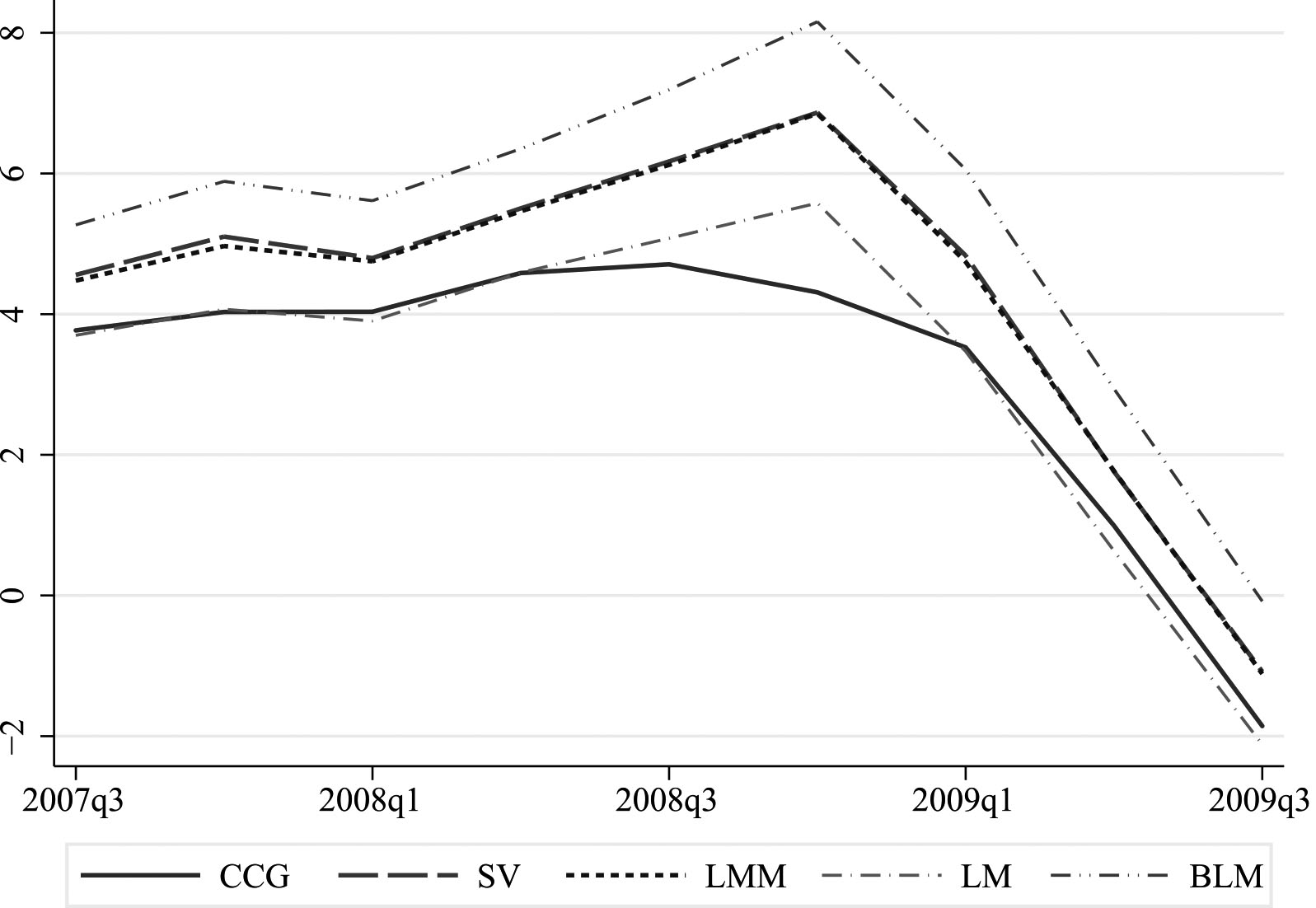
As discussed in Sections 3 and 4, these indexes are derived from the same CES model with time-varying taste parameters. Comparisons among
Distribution of average CES index differences across product groups (percentage points)
Notes: Based on data provided by The Nielsen Company (U.S.), LLC. Product group-level index differences are first averaged over time. Department and overall statistics are calculated using the product group’s share of average quarterly expenditure as weights. CCV refers to RW’s CES Common Varieties Index, SV refers to Sato-Vartia, LM refers to Lloyd-Moulton, BLM refers to Backwards Lloyd-Moulton, and LMM refers to the geometric mean of LM and BLM.
Scantrak CES Price Index Averages By Dept. (% change versus year ago). Note: Based on data provided by The Nielsen Company (U.S.), LLC. See notes for Fig. 1.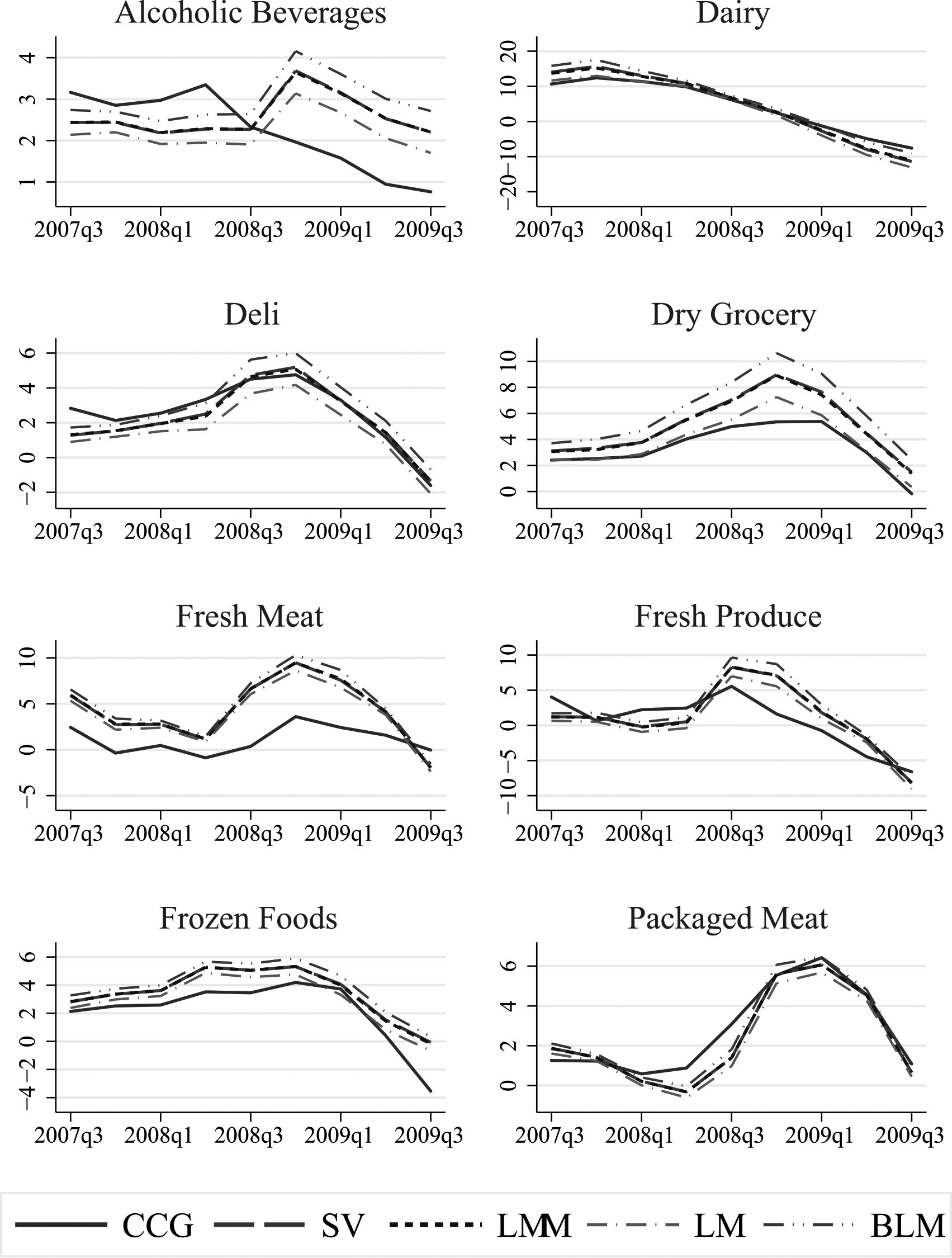
The Scantrack data show that, as in RW, the contributions of tastes tend to lower
Mean CES index differences, 2007Q3 – 2009Q3 (percentage points)
Notes: Based on data provided by The Nielsen Company (U.S.), LLC. Product group-level index differences are first averaged over time. Department and overall averages are calculated using the product group’s share of average quarterly expenditure as weights. CCV refers to RW’s CES Common Varieties Index, SV refers to Sato-Vartia, LM refers to Lloyd-Moulton, BLM refers to Backwards Lloyd-Moulton, and LMM refers to the geometric mean of LM and BLM.
Turning to the conditional COLIs, the Scantrack estimates indicate that the choice of taste vector also impacts the measurement of price change. From Table 7,
CES Price Indexes: CGR versus All Matched UPCs (% change versus year ago). Note: Based on data provided by The Nielsen Company (U.S.), LLC. Plots are comparison expenditure-weighted averages of the four-quarter proportional changes implied by product group-level indexes for food and beverage products. CCV refers to RW’s CES Common Varieties Index, SV refers to Sato-Vartia, LM refers to Lloyd-Moulton, BLM refers to Backwards Lloyd-Moulton, and LMM refers to the geometric mean of LM and BLM. All but the SV indexes require estimated elasticities of substitution. An “A” in the label indicates all matched UPCs were included. Otherwise, the indexes cover only UPCs satisfying the CGR.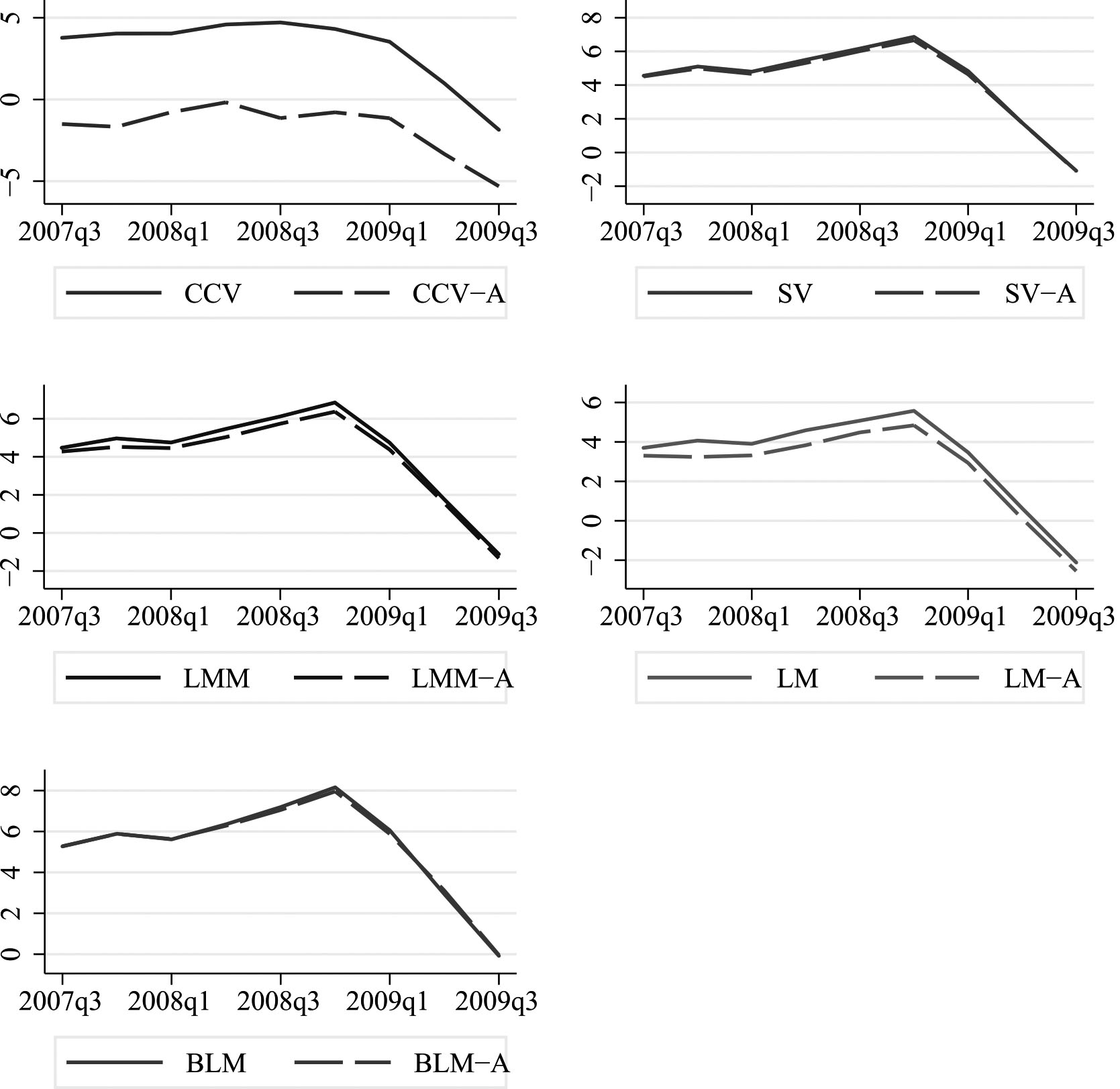
The results discussed thus far are based on a CGR intended to match RW’s as closely as possible. Now, I evaluate the impact of the CGR on the various index formulas by re-estimating the indexes using all UPCs that could be matched between quarters
Average CES Index by common goods definitions, 2007Q3 – 2009Q3 (perc. points)
Notes: Based on data provided by The Nielsen Company (U.S.), LLC. Product group-level indexes are first averaged over time. Overall averages are then calculated using the product group’s share of average quarterly expenditure as weights. CCV refers to RW’s CES Common Varieties Index, SV refers to Sato-Vartia, LM refers to Lloyd-Moulton, BLM refers to Backwards Lloyd-Moulton, and LMM refers to the geometric mean of LM and BLM.
The descriptions of conditional and unconditional COLI presented in this section are based on a relatively simple model. Functional form may matter when estimating either the impact of tastes on a conditional COLI (e.g.,
In a model with changing preferences, there is no longer one true COLI, so it is important to carefully consider the intended theoretical targets when comparing alternative price indexes. When tastes change, the Tornqvist, Sato-Vartia, Lloyd-Moulton and CCV indexes all correspond to different true COLIs. These differ in whether they are intended to reflect only price change (and if so, what preference relation is referenced), or are intended to also capture the pure effect of changing tastes. Users should bear in mind that conditional COLIs are based on reaching a constant indifference curve, while an unconditional COLI is based on reaching a constant utility level. The latter is measurable only under a very strong assumption about utility. This paper’s empirical analysis suggests the set of common goods has a significant impact on the unconditional COLI. If all matched items are incorporated, the relative contribution of prices can be swamped by taste change effects. If there is interest in a COLI that conditions on a specific period’s taste vector, then this paper provides a novel empirical comparison for the CES case. Improvements to the simple CES model are likely possible, and so future research should include more general demand models to more precisely separate taste changes from price-related substitutions.
Footnotes

Acknowledgments
I am grateful to Brian Adams, Rob Feenstra, Thesia Garner, Greg Kurtzon, and others for helpful comments. This paper uses data from The Nielsen Company (U.S.), LLC. All estimates, analysis, and errors are my own.