



Abstract
Broadcasting is a fundamental and essential data dissemination mechanism in Mobile Ad hoc NETworks (MANETs). This paper presents an efficient probability-based broadcast scheme. In the scheme, to accelerate the packets propagation, the nodes with higher velocity are selected with higher probability to rebroadcast the received packet. Moreover, to reduce transmission redundancy and collisions without decreasing packet delivery ratio, the rebroadcast probability at each node is dynamically and adaptively adjusted according to neighbor density. The velocity and neighbor density-based rebroadcast mechanism keeps the scheme insensitive to the ever-changing network environment, even to the high mobility environment. The theoretical analysis and the simulations show that the proposed scheme outperforms the existing broadcast schemes in packet delivery ratio and normalized broadcast overhead, especially in average end-to-end delay.
Keywords
Introduction
There has been a growing research activity on Mobile Ad hoc NETworks (MANETs) over the past years due to their potential and useful civilian and military applications. MANETs as multi-hop wireless networks require no fixed infrastructure, and the deployed mobile nodes act as both the end-points and the routers to forward packets. Due to these self-organizing nodes being free to move randomly, the network’s topology may change rapidly and unpredictably, which brings a fundamental challenge in designing dynamic routing protocol. The routing protocol should efficiently establish routes to deliver data packets between mobile nodes with minimum communication overhead while ensuring high throughput and low end-to-end delay.
Broadcasting as a communication primitive in MANETs is employed widely, such as finding a route to a particular host [21] and propagating an important message [10,15,19]. Because radio signals are likely to overlap with each other in a geographical area, a straightforward broadcasting by flooding is usually very costly and will result in serious redundancy, contention and collisions, to which is referred as the broadcast storm problem [27]. Thus, a number of research groups have proposed more efficient broadcast protocols to minimize the number of transmissions while ensuring a higher packet delivery ratio.
Except for blind flooding [7,9], broadcast protocols can be classified into two categories: deterministic broadcast scheme and probabilistic broadcast scheme.
The first category includes tree-based scheme [2,3] and connected dominating set (CDS) and neighbor elimination-based scheme [6,11,12,16,17,23,25,26,31]. Tree-based schemes construct a routing tree on which broadcast packets are forwarded. Fu-Wen Chen proposed a tree-based broadcast scheme [3] in different way, in which the game theory is used to solve the minimum transmission broadcast (MTB) problem. The authors model the MTB problems as a noncooperative game, named broadcast tree construction game. And the broadcast tree construction game can be regarded as a generalization of the global connection game in the sense that both edge cost and node cost are encouraged to be shared. So, the broadcast tree construction game always converges to the famous stable state, Nash Equilibrium. The game-based broadcast tree construction (GB-BTC) algorithm is developed to construct a forwarding tree without directed cycles. However, the broadcast tree construction game can hardly converge to the stable state as claimed due to high mobility of nodes, it is still not a good broadcast solution in high dynamic environment.
CDS and neighbor elimination-based schemes maintain states on the neighborhood of each node, via “Hello” packets. With the information of its neighbors, each node decides its role (forward node or non-forward node) in a specific broadcasting. For example, Majid Khabbazian proposed broadcast algorithm [12] that every broadcasting node selects at most one of its neighbors to forward the packet. A node has to broadcast the packet if it is selected to forward. Other nodes that are not selected have to choose whether or not to broadcast upon a self-pruning condition called coverage condition. To evaluate the coverage condition, every node u maintains a list
The second category includes probability-based [5,20,22,27,29], counter-based [8,28,33], distance-based [14,18,24] and location-based schemes [1,30,34]. Probabilistic schemes need not any information from whole network but, rather, start of building a network with each broadcast domain. The interest in probabilistic broadcasting schemes is due to their inherent low transmission overhead, low processing complexity, low delay, and high tolerance to frequent and rapid topological changes. Although, they have inability to guarantee full network coverage and avoid some redundant transmission.
In this paper, a probabilistic broadcast scheme in high dynamic environment is proposed, where (1) the higher-velocity mobile nodes are employed to rebroadcast the packet with higher probability to accelerate the message propagation, (2) the rebroadcast probability at each node is adjusted adaptively and dynamically according to its neighbor density. In sparse regions, a big rebroadcast probability is adopted to guarantee high packet delivery ratio. While in dense regions, a small rebroadcast probability is used to reduce the redundancy, contention and collisions without deceasing packet delivery ratio.
The rest of the paper is organized as follows. In Section 2, we give a brief review of probabilistic broadcast schemes in MANETs. In Section 3, the Velocity and Neighbor Density-based Broadcast (VNDB) scheme is presented. Section 4 presents the mathematical analysis of VNDB scheme. Section 5 shows the simulation results to validate the performance of the proposed scheme and Section 6 concludes the paper.
Related work
Probabilistic schemes only need to maintain rough local topology knowledge so they are broadly used in broadcasting. Probability-based schemes [5,27] use some basic understanding of the network topology to assign a fixed probability to a node to rebroadcast. The fixed gossip probability makes the schemes perform not so well in changing and asymmetrical network environment. In RGB scheme [29], dynamic rebroadcast probability is calculated upon the number of neighbors of the forwarding node.
In counter-based scheme [33], the number of neighbors is used to determine whether the node is located within dense, medium distribution or sparse regions and assigned
In distance-based scheme [14], messages are rebroadcasted according to the decision made between the relative distance of mobile node and the previous sender. When a broadcast message is heard for the first time,
In location-based scheme [30,34], a rebroadcast delay is adopted to exploit the neighbor coverage information to obtain an accurate additional coverage ratio. In [30], three node-stamping broadcast algorithms, named basic stamping, advanced stamping, and hybrid stamping, are proposed. Each node in Advanced stamping algorithm collects its 1-hop neighbor information. IDs of each forwarding node and its neighbors are appended to stamp in advanced stamping scheme. When node r receives a broadcast message m for the first time, it uses the stamp of m to check if all its neighbors
In above schemes, the rebroadcast probabilities depend on the count-thresholds, or the distance information, or the coverage knowledge. The accuracy of them is fatal for these schemes. But, the rapid movement of nodes definitely leads to inaccuracy of these information, which makes the rebroadcast not so reasonable. And note that, a random delay is adopted to obtain the key information in all three kinds of schemes above. No doubt, it increases the average end-to-end delay. How to improve the rebroadcast efficiency and reduce the delay in high mobility environment is exactly the problem we plan to solve in this paper.
Velocity and Neighbor Density-based Broadcast (VNDB) scheme
In VNDB scheme, to reduce transmission redundancy and collisions without decreasing packet delivery ratio, the rebroadcast probability at each node is dynamically and adaptively adjusted according to upstream and downstream node density. Moreover, the nodes with higher velocity are selected with higher probability to rebroadcast the received packet. It accelerates the packets propagation and decreases the average end-to-end delay. This section introduces how VNDB scheme works adaptively in inhomogeneous environment.
Collection of neighbor knowledge
The proposed scheme use Hello packets to collect a node’s one hop neighbor knowledge. To reduce the overhead of Hello packets, piggybacking is used. Moreover, piggybacking of the Hello packet by broadcast packet makes the neighbor knowledge fresh. Only when the time elapsed from the last broadcasting packet is greater than a Hello Interval, the node needs to send a Hello packet.
In VNDB, Hello packet includes:
NID: node’s ID
BID: ID of broadcast packet received
v: node’s velocity
flag_leaf: If the node is a leaf, flag_leaf is set to 1. Otherwise, this field is excluded from Hello packet.
Definitions:
leaf: the node has only one neighbor. secondary leaf: if a node has only two neighbors and one of them is a leaf, then this node is a secondary leaf.
Rebroadcast probability based on node velocity
Several studies [4] indicated that the mobility increases the capacity of MANETS. But, for most of existing broadcast protocols the high mobility is a stumbling block to the good performance. In this paper, a small part of high-velocity nodes are employed to propagate the packet with a bigger probability for low delay.
The velocity of node
If
In order to keep a high packet delivery ratio and reduce the collisions, the big and low rebroadcast probability should be adopted respectively by the nodes in sparse and dense area. Xue and Kumar [32] concluded that if each node connects to more than
We stipulate that the nodes one hop away from the source rebroadcast the packet with probability 1 to refrain this packet from dying before spreading into the network.
In our algorithm, the rebroadcast probability of node
In VNDB scheme, the nodes, whose velocities are higher than
The local node densities of upstream node
If node
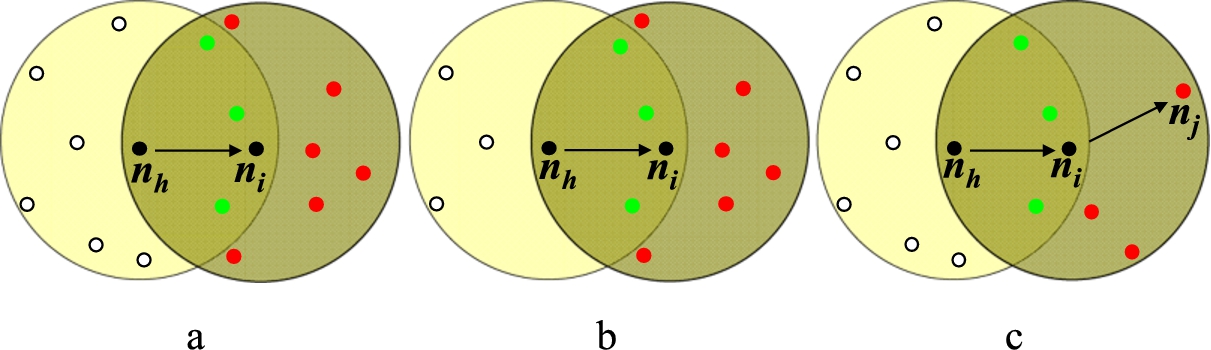
Node density affects rebroadcast probability. (Colors are visible in the online version of the article;
Be different form Fig. 1(a), if
Note that, in Fig. 1(c),
Except for leaf nodes and secondary leaf nodes, other nodes will select the maximum of

Velocity and Neighbor Density-based Broadcast (VNDB) algorithm.
This section provides a mathematical analysis on the packet delivery ratio and the overhead of VNDB scheme.
Packet delivery ratio and delay analysis
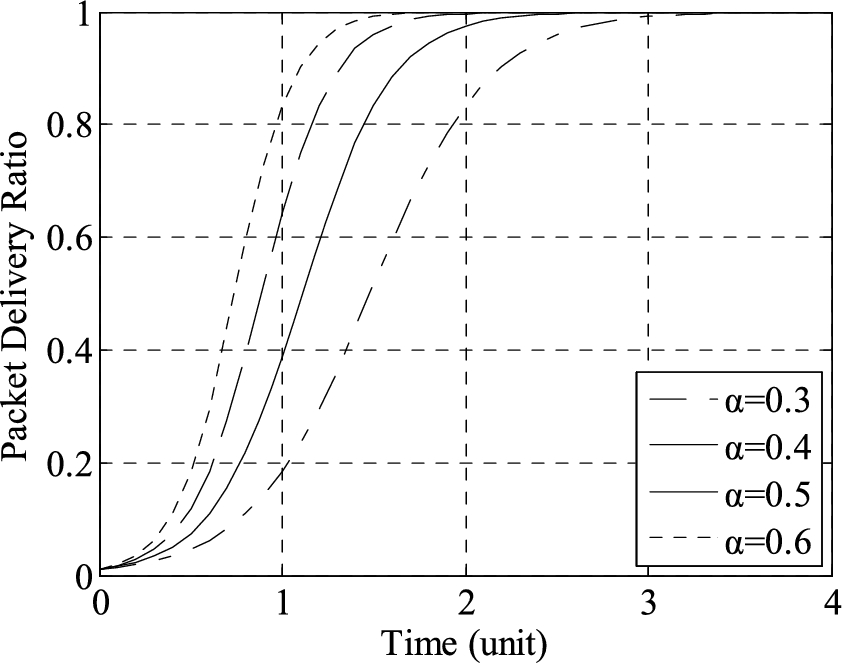
Since VNDB scheme has a strong similarity with epidemic spreading of disease, we analyze it using a simple epidemic model called the SI model in [13]. The SI model we used is somewhat different from the original paper. Their analytical parameters are different from each other. In this paper, we study how the rebroadcast intensity
Some parameters mentioned in the SI model are defined in the following:
N: Number of nodes in the network.
The balance equations are presented as follows:
Since
This first order ordinary differential equation has the following general solution:
To study the relationship between
In a specified network, N is or almost is constant, then the packet delivery ratio
The control overhead of Hello packets are reduced by piggybacking in our scheme. The transmission overhead includes redundant rebroadcasts based on node density and velocity.
There is a controllable tradeoff, by adjusting the value of α, between the packet delivery ratio, the delay and the transmission overhead incurred by rebroadcast based on node density. The selected bigger rebroadcast probability
We assume that the node velocity obeys uniform distribution between
Simulation and analysis
In this section, we evaluate the performance of VNDB scheme compared with Local Broadcast Algorithm (LBA) [12], DCB [33] and NCPR [34] using the NS-2 (v2.35) simulator. The IEEE 802.11 MAC with Distributed Coordination Function (DCF) is used as the MAC protocol. The mobility model is based on the random waypoint model in a square of size 1000 × 1000 m2 . The detailed simulation parameters are listed in Table 1, and the values of α and ω in VNDB are set to 0.5.
We have used the following performance metrics for comparison purposes.
Normalized broadcast overhead: the broadcast overhead indicates the normalized transmissions of the broadcast operation per node. It defines the ratio of the total transmissions, including the broadcast packets and extra control packets to the broadcast packets per node. It is measured by bytes per broadcast byte per node.
Average end-to-end delay: the average delay of successfully delivered broadcast packets from source to destinations.
Packet delivery ratio: the percentage of nodes which receive the broadcast packet.
The simulations are divided to three parts, and in each part we evaluate the impact of one of the following parameters on the performance of broadcast schemes.
Mobility velocity. We change the max mobility velocity of nodes from 0 m/s to 25 m/s to evaluate the impact of different node mobility. In this part, we set the number of nodes to 200, and set the number of CBR connections to 50. Number of nodes. We change the number of nodes from 50 to 300 in a fixed square to evaluate the impact of different network density. In this part, we set the max mobility velocity of nodes to 20 m/s, and set the number of CBR connections to 20. Number of CBR connections. We change the number of randomly chosen CBR connections from 10 to 60 with a fixed packet rate to evaluate the impact of different traffic load. In this part, we set the max mobility velocity of nodes to 20 m/s, and set the number of nodes to 200. Simulation parameters
Figure 4 shows that the normalized broadcast overhead of all schemes increases proportional to the node mobility. It is due to the fact that when the node mobility grows, the topological changes also increase and more control packets are generated to maintain the topology. Furthermore, the frequent change of topology incurs many collisions followed by retransmissions. LBA gives up rebroadcasting only when receiving the integrated neighbor coverage knowledge, which is almost impossible in high mobility environment. Then, many redundant packets are sent out, leading to severe overhead. In DCB, the node mobility brings inaccuracy for both the value of the thresholds and the number of duplicate packets received, and incurs redundant rebroadcasts and collisions. Different from LBA and DCB, VNDB and NCPR are affected by node mobility slightly since their rebroadcast probabilities do not rely on the precise neighbor knowledge.
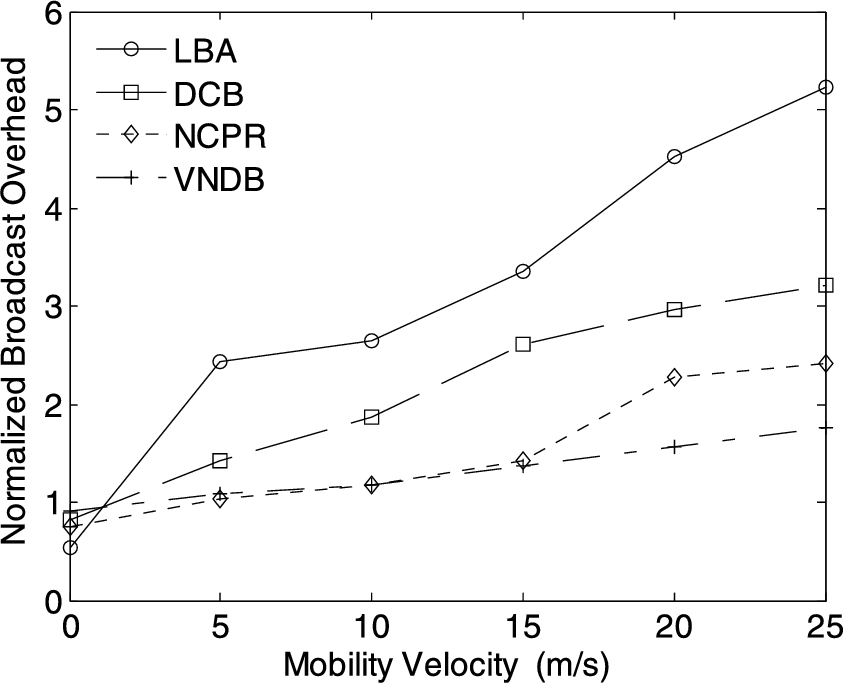
Mobility velocity vs. normalized broadcast overhead.
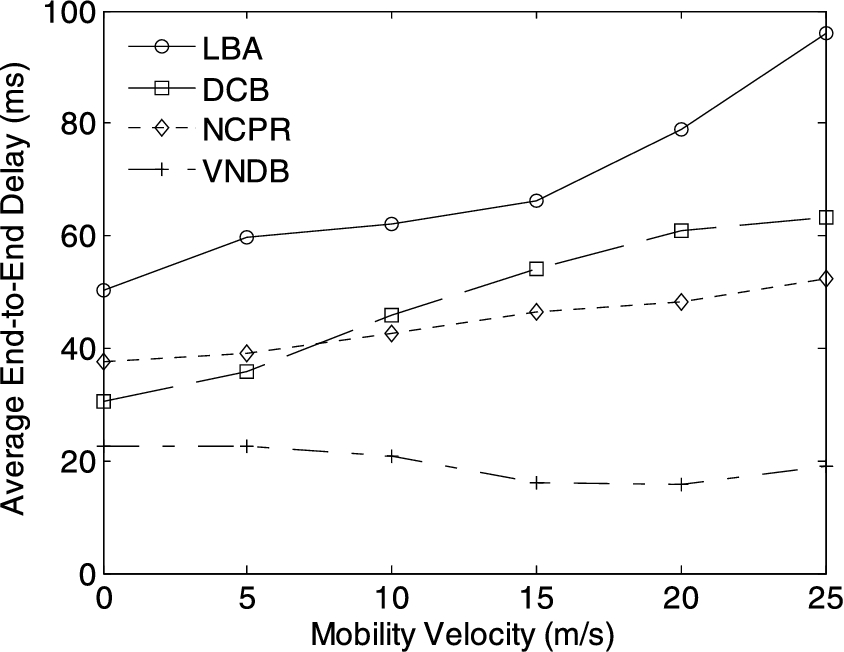
Mobility velocity vs. average end-to-end delay.
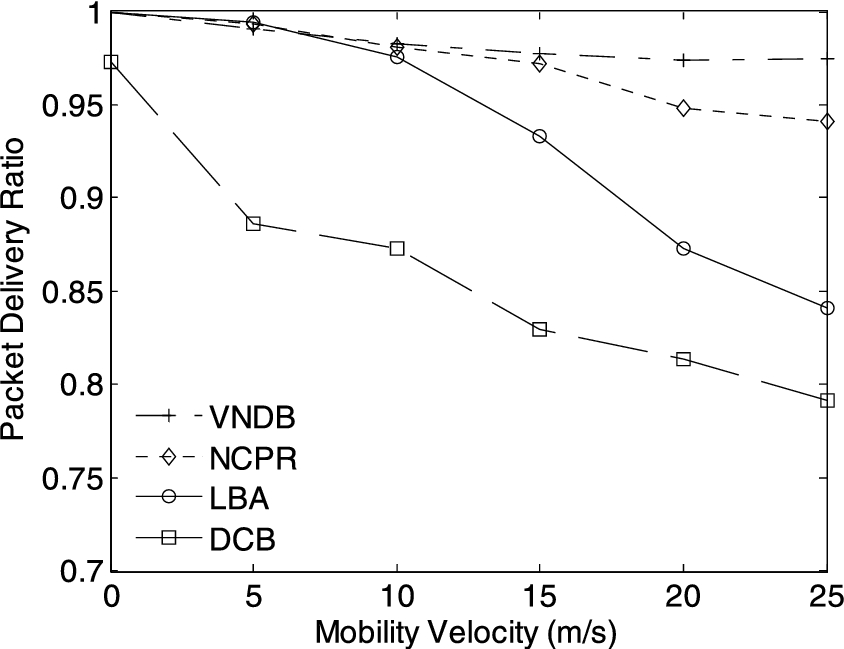
Mobility velocity vs. packet delivery ratio.
Figure 5 shows the effects of node mobility on the average end-to-end delay. As mentioned in last paragraph, the topological changes incur the collisions and the retransmissions, leading to more delay. No doubt LBA deserves the worst average end-to-end delay followed by DCB. The node mobility has less impact on average end-to-end delay of NCPR than that of LBA and DCB. VNDB performs the best performance of delay, because it doesn’t introduce the rebroadcast delay to collect the duplicate packets as the other three schemes do. Moreover, VNDB avoids many contentions and collisions. As can be noticed, the node mobility does accelerate the propagation of packet in VNDB, since the nodes with higher velocities are employed to rebroadcast.
Figure 6 shows that the node mobility affects the packet delivery ratio achieved by all scheme in negative way. The packet delivery ratio of NCPR is affected gently, because its rebroadcast doesn’t rely on the accurate neighbor knowledge. Unlike VNDB and NCPR, LBA is liable to make wrong deterministic rebroadcast decisions upon 100 percent accurate coverage knowledge. For DCB, the changing of the topology reduces the accuracy of the threshold significantly, leading to the severe declining of its packet delivery ratio. Compared with the other three schemes, except for at low velocity, VNDB scheme obtains a better packet delivery ratio in most scenarios, especially at high velocity. The adaptive, smooth change of rebroadcast probability at each node makes VNDB difference in packet delivery ratio.
The effects of the network density on the performance are illustrated in this section.
As shown in Fig. 7, at the very start, the normalized broadcast overhead of all schemes decreases as the number of nodes grows, since the network connectivity is enhanced by the joined nodes and once rebroadcast can cover more nodes. But, the continued increasing of the nodes incurs many collisions, which results in the increasing of the normalized broadcast overhead afterwards. The curves of NCPR and VNDB are almost flat due to the adaptive changing of their rebroadcast probability with the network density. Different from the other schemes, the normalized broadcast overhead of DCB decreases in dense node scenario. That is because the value of threshold
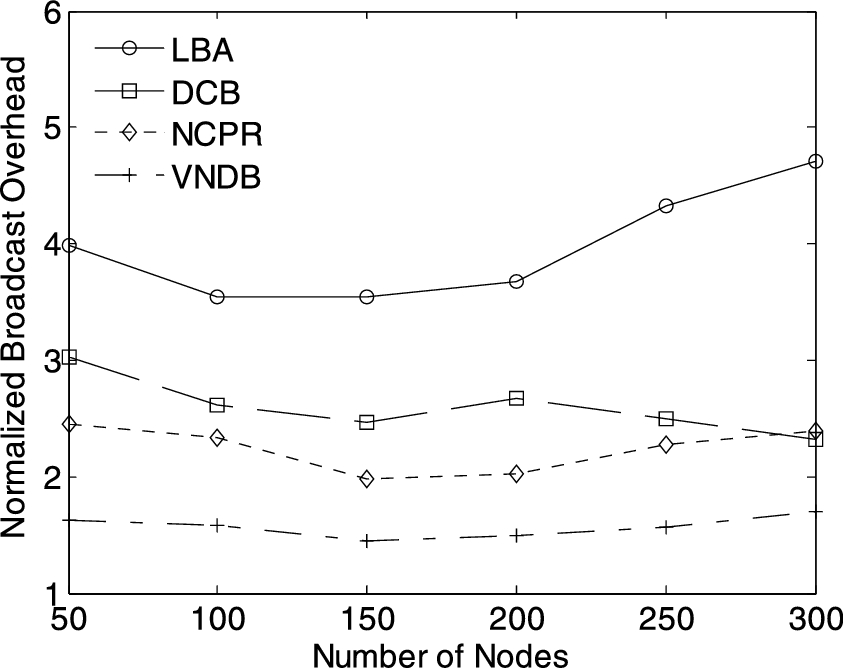
Number of nodes vs. normalized broadcast overhead.
Figures 8 and 9 show the effects of network density on the average end-to-end delay and the packet delivery ratio. As mentioned in last paragraph, the overhead decreases with the rise of node number in sparse network environment. It makes the rebroadcast more efficient, namely, less delay and higher delivery ratio. But, in dense network, the increasing of the nodes results in many collisions and retransmissions, incurs long end-to-end delay and aggravates the delivery ratio. The network density affects NCPR and VNDB slightly on the delay and the delivery ratio as on the overhead. Rebroadcast without rebroadcast delay makes VNDB perform more excellently in delay than other schemes.

Number of nodes vs. average end-to-end delay.
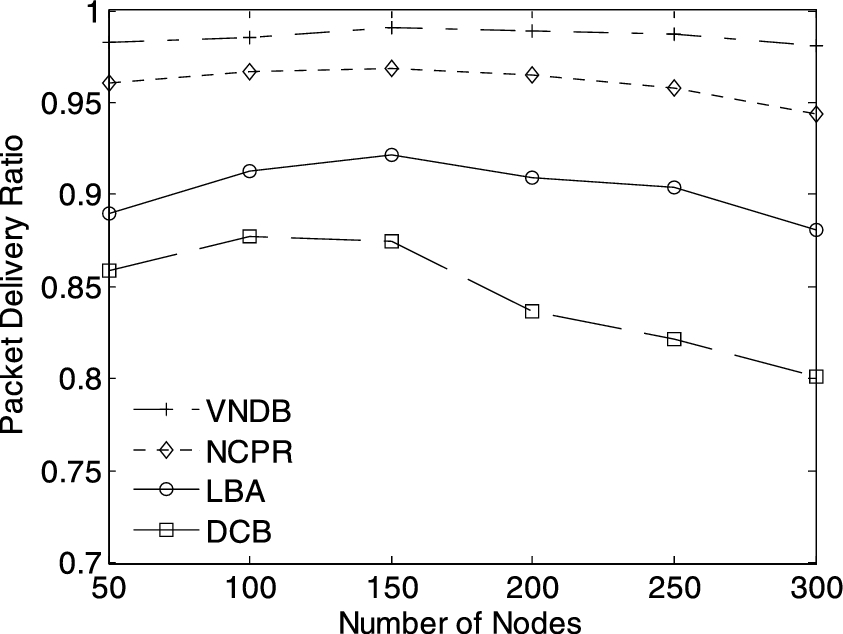
Number of nodes vs. packet delivery ratio.
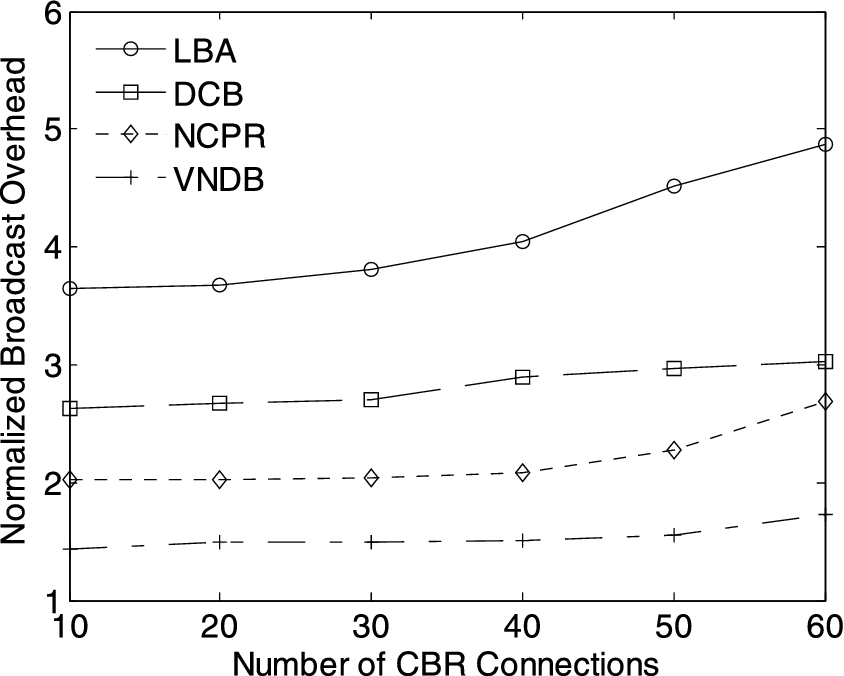
Number of CBR connections vs. normalized broadcast.
The effects of the traffic load on the performance are illustrated in this section.
As shown in Fig. 10, the normalized broadcast overhead of all schemes increases as the traffic load grows, because more traffic load leads to more contentions and collisions. Apparently, there is a more noticeable increase of the overhead in LBA than that in other scheme. In this part, we set the max mobility velocity of nodes to 20 m/s and the higher mobility velocity is disadvantageous especially to LBA as mentioned in the Section 5.1. In NCPR scheme, the rebroadcast delay of a node is inverse ratio to the number of the common neighbors between the upstream node and this node. Generally, a node with many neighbors has a smaller rebroadcast delay and it rebroadcasts the packet more possibly. Then these nodes forward more packets in less time than the other nodes, which incurs the contention and the collision more likely. The situation becomes worse as the traffic load increases. As shown in Fig. 10, the overhead of NCPR increases remarkably when the CBR connections are set to 50 and 60. The rebroadcast mechanism of VNDB keeps the traffic load distribution relatively uniform in the network, which has less effect on the normalized broadcast overhead. Correspondingly, the increasing of the average end-to-end delay and the decreasing of the packet delivery ratio of all schemes follow with the rise of the contentions and the collisions, as shown in Fig. 11 and Fig. 12. VNDB scheme still is the best one in keeping low average end-to-end delay in the different load cases among all four schemes.
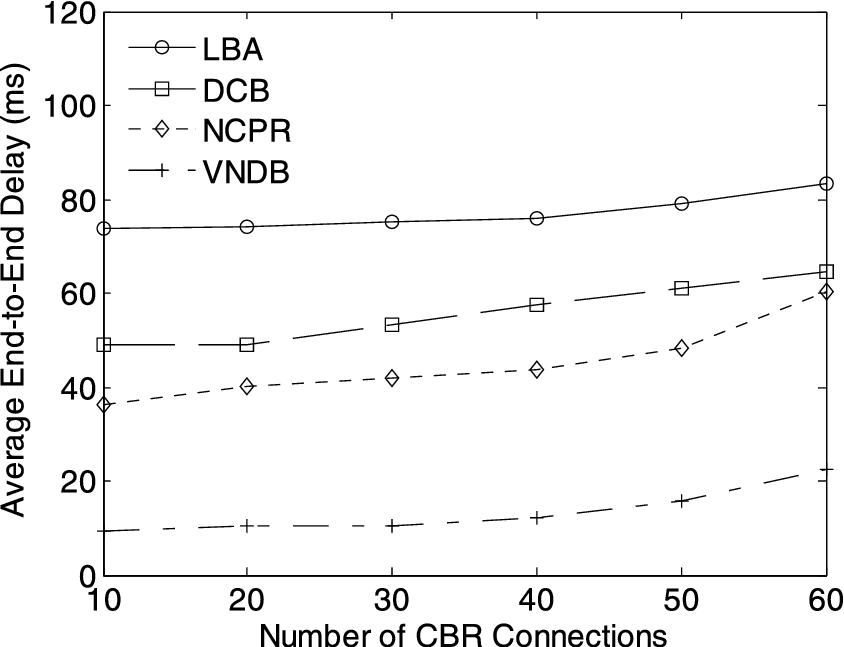
Number of CBR connections vs. average end-to-end delay overhead.
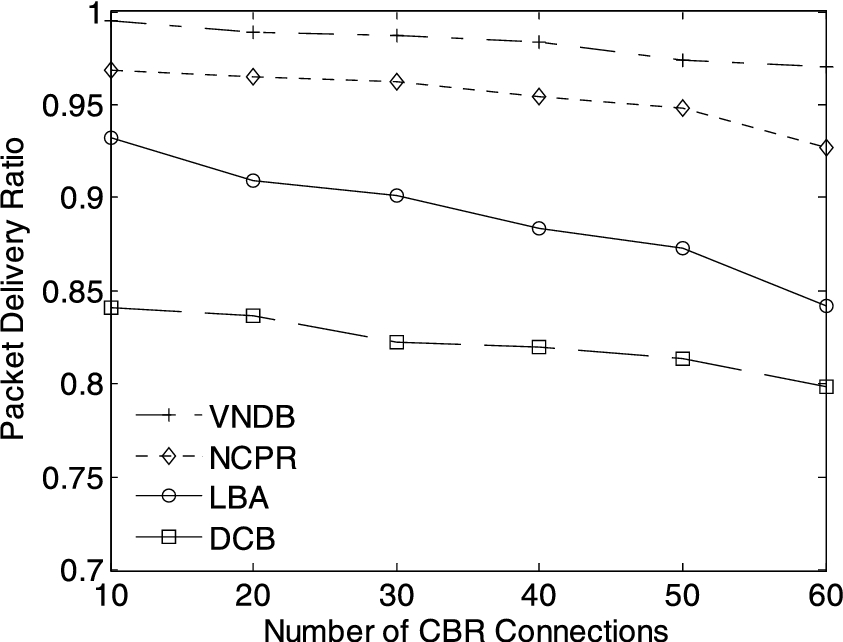
Number of CBR connections vs. packet delivery ratio.
In this paper, a velocity and neighbor density-based probabilistic broadcast scheme in MANETs is proposed, where the rebroadcast probability at each node is dynamically and adaptively adjusted according to its mobility velocity and local node density. This mechanism guarantees a low broadcast overhead, delay, and a high packet delivery ratio in the high mobility environment, although Fig. 4 and Fig. 6 show that VNDB scheme is not the best one in the low mobility environment among all schemes. Furthermore, the probabilistic characteristic enables VNDB to obtain a desired tradeoff between the overhead and the delivery ratio by tuning the rebroadcast intensity
Footnotes
Acknowledgements
This study is supported by National Natural Science Fund, China (Grant Nos. 61300198 and 61070092), Guangdong Province Natural Science Foundation (No. S2013040016582). Guangdong University Scientific Innovation Project (Nos. 2013KJCX0177 and 2014KTSCX188).