



Abstract
This paper deals with the NP-hard Capacitated Network Design Problem (CNDP) with modular link capacity structure. We aim to optimize the underlying network, the allocation facilities and the transportation costs. It is assumed that for connecting two nodes, a fixed construction link cost is occurred or a specific unit transportation cost. There are several types of module facilities to allocate on links. In this paper, we propose a general model that combines design, allocation and routing problems. An hybrid approach is proposed which uses a greedy constructive and an iterative local search heuristics. Our proposition is tested on the Survivable fixed telecommunication Network Design Library (SNDlib) and a comparison of its performances against the best solution available in the literature is done. Computational tests show that our proposition is very efficient.
Keywords
Introduction
Network design models have a wide application in telecommunication and, transportation planning [14,16,17]. In these applications, it is required to send flows to satisfy demands given on arcs with limited capacities, or to allocate facilities in a discrete multiple of facilities. All these operations cost money, not only for routing flows, but also for opening an arc or installing facilities. The objective is, then, to determine the optimal quantities of flows to be routed and, the facilities to be used.
The CNDP is a particular case of the well known Multicommodity Network Design Problem (MNDP), in which we distinguish an important number of special cases and extensions [12]. The most studied are: the unsplittable variant where the flow of each commodity is required to follow one route between the origin and the destination, which increases the difficulty of the problem [33]. The expansion variant, where some edges already have an existing capacity. The fixed charge MNDP [12,30] in which the link capacities are known. Solving MNDP consists to determine the set of edges that should be opened in the final topology. The capacitated MNDP, where the number of modules to install on the edges are modeled by integers [12]. The Network Loading Problem (NLP), where the number of module types is limited, each one with given unit cost and capacity.
Various heuristics and exact approaches have been developed for designing capacitated networks. However, the heuristic approaches are more likely to be trapped in local optima, while the exact approaches are applied only to small or medium size problems. Due to the weaknesses of the two approaches, and the increasing popularity of metaheuristic approaches, we have witnessed many metaheuristics being applied to network optimization problems [8,11,28,31,32,34].
We will focus on designing low cost network, given point-to-point traffic demands, potential links and a set of module capacity with their corresponded costs. The objective is to define the minimal network topology, the different modules to allocate on links in order to route all demands at minimum cost. We propose a hybrid heuristic for CNDP with modular link capacity. We combine between a greedy constructive approach that search an initial feasible solution through an iterative routing of demands, then we improve the quality of the solution by an Iterative Local Search (ILS) which based on two moves that we define. The rest of this paper is structured as follow: the related works are given in Section 2. The notations of the addressed problem are formally stated and a proposed mixed integer programming formulation to model the problem are given in Section 3. Section 4 explains in details the proposed algorithm. Experimental results are discussed in Section 5. Conclusion is presented in Section 6. A nomenclature of all variables used in this paper is given.
Related work
Capacitated Network Design Problem is one of the major research area in network optimization. It is related to two issues: Network Design Problem (NDP) and Network Loading Problem (NLP). In the NDP, the goal is to identify the network topology by selecting routers and links that interconnect them. Thus, the objective function aims to minimize the total constructive cost under some topological constraints. In this class of problems, the flow is not
One can say that most of network optimization problems can be seen as a kind of (1) NDP, (2) NLP or (3) a combination of both where the objective and the constraints may differ from one problem to another: connectivity [1,5], limited budget [29], hop limit [21,33], delay [19,20], reliability [19,21], survivability [20,27].
The NLP in capacitated or uncapacitated case and with both single or multiple facilities are a special case of the well known MNDP. Previous works on this problem can be classified as:
Uncapacitated network design problems where on each link of the network, it is only possible either to open the link with infinite capacity and a given fixed cost, or the cost is zero and no capacity is available [25].
Single facility capacitated network loading problem where, the capacity can be done by installing on each link an integer unit of a given basic facility [6].
Two facilities capacitated network loading problems where the capacity can be achieved by means of two types of modules, each capacity has a specific cost [18,24].
Recently, multi type facilities capacitated network loading problems where various types of capacities can be installed on each link, each facility has a specific cost [2,29].
The NLP has been widely study with approximate methods, the modular capacity version is initialized by [22]. The authors in [23,24] introduced the residual capacity inequalities. They considered the single-commodity problem of undirected link models and a modular capacity structure with up to three different modules. Then, introduced the cutset inequalities and strengthened the multicommodity flow formulation with integer cable installation variables with cutset, three-partition and arc residual capacity inequalities. [7] studied polyhedra based on bidirected problems with two divisible base capacities. They generalized the cutset inequalities that force the capacity on both edge sets of a bipartition of the cut edges to be integral. In [3] Atamturk generalized these flow cutset inequalities by expressing the coefficients with a subadditive function for the single commodity problem. Chopra et al. in [9] introduced general flow cutset inequalities for directed models with a single module and showed their validity. Atamturk in [4] given a detailed analysis for directed cutset polyhedra. The authors studied the flow cutset inequalities introduced in [9] and provided a complete description for single-commodity and single-module case. Further, Atamturk generalized directed flow cutset inequalities to an arbitrary number of modules. All these works consider that the underling network is established, they identifies only the facilities to allocate and how to accommodate demand flows. Their effectiveness depends on the size of the problem instance.
With the appearance of metaheuristics, both the NLP and the NDP have attracted some attention. The authors benefit from their efficiency to deal with more complex variants with real size instances. In [15], the author compared several neighborhood structures to solve the uncapacitated facility location problem. In [20], the authors proposed an evolutionary approach for capacitated network design considering cost, performances and survivability. The objective minimizes network cost and packet delay. Kleeman et al. [19] used an evolutionary algorithm to solve multicommodity capacitated network design problem with an objective function optimizing costs, delay, robustness, invulnerability and reliability. A tabu search heuristic algorithm with real costs on facilities is developed in [8]. A firefly algorithm is proposed by Rahmaniani and Ghaderi [29], they combined facility location and network design problem with multi type of capacitated link and limited budget on facilities. Contreras and Fernández [10] presented a unified framework of general network design problems which combine location decision and network design decision.
Problem formulation
Let be
the set of elementary paths used to accommodate
the set of all paths,
the set of the paths that use
the flow on the path p
the existence link matrix with cardinality
the fixed cost matrix with cardinality
the fixed cost of established link
the routing cost matrix with cardinality
the unit routing cost on link
the set of module types available to allocate on the network
the cardinality of L set
the capacity of module type l such that
the installation cost of module type l on link
the module capacity matrix
the working capacity matrix with cardinality
the unused capacity matrix with cardinality
The decision variables that we search to fix for (CNDP) are: the binary variable
The constraint expressed in (2) ensures that all traffic demands are satisfied in Normal Operating State (NOS). Constraint (3) ensures that the final topology contains only links witch are at least used by one path. Constraint expressed in (4) shows that the working flow on each link is able to route all traffic demands accommodated on it. Constraint expressed in (5) ensures that the number of modules allocated are enough to route the whole traffic demands. The trivial constraints are expressed in (6), (4), (8) and (9).
In the objective function, the value
Proposed heuristic
We develop a hybrid heuristic approach combining greedy and ILS heuristics. The greedy algorithm generates the initial feasible solution by routing demands on shortest paths, It defines the network topology and allocates the module capacities. The ILS algorithm improve the initial solution through two types of moves that reduce the number of modules capacity.
Initial feasible solution
The constructive approach attempt to find a solution by starting with the problem graph, without any edges, and to construct the solution by adding edges one at a time. For the CNDP, it is easy to reach a feasible solution. We propose a Working Capacity Search (
For each commodity k,
Let
For each link The link is not activated in the previous topology ( If the link is activated ( the link have enough unused capacities to route the unused capacities are not sufficient. We allocate module l and we do the necessary updates.
We iterate all previous steps for each demand
Let be
To reduce cost of previous modules installed, we verify in each routing iteration the possibility of substituting α installed modules type x with a new module type z,
The cost of module type z does not exceed the cost of α modules type x
The total capacity of α modules type x does not exceed capacity module type z
This verification process is expressed by the
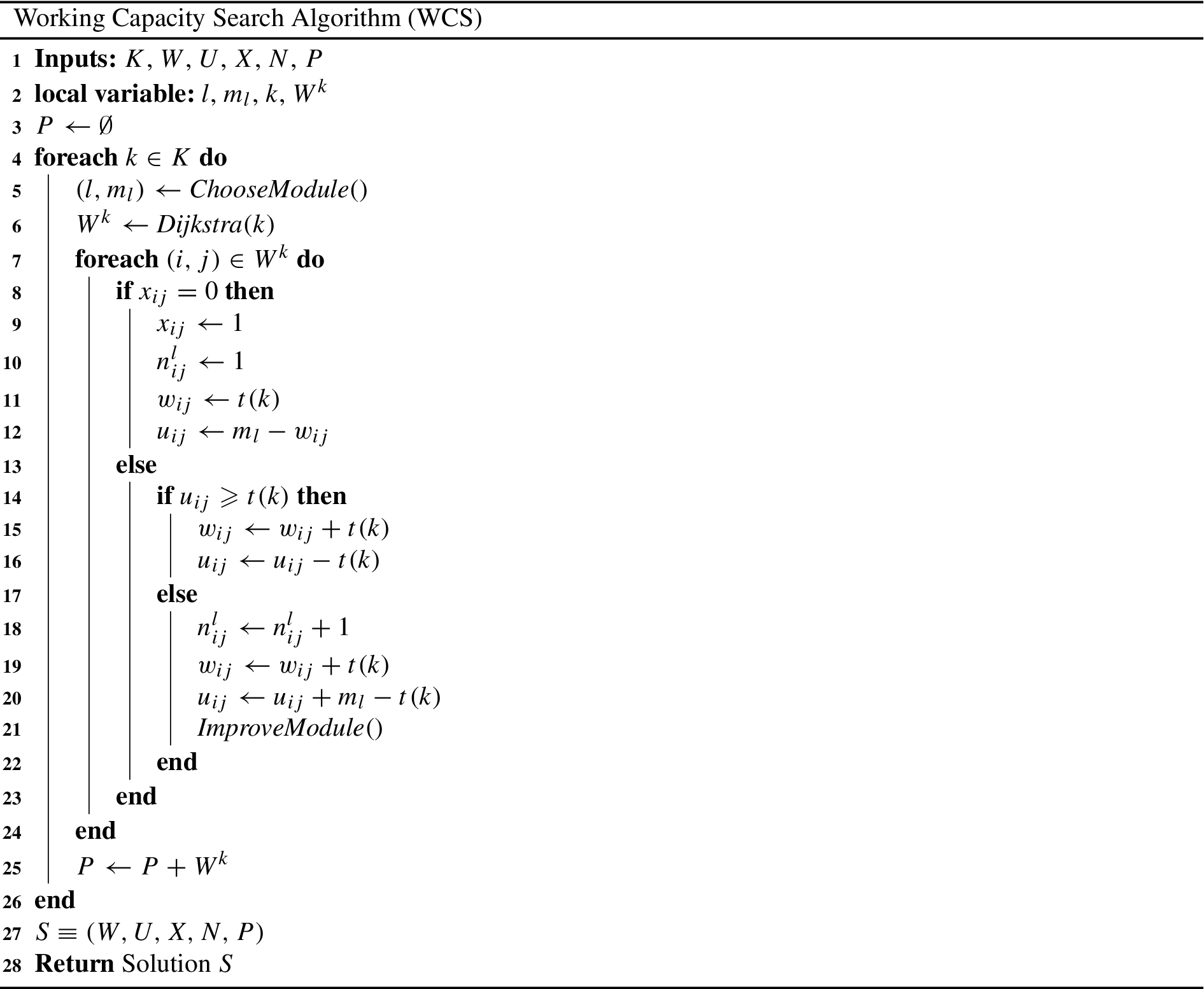
Algorithm that construct initial solution S. K is the demand set. W is the working capacity matrix where
The inequalities (12), (13) aim to substitute α installed modules of type x with a new module type z, that provides the same capacity or the higher one with at most the same cost. This optimization process is based on capacity reduction cost, and results on the following consequences:
We benefit a decrease in total constructive cost.
Extra capacities that can be used to accommodate next demands to be routed on this link. Then, the obtained network at this step has too much unused capacities. Moreover, in the routing process, each demand takes a single path to join their extremities. So, there is no diversification of demands.
As a second stage of our framework, consists in the Maximum Unused Capacity algorithm (
Promising link
We have mentioned that one of WCS drawbacks is the extra unused capacities. Obviously, the improvement process is guided by links which disposed a great amount of unused capacities. These links appear as the most promising to contribute in the neighborhood search. They are determined according to the procedure defined in Fig. 4.
Let
Let be
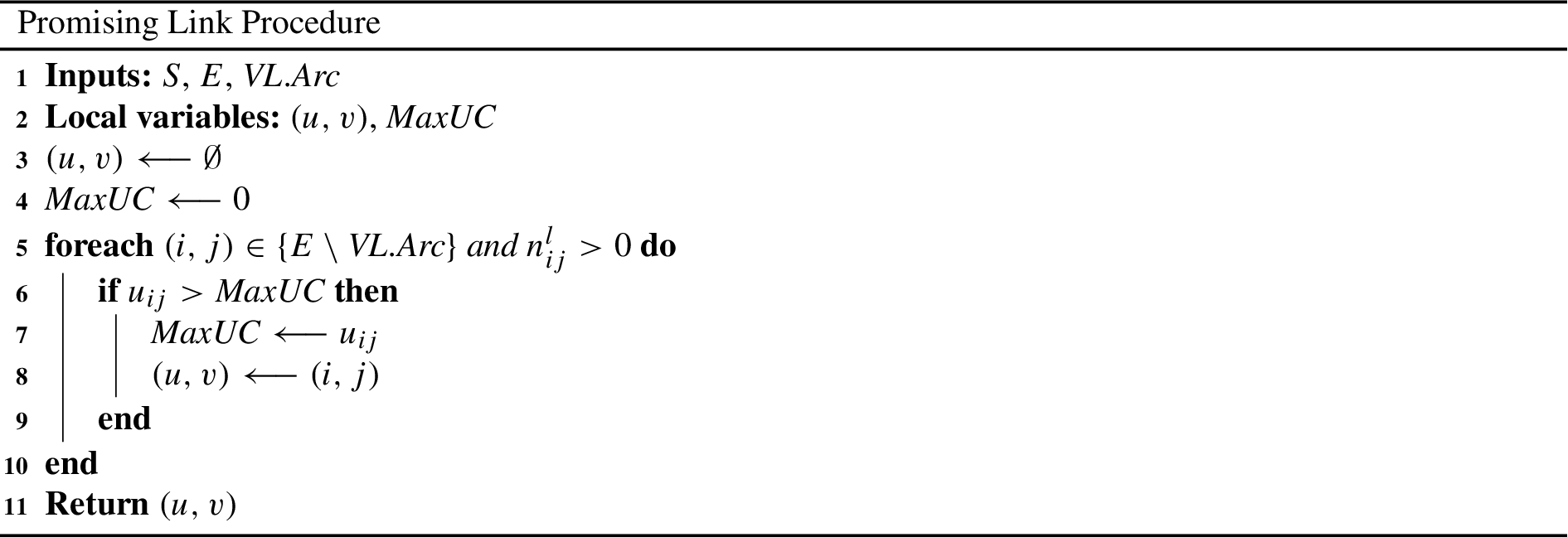
PromisingLink procedure that identifies the link
After identifying the promising link, we search the route R that joint their extremities to re-route
The Re-Route procedure defined in Fig. 4 allows to find the best path between extremities of promising link, where
We favorite shortest paths to decrease the additional capacities used to route flows initially accommodated on optimal paths. We deduce that the length of R routes influences the amount of working capacities and facilities allocated. In the MUC steps the length constraint is relaxed from one iteration to another, until we reach the stopping criteria.
Figure 3 gives an example of an execution of the Re-Route procedure on a small network composed of 6 nodes and 8 links. Figure 3(a) and (c) correspond to the input networks, Fig. 3(b) and (d) are the resulting networks for the two cases
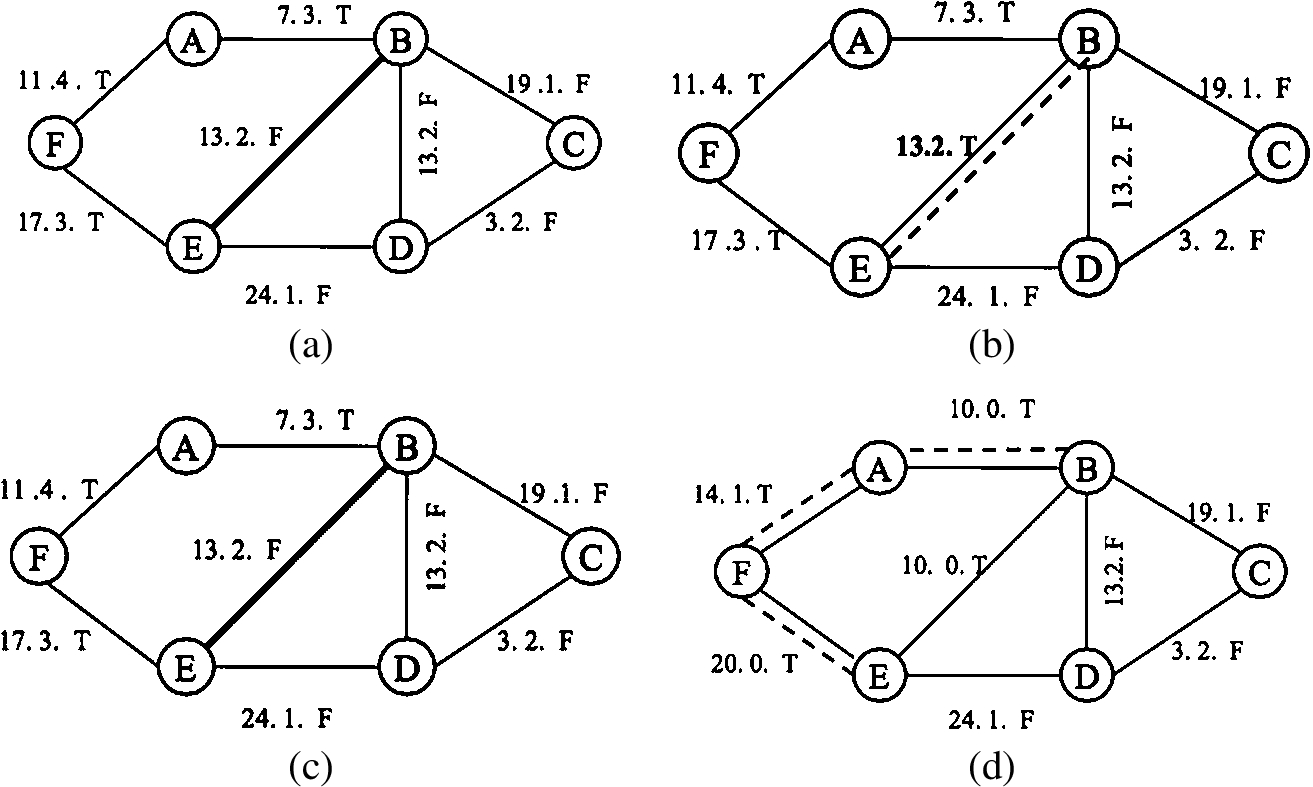
Example on the Re-Route procedure. Three values are mentioned for each link representing respectively

Procedure that searches a route R between the extremities of promising link
MUC algorithm is an ILS, essentially based on the promising links and the re-route of flows to decrease the cost. This section show how our algorithm use the last two procedures to search neighborhoods and improve the WCS solution.
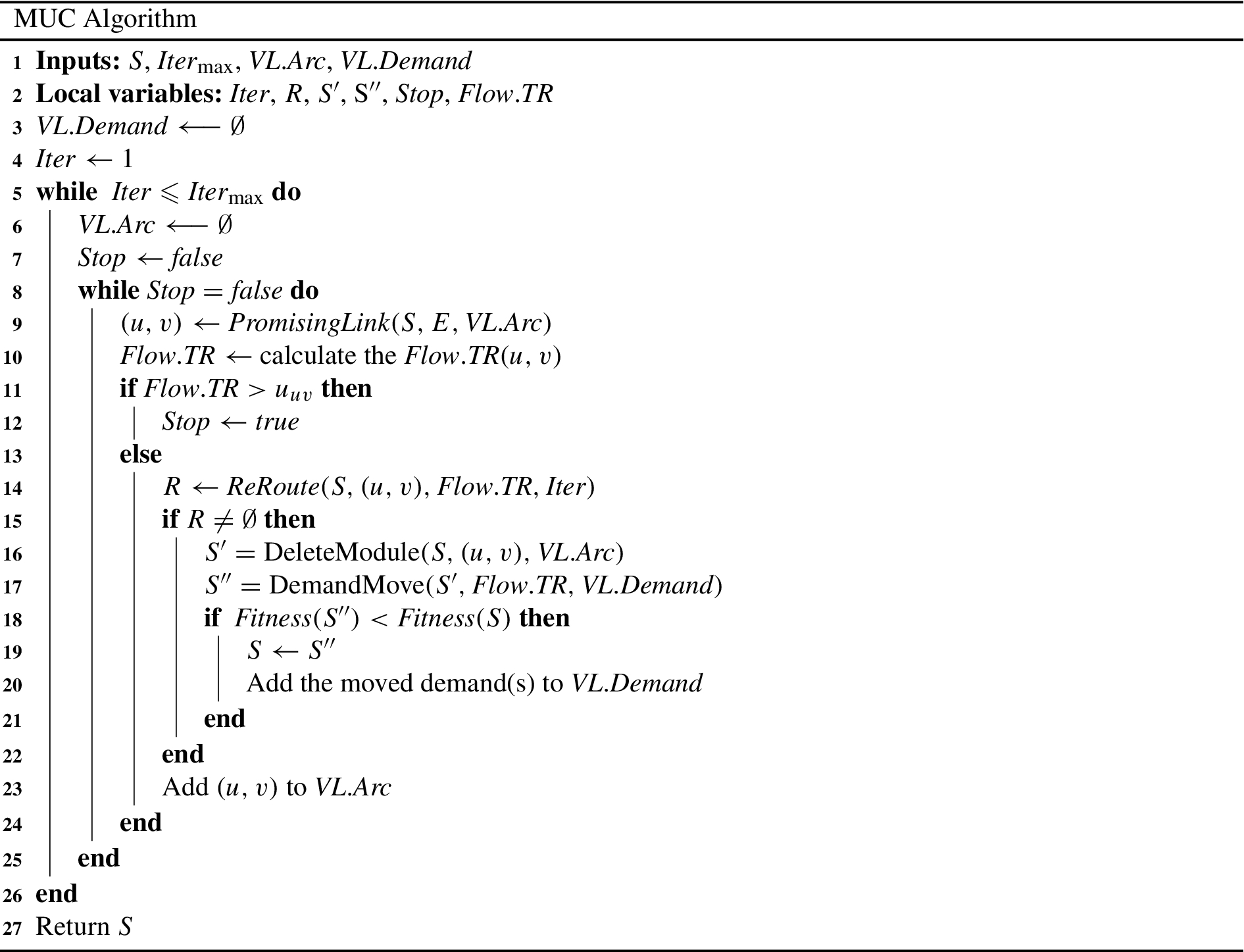
S is the initial solution returned by
In the basic version of
In Fig. 5, solution S reached by WCS algorithm that corresponds to a network configuration that includes
The
Generally neighborhood search algorithm stops after certain number of iterations. This one depends on the problem nature and the moving strategy. Our
Results
The model filter
The model filter
The instance setting parameters
The
The evolution of MUC algorithm during the
In Table 3, WCS and the MUC are respectively the solutions obtained by WCS and MUC algorithms. We examine the optimality gap (see equality (20)), which is defined by the difference between WCS cost (
As we can see, WCS generates solutions close to the optimality for Polska and Pioro40 networks. SF instances (France and Germany50) results are worse compared to the TF ones. This behavior is due to the fact that ImproveModule procedure can not be applied. Therefore, no improvement is done during the constructive stage which is clearly appreciable for TF instances.
The MUC algorithm proves its effectiveness. It starts with an average gaps of 17.14% and 4.26% for SF and TF instances respectively. Then, it reduces the gaps to 6.23% and 3.22%. Contrarily to
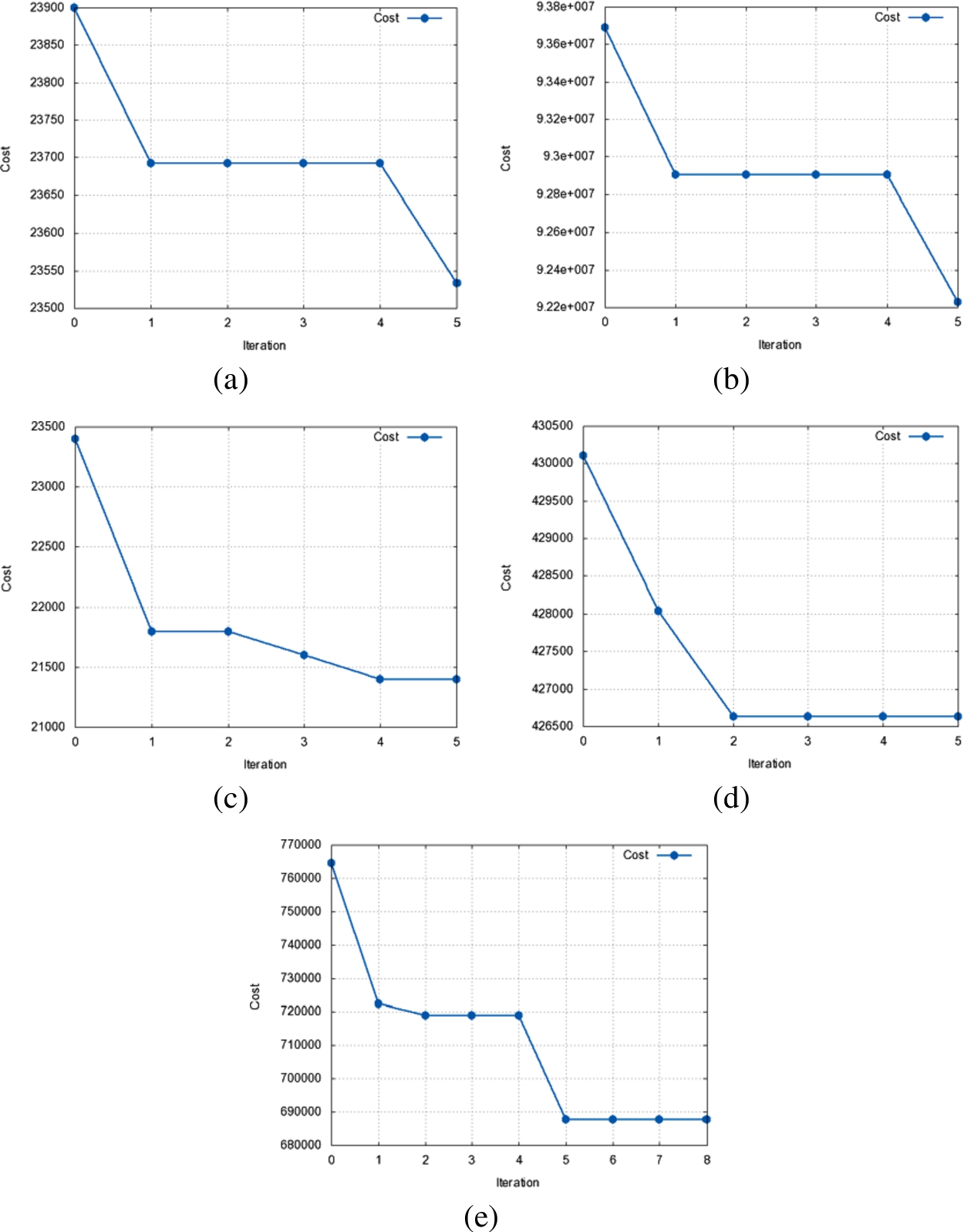
The evolution of MUC algorithm during the
Table 4 and Fig. 6 show respectively the values and the corresponded curves of MUC algorithm convergence. We collect the objective function values during the MUC iterations.
For all instances, we remark that the first iteration (
The number of iterations
The SNDlib library uses many parameters to evaluate solutions in details. It classifies them in two sets; the general statistics and the routing statistics that are respectively presented in Table 5 and Table 6. The general statistics summarize the details information about the generated topology (nodes, links and capacities) with theirs corresponded costs. The routing statistics provide length and number of working paths used to accommodate demands.
In Table 5, the total number of installed links, Min, Max and Average node degrees parameters confirm that both WCS and MUC solutions generate graphs with the same BS topologies except for the Pioro40 instance which constructs a graph with 89 links whereas BS has only 86 links.
We remark that France and Germany50 topology instances are densest in WCS, this density has been reduced by MUC up to BS values. Although our improvement process is only based on capacities, it can deal with the topology improvement. The MUC algorithm based on capacities reduction, this later is clearly appreciable when comparing WCS and MUC total installed link capacities.
Figure 7 shows the allocated capacities and their usage in the five network instances. For each network, we compare the total installed link capacities, the total working capacities and the total unused capacities. It is notable that total installed link capacities in WCS and MUC solutions are more than BS ones, which justify the cost gap. Although Polska and Pioro40 networks allocate low capacities, the gap cost persists. This later is related to allocation module costs that differ from link to another.
The general statistics
The routing statistics
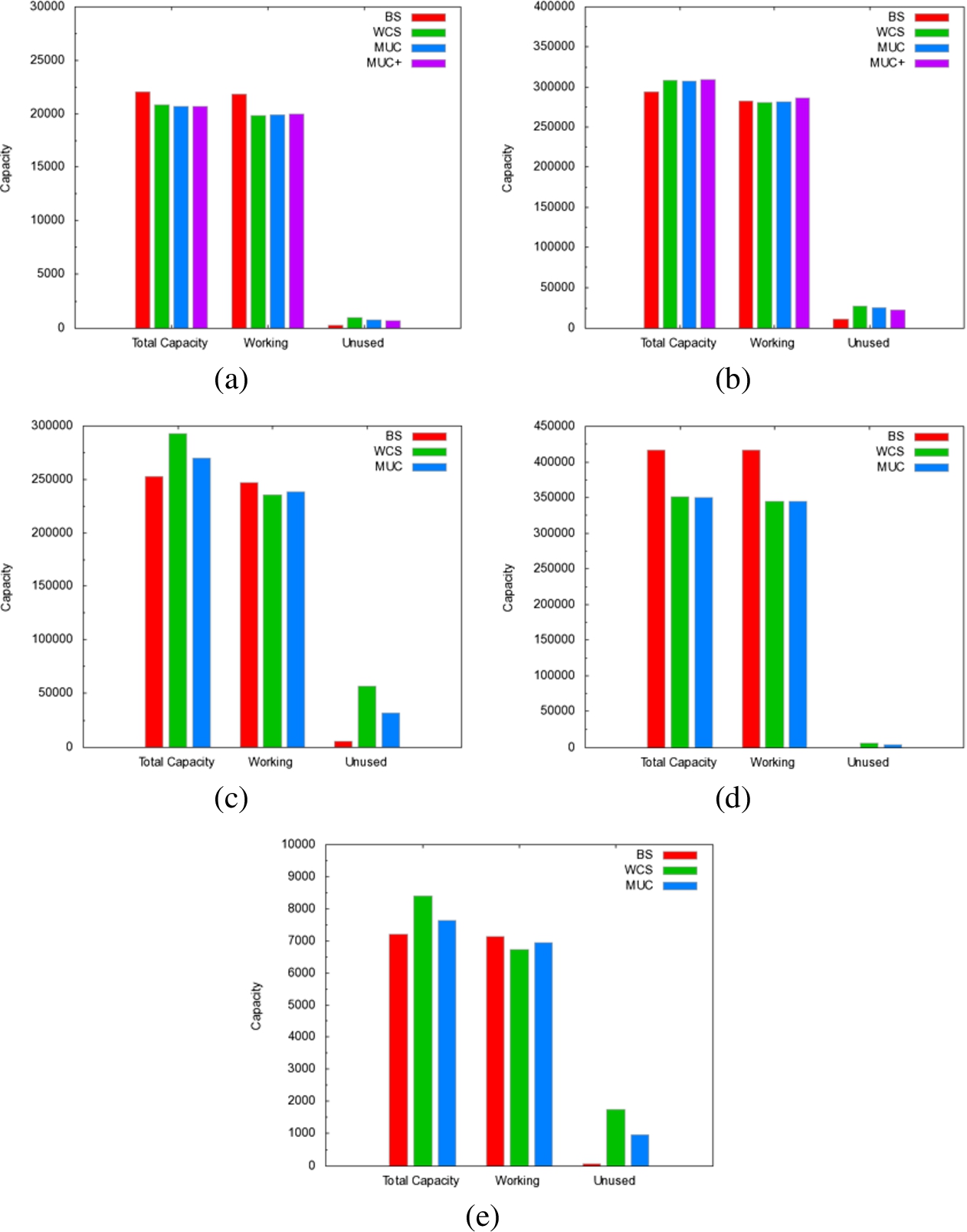
Comparison between
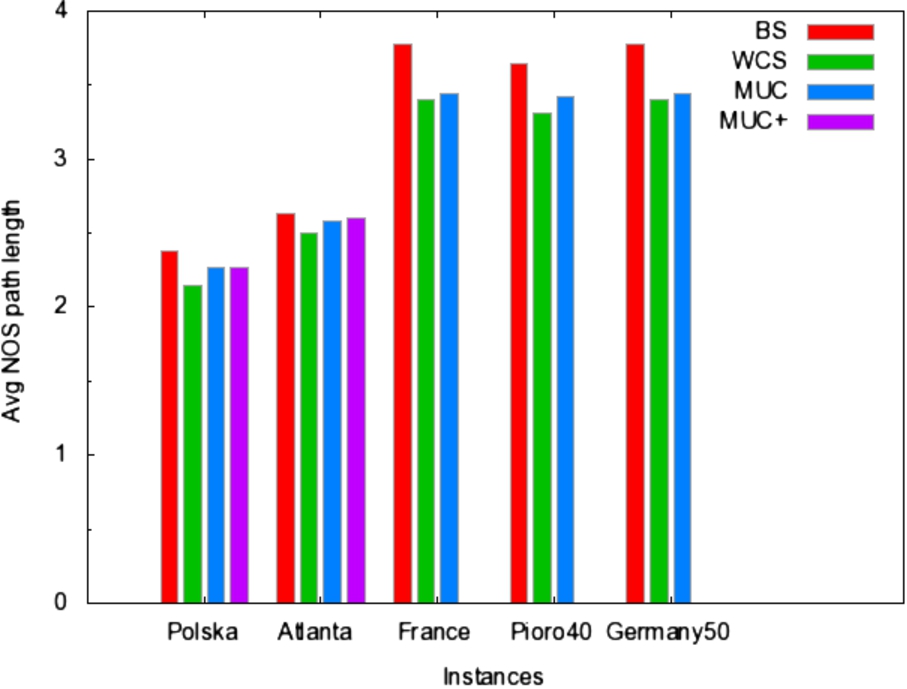
The average path length in NOS. (Colors are visible in the online version of the article;
The usage of capacities is expressed with min, max and average link capacity usage in normal operation state. We remark that the initial solution does not allow a best capacity usage, which is ameliorated later by MUC solution.
The average path length is defined as the fraction between the sum of all the path lengths and the total number of NOS paths. The exact values of all the network instances are reported in the routing statistics (see Table 6). In Fig. 8, we can see that our average NOS path length in WCS is the lowest. This behavior is due to the fact that we route demands on single shortest paths. MUC allows diversification demand and accepts longer paths in the move strategy which induces a little increase.
Despite BS is less expensive, the details of the general statistics and the routing statistics prove that our solution is better in total working capacity. BS aims only the reduction of network cost, which is done by favoring the routing of demands in longer paths to avoid additional allocated facilities.
In this paper we have proposed a hybrid heuristic for Capacitated Network Design Problem, which is NP hard. It combines greedy heuristic (WCS) and iterative local search heuristic (MUC) to construct an initial solution and improve it. The WCS algorithm generates an initial feasible solution by iterating routing demand process. At each iteration, it searches the shortest path to route commodity, allocates the necessary facilities and updates the network topology. The constructive phase is followed by MUC algorithm which reduces the total constructive cost by decreasing the allocated capacities. In fact, it defines DeleteModule move and Demand move that explore unused capacities on links.
The proposed algorithms are simple and easy to implement, the effectiveness of their combination is proved by simulation. Our proposition produces near optimal solutions compared to the best ones presented in the SNDlib library.
Nomenclature
the set of nodes
cardinality of the nodes set
the set of potential links
the cardinality of the set of links E
undirected graph corresponds to sets V and E that model the network topology
the set of demands
cardinality of demands set
a demand
the source of demand k
the destination of demand k
the traffic amount of demand k
the set of all elementary path used to accommodate demands
the set of elementary path used to accommodate the flow of demand k between the extremities
the flow belonging to the traffic demand k and passing on the path p
the existence matrix with cardinality
a binary decision variable indicating whether the link
the working capacity matrix with cardinality
the working capacity on the link
the unused capacity matrix with cardinality
the unused capacity on the link
the fixed cost matrix with cardinality
the fixed cost of establishing link
the routing cost matrix with cardinality
the unit routing cost on link
the set of modules type to allocate on the network
a module capacity type l,
the capacity of module type l
the module matrix
the installation cost of a module type l on link
the number of modules type l installed on link
the link witch have the maximum unused capacity on the network (the promising link)
the route that joint the extremities of link
the length of route R (number of links on R)
the flow to reroute between extremities of link
the working path of demand k
the second route of demand k
the list of previous promising links
the demands list that theirs working paths are moved
the maximum iteration numbers of MUC algorithm
current iteration of MUC algorithm