



Abstract
WiMAX networks offer quality assurance for various communication services, such as Voice over IP (VoIP), Video on Demand (VoD), File Transfer Protocol (FTP), and Hyper Text Transfer Protocol (HTTP). Over the past few years, communication services, such as streaming audio, video, and multimedia for residential and business users, have experienced rapid growth. This expansion of services causes traffic communication to suffer from congestion and become vulnerable. A scheduling approach, which aims to improve user satisfaction, has thus become more significant for wireless infrastructures. In this work, we present Class-Based QoS Scheduling (CBS), which provides QoS assurances in WiMAX network communication. The proposed scheduling approach focuses on downlink-stream traffic communication to achieve high network performance and QoS guarantees. CBS consists of the three main functions of priority elevation, virtual ranking queues, and class-based packet scheduling. The CBS approach supports diverse types of traffic services to guarantee variability in the communication services of WiMAX. The simulation results illustrated that the proposed scheduling approach exhibited considerably better performance in terms of the throughput and the delay than the other scheduling schemes.
Introduction
Considerable developments in wireless networks have been implemented in the recent years. Furthermore, wireless and broadband technologies are expected to grow together in the next generation of networks [19]. Worldwide Interoperability for Microwave Access (WiMAX) is based on Broadband Wireless Access (BWA) networks. The wireless standard for WiMAX is known as IEEE 802.16 [20]. WiMAX is considered to be a fourth-generation wireless network technology (4G) that involves a Base Station (BS), which provides connection classification and scheduling techniques, and a number of Subscriber Stations (SSs), as shown in Fig. 1. The downlink and uplink connections are controlled by the serving BS, which consists of a Physical (PHY) layer and a Media Access Control (MAC) layer where decision-making procedures are applied. In addition, the MAC layer is divided into two sub-layers: Convergence and Common Part sublayers, as shown in Fig. 2. These sub-layers support WiMAX in terms of Quality-of-Service (QoS) scheduling, packet classification, connection management, and link control.

WiMAX BS architecture [17].

WiMAX network layers [15].
WiMAX IEEE 802.16 supports five types of traffic services in its communication, as shown in Table 1 [16]. Over the past few years, there has been a rapid growth in the number of new services provided, such as streaming audio, video, and multimedia TV for residential and business customers. Multimedia communication entails diverse QoS requirements for its different applications. These multimedia services normally cause a sharp increase in demand for bandwidth [6], which places greater strain on the infrastructure of the Internet Service Providers (ISPs) to deliver the desirable QoS.
Services provided for each type of traffic
The network QoS can be achieved on the basis of the assured level of performance in a scheduling algorithm. The scheduling algorithm provides network guarantees, which are distinguished by criteria involving certain performance metrics, such as bandwidth, latency, delay, packet loss ratio, and jitter. For example, QoS is degraded when the packet data flow experiences limited bandwidth, high packet loss rate, or large delay variation. The loss of data and the wastage of network resources are also major burdens for providers that run a business based on Infrastructure as a Service (IaaS). When providers need to support the exceeded/overloaded traffic communication, increased violations and penalties in terms of the Service Level Agreement (SLA) are observed. Ultimately, this leads to unexpected increases in the operation and maintenance costs. Therefore, providers are required to provide efficient bandwidth utilization while guaranteeing QoS for their subscribers. It is thus very important to design a comprehensive, cost-efficient scheduling algorithm that maximizes bandwidth utilization in WiMAX to satisfy the QoS traffic service requirements.
WiMAX traffic services differ in terms of their communication capabilities and applications. Some of these services are Unsolicited Grant Service (UGS), Real-Time (RT), Extended Real-Time (ERT), Non-Real Time (NRT), and Best-Effort (BE) [16,23]. Each traffic service represents different network protocols, such as VoIP, VoD, FTP, and HTTP, respectively. In this work, we considered scheduling in the downlink stream and focused on three different types of services (i.e. VoD, FTP, and HTTP) to expose the scheduling algorithm to heterogeneous testing sets. The downlink Class-Based QoS Scheduling (CBS) system proposed in this paper highlights the QoS guarantees in the 802.16 IEEE standard networks. It makes a significant contribution to downlink resource management by using various methods such as Priority Elevation (PE), Virtual Ranking Queues (VRQs), and Packet Scheduling (PS), with the ultimate goal to ensure QoS guarantees while dealing with diverse communication traffic.
Researchers have considered the Wireless Metropolitan Area Network (WMAN) as a potential resolution for mobile communication technology to suit the continuing growth of data communications, which has led to the evolution of WiMAX. WiMAX can deliver boundless coverage, highly stable wireless access, high transmission rates, and better QoS [14].
The WiMAX schedulers can be classified into two main categories: channel-unaware schedulers and channel-aware schedulers [23]. The channel-unaware schedulers assume that the channels are error free. However, there is a high variability of radio link issues in wireless environment, such as channel attenuation, fading, and noise interference. Such environments make the “error free” assumption unconvincing. In contrast, the channel-aware schedulers consider the channel state information while scheduling the packet. In most cases, the researchers have designed hybrid schedulers that combine more than one type to satisfy the QoS requirements of the multiple service traffic in WiMAX networks [16]. The following section discusses the latest and most well-known research achievements on WiMAX schedulers.
The authors of [12] proposed a resource scheduling mechanism in WiMAX using indecisive fuzzy logic principles. Their mechanism generated dynamic weighting updates for different queues in a Weighted Fair Queuing (WFQ) scheduler. This method calculates a new weight value for different queues adaptively by exploring three input parameters at the simulation time. This scheme outperforms other systems, as it considers instantaneous values and the amount of RT and NRT traffic in the queues together with the latency and throughput requirements. However, fuzzy logic is very complex, as the authors have used a manual method of designing the rule base with linguistic labels to encode the knowledge base directly. This usually takes a considerable amount of time to design and tune the functions. Automated learning techniques can instead be used to reduce the development time and cost, while improving performance.
Moreover, the authors of [3] proposed an optimal scheduling algorithm called the scheduling algorithm with a dynamic programming approach (SADP). SADP maximizes the network throughput on the basis of multiple factors: the network topology, bandwidth requests of SSs, and a heuristic scheduling algorithm to reduce the computing complexity. The performance results were approximately optimal. However, one of the limitations of heuristic algorithms is that it is very complex as resources can execute only one job at a time [10]. In addition, the size and the number of resources are static and need to be known beforehand, which adds to the processing and design complexity, particularly in large environments.
Another QoS-aware scheduling algorithm was proposed to enhance user satisfaction in Orthogonal Frequency-Division Multiple Access (OFDMA) systems. The authors of [7] presented two cross-layer approaches that aim to modify the parameters of the shifted log-logistic utility function to enable different resource distribution strategies and thus maximize the user satisfaction of NRT and RT traffics. Their accomplishment indicates an efficient and low complexity scheduling algorithm that can maximize satisfaction indexes. However, some channel state information parameters are neglected in their work, which could affect realistic scenarios.
In [8] and [25], the authors proposed a QoS-based Dynamic Bandwidth Allocation (QDBA) together with the Prediction-based Fair Excessive Bandwidth Allocation (PFEBA) scheme. Both works considered the optical and wireless network integration to provide an end-to-end differentiated service data transmission for diverse QoS requirements in order to enhance the network performance. In QDBA, each Optical Network Unit (ONU) handles three queues with different priorities, which represent voice, video, and data traffic, respectively. It classifies the WiMAX traffic into three priority levels for assigning the traffic into different queues. However, their proposed scheduling scheme assigns the high-priority traffic to a fixed location of the frame, which is unfair to the variable-size packets. In addition, the packet delay variation of PFEBA is not favorable when the traffic load is high.
Weighted round robin (WRR) and deficit-weighted round robin (DWRR) are considered to be homogenous schedulers in [5] and applied to WiMAX scheduling. WRR assigns a weight to each queue; this value is used to determine the amount of bandwidth allocated to the queue. It allows each queue to be serviced in a set order, sending a limited amount of data before moving onto the next queue and cycling back to the highest-priority queue after the lowest-priority queue is served. The weight parameters are used to adjust the throughput/delay requirements and are set to reserve the least possible rate for each type of traffic. In particular, the minimum reserved rate of a VoIP connection is calculated as the sum of the VoIP sources’ peak rates (12 Kbps). Similarly, the RT, NRT, and BE connections are provided with a respective minimum reserved rate (72 Kbps, 25 Kbps, and 1 Kbps). These values are equal to the sum of each traffic source’s average rate.
The authors in [15] proposed a delay-based scheduling algorithm for RT and NRT traffic. They applied Earliest Deadline First (EDF) or Earliest Due Date (EDD) in their scheduling algorithm to serve a connection on the basis of the deadline where the delay tolerance became the primary QoS parameter. However, their work does not guarantee the throughput for UGS. Moreover, another QoS-aware scheduling mechanism for the integrated WiMAX and Ethernet Passive Optical Networks (EPON) was proposed in [13], but it does not consider the size of the ONU queues. In contrast, in [1], a two-level scheduling scheme for the integrated EPON–WiMAX network was proposed; this scheme takes the queue length and the Head-of-Line (HoL) delays into consideration. In this scheme, proportional fairness scheduling is used for the SSs, and a centralized mechanism at the optical line terminal that connects multiple BSs is used as well. However, the RT constrained traffic does not show its effectiveness in the mentioned scheduler.
The authors of [11] analyzed the First In-First-Out (FIFO) method in wireless platforms for organizing and manipulating a data buffer where the oldest (first) entry or “head” of the queue is processed first. Such a scheduling algorithm is known for its simplicity of serving packets with no priority considered. It serves the first-arrived packet until this particular packet departs, and then, it continues to serve the next packet. However, when the load is high, the packet loss and starvation increase.
Moreover, in [2], the researchers proposed a QoS control scheme called the Single Carrier Scheduling Algorithm (SCSA), which was designed for the single-carrier point-to-multipoint mode wireless metropolitan area network (WirelessMAN) systems; this scheme enables the predefined service parameters to control the service provided to each uplink and downlink connection. The proposed MAC-PHY cross-layer scheduling and resource allocation scheme is robust against particular wireless link degradation due to the newly developed Frame Scheduling Unit (FSU) in the BS and the involvement of three functional modules, namely the downlink request management module, the resource allocation module, and the frame creation module. Their simulation experiments confirmed and validated the effectiveness of the proposed QoS control scheme. However, the UGS and BE classes produce a relatively high average delay and lack a fairness principle, as compared to the other schemes.
Nevertheless, the authors in [4] mentioned the essential needs for buffer management in WiMAX 802.16, particularly in the TDD mode, and proposed an algorithm that adjusts the uplink and downlink bandwidth dynamically by using a hierarchical scheduling structure. Their scheduling algorithm uses a combination of Deficit Fair Priority Queue (DFPQ) for multiple service flows, which included round robin for the BE traffic, EDF for the RT traffic, and WFQ for NRT. DFPQ was proposed to achieve a relatively high throughput for unbalanced traffic. However, the quantum value that they presented to determine the deficit counter seems to have a complex theory and calculation, which affects the entire architecture when the load is heavy. This produces a large overhead delay and a low throughput for the NRT traffic in the network. The well-known and recognized schedulers that address QoS guarantees in wireless networks are summarized in Table 2.
Schedulers analysis summary
Schedulers analysis summary
To sum up, the primary objective of WiMAX schedulers aims to achieve the optimal usage of resources, guarantee QoS, share the total system bandwidth fairly, maximize the throughput, reduce the delays, and minimize the packet loss for all types of traffics, while ensuring feasible computing complexity and system scalability. However, it is very difficult for any scheme to handle all the above-mentioned parameters in one system. Hence, we propose the CBS scheme and compare it against three of the above-discussed existing schedulers, namely FIFO, SCSA, and DFPQ.
CBS differs from these algorithms, as it provides QoS guarantees for all different types of traffic, featuring a hierarchical scheduling structure that involves three modules. Firstly, the packets pass through the designed PE module that adjusts priorities dynamically in order to avoid lower priority packets from starvation. Secondly, more classified buffers are added to the system by sending the packets to the VRQ module, to store the packets, avoid lower connection breakdowns, and minimize packet loss. Lastly, the packets are sent to the PS module that is based on a customized WFQ scheduler to provide the prioritized traffic an extra serving percentage. Hence, QoS assurance is enhanced as compared to that in the other competitive algorithms.
The following section discusses the design, methods, and implementation of all the CBS modules in detail.
The proposed scheduling algorithm considers QoS restrictions by satisfying all variant types of traffic classes and service applications. The QoS parameters defined by the 802.16 standard are quantified to allow the scheduler’s adjustments to be more flexible and precise [24]. In this work, the five service categories defined by WiMAX IEEE are divided into two different group services: Delay Constrained Services (DCS) and Throughput Guaranteed Services (TGS). In particular, the DCSs include UGS, ERT, and RT, while TGSs include the NRT and BE traffic. Our scheduling algorithm (CBS) has three main modules and will be discussed in the following section. All the modules are applied to the groups of services that aim to enhance the overall network performance (shown in Fig. 3).

CBS proposed architecture.
In this section, the PE mechanism for TGS and DCS is presented. We used a service interrupt counter, Ƈ, to observe the status of every connection in both groups (i.e., DCS and TGS). Ƈ was used to elevate the priority of services. The connection with the lowermost priority inside a similar group promoted itself to prevent starvation or connection failure. The scheduler checked the transmission rate μ in the last frame. If the transmission rate equal to zero, then Ƈ incremented by one. If Ƈ exceeded the threshold Ⱦ (where Ⱦ refers to the maximum waiting time for the packets to be served in the queue), the connection was presumed to be starving and its priority was then elevated. Starved connections were then inserted into the bottom of the VRQs. For the DCS group, traffic classes, such as RT and ERT, could be promoted to a UGS and vice-versa. For the TGS group, BE could also be promoted to NRT and vice-versa, as shown in Fig. 4. The following are the parameters used to obtain the threshold (Ⱦ).

Priority elevation (PE).
Hence,

Priority elevation
The concept of a VRQ was proposed to satisfy the QoS requests by avoiding lower priority connection breakdowns. It also assured the minimizing of the packet drop by adding more classified buffers to the entire scheme. Our VRQ separated and classified the traffic into two categories in different queues, namely DCSs and TGSs. It was used to store the packets from the PE stage (either DCS or TGS) to be queued before sending the packets to be processed. Technically, a VRQ acted as a holding area for priority data after it had been classified and passed by PE, as shown in Fig. 5. In addition, the queue limit was configured to determine the maximum number of packets that a queue could accommodate, which was equal to the queue length.

Virtual ranking queues (VRQ).
This was calculated by using the average arrival rate, λ, multiplied by the average time that a packet spends in the queue
Despite this queue’s existence, no additional queuing latency (above the transmit-ring latency) was incurred, as the packets in this queue were immediately drained to the transmit unit by the packet scheduler. In this case, the scheduler immediately presented the packet to the egress interface transmit unit. The implementation steps that involve VRQ are stated and explained clearly in Algorithm 2.

Virtual ranking queues
We formed a customized WFQ scheduler as the final stage for the packets to be sent to the user (Fig. 6) and hence the two different queues from the VRQ module (i.e., DCS and TGS) were introduced for each traffic group. The generic WFQ is an egress traffic-scheduling algorithm. It determines how the traffic placed in different queues is sent out of the network device. For instance, traffic placed on two different queues is served in sequence alongside each other. Hence, the standard behavior of WFQ serves the traffic as {(task 1 at queue1), (task 2 at queue2), (task 3 at queue1), (task 4 at queue2), …} in a cyclic manner.

Customized WFQ packet scheduler (PS).
In contrast, our customized Packet Scheduler (PS) based-WFQ was configured with an extra serving percentage to be allocated to the DCS or the TGS queues, based on the user preference. In particular, PS automatically set an extra weight percentage to be served for the prioritized group to ensure bandwidth dominance. We set the Departure Rate (DR) of the packets according to the weight service rate of 60% given to the selected group, which was considered priority number one and symbolized as Weighted High Priority (WHP), while the other 40% of the weight service rate was given to the least selected group, denoted by Weighted Low Priority (WLP). The 60% weight value was used to upsurge the service for the topmost priority connections and reduce starvation to the second connection as it still served with 40% weight value, while retaining fairness to both the connections according to the predefined user priority settings.
In our scenario, we assumed that the user had selected the RT traffic as priority number one, which belonged to the DCS group. Hence, the DCS queue received an extra proportional weight ratio to TGS (i.e., 60:40 or 3:2). This ratio implied that DCS was served more than TGS, proportionally. The queues were then served as {(task 1, at DCS queue), (task 2 at DCS queue), (task 3 at DCS queue), (task 1 at TGS queue), (task 2 at TGS queue), (task 4 at DCS queue), (task 5 at DCS queue), (task 6 at DCS queue), (task 3 at TGS queue), (task 4 at TGS queue) …}.
The WFQ handled the assignment of the weights and the finish time by using a generalized processor sharing approach. In which,

Packet scheduler
To sum up the entire CBS workflow, the incoming traffic and service applications were first received by the PE module, where the packets were elevated on the basis of the user priority assignment to eliminate packet starvation. Then, the traffic was sent to the VRQ module to be stored and categorized, to eliminate a connection breakdown, before it was received by the PS module that upsurge the service rate for the preferred traffic categories before being sent to the user. A detailed outline overview of the logical processes and module workflow of CBS is shown in (Figs 7 and 8), respectively, from the reception of packets to successful transmission. In addition, because of the large number of symbols in this work, Table 3 clearly presents the physical meanings of the used symbols.
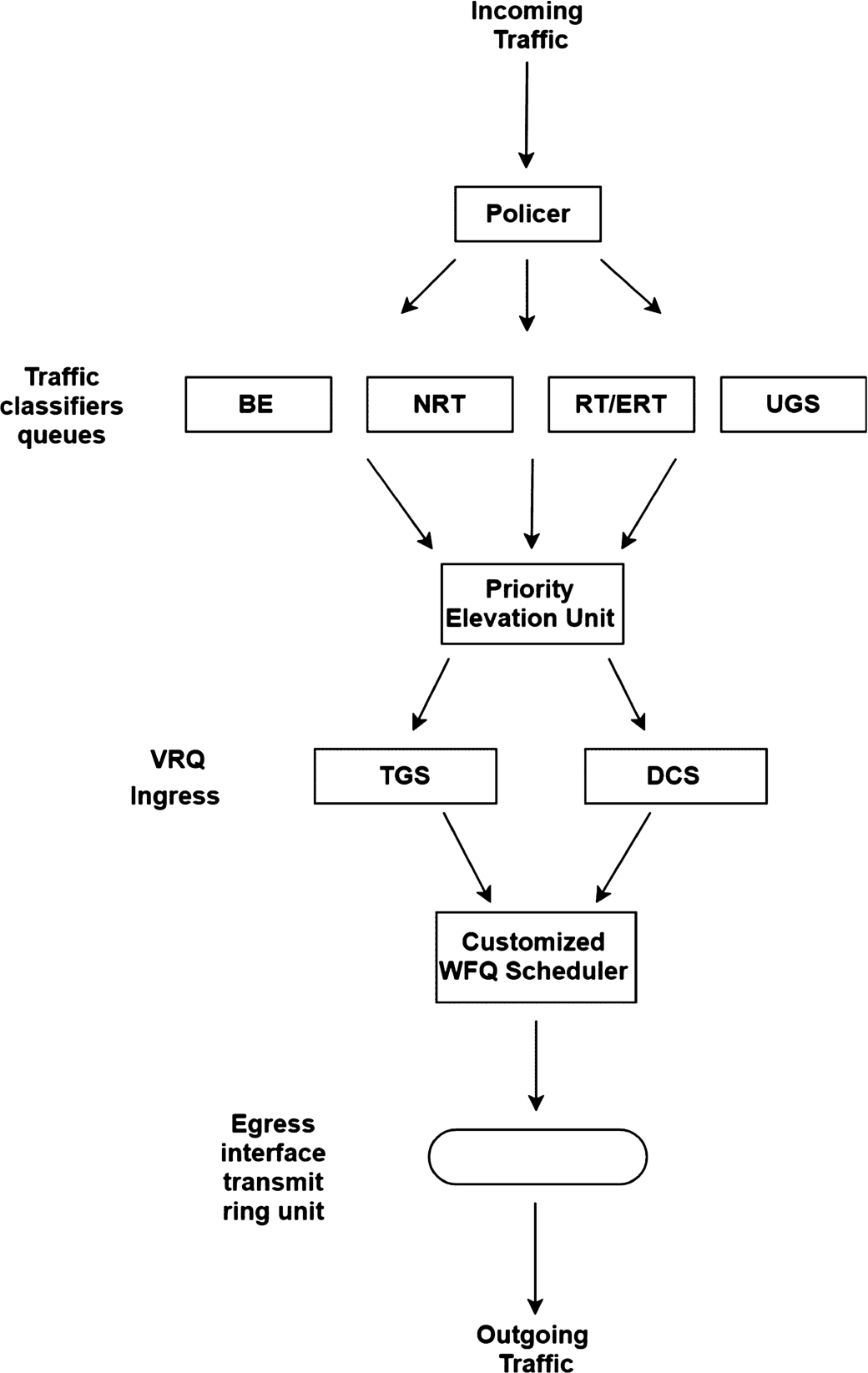
Logical processes of CBS.
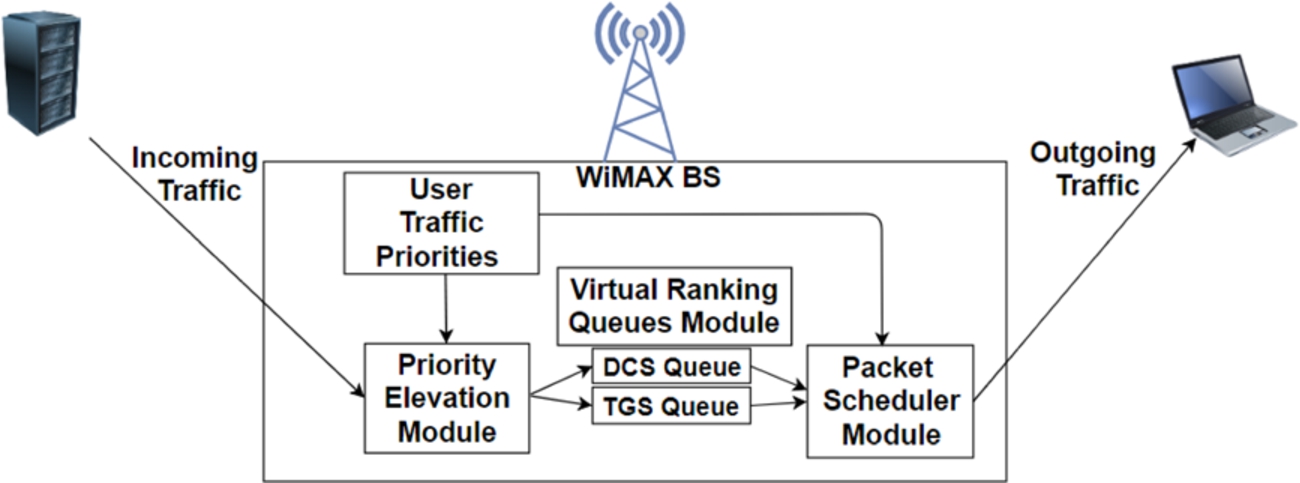
CBS modules workflow.
Variables description
In this section, we explain in detail the simulated network model together with the configured traffic for evaluating the quality of service performance over fixed WiMAX, as given below. We used the point-to-multipoint network architecture in our simulation model involving one WiMAX Base Station (BS) with nine Mobile Stations (MSs), as shown in Fig. 9. The experiments were implemented in a WiMAX cluster running on an OPNET modeler by using the assumptions and parameters given in Tables 4 and 5, respectively. All the three procedures (i.e., PE, VRQ, and PS) were controlled by the BS, which took into consideration the downlink operation. In our experiment, we set up a network scenario where one of the MS was requesting the VoD, FTP, and HTTP services with the traffic application priorities shown in Table 6.
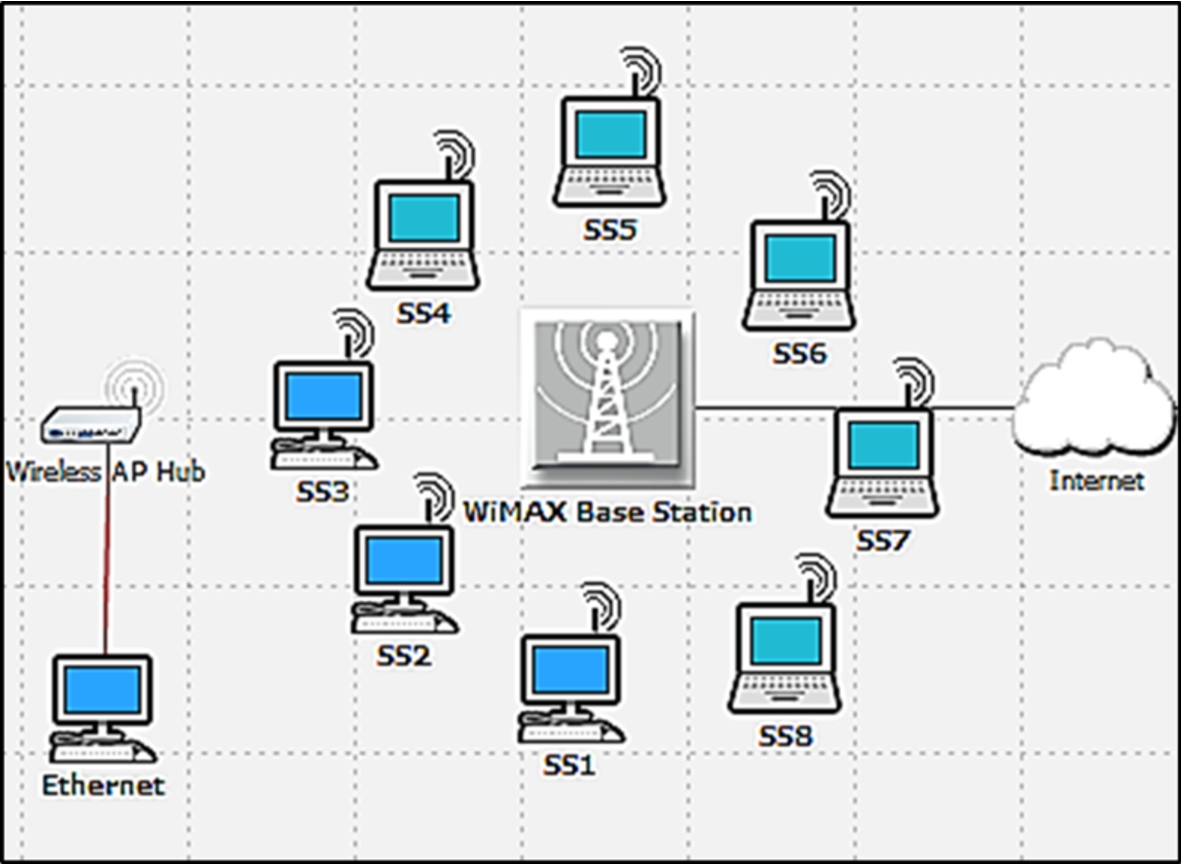
Network architecture scenario.
Assumptions
QoS Parameters
Simulation traffic priorities
Moreover, in order to obtain accurate results of the proposed CBS algorithm against the existing algorithms, we recreated FIFO, SCSA, and DFPQ in our simulation environment to ensure a fair comparison practice of the proposed CBS algorithm and considered the following performance metrics.
Average delay
The average delay is quantified by dividing the total number of delayed packets by the total number of transmitted packets [18]. As soon as a packet misses the deadline threshold, the packet is dropped. This implies that the individual packet delay is less than the packet limit timespan and can be expressed as follows:
Mean absolute percentage deviation (MAPD)
To achieve an accurate comparison, we introduced the Mean Absolute Percentage Deviation (MAPD), a method in statistics, defined as the ratio of the absolute measurement to the measurement being taken [21]. In our case, the deviation between the two values indicated the effectiveness of our modules. MAPD is expressed in percentage and has no units, as shown in Eq. (5):
Analyzing back-end throughput
Network throughput refers to the average rate of successful message delivery over a communication channel in a given time. This performance can be delivered over a physical or logical link or passed through a certain network node. The throughput is usually measured in bits per second (bps) or in kilobits per second (kbps). It can be analyzed mathematically by using the queuing theory [22]. The throughput could be expressed as follows:
Analyzing utilization
We defined utilization as the ratio of the amount of resources that is actually used, to the maximum amount of resources that could be used [9]. Utilization therefore has no units and should be between zero and one, or between 0 and 100% (as it is not possible to use less than nothing or more than is possible). It can be expressed as follows:
Results
In the first experiment, as shown in Fig. 10, CBS was subjected to the average delay for the RT traffic in comparison with the other existing scheduling algorithms. For instance, the user was requesting a VoD, which was obtained in the MPEG-4 format. As the simulation time increased, the average delay of the CBS became increasingly steady 200 ms onwards, which reflected higher network speed in comparison with the other algorithms. The figure also shows the remarkable network speed performance of the proposed algorithm as compared to that of the nearest competitor, SCSA. Moreover, by introducing MAPD in Eq. (5), we found that the proposed CBS enhanced the speed of video streaming by 13% against SCSA for the average delay, which was considered significant in the queuing performance. We also found that the proposed CBS algorithm responded well specially for the top prioritized traffic, because of the three implemented modules of PE, VRQ, and PS that all aimed to ensure better service for the preferred traffic. This provided faster, more stabilized, and more lag-free video streams than all the other existing algorithms of FIFO, SCSA, and DFPQ.
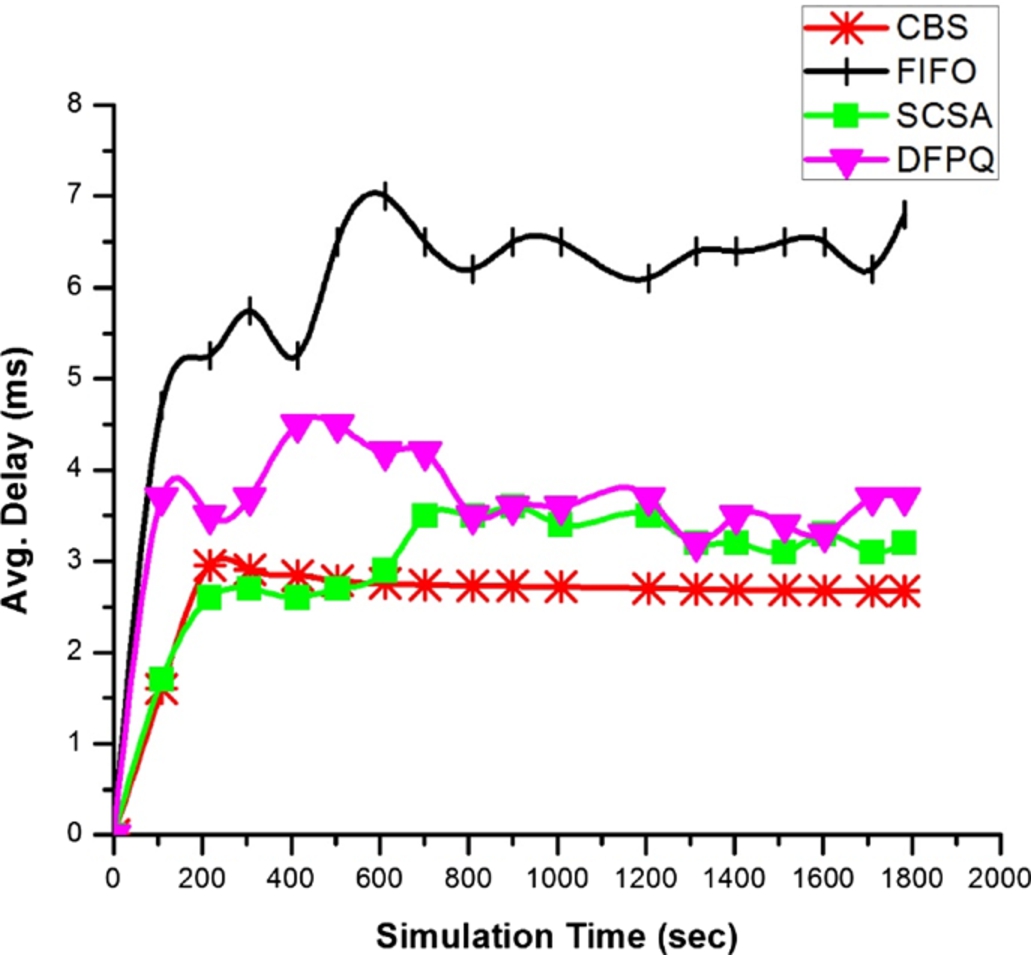
Average delay RT traffic (VoD).
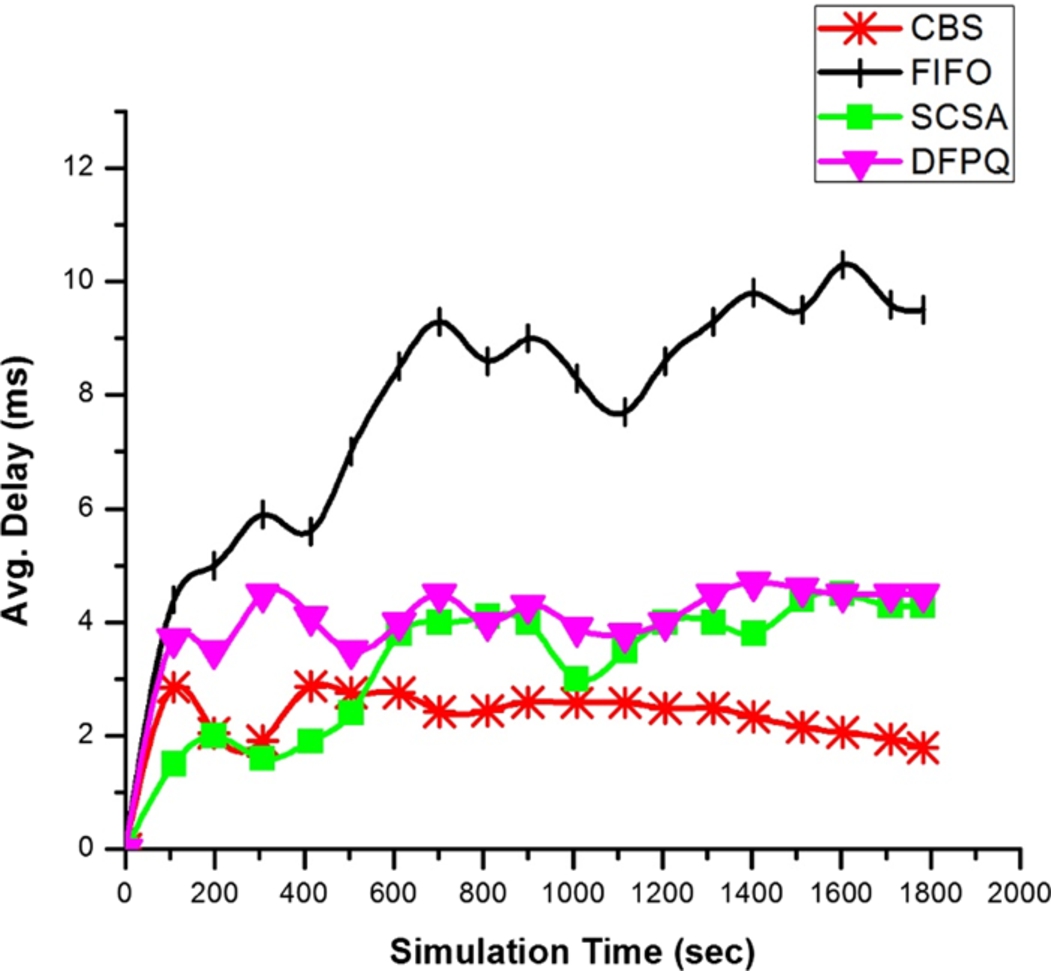
Average delay NRT traffic (FTP).
In the second experiment, we tested CBS to the average delay for NRT traffic when the user was downloading a file from the Internet (Fig. 11). From 400 ms onwards, the average delay showed that there was no fluctuation. This reflected the notable speed of the proposed algorithm due to our fine-tuning queuing scheme, which was significant and provided better service. The nearest competitor to the proposed approach is the SCSA algorithm, because of its defined service parameters prior to the traffic control and its effective frame-scheduling unit. However, by introducing MAPD using Eq. (5), we found that the proposed algorithm enhanced the speed of downloading a file by 40% against SCSA for the average delay, which was considered significant in determining the network and queuing performance. This proved the substantial network reliability of the proposed algorithm that held the packets in queues to ensure the smooth transmission and still served a proportional rate of 40%, while the other higher priority traffic was served with 60%, thereby maintaining the fairness level for the second prioritized traffic, in contrast to the existing algorithms that lack the fairness principle.
In addition, we tested CBS in the third experiment for the average delay of BE traffic, when the user was browsing heavy images through HTTP. Even with our simulation set had the third and least priority for the BE traffic, the average delay (shown in Fig. 12) indicated a competitive speed of CBS as compared to the SCSA and DFPQ algorithms. Nevertheless, DFPQ exhibited a good value for the average delay because of its hierarchical scheduling structure, which uses a combination of scheduling algorithms for multiple service flows. However, CBS still exhibited the maximum gain in network speed and achieved remarkable network performance as compared to the other algorithms because of our effective queuing mechanism that even serves any backlogged traffic with the spare remaining bandwidth.

Average delay BE traffic (HTTP).
Moreover, we analyzed the average throughput, as shown in Fig. 13; CBS reached the maximum throughput value of 560 Kbps as compared to 250 Kbps for SCSA. As seen in the figure, the value started to increase dramatically from zero to 200 s and became steady after 200 s. This steadiness and throughput improvement implied that the adaptive queuing mechanism of CBS could reach the overall throughput guaranteed service and overhead reduction. Such performance showed the reliability of the proposed scheduling approach that tended to maximize the data transfer rate of packet delivery and reached effective transmission.
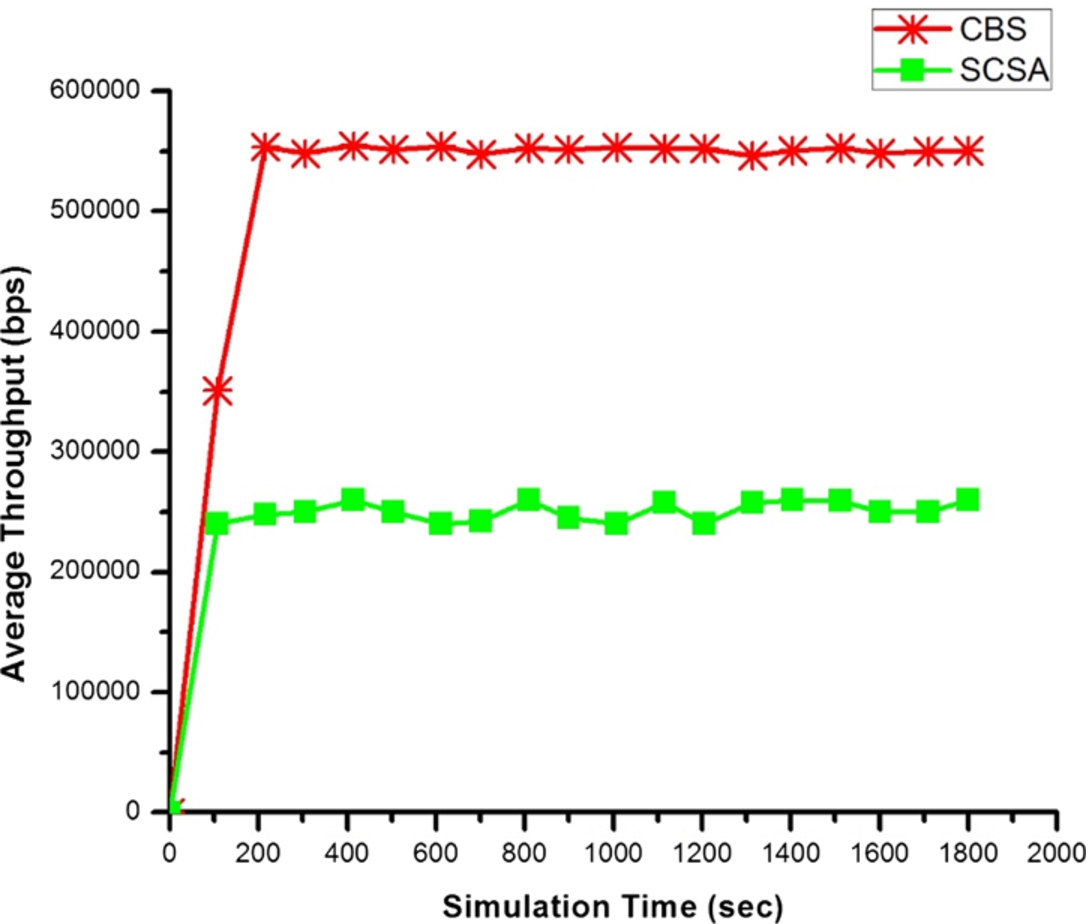
Average throughput.
Finally, the utilization is shown in Fig. 14; the line chart depicts a slight increase in the first part of the simulation time before becoming constant during the rest of the simulation. By applying Eq. (7), we calculated the average utilization to be around 10% for one application; this implied that the downlink could provide considerably more available bandwidth (around 90%) for other potential new applications or users.
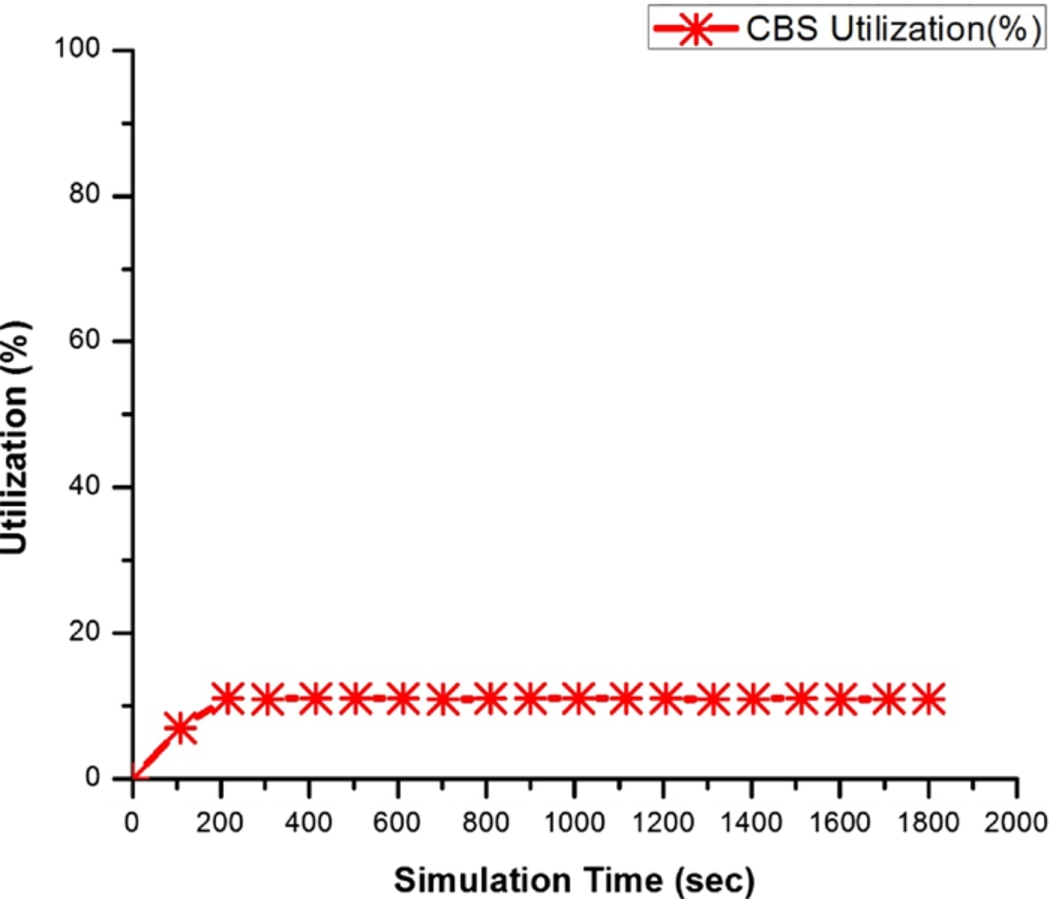
Network utilization.
In this work, we proposed a CBS scheme for the downlink traffic in WiMAX networks. The proposed CBS presented a valuable scheduling algorithm to achieve QoS assurances, prevent resource starvation, and classify services on the basis of the determined priority. Furthermore, the simulation results showed that the implemented CBS added remarkable performance in terms of average delay, average throughput, and network utilization as compared to the existing scheduling algorithms. We succeeded in recording 13% improvement in VoD, 40% improvement in FTP, and relatively fair performance for the least prioritized HTTP traffic among the other algorithms. Therefore, we were able to maximize the resource management performance with a diversity of traffic services and enhance QoS guarantees in WiMAX networks. In the near future, this work will be extended to dealing with dynamic changes in bandwidth allocation to improve QoS in WiMAX for both uplink and downlink network access.