



Abstract
False data detection, intrusion detection and coverage rate are major challenges in wireless sensor networks (WSN). Scheduling in media access control (MAC) using gateway and relay nodes solve some of the problems. In this paper, we carried out a brief survey on scheduling, delay aware MAC, cooperative communications in MAC, and adaptive listening to keep controlling the energy in sensors. In addition, multichannel MAC and various routing strategy techniques for WSN are discussed. Firefly algorithm for dynamic scheduling pipelined scheduling for linear sensor networks gives better throughput and latency. Heuristic configuration solves the overhearing problem, as node power-based MAC controls power of each node. Based on WSN applications and the performance metrics concentrated, various techniques for MAC are discussed throughout in this paper.
Keywords
Introduction
Wireless sensor networks (WSN) have emerged as a premier research area. It has the ability to change lives, introduce smart buildings, smart environment etc. It finds application in missile, military, underwater surveillance and many more. However, it faces problems in conceptual and optimizations, bandwidth constraints, QoS. Types of WSN include mobile, underwater, underground, terrestrial, multimedia etc. Media access control (MAC) layer plays a role in the transmission of data in WSN following 802.15.4 IEEE standard. MAC has also been emerged into multi-channel, multi-layer etc. which faces its own challenges and problems.
Polling distribution (PD) is used in MAC by [59]. This helps in adjusting the duty cycle dynamically and the performance is checked with deterministic, exponential traffic patterns. PD-MAC performs better in terms of energy, complexity and memory usage than other existing MAC protocols. Duty cycling and pipelined scheduling in linear sensor networks are analyzed by [64]. Each node is made responsible for certain area and then have to send packets only based on its own sensing. It helps in better latency, throughput and time ratio. Table 2 show various Cooperative/delay aware MAC and techniques.
Zigbee frame is used by [5] to inform the nodes about their sleep, idle and active times. Dynamic and semi-dynamic scheduling are tried in the Zigbee network using Z-monitor tool. It performs better than static scheduling in terms of data rate, lifetime and latency. Bio inspired scheme for node scheduling proposed by [10] and it helps in system stability. It monitors the sensor node in WSN for different applications, environmental conditions in order to determine the state of adjacent node. This helps in energy saving, decrease the delay.
Gateway for mapping identifier and locator of IoT devices in a network is proposed by [16]. This works in a distributed manner and helps in reducing registration delay, data delivery delay. Texture based compressing scheme is used for multimedia applications in wireless video sensor networks (WVSN) by [61]. Local directional pattern is used for compressing video frames and thereby energy consumption, time is reduced by improving image quality.
MAC allocates channel for the messages based on whether the messages are periodic or event driven or information based by prioritizing the messages. Hence, MAC protocols are of 3 types namely contention based, contention free and hybrid models. Collisions, unbounded delays are few challenges faced in contention-based MAC protocols. However, the contention free MAC protocols allocate the channel based on time, frequency or code namely TDMA, FDMA, CDMA etc. Central entity for channel allocation is the drawback in contention free MAC protocols. Distributed MAC can overcome a few such disadvantages. Hybrid MAC can also offer solution by using token passing method and decreasing the delay, increasing throughput in MAC protocols.
The rest of the paper is organized as follows: Section 2.1 narrates various approaches carried out in scheduling MAC for multiple nodes accessing the channel, Section 2.2 describes cooperative/delay aware MAC approaches and Section 2.3 elaborates multichannel MAC and Section 2.4 presents various mathematical/routing models for WSN which help in improving performance metrics in the network. Section 3 concludes with observations from various works carried out in the same direction.
Survey of various techniques in MAC for WSN applications
Scheduling/duty cycle
Scheduling the gateway, scheduling the node are major challenges in which the MAC protocol can be used in synchronous or asynchronous operation. An adaptive duty cycle adjustment based on data from sensor and queue length at gateway. This scheduling in gateway for varied traffic conditions achieve reduced delay, energy consumption. Survey is carried out on duty cycled MAC by [4]. Energy consumption in all layers are analyzed and MAC are classified as synchronous and asynchronous which supports for better energy, bandwidth in various wireless applications. Asynchronous duty cycled preamble-based mechanisms used in random access networks by [24,68]. It sends preamble to check the active state of receivers and thereby optimizes sleep cycle of receiver to achieve better delay, energy, reliability and sleep time of the nodes. Synchronous MAC has contention, delay problems. In [31], the authors proposed asynchronous scheduling of MAC for wakeup times of neighbor nodes in the network so that contention, overhearing and latency decreases. It performs better than preamble sampling MAC protocols in energy, packet loss and delay.
Random delay spent by a node for transmission of preamble packet before getting free channel is
The average μ, correlation ρ of T with α being probability of channel busy is given by
Delay aware probability-based MAC is introduced by [29] to overcome problems in conventional handshaking MAC. It eliminates handshaking and helps in concurrent transmissions and hence utility optimization helps in best transmission strategies and thereby improve throughput. Delay tolerant (DT) MAC is proposed by [40] with distributed coupon collection algorithm. Probability model is added in DT-MAC along with traditional interference model and it helps in channel reservation for an optimal throughput. RTS/CTS also help in DT-MAC for its outperformance. Delay sensitive wireless monitoring and control are carried out by [14] in which various 802.11 MAC are analyzed theoretically. It helps in timeliness of MAC mechanisms for various applications. In [48], the authors used space-time super modulation in which temporary redundancy is reduced without increasing block length and decreasing error rate. This is an asynchronous MAC method, removes the necessity for preambles in media access and data transmission. It simplifies MAC design and works without the need for preambles or scheduling. Table 1 show the various types of scheduling approaches in MAC.
Types of scheduling approaches in MAC for WSN
Types of scheduling approaches in MAC for WSN
Inferences from scheduling/duty cycle in MAC protocols. Scheduling gateway remains a challenge for which adaptive duty cycle can be fixed based on data arrival rate from sensor, queue length at gateway to achieve better delay, energy consumption. Firefly algorithm with dynamic scheduling and objective function depending on residual energy, node degree and intra-cluster distance give better energy, overhead in MAC. Pipelined scheduling, duty cycling applied on linear sensor networks helps in better latency, throughput and time ratio. Dynamic, semi-dynamic task scheduling used in the Zigbee network in which the Zigbee frame monitors the sleep, idle states of nodes and thereby improves data rate, latency in WSN. Bio inspired node scheduling scheme helps in monitoring the node for different environmental conditions and the state of adjacent node and thereby controls energy, delay. Preamble sampling MAC has overhead problems, synchronous MAC has overhearing, delay and contention problems. Asynchronous scheduling MAC helps to overcome these.
Duty cycled MAC classified as synchronous and synchronous to analyze energy consumption of all layers for optimal energy, bandwidth for various wireless applications. Energy, latency time are reduced in WSN using dynamic duty cycle in both linear topology and rectangular topology. Sleep time of receiver can be monitored by sending preamble and thereby duty cycle based asynchronous protocols for random access networks give better energy, reliability and sleep time. Polling distribution, dynamic duty cycle adjustment helps in achieving better energy, complexity and memory usage of MAC for WSN applications. Parameter, duty cycle optimizations help in achieving better QoS requirements in telemedicine protocol for WBAN applications. QoS include collision rate, energy, PDR, delay.
When packet generation rate of relay node is small, in [70] the authors introduced a two-way cooperative network coding protocol to increase the throughput of the network. It works on channel based TDMA, also increases the performance of symmetrical networks. Cross layer cooperative MAC is implemented by [26]. Power assignment, relay selection algorithm is used which helps in selection, coordination of relays with optimal power levels and thereby to achieve better energy, overhead and computational costs. An energy balanced cooperative (EC-MAC) protocol is used by [69] to study the impact on QoS in MANET. Algorithm helps in best partner selection based on the conditions of high transmission rate, channel conditions and balanced energy. EC-MAC outperforms the other MAC like cooperative MAC, 802.11 in terms of PDR, throughput, lifetime.
Cooperative/delay aware MAC and techniques
A telemedicine protocol with 802.15.4 for wireless body area network (WBAN) is proposed by [3]. It concentrates on parameter tuning optimization and duty cycle optimization to achieve better energy, data rate and reliability. It helps for better QoS requirements and analyzed in terms of PDR, delay, collision rate. Firefly algorithm with variable step size is used by [62] for dynamic scheduling energy efficient MAC. It decides the optimal position of the cluster head and the objective function depends on intra-cluster distance, residual energy, head count and node degree. It helps in achieving better overhead, energy and lifetime of the network.
The fitness function in the firefly algorithm is given by
Resource allocation in MAC layer is monitored by [65] for virtualization in WSN. Cluster tree protocol in guaranteed time slot helps in managing the resources. The performance of this fair allocation algorithm is compared with round robin, discrete event simulator and proportionally fail scheduling techniques in terms of latency and throughput. Adaptive resource management schemes are introduced by [50] in which queue management is done actively. The schemes are namely deficit round robin (DRR), deficit weight round robin (DWRR) and negative deficit round robin (N-DWRR) and they help in bandwidth utilization rate without effecting latency.
Inferences from cooperative/delay aware MAC protocols. Delay tolerant MAC with probability model along with interference model helps in channel reservation for an improvement in throughput. Delay aware MAC eliminates handshaking, helps in concurrent transmissions and utility optimizations to improve throughput of the network. Best partner selection based on channel conditions, transmission rate in energy balanced cooperative EC-MAC give better network lifetime, energy and PDR.
Active queue management schemes namely DRR, DWRR, N-DWRR help in bandwidth utilization rate without effecting latency. Channel based TDMA with two-way relay in cooperative network coding helps in improvement of the throughput in symmetrical networks. Timeliness of 802.11 mechanisms for various applications help for monitoring and controlling wireless systems.
Resource allocation and management in MAC with cluster tree protocol in guaranteed time slot give better latency and throughput in WSN. Stochastic approximation, relay nodes for a two-tier WSN with energy cost minimization helps in achieving statistical convergence. Cross layer MAC with optimal relay selection helps in achieving better overhead, throughput and energy consumption of the network.
Energy and power levels of a node play major role in network lifetime. The nodes are operated in various modes like sleep, idle listening, adaptive listening, wake up to balance the energy and power levels. Node power-based MAC is proposed by [55]. It takes help of adaptive listening and controls the power allotment to each node. Hence it achieves better energy efficiency compared to sensor MAC and multi-layer MAC. Threshold optimization for depth-based routing (DBR) is carried out in [66]. The courier nodes follow adaptive mobility in underwater wireless sensor networks (UWSN) and control network reliability, overhead, throughput and stability. It is used in range based critical applications. Rate adaption and power control for MAC is concentrated by [60]. Nash equilibrium for controlling transmission power, rate adaption algorithm adjusts the data transmission rates of the nodes. Spectral reuse index is a metric formulated to measure spectral efficiency in the network.
Spatial reuse index is given by
Self-learning L-MAC of wake-up time is followed by [21]. It uses beacon messages for parent child node coordination, so that control over wake-up time can be known. Hence it achieves better energy efficiency, latency. Linear and rectangular topology for WSN is designed by [7], which takes care of node utilization rate, sleeping delay on an average for adjusting the duty cycle. There by energy, latency time are reduced compared to sensor S-MAC. Asynchronous duty cycle used by [67] allows demand sleep for MAC protocol and dynamic traffic overcomes overhearing problem. Receiver uses short token packets and waiting delay of source node is reduced. This helps in better delay, energy, packet loss. Table 3 show various adaptive listening approaches in MAC.
Adaptive listening approaches in MAC for WSN
Adaptive listening approaches in MAC for WSN
Multi-layer ML-MAC implemented by [35] helps for synchronization between nodes using relays. Connectivity and coverage conditions should be followed by relay nodes and thereby improve lifetime, delay and accuracy. Relay nodes are operational state scheduled in [23] and using stochastic approximation, minimum energy cost function the idle listening is eliminated in a two-tier WSN. This method also achieves statistical convergence.
Low power listening MAC for addressing the increasing network traffic is proposed by [11]. A heuristic configuration for saturated and unsaturated conditions help to avoid overhearing, without using long preamble it gives better performance in single and multi-hop scenarios in terms of throughput, delay and energy. Optimizing listening time of nodes in S-MAC by allowing periodic listen/sleep technique, in [39], the authors achieved better energy, latency. SMAC face the problem in contention window adjustment because of random slot selection. Optimization in contention priority distribution is proposed by [56]. It addresses collision probability and idle listening problems.
Inferences from adaptive listening in MAC protocols.
Node power-based MAC controls power allotment to each node by adaptive listening and thereby increases energy efficiency.
Rate adaption controls data rate, Nash equilibrium controls power of the node to acquire better spectral efficiency of the network.
Controlling wake up times of nodes using beacon messages for child parent node coordination helps in achieving better energy, latency.
Relay nodes help in synchronization between the nodes in multi-layer MAC and achieve better delay, energy and accuracy.
Demand sleep DS-MAC uses asynchronous protocol, dynamic traffic to reduce overhearing and achieve better energy, packet loss and delay.
Threshold optimization for courier nodes in DBR for range-based applications in UWSN yield better stability, overhead and throughput.
Heuristic configuration in low power listening MAC addresses overhearing problem and give better energy, delay in single and multi-hop scenarios of WSN.
SMAC with contention priority distribution helps in addressing idle listening and collision probability problems.
Multi-channel and multi-layer in MAC are presently emerging research which has its own pros and cons. Solutions are being proposed by various researchers. Full duplex pipelined Pi-MAC is proposed by [17] in which each node is responsible for suppressing self-interference and low interference due to next hop neighbor relay. Multi hop performs better than single hop scenario in terms of delay. The channel coefficients and delay are analyzed in the presence of interference. Hop by hop dynamic addressing H2-DAB for UWSN is analyzed by [8]. It handles node mobility problems as each node is assigned routable address and without location information, centralized infrastructure. It manages node movements in quick network changes with minimum overhead.
Self-interference, intra-flow interference can be cancelled by adding cancellation signals CS at mth relay node. Cancellation signal for self-interference is given by
Approaches in multi-channel MAC
Approaches in multi-channel MAC
Reservation based multi-channel ML-MAC is implemented by [54]. It transmits packet periodically and avoids collision among multiple senders transmitting packets based on reservation mechanism. Better energy and latency are achieved. New schemes for path discovery, load balancing and neighbor discovery are proposed in [50]. Nodes availability, connectivity and sensor coverage are addressed to increase network lifetime in WSN applications.
Inferences from Multi Channel MAC.
Reservation in ML-MAC allows nodes to transmit periodically and avoid collisions among multiple senders based on reservation. It gives better energy, latency.
Hop by hop addressing helps in addressing node mobility problems in UWSN with route addressing for each node, without centralized infrastructure and with minimum overhead.
Pipelined MAC in multi hop scenario where node suppresses self and next hop relay interference give better delay, channel coefficients.
Path discovery, load balancing, neighbor discovery in WSN can help for achieving improved network lifetime.
Pipelined scheduling, duty cycling applied on linear sensor networks helps in better latency, throughput and time ratio.
False data detection, nodes centrality, receiver signal strength are few problems faced in WSN. Delay, accuracy, bandwidth and gateway are some of the concerns in WSN. Virtual cloud data centers with different topologies can be coordinated using static, dynamic phases and improve revenue, acceptance ratio and decrease path length. Imperfect channel state information problems are addressed using hidden Markov model with bat optimization to improve energy efficiency.
A cluster-based routing protocol which depends on modified partition algorithm is introduced by [49]. It helps in identifying similar users present in the network. Hidden Markov model (HMM) is used by [34] with bat optimization for multi input multi output (MIMO) with AF (amplify and forward) systems. This helps for imperfect channel state information (ICSI) by correcting channel estimation errors and thereby improves energy efficiency and source relay precoders. Path operator calculus centrality (POCC) is used for path finding by [63]. Multi path constraints and problems are overcome by focusing on energy levels, BER. This approach improves network lifetime in WSN. Adaptive resources are provided for data centers by [25] using coordinated and embedded static, dynamic phases. Hence virtual cloud data center problems due to different topologies are addressed and it increases revenue, acceptance ratio and decreases the path length.
POCC of a node n is given by
Using POCC, any node selects the next hop as advanced node based on energy levels rather than normal node which is given by
A distributed Ad-ATMA protocol for wireless acoustic sensor networks (WASN) is designed by [30] for reducing the packet transmission time for nodes without collisions and suitable for low traffic data rates. It achieves better energy, latency and PDR. Machine learning algorithms are applied for classifying distributed denial of service (DDoS) attacks in software defined radio (SDN) by [46,57]. Random forest algorithm and decision tree algorithms are applied to increase classification accuracy of flow table, controller and bandwidth attacks in software defined network. WSN applications in finding localization are concentrated by [2]. Combination of regression trees are used along with ensemble learning for simple computation and accuracy improvement [58]. Received signal strength (RSS) is improved in monitoring moving objects. Impersonal attacks, false data injections are major problems in WSN which are addressed by [44] using end to end, hop by hop approach. Loss of legitimate data is avoided by using end to end privacy and early detection of attack by hop by hop approach. Thereby major dependency on sink node can be reduced. In [15], the authors made a survey on 4G and 5G technologies. The problems in 4G include less bandwidth, less data rate, low interference etc. However, the 5G technologies and the requirements are met by IoT with the new radio (NR). A detailed survey is made by the authors on augmented reality with IoT, beam forming in MIMO antennas, mm wave technologies and heterogeneous networks (HetNets). Table 5 show various routing approaches for WSN.
Various routing approaches for WSN
Various routing approaches for WSN
Missing sensor data prediction using ANFIS and deep learning is carried out by [28]. Grid searching method is applied on Berkeley dataset and parameters are optimized, thereby prediction accuracy is improved. Efficient monitoring approach is proposed by [1] for security alerts, intrusion detection in the case of service rejection and attacks. Integrated positioning algorithm is proposed by [41] for global positioning systems/wireless local area network (GPS/WLAN). Coverage rate and identifying pedestrian positions are the problems faced which is overcome using federal Kalman filter. This improves accuracy and coverage rate.
Inferences from Routing approaches for WSN.
Prediction accuracy is improved in missing sensor data by ANFIS and deep learning with grid search approach. Random forest, decision tree algorithms help in improving classification accuracy of distributed denial of service attacks in SDN like controller, bandwidth and flow table.
False data injection, legitimate data loss problems in WSN can be addressed by end to end privacy and hop by hop early detection. Regression trees help in improving received signal strength with simple computation and accuracy for WSN applications. Node centrality problems are addressed by considering few constraints and operator calculus mechanism to improve BER, lifetime.
Gateway in IoT network maintains device identity and location in a distributed manner and helps in reducing total delay. Ad-ATMA with distributed mechanism helps in low traffic data rate transmissions and improve PDR, energy and latency. Texture based compressing for video frames for WVSN applications can lead to energy conservation, improves image quality. Kalman filter in GPS/WLAN positioning helps in increasing the coverage rate and accuracy for identifying pedestrian positions.
In [52], the authors analyzed various models and protocol stack for IoT which considers reliability, power efficiency and internet connectivity as per the present requirements. In collaboration with industry, a protocol stack is proposed which follows 802.15.4-2006 for physical layer and 802.15.4e for MAC layer. It follows the open system interconnection (OSI) model and Transmission control protocol/Internet protocol (TCP/IP) taking power saving schemes and matching the present needs of real time IoT networks. Figure 1 show the survey carried out in this paper.
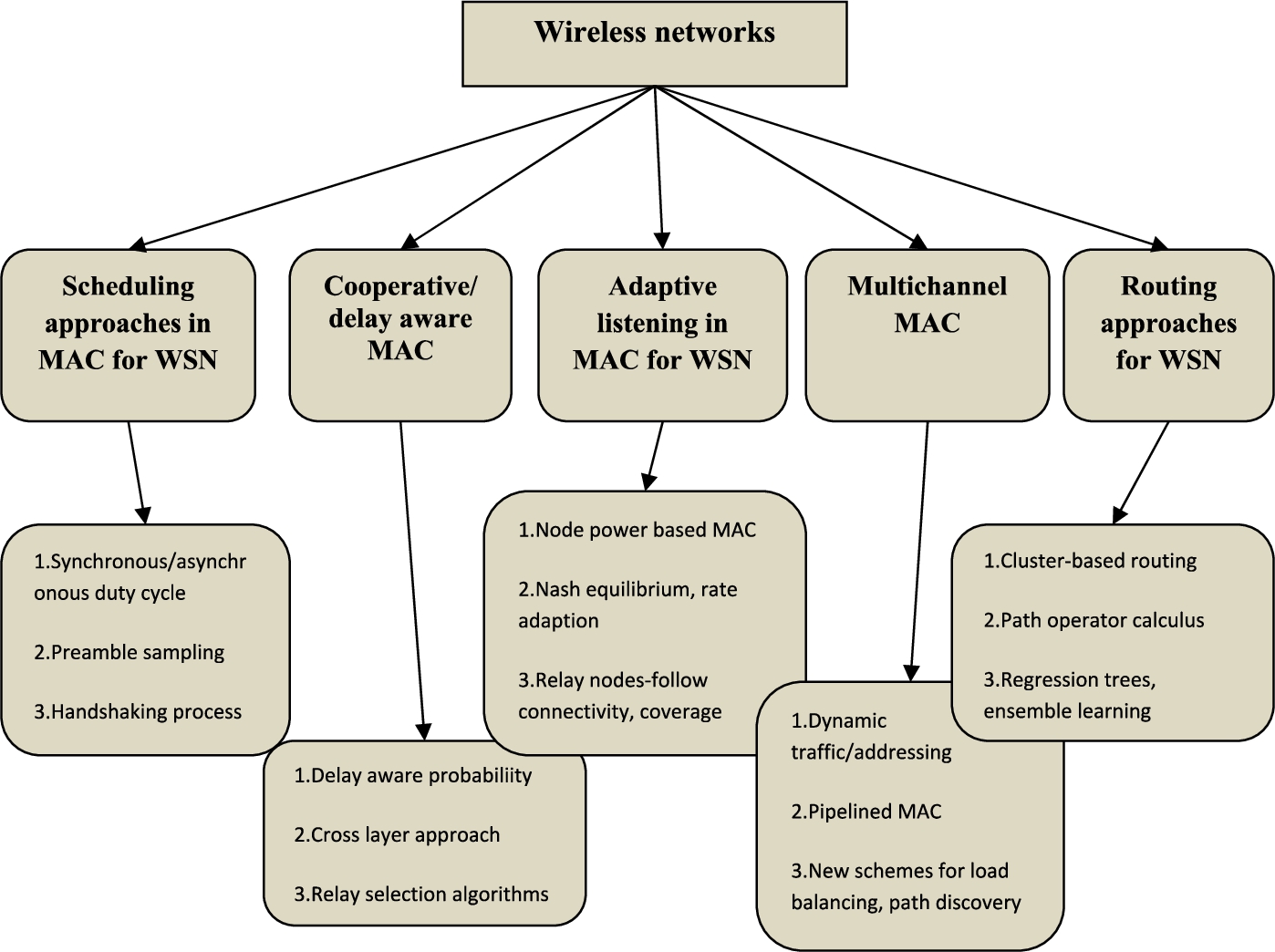
Survey carried out in this paper.
Security, integrity, intrusion detection, virtual cloud data centers, and IoT with thousands of sensors are major applications of WSN. Scheduling, adaptive listening, cooperative communication are possible MAC approaches for energy efficiency of sensors in WSN. Relay nodes, gateway help in coordination of the nodes in the path between source and destination. Heuristic configuration, firefly algorithm, POCC based next hop selection are few approaches for better throughput, energy conservation in the network. Pipelined Scheduling, multichannel MAC, low power listening are some approaches to improve network lifetime of WSN. Regression trees, random forest, Kalman filter, machine learning algorithms help in increasing coverage rate and bandwidth of the network.
Conflict of interest
None to report.