



Abstract
From the recent study, it is observed that even though cloud computing grants the greatest performance in the case of storage, computing, and networking services, the Internet of Things (IoT) still suffers from high processing latency, awareness of location, and least mobility support. To address these issues, this paper integrates fog computing and Software-Defined Networking (SDN). Importantly, fog computing does the extension of computing and storing to the network edge that could minimize the latency along with mobility support. Further, this paper aims to incorporate a new optimization strategy to address the “Load balancing” problem in terms of latency minimization. A new Thresholded-Whale Optimization Algorithm (T-WOA) is introduced for the optimal selection of load distribution coefficient (time allocation for doing a task). Finally, the performance of the proposed model is compared with other conventional models concerning latency. The simulation results prove that the SDN based T-WOA algorithm could efficiently minimize the latency and improve the Quality of Service (QoS) in Software Defined Cloud/Fog architecture.
Nomenclature
Wireless Access In Vehicular Environment Software-Defined Cloud/Fog Networking Minimum Cost Single-Source Unsplittable Flow Firefly Decompose Content Placement And Request Redirection Earth Mover’s Distance Constrained Optimization Particle Swarm Optimization Software-Defined Networking SDN-Service Function Chain Service Function Chain Global Positioning System Modified Constrained Optimization Particle Swarm Optimization On Board Units Online Controller Load Balancing Artificial Bee Colony Access Point Central Processing Unit South Bound Interface Fog Networks Internet of Vehicles Content Delivery Network Virtualized Green Energy-Aware and Latency Aware user Association Internet Of Things Particle Swarm Optimization Base Stations Quality Of Service Fog Node Road Side Unit Whale Optimization Algorithm Genetic Algorithm
Introduction
The rapid growth of Internet technology makes service providers more complex in handling the huge Internet. Since, there was the greatest growth of network bandwidth and user, the server needs to manage huge access requests within less time. If the access request is not handled in a timely manner, then the waiting time of the user gets increased. This might affect the user experience and also paves way for reduced QoS. For enhancing the performance of the server, enterprises have defined some of the measures like processing speed of CPU, cache capacity of the server, usage of the high-speed disk array, and so on.
For computer networking, SDN [1,14,25,26,40,45] is known to be the novel model that permits the network administrators in managing services of the network via the observation of low-level functionalities. This could divide the forwarding and control layer of the conventional network model. The controller that executes in the control layer can control the data forwarding by maintaining the flow table of switches. SDN [2,20,42,43] needs a southbound interface to communicate with the data layer.
One of the significant technologies is load balancing [18,21,36] that aids in saving power and enhancing the network’s resource utilization. The present network infrastructure does rely on vertical architecture, which was based on both software and hardware, hence developing a scenario having minimal flexibility. This kind of flexibility lagging has opposite impacts that are combined in a term named Internet ossification. The typical load balancing model helps to indicate a load balancer for forwarding the client requests to the number of servers. However, this model needs more hardware support that is obviously expensive, lacks of flexibility and the model becomes to be an operational failure. The cloud computing provides more possibilities to aid in enhancing the E-Government and providing new jobs and business opportunities [22,23,33,46]. The utilization of optimization algorithms has undergone diverse modifications as well as enhancements in solving complex issues [5].
Till now, a multi-band load balancing model [15,38,45,47] was developed for the network architecture that could control the access of mobile devices with minimum connections [4,31]. This scenario makes use of resources of the wireless spectrum, can balance the count of users among two different bands, which was mainly for alleviating the congestion in the network. However, load balancing [30] of task processing has not been considered under the fog network. Additionally, a dynamic load balancing approach that was on the basis of graph repartitioning is developed and that forms certain virtual machine nodes graph approach. This subsequently grants services to the users via graph clustering and partitioning. However, it might take more time and more network resources for reaching a new balance once if the node is out of order. Apart from this, a tradeoff among the network’s power consumption and delay is examined and that introduces an approximate solution for decomposing the primal issue into three respective sub-problems. Hence, there is a need of advanced load balancing algorithms to overcome the abovementioned problems.
This paper intends to propose a new load balancing model that aims to the minimization of latency for improved QoS in SDN.
A new optimization concept is incorporated in this model that optimally selects the load distribution coefficient.
The performance of the proposed T-WOA algorithm is compared with other conventional models in terms of latency.
The rest of the paper is arranged as follows: Section 2 reviews the literature work. Section 3 explains the theoretical model of SDN. Section 4 describes the optimization concept of load balancing along with the introduced algorithm. Section 5 discusses the obtained results and Section 6 concludes the paper.
Literature survey
Related works
In 2018, Chein et al. [7] stated that the IoT becomes a common aspect, individuals gather data or information even under any environs, including humidity, and temperature. Nevertheless, the usage of a huge count of terminal equipment was probable to generate large bandwidth demands, followed by rapid growth in data transmission time. To overcome this issue, the authors have developed a service-oriented SDN-SFC load balance approach. Subsequently, the authors have presented a heuristic algorithm for planning the transmission paths between SFCs. This was to minimize the SF load and also to enhance the overall performance of the network. Finally, the outcome shows that the proposed approach could shorten data transmission time and could achieve the load balancing concept.
In 2016, He et al. [12] integrated the SDN and fog computing for addressing the issues of load balancing problems. Here, the fog computing could expand the computing as well as storing to the network edge, and that minimized the latency remarkably for enabling location awareness and mobility support. Subsequently, SDN could grant flexible centralized control. To concern the SDCFN architecture in the IoV, the authors have developed a new SDN based MPSO-CO algorithm that utilizes the inertia weight and mutation particles for enhancing the performance of PSO-CO. At last, the outcomes have indicated that the developed model could minimize the latency and could enhance the QoS in SDCFN art.
In 2018, Zhang et al. [47] developed an OCLB approach to overcome the problem of load balancing. The authors have formulated the load balancing issue as the issue of optimization for reducing the controller response time. Subsequently, they have decomposed it into series of switch migrations, in which every migration aims in minimizing the response time based on real-time request distribution. Then they have designed an OCLB model based on optimality derived and switch condition termination. This was proved to be close to optimal with the bounded competitive ratio. Finally, the formulation has demonstrated that the proposed approach could attain close-optimal load balancing between control layers.
In 2017, Wang et al. [41] aimed to attain better QoS by integrating the control link and some other data layer constraints in SDNs. The authors have formally defined the control link load balancing and the issue of less delay route generation, and have also proven the NP-Hardness. They have presented two algorithms along with the factor of bounded approximation for every issue and have implemented the developed models on the SDN testbed. Finally, the outcomes of the experiment have shown that the proposed algorithms could minimize the control link load and response time, which effectively increased the throughput of the network when compared to other approaches.
In 2016, Han and Ansari [11] proposed a traffic load balancing approach, which could balance the network utilities. Under the consideration of this network, the developed approach was developed as the virtually distributed model that gradually minimizes the communication overheads among BS and users. Finally, the simulation outcomes have shown that the developed traffic load balancing approach could enable the adjustable trade-off among latency and power consumption, and could save a substantial on-grid power amount.
In 2018, Yang et al. [49] proposed a switch migration approach that deduced the migration of switch as the issue of signature matching. This was evaluated as the 3-D earth mover’s distance approach for protecting intentionally vital network controllers. Under the consideration of scalability, the authors have proposed a heuristic approach that was time-effective and appropriate for large-scale networks. Finally, the outcomes of the investigation have shown that the proposed approach could disguise the tactically vital controllers by fading the difference of traffic load between controllers. Further, the developed approach could relieve the controllers’ traffic pressure and enable to prevent saturation attacks.
In 2017, Kiran et al. [29] stated that conventional wireless systems often fail to do efficient work on altering environs. More inflexible along with proprietary hardware-oriented limitations forced the vendors to apply novel networking protocols. SDN was an important solution that was developed for bringing flexibility and programmability that permits the switching control layer for controlling open-flow channels. With the beneficial results of SDN, the authors have proposed a novel SDN-oriented Wi-Fi architecture and have proposed an AP load balance base handover algorithm. They have used a Mininet Wi-Fi emulator for constructing the desired topology for the analysis of performance. Finally, the outcomes have shown the successful handover overloaded with low latency.
In 2018, Liu et al. [19] considered a mobile CDN system, in which the BS was equipped with replicating content storage. For this system, redirecting the user requests (blindly) to content placement could result in traffic congestion. So, the major issue was the load balancing and congestion avoidance that must be tackled in this mobile scenario. The authors have investigated the issue of joint optimization. Particularly, every BS was maintained a transmission queue to reply to the requests that were issued from nearby BSs. Then, the authors have employed the stochastic optimization approach for reducing the transmission cost on the constraints of network stability. With the aid of the Lyapunov optimization approach, the authors have transformed the long-term issue. Along with this, they have developed an on-line algorithm for deciding the content placement as well as request redirection. Finally, the implementation confirmed the attainment of reduced transmission costs by avoiding congestion.
Review
The features and challenges of conventional SDN based load balancing techniques are summarized in Table 1. Service-oriented SDN-SFC load balance mechanism [7] could reduce the load and thereby increases the overall network performance. However, packet processing is difficult. MPSO-CO [12] can reduce task processing latency and also it could balance the workload among fog devices. Nevertheless, it does not consider QoS aspects like security, capacity, and so on. Further, the OCLB [47], minimizes the average controller response time, however, its real-time application is quite complex. MCSF [41] reduces the control link load and increases the throughput as well. However, real time application is difficult. Further, vGALA [11] minimizes the consumption of on-grid power and avoids extra communication overhead. However, it increases the complexity of computation. EMD [49] enhances the scalability, yet the security concern is missed. AP load balance based handover algorithm [29] efficiently deals with the handover process and improves the throughput. An additional requirement of the controlling module is a major issue with this model. DCPRR [19] solves the stochastic optimization problem and avoids the congestion in the network. Yet, the model suffers from subproblem determination.
Features and challenges of conventional load balancing strategies
Features and challenges of conventional load balancing strategies
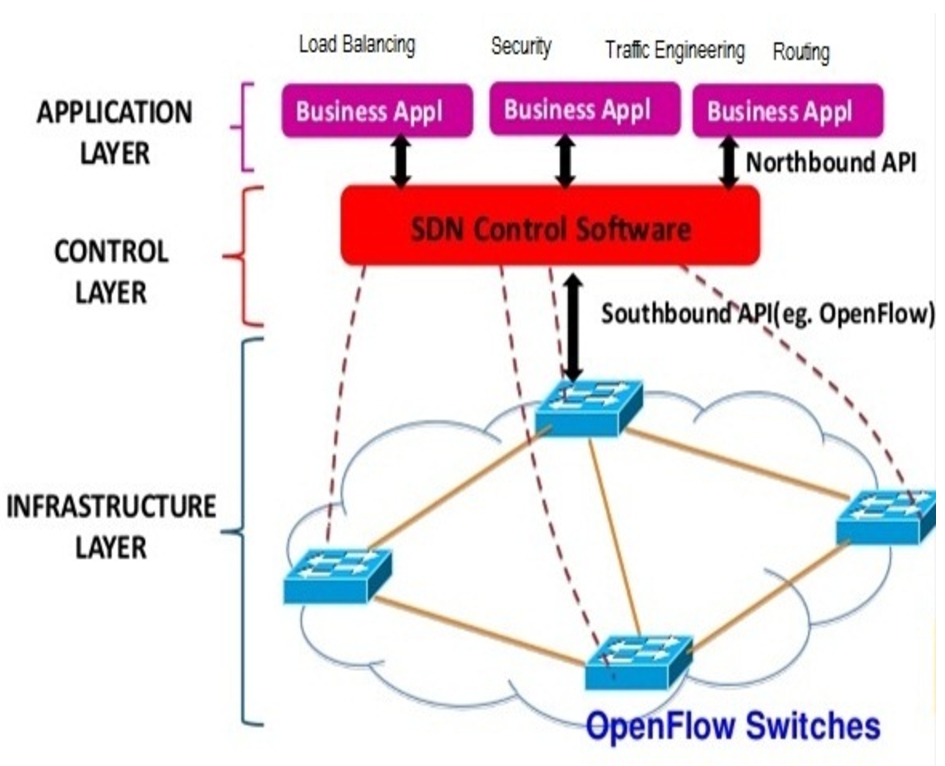
The SDN [12] architecture is sub-divided into three layers (i) Application layer, (ii) SDN control layer, (iii) Infrastructure layer/Data layer. The general SDN architecture is illustrated in Fig. 1.
General SDN architecture.
On top of SDN architecture, the application layer exits many applications such as load balancing, traffic management, and security. The application layer communicates its requirements and desired network behaviour to the control layer through the northbound interface (NBI).
The control layer of SDN involves a centralized logical controller that translates received application layer requirements to SDN data paths and provides SDN application with an abstract view of the network. Control and data layer separation allows the network administrator to easily change the network policies, which enables the network administrator to construct a flexible, scalable network by handling the business need through software rather than hardware. The Control layer interacts with the data layer via a southbound interface, often called the control-data layer interface (i.e. open flow).
As the SDN controllers do collect global data like processing speed, load, and communication latency, it could assess the optimal load balancing strategies. At the same time, SDN controllers grant open programming interfaces for supporting routing in the network, resources management, and so on using software programs.
The data layer of SDN, also called the forwarding layer, comprises many network elements (switches). Traditional devices expose the data path and forward the network traffic over the network. In SDN, switches become simple forwarding devices that forward the traffic as per the rule set by the controller. The SBI is defined between an SDN control layer and data layer which attempt to programmatically control all forwarding.
Hence, the allocation of computing tasks along with the load balancing criteria of FNs is quite complex since it must be sophisticated as per the performance of equipment and communication overhead to reduce the latency as well. This becomes the greatest question, particularly for latency-sensitive services.

Weighted undirected graph of SDN.
The weighted undirected graph of SDN is shown in Fig. 2. Load balancing strategy concerns as the aware routing protocol in SDN. It is a needed entity that aids in attaining the least response time. More people are connected to the internet that often causes web traffic and obviously leads to network congestion and packet loss as well. However, managing the load of the server is not at all an easy task, which often causes unwanted service problems. The general representation of a load balancing strategy is illustrated in Fig. 3. To tackle this load balancing problem, this paper introduces a new load balancing model of SDN that incorporates the optimization concept as the major work. SDN scenario is concerned about having machines, cloud servers, FNs, and SDN controllers. As per the graph theory, the topology of SDCFN is evaluated as the weighted undirected graph
When the task U is transferred from the end-user to switch, and that must be separated into various sub-tasks i.e.

Load balancing architecture.
Solution encoding
This paper intends to propose a new load balancing model that aims at latency minimization via an optimization concept that optimally selects the load distribution coefficient (time allocation (a) of corresponding tasks,
According to the encoding process, the

Solution encoding.
The WOA [28] is a renowned optimization model for resolving many of the optimization problems. Whale optimization proved its effectiveness in both single-objectives as well as multi-objective models [3,6,28,35,37,39,48]. Some of the well-known applications of WOA in multi-objective models are economic and emission dispatch using WOA [8,9,13,16,24,32,44].
The algorithm comprises three phases: prey search, encircling prey, as well as bubble-net foraging. Equation (3) indicates the position update on the best search agent, in which
In both exploration and exploitation phases, a is regularly minimized from 2 to 0, r indicates the random vector that is in the range of
(i) Exploitation phase: Bubble net attacking model: In this phase, two models are determined; shrinking encircling model and Spiral position update.
The shrinking encircling approach is achieved by minimizing a value, where,
The spiral updating position assesses the distance between the whale’s location
The distance between the whale and the prey is depicted as
(ii) Exploration phase: Here, the position updating of the search agent position is done according to the arbitrarily selected search agent. Equations (9) and (11) define the mathematical model, where

WOA algorithm
Even though the WOA algorithm shows better performance in terms of less parameters and lack of local optima, the algorithm suffers under the convergence rate. Hence to improve the convergence rate, this paper aims to introduce an improved algorithm by making some advanced changes in the traditional WOA. In traditional WOA, the spiral updating and prey searching process follow equal probability by setting
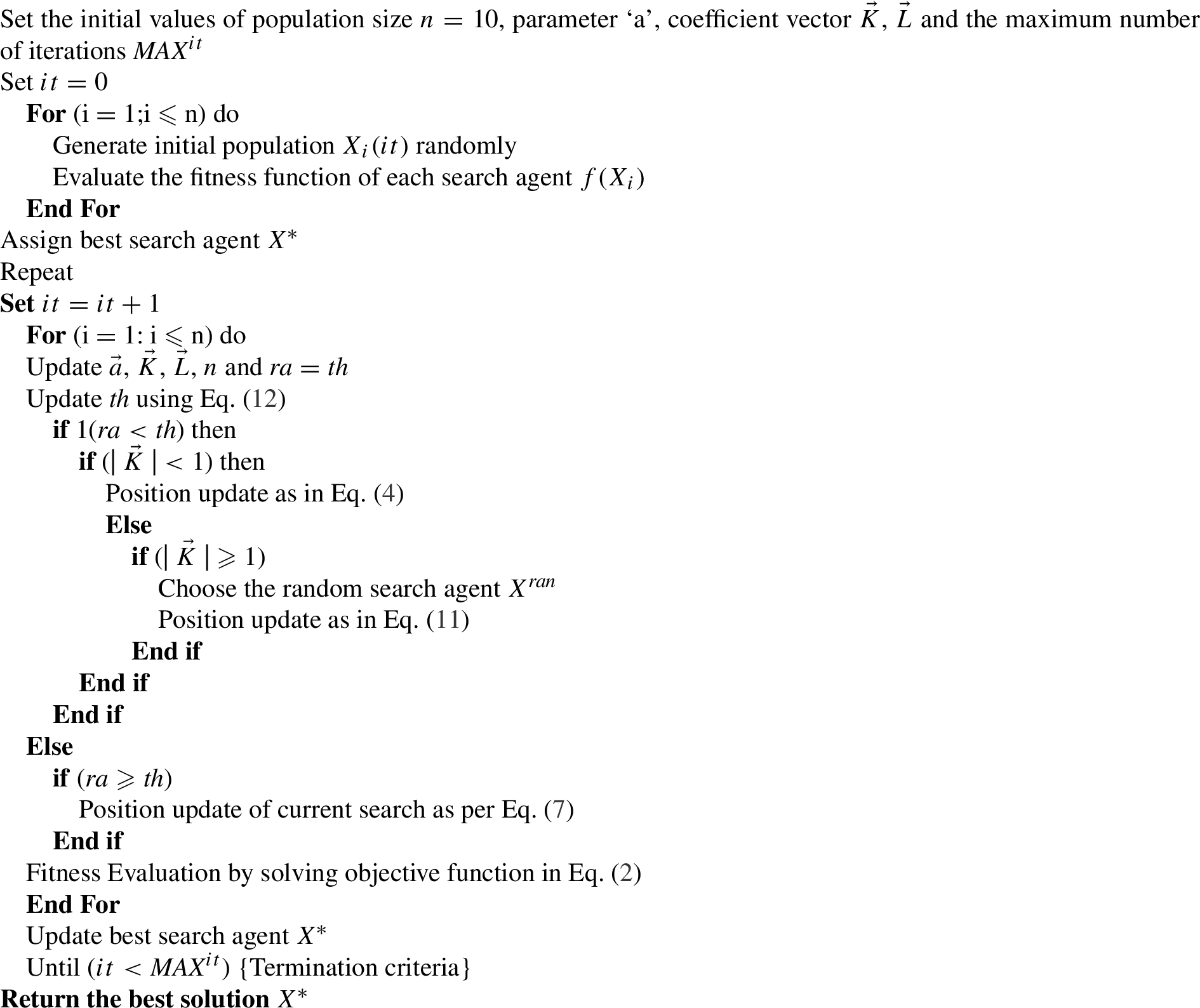
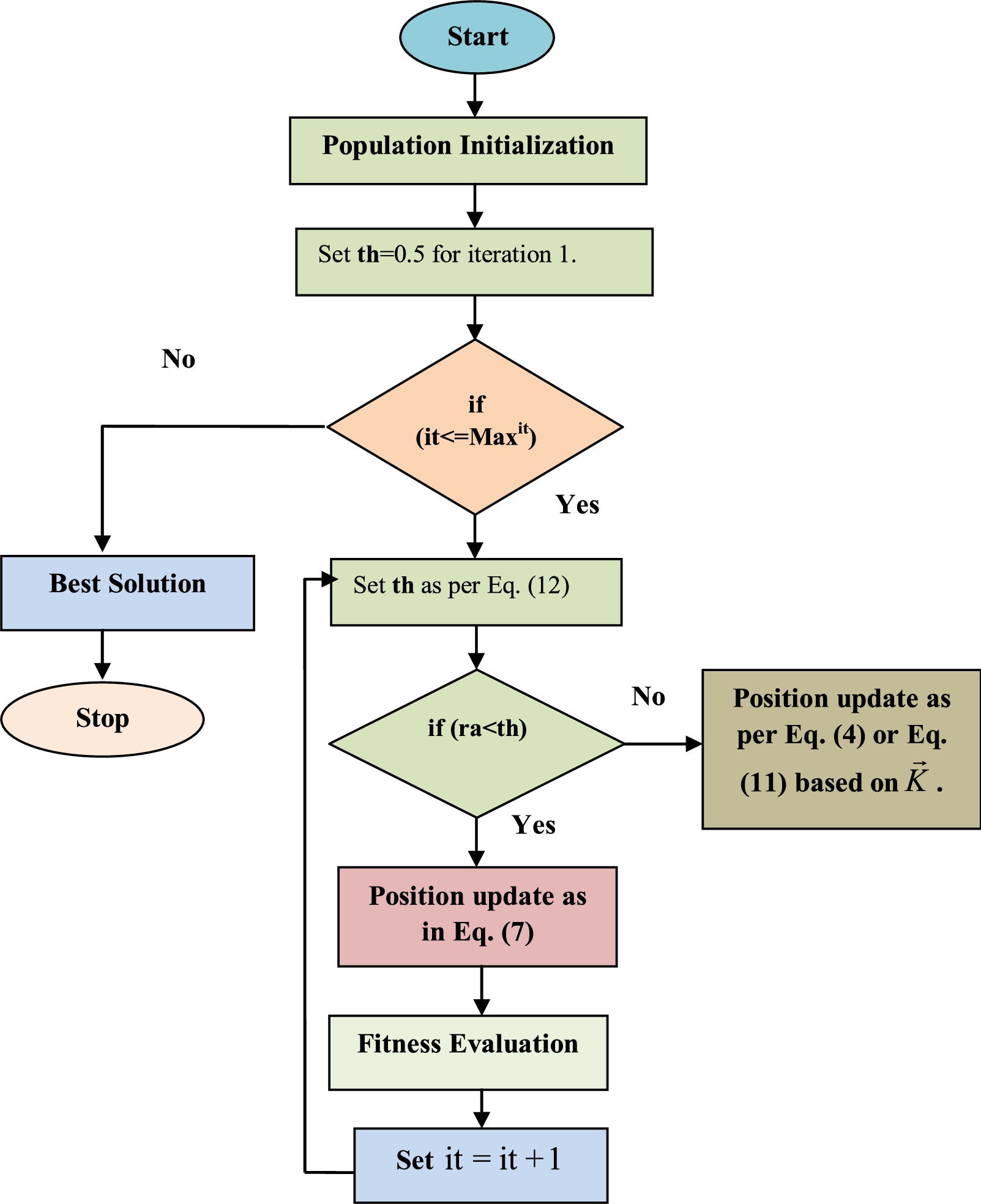
The procedure of the proposed algorithm is as follows: In conventional WOA, there mentioned a condition
T-WOA algorithm
Flowchart of the proposed T-WOA algorithm.
According to Algorithm 2 and Fig. 5,
Simulation setup
The proposed load balancing strategy was implemented in MATLAB 2018a. the network was generated with many nodes (machines) that make the communication with the cloud server, and each node has its own load. The experimentation was done under two strategies: by varying the load to 0.5 GB, 1 GB, 1.5 GB, 2 GB, 2.5 GB, and by varying the network configuration to 10 nodes, 20 nodes, 30 nodes, 40 nodes, and 50 nodes, respectively. The performance of the proposed model was compared with conventional WOA [28] in terms of latency.
Performance analysis by varying load
This section explains the performance of the proposed model with the conventional models by varying the load of nodes to 0.5 Gb, 1 Gb, 1.5 Gb, 2 Gb, and 2.5 Gb. Table 2 shows the performance analysis of proposed with the conventional models during the data transmission under 0.5 Gb load. Here, the proposed algorithm seems to remain with minimal latency. The table shows different connectivity (machine 1, 2
Performance of the proposed model with conventional WOA when load = 0.5 GB
Performance of the proposed model with conventional WOA when load = 0.5 GB
Performance of the proposed model with WOA when load = 1 GB
Performance of the proposed model with WOA when load = 1.5 GB
Performance of the proposed model with WOA when load = 2 GB
Performance of the proposed model with WOA when load = 2.5 GB
The performance of the proposed model under the load of 1 Gb is given in Table 3. Here, it is evident in almost all the connectivity cases, that the proposed model attains minimal latency. When connectivity is by machine 2, the proposed model attains minimal latency, and it is 83.19% better than WOA. When connectivity is by machine 4, the proposed model attains less latency, which is 50.84% better than WOA.
Similarly, the performance under load = 1.5 Gb of all node connectivity is given in Table 4. The values in Table 5 show the superior performance of the proposed work with less latency. When connectivity is by machine 3, the proposed model is 57.66%, better than WOA with less latency. When connectivity is by machine 4, the proposed model is 66.40% superior to WOA. When connectivity is by machine 5, the developed model attains less latency, and it is 50.87% better than WOA. Moreover, the mean of overall performance of the proposed work is less when compared with WOA. A similar analysis is made under the load cases: 2 Gb and 2.5 Gb (Table 5 and 6).
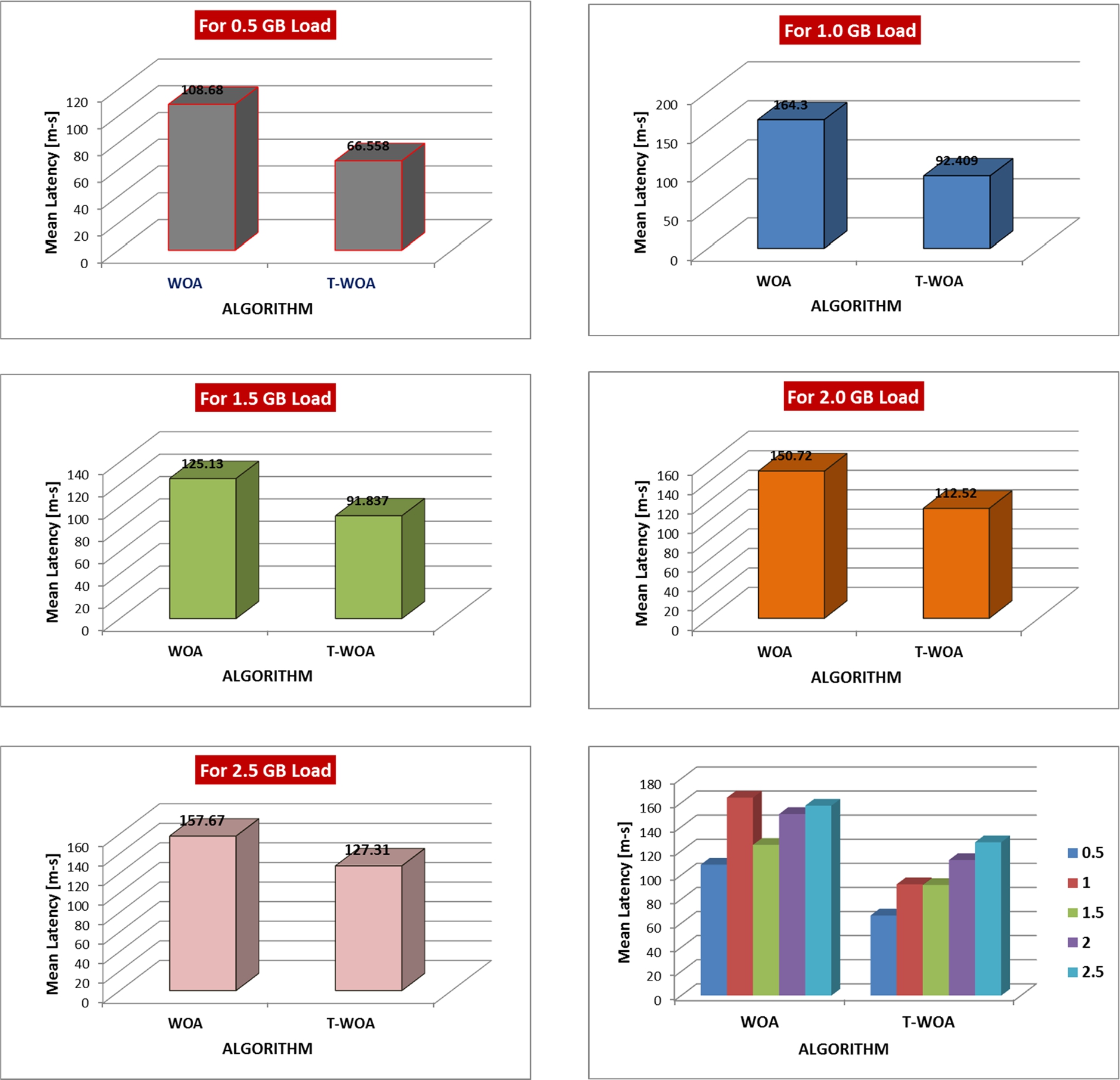
Figure 6 illustrates the mean latency of the proposed and traditional model under various loads in GB. Here, it is observed that, the proposed model attains less latency, which is 38.73%, 43.75%, 26.60%, 25.34%, 19.26% better than WOA with respect to 0.5, 1.0, 1.5, 2.0, 2.5 GB loads.
Comparison of mean latency on the proposed and traditional model under various loads.
This paper has proposed a new load balancing strategy with the incorporation of a new optimization concept that has addressed the problem of “Load balancing” in terms of reduced latency. A new T-WOA algorithm was proposed for the optimal selection of load distribution coefficient. At last, the performance of the proposed T-WOA model was compared with other conventional algorithms in terms of latency. From the results, it was observed that when connectivity is by machine 2, the proposed model attains minimal latency, which is 7.16%, better than WOA. Likewise, the proposed model attains less latency of 21.23%, which is better than WOA when connectivity is by machine 4. On considering the analysis by varying network configurations, the proposed model attains less latency, that is 38.73%, 43.75%, 26.60%, 25.34%, 19.26% better than WOA regarding 0.5, 1.0, 1.5, 2.0, 2.5 GB loads. Thus the performance of the proposed SDN-based T-WOA algorithm was proved successfully for minimizing the latency and improving the Quality of Service (QoS) in Software Defined Cloud/Fog architecture.