



Abstract
For the last few decades, fiber optic cables not only replaced copper cables but also made drastic evolution in the technology to overcome the optoelectronic bandwidth mismatch. Light trail concept is such an attempt to minimize the optoelectronic bandwidth gap between actual WDM bandwidth and end user access bandwidth. A light trail is an optical bus that connects two nodes of an all optical WDM network. In this paper, we studied the concept of split light trail and proposed an algorithm namely Static Multi-Hop Split Light Trail Assignment (SMSLTA), which aims to minimize blocking probability, the number of static split light trails assigned and also the number of network resources used, at the same time maximizing the network throughput. Our proposed algorithm works competently with the existing algorithms and generates better performance in polynomial time complexity.
Introduction
For the last few decades, fiber optic cables not only replaced copper cables but has also made drastic evolution in its technology to overcome the optoelectronic bandwidth mismatch. Light trail concept is an attempt to minimize the optoelectronic bandwidth gap between actual WDM bandwidth and end user access bandwidth. A light trail is an optical bus that connects two nodes of an all optical WDM network [21,22]. A network which is made up of optical nodes, optical links and (intermediate) optical devices is known as an all optical network [7]. The concept of light trail was first proposed by Gumaste and Chlamtac [8,15]. The architecture [15], protocol [8], key features [19,25] and realization [12,16,17] of a light trail is discussed vividly in the referred research articles. The first node of a light trail is known as a convener node and the last node of the light trail is known as end node [18]. It is observed that a light trail is similar to lightpath, because both support optical communication. Lightpath is a path made up of wavelength(s) along the physical links of the optical network [39].
Light trail is more advantageous than lightpath because each node of a light trail is buildup of more mature components and hence it supports sub-wavelength granularity, dynamic provisioning and optical multicasting [19,28,39]. Some more advantages of light trail over lightpath are discussed in other studies [19,22,25]. The main disadvantage of lightpath is that an entire wavelength needs to be allocated for a single connection request in the absence of traffic grooming [11,27]. Traffic grooming is the ability to share two or more fine granule traffics by a single wavelength [29,30]. This factor led to the development of light trails. A single light trail of n nodes can support nC2 number of connection requests because of its inherent property of traffic grooming [6,22]. The conceptual differences between them is demonstrated in the study by Gumaste and Zheng [22]. Traffic grooming is of two types, namely, static traffic grooming and dynamic traffic grooming. In static traffic grooming, the connection requests are known beforehand while in dynamic traffic grooming, the connection requests arrive on the fly [29]. Traffic grooming can also be classified as single-hop and multi-hop [29], but both are slightly different in case of light trail than that of lightpath. When traffic grooming is performed over a single lightpath, then it is known as single-hop traffic grooming. It can be said that a light trail is similar to a lightpath with single hop traffic grooming, without the need of any costly switching [22]. In case of light trail, the term ‘single-hop’ is not used and the term ‘traffic grooming’ is sufficient to identify single-hop traffic grooming [6]. When a connection request cannot be satisfied by a single light trail, then two or more light trails can be used together to satisfy the request, if they have any overlapping nodes. This technique is called multi-hop traffic grooming [22].
Blocking probability is the ratio between the total number of connection requests blocked to the total number of connection requests arrived [30]. Assignment of light trail is a macro-management process while satisfying connection requests within a light trail is micro-management process [22]. A wide range of research has been performed on both static and dynamic light trail assignment, multi-hop traffic grooming and provisioning. Gumaste et al. proposed three static and two dynamic light trail assignment algorithms for ring topology [20]. Fang et al. [12] and Wu et al. [35] proposed static light trail assignment algorithms for mesh networks, using a pre-processed traffic matrix to avoid the need of multi-hop traffic grooming. Ayad et al. [2] proposed two algorithms for static light trail assignment and incremental light trail assignment respectively. Bhadra et al. proposed two static light trail assignment algorithms [4,5] and its protection algorithm [3]. Paul and Dutta [33] proposed a static light trail minimization technique using genetic algorithm. Naik et al. proposed a static light trail assignment and traffic grooming algorithms [32], which aims to minimize blocking probability. Bhattacharya et al. [6] and De [9] also proposed two different static light trail assignment and traffic grooming algorithms respectively, which aims to maximize network throughput. Ye et al. [36] proposed a multi-hop traffic grooming for dynamic connection requests. Fu et al. [14] proposed a DFS based dynamic light trail assignment and traffic grooming algorithm. Hsu and Tang [23] proposed a dynamic traffic provisioning algorithm using light trail. Zhang et al. proposed two different research papers for dynamic light trail routing algorithms [37,38]. Light trail finds its application in elastic optical networks also in studies by Majumdar et al. and Abkenar et al. [1,26].
In this paper, we have proposed a traffic grooming, routing and wavelength assignment algorithm (GRWA) using multi-hop static split light trails, which aims to minimize blocking probability of the static connection requests, the number of static split light trails assigned and the number of network resources used while maximizing the network throughput. The concept of split light trail is proposed by Fu et al. [13] in which the capacity gain can be achieved two times than that of the original light trail by using split light trail. We have used their concept and applied static GRWA and produce results, which competes with the existing algorithms. Since, the work is carried out for static connection requests, so the term static split light trails is used by us. Since, routes are found based on both Hamiltonian Path and shortest path, so the probability of finding a suitable route is very high. If any network does not contain any Hamiltonian Path, then routing can be done using the appropriate shortest path as described later in the proposed algorithm. Hamiltonian Path is used to facilitate multi-hop traffic grooming. The use of such a multiple routing technique is one of the advantages of the proposed algorithm SMSLTA over the existing algorithm SLTA [5].
As discussed above, recent studies [1,24,26] show that elastic optical networks provide an immense flexibility in spectrum allocation and data rate accommodation, therefore elastic light trails are proposed to utilize the flexibility through routing and spectrum assignment (RSA). Multicore fibers have been proposed recently [34] which claim to utilize the space division multiplexing [31]. Studying the research by Din and Huang [10], it can be said that light trail is finding its applications in recently developed multicore fibers (MCFs) and space division multiplexing (SMD). Thus, the split light trail is a promising candidate in the near future to be used as the end-point connectivities and can replace the existing lightpaths in all the current aspects of all optical networks.
The rest of the paper is organized into five sections. Section 2 presents the mathematical formulation of the proposed work. Section 3 lays out the problem statement and gives the overview of the solution with an illustration. Section 4 illustrates the proposed algorithm. Section 5 analyses the complexity of the proposed algorithm. Section 6 analyses and discusses the simulation result obtained by the proposed algorithm. Here, one more variation of the proposed algorithm is discussed, analyzed and compared in terms of blocking probability of the connection requests, number of static split light trails established and network resources used. Section 7 concludes the paper.
Mathematical formulation
Variables and notations
N: Set of all Vertices of a given network A: Adjacency Matrix of a given network α: relative cost of an optical transmitter (Tx) and receiver (Rx) β: relative cost of a wavelength (λ) R: a two dimensional array which stores shortest path routes of length ⩽ Lmax between source-destination pair of every R_HP: stores the route having highest load carrying capacity within
Assignment of static split light trail
Maximize capacity of each static split light trail by traffic grooming
Minimize number of blocking probability
Minimize number of static split light trails established
Minimize cost of network resources
Optical capacity of each static split light trail less than equal to twice of
Hop length of each static split light trail should be less than equal to
Each connection request Two static split light trails passing through the same link cannot share the same wavelength
Every static split light trail is given exactly one wavelength, as wavelength converter is not used
In order to achieve multi-hop traffic grooming, the static split light trails lying on the same Hamiltonian path, with overlapping nodes is allotted the same wavelength
Problem statement, overview and illustration of the solution
Problem statement
We modeled the optical network as a directed network graph
Overview of the solution
Algorithm 1: Static Multi-Hop Split Light Trail Assignment (SMSLTA)
Step-1: The route using the shortest path is found between each source and destination pair of the connection requests. Hamiltonian paths are found and partitioned (if Lmax > 5) into smaller overlapping routes. Each sub-paths can be used as a candidate route for split light trail assignment or several such partitions can be used together to apply multi-hop traffic grooming. Splitting is performed on each route obtained.
Step-2: The split route with highest load carrying capacity is selected. A free wavelength is assigned using the first-fit algorithm and network resources are allocated. A static split light trail is established along the selected split route and traffic grooming is carried out. Step-2 is repeated while no more connection requests can be satisfied.
Step-3: If the given traffic matrix is yet unsatisfied, then select a Hamiltonian Path having highest load carrying capacity considering proper partitioning and splitting. Assign a free wavelength and establish a set of overlapping static split light trails along the Hamiltonian Path. Multi-hop traffic grooming is performed maintaining the capacity constraint. Step-3 is repeated till no more connection requests can be satisfied.
Illustration
A small illustration is done with Network-1 as shown in Fig. 1(a) with five connection requests as
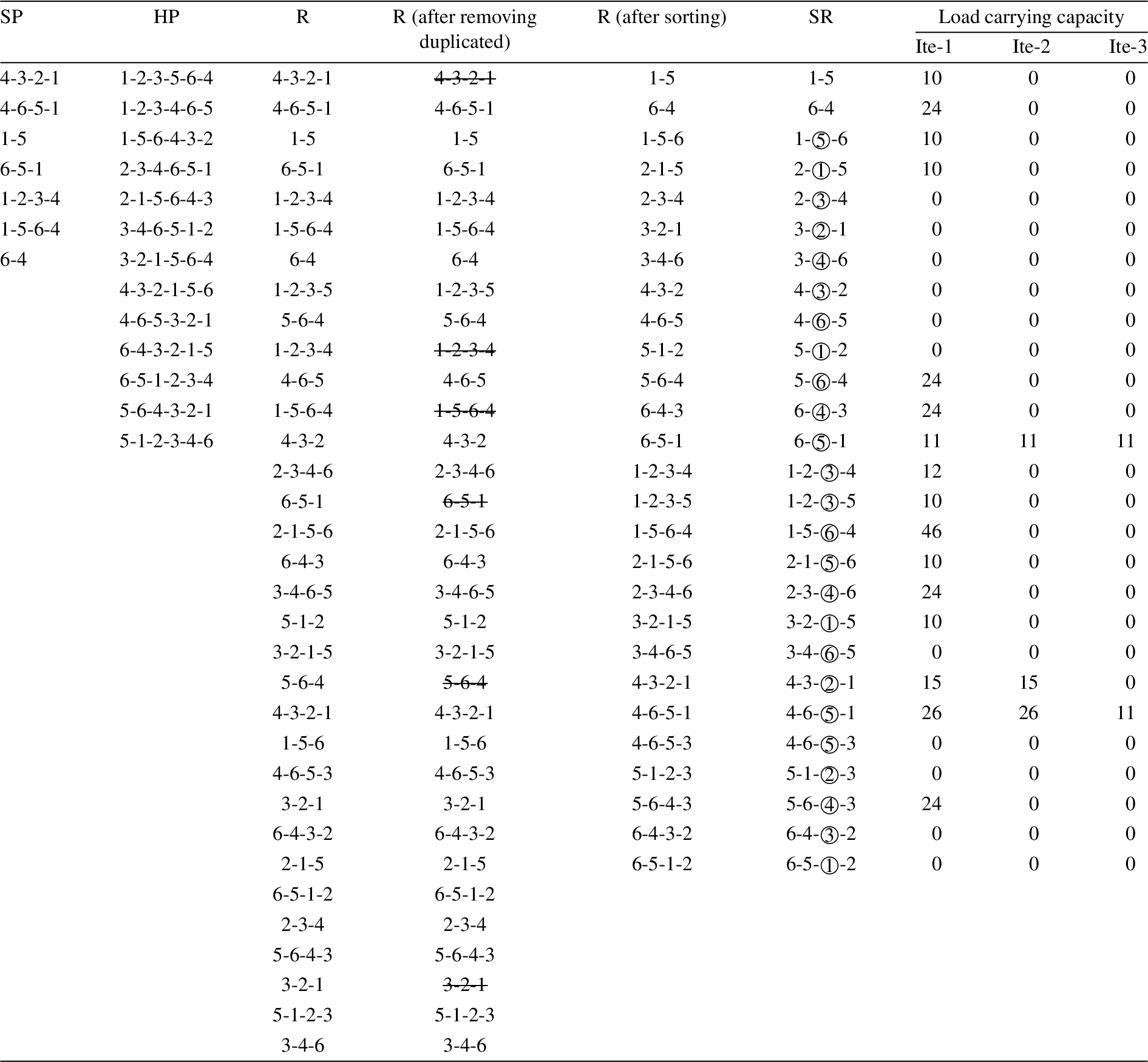
Firstly, all possible shortest paths are computed between each source and destination of the given connection requests. Those are then stored in the 2D matrix R. Then, all possible Hamiltonian paths are found and stored in the 2D matrix HR in order to support multi-hop traffic grooming, if needed in future. Then each route of HR is partitioned into smaller sub-paths (in-order to generate new routes) and are stored as separate routes in the 2D matrix R. For example, 1-2-3-4-6-5 is partitioned at position 4 in-order to obtain 1-2-3-4 and 4-6-5. This is shown in Fig. 1(b) and Fig. 1(c). Both the routes can be used separately as a split light trail, or can be used together to accomplish multi-hop traffic grooming. In the latter case, the traffic is downloaded from the first split light trail, and uploaded to the second split light trail by using node 4. This is explained pictorially in Fig. 1(c).

Illustration of the example, (a) network-1 with 6 nodes, (b) partitioning a Hamiltonian path, (c) scope for multi-hop traffic grooming, (d) splitting a candidate route.
In the next step, all the duplicate routes of the 2D matrix (R) are discarded and then the 2D matrix (R) is sorted in ascending order. All the routes of the 2D matrix (R) are split at their mid position and stored in another 2D matrix SR. For example, as shown in Fig. 1(d), the route 4-6-5-1 is split as 4-6-5 and 5-1 and stored in matrix SR. In cases where the routes having hop length equal to 2, are directly copied to the 2D matrix SR without splitting. Load carrying capacity is calculated for each route of SR for each iteration and the maximum loaded split route is selected. All the connection requests corresponding to that route are satisfied using traffic grooming. For example, during the first iteration, the route 1-5-6-4 is found to have the highest load carrying capacity i.e. 46, because it is capable of satisfying connection requests
Intermediate steps of the illustration
Summary of the illustration

Thus all the given connection requests are satisfied using only two light trails. The intermediate steps and the summary of the illustration is displayed in Table 1 and Table 2 respectively.

Static multi-hop split light trail assignment (SMSLTA)
Worst case complexity of the proposed algorithm SMSLTA is
Step-1.1.1 requires O(n2) time complexity. Step-1.1.1 is repeated for n static connection requests. So the overall time complexity of Step-1.1 is O(n3). Step-1.2 requires
For m number of routes, the load calculating formula requires
Step-3.1.1 to Step-3.1.3 requires a constant amount of time, say C2. Step-3.1.4 is similar to steps 1.3, 1.6 and 2.1. Considering the time complexity of those three steps for m number of routes, the time complexity of Step-3.1.4 can be estimated as
Considering Steps 1 to 3, the total time complexity is
Correctness Proof:
SMSLTA eventually terminates.
Within the proposed algorithm, all the repeating loops of all the functions used executes for a finite amount of time, therefore the algorithm terminates after a finite amount of time. □
The proposed algorithm is applied on two more networks namely, Network-2 and NSF Network as shown in Fig. 2 and Fig. 3, which are both reused from [12] and [2] respectively. The traffic matrix for the two networks are shown in Table 3 and Table 4. The entire simulation is carried out in MATLAB. As explained by Wu and Yeung [35], a light trail cannot travel more than 5 hops due to internal power consumption. Therefore we maintained Lmax to be 5 hops throughout our entire simulation. The capacity constraint (
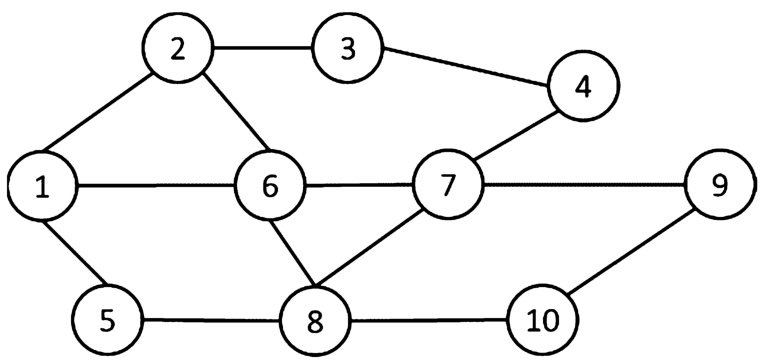
Network-2 with 10 nodes.
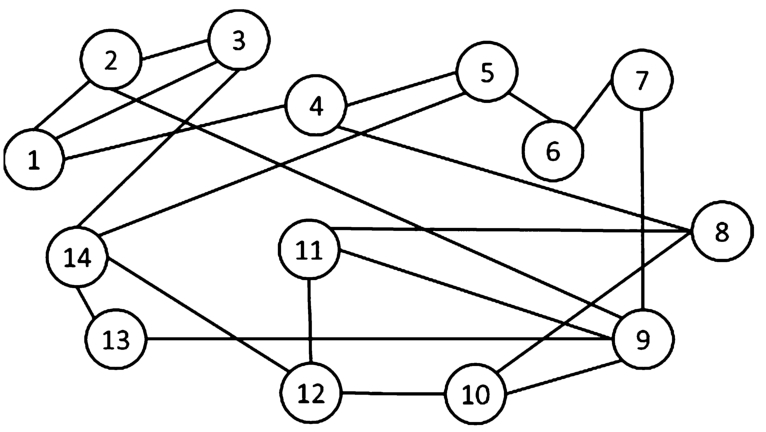
NSF network with 14 nodes.
Traffic matrix for network-1
Traffic matrix for NSF network
When Tx/Rx and W is unrestricted, zero blocking probability is achieved for both the networks. Under the above mentioned condition the relationship between number of static split light trails versus Erlang for both the networks is plotted in Fig. 4(a) and Fig. 4(b) respectively. It is also observed that as the traffic density is increased the number of static split light trails is also increased. However, the increase is slower for the proposed algorithm SMSLTA as compared to existing algorithms Traffic Grooming using Light Trail 1 (TGLT1) [6] and Existing Heuristic (EH) [2]. It is also noticed that splitting a light trail generates better results compared to without splitting. Moreover, the proposed algorithm SMSLTA uses a lesser number of wavelengths to satisfy all the connection requests compared to the other algorithms.
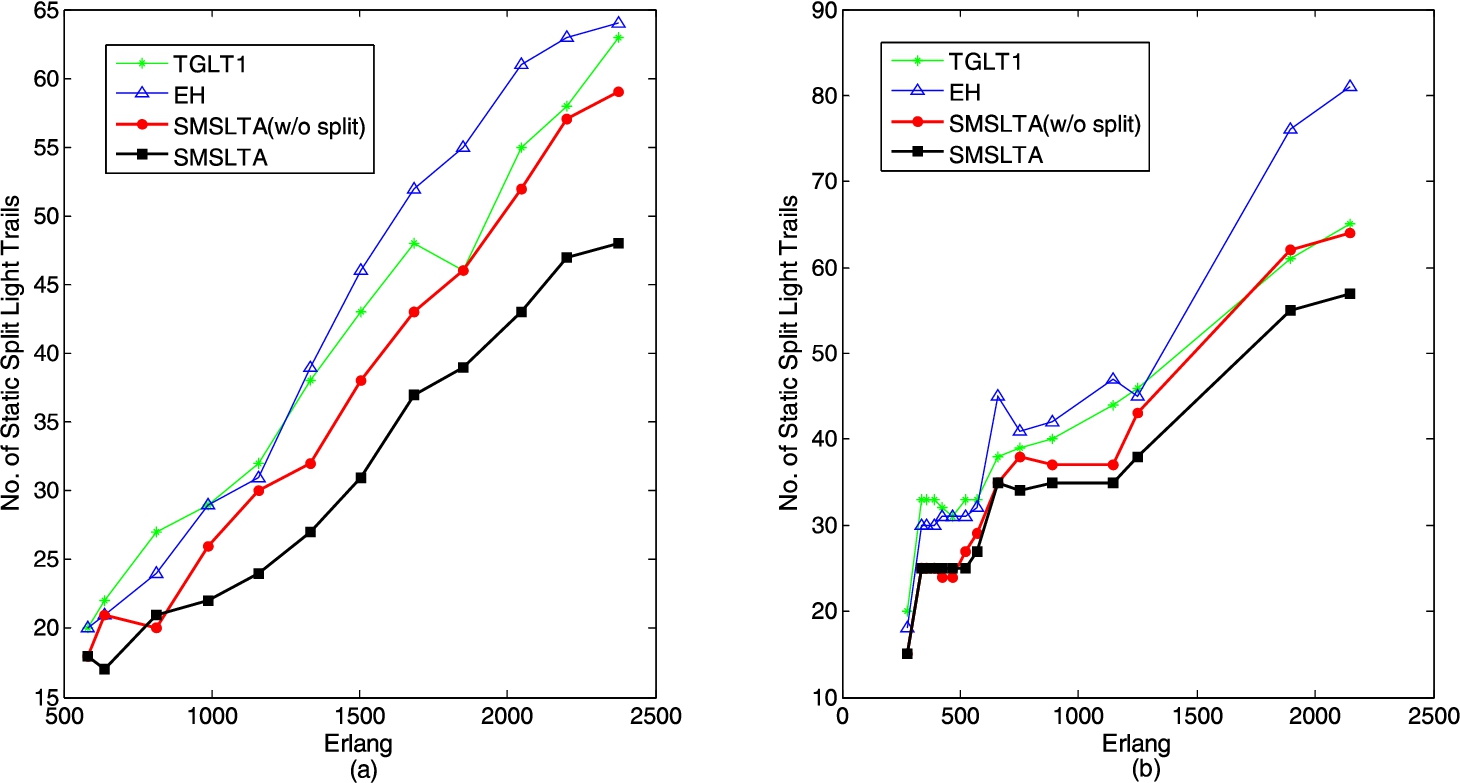
Comparative study on number of static split light trails assigned vs network throughput generated for (a) network-2 and (b) NSF network.

Comparative study of wavelength vs throughput on (a) network-2 and (b) NSF network.
Figure 5(a) and Fig. 5(b) shows the relationship between throughput versus wavelength for both the networks respectively for SMSLTA, TGLT1 and EH. We used equal number of transmitter and receiver per node i.e. Tx = Rx. When the number of wavelengths is kept constant, it is observed that in all the cases, the proposed algorithm SMSLTA works better than TGLT1 and EH. It has been observed that the graph plotting of EH for different parameters is a bit rocky throughout the simulation and comparison. The reason is self-explained [2] that the ‘manual inspection’ of the results of routing reveals that the routing decisions contain some flaws and does not serve the algorithm properly. Hence, it can be said that the ‘glitches’ of the routing part of the algorithm does not allow proper grooming of the eligible paths and thus sometimes malfunctions. In comparison, the simulation results obtained by our proposed algorithm (SMSLTA) are thoroughly smooth.
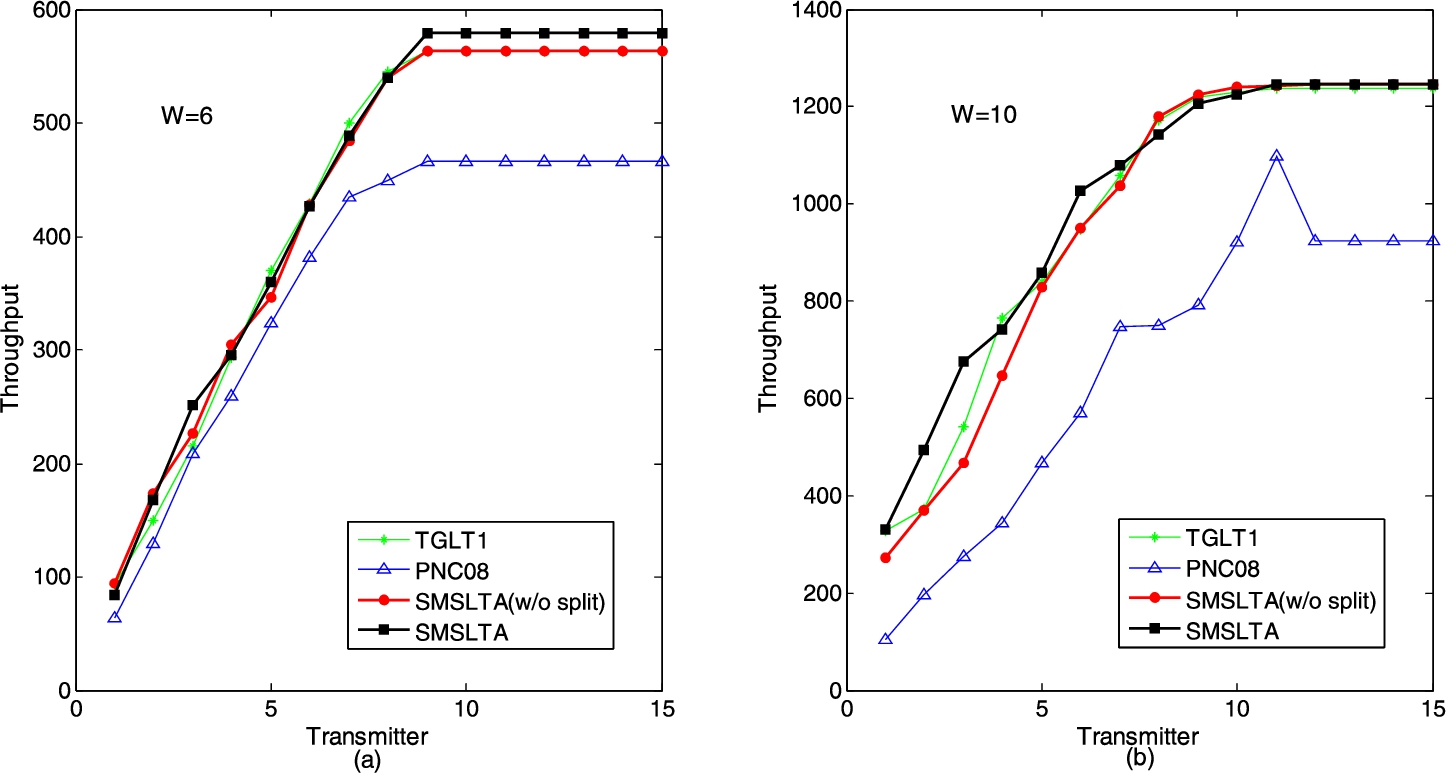
Comparative study of transmitter vs throughput on (a) network-2 and (b) NSF network.
Figure 6(a) and Fig. 6(b) shows the relationship between throughput versus transmitter for both the networks respectively for algorithms SMSLTA, TGLT1 and EH. We used equal number of transmitter and receiver per node i.e. Tx = Rx. When the number of wavelengths is kept constant, it is observed that in all the cases, the proposed algorithm SMSLTA works better than existing algorithms namely TGLT1 and EH.
In this paper, we have studied the concept of split light trail and proposed an algorithm namely Static Multi-Hop Split Light Trail Assignment (SMSLTA), which aims to minimize blocking probability, the number of static split light trails assigned and also the number of network resources used while maximizing the network throughput. Our proposed algorithm works in polynomial time complexity and generates better results than the existing algorithms namely, TGLT1 and EH. Moreover, the proposed algorithm finds routes between source to destination based on both Hamiltonian path and shortest path. If any network does not contain any Hamiltonian path, then routing is possible by using the appropriate shortest path as described in our proposed algorithm. This is one of the advantages of the algorithm SMSLTA over the existing algorithm SLTA. In future, the algorithm can be modified to handle dynamic traffic requests.
Conflict of interest
None to report.