



Abstract
Multimedia is inconvenient to use, difficult to maintain, and redundant in data storage. In order to solve the above problems and apply cloud storage to the integration of university teaching resources, this paper designs a virtualized cloud storage platform for university multimedia classrooms. The platform has many advantages, such as reducing the initial investment in multimedia classrooms, simplifying management tasks, making maximum use of actual resources and easy access to resources. Experiments and analysis show the feasibility and effectiveness of the platform. Aiming at the problems of the single-node repair algorithm of the existing multimedia cloud storage system, the limited domain is large, the codec complexity is high, the disk I/O (Input/Output) cost is high, the storage overhead and the repair bandwidth are unbalanced, and a network coding-based approach is proposed. Multimedia cloud storage. System single node repair algorithm. The algorithm stores the grouped multimedia file data in groups in the system, and performs XOR (exclusive OR) on the data in the group on the GF(2) finite field. When some nodes fail, the new node only needs to be connected. Two to three non-faulty nodes in the same group can accurately repair the data in the failed node. Theoretical analysis and simulation results show that the algorithm can reduce the complexity and repair of the codec, and reduce the disk I/O overhead. In this case, the storage cost of the algorithm is consistent with the storage cost based on the minimum storage regeneration code algorithm, and the repair bandwidth cost is close to the minimum bandwidth regeneration code algorithm.
Introduction
The rapid development of the Internet has generated massive data, resulting in an increasing number of transmission and storage scenarios for massive data. In this context, data storage technology has been rapidly developed [3,8,15]. Multimedia files produced in multiple application fields over the past 10 years. The number of multimedia files is very fast, and multimedia files occupy a large proportion in Internet information. Therefore, massive multimedia file storage technology is an important research topic [10,17], and distributed file systems have become a hot research topic.
At present, when storing massive multimedia files in a distributed file system, there are also problems such as low storage performance, low storage space utilization, performance bottlenecks, and single point of failure. Therefore, how to solve the process of storing and transmitting massive multimedia files many practical problems existed in the current research field of computer storage technology [12]. Multimedia data has become a problem to be solved due to its large amount of data and complex types; cloud storage system the advantages of low cost and easy expansion are of great concern. In cloud storage systems, the reliability of the system mainly depends on redundant storage of data. The traditional strategy is mainly to copy and erasure codes [4]. For copying and erasure codes the limitations of the strategy, Dimacis et al. introduced network coding technology into distributed storage systems, proposed the concept of regenerative codes, analyzed storage overhead and repaired bandwidth overhead, and gave a trade-off curve for storage bandwidth overhead [11,20]. Subsequently, they also proposed Such as the concept of minimum storage regeneration code and minimum bandwidth regeneration code [1,14]. For the node restoration problem in the regeneration code in the cloud storage system, the node restoration mechanism proposed by U. Goparaj can reach the lower limit of MSR under any parameter [2]. Rashmi et al. [9] designed a deterministic repair minimum bandwidth regenerative code method applicable to arbitrary parameters by using matrix product method. With the wide application of cloud computing technology, more and more applications provide users with storage and query services for multimedia files such as pictures, videos, audio, etc. This type of file usually has a long storage period, frequent copying and copying, and file content is not suitable for segmentation. Other characteristics [7,13,19], the use of distributed storage can improve the access efficiency of multimedia files, avoid the network transmission bottleneck caused by the access delay of multimedia files and disk storage space bottlenecks on multimedia file storage caused by the decline in throughput performance. However, many the multimedia file uploading portal provided by the application to the user causes the cloud storage platform to accumulate a large number of duplicate multimedia files, which increases the storage cost for the application developer and reduces the access efficiency of the multimedia file [5,6,16,18]. The above research is not a branch of research in terms of cost and personal privacy, which will make the entire system insecure.
This paper proposes a new node repair algorithm to minimize the bandwidth overhead and codec complexity of single node repair under the condition of ensuring the minimum storage overhead. This paper proposes a distributed storage directory dynamic modeling scheme, which is used to describe the logical structure of the storage directory of the entire data center. Based on this model, the application can conveniently manage the multimedia files uploaded by users, simplify the process of storing files and obtaining files. The multimedia file cloud storage system implemented by the modeling solution supports the problem that the specified storage program saves the file through the cloud storage system, and does not have to worry that the disk space of a storage directory has reached the storage upper limit. The cloud storage system solves the data. The problem of distributed storage of multimedia files under low storage cost conditions for highly redundant applications.
Network coding
As early as 2000, Ahlswede et al. introduced the concept of network coding. The main content of network coding is to process the received information at the nodes of the network. This processing can be linear or non-linear. After processing, it is sent out. The node here acts as a signal processor and encoder. The role of this method can greatly increase the maximum flow boundary of the network transmission. This finding overturns the perception that intermediate nodes do not have any effect on the processing of data transmission. Network coding has also entered a new level, breaking the traditional mode, increasing the way of network data transmission, and has the advantages that traditional models can’t match. (1) Network coding has obvious advantages over the traditional data transmission speed of the network. The use of network coding can effectively improve the transmission efficiency of network data. The network topology map simulation intuitively reflects the network coding can increase the multicast. capacity. (2) The channel on the network can be well utilized by the network coding, so that the transmission of data is universalized. In theory, when network coding is applied to a single-source network, the amount of data received at each node can be increased to the maximum flow of that node. The advantage of this method is that in the network coding architecture, the location of the receiving data party does not need to be known. When the information rate of the source is greater than the maximum traffic of the node, the user at the node can also receive part of the data. In this case, this part of the data can be compiled according to some of the distortion standards. (3) When the network communication is applied, the robustness and adjustability of the network communication are effectively increased. After the data has been properly coded, it is of equal importance. After the user receives the appropriate encoded data, it can correctly decode and obtain the required information. In this way, the nodes do not work at all, as long as there is a suitable number of operating states, the data transmission of the network can operate normally.
Based on the deep research of basic theory, the network coding technology is also increasingly using network coding technology, and has carried out business innovation in the communication industry, using new methods and systems to improve the performance of communication networks. In terms of multimedia and its video, network coding has made a huge change in video transmission. Multimedia transmission technology based on network coding is a very popular technology field. The technology of network coding in multimedia applications mainly has the following points: (1) Based on linear network coding, in 2003, PAChou et al. introduced the practical problems of network coding in application and solutions. Type network coding system, and related analysis and research. Then Microsoft developed a P2P software called Avalanche based on this technology, and proved the speed of data transmission by the actual application by 30%. The invention of the technology greatly improves the efficiency of the multimedia application in practical applications, and improves the stability of the video transmission. Although the system can effectively improve the transmission efficiency of network multimedia and enhance the robustness of video transmission, how to obtain the best performance of network coding still needs to be deeply explored. (2) The emergence of random linear network coding promotes the promotion of network coding in practical applications. In 2007, the emergence of a real-time video transmission system based on random linear network coding improved the performance of the video transmission system. It mainly used the network node to randomly select the encoding method of the data packet transmission to improve the transmission performance. (3) Opportunistic network coding is a way of application in wireless networks. It provides another new idea for wireless network data transmission. With the theoretical knowledge of network coding technology and the continuous development of practical applications, its application of technology level is gradually utilized by multimedia transmission systems. It complements the shortcomings of network communication technology and improves the network communication system. The construction of the system plays an important role, and it plays a significant role in the security of the network. Network coding has been widely used in today’s society. Its main field is in multimedia: the current popular network P2P streaming media live, on-demand, etc., especially in the video industry, the technology using network coding is constantly improvement and its structure at night to adapt to the rapid development of the information age. Nowadays, network coding technology is becoming more and more important in the field of multimedia.
Single node repair
In real life, the storage capacity required for scientific computing and medical, transportation and other image data is very large. Under these requirements, the status of storage systems is becoming increasingly important. Distributed storage systems are becoming an important storage technology research object due to their large scale, high scalability and high reliability. However, nodes in large-scale distributed storage systems are frequently and frequently failed due to their large number, resulting in loss of stored data. Therefore, when designing node storage, it is necessary to have the reconstruction property of the original data, and after some nodes fail, the redundant data can be downloaded for repair. In addition to the data sending node and the receiving node, the traditional communication network, the intermediate node is only responsible for routing, that is, storing and forwarding, without any processing on the transmitted data content. In order to improve the information transmission rate, the network coding encodes and decodes the information received from each channel in the network, and then forwards the information to the successor node, which is an information exchange technology that combines coding and routing. Li et al., taking the study of the butterfly network of single-source dual-sink, as an example, explained the basic principles of network coding and explained that the use of network coding can achieve higher information transmission efficiency. S is assumed to be a source node, and R, and R2 are two destination nodes, assuming that each side has a capacity of 1, and each link is error-free and has no delay. The transmission will be in error because the only channel between the intermediate nodes 3 and 4 becomes the transmission bottleneck and cannot transmit 2 data at the same time. The intermediate node 3 not only stores and forwards the received information, but also calculates the received information through network coding, and then sends the information to the successor node, so that the data transmission is successful. Current bandwidth resources are very valuable. In order to reduce the bandwidth resources in the system to repair the failed nodes, Dimakis et al. combine network coding with distributed storage and propose a new coding technology. The core idea is to use the network coding theory to model the repair problem of the failed nodes in the storage system. The process is as follows: the node where the original file is located is regarded as the source node, and the original file is sent to each storage node through the output channel, and the storage data node can be regarded as an intermediate node. After the node fails, the system reselects a new node. The new node repairs by acquiring the data in the surviving node. This repair process can be regarded as the intermediate node transmitting data to the new node. At this time, the data transmitted by the intermediate node has been re-encoded. The new node decodes the received information to obtain the data of the failed node. After the repair process is finished, the system is still satisfied, that is, the data receiver (DC) connects to any of the nodes and the data contained in it can restore the original file. This can abstract the repair process of the failed node into a single source multicast problem that is common in communication networks.
For the multicast problem, if any data receiver can receive the original file M sent by the source node, the maximum stream minimum cut by the source node to any data receiver must be greater than or equal to the size of the original file M.
If the maximum flow minimum cut of the source node to any data receiver is greater than or equal to the original file M, when the encoded domain value is large enough, then there is a random linear coding mode, so that any data receiver can restore the original file.
According to the Theorems 1 and 2, the network coding technology is applied to the node repair model of the distributed storage system, and a new coding strategy is created to maintain the nature of the erasure code. And through the setting and analysis of the parameters, it is shown that when repairing the failed node, the data download amount of the surviving node can be greatly reduced compared to the erasure code.
MBR is located in 0 track 0 cylinder 1 sector of the entire hard disk. The MSR partition is the Microsoft Reserved (MSR) partition. It is a partition required by every Windows operating system on the GUID Partition Table (GPT). System components can allocate parts of MSR partitions to new partitions for their use.
Any node data repair strategy can only tolerate the failure of a limited number of nodes, and in order to ensure the persistence of the original file data, the system needs to constantly replenish the data lost due to node failure. There are currently two main repair strategies for failed nodes: Eager repair and lazy repair. Once a single node is detected to be damaged or fails, the strategy for immediate repair is an active fix. For possible node failures, the system delays the repair process as much as possible, and when the unavailable node reaches or exceeds a certain fixed value, the system starts repairing as delayed repair. For these two different repair strategies, the researchers established corresponding repair models according to different setup requirements. Next, we give a specific repair model. In general, by comparing the data stored by the original node with the data obtained by repairing the failed node, there are three types of repair modes: exact repair, functional repair, and accurate repair of only system node data. The data recovered by the new node may be different from the data stored by the failed node, as long as the repair mode that can guarantee the same reliability is called function repair. The repair of the node by the random network coding is a function repair, and the implementation generally needs to perform operations in a large finite field, and the computational complexity is high. The exact repair requirement can accurately recover the data of the failed node, so there is no need to update the data repair and reconstruction rules after the node is repaired, so the overhead is relatively small and more research significance. Accurate repair of system node data only requires accurate repair of system nodes, which ensures that there is always a system part of the storage system after the node is repaired, that is, unencoded raw data.
With the rapid development of cloud computing, the concept of cloud storage came into being, which is an extension of cloud computing. Cloud storage is a virtualization technology that relies on the network. Customers can upload their own resources to the cloud and save them through the network. As long as there is a network, users can access them. Cloud storage treats servers and storage devices such as USB flash drives as a data source and supports multiple working modes. It can automatically and reasonably allocate resource groups according to requirements. With the continuous development of network technology, the use of cloud disk storage information has become the only way for many apps to store internal materials and resources. At present, there are many kinds of common cloud storage technologies, such as Amazon cloud storage. The storage service provides three different products according to the user’s data characteristics: high-read and write hot data has SSDstorage, ordinary read and write data has S3, cold backup data. There are Glacier and others; Microsoft’s cloud storage technology is recognized by the AzureBlobStorage service, which is also the first storage service in the AzurePaaS service. In addition, OpenStack storage and HDFS are more popular in the open source world. OpenStack is the most mature cloud computing project in open source cloud computing technology. OpenStack provides Swift object storage, which can realize distributed PB-level standardized server storage access, and storage access is highly parallel and scalable, and can also guarantee good. The security performance is suitable for realizing the application of frequent reading and writing while ensuring high availability and unlimited horizontal expansion capability. HDFS is a distributed file system of the Hadoop big data platform. It has the advantages of horizontally expanding storage capacity, high reliability, and suitable for distributed computing of data, and can process massive amounts of data. HDFS is very suitable for managing a large number of small files. During the access to files, its focus is on data throughput, and there is a certain data access delay. First, the cloud storage splits and refines the huge data, and then passes the refined small data module to the computer cluster system, and the system stores the small data modules in a distributed manner. The core of cloud storage is the perfect combination of storage devices and application software to achieve free access to storage devices. Cloud storage is a relatively complex system consisting of network devices, storage devices, servers, application software, public access interfaces, access networks, and client programs. Among them, the storage device plays an important role in every part of the system. The data and service access in the storage device are realized by an application software. The structure of the system consists of an access layer, an application interface layer, a basic management layer, and a storage layer, which are arranged from top to bottom. Figure 1 shows a schematic diagram of multimedia cloud storage.

Multimedia cloud storage.
The cloud multimedia classroom virtualization management platform is an application cloud storage and virtual disk storage technology, which mainly solves the problem of operating system startup and end user data storage, and has the advantages of convenient maintenance management and low cost. Figure 1 contains mobile hardware device terminals, cloud services, global mobile communication services, and protocol support for communication processes. Based on the platform, teachers can store data information and install related software under the requirements of their own courses, solving the problem of repeatedly installing software in each classroom. It is not necessary to use U disk to copy courseware every time. Through the services provided by the cloud storage system, teachers do not have to consider which campus they are in, which classrooms they attend, and they can access their own resources and teaching environment through the network. Therefore, the problem of delaying the lecture due to a software installation error or a virus infection is solved. The operating system of the terminal is started by the PXE service. The local device can have a disk or a diskless disk. The local operating system is started in a soft restore mode, which solves the problem that the system operation is affected by the data operated by the user. On this platform, it is operated once on the workstation and is available to all clients, whether it is installing the system or software. Maintenance personnel can install or update the software at any time according to the teaching needs, which greatly facilitates the maintenance of the system and application software. Management server business logic is the core of the entire system, PXE boot and data write back service are the two engines of the system. The PXE boot-up part is mainly used when the client is powered on, and after the network card is initialized, the operating system is downloaded from the server through the network and started. The PXE startup service module is responsible for the booting of the client, and is mainly composed of the client powering up, initializing the network card, and the DHCP service and the TFTP service on the server side. The server’s DHCP service is mainly responsible for the management operations such as the assignment and recovery of the workstation’s IP address, and provides relevant information to the client. The TFTP service can send a file to the workstation to boot the workstation and then download the operating system and boot through the network. The data required for the service terminal to run is stored on the server side, and is obtained through the network using the TCP/IP protocol. For wood or disk, the data is written back locally or on the server.
In software design, the idea of using hardware close to the network is generally more efficient than network storage. In the local storage, three strategies for writing back to the server, such as write-back, real-time writeback, and post-writeback, are designed. On the centralized management platform, the user can set the system startup base parameter, obtain the client online status and network real-time traffic, perform remote restart, remote shutdown, remote operation, etc. for the client, and also validate the operating system image management (Fig. 2).
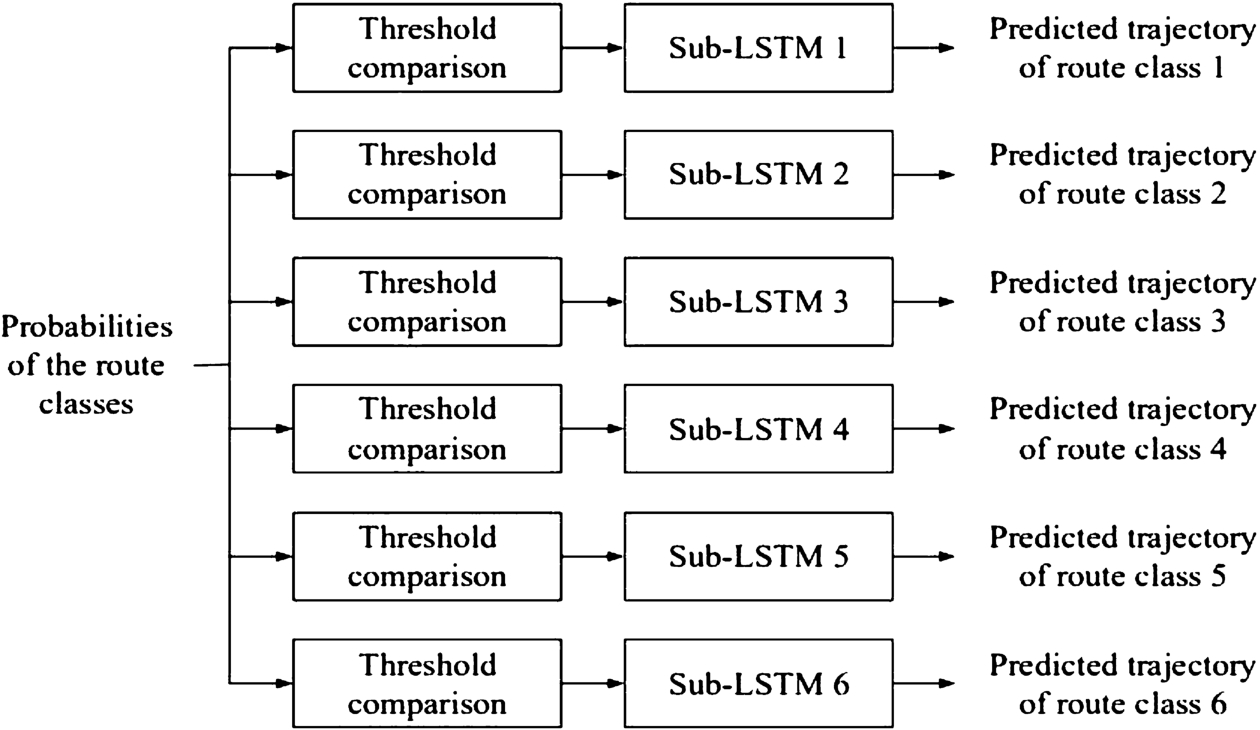
Future trajectory prediction based on the classification.
Initialized IO input and output. In order to simplify the input operation and save cost and resources, this article uses a simple GBK file containing the content of “ABC”. The interface reflects the data server startup, cross-network segment and super workstations in different colors. Multi-system startup, the cloud storage platform is preferentially set to network virtual startup. Only when the network fails, in order to ensure the normal operation of the system, the system can be switched to start from the local hard disk to avoid the occurrence of teaching accidents. Network boot support for Windows XP, Win7 and Win10. The classroom BIOS setting is required to support the remote wake-up function, and the CMOS is set to the network boot priority option. Before setting up the data server and workstation software installation, you should disable the QS protocol deletion and firewall of the machine to prevent the DHCP packet from being filtered out. If the client and server are not in the same VLAN, you need to perform DHCP relay on the switch. For the data server to be used, set the default working directory in the Server Basics tab. The image file directory and the restored file are mainly read operations, generally placed under the same disk partition, the temporary file is mainly a write operation, and the directory is placed in another partition. Then add a 5-15G diskless boot disk in the Disk Management tab. After the data server is established, the workstation parameters must be set. When the workstation is not booted for the first time, it will be started according to the default parameters of the workstation. Use a server to set up a workstation in the IP segment. If there is a disk, start the workstation and copy the FLCL ENT file package to the hard disk. After the installation, install the corresponding service file, configure the configuration network card model, and shut down the computer. On the server side, set the default setting of this workstation to the specific IP address of the current data server, and then set this workstation as the super workstation. At this point, the disk starts the super workstation, executes the FLCLIENT client program, selects the system upload, and closes the corresponding SERVER end after the upload is completed to close the super station function of the workstation. Then all workstations choose network boot, and you can achieve diskless boot. If you want to install the program later, repeat this process, after installing the required software on it, upload the system image, and all workstations will be mirrored after the new installer file. When the cloud storage platform obtains the administrator synchronization command, it will automatically penetrate the difference data between the virtual system and the local system into the local hard disk system. The so-called penetration, in layman’s terms, is to update the disk system with a diskless system. The cloud virtualization management platform has a multi-server hot standby function. Here, the server can be any node in the cloud. Through the cloud storage, all the multimedia classrooms of the school can be incorporated into the cloud multimedia classroom virtualization management platform. Multi-server hot standby is used in combination with multiple I/O servers. When an I/O server is down, the client automatically switches the I/O server to achieve hot standby, thus avoiding the emergence of an I/O server. In the event of a failure, it affects the entire I/O service.
For complex multimedia data types and the large difference in question, in order to reduce the number of nodes connected to a single node during the repair, i.e., reduce disk I / O overhead herein, all storage nodes are grouped, so that the same type of a data packet stored in the same the encoding algorithm: 1) a cloud storage system provided multimedia total number of nodes is n, and m are divided into groups, there are four nodes in each group, then
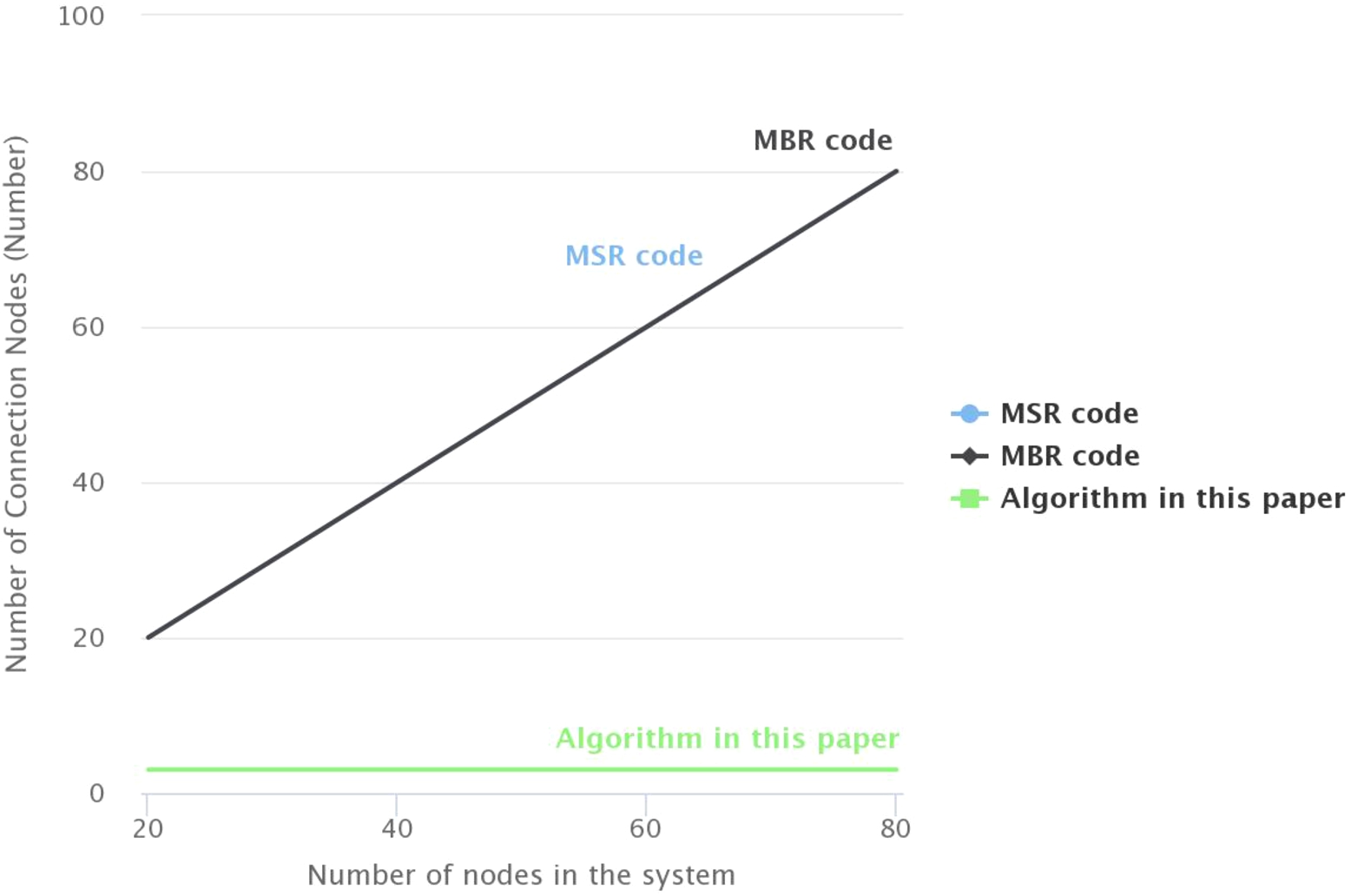
Number of surviving nodes to connect when repairing a single node.
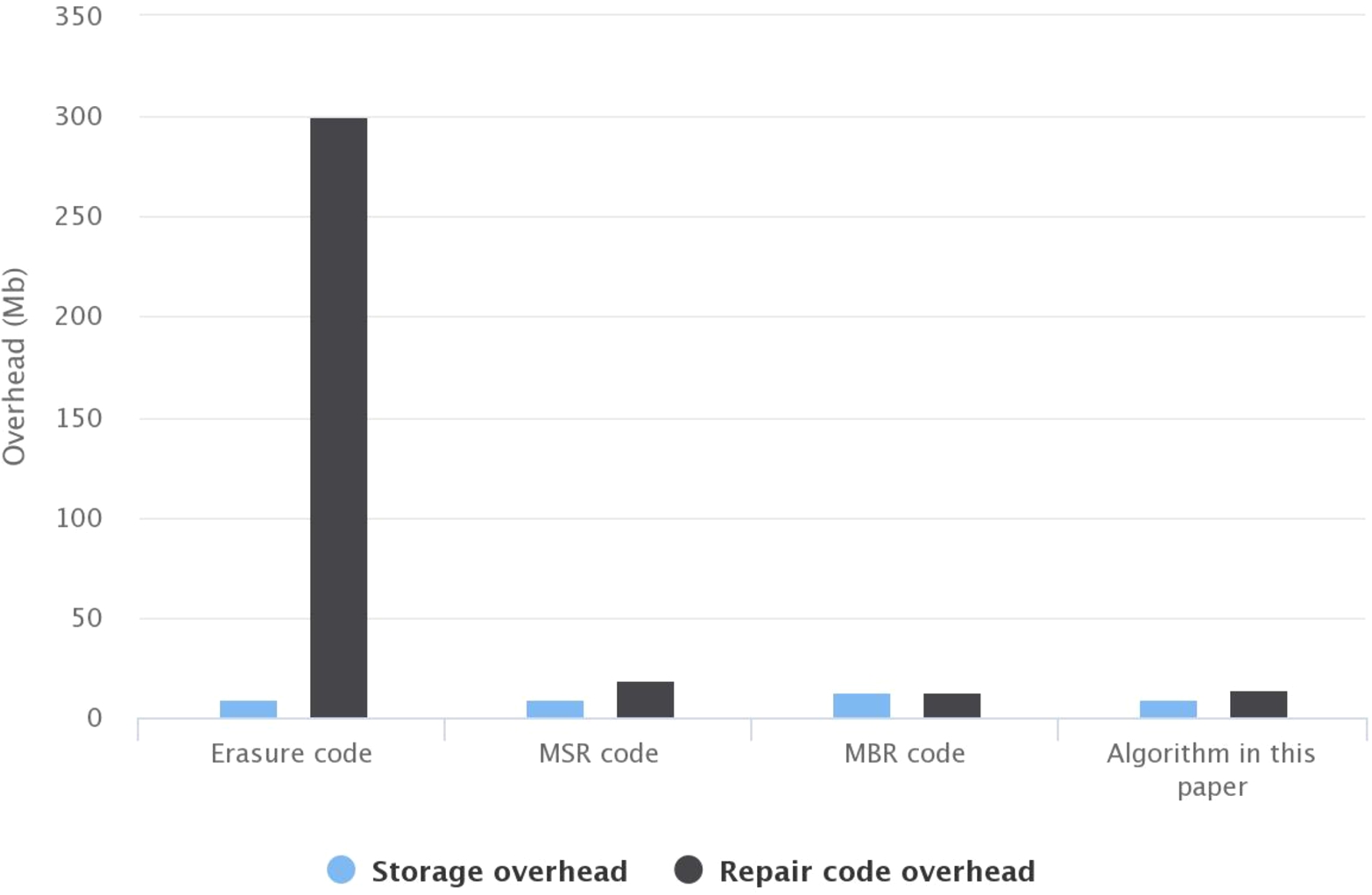
Storage overhead and repair bandwidth of different algorithms.
In a distributed storage system, the disk I/O cost during node repair is usually measured by the number of surviving nodes connected by the new node. Figure 4 is the number of surviving nodes connected in the single node repair in different algorithms, and also represents the single node of each algorithm. Disk I/O overhead during repair. As can be seen from Fig. 3, the disk I/O overhead of the algorithm in the node repair process is stable, which is less than the traditional MSR code and the traditional MBR code algorithm under the same conditions, and the total number of nodes in the system. Increase, its performance advantage is more obvious, this is because the algorithm in this paper repairs the data on the failed node, as long as the other three nodes of the group where the node is connected, regardless of the total number of system nodes. When

Stateful model.
In the Fig. 5, the repair bandwidth is the smallest, and the repair bandwidth based on the erasure code algorithm is the largest. In short, the storage overhead and repair bandwidth overhead of MSR, MBR and this algorithm are relatively balanced, which is better than the erasure code algorithm. The size also has an impact on storage overhead and single-node repair bandwidth. The algorithm has the same node storage overhead as the MSR algorithm, and is smaller than the MBR algorithm. This is because the original data block
With the popularity and rapid development of Internet and network applications, storage technology has made great progress and faced enormous challenges: the increasing number of users, the wider geographical distribution of data, the explosive growth of data storage and more and more high data reliability requirements, etc., require the construction of large-scale, high-efficiency, easily scalable, and highly reliable storage systems. Distributed storage systems can meet the storage requirements of massive data due to their own characteristics. However, in the system, temporary or permanent failures are likely to occur due to disk failure, server abnormality, etc., so that the data stored therein is unreadable or lost. Node failure and data loss will bring huge losses to providers and users in the storage system. Therefore, in distributed storage systems, redundant data needs to be set to ensure the reliability of the entire system. As a new data redundancy technology, the regenerated code can effectively reduce the amount of downloaded data needed to repair a failed node in a distributed storage system. For the failure problem of a single node, the coding strategy of the exact repair proposed in this paper has been solved in multimedia cloud storage
Footnotes
Acknowledgements
This work was supported by the 2020 Scientific Research Fund Project of the Education Department of Liaoning Province: Research on public opinion struggle and guidance mode of public emergencies in virtual community under big data environment (Project No. L2020007); Research Fund Project of Changzhou Vocational Institute of Engineering (Project Approval Number: 11130300120003).
Conflict of interest
The authors have no conflict of interest to report.