




Abstract
With the vigorous development of blockchain technology represented by bitcoin, blockchain technology has gradually entered the stage of blockchain 3.0 characterized by “programmable society”. And the application of blockchain technology in all walks of life has achieved actual results. Blockchain technology has typical characteristics of decentralization, Tamper-resistant data, information openness and transparency, and natural fit with the application requirements in the field of certificate tracing, which makes the development of the applications of blockchain deposit and traceability in full swing. First, this paper describes the concept, application process, key technology of blockchain deposit and traceability, the three application architectures of blockchain deposit and traceability, and the overall architecture of its system. Then, it introduces the application of scenarios and the blockchain deposit and traceability in various fields. Next, it discusses the issues existing in the development of the application of blockchain deposit and traceability. Finally, the paper also expresses the best wishes for the future of its application.
Introduction
As the supporting technology of bitcoin, blockchain was first introduced in the article Bitcoin: A Point-to-point Electronic Cash System published by Satoshi Nakamoto in 2008. [30] Blockchain is developed from bitcoin, but it is not limited to digital currency because it provides a new idea of how to build trust and transfer value under the premise of decentralization at present. The development of blockchain has mainly gone through three stages: the 1.0 stage of blockchain represented by bitcoin, which means the digital currency stage; the 2.0 stage of blockchain, represented by Ethereum and super ledger fabric, is the stage of smart contract; the 3.0 stage of blockchain, which is characterized by “programmable society”, is moving towards the application exploration and popularization stage of blockchain in various industries now.
With the in-depth development of Internet finance, blockchain technology is becoming more mature and has gradually become the focus of people’s attention. Its core ideas of openness, credibility, decentralization and sharing are widely recognized. Now, blockchain technology has moved from concept to practical application, and the application of blockchain is more and more widely. Blockchain technology also can enhance efficiency for all walks of life. In addition, blockchain has played an important role in the application of deposit traceability. And deposit traceability has been the focus of people’s attention recently.
This paper comprehensively reviews the related concepts, architecture, technology, and application scenarios of blockchain deposit and traceability. This paper includes six parts. The first part briefly introduces the blockchain technology, focusing on the definition of the traditional type of deposit traceability and the blockchain-based traceability, as well as the respective application processes of deposit and traceability; the second part summarizes the three types of blockchains and the three application architectures of blockchain deposit traceability; the third part briefly summarizes the overall architecture and key technologies of the blockchain deposit traceability system. The fourth part describes the application scenarios and application implementation of blockchain-based deposit traceability in various fields. The fifth part analyzes the existing problems in the traceability of blockchain deposit certificates. The sixth part expresses wishes for a bright future for the application of blockchain deposit traceability.
Basic overview of blockchain deposit traceability
Blockchain is a decentralized distributed ledger technology that is jointly maintained by multiple parties. It uses cryptography technology and distributed consensus protocols to ensure network transmission and access security and can achieve accounting technology of consistent, non-tamperable and traceable data storage. In the blockchain system, data is usually stored in a block-chain structure. The structure organizes data of a specific structure into blocks in a certain way, and then forms a data chain in a chain structure according to the time sequence. The block header includes a large amount of data, such as a hash value of the parent block, timestamp, Merkle tree root (used to effectively summarize the data structure of all transactions) and blocks height, etc. The block structure is shown in Fig. 1.

Structure of block.
As a new computing paradigm and collaboration model that establishes trust relationships at low cost in an untrusted multi-agent competitive environment, blockchain has become an important skill for many industries to compete with each other by its features of unique trust establishment mechanism. It plays an important role in the fields of finance, public services, energy, medical and health, certificate deposits, and traceability.
Ordinary electronic deposit is to record electronic data (text, pictures, video, audio and other objective materials based on electronic technology such as computer application, communication and modern management technology) through information technology to prove when and where the incident happened in the future. With the rapid development of electronic data storage, it is frequently used and data volume have increased significantly. Electronic evidence is formed in a different way, it is easy to die out, easy to tamper, strong technical dependence and so on, which greatly affects the authenticity and integrity of electronic data.
Blockchain deposit evidence [44] refers to storing electronic data that requires evidence preservation of the blockchain, to achieve the purpose of security protection of electronic data, prevention of tampering, traceability, and trustworthy data sources. In order to achieve fast storage without making the blockchain too bloated, usually, the on-chain and off-chain collaborative work is adopted, and the file is separated from the hash value. Only the hash value of the file is stored on the chain, and the original file is stored off the chain. In the process of data storage, each participant maintains information sharing and data consistency, which greatly reduces the possibility of malicious tampering or data loss. The basic process of blockchain deposit is shown in Fig. 2.
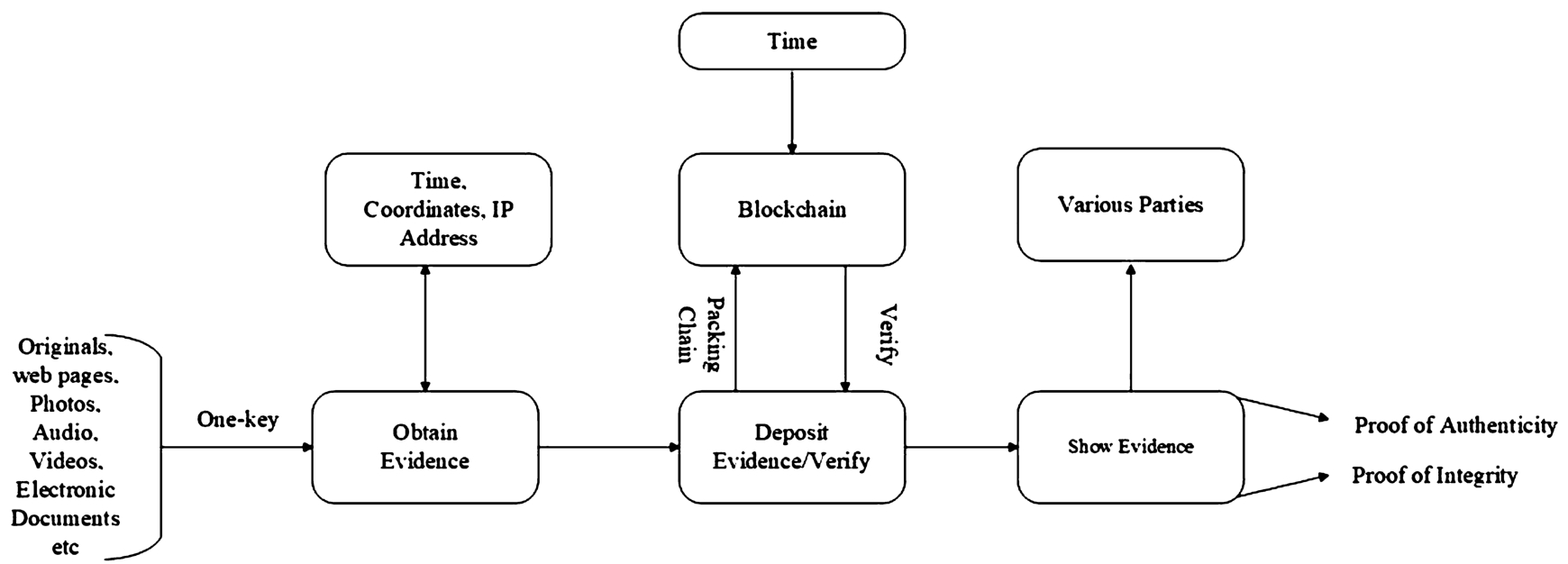
Blockchain deposit process.
Traceability refers to the activity of tracing the history, application, or location of an object through records or identification. In the entire distribution process of items, various collection and retention methods are used to record and store all aspects of data and information in a certain format or method, so as to achieve the effect of tracing the source of the items and information. Although the traditional traceability model has been taking shape for many years, the centralized traceability system has been criticized and regarded as a monopolistic, asymmetric and opaque information system, which can easily cause corruption and information fraud.
Blockchain traceability [6] refers to the integration of information about the production, circulation and transmission process of the product supply chain and writing it into the blockchain network to realize the retrieval and tracking of information such as product materials, raw materials and the origin and history of products, and enhance the transparency and authenticity of the information on the supply chain. In the traceability system, the use of blockchain can reduce many supply chain risks, such as interruption of basic information facilities, information delay, insufficient information transparency, the lack of compatibility and the reduced internet security of information technology platforms between supply chain partners. The basic process of blockchain traceability is shown in Fig. 3.
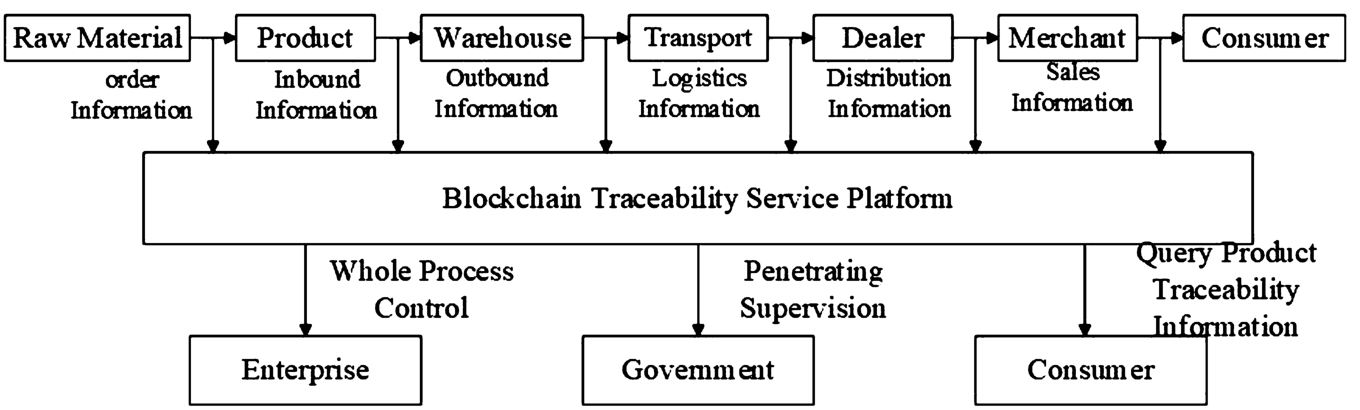
Blockchain traceability process.
Based on the interpretation of the concepts of deposit and traceability of blockchain, we may have a general understanding of blockchain deposit traceability: integrate multiple events into one block and store them in the blockchain, which is evident; the syntax elements of the event storage block are inherited from different associated event storage blocks to form an event chain; The event chain pointers are connected in series to save the relationship and sequence of events; when we obtain evidence on the blockchain, we deduce it layer by layer to restore the complete event process, which is traceability. Therefore, it is not difficult for us to find that evidence is the root of traceability, and that evidence and traceability belong to the individual and the whole.
The structure of the blockchain deposit traceability application essentially adopts the design of the alliance chain, which builds a trustworthy “Ecosphere” by multiple centers based on the high performance, safety and reliability of the alliance chain. Each alliance entity completing the deployment of the blockchain independently.
Classification of blockchain
According to the technical form, application mode, access and permission management, blockchain can be divided into three categories [40], namely public chain [36], private chain [32] and alliance chain [23].
Public chain: A public chain refers to a blockchain in which anyone in the world can participate in system maintenance, data reading, sending confirmable transactions, and participating in consensus. Typical representatives of public chains are Bitcoin, Ethereum, etc.
Private chain: A private chain refers to a blockchain in which the permissions of reading, writing, and consensus accounting are completely in the hands of an organization or someone. It is a form of blockchain that is opposed to the community chain in terms of access principles.
Alliance chain: Alliance chain refers to a blockchain with several institutions or organizations participating in the management. Each organization or institution runs one or more nodes to record transaction data together. The read-write permission and accounting permission of the data onto the blockchain is formulated according to the alliance rules, which is a blockchain form of the public chain and the private chain in the access principle.
The comprehensive comparison of the characteristics of the three types of blockchains is shown in Table 1.
Comparison of three different types of blockchains
Comparison of three different types of blockchains
The three types of blockchains have their own advantages and disadvantages. The appropriate type of blockchain is often selected for different application scenarios: public blockchain is mostly used in scenarios that have high requirements for credibility and security, but are not demanding for transaction speed. For landing applications that focus on privacy protection, internal supervision, and transaction speed, it is more appropriate to use a private chain or an alliance chain. In the field of deposit traceability, public chain, alliance chain, or a mix of the three chains are often used.
The application of blockchain-based deposit traceability is still in the early stage of practice. At present, a unified and recognized application architecture has not yet been formed, and there is still diversity of the application. According to the corresponding relationship between the chain and the application, it can be divided into three categories: the single-chain and single-application architecture, the single-chain and multi-application architecture, and the multi-chain and multi-application architecture.
The single-chain and single-application architecture
The single-chain and single-application architecture provides blockchain nodes by all participants to form an alliance chain and provides distributed shared ledger, while the upper application is still a single application. In this architecture, each participant stores the generated transaction data and operation behavior in a distributed way through the same blockchain application system. This kind of architecture is often led the core enterprises to build and operate the blockchain network. Due to the strong position of the core enterprises, the implementation and promotion of its technology are relatively easy. The schematic diagram of the single-chain and single-application architecture is shown in Fig. 4.
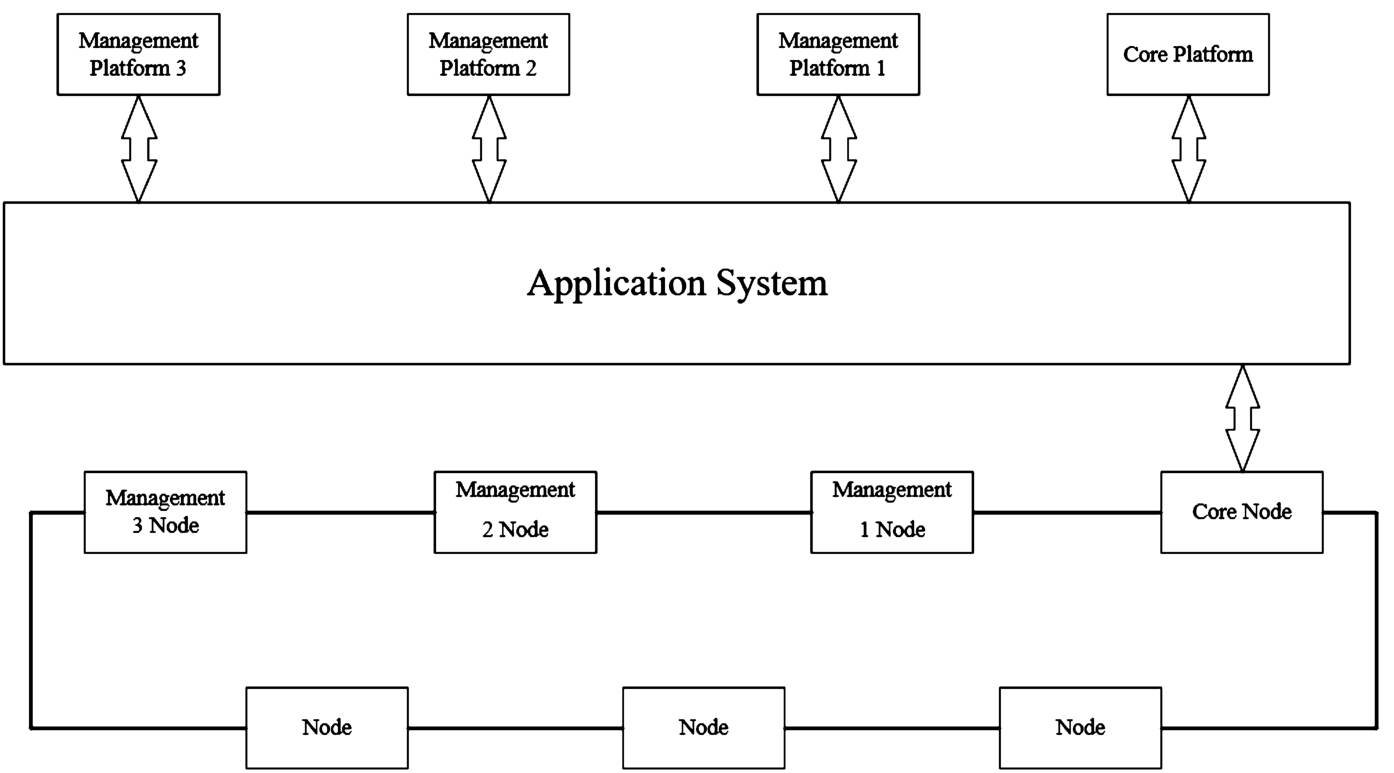
Schematic diagram of single chain single application architecture.
Single-chain and multi-application architecture is still composed of multiple participants. But for different roles of participants, different application systems are provided for users. Different participants operate in their applications, run their nodes, record data together, and realize multi-party data sharing among a consensus mechanism. This architecture can be understood as a third-party platform architecture. In this architecture, each participant can connect the blockchain network with their enterprise information system to meet the needs of users to operate the internal system of the enterprise and collaborate with exterior enterprise businesses.The schematic diagram of the single-chain and multi-application architecture is shown in Fig. 5.

Schematic diagram of single-chain and multi-application architecture.
With the single-chain architecture of the existing blockchain technology. It is difficult for different participants to build a single network due to data isolation, business coordination, and other problems, and there are bottlenecks in performance, capacity, privacy, isolation, and expansion. Therefore, the multi-chain mode arises out of the historic moment. The multi-chain and multi-application architecture is more complicated. In this architecture, the blockchain networks that different participants participate in are not the same. They can participate in one blockchain network of or multiple blockchain networks at the same time. Interoperability between different blockchain networks is achieved through cross-chain mechanisms, to achieve a larger range of business collaboration and data sharing. Under this framework, there are generally multiple equal subjects, and there is no single strong party. Therefore, the establishment of the alliance, the formulation of specifications, and the establishment of the platform require the coordination of all parties, which is difficult to implement. The schematic diagram of the multi-chain and multi-application architecture is shown in Fig. 6.

Schematic diagram of multi-chain and multi-application architecture.
There is a specific architecture of multi-chain and multi-application architecture, known as the main-side-chain application architecture, which is commonly used in the field of deposit traceability. The main side chain application architecture uses a main chain of blockchain as the underlying foundation, which is responsible for global consensus and data sharing. According to different application scenarios, multiple side chains are deployed to further to expand the application scope and innovation space of blockchain. The side chain is relatively independent, which makes local consensus and greatly improves performance; the main chain provides a wider range of supporting on business collaboration. Through the mainside chain mode, the system division of labor is obvious, which can not only to realize the requirements of efficient collaboration and information exchange in a small range but also realize the worldwide verifiability of data without increasing the burden of the main chain on the premise of code and data independence. To build an ecosystem with asset interconnection, high performance, and high scalability to meet the performance requirements of large-scale applications in some scenarios. The schematic diagram of the main side chain architecture is shown in Fig. 7.
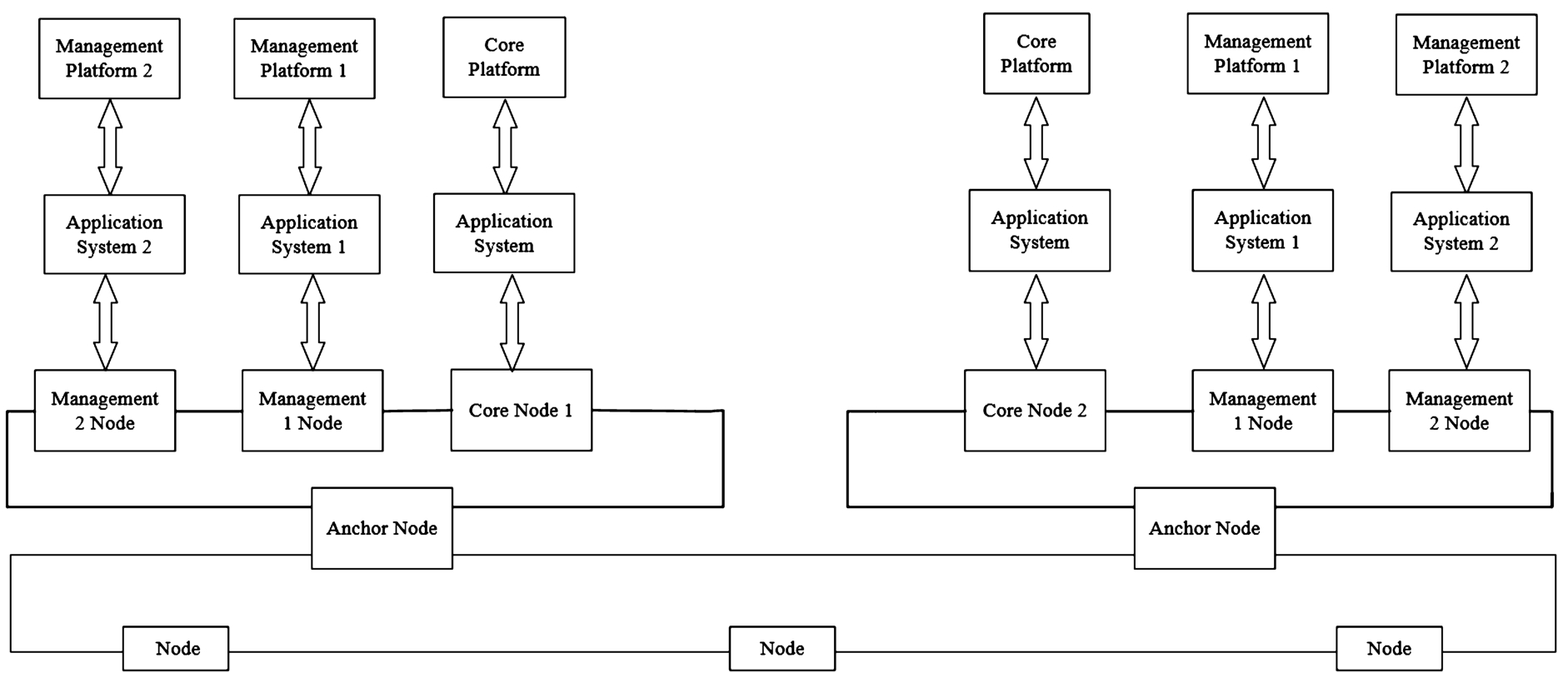
Schematic diagram of main side chain architecture.
Generally speaking, the application of the blockchain traceability system consists of four levels: the basic layer, the management layer, the blockchain service layer, and the application layer. The blockchain service layer is composed of two sub-levels: the core layer and the service layer, which describe the typical functional modules in the application of certificate tracing. The degree and related content can be adjusted appropriately according to different application scenarios of deposit traceability. The overall architecture diagram of the blockchain deposited traceability system is shown in Fig. 8.

System’s hierarchical management structure.
Application layer: the application layer can be both the source and the receiver of data. Through the call to the service layer, secondary development is carried out to dock with specific business scenarios. By calling the service layer, secondary development is carried out to connect to specific business scenarios.
Service layer: the service layer is built on the support provided by the core layer to provide core blockchain-related services for various service modules, so as to ensure the high availability and convenience of services.
Core layer: The core layer is the basic support for each module of the service layer, and it is also the most important part of the blockchain system. The stability of the core layer will directly affect the safety and reliability of the entire system.
Management layer: management layer is one of the important components in the implementation of deposit and traceability application. Information exchanges with authoritative nodes to ensure the authenticity of data. At the same time, it also monitors abnormal data in circulation to ensure the reliability of the data flowed process.
Basic layer: the basic layer involves the data storage of the underlying blockchain, which provides efficient and accurate data services through the safe storage, sharing, and calculation of data.
The key technologies of the blockchain deposit traceability system included two aspects: core technologies and related technologies. The core technology is used to build the underlying foundation of the blockchain system, and the related technology is used to provide support for multiple application scenarios of the blockchain deposit traceability system. The following is a detailed description of the key technologies of the blockchain deposit traceability system.
The core technology of the blockchain deposited traceability system is used to ensure the characteristics of the blockchain, such as multi-party participation, tamper-proof, and loss prevention, including: distributed ledger [4], consensus mechanism [22], cryptography, [17] and smart contracts [9]. They also have their functions of the blockchain, namely: data storage, data processing, data security, and data application.
Distributed ledger
As one of the core technologies at the bottom of the entire blockchain, the distributed ledger constructs the framework of the blockchain, which is essentially a distributed database. Based on the P2P network, resources and services are distributed over all nodes. Without the participation of third-party organizations, information transmission and service implementation are directly carried out between different nodes. Through the P2P communication mechanism, the data onto nodes can be quickly synchronized nearby, to avoid possible bottlenecks and enhance the anti-network attack ability of blockchain. That is to say, the core participants of the distributed ledger use the consensus algorithm to copy data onto nodes through the point-to-point network.
Most of the blockchain systems follow the chain structure of Bitcoin. In this structure, the blockchain is a data structure in which blocks contain transaction information is linked to an orderly manner back to front. With the in-depth research on the performance and security of the blockchain, two new data structures have been proposed, namely a tree structure and a graph structure [18]. Table 2 provides a basic overview of the three data structures.
Overview of blockchain data structure
Overview of blockchain data structure
The chain structure and tree structure are the most widely used for the moment, but due to the expansion of the block and the defects of the transaction rate becoming more and more visible, the graph structure can be developed. The graph structure does not need to consider the expansion problem, which is crucial. To a large extent, the speed of the blockchain network can be increased, but the resulting data structure load is too complex, which requires more storage space to back up and manage data. But what we can still foresee is that DAG is a new generation of blockchain facing the future, whether it is from a macro graph topology model, or from single-chain evolution to tree and network, from block granularity to transaction granularity The transition from a single point to concurrent writing is an innovation of the blockchain from capacity to speed.
The consensus mechanism is a multi-party collaboration mechanism that is used to coordinate multiple participants to reach the only result that is mutually accepted, and to ensure that there is no deception in this process and continue to operate stably. In the blockchain system, the consensus mechanism is the law of the blockchain world, which enables the normal operation of the blockchain and determines the security, scalability, and distributed characteristics of the blockchain system at the basic level.
In general, the consensus mechanisms used by the public chain, alliance chain and private chain are different. Among them, the consensus mechanism of public chain mainly includes Proof of Work (POW) [24], Proof of stake (POS) [33], Delegated Proof of Stake (DPOS) [33], ripple [29], algorand [27], etc.; the representative consensus mechanism of the alliance chain includes the practical Byzantine fault tolerance algorithm PBFT (Practical byzantine fault tolerance) [42], Kafka [5], etc.; In the private chain, consensus mechanisms such as Paxos [10] and Raft [11] are commonly used. Table 3 analyzes and compares the mainstream consensus algorithms in the blockchain networks.
Classification and comparison of mainstream consensus algorithms
Classification and comparison of mainstream consensus algorithms
Each of these consensus algorithms provide solutions for specific areas, and although they have their own advantages and disadvantages, they serve different purposes. At present, the research trend of consensus mechanism is turning to hybrid consensus, that is, the application of two or more consensus mechanisms in the underlying structure of the same blockchain public chain. The rational use of mixed consensus can make up for the shortcomings of inefficiency, loss of security protection, or sacrifice to/for centralization caused by a single consensus mechanism.
The data security of blockchain mainly depends on cryptography-related security technology. Digital encryption technology is the use of cryptography technology to ensure the features of the blockchain, such as integrity, tamper proof and verifiability, which is the basis of ensuring the security of blockchain. The direct demand of blockchain for cryptography is mainly based on two aspects: protecting data privacy and determining the ownership of digital assets.
Because the data onto the account book is open and transparent, and some data records contains/contained the associated information about/on accounts, the user’s personal privacy will be difficult to protect if the plaintext is directly linked to the chain. Therefore, cryptographic tools such as symmetric encryption algorithms, asymmetric encryption algorithms, hash algorithms, etc. are used to encrypt data to ensure data security, integrity, and privacy. Table 4 compares and analyzes the main digital encryption technologies.
Classification and comparison of encryption algorithms
Classification and comparison of encryption algorithms
The application of cryptographic technology directly determines the security strength and efficiency of the blockchain system. While studying how cryptographic algorithms improve the security of the system, the improvement of efficiency should also be considered to support large-scale high-frequency transactions. Research on an autonomous and controllable cryptographic system based on the national secret algorithm can’t wait. With the rise of quantum technology, we should build account and transaction security defense mechanisms to deal with the threat of quantum computers and quantum algorithms, study different types of blockchain systems, and design a new cryptographic algorithm in line with the security attributes of blockchain system combined with different application scenarios.
The smart contract is a kind of computer transaction agreement that does not rely on the central organization, self-verification and automatic execution of the contract terms. Its essence is an executable code deployed on the blockchain. Due to the decentralization, distrust, and non-tamperability of the blockchain, it happens to provide a good operating foundation for smart contracts, and smart contracts are playing an increasingly vital role in the blockchain.
Smart contracts exist in almost all current blockchain systems, including the most widely known Bitcoin, Ethereum, and Hyperledger. The development of smart contracts can use embedded scripting languages, smart contract-specific development languages, and general-purpose languages. Bitcoin uses Bitcoin Script scripting language; widely used in the Solidity language of Ethereum; Hyperledger Fabric’s smart contract writing language is more extensive, you can use go, java or nodejs to develop smart contracts, but the best-supported language is gone. Table 5 compares the characteristics of several languages.
Comparison of smart contract languages
Comparison of smart contract languages
According to the operation mechanism of the smart contract, its life cycle can be summarized as six stages: negotiation, development, deployment, operation and maintenance, learning, and self-destruction. The main task of the development stage is to test the contract before it is put on the chain, and the learning stage includes solving the operation feedback on/from the smart contract and updating the contract in real-time. The basic architecture of the smart contract is shown in Fig. 9. Generally speaking, the infrastructure model of the smart contract is divided from bottom to top into data layer, transport layer, smart contract subject, verification layer, execution layer, and application layer.
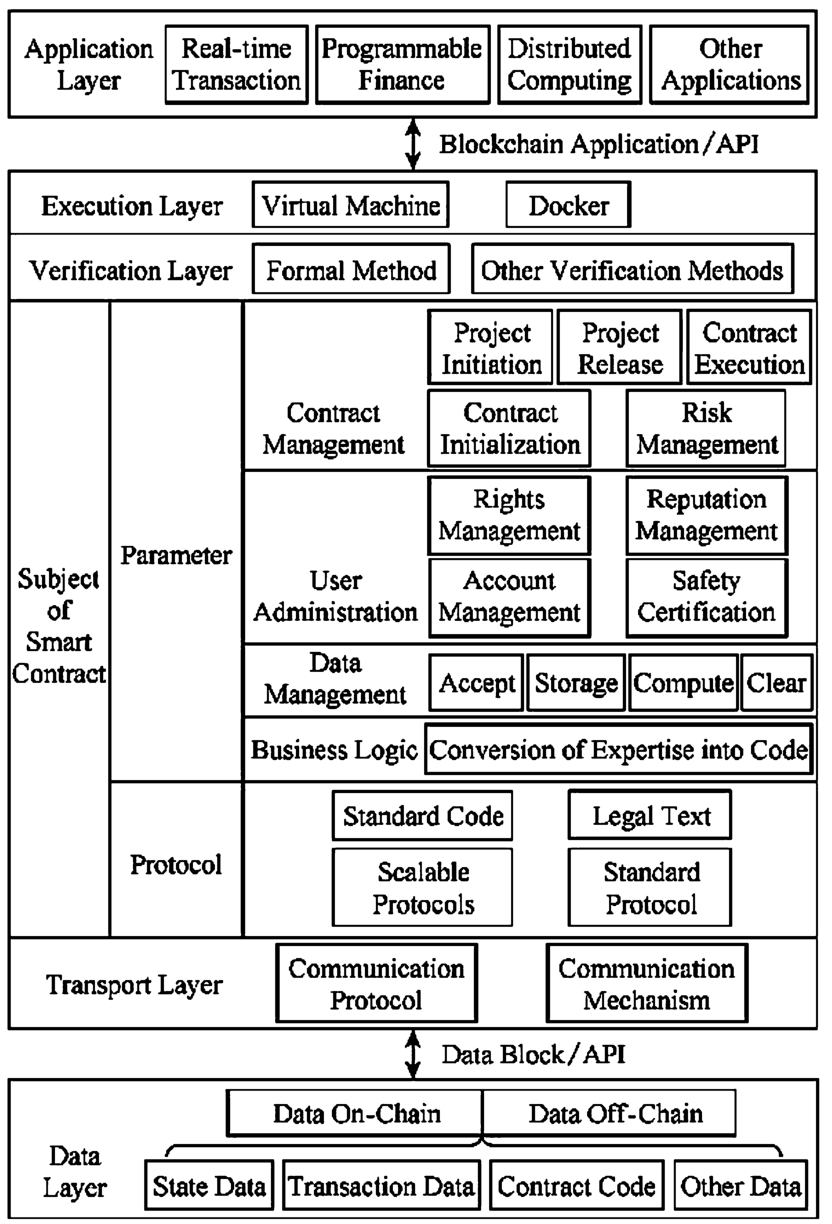
Basic framework of the smart contract.
The data layer to encapsulate the static contract data, including the data onto the chain and the data off the chain, which can be regarded as the static database of the smart contract. The transport layer encapsulates some infrastructure, such as the protocols used to support “on-chain to on-chain” and “on-chain to off-chain” communication and data transmission. The subject of the smart contract provides a complex agreement framework to identify the behavior and status of the contract with/for the key parameters of the smart contract. The verification layers/ed encapsulate to various verification algorithms to ensure the consistency of the contract code and contract text. The execution layer encapsulates the related software of the smart contract execution environment. The application layer encapsulates the specific application of smart contracts with/for a specific field.
In the field of deposit traceability, three main application directions of smart contracts are listed below, not for specific application scenarios [37]:
Authority control: By setting authority control information for the smart contract, it is ensured that only specific users can call the smart contract. Based on different dimensions, different granularity of permission controls information, the requirements of permission control will be met in various application scenarios.
Data recording: Automatic processing of data recording compliance is realized through a smart contract, which can reduce service costs and improve data transparency.
Internet of things: the intelligent contract is used to realize the automatic exchange of data between devices and the generation of transaction behavior, which not only ensures privacy, but also takes into account the value of digital assets, and promotes the sharing of services and resources.
With its unique advantages, smart contract technology has attracted many researchers. Because of its immutability, it eliminates the possibility of human intervention. At the same time, it removes the middleman link, reduces the cost of trust, and speeds up the process of contract verification and execution. However, blockchain smart contract technology is still in the early stage of development, and there are some limitations on technology and implementation. At present, the research on smart contract mainly reflects the solution to contract coding, contract performance, contract security and contract privacy. Before the large-scale application of intelligent contract, the balance among decentralization, low energy consumption and security should be ensured.
This section analyzes the current research progress of three aspects: expansion technology [31], cross-chain technology [1], and privacy protection [39].
The extended technology
Currently, there is a serious performance bottleneck in the blockchain system, that is, the transaction throughput and transaction speed are limited, and it is difficult to meet the actual application requirements when facing most of the businesses in the field of deposit traceability. Therefore, scalability has become a key technology for the current blockchain to improve system performance. This section summarizes some existing scalability technologies, including sharing technology, on-chain capacity expansion, and off-chain capacity expansion.
Slicing technology. Referring to the traditional database fragmentation technology, that is, large databases are divided into smaller, faster, and easier-to-manage data fragments, and the blockchain network is divided into several smaller component networks. Each fragment only needs a small range of consensus to process transactions or transactions in parallel, thereby greatly reduced the number of redundant calculations and improving the performance of the blockchain system.
At present, the mainstream fragmentation technologies include network fragmentation, transaction fragmentation and state fragmentation, and their technical difficulty increases in turn. Network fragmentation is the foundation and premise of the other two fragmentation technologies.
Network fragmentation: the whole blockchain network can use the random function to randomly select nodes to form a fragmentation, that is, a subnetwork. The nodes in the fragmentation reach an agreement on/with/to the consensus mechanism, so as to support a larger number of consensus nodes.
Transaction fragmentation: transaction fragmentation is based on the technology of network fragmentation, which allocates transactions to different network slices according to certain rules for sub-regional processing. It can not only avoid double flower transactions but also achieve the purpose of parallel transaction processing, so as to improve the overall performance of the blockchain network.
State fragmentation: state fragmentation also separates the whole storage on the basis of network fragmentation. Each fragmentation no longer stores the complete blockchain state, but stores part of the ledger information. Each node is only responsible for hosting its own fragmentation data. Compared with transaction fragmentation, state fragmentation is the most ideal fragmentation method, which can essentially to solve the problem of blockchain expansion. However, there are still some technical barriers, such as difficult implementation, frequent cross slice communication, and data availability problems.
At present, Ethereum 2.0, Zilliqa, Quarkchain, Monoxide and many other projects have begun to use fragmentation technology to expand capacity. In order to enhance the performance of blockchain, transactions and data are processed by fragmentations. However, there are also some security issues, such as poor security and efficiency of internal fragmentations, poor security and efficiency caused by cross-fragmentation transactions, etc. In general, for solving the problem of capacity expansion, fragmentation technology still has strong advantages and good application prospects.
Capacity expansion on the chain. Capacity expansion of the chain is a solution to achieve capacity expansion of the basic level protocol of blockchain. By modifying and optimizing the underlying structure of the blockchain, such as increasing the block size and using the consensus protocol with higher performance, the scalability of the system can be improved. Capacity expansion of the chain mainly includes block expansion, isolation witness, DAG technology and consensus mechanism improvement.
Block expansion: block expansion is a solution to expand block capacity. By expanding the capacity of data block, the block can pack more transactions, and then improve the system throughput. In February 2016, bitcoin expanded the block size of 2M through hard bifurcation. However, the consensus ended in failure. In August 2017, Bitcoin Cash (BCH), which was bifurcated out from bitcoin, implemented hard bifurcation at the height of 478558 bitcoin block, expanding the original block 1 MB to 8 MB. After that, BCH was upgraded four times through hard bifurcation.
Isolation witness: data block includes digital signature and transaction information, in which digital signature occupies most of the space of the block, but it is only used for verification stage. The main idea of isolated witness is to take out the digital signature information stored in the block and expand the block size of disguise, so that each block can carry more transaction records and achieve the purpose of expansion indirectly.
DAG technology: directed acyclic graph has been introduced in Section 4.1.1, which is a kind of acyclic directed graph data structure. Currently, the three most famous wagons using DAG technology are IOTA, Byteball and Nano.
improved consensus mechanism: The consensus protocol has also been introduced in Section 4.1.2. So far, there has not been a consensus algorithm that solves the ternary paradox of blockchain distributed systems, so the research on efficient blockchain consensus mechanisms is a current research hotspot and difficulty.
Capacity expansion of the chain can fundamentally alleviate the congestion of the blockchain and solve the performance bottleneck of the blockchain, but the effect of capacity expansion is limited and the technical difficulty is high.
Off-chain expansion. Off-chain expansion is the transfer of various calculations and transactions originally placed on the on-chain to the off-chain. The on-chain is only used as a transaction record or arbitration platform, thereby reducing the number of transactions on the blockchain and increasing the speed of data processing by the blockchain. The off-chain expansion plan mainly includes state channels, side chains, and off-chain calculations.
State channel: the main idea of state channel is the off-chain channel interaction and the on-chain clearing. The general process of using state channel is as follows: the counterparties lock a certain state on the chain, then directly establishes/ed a point-to-point channel off the chain, realize data interaction in the channel, and finally submit the final state to the chain. When the perpetrators appear, the participants can submit the previous state to the chain for arbitration, so as to ensure the security of the transaction off the chain. Generally speaking, the mode of state locking on the chain is contract locking or multi signature wallet. At present, the more classic state channels/led schemes are lightning network based on bitcoin network and lightning network based on Ethereum network.
Side-chain: the side-chain mechanism is mentioned in Section 3.2.3. The side-chain exchanges data with the main chain through two-way anchoring, and processes transactions independently of the main chain, so as to reduce the transaction load of the main chain.
Off-chain computing: off-chain computing is a model that transfers all kinds of computing and transaction processing from on-chain to off-chain, and then delivers the corresponding results to the on-chain for data verification.
Since the transaction performance under the chain is not affected by the blockchain, there is no upper limit on the capacity expansion performance. However, there are also some problems such as low centralization and data modification.
The expansion schemes mentioned above focus on performance improvement, security and decentralization. Compared with the expansion of on-chain and the expansion of off-chain, the expansion effect of the on-chain is obvious, but it may increase the degree of system centralization; Due to the long implementation period, the expansion of the off-chain may bring some security risks, but it will improve the performance of the blockchain system more. The comparison of various expansion schemes for blockchain is shown in Table 6.
Comparison of capacity expansion schemes of blockchain
Comparison of capacity expansion schemes of blockchain
Cross-chain technology is an important technical means to realize data communication between blockchains and to solve the problem of value islands between different chains. It is a bridge for the expansion and connection between/to/with blockchains. In the field of deposit traceability, cross-chain technology is particularly important. Its main function is to connect homogeneous or heterogeneous blockchain systems to realize asset and data interoperability. At present, there are four mainstream cross-chain technologies: notary mechanism, side-chain /relay, hash locking, and distributed private key control. Table 7 analyzes and compares the performance of four mainstream cross-chain technologies.
Notary mechanism: by electing one or a group of trusted nodes as notaries, it monitors the events on blockchain x, verifies the specific events, and performs the corresponding operations on blockchain y to realize the response to the events and form a cross-chain communication path. Side-chain / relay: the side chain or relay blockchain is used as the intermediary network between heterogeneous blockchains to anchor the account information on the main chain, so as to realize the basic information verification, digital asset trading, interoperability and other capabilities. It is representative of the internet of value. Hash locking: hash locking technology mainly supports the exchange of atomic assets in cross-chain, and realizes fair transaction by asset locking and setting corresponding time and unlocking conditions. Distributed private key control: control the private keys of various assets through distributed nodes and map the original chain assets to the cross-chain to ensure the interconnection of various assets in the blockchain system.
Mainstream cross-chain technology performance comparison
Mainstream cross-chain technology performance comparison
Protection section of mainstream privacy technologies
Although cross-chain technology has developed rapidly in the past few years, the cross-chain technology of blockchain is still in the early stage of technological development. In order to improve the interoperability between the on-chain and the off-chain and among chains, it is necessary to design the convergence design for the related components, such as unifying the input and output caliber of the cross-chain messages, constructing the standard message format, designing the efficient and verifiable data structure, etc.
In a typical public chain system, because the historical data of blockchain is open and transparent, each node can obtain the system account book, and based on these data, it can track and analyze the user’s relevant privacy information, which to a certain extent brings the extremely dangerous risk of data privacy leakage. Therefore, privacy protection is also the first problem to be solved in the process of the application of blockchain deposit traceability, that is, to achieve “data confidentiality” and “identity privacy”. Blockchain developers propose a variety of privacy protection technologies, including ring signature, zero-knowledge proof, homomorphic encryption, and secure multi-party computing, to improve the privacy of blockchain. Attribute-based encryption and partition consensus mechanism are used to divide the access rights of different nodes, and privacy transaction is used to realize invisible but verifiable transactions. The contents protected by these privacy protection policies are roughly divided into the sender (input address), the receiver (output address), and the transaction itself. Table 8 compares the protection links of mainstream privacy technologies.
Ring signature: A ring signature is a digital signature scheme without a trusted center. A member is allowed to sign on behalf of the members of a group without leaking the signer’s information, which realizes the concealment of the signer’s identity.
Zero-knowledge proof: On the premise of not destroying the characteristics of the blockchain, the prover can prove to the verifier that a certain assertion is correct without revealing any useful information. zero-knowledge proof can solve the problems of private information leakage, commercial secrets, and other content that needs to be kept secret when circulating on the blockchain, while retaining information about/on audit.
Homomorphic encryption: Homomorphic encryption is a method that can perform calculations without decrypting encrypted data in advance. The result of processing homomorphically encrypted data and the output result of processing unencrypted original data in the same way Unanimous.
Secure multi-party computing: it is the function of collaborative computing for a computing task on the premise that participants do not trust each other and input data privacy is guaranteed. It is generally used in the scene where the key information or sensitive information of a file needs to be stored and the original content cannot be disclosed.
Attribute-based encryption [45]: identity is regarded as a series of attributes. Only users whose attributes meet the access control policy can successfully decrypt data.
Partition consensus mechanism: set the permission level of the data, divide the node into multiple partitions, and the node can only view the data in its own partition, but not the data in other partitions.
Private transaction: when sending a transaction, the transaction details are only stored in the relevant parties of the transaction, and the hash of the private transaction is stored after the consensus of the whole network, which not only ensures the privacy of the transaction data but also verifies its effectiveness.
Privacy protection is one of the main guarantees for the implementation of blockchain certificate tracing applications. Therefore, the privacy protection mechanism should not only protect the user’s privacy from being leaked but also keep the characteristics of the blockchain system, such as decentralization, non-tampering, and trustworthiness. However, the existing technology can not fully solve the threat to privacy protection, and there is still a large space for the development of various protection mechanisms.
The related technologies
The related technology of the blockchain is used to provide support for a variety of application scenarios of the blockchain system.
General technology
The existing evidence traceability system generally collects information through IoT devices, and then deploys nodes through ZigBee technology. In the transportation link, existing technologies, such as QR code technology, are used to assign unique identification information to each product, GPS and cameras are used to monitor location changes, and the collected information is integrated and stored through blockchain technology. When consumers buy a product, they only need to scan the QR code on the product to trace the origin of the product in an all-around way.
Radiofrequency identification technology
Radio frequency identification technology uses wireless radio frequency to carry out non-contact two-way communication of data, and reads and writes the recording medium through radio frequency technology, thus achieving the purpose of identification and data exchange.
ZigBee protocol
ZigBee is a short-distance, low-rate wireless network technology. The main application scenarios include: many network nodes for collecting information, complex terrain, densely transmitting and receiving network coverage, and extensive and dense monitoring points.
GPS module
The GPS module integrates high sensitivity and low power consumption. The GPS chipset solution can track up to 20 satellites at the same time, and quickly determine it, and 1 Hz navigation update.
Wi-Fi technology
The protocol used by Wi-Fi is the IEEE 802.11b local area network protocol, using DSSS (Direct Sequence Spread Spectrum) and QPSK or BPSK (Phase Shift Keying), and the communication range is more than 100 meters.
Two-dimensional code technology
A two-dimensional code is a graphic that records data symbol information distributed on a plane according to a certain rule. In terms of anti-counterfeiting traceability, users can view the place of production by scanning the QR code; at the same time, they can obtain the final place of consumption in the background.
Other emerging technologies
The simple use of blockchain technology cannot solve all the pain points of the industry, and it is difficult to fully realize its due value. Therefore, blockchain needs to be cross-integrated with 5G [7], Internet of Things [2], big data [3], artificial intelligence [19], edge computing [43], and other technologies to form an integrated solution using coordination effects and to accelerate the large-scale implementation of blockchain applications.
5G
As the fifth-generation mobile communication network, 5G network is of high-speed, low delay, massive access and other characteristics, helps the blockchain to speed up transactions and avoid the phenomenon of long-term non-response or stuck. In 5G network environment, blockchain data can realize real-time data transmission, reduce the difference data caused by network delay, greatly improve the consistency of data, and improve the efficiency of consensus algorithm, which will greatly improve the performance and application space of blockchain system.
Internet of Things
Internet of Things refers to a technology that connects objects to the internet through various communication perception technologies, such as intelligent perception devices, identification technologies, and pervasive computing, so as to realize intelligent identification, positioning, tracking, and supervision of objects. The terminal equipment of the Internet of things is put into the blockchain node for management, so as to solve the identification and data confirmation of the Internet of things terminal, ensure the reliable data is on-chain, and realize the deep binding between the blockchain data and the application scenario.
Big data
Big data has massive data processing technology and flexible and efficient analysis technology, which is of great help to enhance the value and use space of blockchain data. The huge data collection of the blockchain contains all the historical data for deposit traceability. Through the use of big data technology to accurately analyze and in-depth mining of these massive data, the data of interest can be refined and abstracted to realize the value of the data.
Artificial intelligence
Through the integration of blockchain and artificial intelligence technology, automated processing and intelligent decision-making of the business are realized, and artificial intelligence technology is used to assist the blockchain to detect fraud, identify the similarity of data sources, and ensure the data security of the blockchain.
Edge computing
Edge computing is a method to process data near objects or data sources. Processing data at edge nodes will reduce delay, achieve real-time and more efficient data processing, and ensure the privacy of user data, so as to achieve a powerful supplement to cloud computing. The blockchain is deployed on the edge computing node to ensure the convenience of data docking and the controllability of the propagation path, so as to alleviate the bandwidth pressure and improve the real-time transmission.
Application scenarios and application cases of blockchain evidence traceability
At present, blockchain 3.0 with platform, credibility and intelligence as the core has been applied to various real scenes, enabling all walks of life. Through the combination of the Internet of things, artificial intelligence and other technologies, its application scope has been expanded on the whole society, proving and guaranteeing the value of information in all kinds of social life, realizing data sharing, optimizing business processes, reducing operating costs, improving collaborative efficiency, and establishing a trusted system. At present, according to the purpose of traceability of the deposit and certificate, it can be divided into three application scenarios, namely, product traceability [8], judicial certificate [44] and digital voucher [15], and a more detailed application case and two general cases are listed to understand its purpose and advantages.
Product traceability
Product traceability and logistics tracking are one of the first application areas of blockchain, and it is also the most widely used and fastest application field of blockchain. Product traceability refers to the traceability of the entire life cycle of the product from raw material procurement, production, processing, quality inspection, logistics, sales, and use, to achieve the non-tamperability and integrity of the data, to open up the entire process of data, and to make the information open, transparent and traceable, so as to realize the effective traceability of goods, effective supervision of logistics, and improve the efficiency of the supply chain. At present, the sources of certificates are food [13], medicine [38], animal husbandry [25], express delivery, luxury goods, electronic products, manufacturing [28], automobile [20], textile [16], wood, dangerous goods, etc.
Cold chain traceability case
The introduction of the case. The cold chain is a special supply chain. In the entire supply process, the product temperature should always be within a specified range to ensure the quality of its products. The fact of the current cold chain product supply chain is that the authenticity of information cannot be guaranteed and all links are unable to realize the problem of information sharing.
China Chain Technology has built a blockchain-based full cold chain traceability platform. Blockchain has a series of core technologies such as distributed accounting, digital signature and traceability, which breaks the information monopoly, realizes data sharing, and solves the problems of data centralization, information security and reliability in traditional traceability technology. The system realizes the structured storage of quality and safety data and real-time warning of quality and safety risks through smart contracts, and constructs a new type of ecological scene.
The introduction of the case. Based on the blockchain technology, combined with RFID and sensor technology, big data, cloud computing and other emerging technologies, the cold chain traceability solution of China Chain Technology builds a cold chain logistics environment monitoring and traceability platform. The main functions of the platform include:
Reliable traceability: the participants of each key link of cold chain are regarded as nodes, and the quality and safety information of each link of cold chain logistics can be collected in real time through RFID and sensor technology. The production information, product information, satellite positioning information, cold chain logistics information and temperature, humidity, light and other information in the logistics transportation process are hashed and then the whole process is put into the chain for storage, which provides reliable data support for traceability.
Real time monitoring: in all circulation links of cold chain goods, it can realize the all day long real-time monitoring of quality and safety information such as temperature, humidity, location, etc., so as to ensure that the cold chain goods are always under the specified environmental parameters.
Early warning management: a unified data structure, threshold and automatic discrimination mechanism are designed for terminal nodes through smart contract. Once the temperature, humidity, location and other parameters in the environment exceed the set threshold, the system will automatically alarm and take emergency preventive measures.
Query service: The platform provides different types of information query services for different users, so that all participants can grasp the status of cold chain goods in transportation in real time.
In addition to the above functions, the platform also provides personnel identity management, product file management, asset management, real-time GPS positioning and cold chain commodity handover management during transportation.
Temperature and time are two important factors that must be considered in cold chain logistics, which run through the whole process of cold chain logistics. The system uses RFID tags to replace the traditional environmental monitoring method. The tag is equipped with an antenna RFID chip, temperature sensor, humidity sensor and light sensor. After collecting the temperature, humidity and light information of the environment, the sensor converts it into digital information and writes it into the chip, and transmits the information to the reader according to a certain practical interval, and then uploads it to the monitoring center. When the data exceeds the set threshold, the system will automatically give an alarm, and take corresponding emergency preventive measures through the agreed rules in the smart contract. In this process, all the humidity, temperature, light and other information are stored in the whole chain to prevent the data from being maliciously deleted and tampered, which provides reliable data support for the cold chain traceability platform.
The value of the case. The combination of blockchain technology and cold chain traceability can improve the visibility of cold chain supply chain and build a credible cold chain traceability alliance chain. Data sharing and transmission through the blockchain network can ensure the integrity and authenticity of the data, effectively avoid the potential dishonesty of the platform caused by information fraud and other problems, and create a trusted cold chain traceability ecology of mutual trust and sharing.
Judicial deposit
Blockchain is also rapidly applied in the judicial field. Through blockchain technology, blockchain can store and confirm the rights of electronic data of the whole network, including words, pictures, audio and video, solidify the content and formation time of electronic data in real-time, preserve the data, form an evidence chain, and endow electronic data documents with legal proof effect. The main application scenarios of judicial deposit are e-license [41], copyright [34], government affairs [12], people’s livelihood [14], etc. The scene of electronic license is divided into electronic contracts, electronic evidence, identity authentication and so on; The copyright scene can be divided into three categories: confirmation of rights, such as proof of intellectual property rights, evidence collection of infringement and ownership transfer; In the field of government affairs, the scenarios of certificate storage include government data sharing, voting, donation, etc.; In the field of people’s livelihood, there are health records, credit investigation, public charity, etc. The main services include blockchain certificate storage, web forensics and online judicial certificate issuance.
Electronic deposit cases
By using the trust mechanism of blockchain decentralization, the characteristics of tamper-proof and traceability, and the development of application access technology and management standard, the “balance chain” realizes the reliable storage and efficient verification of electronic evidence, reduces the cost of protecting rights of the parties and improves the efficiency of judges’ electronic evidence collection.
Since the “balance chain” was launched in September 2018, 20 nodes of cross-chain access blockchain have been completed, attracting 23 application units in 9 categories, such as third-party data service platform, electronic contract, copyright, copyright, Internet platform, insurance, bank, Internet finance, supply chain finance. Ten million pieces of cross-chain evidence have been collected in the Tianping chain, and the amount of online evidence data has exceeded 4.72 million. In the trial of cases, 945 pieces of cross-chain evidence data have been verified, involving 58 cases. As of April 2019, among the certification cases based on the “balance chain”, there are 1 judgment case and 41 mediation cases that facilitate the settlement of the parties. The balance chain has realized a new mode of “business chain, management chain and ecological chain” utilizing socialized participation and socialized co-governance, and created a judicial alliance blockchain with high-security reliability, high social influence and high industrial participation.
Digital voucher
Blockchain digital voucher uses blockchain technology to build a new form of electronic invoice [26], which can effectively avoid false digital vouchers, simplify the intermediate links such as bill acceptance and transaction, improve the supervision process of the digital vouchers, and realize the effective supervision of electronic invoice. With blockchain electronic invoice, the operator can apply for, issue, check and enter the invoice on the blockchain; Consumers can store, transfer and reimbursement on the chain; For the tax regulator, it can achieve the technological innovation of the whole process of supervision and realize the whole process of electronic tax management.
Tracing case of electronic invoice
In 2018, the Shenzhen Municipal Taxation Bureau and Tencent jointly launched the pilot promotion of blockchain electronic invoices. Tencent blockchain provides the underlying technical support. It has been widely used in hotels and restaurants, retail supermarkets, financial insurance, Internet services, etc. In hundreds of industries, the cumulative number of registered enterprises reached 15,000, the number of invoices issued exceeded 25 million, and the cumulative amount of invoices reached 25.9 billion yuan. In May 2020, the Shenzhen Taxation Bureau and Tencent and other companies jointly signed a cooperation framework agreement to jointly build a “tax-industry” alliance chain. In the alliance chain, cross-chain technology is used to realize the circulation of data between the tax chain, financial chain and the industrial chain, and each participant realizes data sharing and collaboration through the alliance chain. Enterprises can implement batch invoice inspection, one-click blockchain electronic invoice declaration, and issuance of various tax certificates through the alliance chain. They can also use functions such as on-chain tax digital wallets, which have the advantages of reducing costs, simplifying processes, and ensuring data security and privacy.
Existing problems in the application of blockchain certificate traceability
With the continuous exploration and application of blockchain technology in the field of certificate tracing, has gradually played an important role in all walks of life. However, as an emerging technology, blockchain is facing many challenges. This section lists five problems that need to be solved urgently.
The authenticity of off-chain data
Based on the technical characteristics of the blockchain itself, the data after entering the chain can guarantee its authenticity and integrity, but the data before entering the chain is tampered with, which means that the actual data does not match the mapped data on the chain. How to ensure the authenticity of the data itself and solve the problem of data consistency on and off the chain is an important issue in the application of blockchain certificate traceability.
High performance and storage expansion requirements
With the continuous increase of blocks, the amount of data is also increasing. At this time, to ensure the performance and processing efficiency of the blockchain system is the core factor for the large-scale application of the blockchain. Although the blockchain technology is constantly being optimized, the transaction rate of the alliance chain has been significantly improved. But in the actual business processing, there are still many challenges. With the popularity of 5g and Internet of things intelligent terminals, there is a demand for large-scale concurrent data on the chain, and the business will be more sensitive to transaction delays. Therefore, the efficiency of the blockchain system must be thoroughly solved.
Collaboration inside and outside the chain faces new challenges
Based on the limitations of the blockchain system itself, it must expand the computing and storage capacity through the system outside the chain or other blockchain systems. This requires the effective collaboration of data inside and outside the chain, which means realizing the cross-connection between heterogeneous blockchains and ensuring its security, efficiency and versatility.
The contradiction between privacy protection and data sharing is becoming increasingly prominent
While data sharing is carried out through the blockchain platform, each network node of the blockchain must ensure data consistency, which makes the private data on the chain easy to leak. Therefore, in the actual application landing process, we should normally promote the business under the condition of meeting the privacy requirements, that is, to achieve the balance between privacy protection and data sharing.
The long-term governance needs of the alliance are prominent
In the alliance chain, if there is a strong leader, the essence of its operation is to realize centralized affairs through a distributed architecture; if there is no strong leader, the effective governance of the alliance will be seriously hindered due to the unclear rights and responsibilities of all parties. How to coordinate the interests of all parties and maintain the centripetal force of the alliance is the key to solving the problem. In addition, blockchain technology is still in the stage of rapid development, and the industry has not yet formed a unified blockchain standard and mainstream technology route, which leads to poor ecological compatibility and scalability of the blockchain industry. Therefore, it is urgent to improve the technical standard system.
Conclusion
Undoubtedly, with its unique trust establishment and value transfer mechanism, blockchain technology will eventually become the infrastructure of the next generation of Internet applications and open up a new business field. Many countries have successively enacted legislation on the application scenarios of blockchain, and major companies have devoted themselves to blockchain business. This indicates that blockchain technology has been widely used worldwide and has entered a stage of rapid development [21,35].
At present, there are relatively successful landing cases of blockchain certificate traceability in many fields, achieving a breakthrough of “from scratch”. The next step is to build and improve the application system of the blockchain certificate traceability system and form a new business ecology. We believe that as an important application direction, blockchain deposit traceability can be expected in the future.
Footnotes
Acknowledgements
We acknowledge the support provided by the State Key Laboratory of Mathematical Engineering and Advanced Computing. And this research work is supported by the Innovative Research Groups of the National Natural Science Foundation of China (Grant No. 61521003), Intergovernmental Special Programme of National Key Research and Development Programme (2016YFE0100300, 2016YFE0100600) and National Scientific Fund Programme for Young Scholar (61672470).
Conflict of interest
None to report.