



Abstract
Today, Internet of Vehicles (IoV) applications communicate with smart devices and deploy Intelligent Transportation Systems (ITS) to recognize traffic congestion problems. One of the main challenges of smart cities and IoV platforms is data routing methods for smart traffic congestion problems to navigate the individual information of data transmission as a critical issue in the ITS. Providing a way to extend the Quality of Service (QoS) variables and energy efficiency methods for directing data transmission in routing-based traffic management systems within the IoV environment is an important issue since the energy consumption of IoV devices is a critical issue in low-power saving storage. This paper presents a hybrid Genetic Algorithm and Social Spider Optimization (GA-SSO) algorithm for an energy-aware routing schema for optimizing traffic congestion and smart devices in the IoV environment. After conducting some studies and comparisons, the exactness and prevalence of the proposed schema were received. Experimental results confirmed that the GA-SSO algorithm calculation decides optimal and ideal arrangement for energy-aware routing schema demonstrate by essentially making strides the execution of QoS variables can oversee information blockage comes from data transmission between IoV nodes.
Keywords
Introduction
Nowadays, Internet of Vehicles (IoV) schemas are rising to improve quality of life in smart cities, traffic management and Intelligent Transportation Systems (ITS) that the intelligent properties are connected to real-time network based on smart computational strategies [16]. In these schemas, existing individual tasks are registered as a decentralized trading substance where individuals can exchange intelligent devices without the intercession of any third party through the Quality of Service (QoS) variables [1]. These activities incorporate data access, response time, energy usage, privacy, and security and ought to be backed by the IoV framework [14]. The significance of data security and energy administration within the IoV schemas is irrefutable given the structure of expansive service administration units as well as the sort of competition between cloud-edge centers and vehicles in smart cities [22].
On the other hand, supporting a high energy effectiveness approach for both secure and safe routing protocol could be a standard that can give a steady structure for accomplishing a suitable data transactions between IoV schemas in smart cities [13,19]. Ultra-innovative arrangements are one of the reasonable strategies that have special highlights such as depending on generally basic concepts, simple usage, and utilization in a wide run of issues in traffic management concept. One of the criteria of meta-heuristic calculations is nature-inspired, which can solve energy-aware routing protocols as an NP-hard optimization issues [21]. Traffic Congestion-based management algorithms perform superior to the other routing methods due to fewer administrators, simpler usage, more adaptability, and fewer control parameters in smart cities. Hence, in this study, we utilize a hybrid Genetic Algorithm and Social Spider Optimization (GA-SSO) algorithm [2] to optimize the energy efficiency of routing protocols for smart traffic management applications in IoV [8].
The most reason of this study is to apply an arrangement to optimize the energy utilization of client information for the IoV routing protocols in smart cities. Within the field of energy proficiency in IoV environments, a lot of work has been done utilizing distinctive strategies and each of them utilized extraordinary algorithms for this reason. One of the foremost vital methods utilized for this reason is the usage of meta-heuristic algorithms. For example, one of important issues in routing method is evaluating Data transfer rate data transfer rate and packet delivery ratio based on minimum energy consumption factor [3,7]. On the other hand, meta-heuristic algorithms and fuzzy logic have high potential evaluation on optimization of routing method for send or receive data packets with minimum energy consumption factor [5,9].
In this investigation, we arrange to utilize the GA-SSO algorithm to set up energy efficiency and decrease traffic congestion management within the IoV routing protocols. Routing enhancements in IoV have been chosen to reply to client demands in this area. The GA-SSO algorithm is one of the population-based algorithms which could be a modern algorithm and is motivated by the life and look behavior of social spiders. The distinction between this method and past strategies is that their behavior can be depicted as a collective development towards the food site; we will utilize the same highlight to attain the objective of expanding QoS components and diminish energy consumption within the IoV. The main objectives of this paper are as follows:
To propose a hybrid Genetic Algorithm and Social Spider Optimization (GA-SSO) algorithm to establish energy efficiency and optimize QoS factors of routing protocol in the IoV.
Obtaining the optimal routing method to send packets with the minimum time and energy usage.
Minimizing the dead nodes in the IoV routing schema.
The rest of the paper is organized as takes after: Section 2 examines the related works on existing energy efficient routing protocols in IoV and wireless networks. Section 3 presents the proposed method with its main areas. Section 4 presents the simulation and experimental comes out. Section 5 shows the conclusion with a future direction.
Related works
Smart cities’ theory and its real implementation are various features. The growth of smart city schemes in the aspect of plan, methods, deployment, and development platforms has different difficulties and complexities. Selem et al. [18] planned an innovative protocol to manage some difficulties in wearable nodes. The principal purpose of this protocol is to succeed in the disconnection problem because of the extremities’ movement. Furthermore, the presented protocol increased the throughput and reduced the energy waste.
Jorado et al. [4] presented a novel energy-based routing method and a new technique for control overhead discount and also improving the overall system existence of a software-defined WSN, while additionally keeping acceptable packet delivery ratio. Moussa et al. [10] proposed an energy-based routing protocol for fog-based WSNs using the Ant Colony Optimization algorithm. Fog computing cooperates in decongesting system traffic by decreasing bandwidth waste. Moreover, a heuristic algorithm is developed to improve the concurrence rate.
Nasri et al. [12] proposed two different routing protocols based on the clustering topology for healthcare IoT applications. These algorithms offer several advanced cloud services to serve patients more effectively from the global illness like COVID-19. Mujeeb et a. [11] suggested a new routing protocol in IoT using advancing an innovative algorithm regarding trust parameters. The purpose of this study is to design an energy-based routing protocol for IoT systems. Moreover, the optimal path is chosen based on a cost parameter and also examines energy consumption and trust.
In another work, Swaminathan et al. [20] introduced an energy-aware framework based on an aggregation approach attempting to obtain stability in the load, minimum delay, and energy waste. In addition, simulation results showed that reducing the number of packets that should be transferred to the border router can optimize energy usage. Safara et al. [15] analyzed the energy waste based on a preferred method. Timing models applied at each network level while transmitting data to its address, regarding network traffic can limit congestion. NS2 simulation outcomes confirmed that the proposed method decreased mesh overhead, delay, and energy loss. Rahmani et al. [14] analyzed some primary routing protocols of the opportunistic network from the energy consumption point of view. Moreover, the achievement of each routing protocol for different conditions is evaluated within the network. The OMNeT
Zhong et al. [23] suggested an innovative approach for the social internet of things that examines social properties and energy consumption. To improve the channel usage effectively, another innovative approach was proposed. Network usage coding method through choosing applicants for multi-type streams in data transmission improves data proceeding. Besides, the simulation outcomes displayed that the proposed coding method works more reliable. Sankar et al. [17] introduced a different data collection method based on a grid platform to optimize energy usage. The main contribution of this study is regarding remaining energy for the excellent parent for forwarding data to the destination. Simulation results showed that the proposed method decreased the delay and saves power consumption.
In Table 1, some important factors of existing case studies have been compared with together based on applied case study, evaluated algorithm and evaluated factors for the IoV and ITS environments.
A comparison of existing case studies on routing protocol based on artificial intelligence algorithms
A comparison of existing case studies on routing protocol based on artificial intelligence algorithms
In this section, a new hybrid meta-heuristic method is presented based on Genetic Algorithm (GA) and Social Spider Optimization (SSO) algorithm. This method is applied to optimize energy efficiency and QoS-based routing architecture in the IoV environments. First, the procedure of the proposed architecture is presented according to a multi-objective energy consumption and QoS factors for routing method. Then, the proposed meta-heuristic GA-SSO algorithm is illustrated to find optimal routing method for minimizing energy consumption and increasing performance of QoS factors.
Multi-objective GA-SSO algorithm
One of the main and critical challenges of Internet of Things (IoT) communication strategies is the energy-aware routing method. In this study, we offer a new multi-objective routing method for decreasing the energy consumption concerning the behavior of the social spider colony and the mutation process of a genetic algorithm that can optimize QoS performance in the IoV environment. According to the procedure of the SSO algorithm, the existing parameters such as execution time, throughput, and packet loss in the system performance. The existing factors are calculated as the proposed QoS factor that should be checked regularly in the routing procedure. This study presents a multi-objective function to optimize QoS parameters and energy consumption.
The hybrid GA-SSO algorithm, is executed on the objective function to get the best solution.
A GA-SSO algorithm is shown with a set of variables (S, W, P, V, G, C, R, M, Q) the following data:
S is a spider position on each respected colony. W is a set of weights P is the amount of current female and male positions for each spider. V is the vibration of each spider position in the colony. G is the best position of each spider C is the number of chromosomes for population size. R is a crossover step in updating existing chromosomes. M is a mutation procedure for enhancing existing chromosomes. Q is a total value of the QoS factors in routing data transmission.
Based on the above definition, Fig. 1 presents a brief illustration of the procedure of the proposed multi-objective routing method using the hybrid GA-SSO algorithm. This procedure suggests a new multi-objective optimal path routing method in IoV based on the concept of the hybrid GA-SSO algorithm. In the proposed method, grouping the IoV devices into a set of clusters with minimum energy consumption for the routing procedure [6]. In this method, we apply the proposed hybrid GA-SSO algorithm for the clustering process as an important procedure for applying energy-efficient transmissions and supporting optimal QoS performance. After assigning the IoT nodes to a specific group, the leader as cluster header can be nominated with the GA-SSO algorithm. In this procedure, the IoV devices are clustered using the hybrid GA-SSO algorithm. For this routing method, the IoT nodes have a real-time act as the end-to-end agent in a set of the available hybrid network. Based on the qualification of QoS factors, this algorithm checks the energy consumption of each neighbor for clustering. After finalizing the existing clusters, the total energy consumption of each path is evaluated.
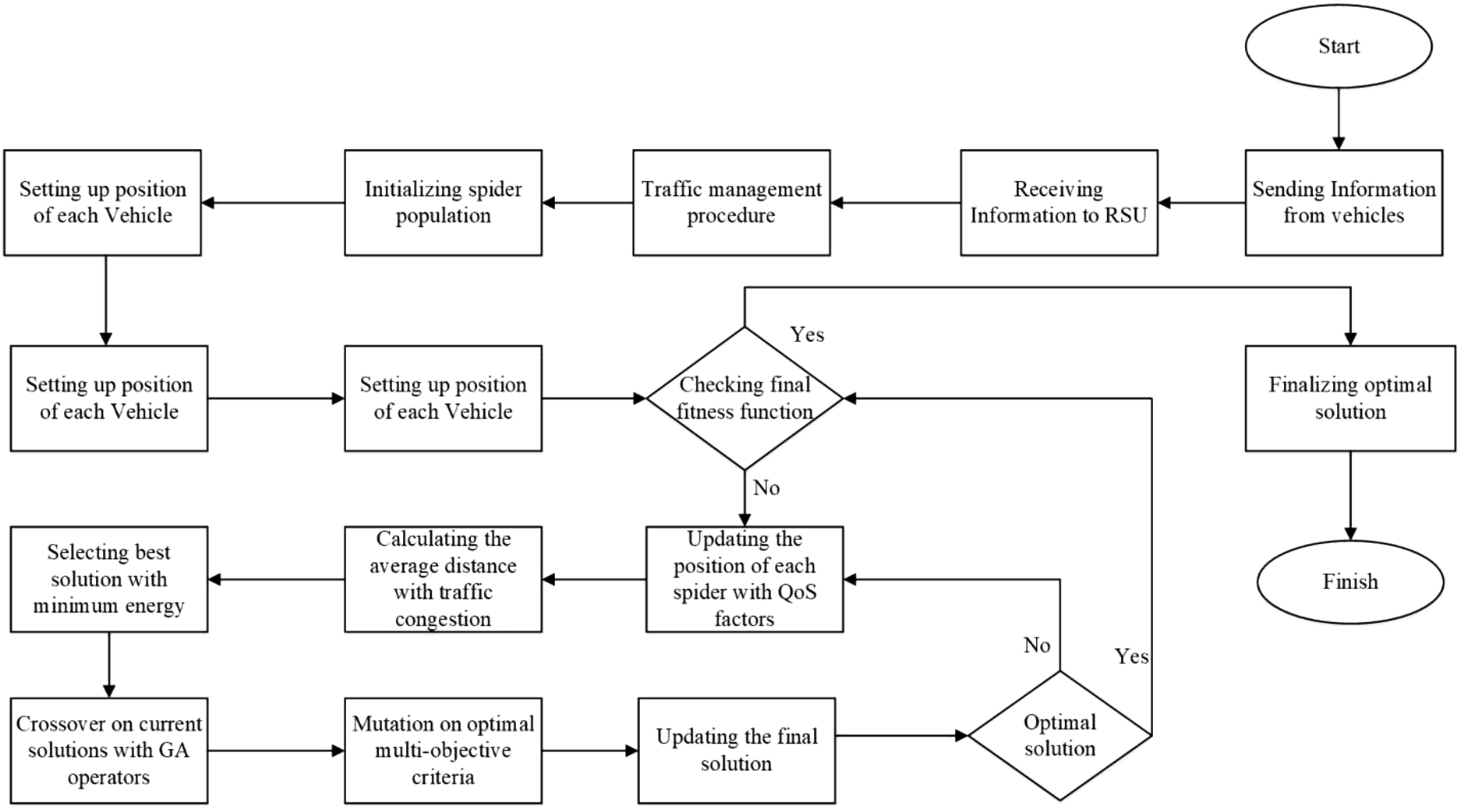
Main flowchart of the proposed GA-SSO routing method in the IoV environments.
According to Table 2, in the social spider algorithm, the initial population is first calculated. The coordinates of the center of each area are evaluated and the distance between the two nodes is calculated and the average communication radius will be calculated too, which equivalent to the proportion of the answer is obtained by each spider. Taking into account the vibrations of the spiders, the amount of coverage is calculated for each node and then the sum of the distance from each point to the target points is obtained. Proportional to the value of the parameters of each node, a value is obtained for it. The nodes are sorted in descending order of magnitude. Half of the points with the highest value are selected and these parameters are stored. Then, using the desired algorithm, their location is also determined. The total number of points is specified, followed by the number of points to be selected. This process is repeated over and over again to achieve the optimal value. The algorithm first calculates the total fitting values of the artificial spiders in different network positions and updates the global optimization value if necessary and possible. Fit values are evaluated only once for each spider in each iteration, and spiders evaluated during the iteration produce vibrations in their position. After generating the vibrations, the algorithm simulates the process of these vibrations. Each spider, after generating the vibration, receives a value that indicates the population of the spiders, and the information received from these vibrations includes the position, the source of the vibration, and the intensity of the damping.
Existing procedure of the proposed hybrid GA-SSO algorithm
According to the above steps, the QoS factors are considered as a set of weights for each solution and it is also used to enhance the new solutions according to crossover and mutation of the genetic algorithm. Both female and male spiders have a set of weights
The movement of existing spiders in a set of populations, and the information of each IoT node in the routing algorithm depends on the total QoS factor. The total QoS factor for each optimal solution can be evaluated by equation (2):
To select a minimum energy consumption routing path, several IoV nodes are randomly selected in the network. In the proposed GA-SSO algorithm, solutions can calculate the position of each IoV node by sending a torrential process across the network, and a mutation procedure is applied to improve the performance of the QoS metrics with high fitness values.
According to equation (5), F is the total fitness function value for the routing procedure between the IoV nodes i and j with the sum of the minimum value of total energy consumption factor and maximum QoS value that include data transfer rate and packet delivery ratio in the routing strategy. Finally, the proposed method is evaluated according to the fitness function factor as the total QoS metric and energy consumption factor.
This section shows simulation results of the proposed GA-SSO algorithm in estimating hybrid QoS factors and energy-efficient routing methods through a MATLAB environment. The performance of the proposed algorithm compared with an existing algorithm such as GA, SSO, and Ant Colony Optimization (ACO) algorithms.
First, the desired parameters such as the number of network nodes, the size of the network under consideration, the size of sent and received packets, and other items mentioned examined in Table 3. Using these parameters, the proposed method according to the number of IoV nodes (50, 100, and 200) and in a different number of iterations examined to investigate the efficiency of the network under several conditions. In all comparisons of the tested network, with the help of the proposed method, it achieved a longer life and better performance because the number of nodes remaining was more than the other three methods.
In Table 3, we have shown the initial parameters of simulation environments that presents the number of sensor nodes in each round considered to be 25 and 50. The size of the square grid is 50 by 50 square meters. The required initial energy consumption to transmit packets of data in each routed path is equal 0.5 joule. The packet size is the same packet that is to be transmitted between nodes, which is 2000 bits. The next parameter shows remaining energy consumption rate as 0.1. totally, there are 25 and 50 sensor nodes for routing method and the number of IoV nodes are (50, 100, and 200).
Initial parameters for simulation environment
Initial parameters for simulation environment
To evaluate the method presented in this research, several criteria should be considered, including the feasibility of implementation in the real world. Figure 2, shows the number of IoV nodes based on minimum energy consumption factor. The amount of energy consumption for the proposed algorithm against the number of IoV nodes was compared with other algorithms for different numbers of nodes. The results are shown in Fig. 2, respectively.

Total minimum energy consumption per number of IoV nodes.
The total remaining energy of the nodes in each round: If clustering is not done, the spiders must vibrate with all the other spiders, which causes a much higher energy loss, but in clustering, the signaling is related to spiders in the same cluster. At higher levels, the mutation procedure will applied for each solution, which is minimum energy-consumption value.
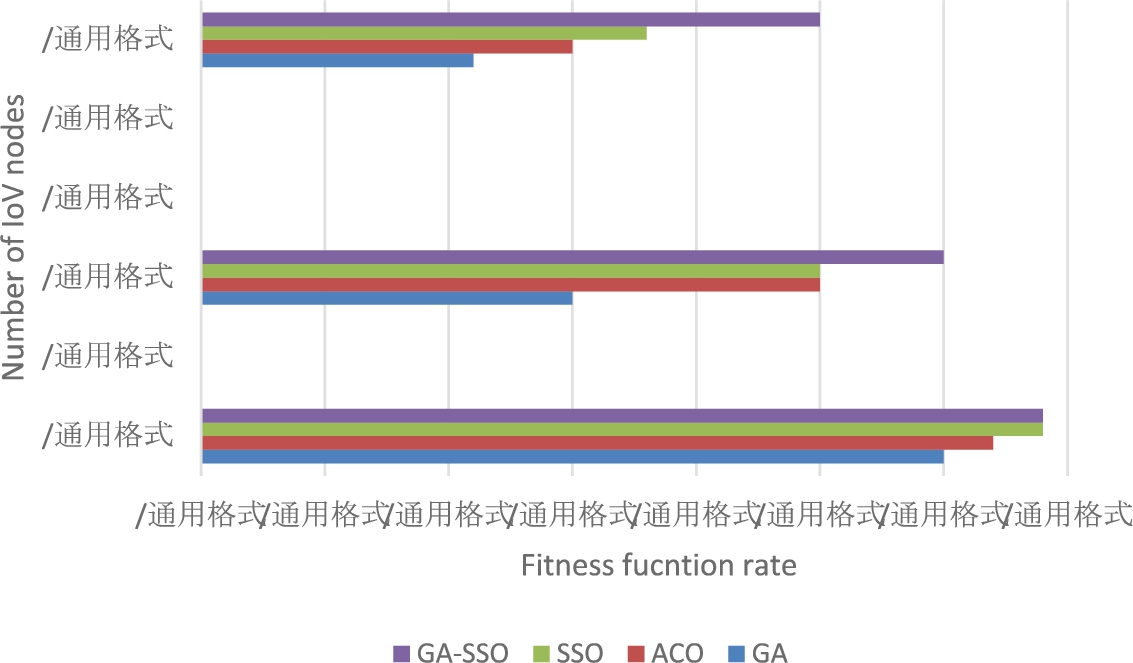
Fitness function ratio for existing algorithms in routing method.

Data transfer rate based on number of IoV nodes.

The packet delivery ratio based on the existing algorithm in IoV environments.
According to Fig. 3, the number of vehicles is 25, the number of servers is 10 and the probability of sending and receiving packages is 1. The experimental results show that changing the maximum transfer range by keeping the number of vehicles between IoV nodes has maximum fitness function for each algorithm. Therefore, we conclude that the proposed GA-SSO routing algorithm has optimized performance for total fitness function in data transfer rate, packet delivery ratio and minimum energy consumption factors in the number of IoV nodes.
Figure 4 shows a comparison of the data transfer rate versus the number of IoV nodes. Data transfer rate is mentioned that the amount of existing traffic information is moved from one vehicle node to another IoV nodes in each routing path. This rate is depends on factors such as choosing the shortest and fastest route to send data, which improves energy consumption. From the experimental results, it can be concluded that the proposed GA-SSO method has more remaining data transfer rate than other algorithms. Data transfer rate is one of the most important factors used in comparing algorithms.
Figure 5 shows a comparison of the packet delivery ratio versus the number of IoV nodes. The proposed GA-SSO method improved up to 10% the packet delivery ratio than the SSO algorithm. The packet delivery ratio in the ACO algorithm is slightly better than GA algorithms. Therefore, due to the existing comparisons, the correct performance of data delivery by the GA-SSO algorithm is better than other studied algorithms. The packet delivery ratio means the average number of data packets delivered by final source vehicle in a routing path to the total number of packets that sent from IoV nodes to final vehicle node.
In IoV networks, communicating smart devices and intelligent vehicles, and sending/receiving responses from other smart traffic management applications requires energy consumption. Also, sending a signal from the vehicle nodes in the defined domain requires energy to find other valid and desired nodes is an important and critical challenge in the IoV. Using a hybrid Genetic Algorithm and Social Spider Optimization (GA-SSO) algorithm for an energy-aware routing schema for optimizing traffic congestion and smart devices in the IoV environment, the chosen path has the lowest energy consumption. The proposed hybrid algorithm is a new algorithm whose functions and benefits are not yet fully understood. There has been a lot of research in this field that demonstrates the benefits of using it in many branches of computer science, but so far research to prove its impact on optimizing the smart city and increase security and reduce costs and overall increase the efficiency of the smart city. It was not done that this research is the first case in this field and it has reached this goal by optimizing it and using clustering. The innovation in the method of this method is that by distributing and clustering the vehicles, it has found the best way to send packets, which increase the packet delivery ratio, data transfer rate, and reduces energy consumption for traffic management approaches in IoV environments. In future work, some other intelligent algorithms such as federated learning can be applied to enhance quality of routing method based on energy consumption and data transmission date as well in the IoV environments.
Conflict of interest
None to report.