



Abstract
IP mobility support is based on terminal behavior, recognizing mobility and maintaining a continuous communication session.
The existing mobile IP location registration sends a message to one or more routers during a handoff within a domain by using a multicast address to process messages continuously. This implementation requires persistent message processing among all routers to determine new multicast address assignments. To solve this problem, we propose a method that enables the mobile user to obtain a QoS guarantee when the mobile device moves to an overlapping area under the mobile IP. Therefore, dynamic mobility management includes location updates under the mobile IP, and transmission of packets from the expected access points. When a handoff occurs while the mobile device is connected, the mobile host dynamically adapts to the mobility characteristics of the mobile node and transmits missed packets.
In addition, by first using a location router, handoff latency reduction and packet loss requirements between domains in the overlapping mobile network environment are resolved. Second, the proposed algorithm has low-control traffic in the mobile network, allowing quick handoffs. Although instantaneous throughput is reduced during handoffs, tunneling is reduced by 10-30%, even after a handoff, by retransmitting packets missed by the mobile host, while location-registration-update times are reduced by 20-80%.
Keywords
Introduction
Mobility support in IP networks is an important research topic because IP networks started with services provided for switched circuits such as voice [7,10,13].
Existing IP mobility support such as mobile IPv4 and IPv6 must recognize mobility based on the terminal, and must work to maintain a communication session continuously.
The key point is to develop a method to provide mobility support for terminals that move and change access points within a specific area. In this method, terminals perform only standard IP operations without any related specific functions in the IP layer.
The structure proposed in this paper includes a function to receive information flow to terminals through different network interfaces connected at the same time. In addition, in such a situation, multicast traffic and handover procedures necessary for the operator, as well as a mobile network for users, can be supported.
A Mobile IP Network (MIPN) [16] can change locations in different subnets of the Mobile Host (MH). The MH has a permanent address registered in the home network, and its IP address does not change, can be used for identification and routing, and is stored with the Home Agent (HA). At this time, the location update cost may be excessive due to the relatively high mobility and long distances in the HA.
The Call-to-Mobility Ratio (CMR) [18] is the ratio of the number of calls to find a mobile client to the number of crossings of cell boundaries. When the CMR is small, there are few location calls to the mobile client per cell boundary crossing, and generating a location update in the mobile client does not reduce the cost of searching for the mobile client.
The provision of various types of real-time multimedia to mobile users has become the main purpose of next-generation wireless networks based on IP, and stable support of the Internet backbone is required [2].
Such a wireless mobile Internet must provide fast handoffs and QoS for an IP-based wireless access network. This is because handoff delay is an important issue for quality of service in a mobile network. For this, technology supporting the IP platform between the endpoints of a real-time multimedia service in a wireless network, and development of the wireless Internet infrastructure, must be provided [8,14,19].
To solve this problem, this paper uses two schemes to support QoS in the mobile Internet. The Location Registration Scheme (LRS) and the IP Datacast Dynamic Scheme (DDS) support handoffs and multicast Avoid-message overhead for groups. This prevents multicast address collisions and enables quick handoffs in domains.
Existing handoff techniques [9,15] do not provide much information on cross-domain handoffs owing to exclusion of this type of handoff. However, the proposed method determines whether to send a registration request to HAs or the MN’s previous domain Foreign Agents (FAs) using location information of the domain FAs. If the MN does not move away from the HA, based on comparing the distance from the HA, the local HA function is given. Therefore, the proposed method can transmit a packet from the expected access point, and when the mobile device is connected again, transmits any packet missed by the MN during the handoff. In this proposed method, although instantaneous throughput is reduced during a handoff, the MN is compensated with improved throughput after the handoff by retransmitting the missed packet.
The structure of this article presents related research in Section 2. Section 3 shows the method proposed, and Section 4 shows performance comparison of the proposed method against the existing method. Section 5 presents the paper’s conclusion and suggests future research directions.
Related work
Mobile-network-based section mobility management
When the IPv4 protocol was designed, user mobility was not considered part of the Internet [3]. Therefore, the protocol was designed to use IP addresses in two different roles: as a locator and as an identifier (without mobility). Since then, IPv6 was designed with the same roles but without distinguishing between the two.
Mobile services based on mobile IP are shown in Fig. 1. However, mobility requires separating the identifier’s information from the locator role. This is because, as an identifier, the address of a node never changes, but a locator needs to be changed whenever the node moves to a new location. In order to solve this problem, it is necessary to provide a method for separating the two roles by using two different addresses: a Home Address (HoA) as an identifier and a Care-of-Address (CoA) as a locator.
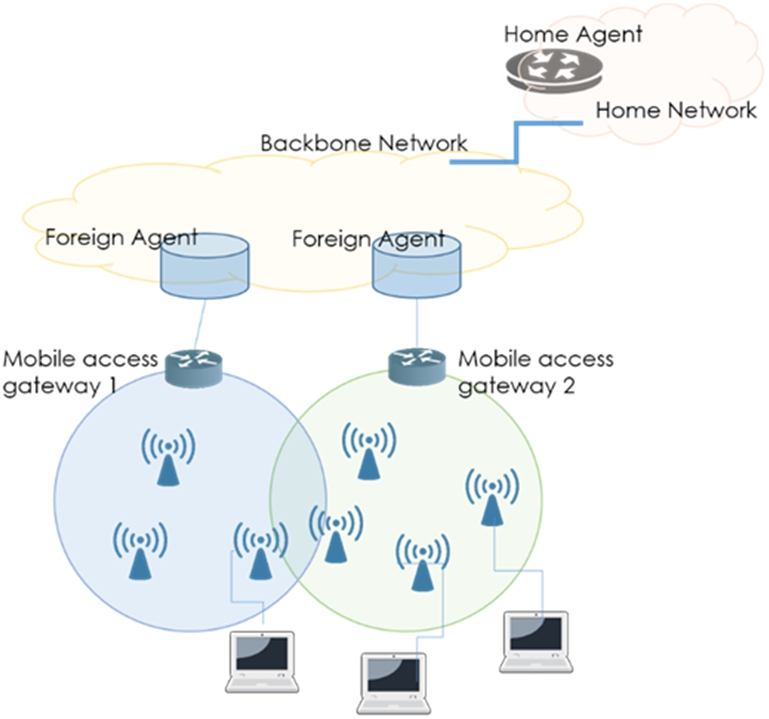
A mobility service system based on mobile IP.
However, the HoA should be maintained as a permanent identifier for a mobile node in a network, and the CoA should be updated whenever the MN of the sub-network changes.
Although mobile IP enables mobility in MNs [1] by allowing a change in connection point on the IP network while maintaining a permanent identification, it does not provide optimal and efficient handovers. In order to solve this problem, the MN needs a method that supports IP mobility and includes a function for receiving information flow to a terminal through different network interfaces connected at the same time.
Session Initiation Protocol (SIP) [22] is widely used as an application layer protocol for Internet multimedia and telephony services that can be used on the wireless Internet. As shown in Fig. 2, the technology to accommodate mobility among multimedia services with SIP is to deliver the changed IP address directly to the communication server or Correspondent Node (CN). The MN delivers an INVITE message directly to the CN with the new IP address and updated session information. Therefore, the location update has a one-way delay after the MN confirms the IP address change.
Mobile IPv6 has a local IP address and the CoA and is based on an HA for the MN to use a foreign network. The HA intercepts all packets and transmits the CoA through IP tunneling.
Mobile IP is burdened by a potential handoff delay and the signal transmission load from packet transmission. Many methods have been proposed to reduce the delay in the location registration step [21]. SIP is a simple text-based protocol used for call/session control, with various methods defined, such as INVITE, ACK, BYE, OPTIONS, CANCEL, and REGISTER for setting up sessions between various users.

The SIP-based mobility management structure.
Management, as shown in Fig. 2, is a process used to find the current location of the mobile user in order to deliver a mobile network message. The first step is location registration. In this way, mobile users are periodically notified of a network with new access points [20].
In this chapter, the Location Registration Scheme and the Datacast Dynamic Scheme proposed in this paper are presented.
Job scheduling for the IP datacast dynamic scheme
In this paper, we propose an LRS for a mobile IP as a basic structure. The Mobile Agent is similar to Mobile IP Local (Internal: Local) registration, which uses a Gateway Foreign Agent (GFA) and supports direct use of packets, as seen in Fig. 3. The MN selects and registers its own CoA with an external Visitor Location Register (VLR), which in turn performs location registration of the MN. The LRS will return a response within the time allowed by the MN.
This process includes the services required by the MN for the related HA information of the related FA and the new Care-of-Address. The registration process is composed of changes between the MN and the HA with two messages, the registration request and the registration response, and this is called blinding modified.
Figure 3 shows the proposed mobile IP network structure. The main processing steps for each stage of the proposed structure are as follows.
Support real-time network environments.
Connect the MNs and CNs having different arrival rates in the network to the FA or the HA.
The registration, discovery, tunneling, and routing procedures associated with the MN will process other tasks with specific priorities.
To support the HA multiprocessing agents, the Home Agent handles duplicate binding updates to support failovers.
Other jobs that arrive for the agent are quickly processed by the main processor.

The proposed mobile IP network structure.
Figure 3 illustrates a new algorithm defined for mobility management based on the architecture. This algorithm is based on bidirectional Mobile IPv6 and provides priority management in real time. The proposed algorithm is based on the structure proposed above [Figs 3 and 4], and defines a new algorithm for mobility management.
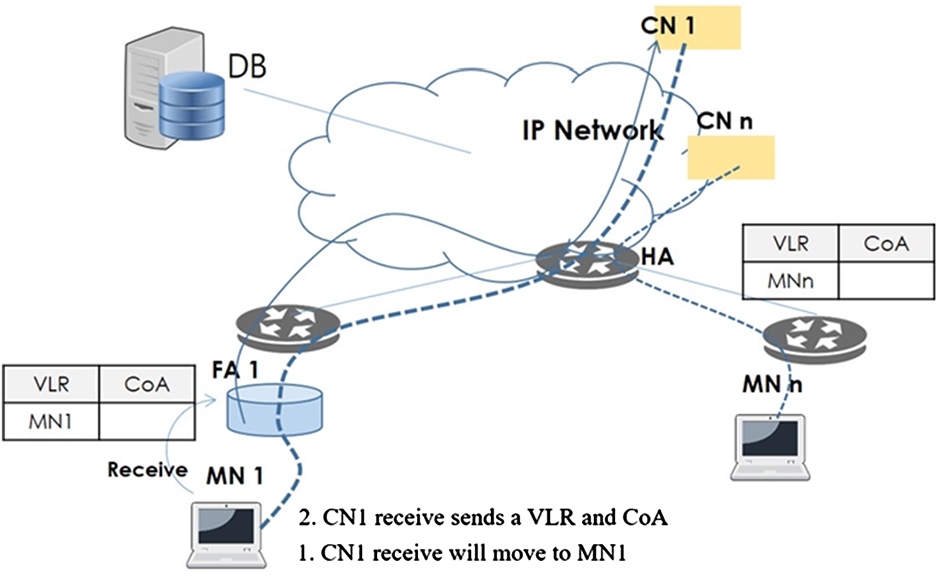
Task assignment and location registration in the proposed mobility management.
The proposed algorithm adds the lifecycle scope used in Mobile IPv6. Also, instead of waiting for external information, the MN at the starting position allows an initial FA location search. In addition, the proposed algorithm can maintain a list of the most recent FAs that try to connect first, before any broadcast searches are initialized. Figure 4 shows the processing of the task scheduling and allocation algorithm.
Tasks are sorted and assigned to processors based on deadlines. If tasks have a short deadline, they are assigned to the fastest processor; otherwise, they are assigned to the regular processor. A task is assigned to a processor only when the current utilization is less than 1. Therefore, the processor is not utilized to its full capacity as a full processor while other processors are not being used.
The VLR registration procedure is a task executed by the HA with the highest priority. These tasks may preempt other mobility management tasks for the current user.
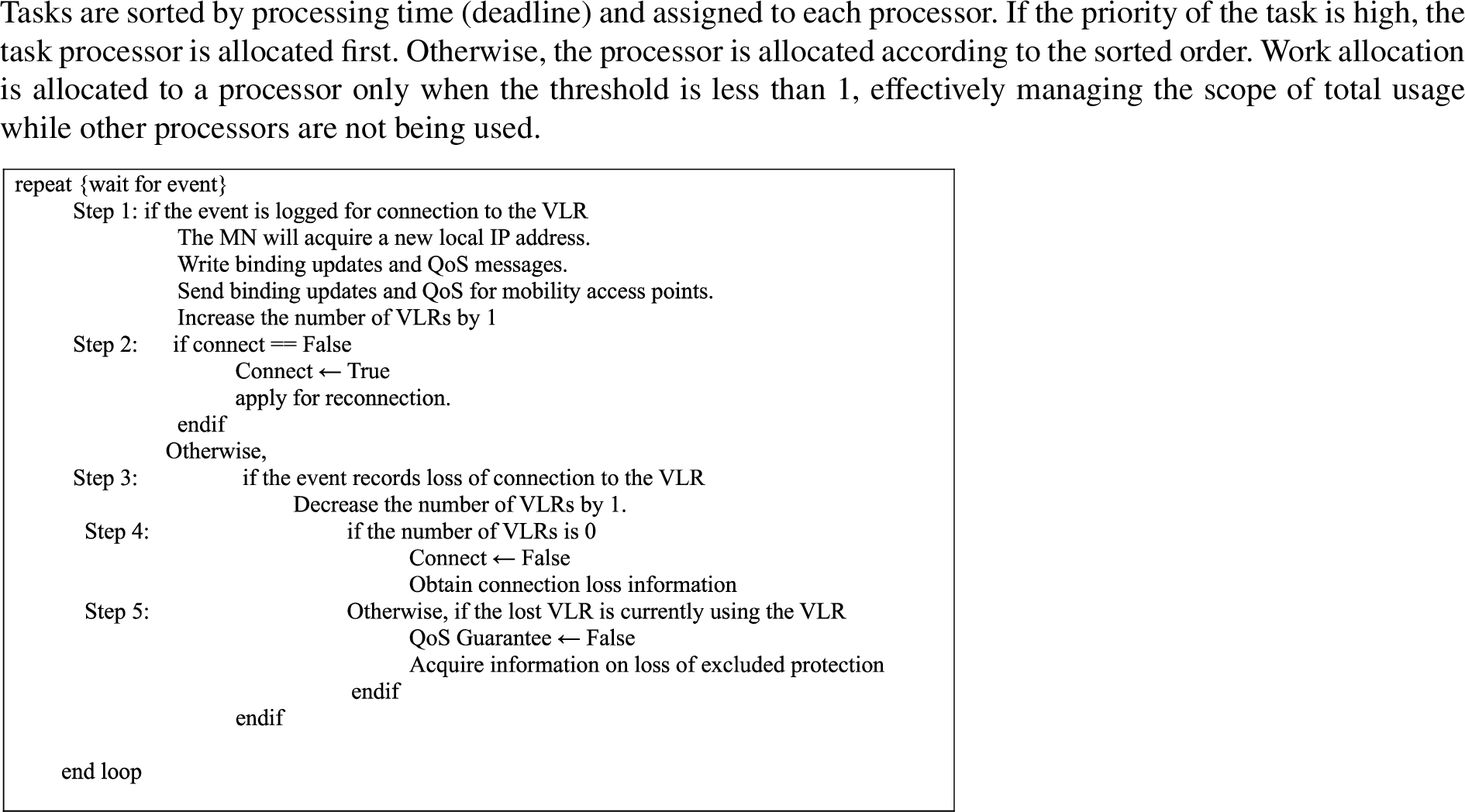
Task scheduling and allocation algorithm
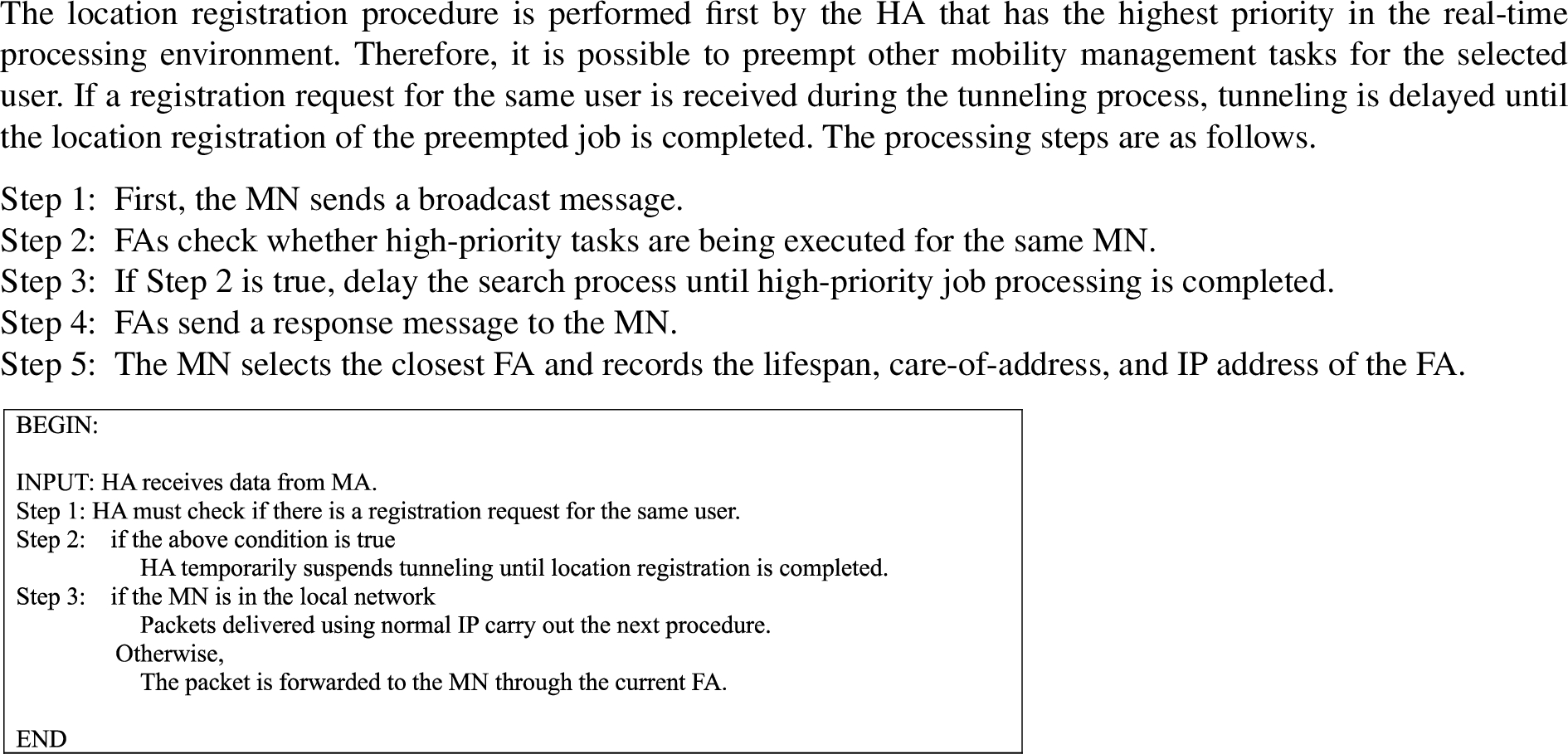
Routing and tunneling algorithm for location registration
That is, if a registration request for the same user is received, the tunneling process delays processing until registration for the user is completed.
The task assignment and location registration steps for mobility management in Fig. 4 are as follows.
The MN sends a registration request to the HA.
The HA double-checks that no operation other than registration is being processed for the same user.
If so, the job is processed first for registration.
The HA sends a response message to the MN.
If the request is not accepted, when the registration process is completed, the MN will retry the process until the request is accepted.
IP datacast transmission complements and enhances the bi-directional access system’s mobile Internet service, which is based on various approaches [6] to integrating network terminals of the system. It is based on integrating the services of the terminal.
In a hybrid terminal [11] with bidirectional access and an IP datacast processing capability, the MN stores the IP addresses of mobile agents in a buffer, and one MN records the FA’s address in the buffer when registering a new FA. If a new subnet of the MN is detected, a registration request transmission for the FA’s registered IP address is processed.
The MN compares the IP address of the FA in the new subnet with the address stored in its buffer. If the current FA address is not there, the MN writes it to the buffer.
If the total number of addresses in the buffer and the number of addresses of the current FA exceed a set threshold, the contents of the MN’s buffer are deleted, and a new address is registered. Such dynamic processing of the MN is the same as Algorithm 1 following bidirectional access.
The algorithm for the search will first determine the priority of the work in the real-time environment based on lifetime expiry and scope. A search procedure has second priority.
The proposed algorithm is based on the structure proposed above [Figs. 3 and 4], defining a new algorithm for mobility management is the same as Algorithm 2.
In this chapter, we present a performance analysis of the proposed method compared to the existing Call-to-Mobility Ratio (CRM). In the existing method, the location update of the MN is completed after multicasting by the CN, but the proposed method uses multicasting for the location update of the MN. At this time, the total cost is calculated based on the MN’s initial registration and the location update of the network related to data transmission and connection costs. The data transfer cost includes the size of the data (in bits) shared between nodes, and the cost of binding for the location registration update at the destination. The connection cost includes the cost of initial connection establishment, the number of messages with the host, the cost of control packets transmitted between the networks visited by the mobile user, and the cost of updating the location registration.
The performance analysis is based on the existing CRM [4,11,17] and the proposed Dynamic Call Mobility Ratio (DCMR). The DCMR is the average number of networks visited by mobile users at a given time, or the average number of messages sent to users, divided by the number of subnets.
The purpose of DCMR performance analysis is to compare the performance of the algorithm to the existing method based on reducing the user’s location update and tunneling time. Therefore,
The system environment for the computer simulation of the scheme proposed in Mobile IP and SIP [15,21] in the home network and the external network is as follows.
The simulation environment included the HA, the FA and three corresponding PC environments, and one laptop playing the role of the MN. The network used was 1 Gbit/s Ethernet with an eight-port hub. The implementation of the mobile IP algorithm and the proposed structure and algorithm were simulated in real time. The simulation results include the number of tasks the HA missed, the average location update time, the average tunneling time, and the number and speed of the MN and HA processors. Table 1 shows the parameter definitions used to evaluate the performance of DCMR in the mobile IP environment.
Parameter Definition
Parameter Definition
The total cost calculation is as follows.
Thus,
In the performance evaluation, the DCMR is the average number of messages sent to a user divided by the average number of networks visited by the user at a specified time. The purpose of the DCMR is to determine the rate at which the MN’s location-update and tunneling times are reduced. Figure 5 compares the existing CRM [4,5,12,17,23] with the proposed DCMR, and we can see that the location-update and tunneling times are reduced by at least 50% and 25%, respectively.
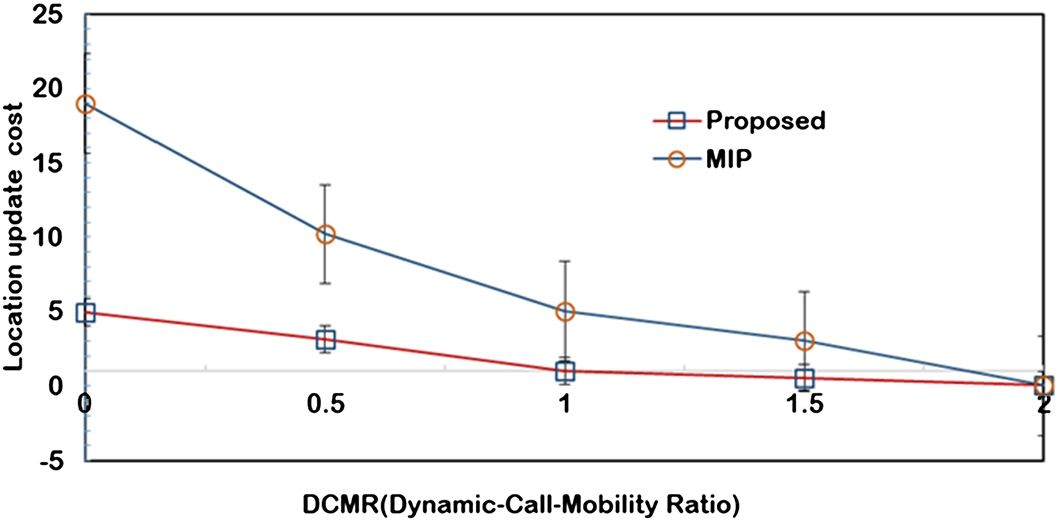
Comparison of location update cost (
Figures 6 and 7 show the existing CRM and the proposed DCMR when the MN exists on the home network, when the HA is away from the MN and connected by a wireless link, and when the MN and the HA are close to each other. The figures compare the transmission time for location registration update between the MN and the FA under DCMR. CRM does not include multicasting to determine the location of the MN. However, the proposed method supports a minimum transmission time whenever a host distributes a data packet with a location update in a mobile IP network.

Comparison of location update cost (
The DCMR-based architecture proposed in Figs 5 and 6 shortens the location update time by 80% for c (location update procedure execution cost) = 0.2, and by 50% for c (location update procedure execution cost) for a small value of dynamic call mobility. When the dynamic call movement rate increases, mobile users can maintain a longer connection in the same network, and when the location update time increases, both the existing method [5] and the proposed method showed close to zero results.
Figure 7 shows the total cost of location update and tunneling. It shows a decrease from 67% to 80% when
In Mobile IP, the location update time is constant and does not depend on the user’s arrival rate in the network. The location update’s average rate is about one second. In the proposed method, the location update’s time increases according to the user’s arrival rate. The maximum increase was about 0.8 seconds. Figure 7 shows the average time for location updates at different arrival times in the network.
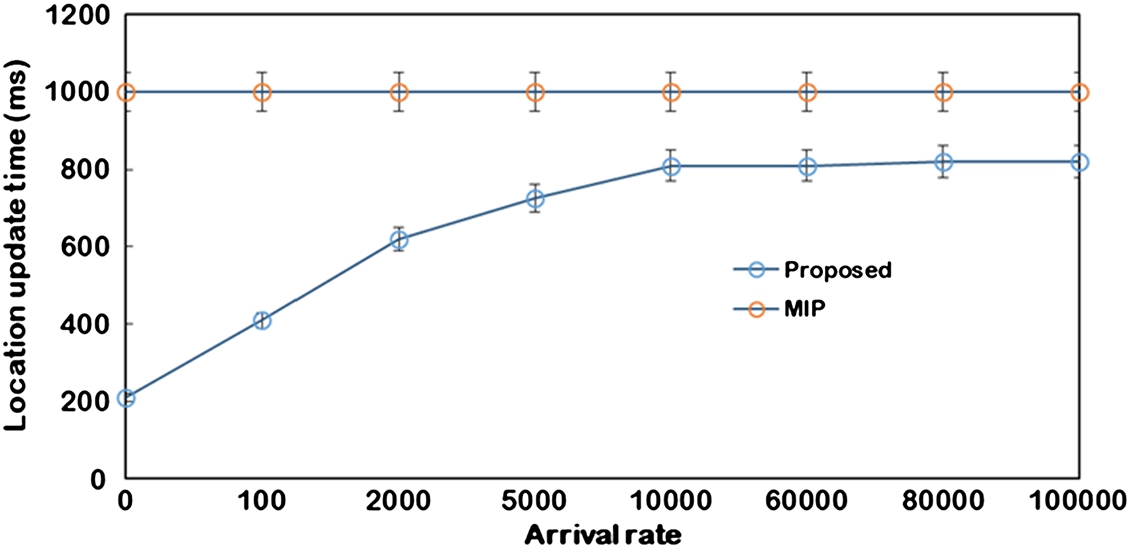
Comparison of average times for

Comparison of average tunneling time of
In Fig. 7, the location update time was reduced by 80% when the dynamic call movement rate was 0.2, and in [Fig. 8], the location update time was reduced by 50% when the dynamic call movement rate was 0.5. As a result, the number of location update requests from high-priority mobile users and task processing scheduling at the HA indicated that the proposed method manages user mobility faster than the existing method. In the Mobile IP architecture, message
Figure 8 shows the fragmentation time as the delay time from the MN to the HA. MN and HA are connected wirelessly on the network. MN and HA have large delay. When sending a message to the home network, a delay time between the MN home network and the HA is added.
As a result, the total processing time in the system was reduced. Therefore, tunneling time was reduced from 10% to 30% in the proposed method. This is the result of exceeding the 25% target set by the proposed method.
We presented a novel approach to a mobile IP architecture as well as a real-time mobility management algorithm. Compared to existing methods and algorithms, implementation of the proposed structure and algorithm showed better results in terms of average location-update and tunneling times, as well as dynamic call movement rates. Performance evaluation of the proposed algorithm showed tunneling time was reduced 10-30%, while the location update time was reduced 20-80%. These results satisfy the time constraints under a real-time system environment.
This paper proposed a method that enables a mobile user to obtain QoS assurances when a mobile device moves to an overlapping area under the mobile IP. First, by using a location router, handoff latency reduction and packet loss requirements between domains were resolved in an overlapping mobile network environment. Second, the proposed algorithm has low-control traffic, and a fast handoff is possible. Therefore, it provides a dynamic scheme for location transmissions and IP transmissions requested by the user through the IP datacast dynamic structure and the IP transmission structure. Therefore, the cost of updating the location of the network for mobile users is reduced, and Mobile IP overlapping is effective at reducing delay for dynamic mobility management.
In the existing algorithm, processors must have the same speed to ensure optimal scheduling and allocation, but the scheduling and allocation algorithm of the proposed method is optimized for different numbers of processors at various speeds.
The proposed method implements new algorithms and structures as well as real-time algorithms in real networks. Since the current protocol is designed for micro-mobility, it will be very useful for real-time implementation in future studies, and will be able to achieve optimal results. In addition, research is needed to ensure the reliability of data by shortening the location update time by improving the mobility management algorithm proposed in this paper. Furthermore, in order to implement versatility, more research should be conducted on how to manage a large amount of real-time information as well as client location information in the future by integrating intelligence and mobility.
In addition, in order to realize versatility, a method for managing a large amount of real-time information as well as location information of a client by integrating intelligence and mobility should be studied further.
Conflict of interest
The author has no conflict of interest to report.