



Abstract
Aiming at the problem of delay and packet loss in current remote network, a delay compensation algorithm for high-speed network is studied and applied to the remote auction of digital art works. High-speed network delay mainly includes: transmission processing delay, waiting delay, transmission delay, and reception processing delay. The delay model of high-speed network is designed by using a time division multiple access protocol. Based on the high-speed network delay model, the Kalman filter is used to design the high-speed network delay control algorithm to maintain the high-speed network delay. At the same time, the round-trip delay compensation algorithm based on link delay is used to compensate the high-speed network delay. The experimental results show that the proposed method compensates the delay of more than 235 ms, and the packet loss rate of high-speed network is only 0.59%, and the throughput reaches 241 Mbit/s, which validates the algorithm can effectively compensate the delay of high-speed network and reduce the packet loss rate of high-speed network.
Keywords
Introduction
There are many information sources in the high-speed network, and it needs to occupy the multi-channel data time-sharing transmission while the carrying capacity and communication bandwidth of the network are limited, resulting in information collision, retransmission, and other phenomena, so there is a high delay in the transmission process of information [3,6,9]. The delay of high-speed network greatly reduces the enforceability of communication network transmission scheme [11], and even leads to the instability of communication network. Even if the communication network remains stable, the amount of stable area is significantly reduced. Therefore, the delay problem of high-speed network has gradually attracted the attention of relevant scholars [4], and the delay compensation method of high-speed network has been deeply studied.
Shi et al. studied a new fast flooding method with real-time delay compensation for time synchronization in wireless sensor networks [12], which compensates for the delay of wireless sensor networks. The flooding delay of reference time information is significantly reduced by using the fast flooding protocol, and the joint clock skew offset maximum likelihood estimation (MLE) is designed in order to obtain accurate clock parameter estimation and real-time packet delay estimation, and achieve efficient delay compensation.; however, this method has the problem of high packet loss rate after compensation. The experimental studies show that this method can improve the delay problem of wireless sensor networks. Tian et al. studied time synchronization based on delay compensation under random delay: algorithm and experiments [16]. This method is aimed at wireless sensor networks with random bounded communication delays. It is analyzed and clarified that under the framework of a time synchronization algorithm based on consistency. Despite the drift estimation converging at a rate higher than the sampling rate, drift estimation may still diverge when there is an uncertain delay, in networks with at least two root nodes. Finally, the delay compensation mechanism is introduced in the offset estimation algorithm, and the first-order difference of offset estimation is used to adjust the delay compensation adaptively, and the upper bound of adjustment gain is given to ensure the boundedness of offset estimation, so as to realize the delay compensation of high-speed network. However, the application scope of this method is small, and it is not suitable for the diversity of high-speed network delay compensation.
Aiming at its existing problems, this paper studies the high-speed network delay compensation algorithm and applies it in remote auction based on the above three communication network delay compensation methods. This method analyzes the types of high-speed network delay in detail. Based on this, the network speech model is constructed through time division multiple access (TDMA) protocol, and the compensation method is designed in combination with the round-trip delay compensation algorithm of link delay [23] in order to effectively compensate the delay of high-speed network and improve the performance of high-speed network.
Analysis of high-speed network delay
Analysis of high speed network delay
The premise of solving the impact of high-speed network delay is to understand the mechanism of network delay. The delay changes with the load of high-speed network, which is time-varying and uncertain. The existence of delay reduces the network communication performance [20]. There may be many different properties of network delay (constant, bounded, random time-varying, etc.) although the analysis and modeling technology of network delay has made great progress in recent years [1,10,13], which makes the existing methods generally unable to be directly applied. And the process of information transmission is essentially the process of a device (node) on the communication network in the high-speed network, in which the task generates and sends information [17]. The data is encapsulated by various layers of protocols, parsed into packets, and reaches another device through the network channel. The delay in high-speed network can be divided into four components according to the different characteristics of the network delay generation process: transmission processing delay
In Eq. (1), Transmission and processing delay Waiting delay Transmission delay In Eq. (2), N represents the number of bits of the data frame sent by the communication network, Receiving and processing delay
High speed network delay model design
A high-speed network delay model is established based on the analysis of high-speed network delay [5,14,19]. Time-division multiple access (TDMA) protocol [15] is widely used in high-speed networks as an effective multiple access method. A TDMA protocol has N transmission units, and the transmission time of the message is divided into continuous time frames, and each time frame is composed of continuous time slots. Let τ be the size of time slots, and M be the number of time slots per frame. When the communication units of high-speed network are allocated time slot transmission messages in a certain time frame, a message will be formed every several time slots. If the message transmitted in the communication unit of the high-speed network is the number of time slots
The expression of probability generating function is as follows:
When the message reaches the communication network, the service time follows the random distribution principle, where n represents the communication node,
Assuming tht the communication bits of high-speed networks are distriubted independently, the message transmission process is abstracted as a queuing system. Accordng to the message first-come-first-served rule, the second moment transformation is carried out. Let
In Eq. (5),
According to
Eq. (7) gives the message transmission delay when the communication unit of the high-speed network allocates only one time slot in each time frame. This conclusion is generalized, that is, the communication unit allocates multiple time slots in each time frame, and the allocated time slot positions are evenly distributed in the time frame. Suppose that the number of time slots allocated by the communication unit in each time frame is
According to the TDMA protocol, let each message consists of only one packet, that is,
High speed network delay control algorithm
A high-speed network delay control algorithm based on Kalman filter is designed for the established high-speed network delay model, the route detection protocol of high-speed network transmission process is designed by the shortest path optimization method, and the fractional interval equilibrium control model of high-speed network output is constructed. The adaptive allocation function of the geometric center position of each region of high-speed network is obtained as follows:
In Eq. (9), A represents the amplitude of information collected by high-speed network and compressed sensing,
Using the node self-detection method, the characteristic distribution coefficient of high-speed network modulation and demodulation can be expressed as:
To sum up, the normalized root mean square error modulation method of neighbor node set is adopted to balance the output capacity, and establish the delay error compensation model of high-speed network. The output delay error is
In Eq. (12),
The optimal function of low delay control of high-speed network obtained by using multipath expansion method is:
Using the above process, the low delay control of high-speed network data transmission process is realized, and the channel allocation and error compensation of high-speed network are carried out according to the delay control results, so as to improve the anti-interference ability of high-speed network data transmission.
Round trip delay compensation algorithm based on link delay
The round-trip delay compensation algorithm [23] based on link delay is used to compensate the high-speed network delay based on the high-speed network delay control [2,7,8]. There are often great differences between high-speed network communication paths, which cannot ensure that the round trip time (RTT) of each path is equal. Learn from the biogeography-based optimizatio (BBO) routing idea [18]. When balancing the delay congestion of high-speed network, balance the load on each subflow according to the bandwidth occupation ratio of each subflow. The implementation process is that when a confirmation character is received on the subflow, the congestion window
The round-trip delay compensation algorithm based on link delay considers the influence of different link delays of each subflow on the growth of subflow window, and the influence of round-trip delay
The sleep of high-speed network interface will lead to the loss of transmission data. It is assumed that all paths of high-speed network have the same packet loss rate. Each window is increased by the confirmation character, and the packet loss is reduced. There must be a balance between the increase and decrease of the equation. Therefore, the set α must meet the equation, that is, “receipt Acknowledgement (ACK) rate” × “Average increment per confirmed character” = “packet loss rate” × “average reduction per packet loss”. The equation is as follows:
According to the first goal of multipath transmission control protocol – congestion control protocol: the throughput of a multipath transmission control protocol flow is not lower than that of any transmission control protocol under the optimal single path, we can get:
The second goal: the capacity of a multi-path flow to preempt any shared resources from different paths cannot be more than that obtained when a single data flow is transmitted in a single path, that is:
In order to meet the first and second objectives of congestion control of high-speed network multipath transmission control protocol, a joint expression is established as follows:
In Eq. (18),
Integrating the above analysis process, we can deduce the expression of α as follows:
It can be seen from the expression that in the round trip delay compensation algorithm of link delay [21], the aggression factor α is determined by the round trip delay,
Results
This method is applied to the high-speed network of a digital art remote network auction in order to verify the performance of the studied high-speed network delay compensation algorithm in high-speed network. The bandwidth of the high-speed network is 26.8 kbps, the working frequency band is 1024 mhz, and the packet length is 85 bytes. The specific experimental parameters are shown in Table 1.
Statistics of communication delays changes in high-speed networks. If the delay is more than 200 ms, it indicates a packet loss in the online remote auction of digital artwork. Compare the changes of communication delay in high-speed networks before and after applying the developed algorithm, the results of delay distribution in certain high-speed networks are shown in Fig. 1. By analyzing the experimental results in Fig. 1, we can see that the delay distribution of high-speed network is periodic, but it is not a fixed period. The delay of the network is fluctuating, but it can be stable in a fixed range in a short time. Before using this algorithm to compensate the network delay, there is obvious packet loss in the auction network, and the delay is high. After using this algorithm to compensate the delay, there is no packet loss in the network, and the communication delay has been significantly reduced, which verifies the effectiveness of this algorithm.
Experimental parameter settings
Experimental parameter settings

High-speed network latency distribution in remote auctions of digital artworks.
When the high-speed network is running, the throughput of the communication network changes, and the throughput change results of the algorithm in this paper are compared with the algorithms [12,16]. The results are shown in Fig. 2.
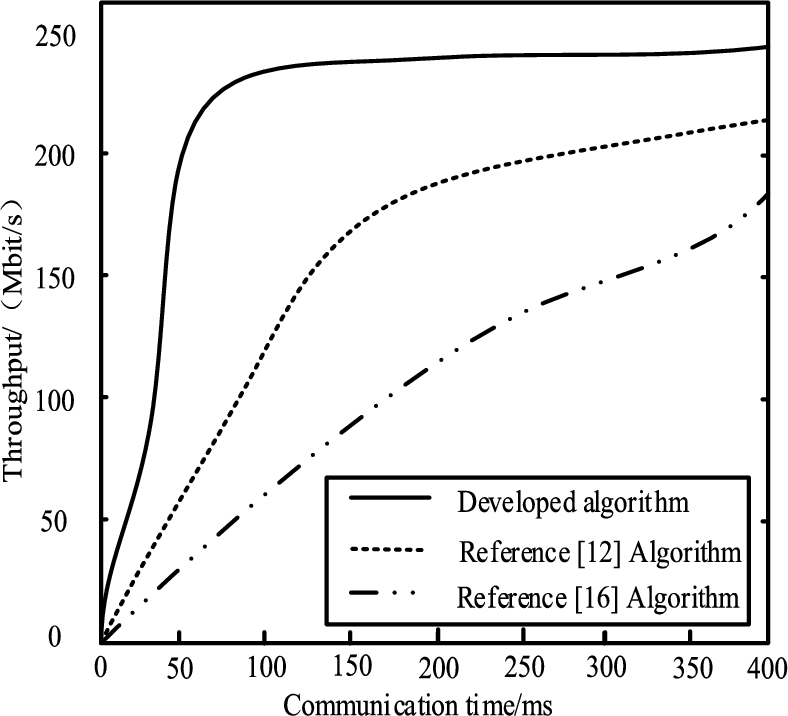
Variation of high-speed network throughput in remote auctions of digital artworks.
The throughput has been significantly improved after the algorithm in this paper is used to compensate the high-speed network delay according to the experimental results in Fig. 2. The maximum throughput of this method is 241 Mbit/s, and the maximum throughput of the literature method is only 212 Mbit/s and 139 Mbit/s, which is 29 Mbit/s and 102 Mbit/s higher than the literature method, the experimental results in Fig. 2 show that using this algorithm to compensate network delay can effectively compensate network delay and improve network throughput.
When the algorithm in this paper is used to compensate the network delay, the packet loss rate of the communication network, and the algorithm in this paper is compared with the algorithm [12,16]. The comparison results are shown in Fig. 3.

High-speed network packet loss rate in remote auction of digital artworks.
From the experimental results in Fig. 3, it can be seen that the packet loss rate of high-speed network using the algorithm in this paper to compensate the delay of high-speed network is significantly lower than that of the algorithms [12,16]. The packet loss rate is the direct embodiment of the network communication delay state. According to data analysis, the highest packet loss rate of this method is only 0.59%, while the lowest packet loss rate of literature [12] method and literature [16] method reaches 2.58% and 1.21%. Compared with the three methods, this method reduces 1.99% and 0.62%, therefore, using this algorithm to compensate the high-speed network delay, the packet loss rate of the high-speed network is significantly reduced, indicating that the delay of the high-speed network has been significantly improved, which verifies that this algorithm is effective for the high-speed network delay compensation.
The compensation of network delay when different digital artworks are auctioned on the network is counted after the algorithm in this paper is used to compensate the high-speed network delay. The statistical results are shown in Table 2.
Compensation results of high-speed network delay in remote auction of digital artworks
It can be seen that the algorithm in this paper can effectively compensate the delay of high-speed network from the experimental results in Table 2, the method compensates the delay of more than 235 ms, and the maximum value reaches 754 ms. After compensation by the algorithm in this paper, the delay of high-speed network is significantly reduced. It improves the defects of slow communication speed and affects the practical application in the high-speed network, improves the applicability of the high-speed network, and helps both sides of the auction transaction successfully complete the remote auction of digital art works.
The high-speed network has a long delay, which leads to serious packet loss of network data. In order to improve the throughput of the high-speed network, this paper designs a high-speed network delay compensation algorithm by using the Eq. (9) to Eq. (20) in order to improve the packet loss caused by network delay in high-speed network, and applies this algorithm to the practical application of network auction. It also showed that the developed algorithm can effectively improve the communication delay of high-speed network and improve the real-time performance of auction. Experimental results show that the algorithm has better performance in compensating for the delay of high-speed networks and reduces the delay overhead of high-speed networks. The proposed method can be used in future remote sensing research.
Footnotes
Acknowledgements
This paper was funded by the Jiangxi Province Literature and Art Federation Project (Jiangxi Federation of Literature and Art) under no. [2017]024.
Conflict of interest
None to report.