




Abstract
Channel estimation is crucial for massive multiple-input multiple-output (MIMO) systems to scale up multi-user (MU) MIMO, providing great improvement in spectral and energy efficiency. The nature of non-orthogonal cause pilot contamination is experienced only while estimating multi-cell MIMO scheme with the training and it is misplaced while narrowing concentration to multi-cell or one-cell setting, where information of the channel is assumed to be obtainable at no cost. Non-orthogonal multiple access (NOMA) serves numerous users concurrently utilizing channel gain differences. The advancement in massive MIMO-NOMA technology has offered diverse techniques recently for reducing pilot contamination in massive MIMO-NOMA based on pilot allocation. Here, a new approach called War Strategy Chimp Optimization+Deep Neuro-Fuzzy Network (WSChO+DNFN) is designed for the estimation of channels to reduce pilot contamination in a massive MIMO-NOMA system. It takes place in two phases, the transmitter and the receiver phase. The channel estimation is conducted by DNFN that is tuned by devised WSChO. Furthermore, WSChO is an amalgamation of War Strategy Optimization (WSO) and Chimp Optimization Algorithm (ChOA). Additionally, the WSChO+DNFN attained minimal values of BER and normalized MSE of 0.000103 and 0.000074, respectively. The proposed method has achieved a performance gain of 44.39%, 19.26%, 9.17%, 5.22%, 9.92%, and 6.03% compared to the Orthogonal Frequency Division Multiplexing (OFDM), Group Successive Interference Cancellation assisted Semi-Blind Channel Estimation Scheme (GSIC_SBCE), Sector-Based Pilot Assignment Scheme (PAS), Convolutional Neural Network (CNN), User Segregation based Channel Estimation (USCE), Optimal Channel Estimation using Hybrid Machine Learning (OCE_HML), respectively.
Keywords
Introduction
MIMO has been accredited as the vital enabling element of 5G. Particularly, Massive MIMO [20] technology can decrease the latency of the system and offers outstanding connectivity achievement by utilizing a larger count of antennas as well as the exploitation of space area for multiplexing diverse users. The idea of NOMA comprises of super-posing data symbols of diverse users in a power region at the base station (BS) and utilizing successive interference cancellation (SIC) at the receivers. Along with these features, NOMA could also offer massive connectivity abilities and latency reduction to network [4]. The incorporation of NOMA and massive MIMO is an effectual way of dealing with massive connectivity necessities [9]. NOMA is envisioned as a vital enabling technology, which significantly improves spectral efficiency (SE) as well as user fairness of classical wireless communication schemes [11]. In the NOMA, numerous user equipment (UE) are permitted to receive and transmit signals simultaneously in similar resources like code domain, frequency, and time utilizing diverse signal signatures or else levels of power [9,11,16].
The nature of non-orthogonal cause pilot contamination is experienced only while estimating multi-cell MIMO scheme with the training and it is misplaced while narrowing concentration to multi-cell or one-cell setting, where information of the channel is assumed to be obtainable at no cost [12]. For reducing pilot overhead, semi-blind channel estimation schemes in massive MIMO systems wherein transmission data statistics were utilized for mitigating pilot contamination developed by nearer cells [9]. Owing to the reuse of pilot series across nearby cells, pilot contamination is a significant problem in channel estimation of the massive MIMO systems [8]. When a count of BS antenna approaches to infinity, the pilot contamination could be eliminated. Moreover, it needs centralized processing in BS and every BS has to know all user’s data [7]. To decrease pilot contamination issues, various strategies are introduced. For example, orthogonal pilots are utilized within cells as well as non-orthogonal pilots are utilized across cells [18]. The pilot contamination [25] impacts the state of channel information in the used channel at BS. Thus, channel estimation might be polluted by the linear merging of another channel [5]. Channel estimation having comprehensive information of larger scale fading attained from pilot reuse series is a technique developed for eliminating pilot contaminations in an edge user [22].
Channel estimation is considered a crucial problem in Multi-User massive MIMO systems. Owing to the subsistence of a larger count of receiving antennas in an up-link, channel estimation is easier in this way [18]. Channel estimation could be utilized for finding channel features influencing on received quality of data [6]. Pilot contamination is also caused by channel estimation of massive MIMO-NOMA schemes. The cluster-enabled strategy is generally exploited in channel exploitation of massive MIMO-NOMA schemes [9]. Presently, deep learning (DL) has achieved more consideration in communication schemes [24]. DL is providing deep technological uprising to concepts, patterns and techniques. Amongst all applications of DL to wireless systems, channel estimation is the most expansively studied problem [10]. The performance of channel estimation degrades highly due to inter-cell interference of similar pilot signals from another cell [7].
Motivation
The channel needs to be known to the transmitter and receiver to take full advantage of the massive MIMO characteristics. Due to the fast variation of the channel, a set of training sequences is used to limit the amount of difference. The performance degradation occurs due to the poor values and it limits our communication. It leads to interference in the estimate as some users have to share the same pilot, which cannot be removed easily. It is commonly called pilot contamination thus resulting in a bottleneck for massive MIMO systems. Some of the challenges faced by the existing massive MIMO are a large amount of computational power, more complex and requires more effort and time, and feedback overhead. Although potential, practical execution of massive MIMO creates a probing challenge, which includes challenges like pilot designing, channel estimation and so on. This inspired to present an approach for channel estimation to reduce pilot contamination in massive MIMO-NOMA system by reviewing current techniques.
Contribution
This research proposed a channel estimation in a massive MIMO-NOMA system and is interpreted below,
Literature survey
Risanuri Hidayat et al. [6] developed orthogonal frequency division multiplexing (OFDM) for channel estimation, which increased the capacity of the channel by raising the Signal-to-Noise Ratio (SNR). This method failed due to the impact of the Bit Error Rate (BER), which led to varying accuracy. Cheng Hu et al. [9] presented group successive interference cancellation assisted semi-blind channel estimation (GSIC-SBCE) for eliminating inter-grouping pilot contamination. In this approach, channel estimation was highly accurate, but still, it required many receiving antennas for distinguishing eigenvalue subspaces of diverse groups. Cheng Hu et al. [8] introduced a sector-based pilot assignment scheme (PAS) that was devised for eliminating pilot contamination. This method decreased an overlap probability, even though it took much time for training. Hiroki Hirose et al. [7] utilized a convolutional neural network (CNN) for reducing pilot contamination influencing and could evaluate a channel in cases of unsatisfactory timing synchronization for User terminals (UTs) in nearby cells. However, mapping of LS estimated channel to a highly accurate channel was not performed. Adeeb Salh et al. [22] developed large-scale fading for channel estimation, which decreased performance loss, enhanced the quality of estimation in the channel and increased an obtainable rate of data, but it failed to concentrate on ordinary pilot wherein data evaluation was treated for improving channel estimation. Parisa Pasangi et al. [18] introduced a blind technique for down-link channel gain estimation in the occurrence of pilot contamination issues. This approach shown better performance than the traditional mean technique, but small-scale fading coefficient values assumed in this approach were not fairly accurate. Reza Ebrahimi et al. [5] presented a low-complexity subspace-enabled technique for the elimination of pilot contamination. This method shown slower computational complication, but it required more count of antennas for predicting much accuracy. Kaiming Shen et al. [23] devised a Fractional programming (FP) technique for mitigating pilot contamination in the massive MIMO. In this technique, the computation was easier as it had a closed-form design, even though it did not consider many parameters and hence, performance was affected.
Challenges
The issues confronted by classical software development effort prediction methodologies are described below,
In [6], the Least Square (LS) method is utilized for the initial channel estimation, but it ignores the existence of the noise in the estimation process. For the presence of a pilot contamination problem [18], the estimation of downlink channel gain in the TDD-based multi-cell MU massive MIMO system is done using the Blind method. However, this method suffers from an intractable ambiguity problem in MIMO estimation. Some of the challenges faced by the existing massive MIMO are a large amount of computational power, more complex and requires more effort and time, and feedback overhead.
System model
Assume X hexagonal cells wherein individual cells comprise a single BS that is equipped with α antennas and τ UTs having one antenna. A channel from
When spatial correlation is autonomous, it can be represented by
Here, a range of θ is eliminated,
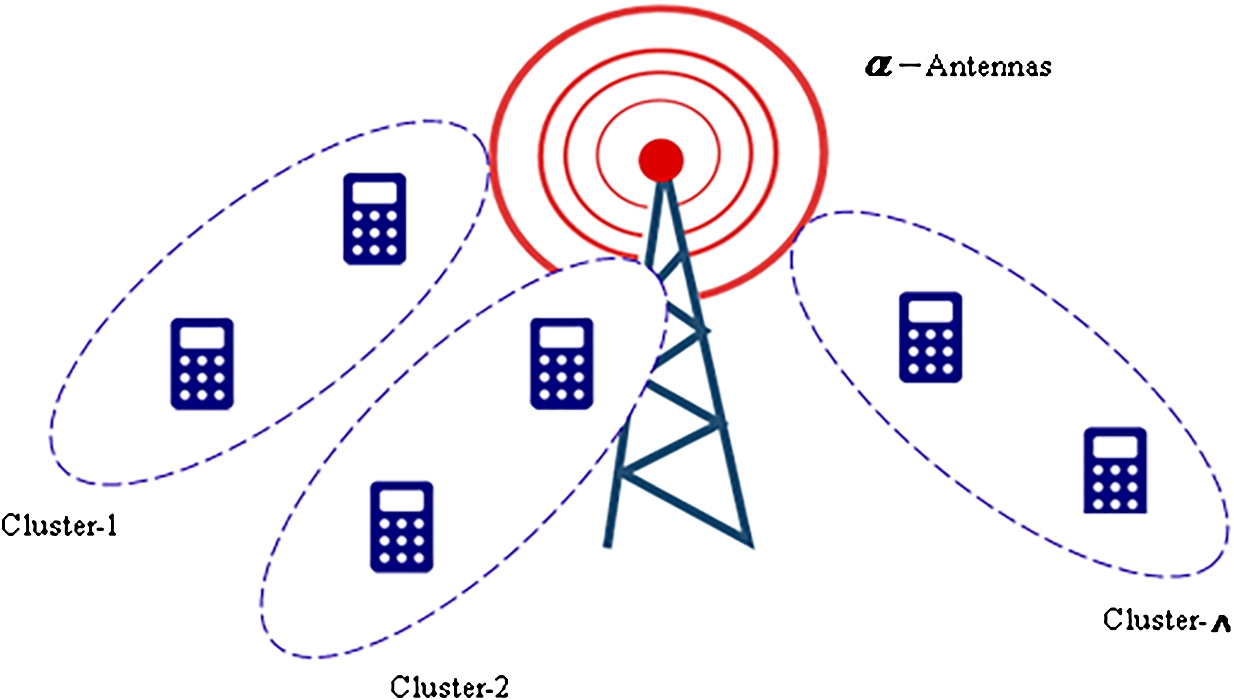
System model.
Most of the multi-cell literature assumes perfect timing synchronization [7] for simplification. The ∂ length of pilot signal assigned to
If a pilot signal satisfies the above mentioned equation, pilot contamination does not happen. Let us consider
The BS in
For estimating a channel, BS in
MMSE-enabled channel estimator is a general technique for suppressing pilot contamination. BS in
A channel covariance matrix is specified as
Notations
Notations
The receiver must know the communication channel about the capability to detect signals correctly. In this work, WSChO+DNFN is presented for optimal pilot location identification and channel estimation in a massive MIMO-NOMA scheme. Here, a process is carried out in two phases namely transmitter and receiver phases. In the transmitter phase, input data is given and the steps then performed are demultiplexing, S/P conversion, mapping 32 QAM and pilot-aided optimal location. The pilot-aided optimal location is conducted utilizing WSChO, which is formed by incorporating WSO and ChOA. Then, the signal is received by the receiver phase wherein LS estimation, channel estimation, demapping 32 QAM, P/S conversion and multiplexing are carried out. The channel estimation is carried out utilizing DNFN and finally, the output is attained. The pictorial illustration of WSChO+DNFN for channel estimation is delineated in Fig. 2.

A pictorial illustration of WSChO+DNFN for optimal pilot location identification and channel estimation in a massive MIMO-NOMA system.
Consider the single cell having BS, users
The encoded signal is converted from serial to parallel utilizing an S/P converter. By performing S/P conversion, a symbol sequence is transmitted by α antennas [2]. Owing to larger MED, mapping 32-QAM [26] is selected as the mother constellation amongst modulations. The vector formulation of 32-QAM can be modeled by,
During the pilot estimation stage [15], users connected with BS transmit the pilot sequences. Here exists χ pilot sequences that are ortho-normal such that
Therefore, the transmitted signal can be modeled by,
Where,
Optimal pilot location identification utilizing WSChO
The pilot sequences utilized within particular cells are orthogonal, but the similar pilot group is generally reutilized in adjacent cells owing to the lesser count of orthogonal pilot sequences. Therefore optimal pilot location identification is necessary for continually detecting active users. Here, optimal pilot location identification is carried out utilizing WSChO.
Solution encoding
In solution encoding, estimation is performed to find out the optimal location of the pilot by considering

Solution encoding.
A fitness measure is evaluated based on BER, which is defined as the rate at which errors occur in the transmission system. An expression for fitness measure is computed as follows.
Algorithmic steps for devised WSChO
WSO [1] is an optimization approach that is based on the strategy of ancient war. It is performed on the basis of the army troop’s strategic movement at war. ChOA [13] is enthused by the individual cleverness and sexual motive of chimps in group hunting that is diverse from other predators. The integration of these two approaches proved as an efficacious technique for the identification of optimal pilot locations.
At first, the solution is initialized for resolving optimization issues that are mathematically given by,
An objective function is evaluated based on BER computation, which can be formulated utilizing Eq. (12).
At this step, two kinds of war strategy are represented in which first criteria is executed by each of the soldier position updates based upon commander as well as king. If a war is closer to the ending stage, the locations of the commander, soldier and king are remained to be nearer as they come up to the target.
The standard equation of Chimp is expressed as,
Where,
Assume,
Let,
Therefore, Eq. (20) becomes,
Substitute Eq. (26) in Eq. (16)
An updated equation of WSChO is given by,
Each soldier’s rank relies on attainment history in the war field, which is influencing subsequently the weight factor
If an attack force in the new location
If a soldier’s position is successfully updated, then the rank
On a rank basis, the new weight is formulated as follows,
Next, strategy location is updated considering the king, randomly selected soldier and head of an army. Hence, weight and rank update remains to be equivalent.
For high values of
A weaker soldier consists of poorer fitness is determined for all iterations. The simplest method substitutes the weakest soldier having a randomly selected soldier as modeled by,
Secondly, a method relocates the weakest soldier close to the whole army median in the field of war as signified in Eq. (38). Convergence features of this algorithm are enhanced by this method.
WSChO algorithm steps are done in a repeated manner to acquire the best solution for all optimization problems. The Pseudo code of WSChO is interpreted in Algorithm 1.

Pseudo code of WSChO
LS channel estimation technique [21] is established for massive MIMO-NOMA systems incorporated with OFDM and high-order modulation methods. The expression for LS channel estimation is modeled by,
From the above equation,
Assume training over b consecutive symbols of OFDM, a data model is considered as follows,
Here,
The LS channel estimation method lessens the noise specified in Eq. (41) based on the cost function mentioned in Eq. (46) for obtaining the evaluated channel noted as
From the above equation, considering relative to
Lastly,
Due to this
Channel estimation for massive MIMO-NOMA systems with pilot contamination using DNFN
LS estimated channel [7] comprises the sum of channels for every UT utilizing a similar pilot. An input given for channel estimation is specified as
MMSE estimation is evaluated by
Here,
The LS estimated channel is utilized as input data to neural networks
Architecture of DNFN
The DNFN [27] is a fusion method wherein a deep neural network is utilized initially and followed by fuzzy logic to compute the objectives of the system. Let us assume two premises
In the above mentioned equation, v and w specifies input to each
A second layer termed the rule base layer is used to describe a set of rules. A product of membership variable values specifies a firing strength of rule as modeled by,
In the normalization layer, all entities compute a firing strength ratio of
A defuzzification layer can be formulated as follows.
Here,
The output of DNFN is specified as

Architecture of DNFN.
The transmitted signal is received by the receiver phase wherein demapping 32 QAM, P/S conversion and multiplexing [14] are carried out. The received signal can be expressed by,
Results and discussion
The WSChO+DNFN attained better outcomes that are explained in this segment together with experimentation setup, performance evaluation and comparative assessment.
Experimental setup
WSChO+DNFN approach for reducing pilot contamination is carried out by simulation and the parameters utilized for simulation and the parameters of DNFN are shown in Table 2.
Experimental parameters
Experimental parameters
The devised WSChO+DNFN is examined for analyzing the performance with respective to metrics namely Bit error rate (BER) and normalized mean square error (MSE). The WSChO+DNFN is assessed to determine its performance by changing signal-to-noise ratio (SNR) values with several iterations for antenna sizes
Analysis based on antenna size
The evaluation of performance by changing SNR with several iterations is demonstrated in Fig. 5. Analysis regarding BER is described in Fig. 5 a). For the SNR value 4 dB, the BER values acquired by the WSChO+DNFN are 0.000281 for iteration-20, 0.000194 for iteration-40, 0.000184 for iteration-60, 0.000170 for iteration-80 and 0.000150 for iteration-100. Figure 5 b) elucidates the estimation in terms of normalized MSE. For SNR value 4 dB, the WSChO+DNFN obtained a normalized MSE of 0.000201 for iteration-20, 0.000138 for iteration-40, 0.000132 for iteration-60, 0.000121 for iteration-80 and 0.000107 for iteration-100 respectively.

Performance assessment based on antenna size
Figure 6 illustrates the performance estimation by changing SNR values. Figure 6 a) explains the analysis of WSChO+DNFN regarding BER. For SNR value = 4 dB, the WSChO+DNFN acquired BER of 0.000262 for iteration-20, 0.000181 for iteration-40, 0.000172 for iteration-60, 0.000160 for iteration-80 and 0.000140 for iteration-100. Assessment of WSChO+DNFN in terms of normalized MSE is delineated in Fig. 6 b). By considering the SNR value as 4 dB, the normalized MSE values attained by WSChO+DNFN are 0.000188 for iteration-20, 0.000129 for iteration-40, 0.000123 for iteration-60, 0.000114 for iteration-80 and 0.000100 for iteration-100.

Performance assessment based on antenna size
The WSChO+DNFN is compared with the techniques like OFDM [6], GSIC-SBCE [9], sector-based PAS [8], CNN [7], USCE [19], and OCE-HML [3] to show its effectiveness. The designed WSChO+DNFN is assessed based on antenna sizes
Analysis based on antenna size
Figure 7 reveals the estimation of comparison by varying SNR values for antenna size
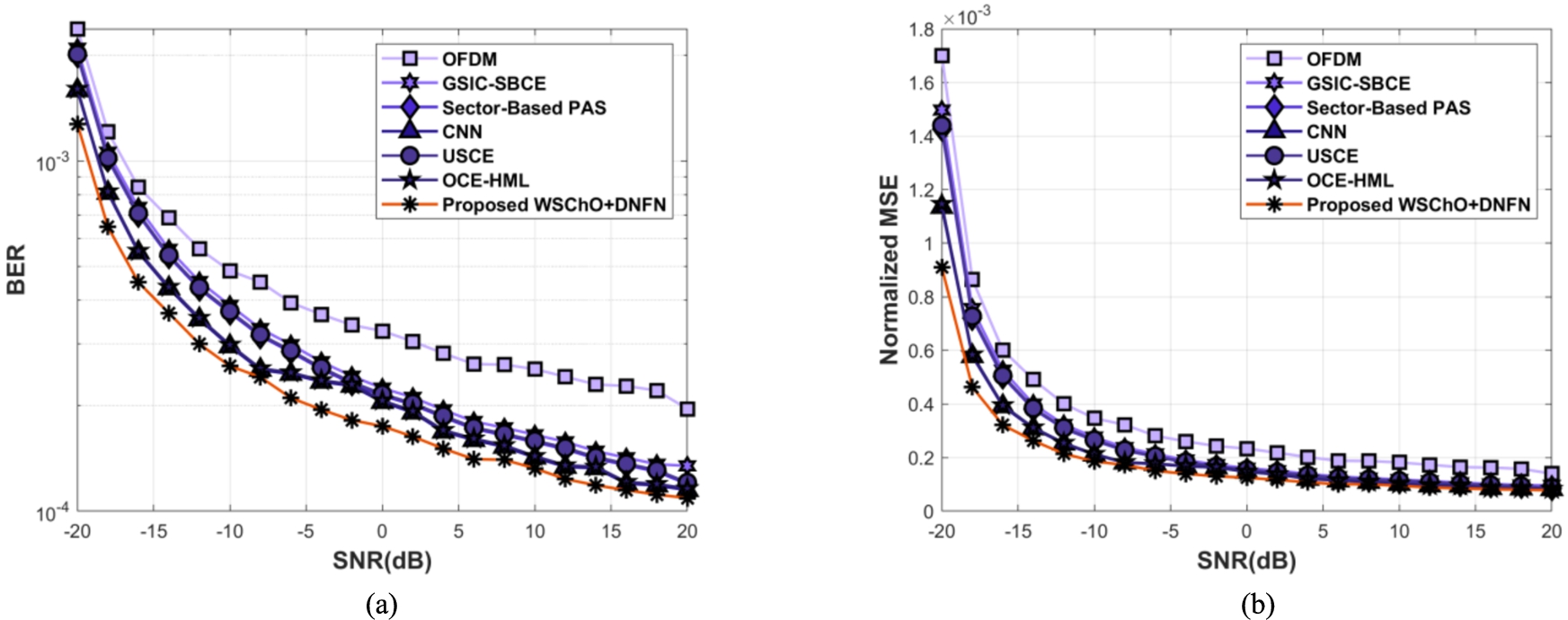
Comparative estimation based on antenna size
The evaluation of WSChO+DNFN by varying SNR values is revealed in Fig. 8. The assessment of WSChO+DNFN regarding to BER is shown in Fig. 8 a). When the SNR value is considered as 20 dB, the BER achieved by WSChO+DNFN is 0.000103 whereas OFDM, GSIC-SBCE, sector-based PAS, CNN, USCE, and OCE-HML obtained 0.000192, 0.000119, 0.000119, 0.000108, 0.00012, and 0.000109. Figure 8 b) delineates the estimation of WSChO+DNFN respective to normalized MSE. For SNR value 20 dB, the WSChO+DNFN acquired normalized MSE of 0.000074 while the values of OFDM are 0.000137, GSIC-SBCE is 0.00085, sector-based PAS is 0.000085 and CNN is 0.000077 USCE is 0.000085, and OCE-HML is 0.000077.

Comparative evaluation based on antenna size
The convergence of the established WSChO approach and the standard models is observed by varying the iteration count from 10-100. Figure 9 represents the convergence analysis of the proposed model over the other models. The standard algorithms used for comparison are CSA, ACO, PSA, and the proposed WSChO. For iteration 100, the fitness value obtained by CSA is 0.214, PSA is 0.103, ACO is 0.009, and the proposed WSChO is 0.006. Thus, the fitness values of the proposed method are low compared to the other algorithms.
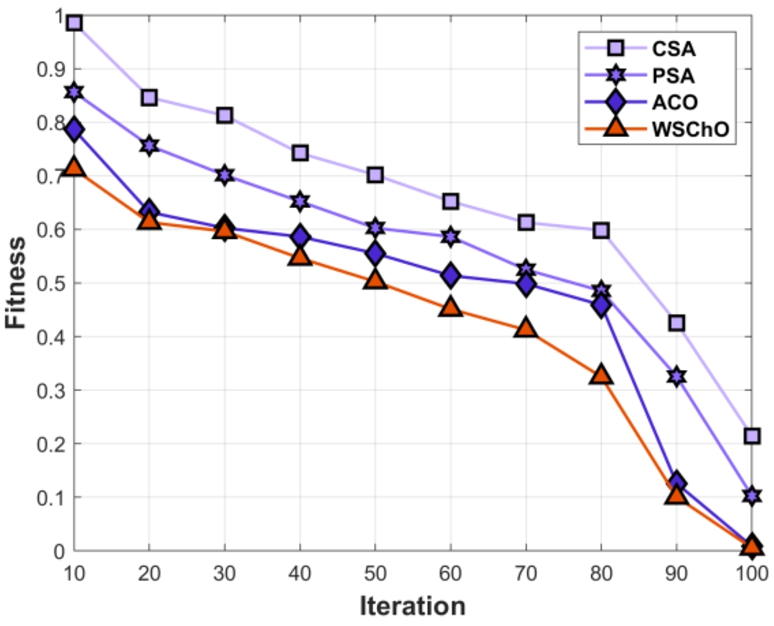
Convergence analysis graph of the proposed WSChO.
The advancement in massive MIMO-NOMA technology has offered diverse techniques recently for reducing pilot contamination in massive MIMO-NOMA based on pilot allocation. Here, a novel approach called WSChO+DNFN is designed for the estimation of channels to reduce pilot contamination in a massive MIMO-NOMA system. It takes place in two phases, the transmitter and the receiver phase. In the transmitter, input data is considered and fed to demultiplexing, which is followed by S/P conversion, mapping 32 QAM and pilot-aided optimal location steps. Then, the signal is received by the receiver phase, where steps like LS estimation, channel estimation, P/S conversion and multiplexing are conducted. The channel estimation is conducted by DNFN that is tuned by devised WSChO. Furthermore, WSChO is an amalgamation of WSO and ChOA. Additionally, WSChO+DNFN attained minimal values of BER and normalized MSE of 0.000103 and 0.000074. In future, pilot contamination attacks in a single superposed signal will be detected utilizing new optimization approaches. Another option is to employ some form of time division technique in which the users transmit or receive in all directions at one point in time to establish useful communication.
Conflict of interest
The authors have no conflict of interest to report.