



Abstract
Massive MIMO (M-MIMO) devices are the key tool to meet the performance stards established for 5G-wireless communication. However, more Radio Frequency (RF) chains needed in base station (BS) with a huge count of transmitting antennas, involve expensive hardware and computing complexities. In order to decrease the RF chains needed in BS, this work intended to use the optimal transmit antenna selection (TAS) strategy. This strategy is gaining a lot of interest since the optimization algorithm aids in the ability to enhance the system performance considerably the efficiency and secrecy rate. This work proposes a novel Coati Adopted Pelican Optimization (CA-PO) for choosing the optimal TA by considering efficiency as well as secrecy rate. In addition, the CA-PO algorithm makes the decision on which antenna to be elected. At last, the supremacy of CA-PO-based TAS is proven from the analysis regarding secrecy rate and EE analysis. Accordingly, the proposed CA-PO method for MF for set up 2 has attained a higher EE of 0.976; whereas, the DMOA, COA, MRFO, POA and BEA techniques have got a relatively lower EE of 0.968.
Nomenclature
Nomenclature
Massive Multiple Input Multiple Output (M-MIMO) technology has got the most attention in recent times due to its remarkable ability to offer faster data rates, improved connection stability, and considerable power savings for systems that will replace 4G in the future [16,32,37]. Rich scattering environments that once made it difficult to use conventional MIMO systems are no longer an issue with the use of hundreds or even more low-power antennas at the Base station (BS), as there are undoubtedly enough independent channels to be found in such a vast channel space [6,21,22]. However, as the antenna count rises, the hardware and signal processing costs become a significant burden. It has been demonstrated that performance increases as the amount of receive antennas rises. The primary goal is to increase Spectral Efficiency (SE) and Energy Efficiency (EE), which is accomplished by adding more antennas and Radio Frequency (RF) chains [2,4,24]. The TAS method uses less RF chain, which raises the intricacy of the network and energy consumption of hardware. The TAS approach may be used to utilize fewer RF components than the total number of accessible antennas to lower hardware expenses and computing challenges whilst maintaining the majority of the variety or multiplex advantages of every antenna [34,35,39].
It is well known that thorough searching can lead to the discovery of the ideal antenna subset. However, as the count of accessible antennas increases, the computing cost of exhaustive search increases exponentially [5,10]. Because so many antennas are used in huge MIMO systems, it is therefore impracticable to do an exhaustive search [28–30]. Many low-complexity TAS methods were already in use, like beam forming and Space-Time Coding (STC), which were presented to get a suboptimal solution in traditional MIMO technology. Nevertheless, the techniques are not appropriate for M-MIMO systems’ real-time TAS implementation [17,20,35]. Nomenclature is depicted in Table 1.
The literature has recently examined the use of antenna selection techniques in huge MIMO systems [12,19,27]. However, they only paid attention to systems that had users of a single antenna, and the amount of available antennae was not as great as “massive” [9]. Additionally, a variety of methods, including the bidirectional branch method, limit searching and others, were developed for M-MIMO TAS, but the problem of the RF chains’ increasing cost and complexity has not been resolved [1,18,35]. As a result, the TAS for M-MIMO networks was not extensively studied, and it is difficult to develop a TAS method for M-MIMO systems that is low in complexity and memory-intensive [25,26].
The contributions are mentioned as follows:
This work intended to use the optimal Transmit Antenna Selection (TAS) strategy in order to decrease the RF chains needed in BS.
As a novelty, this work proposed novel Coati Adopted Pelican Optimization for choosing the transmit antenna in an optimal manner that ensures efficiency as well as secrecy rate.
The CA-PO algorithm makes the decision on which antenna to be elected.
Here, Section 2 reviews the conventional TAS in M-MIMO systems. Section 3 portrays the system model. Section 4 portrays the CA-PO-based selection of TA in M-MIMO. Section 5 describes the outcomes and Section 6 concludes the research.
Literature survey
Related works
Seo and Son [23] in 2021 focused on the selection of optimal TAs from a certain amount of available TAs. The TAS must be optimized by taking into account the quantity of TAs to maximize the confidentiality capacity. By pursuing the ideal amount of TAs in M-MIMO channels, the G-OTAS method was presented to maximize the secrecy capacity. It was shown via simulation that the suggested G-OTAS algorithm efficiently decreased computational complexity when compared to the reference methods and improved confidentiality capacity.
For RSM-oriented MIMO, Kim et al. [15] in 2020, suggested two effective TAS techniques. To choose active TAs from the available TAs, an incremental TAS method was first described based on the maximizing of the RSNR. The updated TAS algorithm then ran two consecutive selection steps to further reduce complexity. In the pre-processing step, active TAs were chosen that were equivalent to or more numerous than receive antennas and less numerous than the total number of TAs to be chosen. The other operable antennas were then picked in the post-processing phase. A basic norm-based approach was used in the initial stage to drastically minimize the complexity. Finding more TAs was done in the second step using an incremental selection technique. Additionally, the simulation results demonstrated that when there was a big disparity between the amount of chosen TAs and the total TAs, the suggested TAS schemes offered much less complexity than the decremental TAS.
In 2023, Yang et al. [33] characterized the TAS issue as a multi-class categorization issue and suggested an effective TAS algorithm based on GBDT taking into account the system’s safe transmission. Here, the network safety and computing complexity were taken into account as the optimizing goals. Accordingly, the system reliability was enhanced as the attainable security capacity was very similar to the conventional exhaustive search method. Accordingly, when complexity increased, GBDT’s training effectiveness considerably increased. Additionally, the effectiveness of the suggested algorithm in an M-MIMO system was assessed using the NYUSIM approach that was based on actual channel measurements. Performance investigation demonstrated that the suggested GBDT-based strategy may greatly lower the computing complexity while improving the secrecy capability of the system.
A TAS method to overcome SE issues was suggested by Zhu et al. [38] in 2022. The TAS problem was specifically framed as an optimization issue of enhancing the network’s total SE. As it was an NCIP issue, an EPGA, which used an elite preservation tactic, was deployed to make sure that there were no losses during mutation or crossover. The simulated results revealed that the EPGA achieved significantly better than random selection and was almost similar to an exhaustive search.
A computationally effective and ideal technique based on PDL for TAS was suggested by Salman et al. in 2021 [13]. The suggested approach can produce an optimal result for the real-time TAS issue and is computationally effective. After TAS, a consecutive interference cancellation method was used for pre-coding with chosen antennas since beam forming and pre-coding were also seen as crucial strategies to mitigate route loss brought on by high-frequency communications. The suggested combined TAS and pre-coding approach was computationally effective and almost optimum on SE when compared to an exhaustive search strategy as per the simulation findings. The suggested technique also optimized the EE of the network, which improved the performance of M-MIMO systems.
A new Augment TAS method based on the maximum flow minimal cut theory was suggested by Daphney et al. [7] in 2022. It captured the best antennas depending on the combined capacity of all potential antenna combinations. This algorithm’s first step suggested a subset of antennae to calculate enhanced pathways, and its second step selection takes into account the remaining antenna capacity to calculate the highest flow in a network. To increase spectrum and energy efficiency, this system chooses ideal antennas with improved channel conditions. The simulation findings have shown the efficacy of the developed work.
In 2022, Yiwen et al. [36] investigated and contrasted the accuracy, cost, and complexity of 3 intelligent algorithms: the Genetic Algorithm (GA), CSA, and PSO. Additionally, the algorithms were suggested using Fractional Coding (FC) rather than binary coding. The simulation results showed that all three methods were capable of completing the TAS successfully. PSO offered the most stability and accuracy, yet it also had the highest level of complexity. When considering total performance, CSO was the best option, especially for practical implementation. Additionally, FC performed more effectively than binary coding.
In 2022, Salman et al. [14] targeted to increase EE with no apparent performance deterioration on SE owing to the dependence of SE and energy on RF chains. In this article, RF chain selection utilizing evolutionary schemes was used to examine this trade-off. A hybrid heuristic strategy was described that combined Successive Interference Cancellation (SIC) for pre-coding with low computationally demanding algorithms for the selection of RF chains. Additionally, it was demonstrated that the analogue pre-coding was the most energy-efficient option for lower Signal to Noise Ratio (SNR) environments, whereas the RF chain selection method was the most effective option for higher SNR environments. Additionally, the channel anomalies have no impact on the suggested plan.
Problem gaps
The problems in conventional TAS in M-MIMO systems are as follows:
Each antenna element in traditional MIMO systems with fewer TAs is given an individual RF chain. While RF chains are expensive, heavy, and power-intensive, antenna elements are rather cheap and tiny.
Because there are so many BS antennas, it is therefore nearly impossible to give a distinct RF chain to each antenna element in huge MIMO systems.
Therefore, a well-motivated task for massive MIMO is the design of transmit pre-coders that require a small number of RF chains to get a good balance between efficiency and hardware performance.
The exhaustive Algorithm (EA) model that analyzes every feasible combination of antenna subsets is frequently used for selecting the antenna subset that will result in the best system performance. Nevertheless, the EA method also significantly increases computational complexity.
This is especially true for large-scale antennas, where the EA computation period is excessively long and its computing volume is rapidly growing, making it challenging to get resultants in a constrained amount of time and ultimately decreasing its applicability.
A JTRAS method is suggested for enhancing the performances of the AS system further and producing effective channel capacity results.
However, the algorithm’s computational cost is still quite high, and its performance remains unsatisfactory in applicability.
Hence, to overcome the aforementioned issues, this paper proposes a novel transmit antenna selection in an M-MIMO system using the metaheuristic-aided model for optimally choosing the transmit antenna and thereby ensuring efficiency as well as secrecy rate.
System model
This work suggests a novel optimal TAS scheme by considering efficiency and secrecy rate. Secrecy capacity is the rate of communicating secret information from one node to another node. The safer rate of communication among authoritative nodes with no leakage of information to an eavesdropper is described by secrecy capacity that depends upon relevant attenuations in the channel. Eavesdropping attack occurs when the hacker enters, delete, or changes data transmitted between 2 devices. For accessing transmitted data among devices, eavesdropping is termed as snooping or sniffing. So as to progress the network performance, it is obligatory to select the optimal TA. Selecting the optimal TA is performed with a new CA-PO algorithm. Figure 1 shows the developed TAS in the M-MIMO scheme.
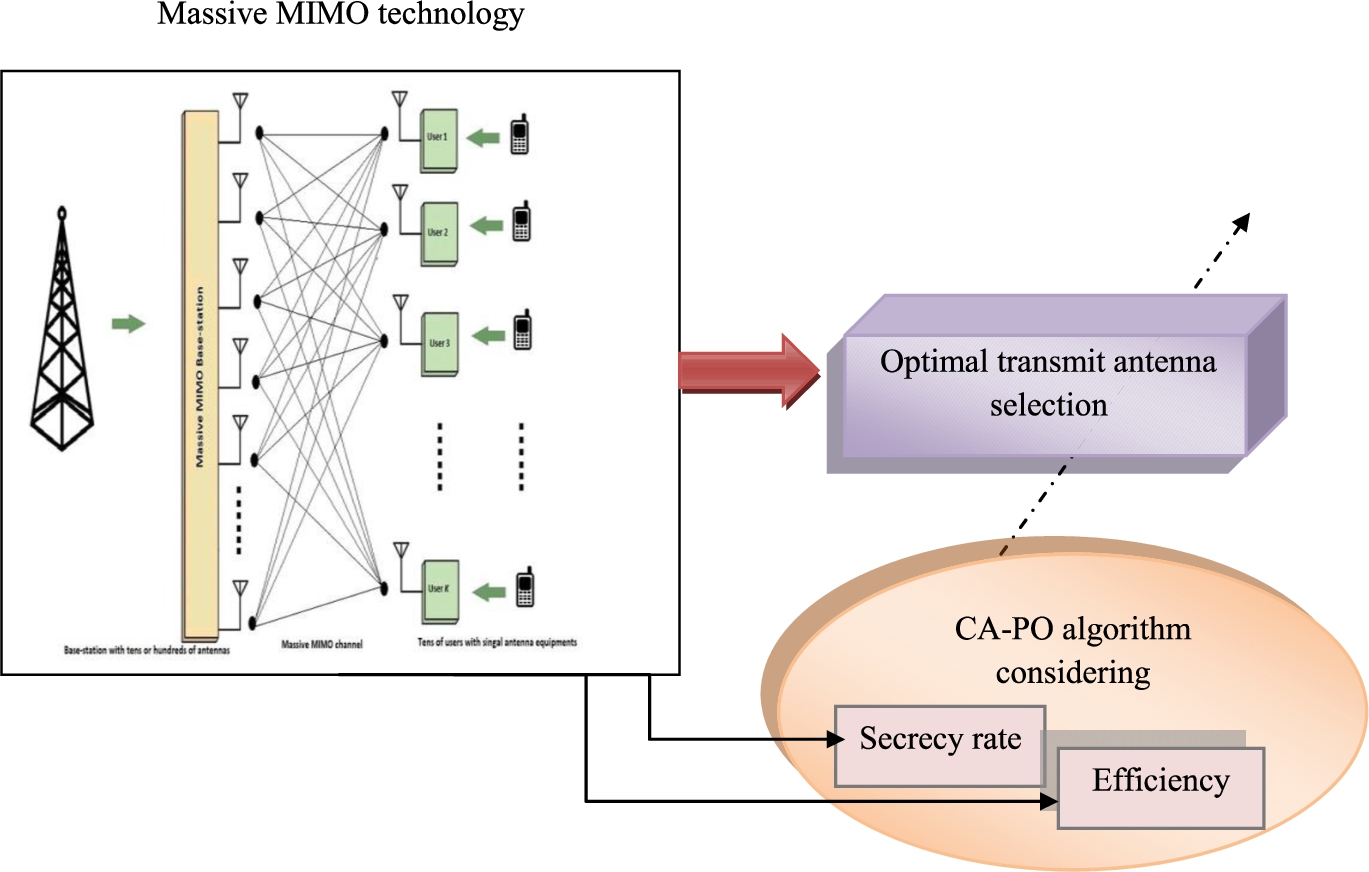
General diagram of developed optimal TAS in M-MIMO system.
Presume a cell containing a BS with B terminal. The TX in
The system will be said to be LS-MIMO when the transmitter contains an idle CSI. To evaluate the EE, there has to be a suitable model for power exploitation. Equation (2) shows the summation of power,
The power consumption
In addition, consider an OFDM system with 1024 subcarriers, 10 MHz frequency, and 78.5% efficiency with 11 dB IBO. In this case, the efficiency of Power Amplifier (PA) is said to be 22%. The relationship amid
The assessment of the LSMIMO BB model
Here,
X corresponds to the bandwidth that utilizes 10 MHz power.
The relationship amid
Optimal TAS
The signal received by hth user is exposed in Eq. (8), here
The size of a remote cell is given in Eq. (9), in which, α corresponds to the scaling term,
Equation (9) is rewritten as given by Eq. (10), when
Thus,
In Eq. (11), the optimum AS for the capacity of the channel as well as EE were equivalent, since
Computation of secrecy rate
The maximum rate of broadcast to target from source, where, a hacker is not capable of getting the data is termed as secrecy capacity
Therefore, the achievable rate of secrecy
CA-PO based optimal selection of TA in M-MIMO
Procedure of CA-PO algorithm
The POA results from inconsiderable solutions, simple execution and few parameters, however, the exactness is somewhat low [31]. Further, coatis have more escape alternatives while pursuing a physical effort approach, which improves the algorithm’s exploratory power and its capacity to escape local optima. Thereby, we combine the theory of COA [8] with POA to lessen the limitations of conservative POA. The hybrid optimization strategy enhances the ability to problem-solve with an increased convergence rate than the single model.
POA is an optimization that depends on the populations of pelicans. Every character in a populace offers a feasible solution. The POA members are assigned as in Eq. (21).
In Eq. (21),
The hunting method of POA has the following steps:
The location of prey is arbitrarily created which is considered a vital element of POA. This enhanced the POA’s capability to accurately assess the issue-resolving domain. Equation (24) characterizes the immigration of the pelican to its targeted prey.
As per CA-PO, Eq. (22 a&b) is modified by combining the concept of COA as shown in Eq. (23 a&b). As per CA-PO, if
In Eq. (23 a&b), I lies among 1 or 2,
In Eq. (29),
The hunting behavior during the exploitation stage is provided in Eq. (30), wherein,
Equation (31) shows the novel position of the pelican, wherein,
Cauchy mutation is modelled as in Eq. (33),
The resulting hybrid mutation strategy is modelled as in Eq. (34),
Here,

Pseudocode for CA-PO
This subsection computes the suggested hybrid CA-PO computational complexity. Four aspects emphasize the computational complexity of the proposed POA: initializing the algorithm, assessing the fitness function, generating prey, and updating the solution. The initialization steps of the algorithms have an
Results and discussions
Simulation setup
The developed CA-PO-based TAS for the M-MIMO system was done in MATLAB. Consequently, the examination was done using 2 setups.“The first setup was
Algorithm parameters
Algorithm parameters
Figure 2 shows the analysis of capacity (bps/w) using the developed CA-PO technique over DMOA, COA, MRFO, POA and BEA. Here, analysis is performed under 2 setups for Zero Forcing (ZF) and MF by changing the user counts from 5 to 40. The capacity of the developed CA-PO technique should be high for better system performance. When the count of user is less, the capacity of the system is less for developed CA-PO as well as existing DMOA, COA, MRFO, POA and BEA. However, with the increase in user count, the system capacity increased gradually. However, developed CA-PO shows high capacity over DMOA, COA, MRFO, POA and BEA. For set up 1, the ZF shows a high capacity of 4.1 ×
Likewise, the system capacity of the adopted CA-PO technique over DMOA, COA, MRFO, POA and BEA for ZF and MF for 2nd set-up is revealed in Fig. 2(c and d). In Fig. 2(d), the developed CA-PO technique for MF has a higher capacity of 8.8 ×

Analysis of capacity for optimal TAS in M-MIMO systems for (a) ZF (b) MF for setup 1 and (c) ZF (d) MF for setup 2.
The EE analysis attained by means of the developed CA-PO technique over DMOA, COA, MRFO, POA and BEA is explained here. The estimation is done for varied users from 5 to 40. In Fig. 3, the developed CA-PO technique has attained higher EE for both ZF and MF over DMOA, COA, MRFO, POA and BEA techniques. When the user count is 5, EE of the system is less for developed CA-PO as well as existing DMOA, COA, MRFO, POA and BEA. However, with the increase in user count, the EE gets increased gradually. However, developed CA-PO shows high EE over DMOA, COA, MRFO, POA and BEA.
Particularly, the developed CA-PO technique for ZF for set up 1 has a high EE of 0.975; whereas, the DMOA, COA, MRFO, POA and BEA techniques have got a relatively lower EE of 0.976 when the user count is 40. Also, the developed CA-PO technique for MF for set up 2 has got a high EE of 0.976; whereas, the DMOA, COA, MRFO, POA and BEA techniques have got a relatively lower EE of 0.968. In addition, for ZF for set up 2, the EE of the developed CA-PO technique has got a higher value of 0.98, whereas DMOA, COA, MRFO, POA and BEA also gained a high EE of 0.98 when the user count is 40. The better EE is owing to the introduction of a novel hybrid CA-PO that helps in selecting the transmit antenna optimally. Thus the proposed model helps in reducing power consumption.

Analysis of relative EE for optimal TAS in M-MIMO systems for (a) ZF (b) MF for setup 1 and (c) ZF (d) MF for setup 2.
Table 3 and Table 4 present the optimal count of TAs chosen using the developed CA-PO technique and existing DMOA, COA, MRFO, POA and BEA techniques for MF and ZF respectively. The analysis is done for varied user counts from 5, 10, 15, 20, 25, 30, 35 and 40. The finest count of TAs chosen by the developed CA-PO technique over DMOA, COA, MRFO, POA and BEA for MF and ZF. In addition, Table 3 shows the finest count of TAs chosen by the developed CA-PO technique over DMOA, COA, MRFO, POA and BEA for MF and ZF for 2nd set-up. This betterment is due to the deployment of CA-PO method, which helps in optimally selecting the transmit antenna.
Optimal TA count in M-MIMO systems for setup 1
Optimal TA count in M-MIMO systems for setup 1
Optimal TA count in M-MIMO systems for setup 2
The analysis of the secrecy rate using the developed CA-PO technique over DMOA, COA, MRFO, POA and BEA techniques is described in Fig. 4. The secrecy rate should be high for better efficiency of the system. Diverse secrecy rates were achieved for diverse user counts. At the initial count of users, the secrecy rates are less for both setups, however, the secrecy rates are increased with the rise in user count.
Particularly, the developed CA-PO technique for MF for set up 1 has got a high secrecy rate of 7.6323; whereas, the DMOA, COA, MRFO, POA and BEA techniques have got a relatively less secrecy rate of 7.6319 when the user count is 40. Also, the developed CA-PO technique for MF for set up 2 has got a high secrecy rate of 7. 6323, while, the DMOA, COA, MRFO, POA and BEA techniques have got a relatively less secrecy rate of 7.6319. Hence, it is evident that the proposed model is highly secure in MIMO communications. The high secrecy rate is owing to the introduction of a novel hybrid CA-PO that aids in optimally selecting the transmit antenna.
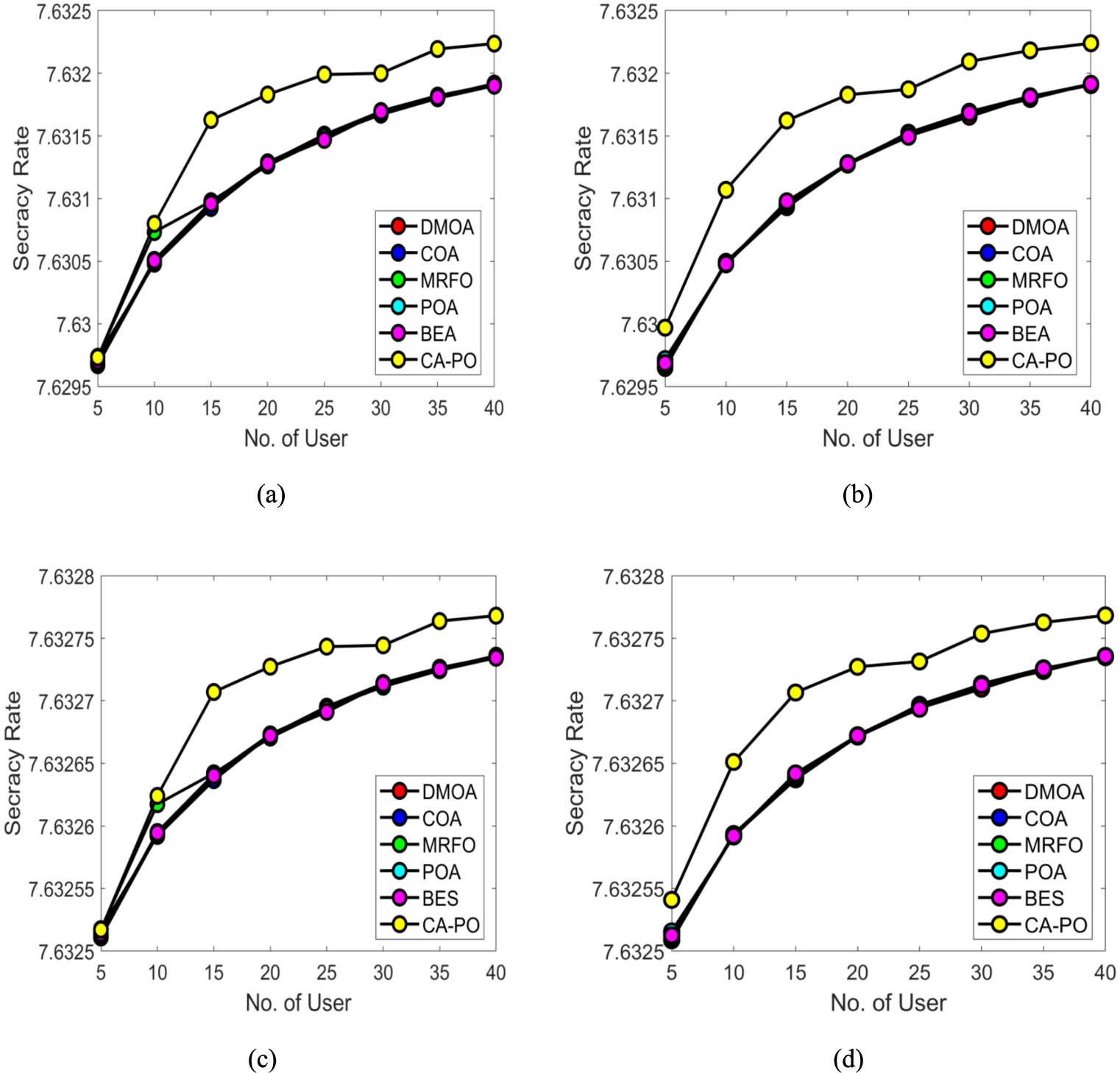
Analysis on secrecy rate for optimal TAS in M-MIMO systems (a) ZF (b) MF for setup 1 and (c) ZF (d) MF for setup 2.
The analysis on convergence using the developed CA-PO technique over DMOA, COA, MRFO, POA and BEA techniques is described in Fig. 5. In Fig. 5(a), the convergence probability for set up 1 is high for the developed CA-PO algorithm over other compared algorithms. Likewise, in Fig. 5(b), the convergence probability is high for the developed CA-PO algorithm over others for set-up 2. The convergence probability for both setups lies between 0.92 and 0.93 approximately. This shows that the convergence probability of the developed CA-PO algorithm is high to get minimum fitness as specified in Eq. (20).

Convergence analysis in M-MIMO systems (a) setup 1 and (b) setup 2.
The computational time of the proposed CA-PO method in comparison to the existing algorithms is portrayed in Table 5. On seeing the results in Table 5 it is noticed that the adopted CA-PO method takes very less time to compute when compared with the traditional models. The computational time of the suggested method is 54.20%, 19.14%, 41.82%, 12.61%, and 32.28% better than DMOA, COA, MRFO, POA and BEA techniques. The computational analysis of hybrid CA-PO is lower because in this work the updation of COA is replaced by POA. Hence for a hybrid CA-PO algorithm, the computational time is high.
Computational time
Computational time
This work developed a novel CA-PO for selecting the optimal TA by considering efficiency as well as secrecy rate. Together with this, the CA-PO algorithm makes the decision on which antenna to be elected. At last, the supremacy of CA-PO-based TAS was proven from the analysis regarding secrecy rate and EE analysis. At the initial count of users, the secrecy rates are less for both setups, however, the secrecy rates were increased with the rise in user count. Particularly, the developed CA-PO technique for ZF for set up 1 has a high secrecy rate of 7.6323; whereas, the DMOA, COA, MRFO, POA and BEA techniques have got a relatively less secrecy rate of 7.6319 when the user count was 40. Also, the developed CA-PO technique for ZF for set up 2 has got a high secrecy rate of 7.6323, while, the DMOA, COA, MRFO, POA and BEA techniques have got a relatively lower secrecy rate of 7.6319. In the future, massive antenna arrays can be attained with excellent spatial multiplexing and array gains. This trend is being further accelerated by new concepts such as intelligent surfaces and cell-free massive MIMO.
Conflict of interest
The authors have no conflict of interest to report.