



Abstract
In this paper, we present a hybrid intelligent simulation system for optimization of mesh routers in Wireless Mesh Networks (WMNs) called WMN-PSOHCDGA. We implemented six mesh router replacement methods: CM, RIWM, LDIWM, LDVM, RDVM and FC-RDVM and consider Two Islands distribution of mesh clients. We carry out a comparison study of these router replacement methods for small and middle scale WMNs. We assessed the performance by computer simulations. The simulation results show that six methods have a good performance for connectivity and coverage metrics, for both small and middle scale WMNs. However, they have different behavior for load balancing. For small scale WMNs, the load balancing of LDIWM, RIWM and FC-RDVM is better than CM, LDVM and RDVM. While, comparing LDIWM, RIWM and FC-RDVM, the LDIWM has better load balancing. We found that the load balancing for small scale WMNs is not good, because there is a concentration of mesh routers in some areas. For middle scale WMNs, the CM, LDIWM, LDVM and RDVM have not a good load balancing. While, the RIWM and FC-RDVM have better performance. Comparing RIWM and FC-RDVM, we found that the load balancing of FC-RDVM is better than RIWM.
Keywords
Introduction
Networks of today are going through rapid evolution and there are appearing different kinds of wireless networks, which have different kind of applications. One of them are Wireless Mesh Networks (WMNs), which can be used for last-mile networks and edge computing. They are cost-effective and have good scalability, fault-tolerance, and load distribution capabilities. WMNs are well-suited for linking edge devices and can provide enhanced analytics capabilities, improved response times, better performance, and increased security and privacy.
For design and optimization process of WMNs are needed different parameters including mesh router connectivity, mesh client coverage, Quality of Service (QoS), and network cost, which make the problem NP-Hard. Therefore, it is needed a trade-off among these parameters and this can be done by intelligent and heuristic approaches.
For mesh router node placement problem, the objective is to assign the mesh router nodes in the grid area in order to achieve optimal network connectivity and client coverage while also balancing the load of mesh routers. In order to measure these metrics, we consider three parameters: Size of Giant Component (SGC), Number of Covered Mesh Clients (NCMC), Number of Covered Mesh Clients per Router (NCMCpR).
Node placement problems are known to be computationally hard to solve [2,4–6,13]. In some previous works, there are some intelligent algorithms, which have been investigated for the node placement problem [1,3,7,9].
In our previous work [10,11], we implemented some intelligent simulation systems for solving the node placement problem in WMNs by considering single intelligent algorithms such as Particle Swarm Optimization (PSO), Hill Climbing (HC), Genetic Algorithms (GAs), Simulated Annealing (SA) and so on. Then, we designed and implemented a hybrid simulation system based on PSO and Distributed GA (DGA) called WMN-PSODGA.
In this paper, we present a new hybrid intelligent system for Wireless Mesh Networks (WMNs) called WMN-PSOHCDGA by integrating three intelligent algorithms: PSO, HC and Distributed Genetic Algorithm (DGA). We implemented in WMN-PSOHCDGA system six mesh router replacement methods: Constriction Method (CM), Random Inertia Weight Method (RIWM), Linearly Decreasing Inertia Weight Method (LDIWM), Linearly Decreasing Vmax Method (LDVM), Rational Decrement of Vmax Method (RDVM) and Fast Convergence Rational Decrement of Vmax Method (FC-RDVM).
We compare the results of these six methods considering Two Islands distribution of mesh clients and different instances (different scales of WMNs). The simulation results show that for small scale WMNs, the load balancing of LDIWM, RIWM and FC-RDVM is better than CM, LDVM and RDVM. While, comparing LDIWM, RIWM and FC-RDVM, the LDIWM has better load balancing. We found that the load balancing for small scale WMNs is not good, because there is a concentration of mesh routers in some areas. For middle scale WMNs, the CM, LDIWM, LDVM and RDVM have not a good load balancing. While, the RIWM and FC-RDVM have better performance. Comparing RIWM and FC-RDVM, we found that the load balancing of FC-RDVM is better than RIWM.
The contributions of this research work are as follows.
Design and implementation of WMN-PSOHCDGA hybrid simulation system by integrating three intelligent algorithms: PSO, HC and DGA. The implemented system can be used for different scenarios during engineering and deployment phase of WMNs.
Implementation in WMN-PSOHCDGA system of six mesh router replacement methods, which make the proposed system applicable in different environments.
Consideration of two instances, which make the proposed system applicable in small and middle scale WMNs.
The proposed WMN-PSOHCDGA system assessment is verified by extensive simulation results.
The rest of the paper is organized as follows. In Section 2 are introduced PSO, HC and DGA algorithms. Section 3 presents WMN-PSOHCDGA simulation system. The simulation results are given in Section 4. Finally, we give conclusions and future work in Section 5.
PSO, HC and DGA intelligent algorithms
In this section, we introduce three algorithms, which are combined to implement the proposed hybrid intelligent system.
Particle swarm optimization
In PSO, a group of particles are used to find solutions in the search space of a given problem. The movement of these particles is inspired by the collective behaviour of different species. They collaborate together to find food or migrate to a better environment. The optimal solution is achieved by the interaction of particles in the flock or group.
Each particle determines the movement towards the optimal solution by using the best-known location, the best location achieved by other flock members (best fitness), and random perturbations. The particle communicate with each other particles and are influenced by the best point found by any member of the group. Thus, all members of the group converge to the optimal solution.
Hill climbing algorithm
The HC is a local search and heuristic algorithm used for optimization problems. The HC tries to find a sufficiently good solution to the problem, but this may not be the global optimal solution.
In HC, the local search algorithm continuously moves in the direction of finding the peak of the mountain or the best solution to the problem. The algorithm terminates when it reaches a peak value where no neighbor has a higher value.
The HC has many applications. Especially is used for optimizing the mathematical problems. One of the widely considered examples is traveling-salesman problem, which try to minimize the distance traveled by the salesman. The HC is also called greedy local search because considers only its good immediate neighbor state not beyond that. In HC algorithm, it is not needed to maintain and handle the search tree or graph because the algorithm only keeps a single current state.
Distributed genetic algorithm
Genetic Algorithms (GA) is a robust search technique and has the ability to avoid falling prematurely into local optimas. GA is used and applied to various optimization problems in different domains. However, GAs are computationally expensive and time-consuming.
In our hybrid intelligent system, we use Distributed GA (DGA), which has a mechanism to escape from local optima by considering multiple islands. In DGA, each island computes its own solution and then migrate them as shown in Fig. 1. The GA has many operators, but the main operators are Selection, Crossover and Mutation. We have implemented different operators in our simulations system.

Model of migration in DGA.
In this section, we present the proposed WMN-PSOHCDGA simulation system. We combine three intelligent algorithms (PSO, HC and DGA) by considering their advantages and implement an hybrid intelligent system.

Flowchart of WMN-PSOHCDGA system.
We show the flowchart of the proposed system in Fig. 2. The proposed system starts by generating the initial solution randomly by ad hoc methods [14]. Then, it optimizes each island by using DGA and PSO algorithms. Finally, the HC algorithm is used to improve the convergence of PSO algorithm. The most crucial aspect of HC is defining the neighbour solution, which directly impacts the performance of the HC algorithm. In our WMN-PSOHCDGA system, we use the next locations of particle-pattern as the neighbour solutions.
The system includes these components: initialization, particle-pattern, fitness function, distribution of mesh clients and replacement methods.
The velocity of particles is determined by a random process, which considers the area size. For example, when the area size is
We consider a particle as a mesh router. The fitness value of a particle-pattern is computed by combination of mesh routers and mesh clients positions. Each particle-pattern is a solution as shown is Fig. 3. We represent a WMN by a gene and each individual in the population is a combination of mesh routers.
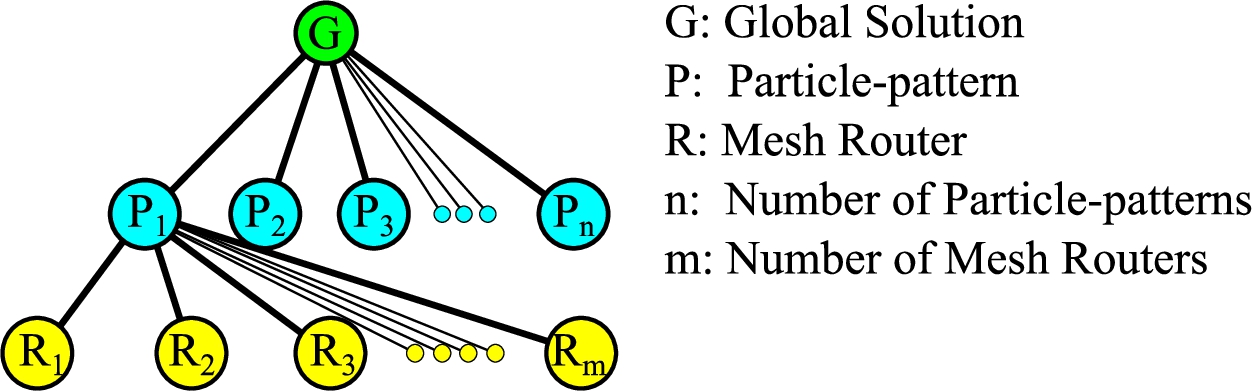
Relationship among global solution, particle-patterns, and mesh routers in PSO part.
The fitness function of WMN-PSOHCDGA considers three metrics (SGC, NCMC and NCMCpR) together with their weight coefficients (α, β, and γ), where
In this work, we consider Two Islands distribution of mesh clients, which considers users located as shown in Fig. 4.

Two islands distribution of mesh clients.
There are many mesh router replacing methods for WMNs. In this paper, we consider six of them: CM, RIWM, LDIWM, LDVM, RDVM and FC-RDVM
In CM, PSO parameters are set to a week stable region (
In RIWM, the ω parameter is changed in random way from 0.5 to 1.0. The
In LDIWM,
In LDVM, PSO parameters are set to unstable region (
In RDVM, PSO parameters are set to unstable region (
In FC-RDVM [8], we consider
In order to assess the performance of considered router replacement methods by computer simulations. For simulations, we set the coefficients of the fitness function as
Simulation parameters
Simulation parameters
We show the visualization results for small scale WMNs in Fig. 5. The simulation results show that six methods have a good performance for connectivity and coverage metrics. So, all mesh routers are connected and all mesh clients are covered.
We show the indicator of load balancing for small scale WMNs in Fig. 6. The parameter r is the correlation coefficient. When the standard deviation is decreased with the increase of the number of updates, the load balancing among mesh routers is better. We can see that the router replacement methods show different performance on load balancing. Considering six router replacement methods, The load balancing of LDIWM, RIWM and FC-RDVM is better than CM, LDVM and RDVM. While, comparing LDIWM, RIWM and FC-RDVM, the LDIWM has better load balancing. We found that the load balancing for small scale WMNs is not good, because there is a concentration of mesh routers in some areas.
We show the visualization results for middle scale WMNs in Fig. 7. For middle scale WMNs, also all router replacements methods show a good performance for SCC and NCMC. However, compared with Fig. 5, the mesh routers have better distribution.
We show the indicator of load balancing for middle scale networks in Fig. 8. For middle scale WMNs, in the case of CM, LDIWM, LDVM and RDVM, the standard deviation is an increasing line. While for RIWM and FC-RDVM, it is a decreasing line. Comparing RIWM and FC-RDVM, we see that the load balancing of FC-RDVM is better than RIWM.
In this work, we assessed the performance of six mesh router replacement methods (CM, RIWM, LDIWM, LDVM, RDVM and FC-RDVM) for WMNs using a hybrid intelligent simulation system by integrating PSO, HC and DGA algorithms called WMN-PSOHCDGA. We considered Two Islands distribution of mesh clients and carried out a comparison study of six router replacement methods for small and middle scale WMNs.
The simulation results have shown that six methods have a good performance for connectivity and coverage metrics, for both small and middle scale networks. However, they have different behavior for load balancing.
For small scale WMNs, the load balancing of LDIWM, RIWM and FC-RDVM is better than CM, LDVM and RDVM. While, comparing LDIWM, RIWM and FC-RDVM, the LDIWM has better load balancing. We found that the load balancing for small scale WMNs is not good, because there is a concentration of mesh routers in some areas.
For middle scale WMNs, the CM, LDIWM, LDVM and RDVM did not have a good load balancing. While, the RIWM and FC-RDVM have better performance. Comparing RIWM and FC-RDVM, the load balancing of FC-RDVM was better than RIWM.
In future work, we will consider the implementation of different crossover, mutation and other router replacement methods. We also will consider less number of mesh routers and carry out simulations for small scale WMNs. Furthermore, we plan to implement a testbed and compare the simulation results with experimental results.

Visualization results after optimization (small scale WMN).
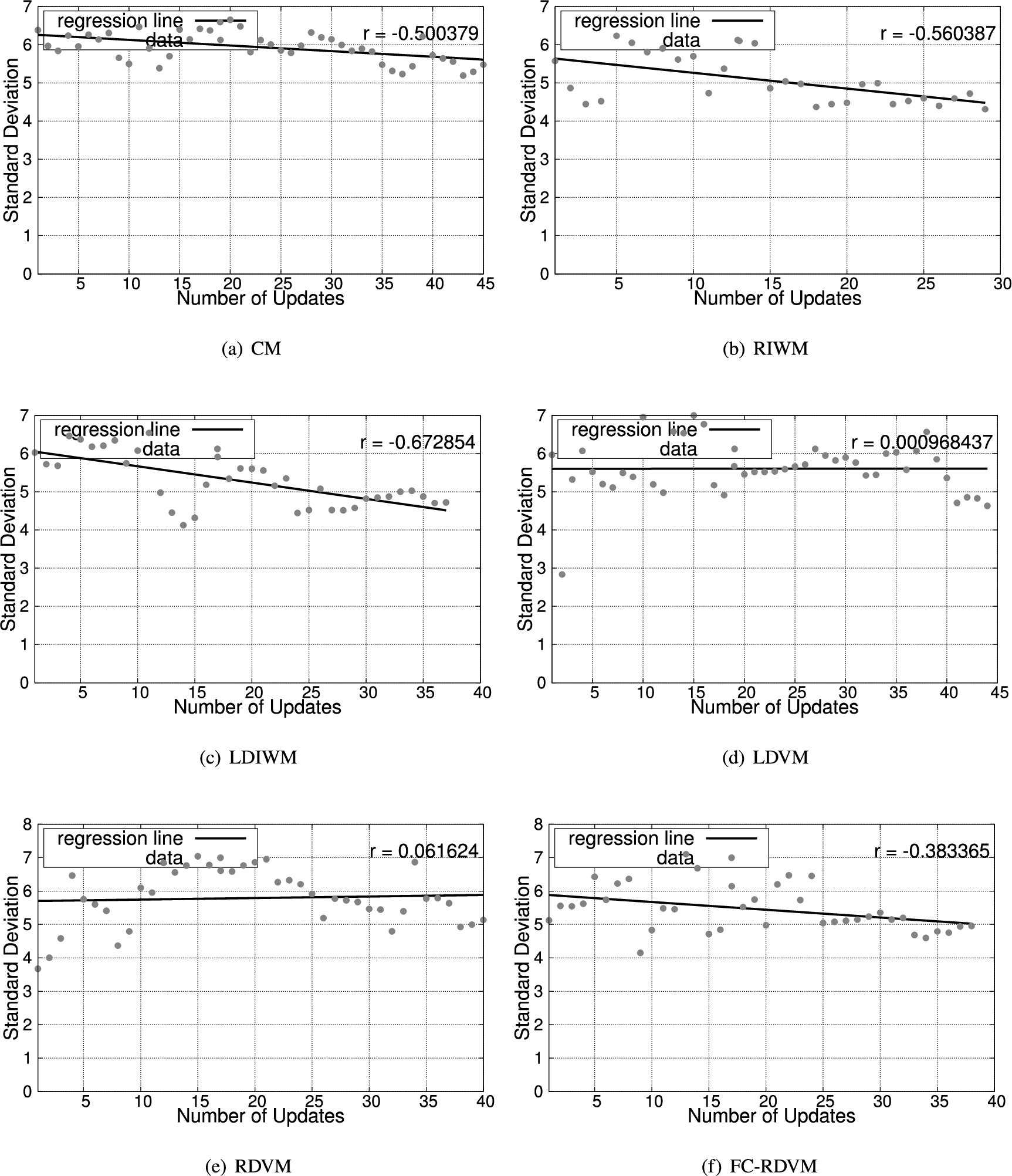
Standard deviation, regression line and correlation coefficient (small scale WMN).
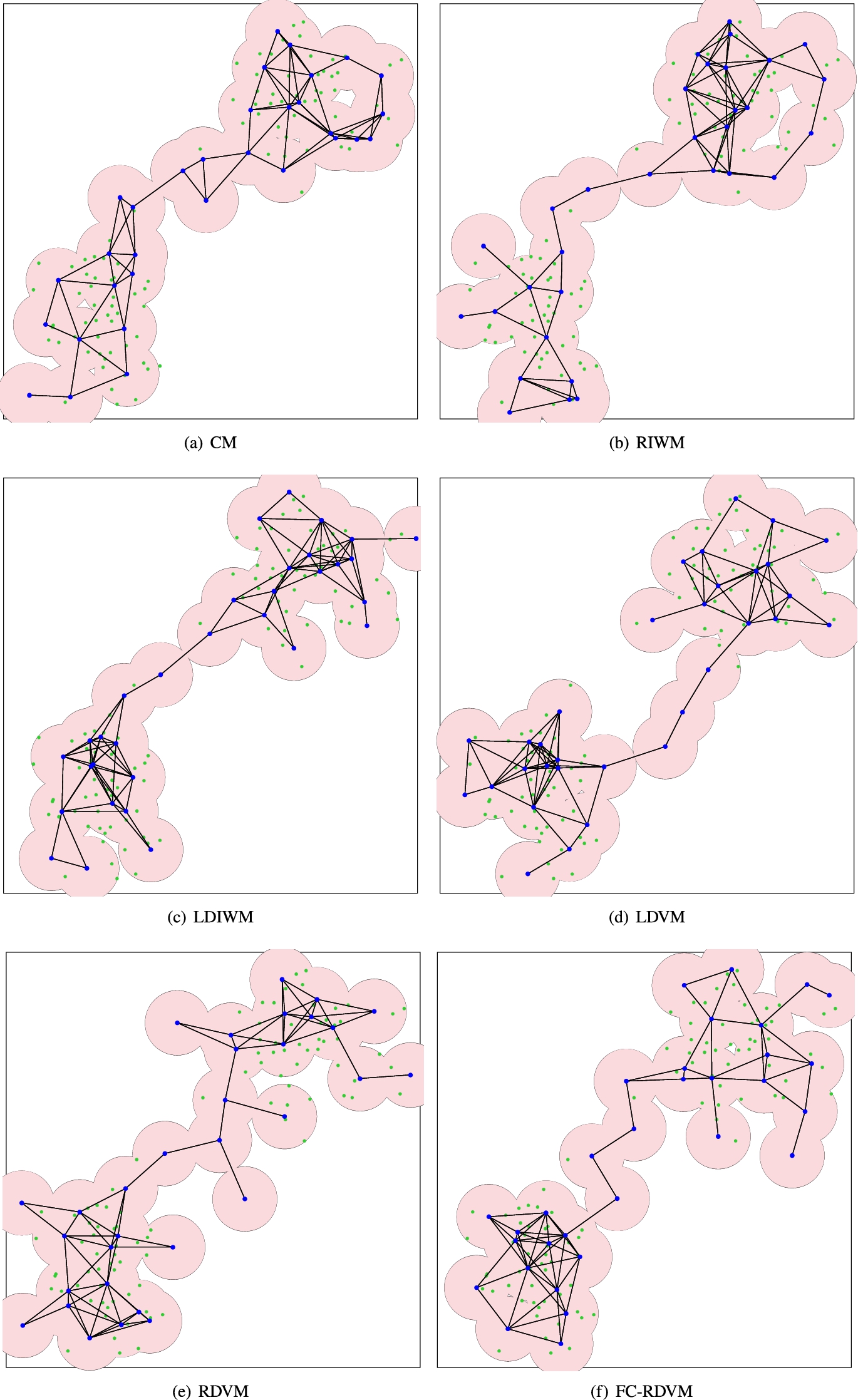
Visualization results after optimization (middle scale WMN).
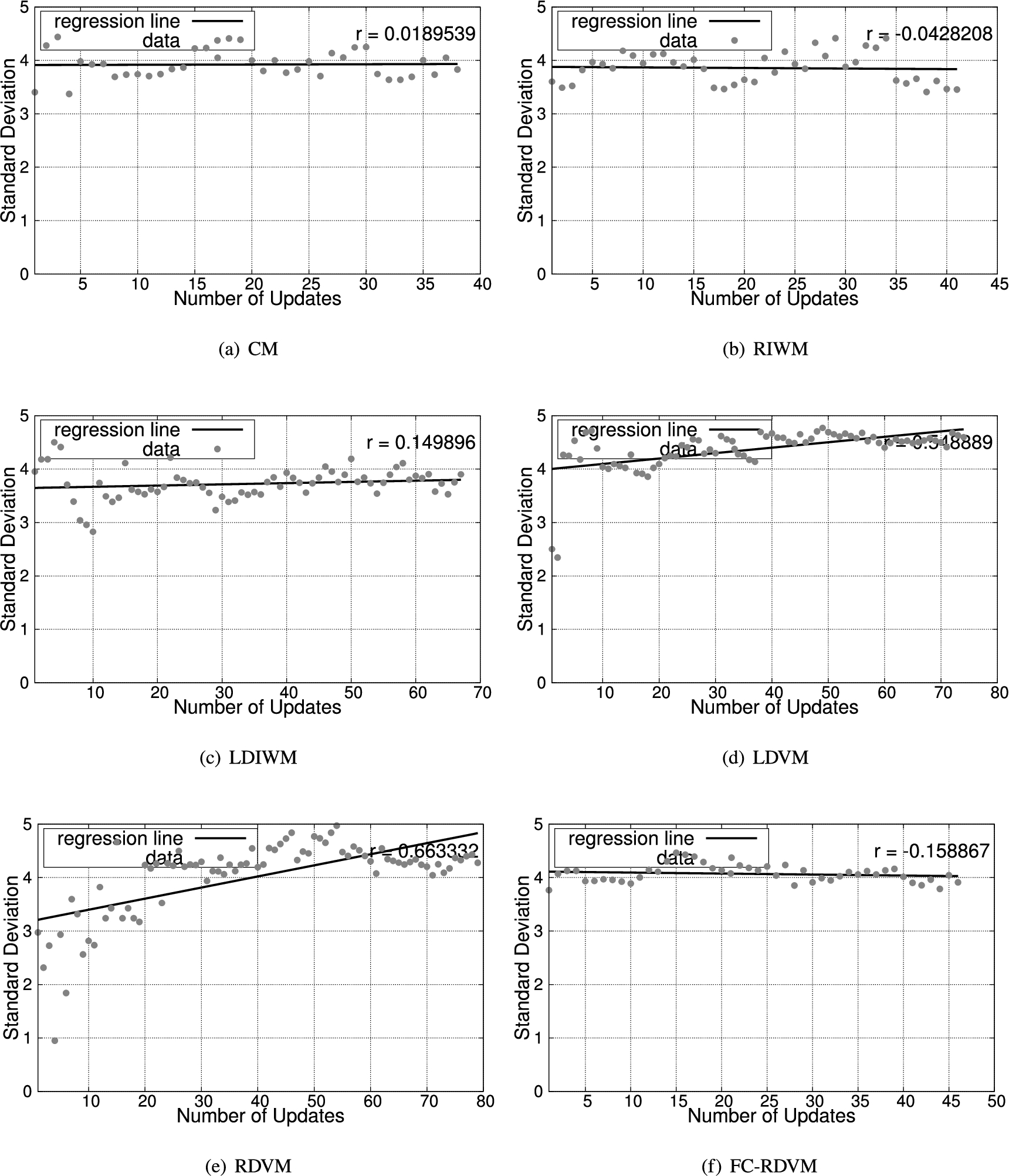
Standard deviation, regression line and correlation coefficient (middle scale WMN).
Conflict of interest
The author has no conflict of interest to report.