




Abstract
Reliability allocation is a very important problem during early design and development phases of a system. There are several reliability allocation techniques which are used to achieve the target reliability. The feasibility of objectives (FOO) technique is one of them that is widely used to perform system reliability allocation. But this technique has two fundamental shortcomings. The first is the measurement scale and the second is that it does not consider the order weight of the reliability allocation factors. The prioritization of the factors is also an important topic in decision making. Practically, all factors in multi-criteria decision making (MCDM) are not in the same priority level. Hence, in decision making situation, it is usual for decision makers to consider different priority factors. So, considering the prioritization of the factors, a reliability allocation method is proposed here to overcome the shortcomings of the FOO technique. Also, a case study on reliability allocation in airborne radar system is considered here to verify the efficiency of the proposed approach. Finally, the results are calculated in different optimistic and pessimistic view point and compared with the FOO technique. This comparison exhibits the advantages and supremacy of the proposed approach.
Introduction
Reliability allocation is a fundamental task during the manufacturing stages of any engineering system. The main aim is to allocate the target reliability to the subsystems and guarantee that the system can achieve its target goals (Bona et al. (2018), Ronchieri and Canaparo (2018), Covino et al. (2000)). In reliability allocation, the allotment of the resources significantly influences the quality of the product and system’s operational success. Therefore, an effective reliability allocation method is required to allocate the reliability to the system.
In the year of 1957, Advisory Group on Reliability of Electronic Equipment (AGREE, 1957) proposed a reliability allocation method depending upon the subsystem’s criticality and complexity rather than failure rate. After that in 1964, considering the failure rate of subsystems, Aeronautical Radio Inc. published the ARNIC method (William & Alven, 1964). In the same year, Brcha (Bracha, 1964) proposed another allocation technique considering the factors: state-of-the-art, complexity, environmental condition and operating time. Whereas, in 1965, Karmiol introduced the apportionment technique based on complexity, criticality, state-of-the-art and operational time. More recently, another important technique namely feasibility of objectives (FOO) technique has been published in the Mil-hdbk-338B handbook (United States Department of Defence, 1988) for military reliability design. There are also some reliability allocation methods like average weighting allocation (Kuo, 1999), integrated factor method (Felice et al., 2010), improved agree method (Liang et al., 2018) etc. But all have a common fault in the scale of measurement. In these methods discrete ordinal scales are used to measure the ratings of the factors which mislead the results. Also the system factors are not similarly weighted which creates some problems to make a decision.
To rectify these problems (Chang et al., 2009) developed some methods based on the Yager’s OWA operator. (Chen. et al., 2015) also proposed a reliability allocation technique considering uncertain preferences which can also overcome the previous problems.
In reality, when a decision is made, all criteria do not get equal importance. Considering this fact, the importance of different criteria is regarded as the priority of criteria. Practically in MCDM situation, it is habitual for decision makers to think about various priorities of criteria. In the literature, many studies have been done including various priorities of criteria in MCDM problems. Yager (2004) proposed that the prioritization of criteria can be modelled by using importance weights. Here he established that the weights associated with the lower priority criteria are interconnected to the satisfaction of the higher priority criteria. In further extension, Yager (2008) introduced a prioritized averaging/scoring aggregation operator using product T-norm. Thereafter, several researchers (Chen and Wang (2009), Yan et al. (2011)) also focused on MCDM problems considering multiple priorities.
In this study, a maximal entropy minimal variance Ordered weight averaging (MEMV-OWA) operator based prioritized reliability allocation method is proposed considering multiple priorities in criteria. Using this operator an attempt has been made to minimize the variance of weighting vector and to maximize the entropy. Moreover, our proposed method can overcome the drawbacks of the previous reliability allocation methods.
The remaining portion of the article is arranged as follows: Section 2 creates a survey on reliability allocation method and its drawbacks. Section 3 presents some theoretical background on the ordered weight averaging operator and its properties. Section 4 introduces the concept of prioritization of criteria and also discusses about OWA operator with priorities. Based on this concept, in Section 5, a prioritized reliability allocation method is proposed. A numerical example has been solved in Section 6 to establish the flexibility of the proposed approach. Also, a comparison with FOO technique and a discussion under different optimistic and pessimistic view point are given in the same section. Finally, Section 7 provides a conclusion on the overall work.
Reliability Allocation Methods
Reliability allocation/apportionment is a critical procedure to allocate the target reliability into each subsystem considering trade-off among multiple attributes ((Hu et al. (2019); Yu et al. (2018)). It is highly required to apportion a feasible reliability to every subsystem. There are different reliability allocation techniques like ARNIC (1964), AGREE (1957), the FOO technique (MIL-HDBK-338B, 1988), the average weighted allocation method (Kuo, 1999) etc. Among these techniques, FOO technique has enormous uses for reliability allocation. The general concept, procedure and shortcomings of FOO technique are discussed below.
FOO technique ((MIL-HDBK-338B, 1988); (Chang et al., 2009))
FOO technique was initially proposed as a procedure of apportioning reliability to the non-repairable mechanical-electrical components. In this technique allocation factors are system intricacy, state-of-art, performance time and environmental conditions. The numerical ratings of these factors are assessed by the experts based on their past experience. Each rating is on a 1 to 10 scaling system, with values allotted as given below:
The system intricacy has a strong effect on the reliability of the system. Generally, the failure rate of highly intricate system is going to be high. So the allocated failure rate is proportional to the complexity of the subsystem. Thus the subsystem with higher complexities should be allocated lower reliability targets.
The least intricate system is allotted as a value of 1 and extremely intricate system is allotted as a value of 10.
The least developed design is set as 10, and the extremely developed design is set as 1.
The component that works for the whole completion time is assigned as 10 and the subsystem that works the minimal time amid the completion time is assigned as 1.
Environmental conditions are likewise evaluated from 10 to 1. Components anticipated that would encounter cruel and extremely serious situations are assigned as 10, and those normal to experience the least serious situations are assigned as 1.
The ratings are given by the design experts depending upon their knowledge and experience. The overall ratings are obtained by multiplying the four ratings for every subsystem. i.e, ISPE= I × S × P × E. Where system intricacy, state of art, performance time and environment factors are denoted by I, S, P and E respectively.
Let a system is formed by N subsystems. Suppose λ
s
be the system failure rate,λ
k
be the allocated failure rate to k
th
subsystem, C
k
′ denotes the complexity of element k, and R
k
′ be the composite rating for subsystem k. R′ is the summation of the composite ratings and r
ik
′ denotes the i
th
rating for each factor of subsystem k, ∀i ∈ (I, S, P, E). R
s
is the target reliability and T is the overall completion time. Then the basic equations of FOO technique (MIL-HDBK-338B, 1988) are:
The FOO technique has a vast application in reliability allocation. However, this technique has been censured for two crucial deficiencies. The first deficiency is that the four factors (I, S, P and E) are assessed by discrete ordinal measurement scale. As ISPE value is evaluated by the product of the ratings of I, S, P and E, so multiplication is meaningless. The second deficiency is that the factors are not similarly weighted, consequently making problems to analyse and understand the outcomes. For instance, let two component with ISPE value of 9 × 2 ××2 × 2=72 and 7 × 3 ×2 × 2=84 respectively, the previous should allocate a higher reliability than the later. But in practice, as the previous ISPE value is less than the later, the FOO technique allocates lower reliability to the previous. Hence, I, S, P and E are not similarly weighted with respect to each other.
Ordered weight averaging operator (OWA operator)
The OWA operator was first introduced by Yager (1988) which is an important aggregation operator.
An n-dimentional OWA operator is a mapping F: R
n
→ R, with an associated weight vector W = (w
1, w
2, . . . . . . , w
n
)
T
such that ∑w
i
= 1, ∀ w
i
∈ [0, 1] , i = 1, 2, . . . . , n . with the properties,
Let F is an OWA operator with a weight function W= (w
1, w
2, . . . . . , w
n
). The degree of orness associated with the weight vector of the operator is defined as:
α= 1 describes the situation when the decision maker is maximally optimistic(a pure optimistic)and α = 0.5 is considered when the decision maker faces a moderate assessment.
The measure of entropy is the degree of utilization of information in an uncertain environment. This is also known as the measure of dispersion and is defined by
The properties include: When w
i
= 1 the dispersion of W is minimum, and disp(W)=0.(∵∑w
i
= 1) This denotes that only one criteria is taken in the aggregation process. When w
i
=
The measure of variance deduces the variability of weight vector for a given level of orness and is explained as
Basically, measure of variance helps to avoid overestimating of a single attribute and control the variance of weighting vector in the decision-making process including multiple criteria.
Depending upon the concept of entropy and variance of OWA operator, a bi-objective model can be formulated to obtain the weighting vector of the MEMV-OWA operator (Chen et al., 2015). Here entropy is maximized to utilize the uncertain information of the decision maker’s experience and variance of the weighting vector is minimized to avoid overestimation of the decision maker’s preferences. So, the model is:
For solving this model, weighted sum method is used here to transform the bi-objective problem into a single objective model giving equal weights to both the objectives. Then LINGO software is used for final solution.
A T-norm is a function T : [0, 1] × [0, 1] → [0, 1] which has the following properties: Commutativity: T(x,y)= T(y,x) Monotonicity: T (x, y) ≤ T (u, v)if x ≤ u and y ≤ v Associativity: T(x,T(y,u))=T(T(x,y),u) The number 1 acts as identity element: T(x,1)= x
And typical example of T-norms are: Minimum t-norm: T
min
(x, y) = min (x, y) Product t-norm: T
prod
(x, y) = x . y(the ordinary product of real numbers) Lukasiewicz T-norm: T
Luk
(x, y) = max (0, x + y - 1)
Prioritization of criteria (Yan et al., 2011)
Suppose a set of criteria C are divided into Q distinct priority levels, H = (H
1, . . . . . . , H
q
, . . . . , H
Q
) when H
q
= (C
q1, . . . . . . . , C
qk
, . . . . . , C
qN
q
),N
q
is the number of criteria in priority level H
q
. C
qk
is the k
th
criterion of the priority level H
q
. Then the prioritization of the priority level is considered as H
1 > . . . . . . > H
q
> . . . . . . . . > H
Q
. Total set of criteria is
Priority hierarchy of a set of criteria C
Priority hierarchy of a set of criteria C
Yager categorized this hierarchy into two cases:
The OWA operator has some interesting properties like symmetry, monotonicity, idempotence and compensativeness. Owing to these properties, this operator can be considered to calculate degree of satisfaction for each priority level. Considering decision maker’s situation parameter α toward priority level H
q
according to MEMV-OWA weight determination method(eq: 10), each priority level H
q
can be related with an weighting vector such that W
q
= (w
q1, w
q2, . . . . . . , w
qk
, . . . . . , w
qN
q
) where w
qk
∈ [0, 1] and
According to Yager (2004), the criteria with lower priority will become significant when the degree of satisfaction of higher priority level has been achieved. Motivated by this perception, each priority level is connected with a priority weight Z q (.), which is obtained from all the higher priority level’s degree of satisfaction. Moreover, T-norms is unable to remunerate the low values by high values, so T-norms are utilized to incorporate the priority weight Z q (.) at each priority level.
Particularly, for priority level H
1, the priority weight Z
1 (.) =1; for H
2, Z
2 (.) = T (Z
1 (.) , Sat
1 (.)); for H
3, Z
3 (.) = T (Z
2 (.) , Sat
2 (.)). Thus the priority weight for H
q
is given as:
So, in this way a priority weight Z q (.) for priority level H q can be calculated. Moreover in priority level H q , there is a local OWA weight with respect to each criteria. In the same priority level to maintain the trade-off between criteria, we should see the degree of satisfaction of each priority level as a pseudo criterion. Along these ways, the aggregated value under the prioritized criteria for each alternative can be calculated as
The basic steps are:
Case study
To check the applicability of the proposed approach, an example of an airborne radar system (Chen & Wang, 2009) is considered here. It is a detection system that uses radio waves to determine the range, angle or velocity of objects. It can be used to detect aircraft, spacecraft, guided missiles and weather formations. This system is composed of five major line reducible units (LRUs), ancillary installation materials and an equipment rack. The LRUs are composed of antenna (ANT), radar data computer (RDC), radar target data processor (RTDP), transmitter (TRAN) and Filter. In this system, Transmitter (TRAN) produces electromagnetic waves in the radio or microwaves domain and an antenna (ANT) is used for transmitting and receiving the signal. Then the FILTER helps for modulation and filtering of signals and finally the processor (RTDP) to determine properties of the objects. Also RDC (Radar Data Computer) is one of the main sub-systems of airborne radar, responsible for radar operations such as radar control, pre-processing, target detection, tracking and post processing. The design of the airborne radar system is shown in Fig. 1.
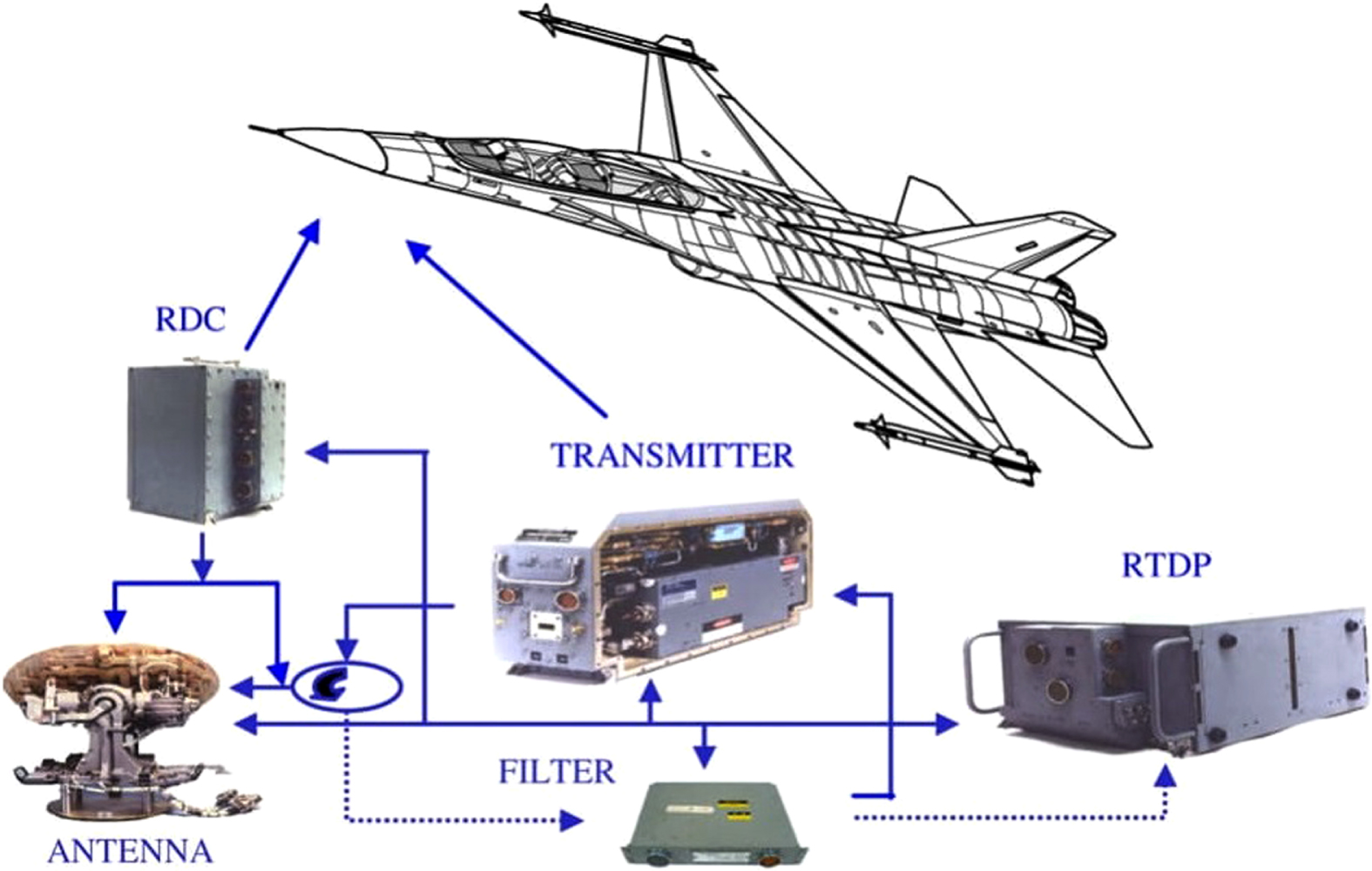
General structure of the airborne radar system.
Depending upon the experts decision, the system reliability target is set as 0.9971429 and the completion time is 2.4h. In this paper I, S, P, E are considered as the reliability allocation factors and the priority level of the criteria’s are set as [H 1 = I] > [H 2 = S] > [H 3 = P, E].
and the overall rating, complexity and failure rate of the subsystem RTDP is R
k
′ = 8 ×10 × 8 ×7 = 4480,
Numerical rating for reliability allocation
Similarly the failure rate of RDC, TRAN, ANT and FILTER are 15.967, 51.094, 2.218 and 0.266 respectively. The obtained results are shown in Table 3.
Allocation results by FOO technique
In this proposed method, a rating matrix is considered which is given in Table 2 and it is normalized using the formula First, we evaluate the degree of satisfaction at each priority level. Sat
1 (RTDP)=0.589970, Sat
2 (RTDP)=0.660938, Sat
3 (RTDP)=0.5402135. Then using product T-norm, the priority weight at each priority level is: Z
1 (RTDP) = T
p
(Z
0 (RTDP) , Sat
0 (RTDP)) = T
p
(1, 1) =1 Z
2 (RTDP) = T
p
(Z
1 (RTDP) , Sat
1 (RTDP)) = T
p
(1, 0.589970) =0.589970 Z
3 (RTDP) = T
p
(Z
2 (RTDP) , Sat
2 (RTDP)) = T
p
(0.589970, 0.660938) =0.389933591 Then the total aggregated value is (using eq: 13):
So, complexity Hence, the allocated failure rate of RTDP (at α = 0.5)= 0.333376646 × 119.22 = 39.74516374/ 105h .
Similarly, the allocated failure rate to RDC, TRAN, ANT and FILTER at α = 0.5 are 23.33522007, 36.55071462, 13.89825784 and 5.690643495 respectively. To show the impact of different situation parameter values on reliability allocation, the allocated failure rates to the subsystems are presented in Table 4-8.
Reliability allocation by proposed method at α=0.1(strongly pessimistic)
Reliability allocation by proposed method at α=0.3(moderately pessimistic)
Reliability allocation by proposed method at α=0.5(moderate assessment)
Reliability allocation by proposed method at α=0.7(moderately optimistic)
Reliability allocation by proposed method at α=0.9(strongly optimistic)
To recognize the flexibility of the proposed method, a comparison between the simulation results is given in Table 9 and Fig. 2.
Comparison of allocated failure rate to the subsystems using two methods
Comparison of allocated failure rate to the subsystems using two methods
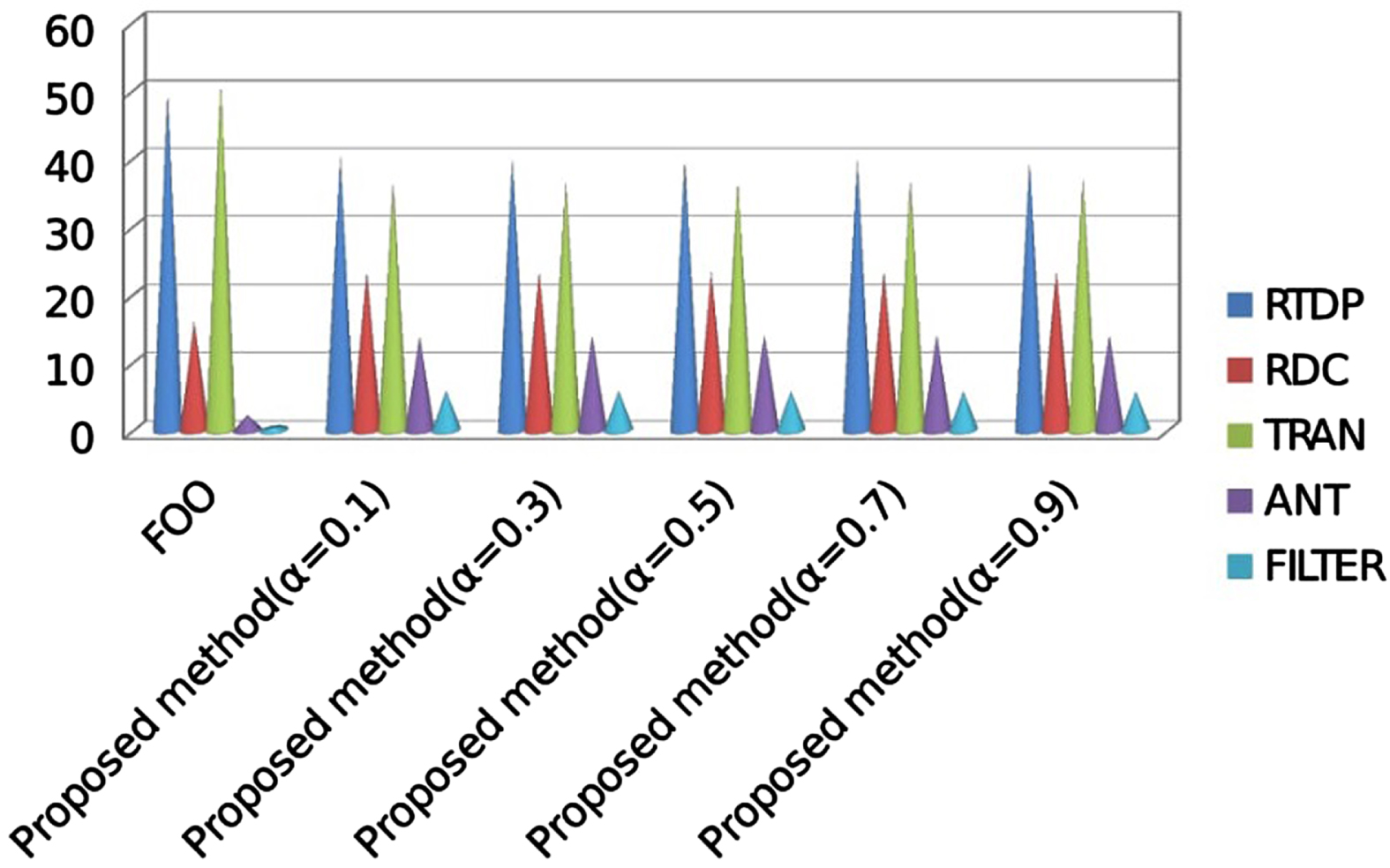
Comparison of allocated failure rate using two methods.
The results of FOO technique (Table 3) show that the allocated failure rates to RTDP and TRAN are high while the ANT and FILTER are less. By this technique, the allocated failure rate to FILTER is very less (0.266/105h). Practically, to create a subsystem with such less failure rate would demolish a large quantity of resources which can affect the budget issue. But by our proposed method the allocated failure rate to FILTER is low, 5.690643495/105h (at α = 0.5). So the required resources to produce a subsystem with this failure rate is remarkably less than those needed for FOO technique. Furthermore by FOO technique, the allocated failure rate of RTDP and TRAN indicates a high failure rate which leads to frequent failures and costly repair of the subsystem. But the failure rates obtained by the proposed method for RTDP and TRAN are reasonably less than the failure rate obtained by FOO technique.
So from all these assessments and figures, we can conclude that the proposed method is more realistic in apportioning the failure rate to the subsystems.
Advantage in measurement scale: Since the ordinal scale measurement is not meaningful, the operations of multiplication and division in FOO technique are meaningless. In our proposed method, we assume an equal numerical scale of rating and also normalize the matrix. So, the results by this method are meaningful and reasonable. Advantage of ordered weight consideration: The proposed method can assess the ordered weight of factors which the FOO technique fails to do. As the ordered weight of factors is one of the vital characteristic in reliability allocation, so the proposed method is more helpful to take a decision. The proposed method can handle the prioritization of factors by considering different priority levels. But in FOO method, there is no priority consideration, means all factor are in same priority level. Thus, we can conclude that the FOO method is a particular type of the proposed method. Finally, this method can deal with situation parameters values which is able to display the decision maker’s correct degree of optimism (strictly optimistic, moderate assessment, pessimistic) to flexibly aggregate the values of factors. However, the FOO technique does not consider situation parameters and so the decision maker mislead to take an incorrect conclusion.
A tabular representation of the comparison between the advantages of FOO technique and the proposed method is summarised in Table 10, where ’✓’ denotes that the related feature is considered and ’×’ indicates that the related feature is not considered.
Comparison of proposed method and FOO technique
This article clearly described the applicability of the proposed prioritized reliability allocation method. The flexibility of this approach is established here using an airborne radar system and a comparison is also made with the FOO technique. The main benefits from this proposed method are: 1) this method can handle effectively the ordered weighted problem and measurement scale problem; 2) It can efficiently cover the priority of factors; and 3) In this proposed method, reliability allocation factors are not restricted only in I, S, P and E, but also it can consider different factors like cost, risk, maintenance, complexity etc.
Hence this method can be utilized as a part of a wide range of different fields and industries which encourages the decision maker to determine a suitable allocation of resources in a system. Here the rating of allocation factors with respect to different subsystems have been considered as a crisp value. But sometimes experts can give their opinion as a fuzzy information like very high, high, medium and low. Therefore, consideration of fuzzy linguistic information with this proposed method is an important future scope.