




Abstract
This study aimed to investigate the effects of learning environment (traditional and non-traditional classroom seating) and course experience on the learning effectiveness of undergraduates. This study also examined the effects of both variables on adaptability, creativity, and motivation; consequently, contribute to learning effectiveness. Overall, 483 undergraduates from a university in Taiwan participated in the survey. Findings evinced that the learning environment and course experience had significant positive influences on learning effectiveness. The relationship between the learning environment and learning effectiveness was partially mediated by adaptability; while creativity partially mediated the adaptability and learning effectiveness relationship. Furthermore, motivation was found to be partially mediated the course experience and learning effectiveness relationship; while, creativity partially mediated the motivation and learning effectiveness relationship. Results suggested that non-traditional classroom seating was promoting adaptability, creativity, and learning effectiveness of students. A good course experience can motivate students, promote creativity, and learning effectiveness.
Introduction
Students’ characteristics and backgrounds have always been perceived as the factors that affect the effectiveness of learning. Yet, empirical research has indicated that learning effectiveness can be affected by the characteristics of the learning environment (Fatou & Kubiszewski, 2017; Lizzio et al., 2002; Meeks et al., 2013). According to Biggs and Moore (1993) 3P model, presage (students’ characteristics and learning environment), process (learning approach), and product (learning outcomes) are the three components that are involved during learning. Therefore, the learning environment plays a major role during the learning process.
The physical space (e.g., classroom), contexts (e.g., learning content), and cultures (how students learn) in which students learn are referred to as the learning environment (Learning environment, 2013). Researchers have explored the influences of the learning environment (Fatou & Kubiszewski, 2017; Lizzio et al., 2002; Meeks et al., 2013) and course experience (Diseth et al., 2010) on students’ learning. However, previous works fall short of capturing factors such as adaptability, motivation, and creativity that may be involved during the learning process.
Nowadays, the world is rapidly evolving towards an artificial intelligence era; routine jobs are gradually replaced by robots and technologies. For example, Cainiao (a logistics firm that is linked to Alibaba) owns a warehouse with over 700 robots working in it. Robots and technologies are extremely intelligent, productive, and effective; however, they lack imagination and creativity. Thus, fostering students’ creativity has become a core task of higher education institutions. Twenty Brazilian professors emphasized that creativity is crucial in higher education; they suggested higher education to use creative strategies, activities, and infrastructures to foster students’ creativity (Alencar & Oliveira, 2016).
Hence, this present study aimed to investigate the effects of the learning environment (traditional and non-traditional classroom seating) and course experience on the learning effectiveness of students in higher education. The current study also looked into how the learning environment and course experience affect adaptability, creativity, and motivation and, as a result, how they contribute to learning effectiveness. Furthermore, the present study also aimed to identify the types of learning environments (traditional and non-traditional classroom seating) that can promote students’ adaptability, creativity, and learning effectiveness.
Literature Review
Learning Environment
According to Zeng (2021), the environment can be defined in three contexts: type, activities, and time. The learning environment refers to the physical space (e.g., classroom), contexts (e.g., learning content), and cultures (how the students learn) in which students learn (Learning environment, 2013). The research on learning environments started to gain attention when Lewin (1936), person-environment congruence theory (Stern, 1970), and matching models (Hunt, 1971) described how a person’s behaviour is influenced by the interaction of his or her personality with the environment.
The learning environment plays an important role in learning; thus, many studies about the conceptualization and assessment of learning environments have been carried out (Aldridge et al., 2012; Fraser, 2012; Khine et al., 2017). An ideal and comfortable learning environment can foster learning and lead to better academic achievement (Lizzio et al., 2002). The students were actively participating in the class when they were placed in soft-furnished, attractive, and friendlier designed rooms (Sommer & Olsen, 1980). A learning environment that allows students to move and work around freely can support the growth of ideas and creativity (Gandini et al., 2005). Learning environments that permit learning activities can promote creativity (Mumford et al., 1994).
To date, research regarding the identification of the types of learning environments (traditional and non-traditional classroom seating) that can enhance students’ adaptability, creativity, and learning effectiveness is scarce. Hence, the learning environment is one of the independent variables in the present study.
Course Experience
According to Biggs and Moore (1993) 3P (presage, process, and product) model, learning process is influenced by the interaction of the students’ characteristics and perception of the learning environment (presage), learning approach (process), and learning outcomes (product). Ramsden (1991) conceptualized perception of the learning context as a course experience.
The course experience questionnaire (CEQ) developed by Ramsden (1991) consists of five scales: good teaching, clear goals and standards, appropriate assessment, appropriate workload, and an emphasis on independence. Often, universities use CEQ to evaluate the teaching effectiveness of a degree programme.
Learning Effectiveness
The meaning of learning effectiveness may vary depending on the person’s learning objective. Piccoli et al. (2001) defined learning effectiveness as the changes in comprehension, expertise, and attitude of a learner upon the completion of a course. The teacher’s enthusiasm, family involvement, learning activities, and teaching methods are the elements that may affect learning effectiveness (Lan et al., 2013). Often, learning effectiveness is measured using test scores or grades and knowledge gained (Wrzesien & Raya, 2010). Bostrom et al. (1990) suggested that the evaluation of learning effectiveness should include both the actual effectiveness of learning content and the attitude of the learner. Biner et al. (1994) proposed evaluating the learning effectiveness by measuring the degree of satisfaction with learning. When Alavi et al. (1995) assessed the effectiveness of learning, they used the satisfaction degree of learning, academic achievement, and classroom assessment as the indicators. Maki et al. (2000) stated that the assessment of learning effectiveness should include the satisfaction of learning and academic achievement. Piccoli et al. (2001) measured learning effectiveness by using the learners’ performance, self-efficacy, and satisfaction. Rovai and Barnum (2003) suggested measuring learning effectiveness by using course perception rather than grades, as grades are often restricted ranges and they are not able to project the actual knowledge that the students have learned from the course, and different teachers grade differently. Neuhauser (2002) measured learning effectiveness from four facets: students’ perceptions towards the general effectiveness of the course, students’ perceptions towards the effectiveness of each course activity in relation to their learning, students’ perception of the course, and test scores and final grades. Meanwhile, Chou and Liu (2005) measured learning effectiveness in four categories: academic achievement, self-efficacy, satisfaction, and learning environment. Self-efficacy means one’s judgement on their ability to attain a certain performance; students with better self-efficacy usually more successful (Bandura, 1986).
Summarizing above literature, learning effectiveness can be assessed by measuring learning satisfaction, academic achievement, and classroom assessment. Hence, learning satisfaction is a useful indicator to assess learning effectiveness.
Adaptability
Adaptability means the capacity to make appropriate responses to changed or changing situations (Adaptability, n.d.). Martin et al. (2012) defined adaptability as a student’s capability to adjust their cognitive, behavioural, and emotional responses spontaneously when faced with fluctuation or unfamiliarity. Cognitive, behavioural, and emotional adjustment refer to the spontaneous adjustment of one’s thoughts, actions, and feelings, respectively. Pulakos et al. (2000) defined adaptive performance as one’s ability to adjust his or her behaviour to fulfil the needs of new assignments, events, or environmental constraints.
Relationship between learning environment, adaptability, and learning effectiveness
Students’ performance is affected by the learning environment; the students who sit near the front of the room are the achievers (Meeks et al., 2013). The students were actively asking questions when they were in a semicircle-arranged classroom (Marx et al., 1999). Rows arrangement classrooms improve the students’ on-task behaviour; whilst, clustered and semicircle arrangement classrooms facilitate interaction between the students and the teacher (Wannarka & Ruhl, 2008). Seat location and classroom arrangement will affect the face-to-face interaction between the teachers and the students. Greater interaction enhances communication and fosters engagement between the teachers and the students; consequently, leads to better academic performance (Fatou & Kubiszewski, 2017).
The learning environment has an influence on the learners’ adaptability. Research done by Tian and Fan (2014) evinced that the learning environment was positively associated with students’ adaptability. Students can focus more when they are well adapted to their learning environment.
Adaptability aids in overcoming challenges; people with a higher level of adaptability rarely fail (Martin et al., 2013). Students with better adaptability have higher willpower to participate in the learning activities (Martin et al., 2013), and show low levels of self-handicapping and disengagement (Martin et al., 2015). Adaptability is positively correlated with performance (Wu et al., 2012), behavioural engagement, and academic achievement (Burns et al., 2017; Holliman et al., 2018; Martin et al., 2012, 2013). Students’ academic performance will be affected if they fail to adapt to the school environment (Merrell, 1994).
Motivation
Motivation derives from the word ‘motive’. Motive, means one’s desire. Motivation stimulates a person to act, commit, and accomplish their goals. Motivation determines the attention and effort a person puts in during an activity (Noe et al., 1997). According to the self-determination theory (Ryan & Deci, 2000), motivation is a continuum of amotivation, extrinsic motivation, and intrinsic motivation. Based on the assumption of self-determination theory, the learning desire is inborn. However, it can be influenced by social factors (Ryan & Deci, 2000). In the academic discipline, the social factors could be the learning environment, teachers, or peers.
Autonomous intrinsic motivation is self-generated. It is characterized by a full sense of willpower within a person. An intrinsically motivated person performs a task or engages in something automatically and naturally out of their interest or enjoyment (Ryan & Deci, 2000). Intrinsically motivated people are more curious, enthusiastic, persistent, and interested in mastering a topic, they dislike rote learning (Ryan & Deci, 2000).
Extrinsic motivation is a desire which is stimulated by external factors such as rewards, money, grades, threats, pleasing someone or escape from punishment (Gagne & Deci, 2005). There are four types of extrinsic motivation: external regulation, introjected regulation, identified regulation, and integrated regulation (Ryan & Deci, 2000). External regulation relies on extrinsic factors such as rewards or escapes from criticism. Meanwhile, introjected regulation is often related to performance-based self-esteem or ego; sometimes introjected regulation drives a person to perform certain actions in order to impress others or avoid being guilty. Identified regulation urges a person to act when he or she identifies the value and importance of that action. Integrated regulation relies on self-determination. They are highly autonomous and perform the activities because they really want to.
Relationship between course experience, motivation, and learning effectiveness
CEQ was initially used as a degree-level teaching performance indicator. However, researchers discovered that course experience was positively correlated with academic achievement (Diseth et al., 2010; Lizzio et al., 2002; Richardson, 2003). Course experience has an influence on the students’ learning approaches (Lizzio et al., 2002). Students adopted a surface learning approach when they perceived heavy workload and inappropriate assessment (Kreber, 2003; Lizzio et al., 2002). Researchers found that course experience has a positive influence on motivation (Diseth et al., 2008; Ning & Downing, 2012). Motivation has an impact on the learning approaches, academic performance, self-efficacy, and psychological well-being of a student (Vansteenkiste et al., 2005). Students showed better academic performance when their intrinsic motivation level was higher (Sobral, 2004; Soenens & Vansteenkiste, 2005) because intrinsic motivation led to the adoption of the deep learning approach (Vansteenkiste et al., 2005). Intrinsically motivated people are more creative as they have a passion for seeking the truth and solving problems (Chen et al., 2009).
Creativity in education
Creativity refers to the ability to use imagination to create something new and extraordinary. Creativity involves thinking, reasoning, restructuring, and recapturing information. Decades ago, researchers identified a connection between creativity and learning (Dewey, 2007; Guilford, 1950). Creativity is an illustration of learning (Guilford, 1950). It involves originality (Beghetto, 2010), imagination (Dziedziewicz & Karwowski, 2015), deductive and inductive thinking (Vartanian et al., 2003), and the ability to use certain strategies to generate novel solutions for complex problems (Beghetto, 2016). All of the above-mentioned characteristics are important in learning (Greiff et al., 2013).
To date, researchers have investigated the impact of the physical school environment (Chan & Yuen, 2014; Gandini et al., 2005; Hong et al., 2009; McCoy & Evans, 2002); availability of resources/materials (Gkolia et al., 2009); pedagogical environment (Gkolia et al., 2009; Rutland & Barlex, 2008; Wood & Ashfield, 2008); the role of play (Cumming, 2007); the use of time (Jeffrey, 2006); the relationship between the teacher and learners (Beghetto, 2016; Burgess & Addison, 2007; Rutland & Barlex, 2008; Wood & Ashfield, 2008); outdoor environment beyond the school (Cumming, 2007; Gkolia et al., 2009; Rutland & Barlex, 2008); the specific roles of teachers (Beghetto, 2016; Jeffrey, 2006; Wood & Ashfield, 2008); teachers’ beliefs about creativity (Beghetto, 2010; Skiba et al., 2010) and the students’ role (Johnson & Hatch, 1990) on the creativity of students.
Research done by Jindal-Snape et al. (2013) demonstrated that students who learned in creativity supporting learning environments showed stronger consciousness of personal achievement, reasoning ability, motivation, engagement, and academic performance. Furthermore, they were highly confident, resilient, and showed better critical thinking and problem-solving skills.
Adaptability and creativity
The learning environment is important in fostering creativity (Richardson & Mishra, 2018). A highly spatial and visual environment can enhance one’s creativity (McCoy & Evans, 2002). Space in the classroom is indispensable for some forms of creativity (e.g. performance or group work); an environment that constrains the discussion or interaction will discourage the students’ imagination and creativity (Chan & Yuen, 2014). The creativity of students is supported when they have places for collaborative work (Hong et al., 2009). Amabile (1989) pointed out that cooperation, collaboration, and social support can foster the students’ creativity. The learning environment influences the learners’ adaptability. Students can focus on their studies when they are adapting well to the learning environment. Adaptability is indispensable (Noppe, 1996). Adaptability leads to creativity (Lassig, 2013; Runco et al., 1998).
Motivation and creativity
Amabile (1993) was among the first to explore the link between creativity and motivation. The two-tier model of creative thinking (Runco & Chand, 1995), the mini-c creativity idea (Kaufman & Beghetto, 2009), the handbook review (Mumford, 2003), and Sternberg (2007) have highlighted that motivation is the keystone for creativity. Studies also found that motivation was positively correlated with creativity (Coelho et al., 2011; Sung & Choi, 2009). Previously, extrinsic motivation was thought to constrain intrinsic motivation; however, Hennessey and Amabile (2010) discovered that rewards can boost intrinsic motivation. The impact of motivation on creativity is enhanced when both extrinsic and intrinsic motivation are combined synergistically (Amabile, 1993).
Creativity and academic achievement
Beghetto (2016) defined creativity as novel and expressive changes in views, outcomes, and actions. Learning means a constant transformation in comprehension and behaviour (Alexander et al., 2009). Creativity and learning are viewed as processes and products (Alexander et al., 2009; Beghetto, 2016). Creativity and learning mutually support each other (Beghetto, 2016). Considering the conceptual links between creativity and learning; it seems sensible to propose that creativity correlates with academic achievement, as academic achievement is an outcome of learning. Gajda et al. (2017) indicated that creativity was positively correlated with academic achievement.
While research on creativity is on the rise, most efforts have not focused on the influence of the learning environment (type of classroom, e.g., traditional and non-traditional classroom seating) and course experience on creativity.
Research methodology
While an extensive body of research exists regarding the impact of the learning environment (Fatou & Kubiszewski, 2017; Lizzio et al., 2002; Meeks et al., 2013) and course experience (Diseth et al., 2010; Lizzio et al., 2002; Meeks et al., 2013; Richardson, 2003) on the learning outcomes; likewise, the effects of course experience on students’ learning approaches (Kreber, 2003; Lizzio et al., 2002) and motivation (Diseth et al., 2008; Ning & Downing, 2012); much less focus has been paid to the factors such as adaptability and creativity that may be involved in the learning.
Built on earlier literature, the present study investigated the effects of the learning environment (traditional classroom and non-traditional classroom seating) and course experience on the learning effectiveness of undergraduate students. The present study also aimed to investigate how both variables influence adaptability, creativity, and motivation, thereby promoting the learning effectiveness of students.
Precisely, it was postulated that while the learning environment directly influences the learning effectiveness, it also influences adaptability and creativity, which in turn, enhances the learning effectiveness (Figs. 1 and 2). Therewith, adaptability would be partially mediating the relationship between the learning environment and learning effectiveness (Fig. 1); whilst, creativity would be partially mediating the relationship between adaptability and learning effectiveness (Fig. 2).

The postulated relationship between learning environment, adaptability, and learning effectiveness.

The postulated relationship between adaptability, motivation, creativity, and learning effectiveness.
Moreover, it was also postulated that while the course experience directly influences the learning effectiveness, it also influences motivation and creativity, which in turn enhances the learning effectiveness (Figs. 3 and 2). Thus, motivation would be partially mediating the relationship between course experience and learning effectiveness (Fig. 3); meanwhile, creativity would be partially mediating the relationship between motivation and learning effectiveness (Fig. 2).

The postulated relationship between course experience, motivation, and learning effectiveness.
The research frameworks are shown in Figs. 1, 2, and 3. The study is significant as it provides empirical evidence on the value of the learning environment, course experience, adaptability, motivation, and creativity in promoting learning effectiveness.
Participants
Questionnaires were distributed and collected on-site. A total of 483 undergraduates from nine different courses in a Taiwan university participated in this survey. The courses were chosen based on random selection. 434 (89.86%) valid surveys were retrieved. Of those, 174 (40.09%) were male and 260 (59.81%) were female. 337 sets (77.65%) were collected from the traditional classroom, while 97 sets (22.35%) were collected from the non-traditional classroom seating. With grades ranging from freshmen to seniors: freshmen (33.87%), juniors (27.42%), sophomores (23.35%) and seniors (13.37%). The descriptive statistics are shown in Table 1. See Appendix 1 and 2 for the details of each type of learning environment.
Learning environment
In the present study, there were two types of learning environments: traditional classroom seating and non-traditional classroom seating. In the traditional classroom seating (Fig. 4), the desks were arranged neatly row-by-column, with the instructor’s desk located at the front. Meanwhile, in the non-traditional classroom seating (Fig. 5), the desks were in a half circle arrangement; the instructor sat in the centre of the half circle; there were a few round tables and flexible furniture in the classroom to cater for group discussion. The classroom was highly spatial and visualized.
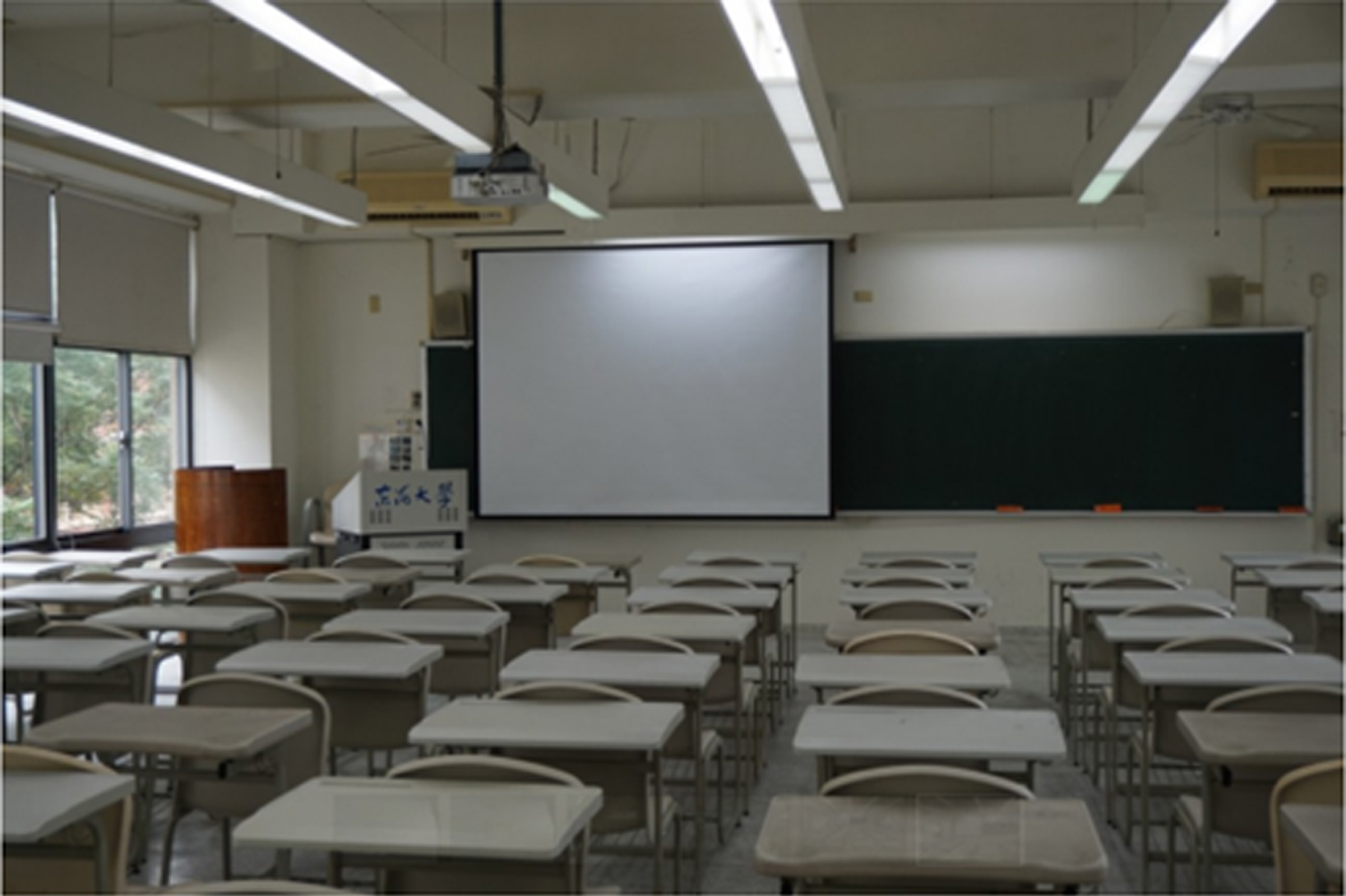
The condition of the traditional classroom seating.

The condition of the non-traditional classroom seating.
Descriptive statistics
Note. N = Number of students.
Course experience (CEQ)
CEQ23 (Wilson et al., 1997) was used to measure the course experience. CEQ23 consists of five scales: good teaching (6-item, e.g., ‘Teaching staff here work hard to make subjects interesting’), clear goals and standards (4-item, e.g., ‘It’s always easy here to know the standard of work expected’), appropriate assessment (4-item, e.g., ‘Too many staff ask us questions just about facts’), appropriate workload (3-item, e.g., ‘The workload is too heavy’), and generic skills (6-item, e.g., ‘This course has sharpened my analytic skills’). Students rated their agreement with each item using a 5-point Likert scale. The course experience score was computed via the average of the 23 items. A higher score indicates that the student has better course experience. The composite reliability (CR) = 0.903 and average variance extracted (AVE) = 0.542.
Adaptability
Adaptability was measured using the adaptive performance questionnaire (Pulakos et al., 2000). The adaptive performance questionnaire measures adaptive performance in eight dimensions; which are related to a job and demanded by organizational and workplace (Pulakos et al., 2000). This present study aimed to measure the students’ ability to adapt immediately and have better learning performance in different learning environments. Hence, only the questionnaire dimensions ‘dealing with uncertain or unpredictable work situations’ (4-item, e.g., ‘I am readily and easily changing gears in response to unpredictable or unexpected events and circumstances in this classroom’) and ‘learning work tasks, technologies, and procedures’ (5-item, e.g., ‘This classroom enables me to learn new methods to solve problems quickly and proficiently’) relevant to the current study were adopted. Students rated their agreement with each item using a 5-point Likert scale. The adaptability score was computed using the average of the nine items. A higher score indicates that the student demonstrates a higher degree of adaptability. The CR = 0.877 and AVE = 0.642.
Motivation
The motivation of students was measured using the Motivated Strategies for Learning Questionnaire (MSLQ) (Pintrich et al., 1991). The present study aimed to measure the students’ perceptions/ general goals for the course as a whole. Hence, only the ‘value components’ in the questionnaire that matched the aim of the present study was adopted. This component consists of: intrinsic goal orientation (4-item, e.g., ‘In a class like this, I prefer course material that really challenges me so I can learn new things’), extrinsic goal orientation (4-item, e.g., ‘If I can, I want to get better grades in this class than most of the other students’), and task value (6-item, e.g., ‘I like the subject matter of this course’). Students rated their agreement with each item using a 5-point Likert scale. The motivation score was computed via the average of the 14 items. A higher score indicates that the student demonstrates a higher degree of motivation. The CR = 0.883 and AVE = 0.603.
Creativity
Creativity was measured using the Epstein Creativity Competencies Inventory for Individuals (ECCI-i) (Epstein et al., 2008). Students rated their agreement with each item (13-item, e.g., ‘I allow myself time every day to think of new ideas’) using a 5-point Likert scale. The creativity score was computed via the average of the 13 items. A higher score indicates that the student demonstrates a higher degree of creativity. The CR = 0.760 and AVE = 0.389. The AVE = 0.4 is acceptable if the CR is higher than 0.6 (Fornell & David, 1981).
Learning effectiveness
Literature has indicated that learning satisfaction is a useful indicator to assess learning effectiveness (Alavi et al., 1995; Biner et al., 1994; Bostrom et al., 1990; Chou & Liu, 2005; Maki et al., 2000; Piccoli et al., 2001). Hence, the learning effectiveness of the present study was measured using the learning satisfaction questionnaire (Chou & Liu, 2005). Students rated their agreement with each item (7-item, e.g., ‘I am satisfied with the learning experience’) using a 5-point Likert scale. The learning satisfaction score was computed via the average of the seven items. A higher score indicates that the student demonstrates a higher degree of learning satisfaction. The CR = 0.896 and AVE = 0.634.
Data analysis
The validity and reliability of each scale were assessed using confirmatory factor analysis (CFA), composite reliability (CR), and the average variance extracted (AVE). Items with a factor loading lower than 0.5 were removed. The AVE≥0.5 and CR≥0.6 are acceptable (Fornell & Larcker, 1981). Next, structural equation modelling (SEM) was performed to analyse the measurement and structural model and assess the hypothesised model. The CFI > 0.90 is considered acceptable fit to the data (Byrne, 2001) and the RMSEA should be < 0.08 (Browne & Cudeck, 1993). The sample size for non-traditional classroom seating may be considered sufficient size as MacCallum et al. (1999) obtained excellent results in their research with a sample size of 60. Hierarchical regression analysis was performed to further determine how the variables influence the learning effectiveness. The course, gender, department, and grade were entered into the level 1 regression. Followed by the course experience and learning environment at the level 2 regression. Creativity, adaptability, and motivation were entered at level 3 regression.
Results
Measurement models
The CFA results for all the constructs are shown in Table 2. The results are acceptable because the goodness-of-fit statistics such as normed chi square, CFI, and RMSEA for all the constructs were within the acceptable range.
CFA results of course experience, adaptability, motivation, creativity, and learning effectiveness
CFA results of course experience, adaptability, motivation, creativity, and learning effectiveness
Note. CE = course experience. AD = adaptability. LM = motivation. CT = creativity. LE = learning effectiveness. **p < 0.001. *p < 0.05.
The normed chi-square = 2.434, p < 0.001, GFI = 0.732, CFI = 0.783, NNFI = 0.768, IFI = 0.785, RMSEA = 0.058. CFI of a model with low item inter-correlations may be lowered. Hence, CFI = 0.80 can be adopted if the RMSEA < 0.08 (Ang et al., 2017). The analytical results showed that this model fits the data reasonably well.
Fig. 6 shows the SEM result for traditional classroom seating. The course experience significantly influenced the learning effectiveness (r = 0.21, p < 0.001) and motivation (r = 0.79, p < 0.001). Motivation significantly influenced learning effectiveness (r = 0.27, p < 0.001) and creativity (r = 0.56, p < 0.001). Adaptability significantly influenced creativity (r = 0.29, p < 0.001) and learning effectiveness (r = 0.14, p < 0.001), while creativity significantly influenced learning effectiveness (r = 0.48, p < 0.001).

SEM result for the traditional classroom seating. The relationships between course experience (CE), motivation (LM), creativity (CT), adaptability (AD), and learning effectiveness (LE).
Fig. 7 shows the SEM result for non-traditional classroom seating. The course experience significantly influenced the learning effectiveness (r = 0.16, p < 0.001) and motivation (r = 0.70, p < 0.001). Motivation significantly influenced learning effectiveness (r = 0.23, p < 0.001) and creativity (r = 0.42, p < 0.001). Adaptability significantly influenced creativity (r = 0.35, p < 0.001) and learning effectiveness (r = 0.19, p < 0.001), and creativity significantly influenced the learning effectiveness (r = 0.55, p < 0.001).
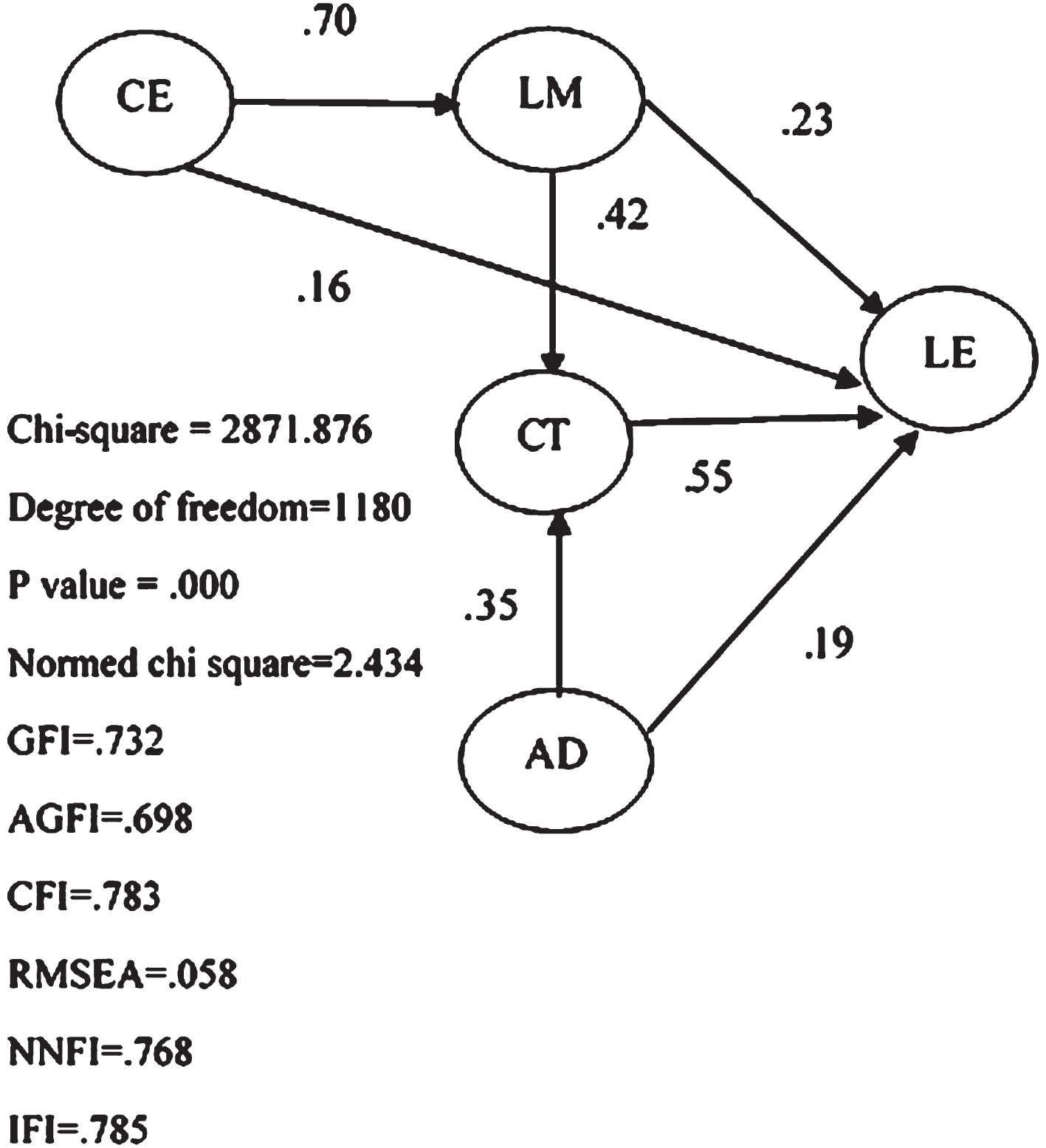
SEM result for the non-traditional classroom seating. The relationships between course experience (CE), motivation (LM), creativity (CT), adaptability (AD), and learning effectiveness (LE).
According to the findings, the learning environment had a positive influence on learning effectiveness; adaptability partially mediated the learning environment and learning effectiveness relationship; creativity partially mediated the adaptability and learning effectiveness relationship. In addition, the course experience had a positive influence on learning effectiveness. Motivation partially mediated the course experience and learning effectiveness relationship; while creativity partially mediated the motivation and learning effectiveness relationship. All the findings supported all the hypotheses proposed.
Table 3 shows the standardized path coefficients for the traditional classroom and non-traditional classroom seating. The relationships between adaptability and creativity, adaptability and learning effectiveness, and creativity and learning effectiveness were found to be stronger in the non-traditional classroom than in the traditional classroom seating. The findings indicated that the students who studied in non-traditional classroom seating showed better adaptability, creativity, and they could learn more effectively.
The standardized path coefficients of each construct in the traditional classroom seating and non-traditional classroom seating
Note. CE = course experience. AD = adaptability. LM = motivation. CT = creativity. LE = learning effectiveness. **p < 0.001. *p < 0.05.
Table 4 shows the summary of the hierarchical regression analysis. The explanatory power for level 1 regression (Model 1), level 2 regression (Model 2), and level 3 regression (Model 3) was 0.044, 0.519, and 0.609, respectively. All the results were statistically significant (p < 0.001).
Summary of the hierarchical regression analysis
Summary of the hierarchical regression analysis
Note. aPredictors: (Constant), course, gender, department, grade. bPredictors: (Constant), course, gender, department, grade, course experience, learning environment. cPredictors: (Constant), course, gender, department, grade, course experience, learning environment, creativity, adaptability, motivation. **p < 0.001. *p < 0.05.
Table 5 shows that in Model 2, the learning environment (β= 0.10, p < 0.05) and course experience (β= 0.71, p < 0.001) had positive influences on the learning effectiveness. Model 3 results showed that the learning environment (β= 0.11, p < 0.01), course experience (β= 0.48, p < 0.001), adaptability (β= 0.10, p < 0.01), motivation (β= 0.16, p < 0.001), and creativity (β= 0.23, p < 0.001) all had positive influences on learning effectiveness.
Regression coefficientsa of learning effectiveness
Note. a = dependent variable. ***p < 0.001. **p < 0.01. *p < 0.05.
The aims of the present study were to examine the effects of the learning environment, and course experience on learning effectiveness and how the learning environment, and course experience affect adaptability, motivation, and creativity; which in turn contribute to the learning effectiveness of students in higher education institutions. There were a few worthwhile outcomes of the present study.
Effects of learning environment on adaptability, creativity, and learning effectiveness
This study provides more evidence of the relationship between the learning environment and learning effectiveness. The present findings matched the results of Lizzio et al. (2002) in showing the significant relationship between the learning environment and learning effectiveness. Results indicated that the learning environment had positive influences on adaptability and learning effectiveness; whilst, adaptability had positive influences on learning effectiveness and creativity. Furthermore, creativity had a positive influence on learning effectiveness. Many studies have found a link between the learning environment and adaptability (Tian & Fan, 2014); adaptability and academic outcomes (Burns et al., 2017; Holliman et al., 2018); adaptability and creativity (Lassig, 2013); and creativity and academic achievements (Gajda et al., 2017). This study showed that adaptability partially mediated the learning environment and learning effectiveness relationship; and, creativity partially mediated the adaptability and learning effectiveness relationship.
According to constructivist learning theories, classroom environments and teaching approaches are crucial in learning; constructivists always refer both as the framework during instructional design (Biggs, 1996). Biggs (1996) asserted that both elements can significantly improve learning and labelled them as “constructive alignment”. According to Dart et al. (2000), classroom environment consists of cognitive and affective dimensions; these dimensions will influence learning behaviour. The present study managed to show that the learning environment had an influence on the students’ adaptability, creativity, and learning effectiveness.
Knowledge is a natural implication of the constructive process (Boghossian, 2006). Based on the core concept of constructivist learning theories, learning is a process of constructing knowledge; and, the students are constructing their own knowledge (Boghossian, 2006). During the learning process, the students are the active participants. Meanwhile, the teachers or instructors are facilitating the knowledge construction process (Boghossian, 2006). According to Vygotsky’s theory (1978), knowledge is constructed through social interaction; students are learning when interacting with the physical and social environment. Social interaction helps to internalize new or complex understandings, problems, and processes (Glasson, 1993).
The learning environment is an instrument; it is important to have learning environments that can promote learning activities, engagement, and fulfil the students’ needs (Henderson et al., 2012). The learning environment has an influence on the students’ engagement. A learning environment that permits a variety of teaching activities such as brainstorming, group discussion, and demonstration can enhance student-teacher interaction. Higher levels of student-teacher interaction and engagement promote learning; consequently, lead to academic success (Fatou & Kubiszewski, 2017). Tian and Fan (2014) indicated that the learning environment was positively associated with adaptability. When the students perceive a sense of belonging and engagement in the classroom (Holliman et al., 2018), their adaptability will be enhanced; subsequently, they will be actively participating in the classroom. Adaptability involves modifying, manipulating, or reshuffling present ideas; all of these lead to creativity (Lassig, 2013). Beghetto (2016) indicated that creativity and learning mutually support each other. Creativity promotes learning as research shows that creativity is positively correlated with academic achievement (Gajda et al., 2017).
The findings indicated that the learning environment had an influence on the students’ adaptability and creativity, which in turn influenced their learning effectiveness. The present study also provides evidence that students who study in non-traditional classroom seating can learn more effectively as the non-traditional classroom fosters their adaptability and creativity. With regard to the practical implications of this research, it seems important for educational institutions to create more non-traditional classroom seating. Making some minor changes, such as arranging the desks in a half circle or allocating some round tables and flexible furniture in the classroom for group discussions, can improve students’ adaptability, creativity, and learning effectiveness. Non-traditional classroom seating is prone to student-centred learning; it can promote positive learning attitudes, collaboration, and enhance student-teacher interaction and engagement (Taylor, 2009). An environment that promotes collaboration encourages idea sharing and the generation of new ideas (Park & Choi, 2014); consequently, fosters students’ creativity (Amabile, 1989; Chan & Yuen, 2014; Hong et al., 2009).
Effects of course experience on motivation, creativity, and learning effectiveness
The study also provides evidence of the relationship between course experience and learning effectiveness. The present findings matched the results of Richardson (2003), whereby, course experience was significantly correlated with learning effectiveness. Results indicated that the course experience had positive influences on learning effectiveness and motivation; while, motivation had positive influences on learning effectiveness and creativity. Moreover, creativity also had a positive influence on learning effectiveness. Numerous studies have indicated that there is a direct relationship between course experience and motivation (Ning and Downing, 2012); motivation and academic outcomes (Vansteenkiste et al., 2005); motivation and creativity (Coelho et al., 2011); and creativity and academic achievements (Gajda et al., 2017). This study managed to provide evidence that motivation partially mediated the course experience and learning effectiveness relation, and creativity partially mediated the motivation and learning effectiveness relation.
According to Biggs and Moore (1993) 3P model, the learning process is influenced by the course experience (perception), learning approach, and learning outcome. The learning approach and motivation are interrelated; motivation will determine the learning approach (Diseth et al., 2008). A good course experience can motivate students and stimulate the adoption of the deep learning approach (Lizzio et al., 2002). Deep learning is characterized by the intention to improve comprehension by applying and comparing ideas; students who adopt a deep learning approach are always the top achievers (Lizzio et al., 2002). Motivation determines one’s focus and attainment; it drives a person to act, commit, and accomplish their goals (Noe et al., 1997). Motivation can trigger one’s creativity; people will only perform creatively when they love what they are doing, or when they are motivated when performing their work (Sternberg, 2007). Based on the conceptual links between creativity and learning, a creative student usually shows better academic achievement (Gajda et al., 2017).
The findings indicated that the course experience had an influence on the students’ motivation and creativity, which in turn influenced their learning effectiveness. As for the practical implications of present research, it is important for educators to pay attention to the five sub-dimensions: good teaching, clear goals, appropriate coursework, appropriate assessment, and general skills when designing a course to ensure the students have a good course experience.
The findings of Los and Schweinle (2019) illustrated that the instructional environment had an influence on the students’ motivation and academic outcome. Hence, it is indispensable to have a good instructional environment. To have good teaching, educators may adopt student-centred learning strategies such as the learning object repository (Arslan et al., 2010) which requires active involvement of students during the learning process. According to constructivist learning theories, students construct their own knowledge as they are the core creators of meaning (Boghossian, 2006). Student-centred learning provides opportunities for students to identify their present understandings and knowledge, interpret the meaning of current experiences, and make proper adjustments to their knowledge framework; consequently, constructing knowledge. Furthermore, student-centred learning also fosters the students’ autonomy, competency, and confidence. According to the self-determination theory, autonomy, competence, and relatedness are the three innate psychological needs for self-motivation (Ryan and Deci, 2000). Students are motivated when their innate psychological needs are fulfilled. The findings of Kaplan (2017) indicated that autonomy support from the teachers was able to motivate the students and enhance their learning experience. Research done by Fatou and Mueller (2017) showed that autonomy support from the teachers had an influence on the students’ motivation, especially when they were in unfamiliar situations (e.g., when the students were learning a new subject or topic).
It is indispensable to set and announce clear goals and standards during the commencement of the course. According to the achievement goal theory, an achievement goal is coupled with motivation and it has an influence on academic performance and a person’s cognitive self-regulation (Covington, 2000). Cognitive self-regulation means the ability of a person to self-organize their learning by analysing the requirements of school assignments, organizing the learning resources to meet the requirements, and closely monitoring their learning process (Pintrich, 2000). Hence, the announcement of clear goals and standards during the commencement of a course will encourage the students to set their learning goals accordingly. The achievement goals will motivate the student and foster their cognitive self-regulation.
Educators are recommended to give appropriate workloads and, likewise, set interesting coursework and assessments to improve the students’ course experience. According to the “instructional alignment” idea (Cohen, 1987), the instructional results would be impressively enhanced when the curriculum and assessment methods are aligned. Appropriate and interesting coursework can open the students’ minds and promote creativity (Rutland and Barlex, 2008). On the other hand, heavy workloads and inappropriate assessments will demotivate the students (Parkinson et al., 2006) and lead to rote learning (Lizzio et al., 2002).
Moreover, more game-like activities such as brainstorming, debate, problem-based learning, role-playing, and drama can be incorporated into teaching. According to Chen et al. (2001), learning activities that are novel, challenging, require exploration and attention, and fun can trigger the students’ interest. Interest supports learning (Walkington & Bernacki, 2014) because interest is a motivational variable (Renninger and Hidi, 2016). Besides, games-like activities also promote the students’ creativity (Jindal-Snape et al., 2013).
According to The Future of Jobs report (2016), creativity ranked 10th among the top 10 skills most needed by employers in 2015; lately, complex problem solving, critical thinking, and creativity have become the top three skills demanded by employers in 2020. Critical thinking and creativity are inseparable as both develop evenly (Paul and Elder, 2006). Meanwhile, Chang et al. (2014) stressed that creativity is a problem-solving skill. All these have highlighted that creativity has become an important skill. Hence, it is important to foster the students’ creativity.
Limitations and future directions
There were several limitations in this study. Firstly, there was only one non-traditional classroom seating that was available for the present research. Due to time and classroom constraints, it was hard to reconstruct more non-traditional classroom seating; hence, the number of surveys collected from the traditional classroom and the non-traditional classroom was not tallied. Secondly, the students were from different courses, departments, and taught by different professors; so, the influence of the learning environment on the learning effectiveness is hard to identify precisely. In future studies, it is recommended that the research can be carried out through collaboration with other universities. Through collaboration, more surveys from non-traditional classroom seating can be obtained. This helps to enhance the power of statistical analyses. Besides, the research can be carried out at the school level. At the school level, there are more students learning the same subject in a classroom, and the subject taught can be controlled. Hence, the influence of the learning environment and course experience on learning effectiveness can be determined more precisely.
Conclusion
Based on the findings, the postulates were accepted as true. The learning environment had a direct influence on the learning effectiveness. Besides, it also influenced adaptability and creativity, which in turn, enhanced the effectiveness of learning. Specifically, adaptability partially mediated the relationship between the learning environment and learning effectiveness, whereas creativity partially mediated the relationship between adaptability and learning effectiveness. Nevertheless, the course experience had a direct influence on the learning effectiveness. Besides, it also influenced motivation and creativity, which in turn enhanced the effectiveness of learning. Furthermore, motivation partially mediated the relationship between course experience and learning effectiveness; while, creativity partially mediated the relationship between motivation and learning effectiveness. Students in the non-traditional classroom seating showed better adaptability and creativity, and they could learn more effectively. Lastly, a good course experience is able to motivate students, promote creativity, and learning effectiveness.
Footnotes
Acknowledgments
The authors greatly appreciate the students from the university who volunteered to participate in this research. The authors are also grateful to the professors at the university who helped to distribute and collect the survey forms during their lecture classes.
Author Biographies
Appendix 1
Traditional classroom seating (378 students participated, 337 valid surveys were retrieved)
Number of students
Departments involved
4
Name of the courses involved
•Business Policy
•Human Resource Management
•Statistics (I)
•Accounting
•Statistics
•Intermediate Grammar
•English Technical Writing
•Sophomore English
Instructors involved
6
Number of students at each grade level
90 students participated, 79 valid surveys (87.78%) were retrieved
Female:40 (50.63%); male:39 (49.37%)
Junior:75 (94.94%)
Senior:4 (5.06%)
64 students participated, 57 valid surveys (89.06%) were retrieved
Female:37 (64.91%); male: 20 (35.09%)
Sophomore:50 (87.72%)
Junior: 4 (7.02%)
Senior: 3 (5.26%)
Number of students
35 students participated, 28 valid surveys (80%) were retrieved
Female:18 (64.29%); male:10 (35.71%)
Freshman: 28 (100%)
57 students participated, 53 valid surveys (92.98%) were retrieved
Female: 39 (73.58%); male:14 (26.42%)
Freshman:34 (64.15%)
Sophomore:3 (5.66%)
Junior: 10 (18.87%)
Senior:6 (11.32%)
60 students participated, 51 valid surveys (85%) were retrieved
Female:35 (68.63%); male: 16 (31.37%)
Freshman: 48 (94.12%)
Sophomore:2 (3.92%)
Senior:1 (1.96%)
22 students participated; 19 valid surveys (89.06%) retrieved
Female: 9 (47.37%); male: 10 (52.63%)
Senior:19 (89.06%)
16 students participated, 16 valid surveys (100%) were retrieved
Female: 6 (37.50%); male: 10 (62.50%)
Sophomore: 4 (25%)
Junior: 7 (43.75%)
Senior: 5 (31.25%)
34 students participated; 34 valid surveys (100%) retrieved
Female:13 (38.24%); male:21 (61.76%)
Sophomore: 31 (91.18%)
Junior: 2 (5.88%)
Senior: 1 (2.94%)
Appendix
Non-traditional classroom seating (105 students participated, 97 valid surveys were retrieved)
Number of students
Departments involved
1
Name of the courses involved
•Environmental Changes and Low-Carbon Life
•Dietary and Diseases
Instructors involved
1
Number of students in each course
and each grade level
54 students participated, 49 valid surveys (90.74%) were retrieved
Female:30 (61.22%); male: 19 (38.78%)
Freshman: 17 (34.69%)
Sophomore: 7 (14.89%)
Junior: 14 (28.57%)
Senior: 11 (22.45%)
51 students participated, 48 valid surveys (94.12%) were retrieved
Female:33 (68.75%); male: 15 (31.25%)
Freshman:20 (41.67%)
Sophomore: 13 (27.08%)
Junior: 7 (14.58%)
Senior: 8 (16.67%)