




Abstract
In this paper, we further investigate the constructions of implications and left (right) semi-uninorms on a complete lattice. We firstly give out the formulas for calculating the upper and lower approximation conjunctive left (right) semi-uninorms of a binary operation. Then, we derive the formulas for calculating the upper and lower approximation NP implications of a binary operation. Finally, we show that the right (left) residuum of the upper approximation conjunctive right (left) infinitely ∨-distributive left (right) semi-uninorm of a right (left) infinitely ∨-distributive binary operation is the lower approximation right infinitely ∧-distributive NP implication of the right (left) residuum of the binary operation.
Keywords
Introduction
In fuzzy logic systems (see [12]), connectives “and”, “or” and “not” are usually modeled by t-norms, t-conorms, and strong negations on [0, 1] (see [1, 17]), respectively. Based on these logical operators on [0, 1], the three fundamental classes of fuzzy implications on [0, 1], i.e., R-, S-, and QL-implications on [0, 1], were defined and extensively studied (see [2, 27]). But, as was pointed out by Fodor and Keresztfalvi [11], sometimes there is no need of the commutativity or associativity for the connectives “and” and “or”. Thus, many authors investigated implications based on some other operators like weak t-norms [10], pseudo t-norms [38], pseudo-uninorms [28], left and right uninorms [36], semi-uninorms [19], aggregation operators [24, 26] and so on.
Uninorms, introduced by Yager and Rybalov [40], and studied by Fodor et al. [13], are special aggregation operators that have been used in many fields like fuzzy logic, expert systems, neural networks, aggregation, and fuzzy system modeling (see [14, 39]). This kind of operation is an important generalization of both t-norms and t-conorms and a special combination of t-norms and t-conorms (see [13, 20]). There are real-life situations when truth functions may not be associative or commutative. By throwing away the commutativity from the axioms of uninorms, Mas et al. introduced the concepts of left and right uninorms on [0, 1] in [21] and later on a finite chain in [22] and Wang and Fang [36, 37] studied the left and right uninorms on a complete lattice. By removing the associativity and commutativity from the axioms of uninorms, Liu [19] introduced the concept of semi-uninorms and Su et al. [30] discussed the notions of left and right semi-uninorms on a complete lattice. On the other hand, it is well known that a uninorm (semi-uninorm) U can be conjunctive or disjunctive whenever U (0, 1) =0 or 1, respectively. This fact allows us to use uninorms in defining fuzzy implications (see [7, 36]).
Constructing fuzzy connectives is an interesting topic. Recently, Jenei and Montagna [16] introduced several new types of constructions of left-continuous t-norms, Wang [34] derived the formulas for calculating the smallest pseudo-t-norm that is stronger than a binary operation and the largest implication that is weaker than a binary operation, Su et al. [30] studied the constructions of left and right semi-uninorms on a complete lattice, Li and Liu [18] derived (U, N)-implications from commutative semiuninorms and pseudo-uninorms, and Su and Wang [29] investigated the constructions of implications and coimplications on a complete lattice. Moreover, Wang [35] discussed the relations between left (right) semi-uninorms and coimplications, Hao et al. [15] investigated the relations between implications and left (right) semi-uninorms, and Niu et al. [25] studied the relations among implications, coimplications and left (right) semi-uninorms, on a completelattice.
This paper continues to explore the research direction started in [15, 30]. Motivated by these works in [16, 34], we will further focus on this issue and investigate constructions of the upper and lower approximation conjunctive left (right) semi-uninorms and the upper and lower approximation NP implications on a complete lattice.
This paper is organized as follows. After recalling some necessary definitions and examples about the implications and the left (right) semi-uninorms on a complete lattice in Section 2, we give out the formulas for calculating the upper and lower approximation conjunctive left (right) semi-uninorms in Section 3. In Section 4, we derive the formulas for calculating the upper and lower approximation NP implications. In Section 5, we reveal the relationships between the upper approximation conjunctive right (left) infinitely ∨-distributive left (right) semi-uninorms and lower approximation right infinitely ∧-distributive NP implications.
It should be point out that some methods and skills in this paper root in [29, 30].
The knowledge about lattices required in this paper can be found in [4].
Implications and left (right) semi-uninorms
Throughout this paper, unless otherwise stated, L always represents any given complete lattice with maximal element 1 and minimal element 0; J stands for any index set.
In this section, we recall some necessary concepts about the implications and left (right) semi-uninorms and illustrate these notions by means of some examples.
An implication I is said to satisfy the neutrality principle with respect to e (w.r.t. e, for short) if I (e, y) = y for any y ∈ L.
An implication that satisfies the neutrality principle is also called an NP implication.
Implications are extensions of the Boolean implication ⇒ (P ⇒ Q meaning that P is sufficient for Q).
Note that for any implication I on L, due to the monotonicity, the absorption principle holds, i.e., I (0, x) = I (x, 1) =1 for any x ∈ L.
(U1) l there exists a left neutral element, i. e., an element e L ∈ L satisfying U (e L , x) = x for all x ∈ L,
(U2) U is increasing in each variable.
(U1) r there exists a right neutral element, i.e., an element e R ∈ L satisfying U (x, e R ) = x for all x ∈ L,
(U2) U is increasing in each variable.
Clearly, U (0, 0) =0 and U (1, 1) =1 hold for any left (right) semi-uninorm U on L.
For any left (right) semi-uninorm U on L, U is said to be left-conjunctive and right-conjunctive if U (0, 1) =0 and U (1, 0) =0, respectively. U is called conjunctive if both U (0, 1) =0 and U (1, 0) =0 since it satisfies the classical boundary conditions of AND.
If a left (right) semi-uninorm U on L is associative, then U is also called the left (right) uninorm in[36, 37].
If a left (right) semi-uninorm U with the left (right) neutral element e L (e R ) has a right (left) neutral element e R (e L ), then e L = U (e L , e R ) = e R . In this situation, we will denote e L = e R by e. Here, U is called the semi-uninorm in [19]. In particular, if the neutral element e = 1, then the semi-uninorm U becomes a t-seminorm (see [31]) or a semi-copula (see [9]); if the neutral element e = 0, then the semi-uninorm U becomes a t-semiconorm (see [8]).
If a binary operation U is left infinitely ∨-distributive (∧-distributive) and also right infinitely ∨-distributive (∧-distributive), then U is said to be infinitely ∨-distributive (∧-distributive).
When J =∅, noting that the least upper bound of the empty set is 0 and the greatest lower bound of the empty set is 1 (see [4, 5]), we have that
For the sake of convenience, we introduce the following symbols:
: the set of all left semi-uninorms with the left neutral element e L on L;
: the set of all right semi-uninorms with the right neutral element e R on L;
: the set of all conjunctive left semi-uninorms with the left neutral element e L on L;
: the set of all conjunctive right semi-uninorms with the right neutral element e R on L;
: the set of all right infinitely ∨-distributive left semi-uninorms with the left neutral element e L on L;
: the set of all left infinitely ∨-distributive right semi-uninorms with the right neutral element e R on L;
: the set of all conjunctive right infinitely ∨-distributive left semi-uninorms with the left neutral element e L on L;
: the set of all conjunctive left infinitely ∨-distributive right semi-uninorms with the right neutral element e R on L;
: the set of all implications on L;
: the set of all right infinitely ∧-distributive implications on L;
: the set of all implications which satisfy the neutrality principle w.r.t. e on L;
: the set of all right infinitely ∧-distributive implications which satisfy the neutrality principle w.r.t. e on L.
The upper and lower approximation conjunctive left (right) semi-uninorms
Constructing logic operators is an interesting work. Recently, Jenei and Montagna [16] introduced several new types of constructions of left-continuous t-norms and Su et al. [30] studied the constructions of left and right semi-uninorms on a complete lattice. In this section, we continue the works in [16, 30] and give out the formulas for calculating the upper and lower approximation conjunctive left (right) semi-uninorms of a binary operation.
For any nonempty subfamily {T
j
∣ j ∈ J} of LL×L, the least upper bound ∨j∈JT
j
and the greatest lower bound ∧j∈JT
j
of are, respectively, define by
Similarly, we introduce the following symbols:
: the upper approximation conjunctive right semi-uninorm of A;
: the lower approximation conjunctive right semi-uninorm of A;
: the upper approximation conjunctive right infinitely ∨-distributive left semi-uninorm of A;
: the lower approximation conjunctive right infinitely ∨-distributive left semi-uninorm of A;
: the upper approximation conjunctive left infinitely ∨-distributive right semi-uninorm of A;
: the lower approximation conjunctive left infinitely ∨-distributive right semi-uninorm of A.
A
la
≤ A ≤ A
ua
. (A ∨ B)
ua
= A
ua
∨ B
ua
and (A ∧ B)
la
= A
la
∧ B
la
. A
ua
and A
la
are increasing in its each variable. If A is increasing in its each variable, then A
ua
= A
la
= A.
If A is left (right) infinitely ∨-distributive, then A
ua
is left (right) infinitely ∨-distributive. If A is left (right) infinitely ∧-distributive, then A
la
is left (right) infinitely ∧-distributive.
If A is left infinitely ∨-distributive, then A is increasing in its first variable,
Similarly, we can show that A ua is right infinitely ∨-distributive when A is right infinitely ∨-distributive. □
Su et al. [30] have constructed the upper and lower approximation left (right) semi-uninorms on a complete lattice. Below, we give out the formulas for calculating the upper and lower approximation conjunctive left (right) semi-uninorms of a binary operation.
If , then . If , then . If and A is right infinitely ∨-distributive, then . Moreover, if A is increasing in its first variable, then .
(1) Let . If , then U1 ≥ A, . Thus, . It implies that U1 (1, 0) = U1 (0, 1) =0 and U1 (e L , y) = y for any y ∈ L. By Theorem 3.2(3) and the monotonicity of , we can see that U1 is increasing in its each variable. So, . If A ≤ U and , then U = U ua ≥ A ua and . Therefore, .
(2) Let . If , then and . Thus, U2 (1, 0) = U2 (0, 1) =0 and U2 (e L , y) = y for any y ∈ L. By Theorem 3.2(3) and the monotonicity of , we know that U2 is increasing in its each variable. So, . If U ≤ A and , then U = U la ≤ A la and . Therefore, .
(3) Let . If , then by statement (1). Noting that A is right infinitely ∨-distributive, we can see that A ua is also right infinitely ∨-distributive by Theorem 3.3(1). Thus, U3 is right infinitely ∨-distributive and . By the proof of (1), we have that .
Moreover, if A is increasing in its first variable, then A ua = A by Theorem 3.2(4) and so . □
By the proofs of Theorem 3.6(3) in [30] and Theorem 3.4(3), we can see that Theorem 3.4(3) improves Theorem 3.6(3) in [30]. In fact, by removing the condition A is increasing in its first variable in Theorem 3.6(3) in [30], we have that by the proof of Theorem 3.4(3).
This example illustrates that an analog of Theorem 3.4(3) may not hold for calculating the lower approximation conjunctive right infinitely ∨-distributive left semi-uninorm of a binary operation.
Similarly, for calculating the upper and lower approximation conjunctive right semi-uninorms of a binary operation, we have the following theorem.
If , then . If , then . If and left infinitely ∨-distributive, then . Moreover, if A is increasing in its second variable, then .
The upper and lower approximation implications which satisfy the neutrality principle
Recently, Su and Wang [29] have investigated the constructions of implications and coimplications on a complete lattice. This section continues to explore the research direction started in [29]. In this section, we will study the constructions of the upper and lower approximation implications which satisfy the neutrality principle.
For any binary operation U on L and x, y ∈ L, it is straightforward to verify that . and . If U (1, 0) =0, then and if U (0, 1) =0, then .
Due to Theorems 4.4 and 4.5 in [36], we know that U and satisfy the following right residual principle:
When U is a left (right) semi-uninorm on L, it is easy to see that and are all decreasing in the first variable and increasing in the second one by Definition 4.1.
It is easy to verify that if J≠ ∅, then
Likewise, for a binary operation A on L, we may introduce the following symbols:
: the upper approximation right infinitely ∧-distributive NP implication of A.
: the lower approximation right infinitely ∧-distributive NP implication of A.
A
li
≤ A ≤ A
ui
. (A ∨ B)
ui
= A
ui
∨ B
ui
and (A ∧ B)
li
= A
li
∧ B
li
. A
ui
and A
li
are hybrid monotonic. If A is hybrid monotonic, then A
li
= A = A
ui
.
(1) If A is right infinitely ∨-distributive, then A
ui
is also right infinitely ∨-distributive,
(2) If A is right infinitely ∧-distributive, then A li is also right infinitely ∧-distributive.
(3) If A is left infinitely ∨-distributive, then
Assume that A is a right infinitely ∨-distributive binary operation on L. By the proof of Theorem 3.3(1), we can see that A
ui
is also right infinitely ∨-distributive. By Definitions 3.1 and 4.1, the monotonicity of A and , and the right residual principle, we have that
Now, we give out the formulas for calculating the upper and lower approximation implications which satisfy the neutrality principle.
If , then . If , then . If and A is right infinitely ∧-distributive, then . Moreover, if A is decreasing in its first variable, then .
(1) Let . If , then I1 ≥ A and by Theorem 4.4. Thus, I1 (0, 0) = I1 (1, 1) =1, I1 (1, 0) =0 and I1 (e L , y) = y for any y ∈ L. By Theorem 4.4(3) and the hybrid monotonicity of , we know that I1 is hybrid monotonic. So, . If A ≤ I and , then I = I ui ≥ A ui and . Therefore, .
(3) Let . If , then I3 ≤ A,
Moreover, if A is decreasing in its first variable, then A li = A by Theorem 4.4(4) and . □
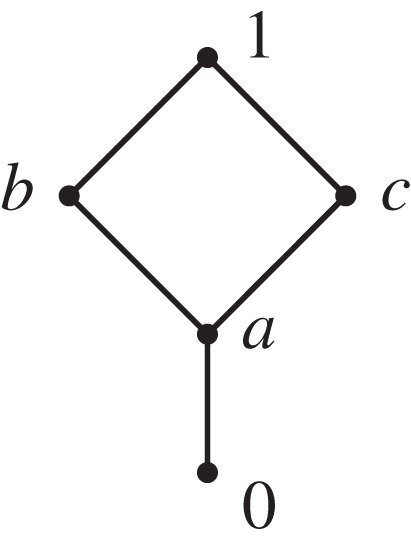
Analogous to Theorem 4.6, we have the following theorem.
If , then . If , then . If and A is right infinitely ∧-distributive, then . Moreover, if A is decreasing in its first variable, then .
The relations between the upper approximation conjunctive left (right) semi-uninorms and lower approximation implications which satisfy the neutrality principle
In this section, we reveal the relationships between the upper approximation conjunctive right (left) infinitely ∨-distributive left (right) semi-uninorms and lower approximation right infinitely ∧-distributive implications which satisfy the neutrality principle.
If and A is right infinitely ∨-distributive, then . If and A is left infinitely ∨-distributive, then .
Assume that and A is right infinitely ∨-distributive. Then it follows from Theorem 4.6 in [36] and Definition 4.1 that is right infinitely ∧-distributive and . Thus, by Theorem 4.6(3). Moreover, it follows from Theorems 3.3(1) and 3.4(3) and the right residual principle that
If P and Q are two propositions, then the generalized modus ponens (GMP) rule (see [7]) gives a lower bound for the truth value of Q when the truth values of propositions P and P ⇒ Q are known. Let . Then U is right infinitely ∨-distributive and by Theorem 5.1. Thus, and satisfy the GMP rule by Theorem 4.3(5) in [36].
Generally speaking, and don’t satisfy the GMP rule even if and A is right infinitely ∨-distributive.
Moreover, we know that , is decreasing in its first variable and right infinitely ∧-distributive,
This example illustrates that an analog of Theorem 4.6(3) may not hold for calculating the upper approximation right infinitely ∧-distributive implication which satisfies the neutrality principle.
Finally, we give out some conditions such that the lower approximation conjunctive left (right) semi-uninorms of a binary operation and upper approximation NP implication of right (left) residuum of the binary operation satisfy the GMP rule.
If , A (x, y) ≤ y for any x ∈ (0, e
L
] and y ∈ L, and A is increasing in its first variable and right infinitely ∨-distributive, then and satisfy the GMP rule. If , A (x, y) ≤ x for any x ∈ L and y ∈ (0, e
R
], and A is increasing in its second variable and left infinitely ∨-distributive, then and satisfy the GMP rule in the form
Assume that , A is increasing in its first variable and right infinitely ∨-distributive. Then, , A
la
= A and by the proof of Theorem 4.5. By Theorem 3.4(2), we see that
By Example 5.2, we can see that the condition A (x, y) ≤ y for any x ∈ (0, e L ] and y ∈ L in Theorem 5.3(1) is also essential for a complete lattice L.
Let L = [0, 1] and 0 < e
L
≤ 1. Assume that , A is increasing in its first variable and right infinitely ∨-distributive on [0, 1]. If A (x, y) > y for some 0 < x ≤ e
L
and y ≠ 1, then A (x, z) ≥ A (x, y) > y when z ≥ y and hence . Thus,
When L = [0, 1], is the condition A is increasing in its first variable in Theorem 5.3(1) redundant? This is an unsolved problem.
Conclusions and future works
Constructing fuzzy connectives is an interesting topic. In this paper, motivated by these works in [16, 34], we give out the formulas for calculating the upper and lower approximation conjunctive left (right) semi-uninorms of a binary operation, derive the formulas for calculating the upper and lower approximation implications which satisfy the neutrality principle, and show that the right (left) residuum of the upper approximation conjunctive right (left) infinitely ∨-distributive left (right) semi-uninorms of a binary operation are the lower approximation right infinitely ∧-distributive NP implications of the right (left) residuum of the binary operation.
In a forthcoming paper, we will further investigate the constructions of left (right) semi-uninorms and coimplications on a complete lattice.
Footnotes
Acknowledgments
The authors wish to thank Associate Editor and the anonymous referees for their valuable comments and advice.
This work is supported by the Jiangsu Provincial Natural Science Foundation of China (BK20161313) and National Natural Science Foundation of China (11571006).