




Abstract
In order to deal with the large amount of uncertain information in the fault diagnosis of gas turbine, intuitionistic fuzzy fault Petri nets (IFFPNs) model are constructed by combining the Intuitionistic Fuzzy Sets (IFSs) with Fuzzy Petri Nets (FPNs). According to the actual fault diagnosis process of gas turbine, we shall give a formal intuitionistic fuzzy reasoning algorithm with parameters such as weights, threshold value and certainty degree which are represented by intuitionistic fuzzy number. Based on the algorithm, the process of fault diagnosis can be transformed into intuitionistic fuzzy reasoning process. Finally, the feasibility and validity of the proposed inference model is illustrated by the instance of gas turbine fault diagnosis.
Keywords
Introduction
One of efficient modeling and analysis tools is Petri nets (PNs), which are used extensively in many fields and have got the fast development in recent years. In artificial intelligence, especially in expert system, PNs are useful because of parallel mechanism. Therefore, PNs have been used in knowledge representation, logic reasoning, completeness of knowledge base, etc. But PNs are a kind of pure theory tools, they cannot fit all the application fields. For example, in fault diagnosis, PNs cannot solve account incomplete and uncertain information. It is essential to find a highly effective inference model to build a fault diagnosis expert system. In order to adapt to the requirements, many improved PNs are proposed such as fuzzy Petri nets (FPNs), colored Petri net, multi-valued Petri net and stochastic Petri net etc.
As an important extension of PNs, FPNs which combine the PNs and the fuzzy sets have been widely applied in many fields, such as knowledge learning, exception handling and fault diagnosis. In addition, FPNs are also a promising modeling tool to represent fuzzy production rules of rule-based expert systems.
Compared to other knowledge modeling methodologies, FPNs have a couple of advantages as follows [1–5]. FPNs are improved in both representation and reasoning ability. They are more effective for asynchronous, describing concurrent, distributed, non-deterministic, parallel and stochastic information processing systems than other modeling tools. FPNs capture the dynamic nature of fuzzy rule-based reasoning by marking evolution and allowing expressing the dynamic behavior of a system [6]. Because the matrix form of FPNs model can integrate knowledge representation with diagnosis reasoning, by some simple matrix calculations, we can quickly get a diagnosis [7–10].
As an important part of artificial intelligence and information science, expert system has been widely established for fault diagnosis and some achievements have been acquired [11, 12]. Fault diagnosis which based on artificial intelligence (AI) is a key method to reduce the risk of accident and ensure the normal operation of equipment. Fault diagnosis expert systems not only carry on the fault detection, but also find the fault reason, and so on.
The major problem in fault diagnostic expert system is diagnostic knowledge representation and reasoning. Since the fault knowledge is often affected by many kinds of uncertainty and fuzzy factors, the fault symptom information often contains many uncertain factors. To address these issues, FPNs are usually used for fault diagnosis [13–15]. FPNs can descript dynamic production and dissemination process of fault obviously as graph, and reflect fuzziness of system and fuzzy reasoning effectively. Therefore, it has widely used in fault diagnosis in recent years [7–10]. However, when FPNs is used for fault knowledge representation and reasoning, there are some problems as follows: Fault symptoms will disappear after faults propagate which is not consistent with factual fault propagation. Because fault information is often complex, redundant, and often accompanied by a large number of uncertain factors, FPNs often cannot fully describe the fault information and fault propagation process. The existing fault reasoning algorithms based on FPNs are not efficient enough when dealing with the fault of large equipment.
There is an urgent problem to make the fault inference based on fuzzy or uncertain fault knowledge to get the real-time accurate diagnostic reasoning result.
The theories of fuzzy sets which can handle uncertainty and vagueness have showed meaningful applications in many fields of studies. In fuzzy set theory, the membership of an element to a fuzzy set is a single value between zero and one. However in reality, it may not always be true that the degree of non-membership of an element in a fuzzy set is equal to 1 minus the membership degree because there may be some hesitation. Therefore, a generalization of fuzzy sets was introduced as intuitionistic fuzzy sets (IFSs) [16] which incorporated the degree of hesitation called hesitation margin.
Intuitionistic fuzzy sets (IFSs) are one of the extensions and evolutions of Fuzzy Sets (FSs) which have a stronger influence in academia. IFSs possess a new additional attribute function, i.e., non- membership function, so they can give a further description of the concepts of “no this/these and no that/those”, the membership, non-membership degree of knowledge and hesitation degree are took into account, with stronger expression ability and flexibility to deal with the uncertain information than fuzzy sets. So, many scholars pay more and more attention to IFSs theory [2–4]. In recent years, IFSs theory has been applied in many fields such as information aggregation, multi-attribute group decision making, etc. [17–19].
In order to deal with fuzzy and uncertain fault information more effectively, intuitionistic fuzzy fault Petri nets (IFFPNs) which combine IFSs [16, 20–22] and FPNs are proposed in this paper. In IFFPNs, t corresponds to rules, d corresponds to propositions of rules, p is the graphical representation of propositions and d contains the meaning of propositions. The fuzziness of IFFPNs is manifested by the certainty factors of places and transitions. IFFPNs not only have the stronger ability of IFSs to deal with uncertain information, but also can make up of the lack of sufficient information for fuzzy reasoning and knowledge representation using FPNs. Different from the traditional FPNs, the token value of each proposition as well as the confidence degree and threshold of the transition in the IFFPNs model are represented by intuitionistic fuzzy numbers, so the limitation of FPNs single membership is solved and the reasoning result is more precise and believable.
Based on the IFFPNs model, a formal intuitionistic fuzzy reasoning algorithm of matrix operation is presented in this paper to perform intuitionistic fuzzy reasoning automatically.
The issue of fact reservation in reasoning procedure is solved by modifying token value’s transfer rules after transitions being fired. The algorithm is consistent with the matrix equation expression method in the traditional PNs. The reasoning algorithm is illustrated feasible and effective through gas turbine fault diagnosis. The result indicates that IFFPNs are effective extension and development of FPNs and it describes the reasoning result more delicately and comprehensively.
The organization of this paper is as follows. Section 2 reviews basic notations and operation rules on intuitionistic fuzzy sets. Section 3 proposes a IFFPNs model. Section 4 presents a formal parallel inference algorithm for gas turbine fault diagnosis based on IFFPNs. Section 5 proposes a fault diagnosis instance to illustrate the feasibility and validity of the proposed inference models. Finally, the conclusions are drawn in Section 6.
Intuitionistic Fuzzy Sets (IFSs)
Fuzzy sets (FSs) are good tools to describe fuzzy and uncertainty knowledge. IFSs are one of the extensions and evolution of FSs. Compared with FSs, IFSs which take into account the membership, non-membership and hesitation degree are more practical and flexible in dealing with fuzziness and uncertainty [20–23]. Therefore, it has become new research hotspot to use IFSs for fuzzy reasoning and information fusion in recent years [17–19, 24–26]. The theory of IFSs proposed by Atanassov [16] has been improved and enriched in the literatures [20, 21]. The definition of IFSs and basic operation are presented as follows [20, 21]:
From the above definition, the traditional fuzzy set can also be expressed as a set of IFSs:
It can be seen that the fuzzy set is a special case of IFSs [20, 21].
[Inclusion]
[Complement]
[Union]
[Intersection]
[Addition]
[Multiplication]
IFFPNs model and fault description
In order to express fuzzy and uncertain knowledge and take full advantage of the parallel processing ability of FPNs, a model of IFFPNs which combines IFSs with FPNs is proposed in this paper. Based on the IFFPNs model, a formal fuzzy fault reasoning algorithm is presented to perform intuitionistic fuzzy reasoning automatically. The reasoning algorithm is illustrated feasible and effective through gas turbine fault diagnosis.
IFFPNs model
According to the definitions and characteristics of IFSs and FPNs, the intuitionistic fuzzy Petri nets given in the literature [20] are extended in this paper which can be defined as a 7-tuple:
IFFPN = (P, T, τ, W, I, O, M0), where P = {p1, p2, . . . , p
n
} is a finite set of place in diagnostic reasoning, each place denotes a proposition; T = {t1, t2, . . . , t
m
} is a finite transitions set of IFFPNs in diagnosis reasoning, each transition corresponds to an intuitionistic fuzzy production rule; τ = {τ1, τ2, . . . , τ
n
}
T
is a finite threshold set of transition set T in IFFPNs, i.e. the condition of the rule that can be fired, where τ
j
is intuitionistic fuzzy number, can be expressed as
W is the IFFPNs weight function of connection arc in IFFPNs, where
If p is the input place of transition t, W = W
I
(p, t) , (0 ≤ W
I
(p, t) ≤1) represents the weight assigned to the arc between place p and transition t. If there are multiple input places p1, p2, ... , p
n
to the transition t, then WI1 + WI2 + . . . + W
In
= 1. If p is the output place of transition t, then W
O
(t, p) denotes certain degree of connection arc between outplace p and transition t. Where W
O
(t, p) is intuitionistic fuzzy number (μ
W
O
, γ
W
O
). μ
W
O
is the membership degree of transition t, and γ
W
O
is the non-membership degree of transition t. I = {w
ij
} is a n × m weighted input matrix of IFFPNs (i = 1, 2, . . . , n ; j = 1, 2, . . . , m) which defines the directed arcs from places to transitions. Where w
ij
∈ [0, 1] and ∑0≤i≤nw
ij
= 1. When p
i
is the input place to the transition t
j
, W
ij
is equal to the weight coefficient of the input arc from p
i
to t
j
. When p
i
is not the input place to the transition t
j
, w
ij
= 0. O = {a
ij
} is a n × m weighted output matrix of IFFPNs which defines the directed arcs from transitions to places and the certainty degree of each output connection (i = 1, 2, . . . , n ; j = 1, 2, . . . , m). If p
j
is the out place of the transition t
i
, a
ij
is the certainty degree c
j
of transition t
i
. Where c
j
is an intuitionistic fuzzy number which can be denoted as c
j
= (μ
c
j
, γ
c
j
), (j = 1, 2, . . . , m), μ
c
j
means the membership degree of t
i
, and γ
c
j
means the non-membership degree of t
i
. If p
j
is not outplace of transition t
i
, then a
ij
= 0. M0 = {M0 (p
i
)} , (i = 1, 2, . . . , n) is the function which assigns a token value to each place in the IFFPNs, also means fuzzy value of the proposition; the initial state vector in the place which can be expressed as M0 = [M0 (p1) , M0 (p2) , . . . , M0 (p
n
)]
T
, where M0 (p
i
) is an intuitionistic fuzzy number (μ
i
0
, γ
i
0
). μ
i
0
is membership degree of confidence of place p
i
, γ
i
0
is non-membership degree of confidence of place p
i
.
Compared with FPNs model, the IFFPNs model which is used for fault diagnosis presented here has the following different: In the IFFPNs model, the firing of transition will not change the state of the input place, and the state of the output place will not affect the firing of transition. The determinants of firing are the token of input place and the state of the transitions. In the model of fault diagnosis, the operation of IFFPNs indicates the process of fault propagation. The token in the place which corresponds to the fault symptom or fault confidence no longer represents resources, but the state of the place. The firing of transitions in IFFPNs implies the generation of intuitionistic fuzzy value. The token in the antecedent place does not disappear after firing of the transitions. Therefore, the problem of traditional collision or conflict will not occur in the process of fault propagation. In this paper, the parameter W in IFFPNs represents weight function of the connection arc which includes two aspects: the input weight function and the output weight function. According to the relationship between the place and the transition, the parameter W is respectively the weight and the certainty degree of the rule which is assigned to the connection arc.
Intuitionistic fuzzy production rules
There is a lot of uncertain fault information in the large complex equipment so that collecting data in a precise way is difficult. In view of this, intuitionistic fuzzy production rules (IFPRs) are adopted, which have been proved to be suitable for uncertain and incomplete knowledge representation.
In IFFPNs, the framework of the net represents the knowledge structure which is based on IFPRs. Similar to FPNs, the transitions represent the IFPRs, the places represent the proposition of the rules, the causal relation between proposition and reasoning was represented by the directed arc between the place and the transition. Let R = {R1, R2, . . . , R n } be a set of IFPRs. Fault diagnosis in accordance with the structure and function can be decomposed into a number of levels of structural relations, where IFPRs are categorized into the following 3 types as shown in Figs. 1–3 [24]:

IFFPNs representation of simple IFPRs.
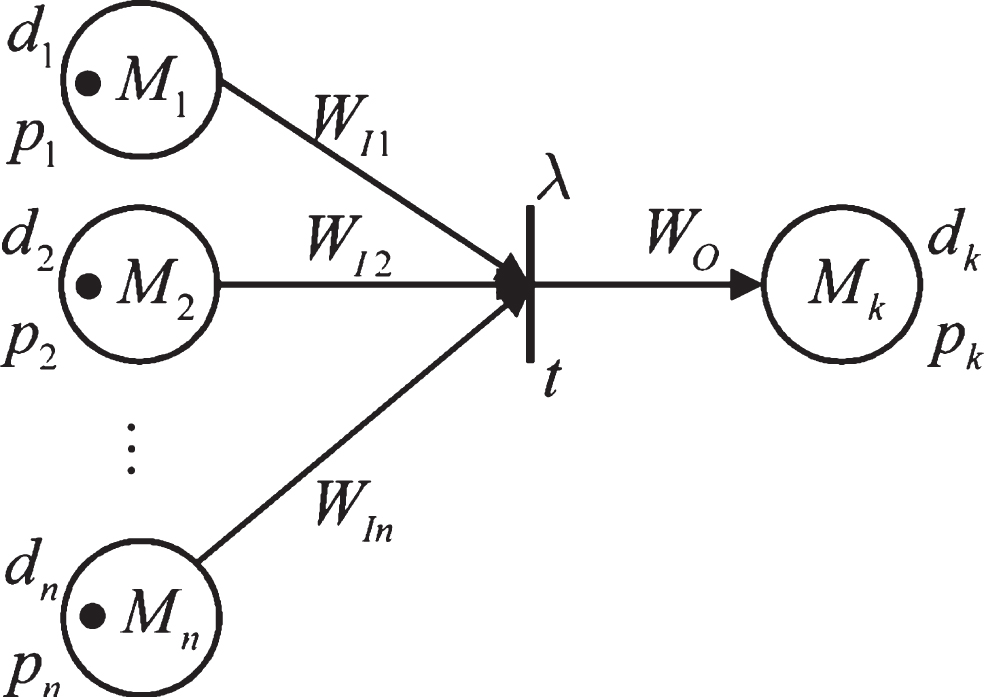
IFFPNs representation of conjunctive IFPRs.
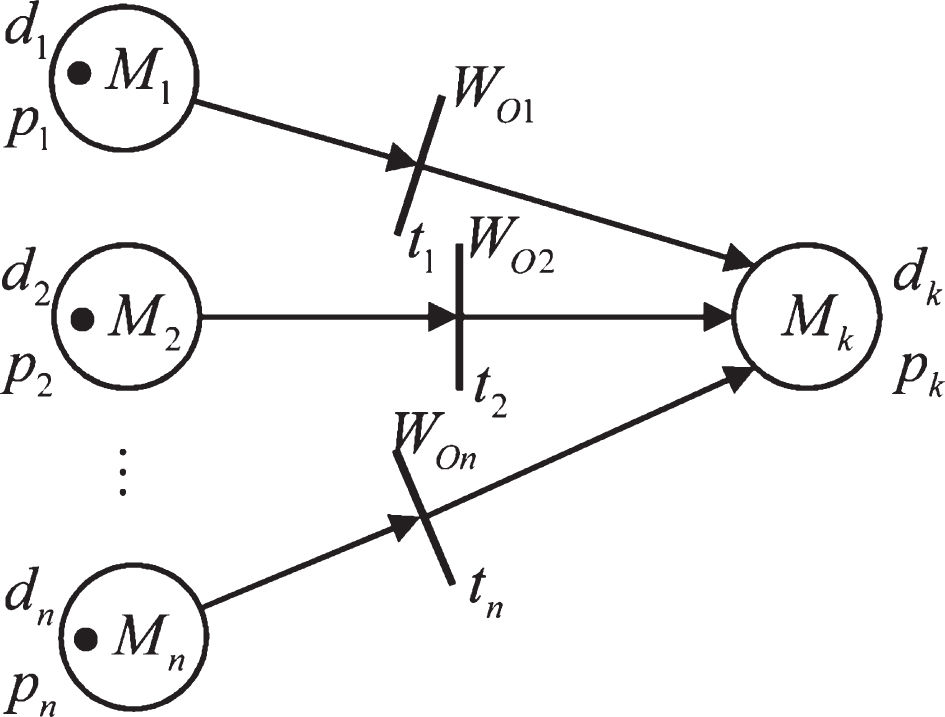
IFFPNs representation of disjunctive IFPRs.
IF d i THEN d j (W O ).
Where d i is the antecedent proposition of the rule, d j is consequent part of the rule, p i is the input place of transition t, p j is the output place of transition t, M i is the token of input place p i , M j is the token of output place p j , W O is the weight of output arc which expresses certainty degree of the rule. Moreover, M i , M j and W O are intuitionistic fuzzy numbers. The structure of IFFPNs corresponding to the type 1 is shown in Fig. 1:
IF d1 AND d2 AND... AND d n THEN d k (λ, WI1, WI2, . . . , W In , W O ).
Where λ is the threshold of the arc from the propositions to the fire rules, WI1, WI2, . . . , W
In
are the weights assigned to the propositions of the rules respectively, in order to show the importance of the various propositions to the result of the rule and
IF d1 OR d2 OR... OR d n THEN d k (WO1, WO2, . . . , W On ).
Where WO1, WO2, . . . , W On are the weights assigned to the propositions of the output arcs respectively which express the certainty degree of the rules as shown in Fig. 3.
In these three types, each transition of the IFFPNs corresponds to an IFPR. The input and the output places of transition correspond to the antecedent and the conclusion propositions of the rules respectively. The threshold parameter λ, the confidence of the rule and the token value in the input place are expressed by intuitionistic fuzzy numbers, respectively.
In order to carry out the fault diagnosis of gas turbine more efficiently, a formal intuitionistic fuzzy reasoning algorithm based on IFFPNs is presented. This algorithm can transform the process of intuitionistic fuzzy reasoning into the matrix operation. We introduce four operators of matrix in a broad sense to express the reasoning process as follows [20]:
Addition operator
Multiplicative operator
Direct multiplication operator
Comparison operator
Because the cells of the matrix A, B and C are all intuitionistic fuzzy numbers, the operations among cells are according to intuitionistic fuzzy logic, such as:
Let n be the number of places, and m the number of transitions. The reasoning algorithm based on IFFPNs can be described as Section 4.
Gas turbine fault diagnosis reasoning algorithm based on IFFPNs
The gas turbine fault diagnosis is a means which can be measured in gas engine operation mode (such as: speed, pressure, temperature, etc.) to compare with the basic data of the normal operation and uses the resulting deviation as bases for testing, isolation and identification of the parts fault.
When fault knowledge is transformed into IFPRs, gas turbine fault diagnostic reasoning can be expressed by the dynamic behavior of IFFPNs.
When applying IFFPNs to represent IFPRs for gas turbine fault diagnosis knowledge representation, places correspond to the state of equipment; transitions correspond to the propagation of fault. The relationships of equipment, IFFPNs and IFPRs are shown in Table 1.
Relationships of equipment, IFFPNs and IFPRs
Relationships of equipment, IFFPNs and IFPRs
Before using IFFPNs for fault diagnosis, a formal parallel inference algorithm for gas turbine fault diagnosis based on IFFPNs is presented as follows.
Initial token vector:
Threshold vector defined on the transition set T:
Through the above of matrix calculation, we can quickly detect a diagnosis. So the method of gas turbine fault diagnosis based on IFFPNs can provide a new theoretical methods and means of realization for rapid diagnosis of the gas turbine.
Algorithm analysis
A IFFPNs model is proposed and corresponding intuitionistic fuzzy reasoning algorithm is presented for the identification of the enemy’s tactical intention in the literature [17]. An improved fuzzy Petri net is constructed for fault diagnosis and the corresponding reasoning algorithm is given in the literature [9]. The differences between the proposed fault algorithm and the conventional ones are as follows: In Step 2, as the weighted parameter from the transition to the input place is added in the input matrix I, the vector of fuzzy tokens can be computed by weighted summation which is more effective than taking maximum. In Step 3, the threshold assigned to the former part of the rule can avoid the fuzzy value of the smaller membership degree to participate in the synthesis of the rule. In Step 4 and Step 5, when more than two rules have the same output place, the certainty degree of the output place can be calculated according to the addition operation. In the process of intuitionistic fuzzy reasoning, the non-membership parameters are considered so that the reasoning result is more precise and believable, moreover, reasoning process can provide more information.
Gas turbine fault diagnosis instance
In this section, a model of gas turbine fault diagnosis provided in the literature [24] is modified to illustrate the application of the algorithm in Section 4.1.
In practice, the dynamic transmission and fuzzy of the gas turbine fault can be divided into several cases:
Case 1: If the power of the fault generator is too low (d1) and unit fuel consumption is too high (d2) and engine temperature is too high (d3) then compressor blade fracture (d5).
Case 2: If the engine temperature is too high (d3) and turbine efficiency is too low (d4) then turbine blade wear (d7).
Case 3: If the compressor blade fracture (d5) and the parts in air passage of compressor wear out (d6) then compressor surge (d8).
It can be described as follows by IFPRs:
The numbers in the brackets represent confidence degree of rules and threshold.
The place collection is P ={ p1, p2 … , p8 }, the tran-sition set is T ={ t1, t2, t3 }. The IFPRs above can be tra-nsformed to IFFPNs model, as shown in Fig. 4:

IFFPNs fault diagnostic reasoning model.
The fault diagnostic reasoning algorithm is applied to solve the fault diagnosis of the gas turbine, and the reasoning process is described as follows:
Let k = 0, input matrix I T , output matrix O, initial toke M0 and threshold of transition τ:
Weighted input matrix I
T
:
Output matrix O:
The initial toke value M0:
The threshold of transition τ:
According to the fault diagnostic reasoning algorithm, the reasoning results are:
Due to M1 = M2, the reasoning is stopped.
After the second iteration, the result of the token value is the same as that of the first iteration, so the iterative calculation is finished. It can be seen from the result that the place whose membership is maximum and non-membership is minimum is p7 = (0.532, 0.415). The inference result can be preliminarily determined p7 corresponding fault turbine blade wear is most likely to occur.
Compared with the results of fault diagnosis in [3, 17, 24], the reasoning model has three advantages as follows: Reasoning process is more efficient. The reasoning process can realize the rapid gas turbine fault diagnosis and provide theoretical basis for real-time fault knowledge representation and reasoning. More accurate result of diagnosis has obtained one can obtain more intuitionistic fuzzy reasoning information, such as non-membership degree of fault reason. The times of the iteration are only related to maximum depths and have nothing to do with the quantity of the intuitionistic fuzzy production rules.
In this paper, the FPNs and IFSs are combined to establish IFFPNs, which have the abilities of concurrency processing. After analyzing instance of gas turbine fault diagnosis, it is shown that the diagnosis model can not only detect the fault sources according to the fault results, but also obtain lots of fault information, such as non-membership degree and hesitation degree of fault reason. The IFFPNs established in this paper is promising to resolve the problems of fault diagnosis in large systems.
As the current researches on this area are relatively few, there are still many valuable works to study in the future, such as, how to distribute weights of place and threshold of the transition reasonably by intelligent learning algorithm. We will address these problems in our future work, which is an interesting topic to research.
Footnotes
Acknowledgments
The authors would like to express their gratitude to the reviewers for their helpful comments and kinds of suggestions in revising this present paper. The work addressed here has been supported by the Provincial Natural Science key Foundation of college of Anhui Province of China under grant NO. KJ2016A580 and 136 talent fund project of Hefei Normal University.