On the basis of α-minimal resolution principle, an α-n(t)-ary resolution dynamic automated reasoning method—multi-ary α-ordered linear minimal resolution method is studied in lattice-valued propositional logic system LP(X) and lattice-valued first-order logic system LF(X) based on lattice implication algebra (LIA). Firstly, multi-ary α-ordered linear minimal resolution method is established in LP(X), while its theorems of both soundness and completeness are proved. Then, multi-ary α-ordered linear minimal resolution method is further established in the corresponding lattice-valued first-order logic LF(X), along with its soundness theorem, lifting lemma, and completeness theorem. Then, the validity of multi-ary α-ordered linear minimal resolution based on lattice-valued logic is analyzed. At last, an multi-ary α-ordered linear minimal resolution algorithm in LP(X) is designed, and it is proved to be sound and complete, then it is further extended in the corresponding LF(X). This lays the foundation for the further study on α-n(t)-ary resolution dynamic automated reasoning program.
Since Robinson presented resolution principle based on the classical logic in 1965 [1], automated reasoning based resolution has become an active realm and aroused the interest of many scholars [2–5]. Many classical resolution methods have also been studied. Particularly, there are three typical resolution methods based on Robinson’s resolution principle, such as semantic resolution, lock resolution and linear resolution [6]. All these methods are devoted to reducing the redundant clauses and improving the resolution efficiency in the course of resolution.
As an important non-classical logic, lattice-valued logic system based on lattice implication algebra provides a strict and reasonable foundation for automated reasoning [7]. Xu et al. (2000 and 2001) introduced α-resolution principle and developed α-resolution deduction in lattice-valued logic based on LIA and proved its soundness and completeness [8, 9]. Compared with resolution principle in Boolean logic, the α-resolution principle in lattice-valued logic based on LIA has new features such as: (a) α-resolution is proceeded at different truth-valued level a (with the possible incomparability) chosen from the truth-valued field—LIA; (b) α-resolution is based on generalized literals, which contain constants and more general implication connective than the one in classical logic. Hence the expressive power is enhanced. Meanwhile, implication connectives in lattice-valued logic are not reducible to other classical logical connectives, which is different from the Kleene implication (i.e., p → q = p′ ∨ q). This irreducibility though semantically justifiable, complicates the calculus; (c) judging whether two generalized literals are α-resolvable should consider both semantic and syntax consistently [8, 9]. As discussed and highlighted in [10], Boolean algebra and Łukasiewicz algebra are special cases of LIA, all the results obtained based on LIA or related logic can be applied into Boolean logic or Łukasiewicz logic accordingly. However, a LIA may not be a Boolean algebra or a Łukasiewicz algebra defined on a chain. LIA is a proper class and includes no-chain algebra as well. Establishing a sound and complete resolution-based reasoning system based on LIA means establishing a sound and complete resolution-based reasoning system based on Boolean algebra and also Łukasiewicz algebra at least. The results obtained in lattice-valued logics based on LIA in several ways have extended and expanded Pavelka fuzzy logic [7, 11]. This shows that the investigation of resolution-based automated reasoning for lattice-valued logic in LIA is worthwhile and is an important extension of classical logic and also some many-valued logics, and is of importance to the research and practitioner community in automated reasoning.
Furthermore, in 2006, Xu et al. [12] established a linguistic truth-valued lattice implication algebra LV (n ×2) by constructing some linguistic truth values frequently used in daily life. In 2007, Xu et al. [13] established the weak completeness of α-resolution in lattice-valued propositional logic (Ln × L2) P (X) based on LIA Ln × L2, and also provided the weak completeness of α-resolution in linguistic truth-valued lattice-valued propositional logic. In 2008, Li et al. [14] studied the properties of α-resolution fields of generalized literals in lattice-valued propositional logic Ln × 2P (X) and the relation between α-resolution in Ln × 2P (X) and that in lattice-valued propositional logic LnP (X). In order to handle more than two generalized clauses simultaneously, in 2013, Xu et al. [10] extended the α-resolution principle to multi-ary α-resolution principle in lattice-valued logic, which can greatly enhance resolution automated reasoning compared with the ones in classical logic and those proposed in some many-valued logics in terms of soundness and completeness, applicability, reasoning capability and reasoning efficiency. This lays the foundation for the research of resolution dynamic automated reasoning methods.
To further improve the resolution efficiency and reduce redundancy clause, α-n(t)-ary resolution dynamic automated reasoning was proposed in the National Natural Science Foundation of China (Grant No. 61175055) by Xu in 2011. In the processing of α-n(t)-ary resolution, the number of generalized literals n(t) is not taken the fixed number. In order to research α-n(t)-ary resolution dynamic automated reasoning, α-minimal resolution principle which determines how to choose generalized literals in LP(X) and LF(X), as well as its soundness and completeness are introduced in [15]. This is the theoretical guidance for α-n(t)-ary resolution dynamic automated reasoning. Under the guidance of this theory, the corresponding resolution method in LP(X) and LF(X) are researched in this paper. Then, an α-ordered linear minimal resolution algorithm in LP(X) is constructed.
This paper is organized as follows: Section 2 reviews some preliminary relevant concepts about LP(X) and LF(X); In Section 3, multi-ary α-ordered linear minimal resolution method in LP(X) is given, as well as its soundness and completeness; In Section 4, multi-ary α-ordered linear minimal resolution method is further established in the corresponding lattice-valued first-order logic LF(X), along with its soundness theorem, lifting lemma, and completeness theorem; In Section 5, we analysis the validity of multi-ary α-ordered linear minimal resolution method in lattice-valued logic from four aspects; In Section 6, we give a multi-ary α-ordered linear minimal resolution algorithm in LP(X). Thus, it lays the foundation for researching α-n(t)-ary resolution automated program in the future.
This paper is an expansion of paper [21], which has been accepted by The 11th International FLINS Conference on Decision Making and Soft Computing (FLINS 2014).
Preliminaries
In this section, we only recall some elementary definitions and properties needed in the following discussions, more detailed notations and results about lattice-valued logic based on LIA and α-resolution principle can be seen in the related References [7, 20].
Lattice implication algebra
Definition 2.1. [16] Let (L, ∨ , ∧ , O, I) be a bounded lattice with an order-reversing involution ¢, I and O the greatest and the smallest element of L respectively, and → : L × L → L be a mapping. (L, ∨ , ∧ , ′ , → , O, I) is called a lattice implication algebra if the following conditions hold for any x, y, z ∈ L:
x → (y → z) = y → (x → z),
x → x = I,
x → y = y′ → x′,
x → y = y → x = I implies x = y,
(x → y) → y = (y → x) → x,
(x → y) → z = (x → z) ∧ (y → z) ,
(x → y) → z = (x → z) ∨ (y → z) .
Example 2.1. [7] (Łukasiewicz implication algebra on finite chain) Let Ln = {ai | i = 1, 2, …, n} , a1 < a2 < … < an. For any 1 ≤ j, k ≤ n, define
Then (Ln, ∨ , ∧ , ′, → , a1, an) is a lattice implication algebra.
Example 2.2. [7] Let L6 = {O, a, b, c, d, I} , O′ = I, a′ = c, b′ = d, c′ = a, d′ = b, I′ = O, the Hasse diagram of L6 be defined as Fig. 2.1 and its implication operator be defined as Table 2.1, then (L6, ∨ , ∧ , → , ′, O, I) is a lattice implication algebra.
Hasse Diagram of L6.
Implication operator of L6
→
O
a
b
c
d
I
O
I
I
I
I
I
I
a
c
I
b
c
b
I
b
d
a
I
b
a
I
c
a
a
I
I
a
I
d
b
I
I
b
I
I
I
O
a
b
c
d
I
Lattice-valued propositional logic LP(X) based on LIA
Definition 2.2. [17] Let X be the set of propositional variables, (L, ∨ , ∧ , ′, → , O, I) be a lattice implication algebra, T = L ∪ {′, →} be a type with ar(′) =1, ar (→) =2 and ar (a) =0 for any a ∈ L. The proposition algebra of the lattice-valued proposition calculus on the set X of propositional variables is the free T algebra on X and denoted by LP(X).
Definition 2.3. [17] The set of formula of LP(X) is the least set Y satisfying the following conditions:
X ⊆ Y,
L ⊆ Y,
if p, q ∈ Y, then ′ (p) , → (p, q) ∈ Y,
where X is the set of propositional variables, L is the set of constants.
In the following, we denote ‘(p) as p’ and ⟶ (p, q) as p ⟶ q.
Definition 2.4. [17] A mapping v: LP (X) → L is called a valuation of LP(X), if it is a T-homomorphism.
Definition 2.5. [18] Let and a ∈ L. For any valuation ν of LP(X), if ν (G) ≤ α, we say G is always less than α (or G is α-false), denoted by G ≤ α (or G = a - ⊚).
Definition 2.6. A lattice-valued propositional logical formula G in lattice-valued propositional logic system LP(X) is called an extremely simple form, in short ESF, if a lattice-valued propositional logical formula G* obtained by deleting any constant or literal or implication term occurring in G is not equivalent to G.
Definition 2.7. [7] A lattice-valued propositional logical formula G in lattice-valued propositional logic system LP(X) is called an indecomposable extremely simple form, in short IESF, if the following two conditions hold:
G is an ESF containing connective → and ′ at most,
For any , if in , then H is an ESF containing connectives → and ′ at most.
Example 2.3. Suppose that x, y, z, p, q are propositional variables in lattice-valued propositional logic LP(X), b ∈ L. Then,
Definition 2.8. [8] All the constants, literals and IESFs in lattice-valued propositional logic system LP(X) are called generalized literals. Here, the definition of literal is the same as that in classical logic.
Definition 2.9. [8] A lattice-valued propositional logical formula G in lattice-valued propositional logic system LP(X) is called a generalized clause if G is a formula of the form
where gi are generalized literals, i = 1, 2, …, n
Definition 2.10. [10] (Multi-ary α-Resolution Principle) Let Ci = pi1 ∨ … ∨ pimi be generalized clauses of LP(X), Hi = {pi1, …, pimi} the set of all generalized literals occurring in Ci, i = 1, 2, …, m, a ∈ L. For any i∈ { 1, 2, …, m }, if there exist generalized literals xi ∈ Hi such that x1 ∧ x2 ∧ … ∧ xm ≤ α, then C1 (x1 = a) ∨ C2 (x2 = a) ∨ … ∨ Cm (xm = α) is called an m-ary α-resolvent of C1, C2, …, Cm, denoted by Rp(m-a) (C1 (x1) , C2 (x2) , …, Cm (xm)) , x1, x2, … , xm are called an m-ary α-resolution group. The m-ary α-resolution group x1, x2, …, xm, denoted by (x1, x2, …, xm) - α.
Theorem 2.1. [10] (Soundness)SupposeS = C1 ∧ C2 ∧ … ∧ Cm, whereC1, C2, …, Cmare generalized clauses in LP(X),a ∈ L . {Φ1, Φ2, …, Φt} is a multi-ary α-resolution deduction fromS to Φt. IfΦt is a - ⊚, thenS ≤ α, i.e., ifΦt ≤ α, thenS ≤ α.
Theorem 2.2. [10] (C ompleteness)SupposeS = C1 ∧ C2 ∧ … ∧ Cm, whereC1, C2, …, Cmare generalized clauses in LP(X). IfS ≤ α, then there exist s a multi-ary α-resolution deduction fromSto α - ⊚.
Lattice-valued first-order logic LF(X) based on LIA
Definition 2.11. [9] Suppose V and F are the set of variable symbols and that of functional symbols in LF(X), respectively, the set of terms of LF(X) is defined as the smallest set satisfying the following conditions:
For any n ∈ N, if f(n) ∈ F, then for any
Remark 2.1.f(0) is specified as a constant symbol.
Definition 2.12. [9] Suppose P is the predicate symbol set in LF(X). The set of atoms of LF(X) is defined as the smallest set 𝒜t satisfying the following condition:
For any n ∈ N, if P(n) ∈ P, then for any .
Remark 2.2.P(0) is specified as a certain element in L.
Definition 2.13. [9] The set of formulas of LF(X) is defined as the smallest set ℱ satisfying the following conditions:
Definition 2.14. [9] Suppose is the set of all functional symbols occurring in G, PG is the set of all predicate symbols occurring in G, and D (≠ Φ) is the domain of interpretation. An interpretation of G over D is a triple ID =〈 D, μD, νD 〉, where,
is a non-empty set
Definition 2.15. [7] A formula G in lattice-valued first-order logic LF(X) is a generalized-literal, if it satisfies the following conditions:
G is a literal, or
G is constructed only by some literals and some implication connectives with the condition that G can not be represented by connectives “∨” or “∧” and G can not be decomposed into a simpler form (G is called an indecomposable implication form).
The disjunction of a finite number of generalized-literals is a generalized-clause. The conjunction of a finite number of generalized-clauses is a generalized-conjunctive normal form.
Definition 2.16. [19] Let C = g1 ∨ g2 ∨ … ∨ gi ∨ … ∨ gn be a generalized clause. If there exists some equivalent generalized literals in C, then we remain the leftmost generalized literal and delete the other equivalent generalized literals. The above process is called left-combination rule.
Definition 2.17. [19] A generalized clause C is called an ordered generalized clause if the following criterions hold:
C has been simplified by using the left-combination rule;
align by the length of the generalized literals from left to right and put the longest generalized literal on to the leftmost position in C, where the length means the order of the generalized literal (if the order is equivalent, they can be arbitrary arrange);
especially, put the generalized literals containing the constants in front of the constants in C.
Corollary 2.1. [9] Let a generalized-Skölem standard form of a formula G, where are generalized- clauses in LF(X), a ∈ L, and |L| < ℵ 0. Then G* ≤ α if and only if there exist such that , where is an ground instance of .
Definition 2.18. [10] (Multi-ary α-Resolution Principle) Let Ci = pi1 ∨ … ∨ pimi be generalized clauses of LF(X), Hi = {pi1, …, pimi} the set of all generalized literals occurring in Ci, i = 1, 2, …, m, α ∈ L. For any i ∈ {1, 2, …, m}, if there exist generalized literals xi ∈ Hi and a substitution σ such that , then is called an m-ary α-resolvent of C1, C2, …, Cm, denoted by Rf(m-a) (C1 (x1) , C2 (x2) , …, Cm (xm)) , x1, x2, …, xm are called an m-ary α-resolution group.
Theorem 2.3. [10] (Soundness)SupposeS = C1 ∧ C2 ∧ … ∧ Cm, whereC1, C2, …, Cmare generalized clauses in L F (X), α ∈ L . {Φ1, Φ2, …, Φt} is a multi-ary α-resolution deduction fromStoΦt. IfΦt ≤ α, thenS ≤ α.
Theorem 2.4. [10] (C ompleteness)SupposeS = C1 ∧ C2 ∧ … ∧ Cm, whereC1, C2, …, Cmare generalized clauses in L F (X). IfS ≤ α, then there exist s a multi-ary α-resolution deduction from S to α-empty clause.
Multi-ary α-ordered linear minimal resolution method in lattice-valued propositional logic system LP(X)
Definition 3.1. Let Ci = pi1 ∨ … ∨ pini be generalized clauses in LP(X), Hi = {pi1, …, pini} the set of all generalized literals occurring in Ci, xi ∈ Hi, i = 0, 1, 2, …, n . α ∈ L, and C0 is an ordered generalized clause. If there exists the leftmost generalized literal x0 in C0 such that x0 ∧ x1 ∧ x2 ∧ … ∧ xn ≤ a, but for any j ∈ {1, 2, …, n} , x0 ∧ x1 ∧ … ∧ xj-1 ∧ xj+1 ∧ … ∧ xn ≰ α, then C0 (x0 = a) ∨ C1 (x1 = a) ∨ … ∨ Cn (xn = a) is called multi-ary α-ordered minimal resolvent of C0 and {C1, …, Cn}, denoted by , and x0, x1, …, xn are called an multi-ary α-ordered minimal resolution group.
Example 3.1. Let L9P(X) be lattice-valued propositional logic system based on lattice implication algebra L = (L9, ∨ , ∧ , ′, → , a1, a9), and
Take a = a5 as a resolution level, C1 is an ordered generalized clause, since there exist the generalized literals such that
but
and
then a multi-ary α-ordered minimal resolvent of C1 and {C2, C3} is obtained
Theorem 3.1.In LP(X), letC0be an ordered generalized clause,Ci (i = 1, 2, …, n) be generalized clauses,Hithe set of all generalized literals occurring inCi, α ∈ L. If there exists the leftmost generalized literalx0inC0and generalized literalsxi ∈ Hi, i = 1, 2, …, n, such thatx0 ∧ x1 ∧ x2 ∧ … ∧ xn ≤ α, and is multi-ary α-ordered minimal resolvent of C0 and {C1, …, Cn}, then
Proof. Let Ci = xi ∨ Ai, Bi = {xi, Ai} , i = 0, 1, …, n . C0 is an ordered generalized clause and x0 is the leftmost generalized literal in C0, Hence,
Therefore
Definition 3.2. Suppose S be a set of generalized clauses in LP(X), an ordered generalized clause C0 ∈ S, a ∈ L . {C0, Φ1, Φ2, …, Φt} is called a multi-ary α-ordered linear minimal resolution deduction from S to an ordered generalized clause Φt (or S can be multi-ary α-ordered linear minimal resolved into Φt) (see Fig. 3.1), if
C0 is a top ordered generalized clause, Ti is a set of side generalized clauses with respect to Φi, where i = 0, 1, … , t - 1, Φ0 = C0 ;
For any side generalized clause set Ti, T0 ⊆ S - {C0} , Ti ⊆ S ∪ {Φ0, …, Φi-1} , i = 1, …, t.
Multi-ary α-ordered linear minimal resolution deduction from S to Φt.
Theorem 3.2. (Soundness)In LP(X), Suppose S be a set of generalized clauses, an ordered generalized clauseC0 ∈ S, a ∈ L . {C0, Φ1, Φ2, …, Φt} is an multi-ary α-ordered linear minimal resolution deduction from S to an ordered generalized clauseΦtwith the top generalized clauseC0. IfΦtis α - ⊚, thenS ≤ α, i.e., ifΦt ≤ α, thenS ≤ α.
Proof. According to Theorem 3.1 and the Definition 3.2, the soundness theorem holds.
Theorem 3.3. (Completeness)Suppose thatS = C0 ∧ C1 ∧ C2 ∧ … ∧ Cm, whereC1, C2, …, Cmare generalized clauses andC0is an ordered generalized clause in LP(X),a ∈ L. IfS ≤ aandS - {C0} is α-satisfiable, then there exists a multi-ary α-ordered linear minimal resolution deduction from S to α - ⊚ with the top ordered generalized clauseC0.
Proof. 1. If S only contains one generalized clause C. By S ≤ α, the conclusion holds obviously.
2. If S contains more than one generalized clause. For any i = 1, 2, …, m, Let Hi be the set of all generalized literals occurring in Ci, denote |Hi| = ωi. Let K(S) be disjunction term number and general clauses in the number of difference, i.e., . Induction of S, the following conditions exist:
If K(S) = 0, then S only consist of unit generalized literals, i.e., every generalized clause contains only one generalized literal in S. Because S ≤ α, so all generalized literals form an α-resolution group. By Theorem 3.1 (Jia 2013), there exists an α-minimal resolution group, we choose anyone of them as an ordered generalized clause, then the conclusion holds.
Assume K(S)<n(n>0) conclusion hold, following we prove K(S) = n conclusion hold.
Let K(S) = n, for top generalized clauses C0, we have the following 2 situations:
If C0 is unit generalized clause, set C0 = g. By K(S) = n, S has one non-unit generalized clause at least, let h be a disjunction term of non-unit generalized clause in S. Set , and is not empty.
Let . Absolutely, S1 ≤ α, S2 ≤ α and K (S1) < n, K (S2) < n. Then S1 - {C0} and S2 - {C0} have one is α-satisfiable at least. Let S1 - {C0} be α-satisfiable, and K (S1) < n, then by induction hypothesis, there exists a multi-ary α-ordered linear minimal resolution deduction D1 from S1 to α - ⊚ with C0. Change all in D1 to Ci, get a deduction . From above know, is a multi-ary α-ordered linear minimal resolution deduction from S, and this deduction get α - ⊚ or α ∨ g.
If is the former, the conclusion holds.
If is the later, due to S2 ≤ α and K(S2)<n. By induction assume, there exist a multi-ary α-ordered linear minimal resolution deduction D2 from S2 to a - ⊚, and change all h in D2 to Ci, get deduction . As above, we know deduct to α - ⊚ or .
If is the former, the conclusion holds.
If is the later, then connect and D2, and put on the front, then we get a multi-ary α-ordered linear minimal resolution deduction from S to α - ⊚ with C0.
If C0 is non-unit generalized clause, set , and is not empty. Let , then S3 ≤ α and K(S3)<n. By induction hypothesis, there exists a multi-ary α-ordered linear minimal resolution deduction D3 from S3 to α - ⊚ with . Change all in D3 to C0, get a deduction . From above know, is a multi-ary α-ordered linear minimal resolution deduction from S with C0, and this deduction get a - ⊚ or g0 ∨ α.
If is the former, the conclusion holds.
If is the later, delete the α in last center generalized clause g0 ∨ α, get deduction D4. Set S4 = g0 ∧ C1 ∧ … ∧ Cm, then S4 ≤ α and K(S4)<n. By induction hypothesis, there exists a multi-ary α-ordered linear minimal resolution deduction D5 from S4 to α - ⊚ with g0. Change all g0 in D5 to g0 ∨ α, get a deduction . Connect and , and put on the front, then we get a multi-ary α-ordered linear minimal resolution deduction from S to α - ⊚ with C0.
Example 3.2. Let C1 = x → y, C2 = (x → z) ′, C3 = (a5 → q) ∨ (y → z) ∨ (y → a2) , C4 = (p → q) ′ be four generalized clauses in lattice-valued propositional logic L9P(X), where a2, a5 ∈ L9, x, y, z, p, q are propositional variables, written as S = C1 ∧ C2 ∧ C3 ∧ C4. If α= a6, then S ≤ α and there exists a multi-ary α-ordered linear minimal resolution deduction from S to α - ⊚.
According to Definition 3.2, multi-ary α-ordered linear minimal resolution deduction as follows:
Step 1. Set a top generalized clause C3 and a set C4 of side generalized clauses such that (a5 → q) ∧ (p → q) ′ ≤ α, then multi-ary α-ordered linear minimal resolvent
Step 2. Set a center generalized clause D1 and a set {C1, C2} of side generalized clauses such that (y → z) ∧ (x → y) ∧ (x → z) ′ ≤ α, then multi-ary α-ordered linear minimal resolvent
Step 3. Set a center generalized clause D2 and a set {C1, C2} of side generalized clauses such that (y → a2) ∧ (x → y) ∧ (x → z) ′ ≤ α, then multi-ary α-ordered linear minimal resolvent
Example 3.3. Let C1 = y → b, C2 = (x → y) ∨ y ∨ (p → q) ′, C3 = (x → z) ′ ∨ (s → t) , C4 = (s → t) ′, C5 = (q → w) ′ be five generalized clauses in lattice-valued propositional logic L6P(X), where x, y, z, s, t, p, q, w are propositional variables, written as S = C1 ∧ C2 ∧ C2 ∧ C3 ∧ C4 ∧ C5. If α = b, then S ≤ α and there exists a multi-ary α-ordered linear minimal resolution deduction from S to a - ⊚.
Step 1. Set a top generalized clause C4 and a set C3 of side generalized clauses such that (s → t) ′ ∧ (s → t) ≤ α, then multi-ary α-ordered linear minimal resolvent
Step 2. Set a center generalized clause D1 and a set {C1, C2} of side generalized clauses such that (x → z) ′ ∧ (y → b) ∧ (x → y) ≤ α, then multi-ary α-ordered linear minimal resolvent
Step 3. Set a center generalized clause D2 and a set C5 of side generalized clauses such that (p → q) ′ ∧ (q → w) ′ ≤ α, then multi-ary α-ordered linear minimal resolvent
Step 4. Set a center generalized clause D3 and a set C1 of side generalized clauses such that y ∧ (y → b) ≤ α, then multi-ary α-ordered linear minimal resolvent
Its proof figure as follows:
Multi-ary α-ordered linear minimal resolution method in lattice-valued first-order logic system LF(X)
Definition 4.1. Let Ci = pi1 ∨ … ∨ pini be generalized clauses in LF(X), Hi = {pi1, …, pini} the set of all generalized literals occurring in Ci, xi ∈ Hi, i = 0, 1, 2, …, n . a ∈ L, and C0 is an ordered generalized clause. If there exists the leftmost generalized literal x0 in C0 and a substitution σ such that , but for any , then is called multi-ary α-ordered minimal resolvent of C0 and {C1, … , Cn }, denoted by , and x0, x1, …, xn are called a multi-ary α-ordered minimal resolution group.
Example 4.1. Let L9F(X) be lattice-valued first-order logic system based on lattice implication algebra L = (L9, ∨ , ∧ , ′, → , a1, a9), and
Take α = a5 as a resolution level, since there exist the substitution σ = y/z and the generalized literals such that
but
and
then a multi-ary α-ordered minimal resolvent of C1 and {C2, C3} is obtained
Theorem 4.1.In LF(X), letC0be an ordered generalized clause,Ci (i = 1, 2, …, n) be generalized clauses,Hithe set of all generalized literals occurring inCi, a ∈ L. If there exists the leftmost generalized literalx0inC0and generalized literalsxi ∈ Hi (i = 1, 2, …, n) such that under a substitutionσsatisfying, andis multi-ary α-ordered minimal resolvent ofC0and {C1, …, Cn}, then
i.e.,
Proof. Similar to Theorem 3.1, we can get the following conclusion:
Since σ is a substitution, so we can obtain
Hence the conclusion holds.
Definition 4.2. Suppose S be a set of generalized clauses in LF(X), an ordered generalized clause C0 ∈ S, α ∈ L . {C0, Φ1, Φ2, …, Φt} is called a multi-ary α-ordered linear minimal resolution deduction from S to an ordered generalized clause Φt (or S can be multi-ary α-ordered linear minimal resolved into Φt) (see Fig. 3.1), if
C0 is a top ordered generalized clause, Ti is a set of side generalized clauses with respect to Φi, where i = 0, 1, … , t - 1, Φ0 = C0 ;
For any side generalized clause set Ti, T0 ⊆ S - { C0 } , Ti ⊆ S ∪ {Φ0, …, Φi-1} , i = 1, …, t.
Theorem 4.2. (Soundness)In LF(X), Suppose S be a set of generalized clauses, an ordered generalized clauseC0 ∈ S, a ∈ L . {C0, Φ1, Φ2, …, Φt} is a multi-ary α-ordered linear minimal resolution deduction from S to an ordered generalized clauseΦtwith the top generalized clauseC0. IfΦtisa - ⊚, thenS ≤ α, i.e., ifΦt ≤ α, thenS ≤ α.
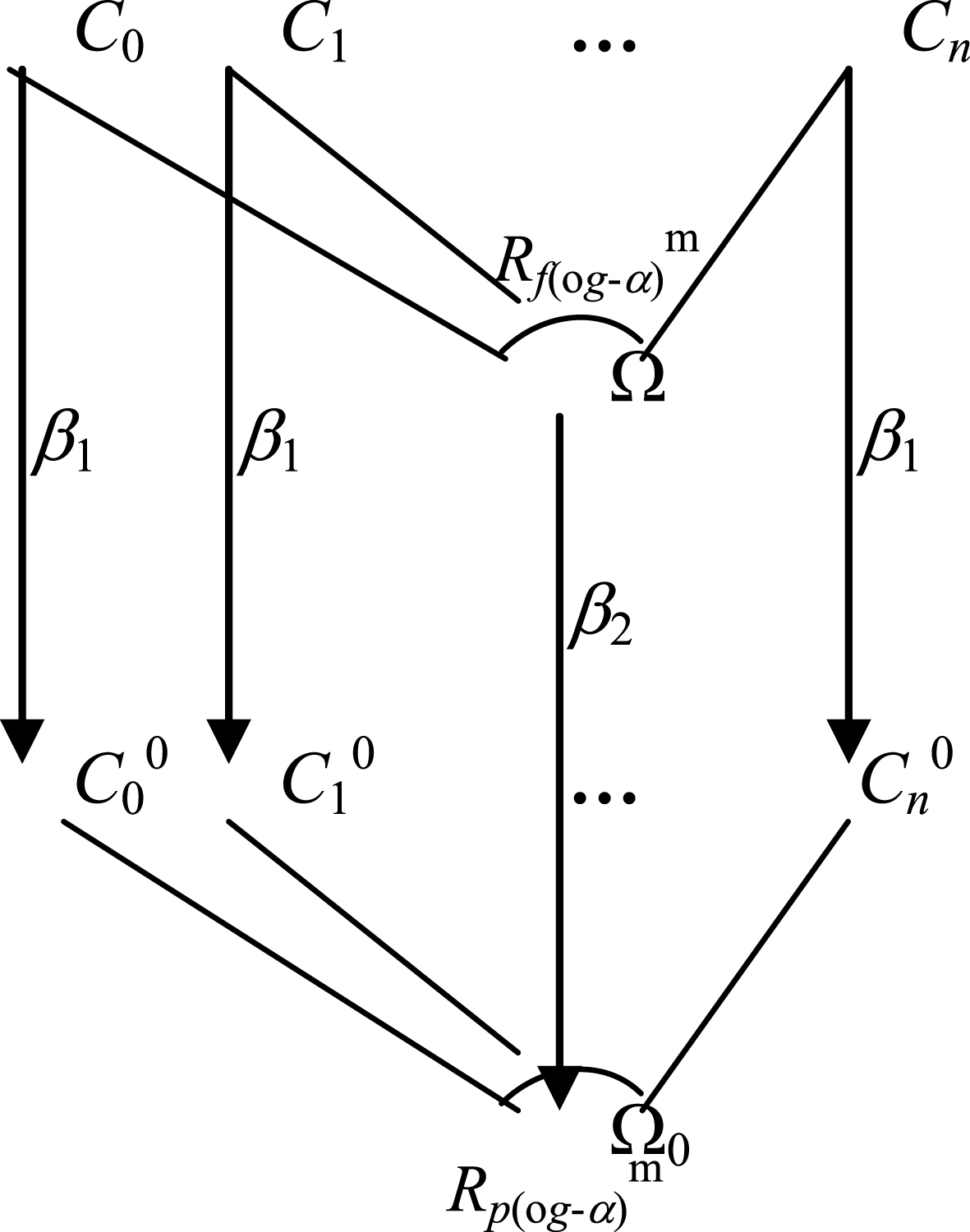
Theorem 4.3. (Lifting Lemma)LetC0, C1, C2, …, Cnbe generalized-clauses without common variables in LF(X), andC0is an ordered generalized clause,an instance ofCi, i = 0, 1, 2, …, n. IfΩ0is a multi-ary α-ordered minimal resolvent of, then there exists a multi-ary α-ordered minimal resolventΩofC0and {C1, C2, …, Cn} such thatΩ0is an instance ofΩ, i.e., Fig. 4.1 holds.
Transformation diagram.
Proof. According to the Lifting lemma [15], we can get the conclusion holds easily.
Theorem 4.4. (Completeness)Suppose thatS = C0 ∧ C1 ∧ C2 ∧ … ∧ Cn, whereC1, C2, … Cnare generalized clauses andC0is an ordered generalized clause in LF(X),a ∈ L. IfS ≤ α andS -{ C0 } is α-satisfiable, then there exists a multi-ary α-ordered linear minimal resolution deduction from S to α - ⊚ with the top ordered generalized clauseC0.
Proof. In fact, if S ≤ α, then there at least exists a ground instance Sσ of S such that Sσ is α-false by Corollary 2.1. According to Theorem 3.3, there exists a multi-ary α-ordered linear minimal resolution deduction D0 from Sσ to α - ⊚ with the top ordered generalized clause . Moreover, we can lift D0 to a deduction D from S to a - ⊚ with the top ordered generalized clause C0 by Theorem 4.3.
Example 4.2.C1 = Q (y) → (P′ (x) → a5) ′, C2 = a7 → R (z) ′, C3 = (Q′ (y) → a3) ∨ (b → P (x)) ′, C4 = P (x) ∨ (R (z) → a3) , C5 = (R (a) → Q (y)) ′ be five generalized clauses in lattice-valued first-order logic L9F(X), where a, b, ai ∈ L9 (i = 1, …, 9) , x, y, z are individual variables, P, Q, R are relation symbols, written as S = C1 ∧ C2 ∧ C3 ∧ C4 ∧ C5. If α = α5, then S ≤ α and there exists a multi-ary α-ordered linear minimal resolution deduction from S to α - ⊚.
According to Definition 4.2, multi-ary α-ordered linear minimal resolution deduction as follows:
Step 1. Set a top generalized clause C5 and a set C2, C4 of the side generalized clauses and the substitution σ = {b/y, b/z}, such that
(R (a) → Q (b)) ′ ∧ (a7 → R (b) ′) ∧ (R (b) → a3) ≤ α, then the multi-ary α-ordered minimal resolvent
Step 2. Set a center generalized clause D1 and a set {C1, C3} of the side generalized clauses and the substitution σ = {b/x, b/y}, such that P (b) ∧ (Q (b) → (P′ (b) → a5) ′) ∧ (Q′ (b) → a3) ≤ α, then the multi-ary α-ordered minimal resolvent
Step 3. Set a center generalized clause D2 and a set D1 of the side generalized clauses such that (b → P (b)) ′ ∧ P (b) ≤ α, then the multi-ary α-ordered minimal resolvent
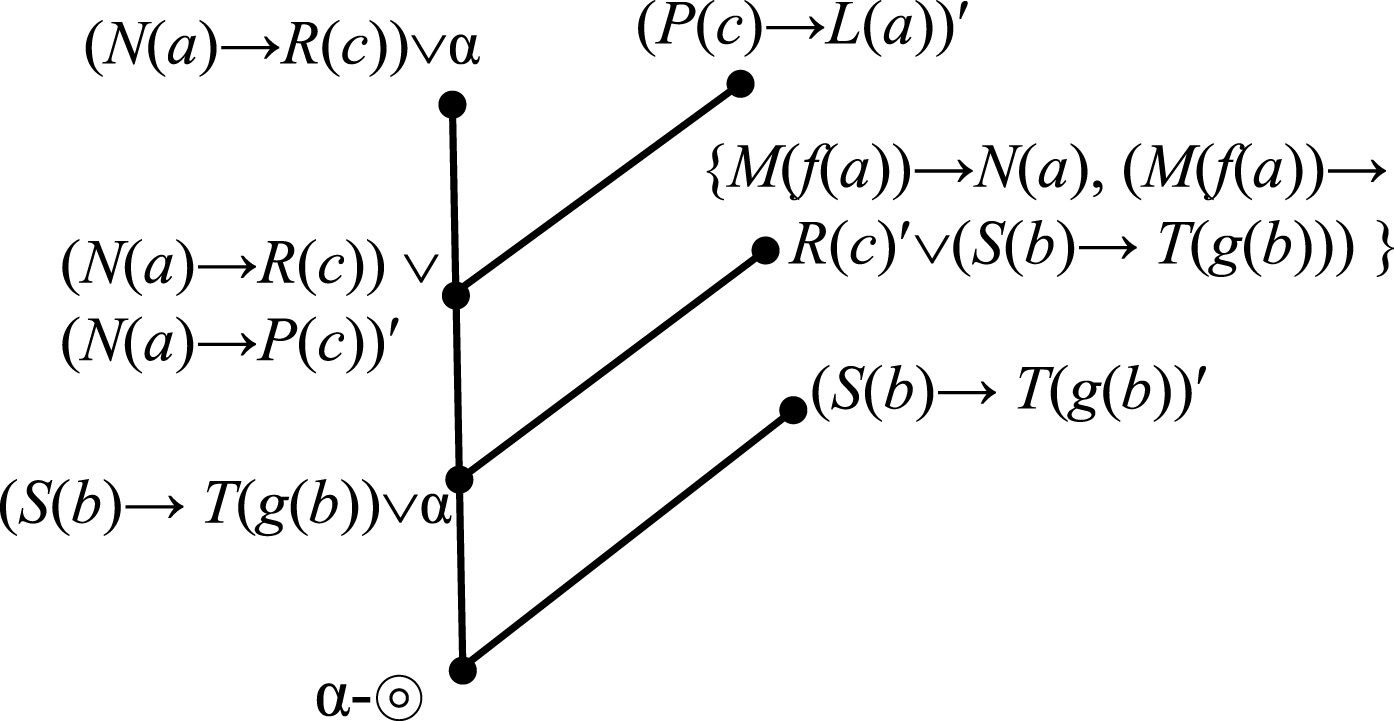
Example 4.3. Let C1 = M (f (x)) → N (x) , C2 = (M (y1) → R (y2)) ′ ∨ (S (μ) → T (g (μ))) ∨ (M (f (x)) → R (c)) ′, C3 = (N (a) → R (z)) ∨ (N (a) → P (z)) ′, C4 = (S (w1) → T (w2)) ′ ∨ (S (w1) → T (g (b))) ′, C5 = (P (c) → L (v)) ′ be five generalized clauses in lattice-valued first-order logic L6F(X), where x, y1, y2, z, μ, ν, w1, w2 are individual variables, a, b, c ∈ L6, and M, N, R, S, T, P, L are relation symbols, written as S = C1 ∧ C2 ∧ C3 ∧ C4 ∧ C5. If α = d, then S ≤ α and there exists a multi-ary α-ordered linear minimal resolution deduction from S to a - ⊚.
There exist a substitution σ = {a/x, f (a)/y1, c/y2, c/z, b/μ, a/v, b/w1, g (b)/w2} , and set C3 as the top generalized clause, we can get the multi-ary α-ordered linear minimal resolution deduction as follows:
Its proof figure as follows:
Validity analysis of multi-ary α-ordered linear minimal resolution based on lattice-valued logic
In this section, we will analysis the multi-ary α-ordered linear minimal resolution method in lattice-value logic from the following four aspects:
More effective in expressing complex p roblem ability. The lattice-valued logic with truth in lattice implication algebras have a stronger ability to describe the problem than classical logic.
More effective in the basis of resolution principle. In order to tackling more complicated problems in real world, Xu. Y etc [10] propose the multi-ary α-resolution principle in lattice-valued logic with truth in a lattice implication algebra. The multi-ary α-resolution principle based on lattice-valued logic is effective promotion of α-resolution principle in lattice-valued logic. The multi-ary α-ordered linear minimal resolution method based on lattice-value logic is established on basis of multi-ary α-resolution principle based on lattice-value logic. The validity of multi-ary α-resolution principle based on lattice-valued logic has been analysed. Therefore, the multi-ary α-ordered linear minimal resolution method based on lattice-value logic is more effective than muti-ary α-resolution principle based on lattice-value logic.
More effective in reasoning ability. The resolution process and main idea of multi-ary α-ordered linear minimal resolution method based on lattice-valued logic system with truth in lattice implication algebra is through control the resolution process to improve the efficiency of reasoning. From Definition 3.1 and Definition 4.1, the multi-ary α-ordered linear minimal resolution method based on lattice-value logic choose two or more than two generalized literals to take part in multi-ary α-resolution, not limit to only two generalized literals in each α-resolution. We first select an ordered top generalized literal C0, and S-C0 is α-satisfiable, then selecting the generalized literals are no longer blind, it is linear minimal resolution with the direction of the center clause step by step. Every resolution group is the minimal resolution group in each resolution processing. So, comprehensive the above two reasons, multi-ary α-ordered linear minimal resolution method can reduce the generation of redundant clause, and it is more efficient in reasoning ability than 2-ary α-resolution method and some multi-ary α-resolution methods based on lattice-valued logic. In fact, from the above examples, we can see the efficiency of the multi-ary α-ordered linear minimal resolution method.
More effective in practicability. In lattice-valued logic, whether 2-ary α-ordered linear resolution deduction or multi-ary α-ordered linear minimal resolution deduction, they are all complete under some conditions. When W. T. Xu study the completeness of α-ordered linear resolution deduction in lattice-valued logic, he points out that the completeness of α-ordered linear resolution deduction need some conditions: (1) S-C0 is α-satisfiable; (2) there exist two generalised literals g and h in the different generalised clauses, and g is the leftmost generalised literal in an ordered generalised clause, such that g ∧ h ≤ α, g and h are independent with S* respectively, where S* = S - {C (g) , C (h)}. But completeness of multi-ary α-ordered linear minimal resolution deduction based on the lattice-valued logic only need one condition that S - {C0} is α-satisfiable. This suggests that the completeness of α-ordered linear resolution deduction in lattice-valued logic need more additional assumptions than the completeness of multi-ary α-ordered linear minimal resolution deduction. It means that the multi-ary α-ordered linear minimal resolution method is more effective and more flexible than 2-ary α-ordered linear resolution method, the completeness of multi-ary α-ordered linear minimal resolution deduction is more easily obtained than the completeness of 2-ary α-ordered linear resolution deduction. Therefore, multi-ary α-ordered linear minimal resolution method with a wider practicability, stronger reasoning ability and higher reasoning efficiency.
An algorithm for multi-ary α-ordered linear minimal resolution method in LP(X)
Based on the multi-ary α-ordered linear minimal resolution method, we can construct an automated reasoning algorithm for this resolution method in lattice-valued propositional logic system.
We suppose that the top generalized clause is unique in S = {C0, C1, …, Ci, …, Cm} (if not, we can always select a top generalized clause) in the following algorithm, and denote the set of the side generalized clause with respect to the center generalized clause C by TC, and denote the number of the side generalized clauses in TC by |TC|.
The algorithm is as follows:
Step 0 Set C0 as the top generalized clause, and S - {C0} is α-satisfiable.
Step 0.1 For the leftmost generalized literal g0, search the generalized clauses such that
If there exist the generalized literal xi in such that g0 ∧ x1 ∧ … ∧ xi ∧ … ∧ xm0 ≤ α, and |TC0| is the least (If it is not unique, then select any one of them), where
Otherwise, the algorithm is terminated, the conclusion is S ≰ α.
Step 0.2 Set the side generalized clause set TC0 and obtain the resolvent .
If D1 = α - ⊚, then the algorithm is terminated, the conclusion is S ≤ α.
If D1 ≠ α - ⊚, then add the resolvent D1 in S such that S1 = S ∪ {D1}, go to Step 1.
Step 1. Set D1 as the center generalized clause.
Step 1.1. For the leftmost generalized literal g1 in D1, search the generalized clauses such that
If there exist the generalized literal xi in such that g1 ∧ x1 ∧ … ∧ xi ∧ … ∧ xm1 ≤ α, and |TD1| is the least (If it is not unique, then select any one of them), where
Otherwise, the algorithm is terminated, the conclusion is S ≰ α.
Step 1.2. Set TD1 as the side generalized clause set, and obtain the resolvent .
If D2 = α - ⊚, then the algorithm is terminated, the conclusion is S ≤ α.
If D2 ≠ α - ⊚, then add the resolvent D2 in S1 such that S2 = S1 ∪ {D2}, go to Step 2.
…
Step k. Set Dk as the center generalized clause.
Step k.1. For the leftmost generalized literal gk in Dk, search the generalized clauses such that
If there exist the generalized literal xi in such that gk ∧ x1 ∧ … ∧ xi ∧ … ∧ xmk ≤ α, and |TDk| is the least (If it is not unique, then select any one of them), where ;
Otherwise, the algorithm is terminated, the conclusion is S ≰ α.
Step k.2. Set TDk as the side generalized clause set, and obtain the resolvent .
If Dk+1 = a - ⊚, then the algorithm is terminated, the conclusion is S ≤ α.
If Dk+1 ≠ α - ⊚, then add the resolvent Dk+1 in Sk such that Sk+1 = Sk ∪ {Dk+1}, go to Step k + 1.
…
Until the algorithm is terminated.
Theorem 6.1. (Soundness and Completeness of the Algorithm)In LP(X), Suppose S be a set of generalized clauses,S ≤ α if and only if multi-ary α-ordered linear minimal resolution algorithm stops at step k.2.
Proof. (Completness) Set S ≤ α. According to the algorithm, selecting a top generalized clause, take its the leftmost generalized literal g. Based on multi-ary α-ordered linear minimal resolution method, there at least exists a side generalized clause set T = {C1, …, Cn} belong to S, and generalized literals xi ∈ Ci (i = 1, …, n), such that g ∧ x1 ∧ … ∧ xn ≤ α, that satisfy step 0.1 (2). When determining the side generalized clause set, we can get a multi-ary α-ordered minimal resolvent . If the resolvent then algorithm stops at step 0.2. If the resolvent , then add the resolvent in S, and take the resolvent as center generalized clause, the algorithm go to step 1. According to theorem 3.3, there exists a multi-ary α-ordered linear minimal resolution deduction from S to α - ⊚, then the algorithm stops at step k.2.
(Soundness) Set multi-ary α-ordered linear minimal resolution algorithm stops at step k.2, that is, we get the resolvent is α - ⊚ in step k.2, According to theorem 3.2, we get S ≤ α.
Note: If modifying the multi-ary α-ordered linear minimal resolution algorithm in LP(X) slightly, we can get the corresponding algorithm in LF(X).
Conclusions
In this paper, an α-resolution method for resolution dynamic automated reasoning based on lattice-valued logic system is studied. Multi-ary α-ordered linear minimal resolution method is presented in lattice-valued logic system based on lattice implication algebra. In a resolution process, a set of side generalized clauses with respect to a center generalized clause is selected, and their multi-ary α-ordered linear minimal resolvent is obtained. Both soundness and completeness theorems are established in LP(X) and LF(X). Then we analysis the validity of multi-ary α-ordered linear minimal resolution method in lattice-valued logic from four aspects. On the basis of the present method of multi-ary α-ordered linear minimal resolution method in LP(X), an automated reasoning algorithm for multi-ary α-ordered linear minimal resolution based on lattice-valued logic system is designed.
Footnotes
Acknowledgments
We would like to thank the anonymous reviewers’ comments and suggestions improved both content and the presentation of this paper. One of reviewer point out many typing mistakes and grammar mistakes in the manuscripts, we gave him (her) heartfelt thanks.
References
1.
RobinsonJ.A., A machine-oriented logic based on the resolution principle [J], Journal of the Association for Computing Machinery12(1) (1965), 23–41.
2.
ChangC L.LeeR.C.T.and Symbolic logic and mechanical theorem proving [M]. New York: Academic Press; 1973.
LuckhamD., Refinements in resolution theory, Proc. IRIA Symp. Automatic Demonstration, Spring-Verlag, New York; 1970, 163–190.
5.
SofronieV.S.IhlemannC., Automated reasoning in some local extensions of ordered structures [J], Journal of Multiple-Valued Logic and Soft Computing13(4-6) (2007), 397–414.
6.
LiuX.H., Resolution-based Automated Reasoning [M]. Beijing: Academic Press of China; 1994 (in Chinese).
7.
XuY., RuanD. and QinK.Y., et al. Lattice-valued logic–an alternative approach to treat fuzziness and incomparability, Berlin: Springer-Verlag; 2003.
8.
XUY., RuanD. and KerreE.E., et al. α-resolution principle based on lattice-valued propositional logic LP(X) [J], Information Sciences130 (2000), 195–223.
9.
XuY., RuanD. and KerreE.E., et al. α-resolution principle based on lattice-valued first-order lattice-valued logic LF(X) [J], Information Sciences132 (2001), 221–239.
10.
XuY., LiuJ. and ZhongX.M., et al. Multi-ary α-resolution principle for a lattice-valued logic[J], IEEE Transactions On Fuzzy Systems21(5) (2013), 898–912.
11.
PavelkaJ.On fuzzy logic I: Many-valued rules of in-frence, II: Enriched residuated lattices and Semantics of propositional calculi, III: antical completeness of some many-valued propositional calculi [J]. in: Zeitschr. F.Math, Logik und Grundlagend Math25 (1979), 45–52, 119–134, 447-464.
12.
XuY., ChenS.W. and MaJ., Linguistic truth-valued lattice implication algebra and its properties [C]Proc. IMACS Multiconference on “Computational Engineering in Systems Applications” (CESA 2006). Beijing, China; 2006, 1413–1418.
13.
XuY., ChenS.W. and LiuJ., et al. Weak completeness of resolution in a linguistic truth-valued prepositional logic [C]Proc. IFSA2007: Theoretical Advances and Applications of Fuzzy Logic and Soft Computing, Cancun, Mexico;2007, 358–366.
14.
LiX.B., QiuX.P. and ChangZ.Y., et al. The properties of α-resolution and J-resolution based on lattice-valued prepositional logic system [J], Chinese Quarterly Journal of Mathematics6 (2008), 262–269 (in Chinese).
15.
JiaR.H.,
XuY. and
LiuY., α-Minimal resolution principle for a lattice-valued logic [J], Computational Intelligence Systems8(1) (2015), 34–43.
16.
XuY., Lattice implication algebras [J], Journal of Southwest Jiaotong University89(1) (1993) 20–27 (in Chinese).
17.
XuY. and QinK.Y., Lattice-valued propositional logic(I) [J], Journal of Southwest Jiaotong University1(1) (1993) 123–128 (English version).
18.
QinK.Y., XuY. and SongZ.M., Lattice-valued propositional logic LP(X) (I) [J], Fuzzy Systems and Mathematics11(4) (1997) 5–10 (in Chinese).
19.
XuT.W. and XuY., α-Ordered linear resolution for lattice-valued logic system based on lattice implication algebra [J], International Journal of Applied Management Science4(4) (2012), 460–479.
20.
XuY., ZhongX.M., HeX.X., et al. Research advances on resolution automated reasoning in lattice-valued logic based on lattice implication algebra [C]The 10th International FLINS Conference on Uncertainty Modeling in Knowledge Engineering and Decision Making (FLINS2012), Istanbul, Turkey, 2012, 714–721.
21.
JiaH.R., HeH.C., XuY., et al. α-Ordered linear minimal resolution method in lattice-valued propositional logic system LP(X) [C]The 11th International FLINS Conference on Decision Making and Soft Computing (FLINS 2014), Paraíba, Brazil; 2014, 191–196.
22.
LiuY., XuY. and ZhongX.M., Multi-ary α-semantic resolution automated reasoning based on lattice-valued first-order logic LF(X) [J], Journal of Intelligent & Fuzzy Systems29(4) (2015), 1581–1593.