



Abstract
In current scenario, big departmental stores used to work more efficiently with the items that can be substituted either with optimum order quantities or selling prices of the products. In this paper, the models are determined as the total profit maximization problem with uncertain finite budget fuzzy constraints thereby solved through a gradient based search technique- GRG (Generalized Reduced Gradient) method. The prices and optimal order quantities of substitutable items are obtained so that total profit for store owner is maximum.
Keywords
Introduction
Inventories are the essential thing needed on most of the places [9]. The function of inventory is inimitable if it passes through the channel of producer to distributor and then finally to a customer. But the absence of inventory shows a tragic moment for customers as far as future profit is concerned. When product becomes out of stock the behavior of customer changes henceforth the following situation arises; a customer may steps aside from that shop and move to some other place or he may wait for item or he may take similar product from the store itself. The phenomenon in the third case is known as product substitution [11]. In a nutshell it depicts how inventory of product will not only effect the demand but also the demand of other products.
Further, Chang [4] calculated the optimal cycle time, optimal reorder time and minimum cost of the EOQ and EPQ models without using classical optimization techniques. Further, Teng et al. [33] determined an algorithm for optimal replenishment cycle time and ordering quantity. It was observed that increase in selling price results in increasing optimal length of ordering cycle, optimal inventory level and maximum total profit per unit time. Again, Teng et al. [34] developed EPQ model that is suitable for today’s high tech product during any time horizon in its product life cycle. Also, the model is developed for the firm which adopt vendor managed inventory.
Besides, the EPQ model shows that the optimum lot size will generate minimum production cost in the real-life scenario of environment the quality of the product usually depends on the state of the production process [36]. Thereafter, several authors developed various models to study the effect of imperfect process on the lot size. However, with imperfect items Shamsi et al. [29] integrated the production of imperfect quality items, rework, and backlogging with inspection error into a single EPQ model. The finding of this study shows that the changes in net batch quantity needed to satisfy the demand and the total cost are very sensitive to error. Furthermore, Taleizadeh et al. [31] established an EPQ model with re-workable defective items when a given multi-shipment policy was used. Likewise, with technical terms Mishra & Singh [21] developed an algorithm to find the solution of the problem. It was thus shown that as the replenishment rate, set up cost per cycle, holding cost per cycle increases, the total optimal average cost of the inventory cycle increases.
In particular, Singh et al. [30] developed EPQ model by considering stock dependent demand under inflation solving the model through Genetic Algorithm with efficient results. Also, Garg et al. [8] used the model which determines optimal discount to be given on unit selling price during deterioration to maximize the profit. The developed model is suitable for new product like automobiles, mobile phones, fashionable goods, etc. Subsequently, Khedlekar [14] conducts EPQ model to study the variation in demand with the disrupted production system. Whereas, Bansal et al. [1] developed inventory model for decaying items by considering backlogging. The developed model helps the decision maker to decide whether to rent the warehouse or not.
Wee et al. [35] applied the renewal reward theorem to calculate total expected profit per unit time while developing EPQ model for imperfect items with shortage and screening constraints. Later, Seyed et al. [28] showed that SQP has satisfactory performance in terms of optimum solutions, number of iterations to achieve the optimum solution, infeasibility, optimal error, and complementary. Analyzing the models having all the parameters with random variables, the problem can be expressed in various other constraints known as chance constraint which help to convert the problem into crisp type. Charnes constraint was initially developed by Charnes et al. [5]. Further, Liu & Iwamura [17] inculcated fuzzy parameters in the problem. To reduce the problems into crisp ones Charnes constraint is the vital source used by Panda et al. [25], Katagiri et al. [13] Liu [16]. Ultimately, Merigo et al. [19] gave an overview of fuzzy research with concerned journals, papers, institutions and authors with a picturesque representation that becomes easy to analyze with bibliometric indicators.
Conventional inventory models were usually developed over infinite timing and planning horizon. As any system involves cost like technological change, design & specification change, managerial prospects change etc., it is reluctant to fulfill assumption of infinite planning horizon by [12] and [6]. Moreover, the likeliness of some particular product also depends on seasonal business period. In order to overcome with as such knot it is better to use finite budget horizon as random. Moon et al. [22] developed an EOQ model in random planning horizon. Astonishingly, Cárdenas–Barrón et al. [2] covered 40+ papers covering extensive scope of inventory management. Later, researchers were able to propagate with new directions. Besides, Maiti et al. [18] solved inventory models with stock dependent demand under random planning horizon. Towards this way there are many more research work carried by Roy et al. [27] and Guria et al. [10]. Recently, in 2016 Nobil et al. [23] considered multi–product problems with non-identical machines that consist of different production capacities with the effective use of Hybrid Genetic Algorithm that dominates the results of general algebraic modelling system. Cárdenas–Barrón et al. [3] The determination of production-shipment policies for a vendor-buyer system by deriving the optimal replenishment lot size and shipment policy for an EPQ inventory model. Taleizadeh et al. [31] showed a manufacturing process of each production cycle where defective items are identified whilst considering scrap and the others that would convert in a perfect quality items, solving a real life case problem. Again, Taleizadeh et al. [32] derives Vendor Managed Inventory model for two-level supply chain that optimizes the retail price along with the replenishment duration of raw materials. Henceforth, Merigo et al. [20] portrayed average price useful for firm, countries or regions. Moreover, while studying range of opinions and environmental uncertainties we can calculate world average price. In general the practicality of substitution between products can be beneficial to include in the needs of customer satisfaction effects on classical inventory models. Furthermore, it can determine the positions of customers changing their priorities due to optimum order quantities and selling price issues which is our main concern. Also, it is a fact that the demand of an item is influenced by the selling price of that item i.e. whenever the selling price of an item increases, the demand of that item decreases andvice versa. Unit production cost is normally assumed constant in EPQ Models. Whereas, in reality it depends on several factors such as raw materials, labours engaged, rate of production. This involves some expenditures and hence unit production cost increases with this process.
So far, these lacunas were ignored by researchers. The main purpose of this present study is to develop a mathematical model with and without shortages for computing the economic order quantities where production process and substitution effect are taken into account. Further, the models are formulated in the form of a profit maximization problem with crisp, random, fuzzy, fuzzy-random, rough, fuzzy-rough constraints and then solving it through a gradient based search technique- GRG (Generalised Reduced Gradient) method. The optimal order quantities and qualities of substitutable products are determined so that total profit for the store owner is maximum. Also, the concavity of the models is derived with providing two illustration for the practical usage of the proposed methods.
The organization of this paper is as follows. In Section 2, it includes mathematical prerequisites, followed by Section 3 with assumptions and notations of inventory models. Further Sections 4 and 5, deals with our derived models. In Section 6 different type of budget constraints are involved along with Sections 7 and 8 having solution methodology and numerical solution with sensitivity analysis. Finally, Section 9 deals with discussion of graphs and figures. Conclusion and future scope at the end of the work has been reported on Section 10.
Mathematical prerequisites
Following to Liu and Iwamura [17], following Lemmas 1-2 are easily derived.
Similarly from the measure of necessity [7, 38] we have,
So for predetermined level δ, γ ∈ [0, 1] we have,
The proof is complete.
Assumptions and notations
Assumptions
Multi-Product Economical Production Quantity inventory models are considered for ith items (where i = 1, 2). Products are substituted on the basis of their selling prices. Lead time is zero with single period model. Shortages are partially allowed in one of the model. The inventory system considers two substitutable items and the demand of the items are price dependent. The time horizon is infinite also unit production cost as well as setup cost is constant. The inventory in building up at a constant rate of (P
i
-D
i
) units per unit time during [0, t
i
]. During substitution, demand of a product is more or equally sensitive to the changes due to its own price than the changes due to its competitors price. i.e. for the demand set d11 ≥ d12 and d21 ≥ d22 During substitution, loss of customers of product-1 is due to its own price is more or equal than the gain of customers of product-2 due to price of product-1. i.e. for the demand set d11 ≥ d22 and d21 ≥ d12 For two susbstituable products under price with demands(1), there is loss of sales (i.e cust.) or no loss in the system if and only if s1(d1-d2)+s2(d2-d1) ≥ 0 i.e: for the demand set d11 ≥ Max(d12, d21), d22 ≥ Max(d12, d21)
Notations
Where, D1 = d10 - d11s1 + d12s2, D2 = d20 + d21s1 - d22s2 B: Finite Budget constraint.
Model-1: EPQ model having substitution with the constant demand and same time period
Model formulation
In this EPQ model during production time t
i
inventory increases at rate P
i
and decreases at rate (P
i
- D
i
) units during a production run for the ith item. For multi-item production processes with different demand functions, the governing differential equations are
Also, continuity conditions hold at t1 and t2. Hence, solving the above equations we have,
According to our problem
Using continuity condition at t1, we have,
Similarly, using continuity conditions at t2 we have,
Also,
Similarly,
Again, we have
Hence we have the value of
Substituting values of t2, t2′, t1, t1′ in the expression of holding cost we have
Similarly,
Hence,
Also,
Finally the
Model formulation
In this EPQ model during production time t
i
inventory increases at rate P
i
and decreases at rate (P
i
- D
i
) units during a production run for the ith item. For multi-item production processes with different demand functions, the governing differential equations are
Shortage cost will be
Here the continuity conditions holds at
Solving the above equations we have,
According to our problem we have,
Again
Similarly,
Using continuity equation at t2 and
Using
Using continuity equation at t3 and
We know that t3 = t3′. Hence, we obtained the value of t1, t2, t3, t1′, t2′, t3′ respectively. Now, substituting them in holding cost for both the items we have.
Holding Cost (Ch1) for
Holding Cost (Ch2) for
Finally the
The
Also,
Hence,
So,
Henceforth,
For the crisp finite budget constraint we have to consider it as p1Q1 + p2Q2 ≤ B
In this consideration, the models remain same as developed above, except the budget constraint of the system. Here,
or, p1Q1 + p2Q2 ≤ m b + σ b Φ-1 (1 - j), (cf. Rao [26])
where m
b
and σ
b
are the expectation and standard deviation of normally distributed random variable
If the space horizon
In this case, the Space Constraint
If the space constraint
where
If the space Constraint
According to Theorem-3, above constraints are finally reduced to the following forms.
Solution methodology and numerical solution of both the models
We have considered following examples:
Finally, calculate
Sensitivity analysis and discussion of models
Table 1 represents the optimum results for Examples 1 and 2 for which further sensitivity analysis have been carried out in Tables 2 and 3 with the different means in the degree of substitution. Tables 2 and 3 especially from Tables 5 and 7 through the given input values from Tables 4 and 6 in Model-1 and Model-2 are circumscribed here. As the Budget constraints is involved in both the models in an uncertain environments such as crisp, fuzzy, random, fuzzy-random, rough, fuzzy-rough value of B can be determined through relation p1Q1 + p2Q2 ≤ B. Thus, value of B is known and it is maximum viz. above crisp constraint sense.
Output results of Examples 1 & 2
Output results of Examples 1 & 2
Model 1 Optimum values for TP,
Model 2 Optimum values for TP,
Input values for different budget constraints of Model 1
Output values for different budget constraints of Model 1
Input values for different budget constraints of Model 2
Output values for different budget constraints of Model 2

Substitution with constant demand and same time period.
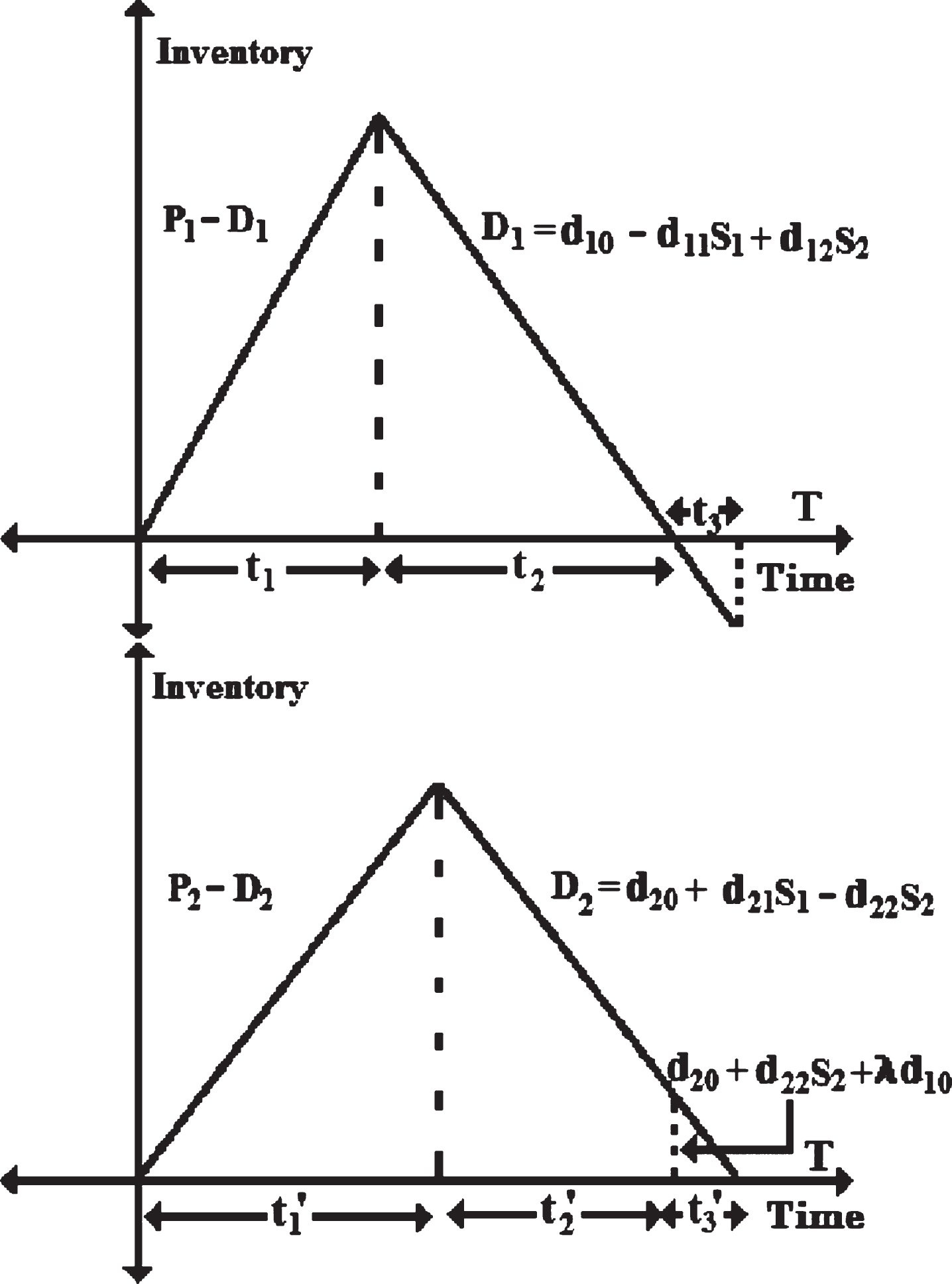
Substitution considering shortage in one of the item with constant demand & same time period.

Nature of 2-D graph considering total profit against selling price (s1) and (s2).
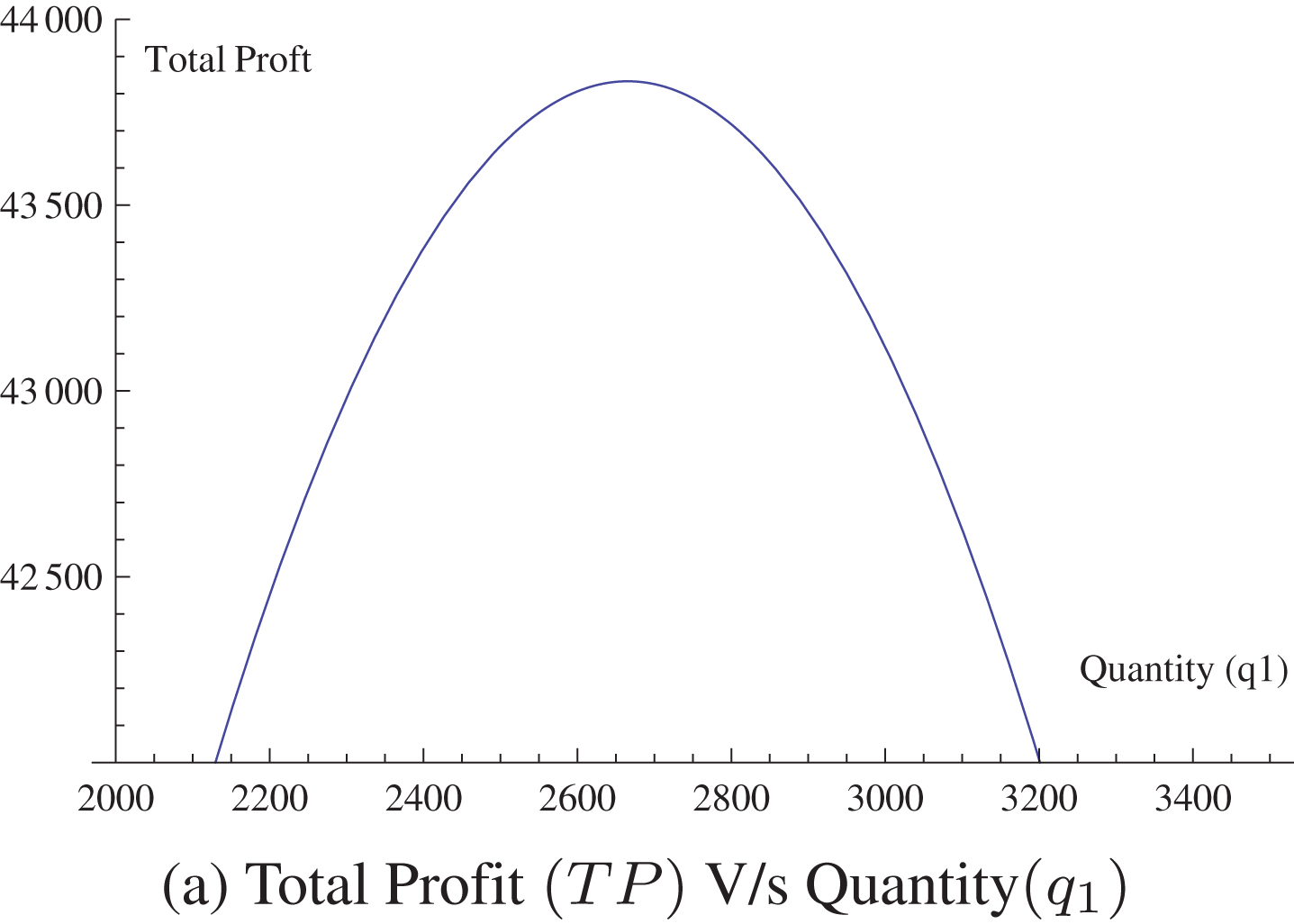
Nature of 2-D graph considering total profit against quantity (q1).
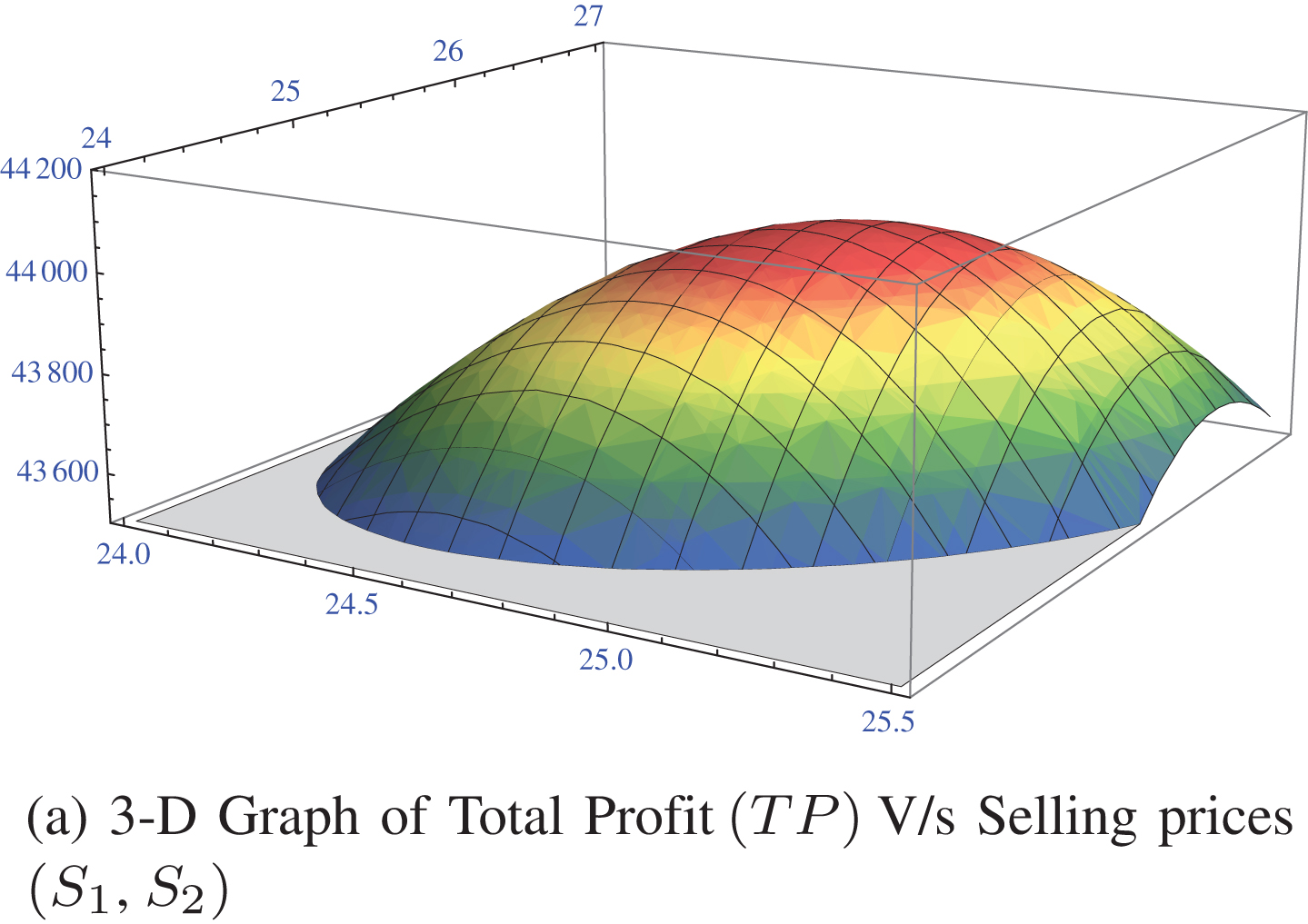
Concavity property of total profit (TP) with respect to selling prices (S1, S2) of
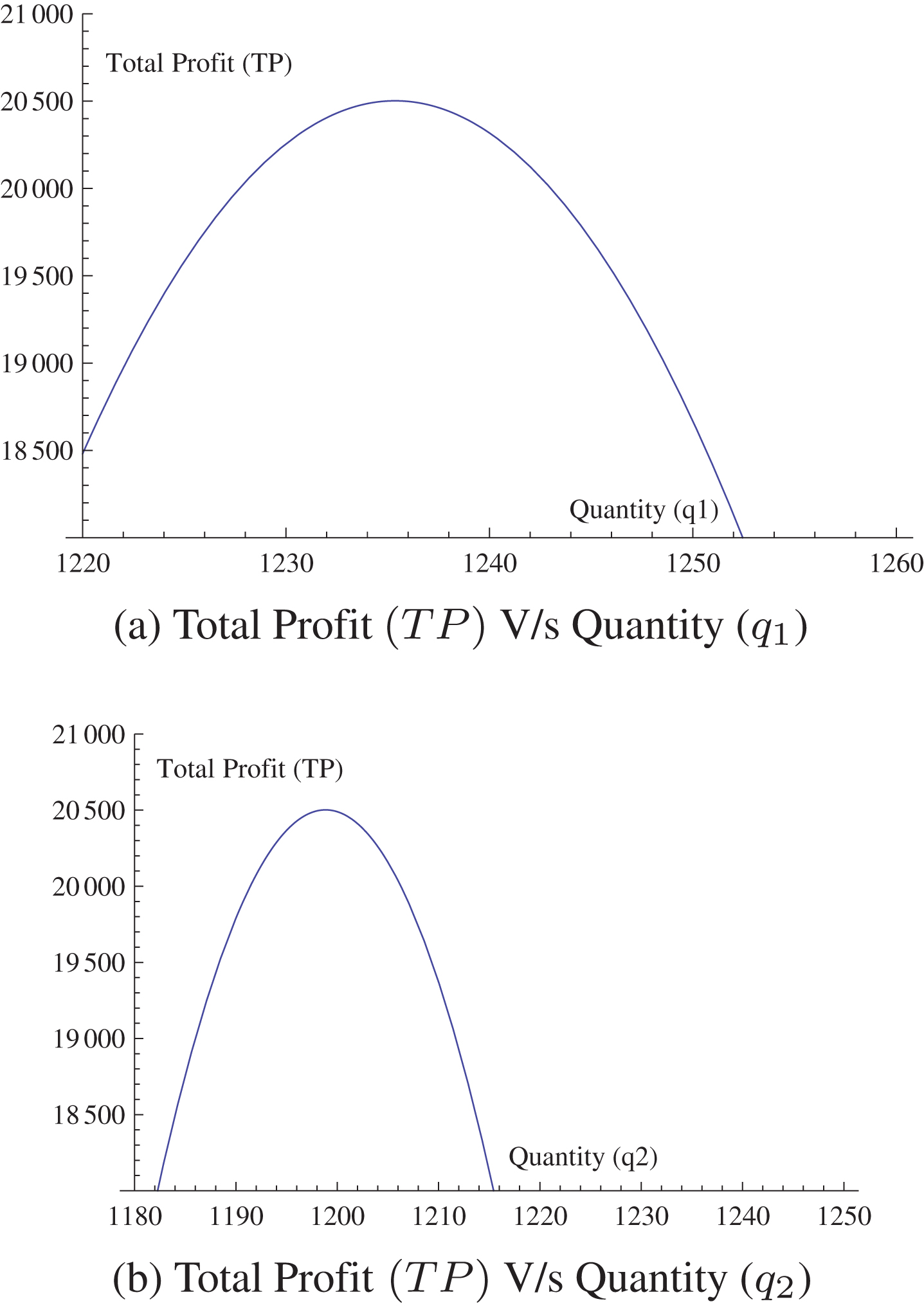
Nature of 2-D graph considering total profit against quantities (q1) and (q2).
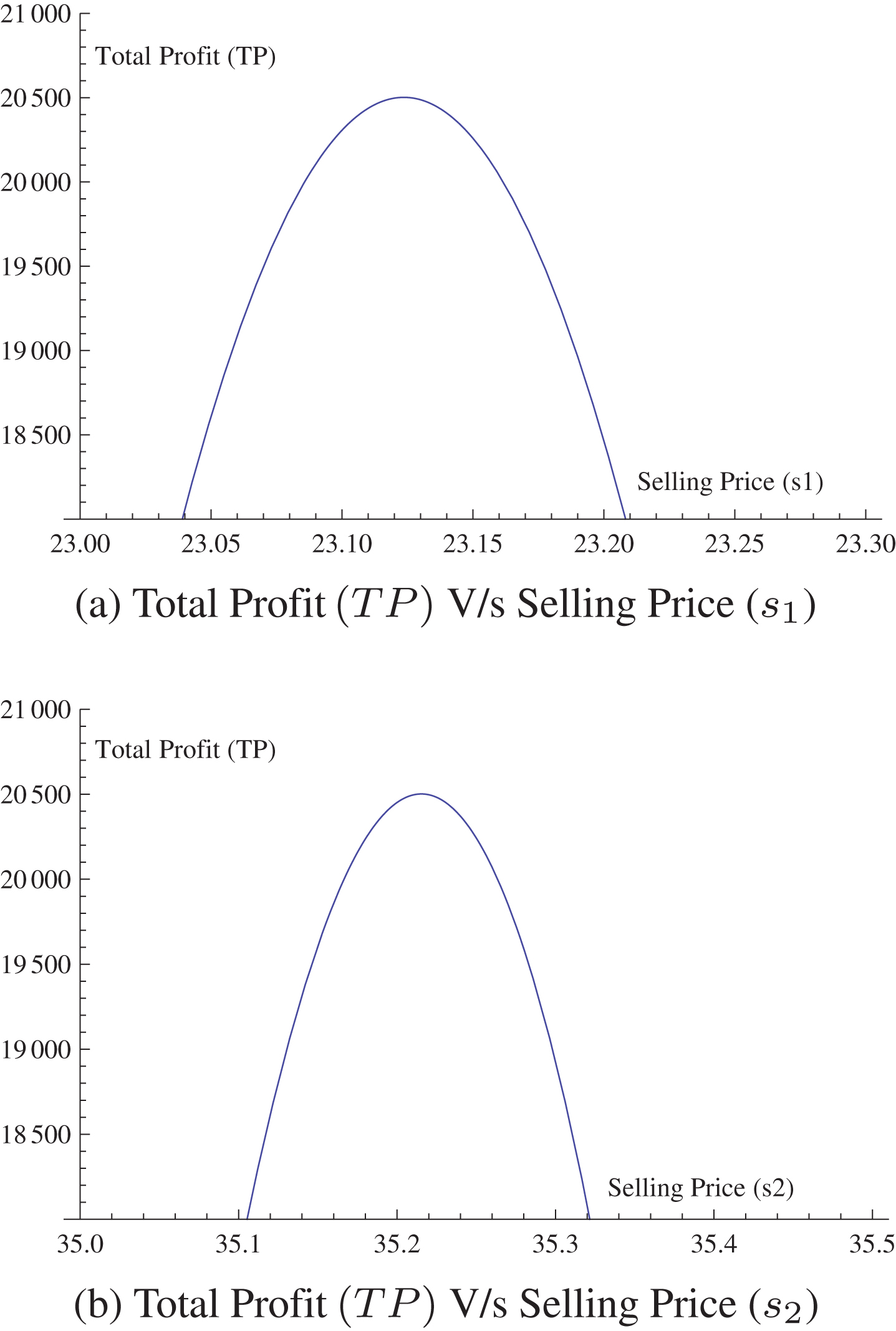
Nature of 2-D graph considering total profit against selling prices (s1) and (s2).

Concavity property of total profit (TP) with respect to selling prices (S1, S2) of
Considering the optimal values of Figure 5 is obtained by plotting the Total Profit (TP) against the different values of Selling Prices (s1 and s2). This Total profit (TP) maximization is a convex function against selling price rate only. Considering the optimal values Figure 8 is obtained by plotting the Total Profit (TP) against the different values of Selling Prices (s1 and s2). This Total Profit (TP) maximization is a convex function against selling price rate only.
In this paper, production cost of the substitutable products on the basis of selling prices and optimum order quantities have been circumscribed over finite time horizon, optimum quantities and production rate cycles so that total profit is maximum. Also, sensitivity analysis have been carried out particularly from the tables based on certain inputs which derives the total profit along with uncertain finite budget constraints. Furthermore, this paper can be extended with others types of production-inventory models such as inventory models with trade credit, two warehouses inventory system, EPQ model with price discount whilst introducing (AUD/IQD) on the substitutable products. Moreover, considering different cases of demand units where one-way substitution i.e. D2 = 0 or D1 = 0 individually can also be possible for multi-items also for those products where shortages are entertained from either of the items and vice-versa. This investigation will be helpful for the managers of stores or production cum sale companies where substitutable products are produced and sold.
The virgin ideas presented in this paper are as follows: Reliability for the production process, More substitutable products, Supply-chain system incorporating retailers and customers. Production cum sale of two substitutable products with can be incurred with effect of selling prices.