



Abstract
In this paper, we study the ordered *-semigroups in terms of fuzzy subsets in detail and define a unary operation * on the set of all the fuzzy subsets of an ordered *-semigroup S, which is a key notion to introduce the concepts of prime, weakly prime and semiprime fuzzy ideals of S. Furthermore, we establish the relationships among these three types of fuzzy ideals and give some characterizations of intra-regular ordered *-semigroups in terms of fuzzy ideals. Finally, we define and study the fuzzy filters of an ordered *-semigroup. In particular, we discuss the relationships between the filters and the fuzzy filters in ordered *-semigroups.
Keywords
Introduction
It is well known that an ordered semigroup is a semigroup together with a partial order that is compatible with the semigroup operation. Ordered semigroups have many applications in the theory of sequential machines, formal languages and error-correcting codes. Many authors, especially Kehayopulu [1], Kehayopulu and Tsingelis [2], Satyanarayana [11] and Xie [14], studied such semigroups with some restrictions. In 1978, Nordahl and Scheiblich [9] considered a unary operation * on semigroups and introduced the concept of regularity on *-semigroups. As a generalization of ordered semigroups, Wu [13] imposed the *-operation on ordered semigroups under the assumption of order preserving.
On the other hand, a fuzzy subset f of a given set S (or a fuzzy set in S) is described as an arbitrary function f : S → [0, 1], where [0, 1] is the usual closed interval of real numbers. This important concept of fuzzy sets was first introduced by Zadeh [17] in 1965, which provides a natural framework for generalizing some basic notions of algebra, e.g. set theory, group theory, semigroup theory and so on. For instance, Rosenfeld [10] investigated fuzzy sets in the context of group theory and formulated the concept of a fuzzy subgroup of a group. In [3], Kuroki introduced fuzzy sets in semigroup theory, and then introduced fuzzy semiprime ideals in semigroup. The applications of fuzzy technology in information processing is already important and it will certainly increase in importance in the future.
Fuzzy sets in an ordered semigroup were first researched by Kehayopulu and Tsingelis in [5], then they defined and studied the theory of fuzzy sets on ordered semigroups for several notations, for example, see [6–8], which have proven useful in the theory of ordered semigroups. Furthermore, Tang and Xie [12] investigated the regular ordered semigroups in terms of generalized fuzzy ideals. It is well known that fuzzy ideals and fuzzy filters of ordered semigroups with special properties always play important roles in the study of ordered semigroups. In the present paper, motivated by the study of ordered semigroups in terms of fuzzy subsets, we shall study the fuzzy ideals and fuzzy filters of ordered *-semigroups, and extend some results of ordered semigroups to ordered *-semigroups.
Let us describe the organization of the present paper. After an introduction, in Section 2 we recall some basic definitions and results of ordered *-semigroups which will be used throughout this paper and define a unary operation * on the set of all fuzzy subsets of an ordered *-semigroup S, which is a key notion to depict prime, weakly prime and semiprime fuzzy ideals of S in the sequel. In Section 3, we study the concepts of prime fuzzy, weakly prime fuzzy and semiprime fuzzy ideals in ordered *-semigroups in detail, and establish the relationships among these three types of fuzzy ideals. In Section 4, we force our attention on the intra-regular ordered *-semigroups. In particular, some characterizations of this class of ordered *-semigroups in terms of fuzzy ideals are provided. The last section is devoted to define and study the fuzzy filters of an ordered *-semigroup S. In particular, the relationships between the filters and the fuzzy filters in ordered *-semigroups are given.
Preliminaries and some notations
In this section, we investigate below necessary notions and present a few auxiliary results that will be used throughout the paper.
As we know, an ordered semigroup (S, ·, ≤) is a semigroup (S, ·) with an order relation “≤” such that a ≤ b implies xa ≤ xb and ax ≤ bx for any x ∈ S. In the following, we shall recall the notion of ordered *-semigroups from [13].
(∀ x ∈ S) (x*) * = x*. (∀ x, y ∈ S) (xy) * = y*x*.
Such a unary operation * is called an involution. If for any a, b ∈ S with a ≤ b, we have a* ≤ b*, then * is called an order preserving involution.
Throughout this paper, we denote by S an ordered *-semigroup. For a nonempty subset H of S, we define
If H = {a}, we write (a] instead of ({a}]. By a subsemigroup of S we mean a nonempty subset A of S such that A2 ⊆ A.
A function f from S to the real closed interval [0, 1] is called a fuzzy subset of S. The fuzzy subset “1” of S is defined as follows:
The set of all fuzzy subsets of S is denoted by F (S). In particular, the element “0” of F (S) also is a fuzzy subset of S defined by
Let f, g ∈ F (S) be two fuzzy subsets of S. Then, for all x ∈ S, the inclusion relation f ⊆ g is defined by f (x) ≤ g (x), and f ∩ g and f ∪ g are defined by
One can easily show that (F (S), ⊆, ∩, ∪) forms a complete lattice with the maximum element 1 and the minimum element 0.
Let S be an ordered *-semigroup. For any x ∈ S, we define A
x
: = {(y, z) ∈ S × S| x ≤ yz}. The product f ∘ g of f and g is defined by
Then, f* is a fuzzy subset of S and it is easy to calculate that, for any f, g ∈ F (S) and all x ∈ S, the unary operation * such that
That is, (F (S), ∘, *, ⊆) forms an ordered *-semi-group with the order preserving involution *.
(f ∪ g) * = f* ∪ g*. (f ∩ g) * = f* ∩ g*.
Let S be an ordered *-semigroup and A a nonempty subset of S. We denote by f A the characteristic function of A, that is, the mapping of S into [0, 1] defined by
Then f
A
is a fuzzy subset of S. A fuzzy subset f of S is called a fuzzy subsemigroup of S if for all x, y ∈ S, f (xy) ≥ f (x) ∧ f (y). A fuzzy subset f of S is called a fuzzy left (resp. right) ideal of S if for any x, y ∈ S x ≤ y ⇒ f (x) ≥ f (y). f (xy) ≥ f (y) (resp. f (xy) ≥ f (x)).
We can easily check that the condition (2) is equivalent to 1 ∘ f ⊆ f (resp. f ∘ 1 ⊆ f). A fuzzy subset f of S is called a fuzzy ideal of S if it is both a fuzzy left and a fuzzy right ideal of S.
In 2008, Xie and Tang [15] introduced the concept of an ordered fuzzy point of an ordered semigroup, and characterizes fuzzy ideals generated by ordered fuzzy points of an ordered semigroup.
It is accepted that a
λ
is a mapping from S into [0, 1], then an ordered fuzzy point of S is a fuzzy subset of S. For any fuzzy subset f of S, we still write a
λ
∈ f instead of a
λ
⊆ f. We denote by I (a
λ
) the fuzzy (two-sided) ideal of S generated by a
λ
. It is not difficult to check that I (a
λ
) = a
λ
∪ 1 ∘ a
λ
∪ a
λ
∘ 1 ∪1 ∘ a
λ
∘ 1 (see [15]). As follows, we also define a unary * on ordered fuzzy points by
f ⊆ (f] for any f ∈ F (S). (f] ⊆ (g] for any f ⊆ g ∈ F (S). (f] ∘ (g] ⊆ (f ∘ g] for any f, g ∈ F (S). ((f]] = (f] for any f ∈ F (S). (f] = f for any fuzzy ideal f of S. f ∘ g, f ∩ g and f ∪ g are fuzzy ideals for any fuzzy ideals f, g of S. f ∘ (g ∪ h] ⊆ (f ∘ g ∪ f ∘ h]. (g ∪ h] ∘ f ⊆ (g ∘ f ∪ h ∘ f]. If a
λ
is an ordered fuzzy point of S, thena
λ
= (a
λ
].
The reader is referred to [14] for notation andterminology not defined in this paper.
Prime fuzzy ideals of ordered *-semigroups
In this section we define and characterize the prime, weakly prime and semiprime fuzzy ideals in an ordered *-semigroup, and investigate their related properties.
In the following we shall study the relationships among the prime fuzzy ideals, weakly prime fuzzy ideals and semiprime fuzzy ideals in ordered *-semigroups.
Conversely, assume that P is a fuzzy ideal of S which is weakly prime and semiprime. Let a
λ
, bμ be ordered fuzzy points of S such that a
λ
∘ bμ ∈ P.Then
By Lemma 3.5 and P is semiprime, we deduce that (bμ ∘ 1 ∘ a
λ
) * ⊆ P. Hence
By Proposition 3.7 in [15],
Thus, (I (a
λ
)) * ⊆ P or (I (a
λ
)) * ∘ (I (a
λ
)) * ⊆ P since P is weakly prime and I (a
λ
), (I (a
λ
)) 2 are fuzzy ideals of S. If (I (a
λ
)) * ⊆ P, then
Notice that P is weakly prime, we conclude that (I (a
λ
)) * ⊆ P or (I (bμ)) * ⊆ P. Hence,
f* ∘ f* = f for any fuzzy ideal f of S. f* ∩ g* = f ∘ g for any fuzzy ideals f, g of S. I (a
λ
) ∩ I (bμ) = (I (a
λ
)) * ∘ (I (bμ)) * for any order fuzzy points a
λ
, bμ ∈ S. a ∈ (Sa*Sa*S] for any a ∈ S.
Similarly, we have f ∘ g ⊆ g*. Thus f ∘ g ⊆ f* ∩ g*. On the other hand, by Propositions 2.4 and 2.8(6), f* ∩ g* is a fuzzy ideal of S. This implies that
Consequently, we have f* ∩ g* = f ∘ g.
(2) ⇒ (3). By Proposition 2.4, (I (a λ )) * and (I (bμ)) * are fuzzy ideals. Then, it is easy to prove that I (a λ ) ∩ I (bμ) = (I (a λ )) * ∘ (I (bμ)) *.
(3) ⇒ (4). We only need to prove that
That is,
(4) ⇒ (5). If we can prove the following two facts:
(i) By hypothesis, we have
(ii) By using a similar argument as the proof of Theorem 3.6, we have (I (a
λ
)) 3 ⊆ 1 ∘ a
λ
∘ 1. So
Therefore,
(5) ⇒ (6). The proof is similar as the proof of Proposition 3.7 (7) in [15], hence we omit the details.
(6) ⇒ (1). By hypothesis, there exist x, y, z ∈ S such that a ≤ xa*ya*z. It means that A
t
≠ ∅ for any t ∈ S. If f is a fuzzy ideal of S, then f (a) ≥ f (xa*ya*z). Thus,
That is, f ⊆ f* ∘ f*. Conversely, for any t ∈ S,
On the other hand, since t ≤ a
i
b
i
for each i ∈ I, we get that
Hence,
Next, we claim that f* = f ∘ f. Since f ∘ f is weakly prime and f ∘ f ⊆ f ∘ f, we have f* ⊆ f ∘ f. Note that, f ∘ f ⊆ f ∘ 1 ⊆ f implies f* ⊆ f. So f ⊆ f* and f ∘ f ⊆ f* ∘ f* ⊆ f*. Therefore, f ∘ f = f*.
Conversely, let f, g and P be fuzzy ideals of S with f ∘ g ⊆ P. Since f* = f ∘ f, we have f* ∩ g* = f ∘ g by Proposition 3.8. Notice that f and g are comparable. If f ⊆ g, then f* ⊆ g*, whence f* = f* ∩ g* = f ∘ g ⊆ P. If g ⊆ f, then by a similar argument, we deduce that g* ⊆ P. Thus, P is weakly prime. □
I (a
λ
) =1 ∘ a
λ
∘ 1 for any ordered fuzzy point a
λ
of S. I (a
λ
∘ bμ) = I (a
λ
) ∩ I (bμ), where a
λ
, bμ are ordered fuzzy points of S.
(2). For any ordered fuzzy points a λ , bμ ∈ S, a λ ∘ bμ ∈ I (a λ ) ∘1 ⊆ I (a λ ). Thus I (a λ ∘ bμ) ⊆ I (a λ ). By a similar argument, we deduce that I (a λ ∘ bμ) ⊆ I (bμ). Hence, I (a λ ∘ bμ) ⊆ I (a λ ) ∩ I (bμ).
Conversely, let x
γ
∈ I (a
λ
) ∩ I (bμ). Then x
γ
∈ 1 ∘ a
λ
∘ 1 ∩1 ∘ bμ ∘ 1. Notice that (bμ ∘ 1 ∘ a
λ
) ∘ (bμ ∘ 1 ∘ a
λ
) ⊆1 ∘ a
λ
∘ bμ ∘ 1 ⊆ I (a
λ
∘ bμ) and I (a
λ
∘ bμ) is semiprime. We can obtain that (bμ ∘ 1 ∘ a
λ
) * ⊆ I (a
λ
∘ bμ). Hence,
This means that x γ ∈ I (a λ ∘ bμ), that is, I (a λ ) ∩ I (bμ) ⊆ I (a λ ∘ bμ). □
Characterizations of intra-regular ordered *-semigroups
As a generalization of the concept of intra-regular ordered semigroups, Wu [13] introduced the concept of intra-regular ordered *-semigroups. In this section, we force our attention on this class of ordered *-semigroups. In particular, we provide some characterizations of intra-regular ordered *-semigroups in terms of fuzzy ideals.
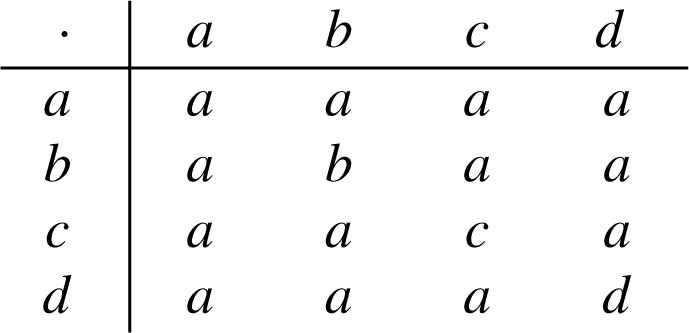

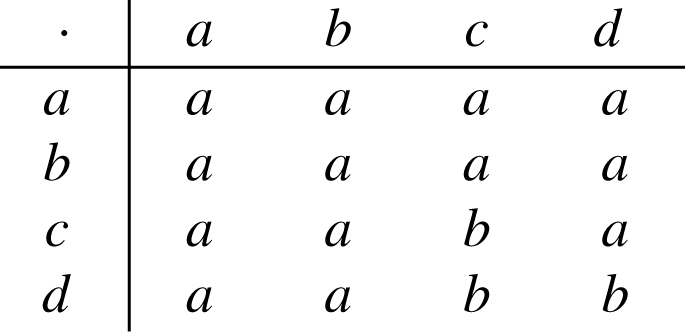
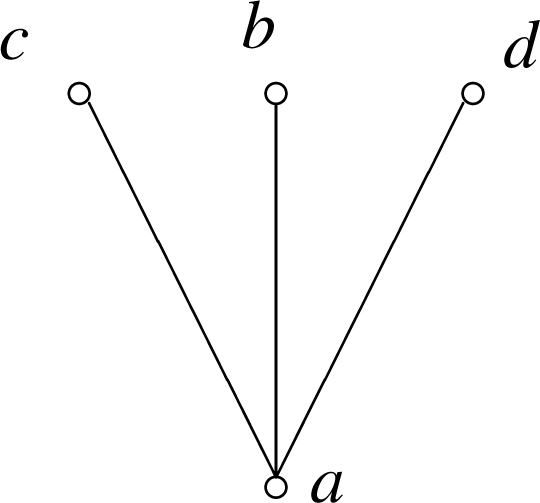
Now define the involution * by a* = a, b* = d, c* = c and d* = b, We can easily check that (S, ·, *, ≤) is an intra-regular ordered *-semigroup with the order preserving involution *.
We now give a characterization of intra-regular ordered *-semigroups by the properties of fuzzy ideals.
S is intra-regular. R* ∩ L* ⊆ (LR] for every left ideal L and every right ideal R of S.
Thus, a ∈ (LR] as required.
(2) ⇒ (1). Suppose that R* ∩ L* ⊆ (LR] for every left ideal L and every right ideal R of S. Then, by hypothesis,
If a* ≤ a2y for some y ∈ S. Then, by a similar argument as above, we can deduce that a* ∈ (Sa*a*S] = (Sa2S]. If a* ≤ ua2v for some u, v ∈ S. Then a* ∈ (Sa2S] as follows. Hence, we can always obtain that a* ∈ (Sa2S]. Therefore, a ∈ (Sa*a*S] and S is intra-regular. □
Now we give a characterization of intra-regular ordered *-semigroups in terms of fuzzy left ideals and fuzzy right ideals.
S is intra-regular. f* ∩ g* ⊆ g ∘ f for every fuzzy left ideal g and every fuzzy right ideal f of S.
This means that f* ∩ g* ⊆ g ∘ f.
(2) ⇒ (1). Suppose that R and L are a right ideal and a left ideal of S, respectively. Then, by Lemma 4.4, f
R
*
and f
L
*
are a fuzzy left ideal and a fuzzy right ideal since R* is a left ideal of S and L* is a right ideal of S. Let a* ∈ R* ∩ L*. Then, by hypothesis and notice that
On the other hand, since (f
R
*
∘ f
L
*
) * is a fuzzy subset of S, we get that (f
R
*
∘ f
L
*
) * (a*) ≤1 for any a* ∈ S. Hence, we obtain
This means that there exist b, c ∈ S such that a* ≤ bc and f L (b) = f R (c) =1. Thus a* ≤ bc ∈ LR, and so R* ∩ L* ⊆ (LR]. By Lemma 4.3, S is intra-regular. □
This implies that f (a*) = f (a2).
(⇐). We denote by I (a2) the ideal of S generated by a2, from the fact of Lemma 4.4, fI(a2) is a fuzzy ideal of S. By hypothesis, we have fI(a2) (a*) = fI(a2) (a2) =1, that is, a* ∈ I (a2) = (a2 ∪ Sa2 ∪ a2S ∪ Sa2S]. Hence, by a similar argument as the proof of Lemma 4.3, we deduce that S is intra-regular. □
That is f ((ab) *) = f (ba). □
Fuzzy filters of ordered *-semigroups
In the current section, we introduce the concept of fuzzy filters of ordered *-semigroups, and investigate their related properties. In particular, we discuss the relationships between the filters and the fuzzy filters in ordered *-semigroups.
(∀ a, b ∈ S) ab ∈ F ⇒ a* ∈ F and b* ∈ F. (∀ a ∈ F) (∀ b ∈ S) a ≤ b ⇒ b ∈ F.
(∀ x, y ∈ S) x ≤ y ⇒ f (x) ≤ f (y), (∀ x, y ∈ S) f (xy) ≤ f* (x) ∧ f* (y).
Conversely, suppose that f
F
is a fuzzy filter of S. Let xy ∈ F for any x, y ∈ S. Then
Conversely, let the level subset f t (≠ ∅) of f be a filter of S. For any x, y ∈ S, suppose that x ≤ y and t = f (x). Then x ∈ f t . Since f t is a filter of S, we have y ∈ f t . Thus f (y) ≥ t = f (x). Moreover, for any x, y ∈ S, let λ = f (xy). Then xy ∈ f λ , which implies that x* ∈ f λ and y* ∈ f λ . So f* (x) ∧ f* (y) = f (x*) ∧ f (y*) ≥ λ = f (xy). On the other hand, by Lemma 5.8, f is a fuzzy subsemigroup of S. Therefore, f is a fuzzy filter of S. □
Acknowledgments
This work was supported by the National Natural Science Foundation (No. 11371177) and the University Natural Science Project of Anhui Province (No. KJ2015A161).