



Abstract
For complex multi-attribute large-group decision-making problems in the interval-valued intuitionistic fuzzy environment, decision attributes are correlated and stratified, and the correlations among them are not always consistent. This paper proposes a decision-making method: a two-stage regularized generalized canonical correlation analysis (RGCCA) based on multi-block analysis method. The proposed two-stage RGCCA method can well represent the different characteristics between the positive and negative attribute blocks, which makes the decision making process closer to actual. Since RGCCA can only handle single-valued information, this research also presents a novel transformation method of interval-valued intuitionistic fuzzy numbers to single-valued numbers. For the two-stage RGCCA model, in the first stage, all attributes are divided into the positive and negative attribute blocks according to the signs of the weight coefficients of block components. In the second stage, we conduct RGCCA based on multi-block analysis method for the two types of blocks, respectively. Finally, in terms of the estimated values of block components in the two types of blocks and weights of the two types of blocks (obtained by the maximizing deviation method), the evaluation value of each alternative is calculated and the ranking result of alternatives is given. An example is illustrated to verify the feasibility and the validity of the proposed method.
Keywords
Introduction
Group decision-making problems have become an increasingly important area of research and a large number of group decision-making methods [1–6] have been developed. With the development of socioeconomic, the increasing complexity of group decision-making problems results in huge changes in many aspects. For instance, decision attributes have become more complicated as a result of correlations among attributes and the stratification of attribute systems. Considering the course of the democracy of the social management, organizations are more inclined to invite numerous experts and stakeholders to cope with complex group decision-making problems by means of the network technology. Chen et al. [7] referred to such group decision-making problems in reality as complex multi-attribute large-group decision making (CMALGDM) problems and summarized their characteristics as follows: (1) Decision makers (DMs) of the group decision-making problems can make decisions in different areas and at different time in networking situations; (2) The number of DMs invited by a certain decision-making department generally exceeds 20, and there exists competition and cooperation among DMs; (3) Decision attributes are comprehensive and correlated; (4) The preference information provided by DMs is uncertain. Compared with the traditional multi-attribute group decision-making problems, CMALGDM problems manifest three main complexities in decision attributes, DMs, and decision environment [8–10]: Complexity in decision attributes: Different types of primary decision attributes containing many sub-attributes are considered (in this paper, they are denoted by attribute blocks and corresponding manifest variables in blocks, respectively). Furthermore, these attributes are inevitably correlated. Complexity in DMs: Large numbers of DMs invited by a certain decision-making department are from various fields of expertise. Thus, these DMs have different knowledge backgrounds, personality traits, and risk attitudes, etc. Complexity in decision environment: Decision making tools employed by DMs to make decisions are diverse and decision-making methods coping with decision-making problems are various.
CMALGDM has become a new focus of research since Chen et al. [7] introduced its major characteristics. Some researches have focused on various aspects of CMALGDM problems, e.g., classification of DMs, determination of DMs’ weights and attribute weights, and decision information aggregation models. In [8], Liu et al. proposed a partial least squares (PLS) path based modelling for CMALGDM, which provided a superior solution to the relativity problems of the decision attributes and objectively assigned weights to the primary decision attributes. In [9], the IVIF-PCA model for CMALGDM was proposed, which can represent major information of original attributes, effectively reduces dimensions of attribute spaces, and synthesizes original attributes into several relatively independent comprehensive variables.
However, there are still two main issues neglected in current researches: (a) Most of the researches ignored the complexity of decision attributes. That is, they generally paid attention to CMALGDM problems with few and comparatively independent attributes. Actually, decision attributes in many real-world CMALGDM problems are correlated and stratified. Moreover, in order to make attribute systems as comprehensive as possible, it is necessary to consider multiple sub-attributes of primary decision attributes. (b) Direction correlations between decision attributes are not always consistent. In other words, there is a positive correlation between some attributes while there is a negative correlation between the other attributes. Therefore, it will lack rationality, if all decision attributes are treated as a whole and different characteristics between the positive and the negative attribute blocks are neglected.
This research proposes a decision-making method, which intends to solve the issues mentioned above for CMALGDM problems. For the issue (a), we consider the complexity of decision attributes. In terms of regularized generalized canonical correlation analysis (RGCCA) put forward by Tenenhaus and Tenenhaus [11], we utilize RGCCA based on multi-block analysis to deal with correlated and stratified decision attributes. This method, in terms of an optimization model, establishes linear relationships of attribute block components (i.e. block components and the super-block components) satisfying: (1) Block components represent their own blocks to a great extent; (2) Block components, which are presumed to be connected with the super-block component, have a high correlation. For the issue (b), we perform the second-stage RGCCA based on multi-block analysis for the positive and the negative attribute blocks, respectively. According to the signs of the weight coefficients of block components obtained in the first-stage RGCCA, these attributes are divided into the positive and the negative attribute blocks. Then, we conduct RGCCA based on multi-block analysis method for the two types of blocks. Finally, in terms of the estimated values of the block components in the two types of blocks and weights of the two types of blocks (obtained by the maximizing deviation method), the evaluation value of all alternatives are obtained and the ranking result of alternatives is determined.
One thing we should point out that, for CMALGDM problems in the interval-valued intuitionistic fuzzy (IVIF) environment, this research presents a transformation method of interval-valued intuitionistic fuzzy numbers (IVIFNs) to single-valued numbers since RGCCA can only handle single-valued information. The idea of the transformation method is given as follows. First, combined with DMs’ risk attitudes, the degree of the membership and the degree of the non-membership of an IVIFN will be transformed into the corresponding aggregation values by means of the continuous interval argument OWA (C-OWA) aggregation operator. Then, the aggregation values of the degree of the membership and the degree of the non-membership are aggregated into a single value by use of our proposed newly weighted C-OWA (WC-OWA) operator.
The remainder of this paper is organized as follows. In Section 2, we review the basic concepts of interval-valued intuitionistic fuzzy sets (IVIFSs) and briefly introduce C-OWA operator. Section 3 gives a brief description of the CMALGDM problem in the IVIF environment and then develops a transformation method of IVIFNs into single-valued numbers utilizing C-OWA operator and the proposed WC-OWA operator. The introductions of RGCCA based on multi-block analysis, two-stage RGCCA based on multi-block analysis for CMALGDM problems, and a weight determination method for the positive and the negative attribute blocks are proposed in Section 4, firstly. Then, on basis of these, specific decision-making steps of CMALGDM problem under IVIF environment are summarized. In Section 5, we provide an illustrative example to demonstrate the feasibility and validity of our proposed method, and a comparison with typical RGCCA based on multi-block analysis is also given. In Section 6, some conclusions are presented.
Preliminaries
It is necessary to review some foundation knowledge before performing our proposed decision-making method concerning two-stage RGCCA based on multi-block analysis for CMALGDM problems in IVIF environment. In Section 2.1, we introduce basic concepts of IVIFSs, which is the decision-making environment of this paper. Then, in Section 2.2, we give a brief introduction of C-OWA operator, which plays a pivotal role in the transformation of IVIFNs into single values in Section 3.2.
Basic concepts of IVIFSs
Because of the complexity and uncertainty of CMALGDM problems, it is difficult for DMs to provide exact decision information concerning alternatives and attributes. Thus, IVIFNs, which contain degrees of membership and non-membership expressed in the form of interval numbers, are more suitable to describe decision information of DMs. Based on intuitionistic fuzzy sets (IFSs) proposed by Atanassov [12], Atanassov and Gargov [13] gave the following concepts of IVIFSs:
Here,
For convenience, an IVIFN is defined as
The ordered weighted average (OWA) operator, proposed by Yager [14], combines a finite argument collection to return a single value with the weighting vector. Based on the OWA operator, Yager [15] put forward C-OWA operator, where the arguments to be aggregated are the values in a certain continuous interval.
Where [a, b] ⊂ P, [a, b] is a random continuous interval and P is the set of all nonnegative interval numbers. And Q is a basic unit-interval monotonic (BUM) function satisfying: (1) Q: [0, 1] → [0, 1]; (2) Q(0) = 0, Q(1) = 1; and (3) Q (x) ≥ Q (y) if x > y.
A deduction of Equation (3) is given in [20], then a simplified form of F is shown as follows:
By denoting
Equation (4) can then be expressed as:
We can see that F Q ([a, b]) is the weighted average of end points of a certain closed interval on the basis of λ, where λ is the attitudinal character of BUM function Q.
Yager considered that the choice of aggregation operators reflects the subjective preference of DMs (i.e. the decision attitude) [15]. And Yager thought that OWA operator could reflect the decision attitude by the choice of the weighting vector. Since C-OWA operator is the extended interval form of OWA operator, C-OWA operator is also a reflection of the decision attitude by the selection of BUM function. As a result of the relationship between λ and BUM function (i.e. Equation (5)), the decision attitude of DMs can be further reflected by λ. Generally, there are three types of decision attitudes: optimistic, pessimistic, and neutral [10]. From Equation (6), we know that: (1) If a decision maker (DM) is optimistic, he/she tends to obtain the aggregation value closer to the right endpoint b of the interval. Thus, λ should be closer to 1. (2) If a DM is pessimistic, he/she tends to obtain the aggregation value closer to the left endpoint a of the interval. Thus, λ should be closer to 0. (3) If a DM is neutral, he/she tends to obtain the midpoint (a + b)/2 of the interval. Thus, λ should be equal to 1/2.
Since RGCCA can only deal with the single-valued information, we should first transform the IVIFNs into single values. Generally, most transformation methods utilize the score function and the accuracy function defined by Xu [16]. Uncomplicated as they are, they are prone to result in the loss of the original decision information given by DMs. To reduce the loss of decision information to a great extent, this paper develops a transformation method based on C-OWA operator and proposes a newly WC-OWA operator. The CMALGDM problems in IVIF environment with some related symbols are descripted in Section 3.1, and the WC-OWA operator and the transformation method is presented in Section 3.2. The details are shown in the followings.
The CMALGDM problems in IVIF environment
For CMALGDM problems in the IVIF environment, we suppose that (1) a = { a1, ⋯ , a
m
} (m ≥ 2) denotes a set of m alternatives, (2) u ={ u1, ⋯ , u
n
} represents a set of n attributes, (3) d = { d1, ⋯ , d
t
} (t ≥ 20) is a set of DMs, (4) λ = (λ1, ⋯ , λ
t
)
T
signifies the vector of DMs’ importance weights, where
Therefore, each line of the matrix
A transformation method based on C-OWA operator and a newly weighted C-OWA (WC-OWA) operator
In order to well present the WC-OWA operator, this subsection is organized as followings. In Section 3.2.1 the treatment of IVIFNs based on C-OWA operator is given. In Section 3.2.2, we propose a new WC-OWA operator and present its main properties (i.e., boundedness and idempotency). Combined with the content in Section 3.2.1 and Section 3.2.2, we provide specific transformation steps of IVIFNs into single values in Section 3.2.3.
The treatment of IVIFNs based on C-OWA operator
Yager introduced some examples of C-OWA aggregation based on various BUM functions Q [15]. Obviously, for different BUM functions Q, the attitudinal character λ and C-OWA aggregation F
Q
([a, b]) are also different from each other. Similar to [17, 18], we choose Q (y) = y
r
(r > 0) as the BUM function in C-OWA operator. Then, the attitudinal character λ has the following expression:
Thus, the C-OWA aggregation F
Q
([a, b]) is
Given the graph of the function Q (y) = y r (r > 0) (see Fig. 1), we have: (1) If r > 1, the value of Q (y) increases dramatically, then BUM function Q is called as the optimistic function; (2) If 0 < r < 1, the value of Q (y) increases slowly, then BUM function Q is called as the pessimistic function; (3) If r = 1, the value of Q (y) increases linearly, then BUM function Q is called as the neutral function. Integrated with the analysis of the relationship between the value of λ and the decision attitude of DMs in Section 2.2, we know that: (1) If a DM is optimistic, then λ will approach 1, further, r will approach 0 and the corresponding BUM function Q is pessimistic; (2) If a DM is pessimistic, then λ will approach 0, further, r will approach infinity and the corresponding BUM function Q is optimistic; (3) If a DM is neutral, then λ will be 1/2, further, r will be equal to 1 and the corresponding BUM function Q is neutral. For the convenience of calculations, for an optimistic DM, we let r = 0.5; for a pessimistic DM, we let r = 2; and for a neutral DM, we let r = 1.
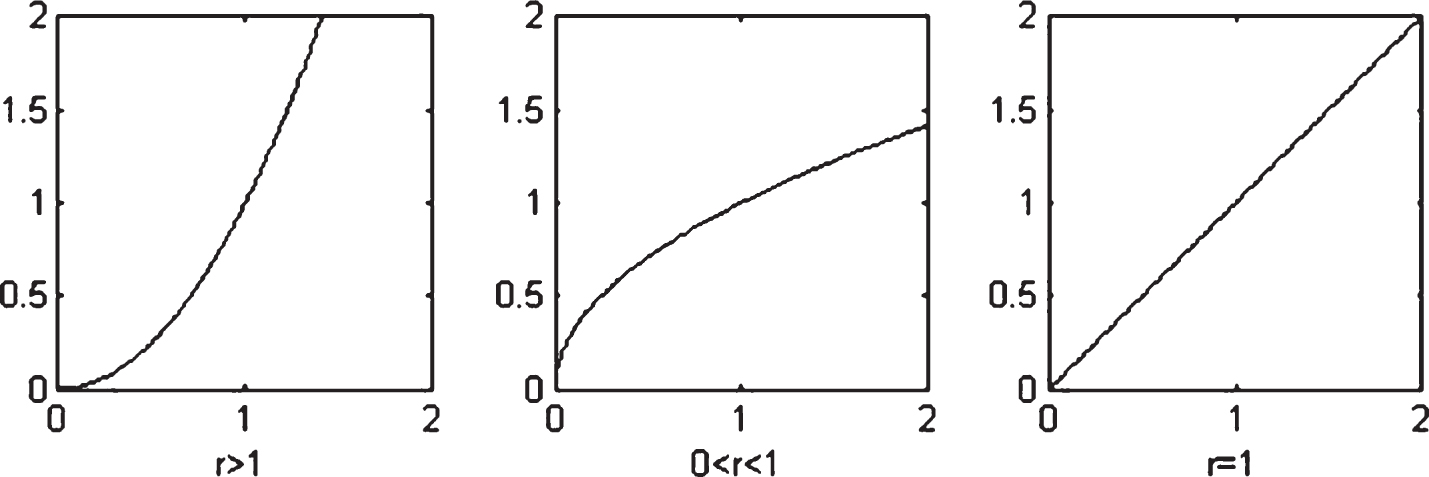
The graph of the function Q (y) = y r (r > 0) for different parameters r : r> 1 ;0 < r < 1 ; and r = 1.
Based on the above analysis, Liu et al. [10] argued that different types of BUM functions Q should be provided to the degree of the membership and the degree of the non-membership of an IVIFN when handling the IVIFN based on C-OWA operator. They thought that the degree of the membership of an IVIFN represents the benefit interval while the degree of the non-membership of an IVIFN signifies the cost interval. Thus, for the interval-valued intuitionistic information given by DMs in this paper, we consider: For an optimistic DM, BUM function Q handling the degree of the membership should be pessimistic while BUM function Q handling the degree of the non-membership should be optimistic. For a pessimistic DM, BUM function Q handling the degree of the membership should be optimistic while BUM function Q handling the degree of the non-membership should be pessimistic. For a neutral DM, BUM functions Q handling the degree of the membership and the degree of the non-membership should be both neutral.
Inspired by the extended C-OWA operators developed by Xu [19], we propose a new WC-OWA operator which will be useful in steps of transforming IVIFNs into single values.
Here, F
Q
i
([a
i
, b
i
]) can be acquired by means of Equations (4 and 5), and ω = (ω1, ω2, ⋯ , ω
n
)
T
denotes the weight vector of F
Q
i
([a
i
, b
i
]) with the condition ω
i
∈ [0, 1] and
Our proposed WC-OWA operator has the following properties similar to those of WC-OWA operator developed in [19].
Suppose the decision preference of DM d
k
is
Next, we define ω = (ω
μ
, ω
ν
) as the risk preference coefficients of a DM, where 0 ≤ ω
μ
(ω
ν
) ≤ 1, and ω
μ
+ ω
ν
≤ 1. Since the degree of membership represents the benefit and the degree of non-membership signifies the cost, we have: (1) If a DM is optimistic, then ω
μ
> 0.5 (i.e. ω
ν
< 0.5). That is, he will assign a larger weight to the value
Based on the above analysis, we give the specific steps for transforming IVIFNs into single values as follows (the whole process is represented graphically in Fig. 2):

A graphical representation of the specific steps for transforming IVIFNs into single values.
For CMALGDM problem in IVIF environment, we propose the decision-making method based on two-stage RGCCA. First, we introduce the typical RGCCA based on multi-block analysis in Section 4.1, which lays a foundation for the decision making process of the two-stage RGCCA based on the multi-block analysis in Section 4.2. To determine the weights of the two types of attribute blocks (i.e. the positive and the negative attribute blocks), we introduce the maximizing deviation method developed by Wang [20] in Section 4.3. Finally, we sum up the specific decision-making steps of CMALGDM problem in IVIF environment in Section 4.4.
Typical RGCCA based on multi-block analysis
RGCCA is a generalization of regularized canonical correlation analysis. It provides a framework which models linear relationships between blocks of variables observed on the same set of individuals. Since there exists a network of connections between the blocks, RGCCA establishes linear relationships of block variables (i.e. block components) satisfying: (1) Block components represent their own blocks to a great extent; (2) Block components, which are presumed to be connected, have a high correlation.
RGCCA based on multi-block analysis for CMALGDM problems is given in Section 3.1 (see Fig. 3). And this method is well known as Consensus PCA proposed by Smilde et al. [21]. First, we divide n attributes into J blocks in terms of their characteristics. We denote (ξ1, ξ2, ⋯ , ξ J ) = (X1w1, X2w2, ⋯ , X J w J ) as the J “block components for decision-making” corresponding to J blocks of decision attributes. Each block contains p j decision attributes, then these decision attributes can be represented as u j = (uj1, uj2, ⋯ , u jp j ) , (j = 1, 2, ⋯ , J), where u jh (h = 1, 2, ⋯ , p j ) denotes the manifest variables in the model. Further, all blocks of decision attributes are integrated into a super-block, and the component of the super-block is expressed as ξJ+1. Additionally, block components have a linear relationship with the super-block component ξJ+1 based on RGCCA. To verify the unidimensionality of blocks including manifest variables, we conduct the unidimensional analysis of each block by Dillon-Goldstein’s ρ. A block is regarded as unidimensional, when the Dillon-Goldstein’s ρ is larger than 0.7. And Chin [22] considered the statistic to be a better indicator of the unidimensionality of a block than the Cronbach’s alpha. If all blocks pass the test, we will perform RGCCA based on multi-block analysis. Otherwise, certain attributes will be removed or classifications of attributes will be adjusted to meet the needs of unidimensionality.
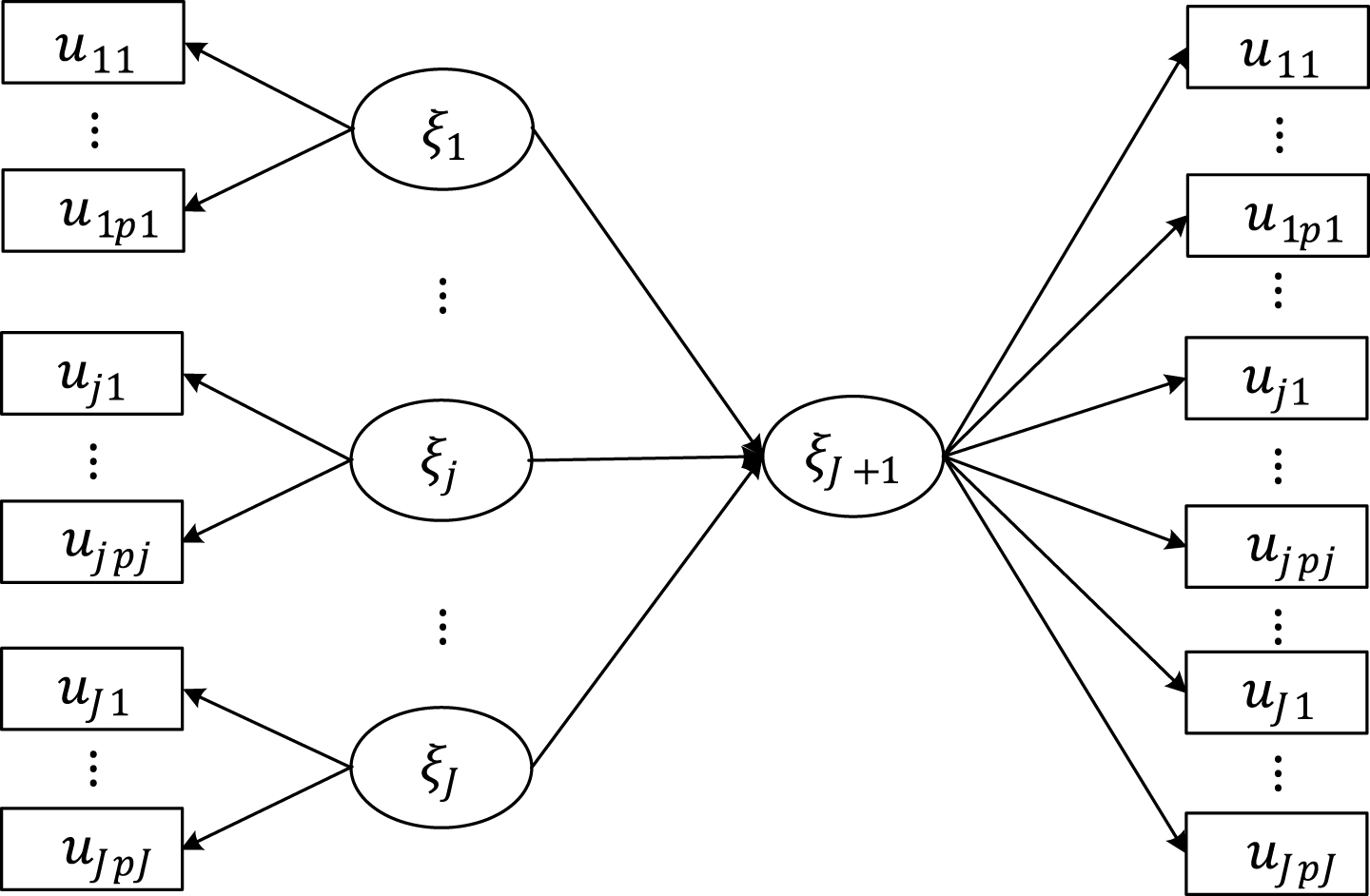
RGCCA based on multi-block analysis for the CMALGDM problem.
RGCCA based on multi-block analysis corresponds to the following optimization problem [16]:
According to the optimization problem (13), we know that not only is each block component X j w j (j = 1, ⋯ , J) well correlated to the super-block component XJ+1wJ+1, but they also describe their own blocks to a large extent. Actually, the solution of the optimization problem (13) is explicit: the super-block component XJ+1wJ+1 is the first principal component of the super-block, and for each block, the block component X j w j is the first PLS component in the PLS regression of the super-block component XJ+1wJ+1 on each block.
According to RGCCA based on multi-block analysis for CMALGDM problems, the signs of weight coefficients of block components can be determined by the correlations between each block component and the super-block component. If the correlations of these block components are not always the same, negative weights will inevitably appear for certain attribute blocks, which will not match with the actual decision making. Therefore, this research proposes a two-stage RGCCA method based on multi-block analysis in CMALGDM problems. First, the weight coefficients of block components can be calculated in the first-stage RGCCA based on multi-block analysis. Then, in terms of the signs of weight coefficients of block components, all decision attributes will be divided into the positive and the negative attribute blocks. Next, we perform the second-stage RGCCA based on multi-block analysis for the two types of blocks, respectively. And we obtain the evaluation values and weight coefficients of block components in the two types of blocks.
The weight determination method of the positive and the negative attribute group
We have obtained the evaluation values of block components in both the positive and the negative attribute blocks in Section 4.2. Further, we need to determine the weights of the two types of blocks if we want to get the final estimated values of alternatives to rank them. Here, we adopt the maximizing deviation method proposed in [20], the idea is showed in the following.
We assume that R = (r
ij
) m×n is the single-valued decision matrix of a certain DM where r
ij
represents his evaluation value of alternative a
i
concerning attribute u
j
. If attribute u
j
does not vary significantly across all alternatives, it indicates that attribute u
j
plays only a small role in the priorities of the alternatives. Therefore, a small weight should be assigned to it. On the contrary, if u
j
makes a difference in the evaluation values of all alternatives, then it will have a large role in ranking alternatives and should be given a large weight. For attribute u
j
, the deviation of alternative a
i
regarding alternative a
l
can be expressed as:
Then, the total deviation of all alternatives concerning other alternatives under attribute u j is:
The larger the total deviation value is, the larger weight attribute u
j
is assigned. In contrast, the smaller the total deviation value is, the smaller weight attribute u
j
is assigned. Thus, the optimization model concerning the maximizing deviation method in [7] is:
Normalize attribute weights obtained from the above model, then the expression is:
On the basis of the above analysis (including Section 3), we sum up the specific decision-making steps of the CMALGDM problem in the IVIF environment as follow.
An illustrtive example and comparison
In this section, we will implement the proposed transformation method with WC-OWA operator, and the two-stage RGCCA based decision making method on a real CMALGDM problem in IVIF environment. The main goal of this section is to show the effectiveness and practicability of our model in dealing with CMALGDM problems. The details of the illustrative example are show in Section 5.1 and a comparison with typical RGCCA based decision making method is presented in Section 5.2.
An illustrative example
To demonstrate the feasibility and validity of the proposed decision-making method in this paper, a CMALGDM problem in reality is provided as follows. A Chinese power development Ltd. intends to establish a large hydropower station in the Yangtze River basin. The primary tasks of the hydropower station are generally recognized as power generation, flood control, irrigation, water supply, and shipping. The engineering department of the company has designed 5 possible alternatives a i (i = 1, ⋯ , 5) for the construction of the hydropower station. To make the whole decision-making process scientific and efficient, the decision-making department invites 30 DMs (d k , k = 1, ⋯ , 30), including 6 government officials, 6 engineering experts, 6 regional economy experts, 6 environmental experts, and 6 public representatives, to evaluate these alternatives at the beginning. These DMs are chosen from the “expert database”, which has been established by the government and the corresponding organization.
After some intense discussions with DMs, the decision-making department finally identifies 8 decision attributes from 4 primary attributes, and they are (1) the influences on society and the economy: the growth of regional economy u1 and flood control capacity u2; (2) the impacts on the environment: the effect on ecological safety u3 and damage to flora and fauna u4; (3) the validity of the project: persistence of the station’s function u5 and the advancement of the station’s function u6; (4) the satisfaction of the public: the satisfaction with the compensation package u7 and the satisfaction with the improvement of air quality u8. Further, all DMs are required to provide their preference values of each alternative concerning each attribute in the form of IFINs. And their decision matrix
The IVIFN decision-making matrix
The IVIFN decision-making matrix
The single-valued decision-making matrix R

RGCCA based on the multi-block analysis for the example.
The results of the uniidimensionality test
By conducting the first-stage RGCCA, the estimated values of each block component ξ j (j = 1, 2, 3, 4) are shown in Table 4. And the path coefficients between each block component and the super-block component are presented in Fig. 5. In terms of the signs of the path coefficients, the attribute blocks are divided into the positive and the negative blocks. ξ2 is the block component in the positive block, and its evaluation values (i.e. the positive evaluation values) are shown in Table 4. ξ1, ξ3, and ξ4 are the block components in the negative blocks.

The path coefficient between each block component and the super-block component in the first-stage RGCCA.
The estimated values of block components in the first-stage RGCCA
Then, by conducting the second-stage RGCCA, the estimated values of block components in the negative blocks are obtained in Table 5 (For convenience, ξ1, ξ3, and ξ4 are expressed as

The path coefficient between each block component and the super-block component for the negative attribute blocks in the second-stage RGCCA.
The estimated values of block components in the negative attribute blocks in the second-stage RGCCA
In this section, we will present a decision-making process to choose the optimal alternative by utilizing the typical RGCCA based on multi-block analysis. (i.e., the first-stage RGCCA in Section 5.1), we have obtained the estimated values of block components in Table 4. Then, in terms of the estimated values of the super-block component and DMs’ importance weights, we get the estimated values of all alternatives: , and . Thus, the final ranking order of alternatives is a5 > a2 > a3 > a4 > a1, and the optimal alternative is a5.
Comparing the ranking results of alternatives of our proposed method and the typical RGCCA based decision making method, showed in Sections 5.1 and 5.2, respectively, we conclude that dealing with different direction correlations among attributes has a direct effect on the ranking results of alternatives. Though a5 is the optimal alternative in the two methods, the sequence of the other alternatives is different in the two methods. From the comparison of those two methods, it will inevitably result in the negative weights of some attributes when the direction correlations among decision attributes are not consistent. Further, if we ignore the different characteristics between the positive and negative attribute blocks and conduct RGCCA method directly, then we will obtain distinctly different sorting results of alternatives and even the optimal alternative.
Conclusions and future works
Suppose the attribute values of alternatives given by DMs are IVIFNs and the weights of attributes are completely unknown, we propose the two-stage RGCCA based on multi-block analysis method. First, to fully utilize the decision information of DMs, we devise a transformation method of IVIFNs into single-valued numbers in terms of C-OWA operator and the proposed WC-OWA operator. Second, to effectively cope with different correlation among attributes and the stratification of the attribute system, we implement the two-stage RGCCA based on multi-block analysis method. In the first-stage RGCCA, the estimated values of block components and the path coefficients between each block component and the super-block component are obtained. The attribute blocks are divided into the positive and the negative attribute blocks, according to the signs of the path coefficients in the first-stage RGCCA. Then, we perform the second-stage RGCCA for the two types of attribute blocks. By aggregating the estimated values of block components in the two types of blocks and the weights of the two types of blocks obtained by the maximizing deviation method, we get the evaluation values of all alternatives. Further, the optimal alternative is determined in terms of the ranking results of alternatives. We demonstrate the feasibility and validity of the proposed decision-making method by an illustrative example. Finally, the comparison with the typical RGCCA based on the multi-block analysis method indicates that, as the proposed two-stage RGCCA method can well represent the different characteristics between the positive and negative attribute blocks, the proposed decision making method seems more suitable for CMALGDM problems with correlated and stratified decision attributes.
However, there still exist certain limitations in our proposed decision-making method, e.g., the relevance among DMs was ignored and the importance weights of DMs were considered equal. Actually, in view of the characteristics of CMALGDM problems in reality, interrelation among DMs is inevitable. And considering DMs are from various areas of expertise and have different personality, their importance weights are generally different. Without taking these aspects into consideration, the final decision-making result can be affected to a certain extent. These two aspects will be the points investigated in our future research.
Footnotes
Acknowledgments
The authors would like to thank editor and reviewers. Their constructive comments give us great help to improve this work. We appreciate the financial support of the National Natural Science Foundation of China (Grant Nos. 71722004, 71102072 and 71772136).