




Abstract
The concept of a central soft set related with some common decision making problems in real life is introduced in this paper. Some basic operations on central soft sets and theirs properties such as distributive law and associative law are given. The study also shows that some classic operations between soft sets can be obtained by central soft sets with selecting different central sets. In the part of application, the concepts of an evaluation system for a parameter set and desired objects of a central soft set are initiated. An algorithm is presented to solve such decision making problems.
Introduction
Molodtsov [1, 2] innovated a novel concept of soft sets as a new mathematical tool for describe some uncertainties which are appeared around everywhere. A soft set is a tuple which associates with a set of parameters and a mapping from the parameter set into the power set of an universe set. In fact, it is a parameterized family of subsets of the universe set. At present soft set theory has combined with several directions such as universal algebra [3–5], relation analysis [6–9] and other mathematical domains [10, 14]. Soft set theory in application has its own significance. Especially the idea to solve decision-making problems [15–18] is intuitive and directly. In this paper we try to solve some decision-making problems by a new type of soft sets.
This case is often encountered in our real life, for example, a jury composed of more than one person will make investigations on a project. The contents of this project needed to be examined are involved with multiple fields. Each member of the jury will make an appropriate judgment on the basis of certain sufficient knowledge background. However, everyone has a specialized area in which they excel generally. So naturally, their relevant scoring in non specialized field need for discretion. In the end we need to make a comprehensive evaluation based on these inspection results. Concerned about this phenomenon, the concept of central soft sets is proposed in this paper. It is different from the study which focuses on valuation objects of attribute sets [10–12], that we pay attention to central attribute sets of soft sets, and examine what role they play in the operations between soft sets. In the part of theoretical application, we define an evaluation system of a parameter set consist of central soft sets. Then an algorithm for making corresponding decision of an evaluation system is given.
The rest of this paper is organized as follows. In the second section the concept of a central soft set is proposed firstly. Some properties of basic operations on central soft sets over a universe set are given in detail. We research the relationship between operations defined in this paper and some classic operations in soft set theory. It should be noted that there are some similar but different conclusions. Therefore central soft sets can not be simply considered as a simple repetition of soft sets. In the last section, we will study an evaluation system for a parameter set and give the method of obtaining its solution.
Preliminaries
First we present some basic definitions and notations used in what follows. In this paper, U is an initial universe set. The symbol
To try to solve problems by an intuitive, simple and practical way is an important and distinguishing feature in the study of soft sets. This is also a reason why we introduce the concept of a central soft set here.
For two central soft sets (f, A) and (g, B), we say (f, A) = (g, B), if f = g and A = B.
In fact, a central soft set (f, A) over the universe set U gives a complete rather than partial parametrization of U by the mapping f. It is different from soft sets (see [1, 2]). Central sets are to illustrate some particularities, which can have a variety of meanings with different backgrounds of problems. For example, in the instance of choosing houses, let (f, A) be a central soft set presents information about the scoring given by Mr. X, where A is a parameter set related with his field of expertise. To take another instance, teachers in a school who are good at teaching some certain subjects will be chosen by students. Let E be a set of school subjects, and U consists of all teachers in this school. For each student X
i
, we assume that A
i
is the set of his excellent courses. A mapping
We write (f, A) ⊔ (g, B) = (h, C).
This operation union between central soft sets is given from the view of information synthesis. It is similar as the union
By definitions of union and intersection on central soft sets, we have (f, A) ⊔ (g, B) = (h, {I, IV, V}), where h is defined as:
If we take a new central soft sets (f, C), where C = {III, IV}. Then (f, C) ⊔ (g, B) = (j, {I, III, IV}), where j is defined as:
Since we choose two different central sets for the mapping f, two different central soft sets (h, {I, IV, V}) and (j, {I, III, IV}) are obtained. It demonstrates that central sets play an important role as mappings in the operation of union.
We write (f, A) ⊓ (g, B) = (h, C).
Clearly, (f, A) ⊔ (f, B) = (f, A ∪ B) and (f, A) ⊓ (f, B) = (f, A ∩ B).
The intersection of central soft sets is different from the extended intersection of soft sets defined in [2] completely. This definition may seem strange, however, actually it gives the maximum central soft set which is contained in two original central soft sets. It will be shown in the following conclusions.
First we assume that F A and G B are two soft sets defined as above. For mappings of soft sets, we will select central sets according to some correspondences respectively. We try to see more deeply the function of central sets in the operations of centralsoft sets.
(1) We choose two central sets A and B for the mappings f
A
and g
B
respectively. By Definition 2.2, the union of two central soft sets (f
A
, A) and (g
B
, B) is a new central soft set (h
C
, C), i.e., (f
A
, A) ⊔ (g
B
, B) = (h
C
, C), where C = A ∪ B and for all x ∈ E,
For all x ∉ C, we have h
C
(x) =∅. Accordingly, for the mapping h
C
a soft set H
C
= {(x, h
C
(x)) : x ∈ E} is obtained. In fact, for each a soft set F
A
, there exists a correspondence with a central soft set (f
A
, A). Then, by the operation defined on central soft sets, actually we define an operation
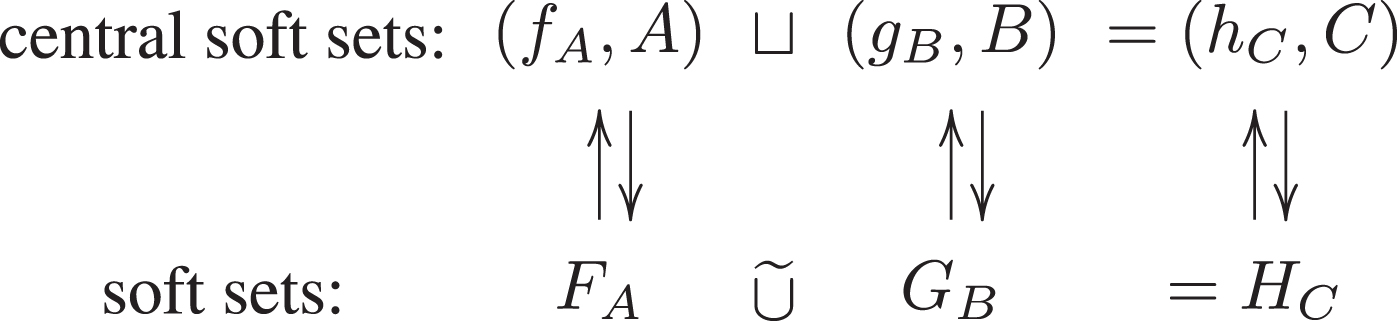
(2) Let E be the default central set. Then the union of two central soft sets (f
A
, E) and (g
B
, E) is a central soft set (l, E), where l is defined as:
Clearly f
A
(x)∪ g
B
(x) = ∅ for all x ∉ C, if C = A ∪ B. Thus a soft set L
C
= {(x, l (x)) : x ∈ E} which corresponds to l is obtained. So, if we choose the set of all parameters as the default central set, the union of central soft sets defines a natural union operation ∪ between soft sets:
Similarly, we can consider the intersection of two central soft sets (f
A
, E) and (g
B
, E). Let (j, E) = (f
A
, E) ⊓ (g
B
, E), where j is defined as:
The mapping j corresponds to a soft set J
D
= {(x, j (x)) : x ∈ E}, where D = {x ∈ E : j (x) ¬ = ∅}. Then the operation intersection of central soft sets just defines a natural intersection operation ∩ between soft sets:
(3) For each mapping f A in a soft set F A , we take the complement set of A as the central set. i.e., we choose two central sets E - A and E - B for the mappings f A and g B respectively.
Assume that (f
A
, E - A) ⊓ (g
B
, E - B) = (k, E - (A ∪ B)). For all x ∈ E,
Accordingly, for the mapping k a soft set K
D
= {(x, k (x)) : x ∈ E} is obtained, where D = {x ∈ E : k (x) ¬ = ∅}. Then the operation union of central soft sets gives a new operation
The discussion above shows that, for the operations of union and intersection of central soft sets, different mappings in soft sets are obtained if central sets are not same. Central sets and mappings play same important role in operations between central soft sets. In one sense, central soft sets and operations defined above can be looked as a generalization of classic soft sets and some related operations.
The following equivalent forms of this ordering defined between central soft sets can be obtained immediately by definitions above.
A ⊆ B and for all e ∉ B - A, f (e) ⊆ g (e); (f, A) ⊓ (g, B) = (f, A).
By Proposition 2.1, we can directly show that the central soft information order is antisymmetric and transitive. Therefore, this ordering is a partialorder.
We have (g, B) ⊑ (m, C).
By the formula (g, B) ⊑ (m, C) showed in this example, we can intuitively understand the meaning of central soft information order from experience. Suppose that (m, C) means a result of evaluation of Mr. Z for choosing houses. The relation B ⊆ C says that Mr. Z has a wider professional knowledge than Mr. X. Meanwhile, for each parameter e not in the set C - B which is an exclusive advantage region of Mr. Z, the set m (e) is “bigger” than the set g (e).
We use the same notation of complement of a soft set in [2], but please note that the substance of two definitions is different obviously.
In fact, let (f, A) ⊓ (g, B)
c
= (h, C), then C = A - B and
For e ∉ A ∩ B, h (e) ⊆ f (e). According to Definition 2.4, we have (f, A) - (g, B) ⊑ (f, A). It accords with the general characteristics of thisoperation.
Properties of operations on central soft sets
In this part we study the properties of operations on central soft sets which are over a same universe set.
[(f, A) ⊓ (g, B)]
c
= (f, A)
c
⊔ (g, B)
c
; [(f, A) ⊔ (g, B)]
c
= (f, A)
c
⊓ (g, B)
c
.
Take any e ∈ E. If e ∈ A c - B c , i.e., e ∈ B - A, we have h c (e) = U - h (e) = U - f (e) = f c (e) = k (e). If e ∈ B c - A c , then h c (e) = g c (e) = k (e) similarly. Otherwise e ∉ (A - B) ∪ (B - A), then h c (e) = U - h (e) = U - (f (e) ∩ g (e)) = f c (e) ∪ g c (e) = k (e). In summary, we have [(f, A) ⊓ (g, B)] c = (f, A) c ⊔ (g, B) c .
According to the definitions above, we can show that [(f, A) ⊔ (g, B)]
c
and (f, A)
c
⊓ (g, B)
c
both represent the same central soft set (j, (A ∪ B)
c
), where the mapping j is defined as follows:
Therefore, the second equation is also established.
The associative laws are also true for two operations union and intersection defined here.
(f, A) ⊓ [(g, B) ⊓ (h, C)] = [(f, A) ⊓ (g, B)] ⊓ (h, C); (f, A) ⊔ [(g, B) ⊔ (h, C)] = [(f, A) ⊔ (g, B)] ⊔ (h, C).
We will show that l (e) = m (e) for all e ∈ E in order to prove the associative law of the operation intersection. If e ∈ (B ∩ C) - A, then l (e) = f (e). Since e ∈ C - (A ∩ B), m (e) = k (e) = f (e) . Thus m (e) = l (e). If e ∈ A - (B ∩ C), it can be divided into three conditions: If e ∈ A, e ∉ B and e ∉ C, then l (e) = j (e) = g (e) ∩ h (e) and m (e) = k (e) ∩ h (e) = g (e) ∩ h (e). If e ∈ A, e ∉ B and e ∈ C, then l (e) = j (e) = g (e), m (e) = k (e) = g (e). If e ∈ A, e ∉ C and e ∈ B, then l (e) = j (e) = h (e), m (e) = h (e). If e ∉ A - (B ∩ C) and e ∉ (B ∩ C) - A, then l (e) = m (e) = f (e) ∩ g (e) ∩ h (e).
Thus we obtain that l (e) = m (e) for all e ∈ E.
The proof of the next equation is omitted here.
The distributive laws are false for soft sets shown in [6]. But they are true for central soft sets with operations defined here.
(f, A) ⊓ [(g, B) ⊔ (h, C)] = [(f, A) ⊓ (g, B)] ⊔ [(f, A) ⊓ (h, C)]; (f, A) ⊔ [(g, B) ⊓ (h, C)] = [(f, A) ⊔ (g, B)] ⊓ [(f, A) ⊔ (h, C)].
Then we need to show that l (e) = m (e) for all e ∈ E. It can be divided into the following severalkinds: If e ∈ A - (B ∪ C), then l (e) = k (e) = g (e) ∪ h (e), i (e) = g (e) and j (e) = h (e). Since e ∉ A ∩ B and e ∉ A ∩ C, we have m (e) = i (e) ∪ j (e) = g (e) ∪ h (e) = l (e). If e ∈ (B ∪ C) - A, then l (e) = f (e). Since e ∉ A ∩ B and e ∉ A ∩ C, we have m (e) = i (e) ∪ j (e). The set (B ∪ C) - A can be divided into three mutually disjoint partsS1 = (B - A) - (B ∩ C), S2 = (C - A) - (B ∩ C) and S3 = (B ∩ C) - A. If e ∈ S1, i (e) = f (e) and j (e) = f (e) ∩ h (e). Then m (e) = i (e) ∪ j (e) = f (e). If e ∈ S2, j (e) = f (e) and i (e) = f (e) ∩ g (e). Then m (e) = i (e) ∪ j (e) = f (e). If e ∈ S3, i (e) = j (e) = f (e). Then m (e) = i (e) ∪ j (e) = f (e). Otherwise e is in the complementary set of [(B ∪ C) - A] ∪ [A - (B ∪ C)], then l (e) = f (e) ∩ k (e). The complementary set of [(B ∪ C) - A] ∪ [A - (B ∪ C)] can be divided into four mutually disjoint parts
If e ∈ S4, then k (e) = g (e) and m (e) = i (e) = f (e) ∩ g (e) = f (e) ∩ k (e) = l (e). If e ∈ S5, then k (e) = h (e) and m (e) = j (e) = f (e) ∩ h (e) = l (e). If e ∈ S6 or e ∈ S7, then k (e) = g (e) ∪ h (e) and m (e) = i (e) ∪ j (e) = [f (e) ∩ g (e)] ∪ [f (e) ∩ h (e)] = f (e) ∩ [g (e) ∪ h (e)] = f (e) ∩ k (e) = l (e) .
Thus we obtain that l (e) = f (e) = m (e) for all e ∈ (B ∪ C) - A.
Thus l (e) = m (e) for all e ∈ E - [(B ∪ C) - A] - [A - (B ∪ C)].
By the proof above we have l (e) = m (e) for all e ∈ E. So the first equation has been shown. By the same way the next distributive property of union with respect to intersection can be shown.
Next we get a natural property which similar as properties of operations of addition and subtraction of numbers.
∀e ∈ E, let I
e
= {i ∈ I : e ∈ A
i
}, we have
Suppose that (g, B) is another upper bound of the set {(f
i
, A
i
) : i ∈ I}. Clearly we have
Following we need to show that k = h.
If e ∈ A - ⋃ i∈IA
i
, then k (e) = g (e). Since {i∈ I : e ∈ A ∩ A
i
} = ∅ and {i∈ I : e ∈ A
i
} = ∅, by Theorem 3.5 we have
If e ∈ (⋃ i∈IA
i
) - A, then k (e) = f (e). Since {i∈ I : e ∈ A ∩ A
i
} = ∅, by Theorem 3.5 we have
Otherwise, for e ∉ A - ⋃ i∈IA
i
and e ∉ (⋃ i∈IA
i
) - A, we have
In any case we obtain that k (e) = h (e).
The purpose of the projection operation is to constrain these central sets of central soft sets. While, mappings of central soft sets will not be changed.
According to the conclusion of Example 2.1, we have k = h. Then
In fact, we can show the following general conclusion.
For all e ∈ E, we have
Clearly (S ∩ A) - (S ∩ B) ⊆ A - B and (S ∩ B) - (S ∩ A) ⊆ B - A. Then we have for all e ∈ E by the definition of h. By Proposition 2.1, we obtain that
If S = (A ∪ B) - D and D ⊆ A ∩ B, then we can show that (S ∩ A) - (S ∩ B) = A - B and (S ∩ B) - (S ∩ A) = B - A. By the definitions of h and h′, we obtain that
Similarly the conclusion on the intersection operation also can be obtained.
These properties of operations given in Propositions 3.1 and 3.2 show some basic regulation of information synthesis (union operation and intersection operation).
Evaluation systems for parameter sets
Let (f, A) be a central soft set and E be a set of initial parameters. If a parameter set B ⊆ E is such that A ⊆ B; |B| = max {|G| : A ⊆ G, ⋂ e∈Gf (e) ¬ = ∅}, where |B| is the cardinality of B,
then x ∈ ⋂ e∈Bf (e) is called a desired object of (f, A). It is clear that such parameter sets B are generally not unique. Especially, if ⋂e∈Ef (e)¬ = ∅, we call x ∈ ⋂ e∈Ef (e) a perfect object of (f, A).
Let A ⊆ E be a set of parameters, {(f i , A i ) : i ∈ I} is a set of central soft sets. If A ⊆ ⋃ i∈IA i , then we call {(f i , A i ) : i ∈ I} an evaluation system for the parameter set A. The desired objects of the central soft set [⨆ i∈I (f i , A i )] ↓A are called the desired objects of this evaluation system {(f i , A i ) : i ∈ I}.
Following we give an algorithm for obtaining desired objects of a central soft set. Then the desired objects of an evaluation system are also obtained.
Give an order for the elements of E, and we denote it by E = {e1, e2, ⋯ , e
n
}. Take a matrix Ln×m, where the elements l
ij
(i = 1, 2, ⋯ , n ; j = 1, 2, ⋯ , m) are defined as follows:
Compute ∑i:e
i
∈Al
ij
and ∑
i
l
ij
for each a fixed j, and denote it by b
j
and a
j
respectively. If the index set J = {j : b
j
= |A|}¬ = ∅, let j* ∈ J be a index such that a
j
*
= max {a
j
: b
j
= |A|}, then o
j
*
is a desired object of (f, A).
For the matrix L, we have b1 = b4 = 2, b2 = b3 = 0, b5 = 1, and a1 = 3, a2 = 4, a3 = 3, a4 = 4, a5 = 6.According to the definitions shown in the above, we know that h4 is the desired object of (f, A).
For the matrix M, we have b1 = 0, b2 = b4 = 2, b3 = b5 = 1, and a1 = 2, a2 = 4, a3 = 2, a4 = 7, a5 = 4. Then h4 is also the desired object of (g, B). Clearly, there is no any perfect objects for central soft sets (f, A) or (g, B).
The following matrix N is corresponded to the central soft set (k, D):
For the matrix N, we have b1 = b2 = b3 = 1, b4 = 2, b5 = 0, and a1 = a2 = a5 = 5, a3 = 3, a4 = 7. According to the algorithm given in the above, we know that h4 is the desired object of this evaluation system.
Conclusions
The concept of a central soft set is introduced in this paper. It is shown some properties of operations such as union, intersection, complement and projection with central sets. The idea of an evaluation system for a parameter set and desired objects of a central soft set are proposed. An algorithm of giving desired objects of a soft set to solve such decision making problems is presented. More operators based on central soft sets can be given, for example the conservative union (for the complementary set of the union of central sets, the image set of each of its elements can be defined to be intersection of the corresponding sets). On the other hand, generalized soft sets with central sets can be considered for further studies.