



Abstract
In a multipath environment, signals generally reach the receiving antenna through two or more paths, causing the existing direction-of-arrival (DOA) estimation methods to be biased. Various particle swarm optimization (PSO) algorithms may provide premature convergence without determining the global optimum. However, the multipath effect is reduced by projecting the received signal onto an appropriate beam space. In this paper, a new memetic PSO (MPSO) scheme is proposed for estimating the DOA in a multipath environment. This scheme addresses the multipath effect by applying local search techniques to PSO, resulting in highly efficient optimization and a reduced multipath effect. The scheme is as follows: First, PSO and the minimum variance distortionless response (MVDR) method are used to estimate the DOA of signals. Second, the individual best position of the swarm and the beam space MVDR (BMVDR) method are used to construct an objective function. Furthermore, the first-order Taylor expansion of the objective function and local search techniques are used to enhance the search accuracy and reduce the search complexity. Two numerical examples are presented to illustrate the design procedure and demonstrate the high performance of the proposed method.
Keywords
Introduction
The use of an antenna array technique for direction-of-arrival (DOA) estimation has been widely studied for radio frequency applications [2, 6]. In wireless communications, signals exhibit the multi-path effect; when a signal propagates through two or more paths and reaches a receiving antenna, the signal energy is concentrated around the DOA, which causes the nominal DOA phenomenon. This nominal DOA phenomenon can substantially degrade the DOA estimation performance [5, 9].
Several DOA estimation methods have been studied. These methods include the minimum variance distortionless response (MVDR) method [3] and conventional subspace-based methods involving singular value decomposition, such as the multiple signal classification (MUSIC) method [24], estimation of signal parameters by using the rotational invariance technique (ESPRIT), and variants of ESPRIT under different conditions [22]. Estimates obtained using the MUSIC and MVDR methods may be biased because multipath propagation and signal dispersion are correlated [6]. Furthermore, in these methods, the search complexity and estimation accuracy primarily depend on the number of search grids used during the search. Moreover, the time consumption and the required number of search grids are difficult to determine in these methods. An efficient search-free modification of this approach, involving polynomial rooting rather than spectral searching, was proposed [21] for an efficient DOA estimation. However, polynomial rooting is suboptimal in multipath environments. Moreover, inappropriate root selection because of problems occurring in the calculation of local solutions often incurs a severe bias in the estimated parameters of a signal, particularly in low signal-to-noise-ratio (SNR) environments [6]. ESPRIT [22] may exhibit high performance and offer computational advantages; how-ever, it requires a translation-invariant structured array, and the estimation variance is large. An efficient approach to solve this problem is to reduce the nominal DOA phenomenon and search complexity by mapping the full dimension of an element space into a low-dimension beam space through beam-forming [6]. In general, in multipath environments, signal DOA is nominally a DOA phenomenon, causing the DOA estimation method to be biased. Recently, dynamical uniform and static logarithmic quantization strategies have been proposed to compensate for quantization errors [28]. Some data-driven model predictive control systems apply modified partial least squares to industrial control systems because the simplicity of computation enables updating of the online prediction mode and excellent approximation ability [7]. Therefore, in this study, received signals were projected onto an appropriate beam space to reduce the multipath effect. The scheme was as follows: First, particle swarm optimization (PSO) and MVDR methods were used to estimate the DOA of signals. Second, the individual best position of the swarm and the beam space MVDR (BMVDR) method were used to construct an objective function. The first-order Taylor expansion of the objective function and local search techniques were used to enhance the search accuracy and reduce the search complexity.
PSO, an evolutionary computation technique, has drawn considerable attention since it was proposed by Kennedy and Eberhart in 1995 [11]. The technique is based on the social behavior of animals, such as bird flocking, insect swarming, and fish schooling. PSO has been successfully used to over-come complex optimization problems. Furthermore, this technique is easy to implement and can efficiently solve difficult optimization problems, such as numerical optimization [4, 8] and multi-objective [12] and nonlinear processing problems [23, 27]. PSO is similar to evolutionary algorithms, such as genetic and differential evolution algorithms, and is a population-based random search optimization technique, where the population is called a swarm. Each swarm consists of numerous particles that represent solutions of the pertinent problem. The position of each particle in the search space is updated according to the particle velocity, and the local and global best positions of the particle in the search space are determined. In PSO, many points are simultaneously evaluated in a parameter space, and although the technique is likely to converge to some local optimal solution, convergence to the global optimum is not guaranteed, particularly when the objective function has a numerous dimensions or is a complex nonlinear function. Moreover, PSO can rapidly determine the global optimum; however, it cannot perform a refined local search to compute the global optimum with high accuracy, unless specific procedures are incorporated in the operator.
In this study, to overcome the premature convergence of PSO and effectively estimate the DOA in multipath environments, a local search was incorporated into PSO to develop an MPSO method for DOA estimation in a multipath environment. The proposed MPSO method is simple and feasible because it involves a first-order Taylor series expansion of the objective function through BMVDR criterion techniques [10] for limiting the solution to certain local optimization points. The method improves the capability of PSO to determine optimal solutions. The first-order Taylor series approximates the spatial scanning vector in terms of the estimated deviation results and reduces a complex optimization problem to a simple one-dimensional optimization problem [20]. Simulation results indicated that the DOA estimation from the proposed estimator exhibits excellent performance in the multipath environment.
The remainder of this paper is organized as follows: The problem description is provided in Section II. Section III introduces the MPSO estimator for DOA estimation, and Section IV presents empirical results that demonstrate the effectiveness of the proposed method. The last section, Section V, summarizes the conclusions.
Problem description
Consider a uniform linear array (ULA) consisting of M omnidirectional sensors receiving signals generated by P far-field narrowband sources. The signal received at the kth measured snapshot can be expressed as
The following assumptions are included:
The second order propagation model corresponding to Equation (4) can be expressed as
The MVDR estimator is a beamforming-based estimator, which estimates the DOA of a desired signal through a spatial search of peaks of the power spectrum defined as [3]
Therefore, the DOA estimated using the MVDR method is biased in the multipath environment. To reduce the multipath effect [6], researchers have proposed the BMVDR estimator, which first projects the original data into a subspace (i.e., the beam space [9]) and then processes the beam space data by using the MVDR estimator. Let
In general, J
B
(θ) is a highly nonlinear function of θ and
In a small region ηθ,
This is a simple one-dimensional optimization problem. The optimum ηθ is given by
If the value of ηθ is small, a convergence solution is obtained (local or global). If the value of ηθ is large, numerous iterations are required to obtain the solution (local or global). If
The utilization of the local search method in MPSO by using the characteristic of ηθ, a hybrid algorithm combining PSO with local search techniques, was proposed in this study. An appropriate
In this study, an MPSO method was employed for DOA estimation in the multipath environment. MPSO was combined with PSO and local search techniques; these techniques consisted of two components, a global search of the search space per-formed using a PSO-based estimator, and a local search, which accurately searched the neighborhood of potential solutions of the first component, by using the problem characteristics. The PSO and pro-posed MPSO are described in this section.
PSO-based estimator
Similar to genetic algorithms, PSO algorithms are population-based optimization algorithms. Moreover, PSO algorithms are convenient because they require few parameters. These algorithms were originally based on the social behavior of animals. Principles of PSO were first published in [11], and details of the technique can be found in [4].
In this study, a PSO-based method was adopted to obtain the DOA in multipath environments. In this design problem, determining the maximum of in Equation (8) was equivalent to obtaining the maximum fitness value in the PSO search process. The following fitness function was used
This study aimed to search for the value of that yielded the maximum value of the fitness function. The population or swarm of the PSO algorithm consists of several particles, where each particle represents a possible solution and is characterized by a position and velocity. The PSO algorithm involves two steps: first, the initialization of the position and velocity of uniformly distributed random particles in their search space, and second, the evolution phase, where each particle searches the search space for the optima and updates its current velocity, current position, the optimal position determined by the algorithm so far, and the optimal overall position deter-mined by the entire swarm so far. The result indicates an improvement in the performance of the succeeding iteration. Therefore, such algorithms are more suitable for the DOA estimation than other search algorithms. The use of PSO to obtain the DOA estimator of the ULA system is described in the following text. First, a swarm of S particles is randomly generated, where S is the swarm size. At the tth iteration for the ith particle, the position and velocity can be represented as θ
i
(t) and v
i
(t), respectively. The second update to the velocity v
i
(t + 1) and position θ
i
(t + 1) of each particle is as follows
After every particle has been updated using Equations (19 and 20), the fitness function value of each particle is calculated again using Equation (17). If the fitness function value of a particle is higher than that of its individual optimum, the individual optimum is replaced with the fitness function value. Furthermore, if the fitness function value is higher than the over-all optimum, the overall optimum is replaced with the fitness function value. This process is repeated and the entire population evolves toward the optimal solution.
The memetic algorithm (MA) was first introduced in [15,16, 15,16]. The MA is an efficient, high-performance combination of evolutionary algorithms and local search. The proposed MPSO algorithm is a hybrid algorithm that combines PSO with new local search techniques. Empirical studies of PSO have indicated that this technique can rapidly determine optima; however, it cannot perform a refined local search to compute an optimum with high accuracy, unless specific procedures are incorporated in its operation. Thus, the MPSO is introduced to address the premature convergence problem and to avoid obtaining solutions that are not guaranteed to be local optima.
The local search techniques used in the proposed MPSO are based on the ηθ characteristics in Equation (16). Moreover, these techniques assist in approaching the exact global optimum and reduce bias in multipath environments. The characteristics of ηθ indicate that for a relatively small ηθ, a convergence solution, which may be local or global, is rapidly obtained. By contrast, for a relatively large ηθ, convergence requires considerable time and updating of the estimated deviation in the approach to the actual value. The estimated deviation ηθ progresses toward a promising search area. Thus, ηθ can be used for local searches in MPSO. The local search of MPSO can be expressed as follows
Update
End While.
Figure 1 presents the concept of the proposed method. The concept is based on the preceding analysis.
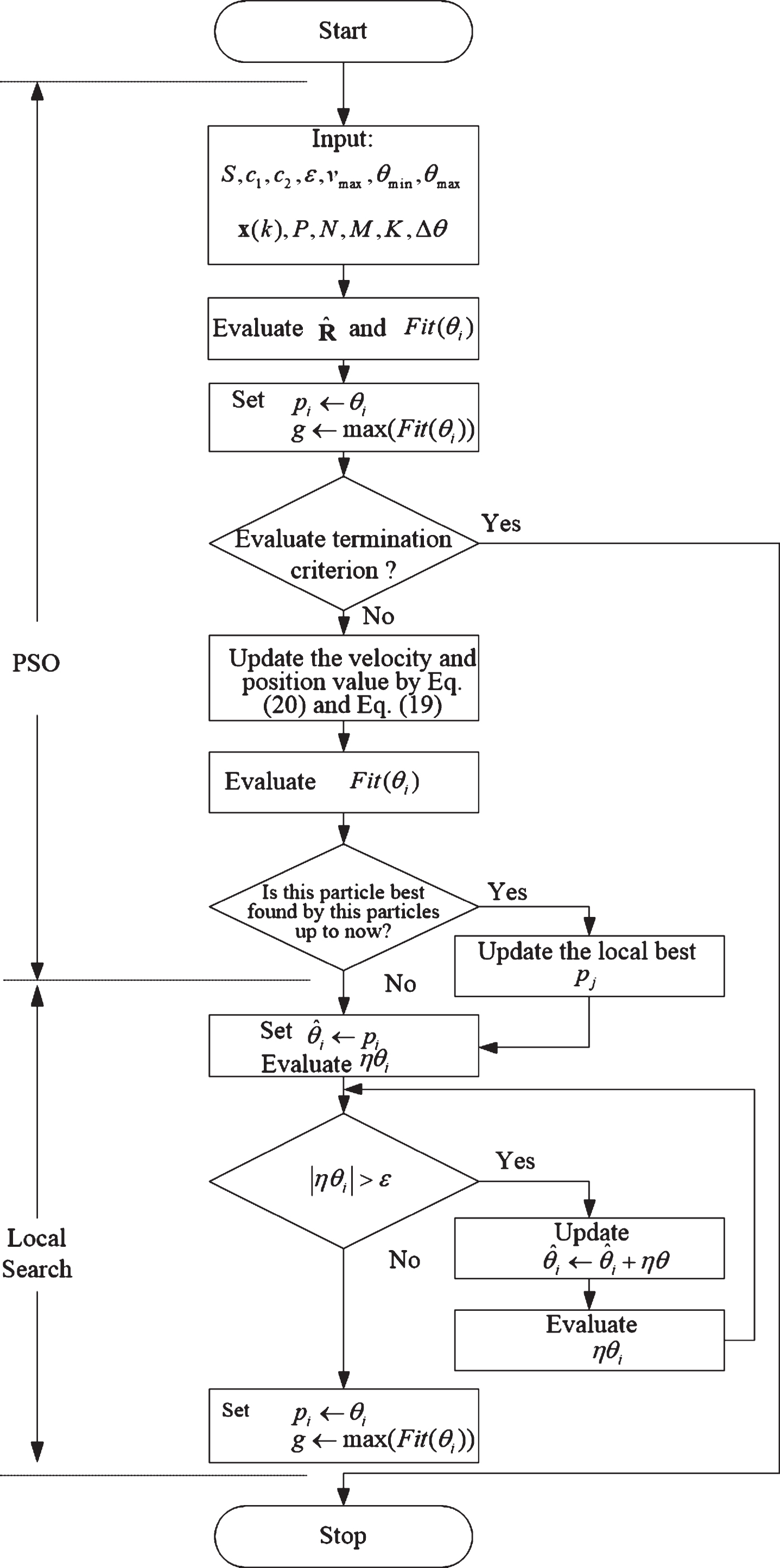
Flowchart of the proposed method.
Two examples were investigated to illustrate the high DOA estimation performance of the proposed estimator for the multipath environment. The results were compared with those of other estimators, including the MUSIC [24], MVDR [3], and ESPRIT estimators [22]. To demonstrate the effectiveness of the proposed method in improving PSO, six state-of-the-art PSO methods were selected for performance comparison including PSO [11], unified PSO [17], comprehensive learning PSO [12], cooperative PSO [1], fitness-distance-ratio-based PSO [18], and fully informed particle swarm [14]. In the literature [25], the root mean squared error (RMSE) was used to compare the estimation performance. The RMSE is defined as
Figure 2 displays the simulated beam pattern for the MVDR estimator. In the figure, the multipath environment causes the nominal DOA phenomenon (green circle region), incurring a bias of 2° in the DOA estimation method. Figure 3 presents the values of ηθ in Equation (16) with the initial

Beam pattern for the MVDR method in Example 1.

Plot of ηθ in Equation (16) against
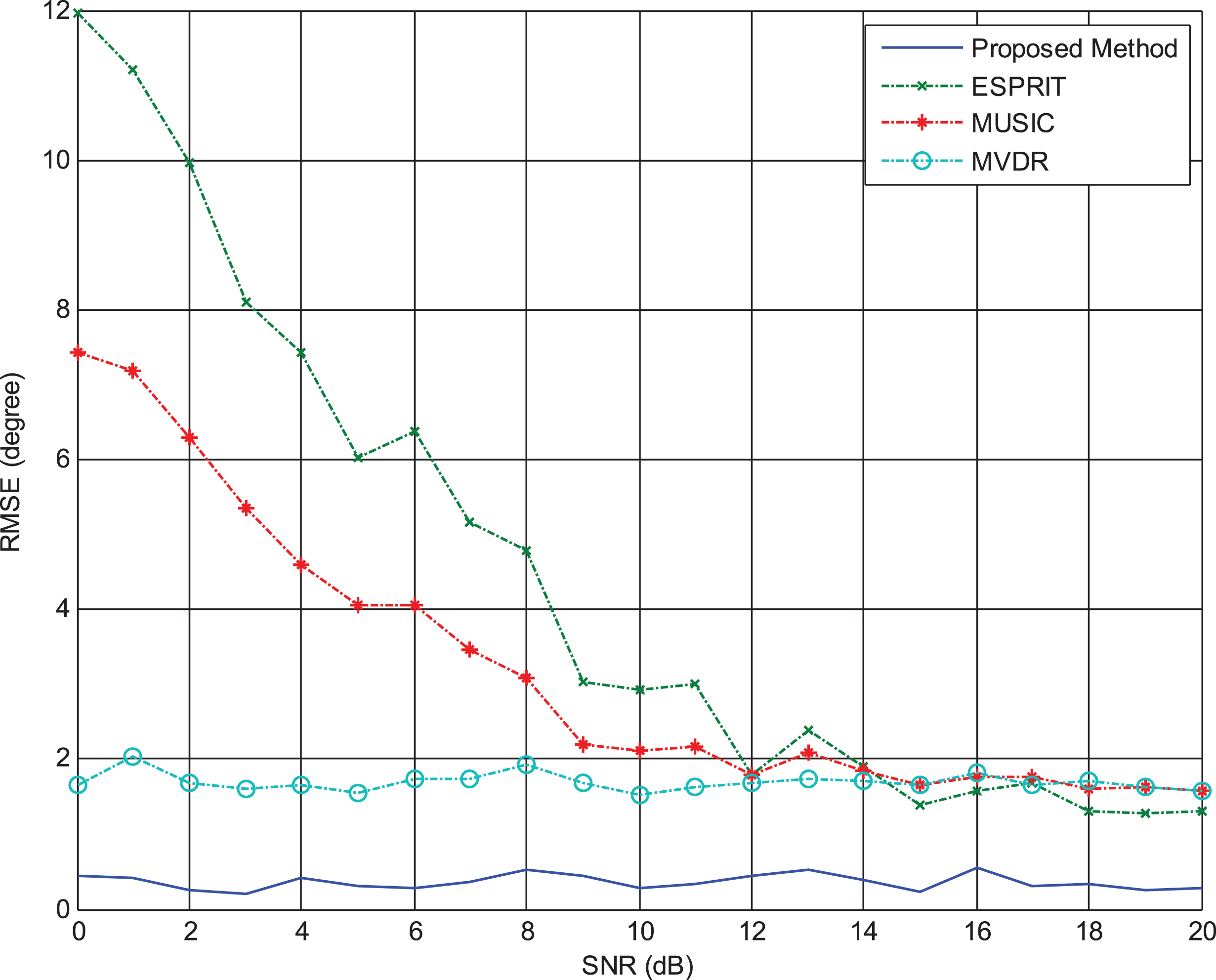
Plots of the RMSE of the DOA estimates versus the SNR for the MVDR, MUSIC, ESPRIT, and proposed estimators for Example 1.
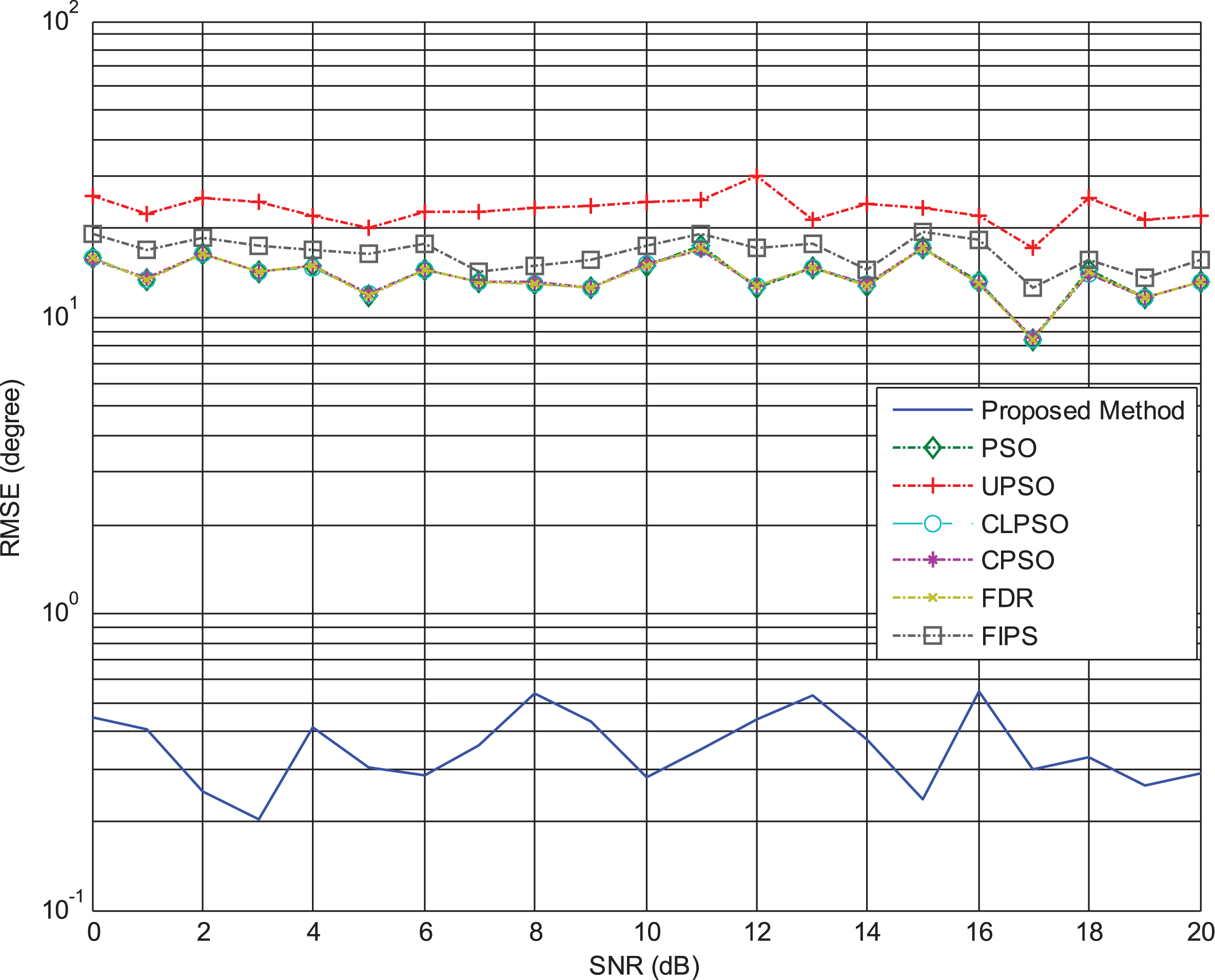
Plots of the RMSE of the DOA estimates versus the SNR for the six PSO-based estimators and the proposed method for Example 1.
DOA estimation in Example 1
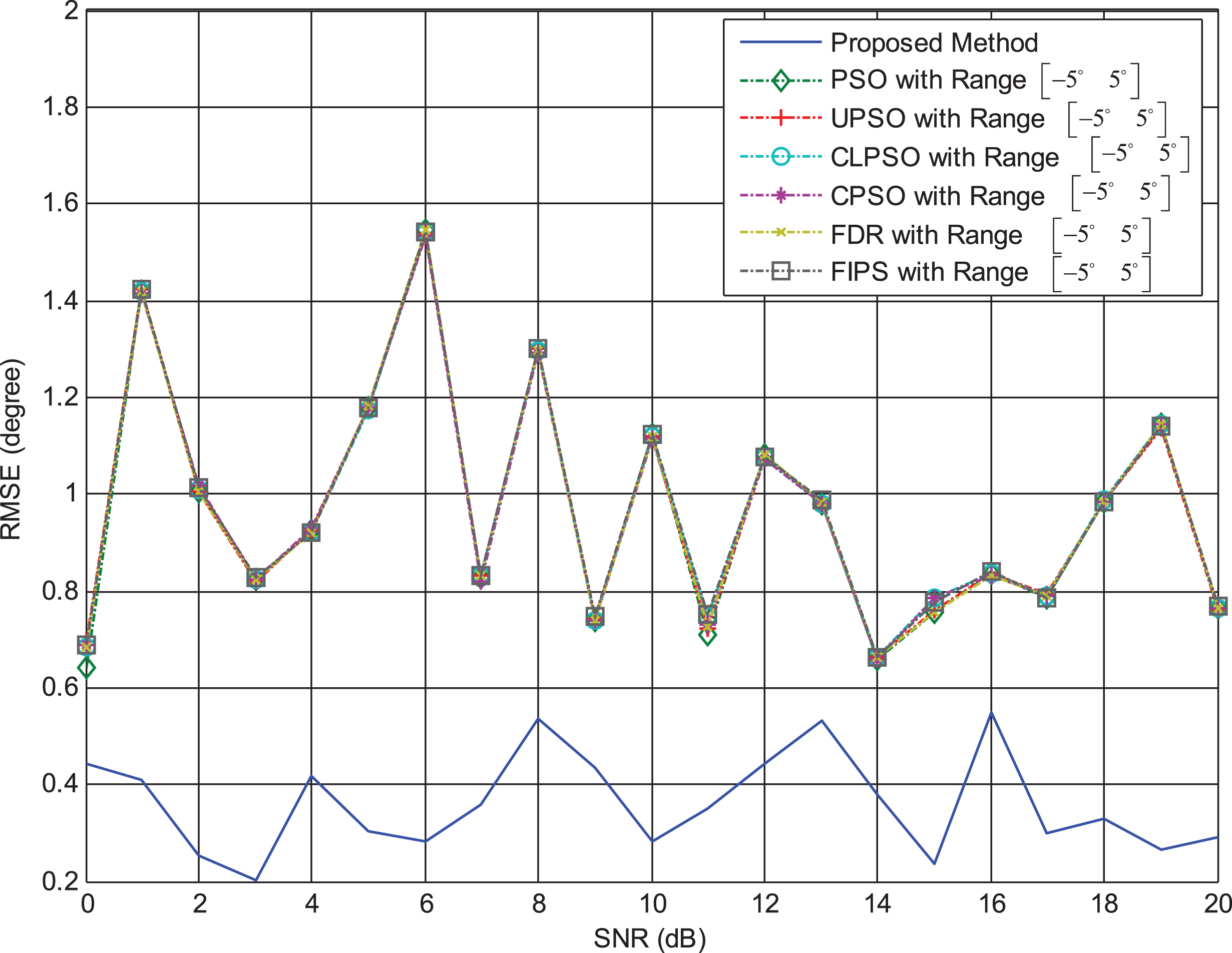
Plots of the RMSE of the DOA estimates versus the SNR for the six PSO-based estimators (for estimates in the range -5° 5°) and proposed method for Example 1.
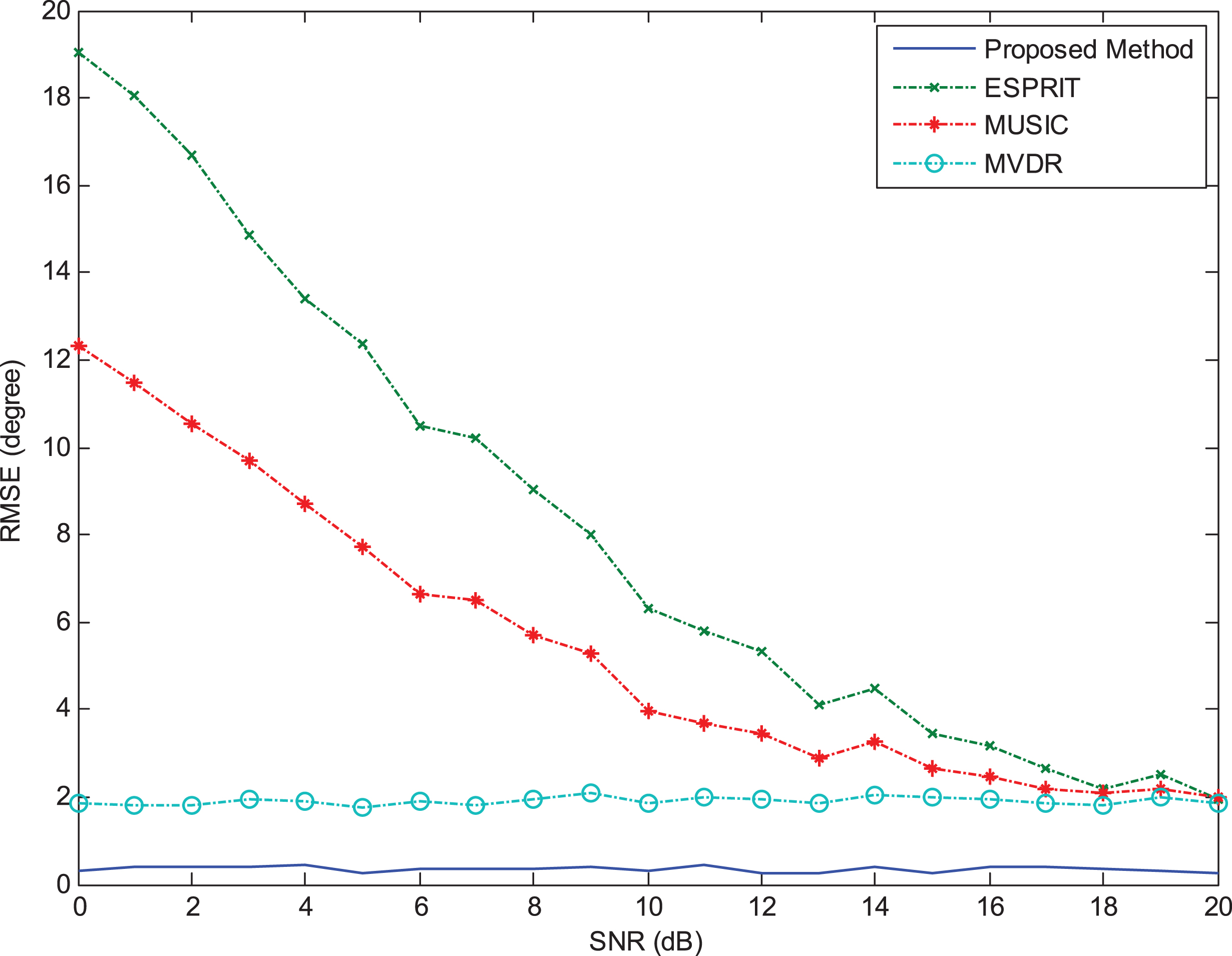
Plots of the RMSE of the DOA estimates versus the SNR for the MVDR, MUSIC, ESPRIT, and proposed estimators for Example 2.
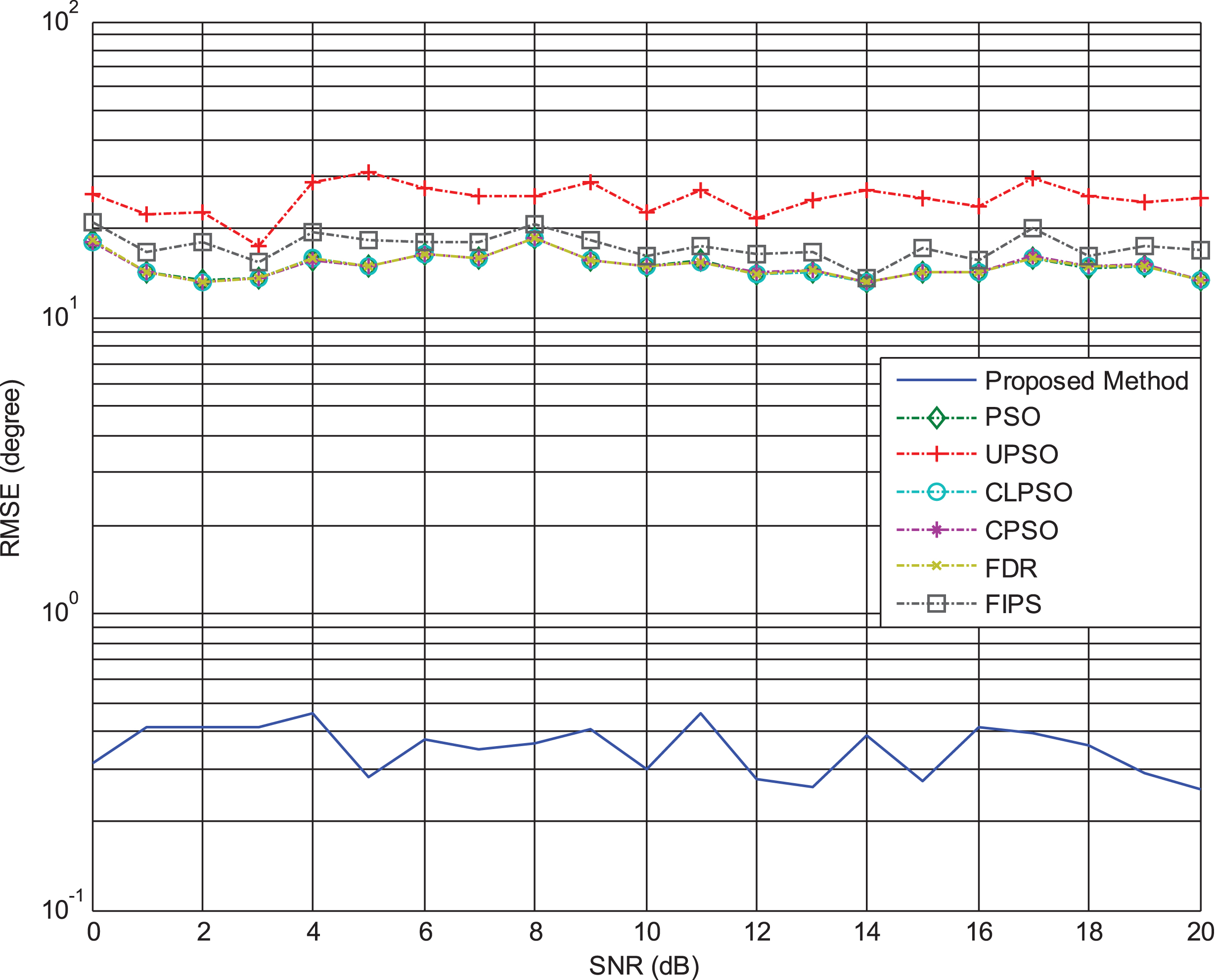
Plots of the RMSE of the DOA estimates versus the SNR for the six PSO-based estimators and proposed method for Example 2.
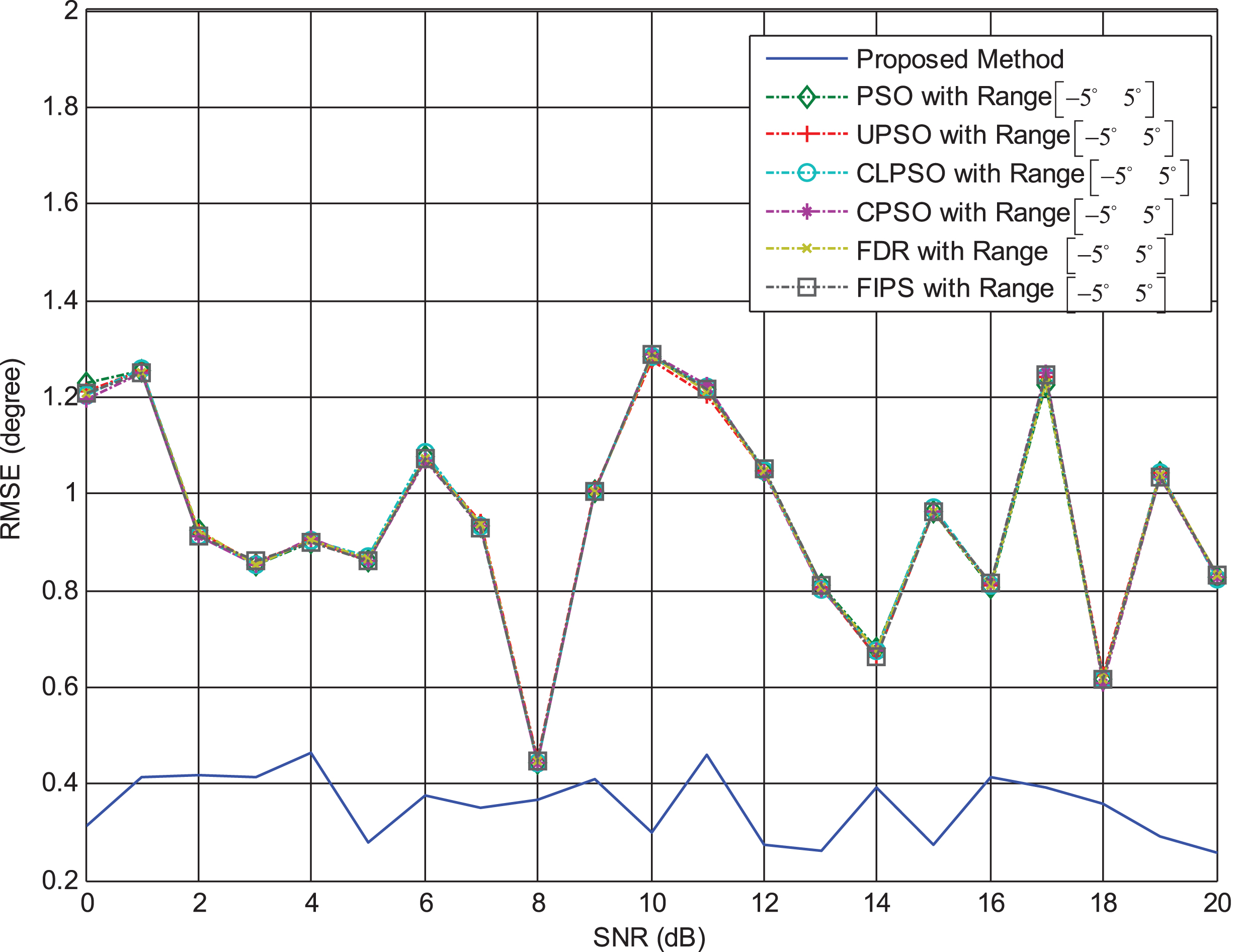
Plots of the RMSE of the DOA estimates versus the SNR for the six PSO-based estimators (for estimates in the range -5° 5°) and the proposed method for Example 2.
DOA estimation in Example 2
In this study, a new MPSO scheme was proposed for the DOA estimation in multipath environments. The empirical results demonstrated that the scheme exhibits an excellent capability to escape local optima. Moreover, the results indicate reduced bias for estimates in multipath environments. The proposed approach for the DOA estimation is efficient. The approach involves a combination of PSO and local search techniques. The local search techniques involve the first-order Taylor expansion approximation of BMVDR characters to obtain the exact global optimum and reduce the bias occurring in multipath environments. PSO methods involve parallel search methods that partially depend on the initial value; however, their performance is biased in multipath environments. Moreover, their performance deteriorates when the desired global optimum is approached. The features of the PSO and the estimated deviation ηθ were combined to achieve high accuracy and rapid convergence. Computer simulations were performed to demonstrate the effectiveness of the proposed estimator at low SNRs and in multipath environments.
Footnotes
Acknowledgments
The author is grateful to the anonymous referees, whose constructive and helpful comments led to significant improvements in the manuscript. This research was supported by the Ministry of Science and Technology under Grant Number 106-2221-E-845 -005 -.