



Abstract
Effective knowledge dissemination plays a vital role for the success of knowledge-based organizations (KBO). From the view of the micro knowledge exchange among individuals, this paper aims to study the process and rules of knowledge dissemination within KBO. First, consulting the SEIR epidemic propagation, this paper divides the individuals into different knowledge statuses, and depicts the process of knowledge dissemination employing the thought of epidemic spread. Considering the influence of individual heterogeneity on knowledge dissemination, this paper develops a heterogeneous cellular automata method to build the knowledge dissemination model. Through simulation of the proposed model, we study the impacts of the proportion of initial knowledge disseminators, the distribution pattern of initial knowledge disseminator and knowledge accessibility among individuals on knowledge dissemination. The results reveal some valuable management enlightenments about how to improve the knowledge dissemination performance in KBO, which are helpful to the managers and decision makers to effectively carry out knowledge management.
Introduction
Knowledge-based organizations (KBO) regard knowledge as the inputs and outputs of organization operation. Aiming at collaborative knowledge innovation, the operation process of KBO can be expressed as the following steps. Firstly, the knowledge asset is invested into the KBO, then the knowledge workers learn, transfer and share the knowledge mutually. Finally, new knowledge is created during the process of knowledge exchange and utilization, and the new knowledge, which is the outputs of KBO, is involved the next round of knowledge dissemination, learning and utilization.
KBOs always consist of members with different backgrounds of organizations, knowledge domains and even cultures. There have asymmetry of knowledge structure and knowledge stock among the members of KBO [1]. Knowledge dissemination is conducive to improving the knowledge stock of members and the whole KBO. Meanwhile, knowledge dissemination can simulate the knowledge complementary advantages among members, thus enhance the knowledge innovation level. On the other hand, as the most important resource of KBO, knowledge in KBO always exist in the form of tacit knowledge [2], which has the following features: no homologation standards, highly individualized, highly creative and used for complex problems. However, the tacit feature of knowledge determine that it can hardly be managed by the regular knowledge management approaches, and can only be obtained and diffused via the informal ways such as communication, imitation and practice, etc. Therefore, the knowledge dissemination via intelligence communication among members plays a vital role for the knowledge discovery, acquisition and utilization in KBO. The purpose of this paper is to develop a systematic and quantitative model to study the knowledge dissemination process and rule in KBO. To do this, the thought of SEIR epidemic spread model is firstly introduced to depict and analyze the knowledge dissemination process among individuals in KBO. On this basis, considering the influence of individual heterogeneity on knowledge dissemination, this paper develops a heterogeneous Cellular Automata (CA) model to study knowledge dissemination. Using the method of simulation, this work investigates the impact factors, process and rule of knowledge dissemination in KBO, which aims to provide a decision support to quantitatively analyze the knowledge dissemination process and rule and forecast the trend of knowledge dissemination.
Literature review
Among the knowledge dissemination researches in collaborative organizations, a number of scholars studied the knowledge dissemination performance and its impact factor. Hansen [3] argued that strong relationships promote the transfer of complex knowledge, while weak ties promote the transfer of simple knowledge. By using patent references, Singh [4] studied the influence of interpersonal ties, social distance, geographic localization and organization boundaries on the intra-regional and intra-firm knowledge dissemination. Cowan and Jonard [5] compared knowledge dissemination in a range of network structures, from the regular network to the fully-random network, and concluded that the steady-state level of average knowledge is maximal when the structure is a small world. Reagans and McEvil [6] investigated the effects of social cohesion and network range on knowledge dissemination, and stated that both social cohesion and network range ease knowledge transfer. The complex network theory contributes noticeably for improving the understanding of knowledge-diffusion. However, the existing network researches mainly focus on the influence of network structure or property on the macro-process of knowledge dissemination, which seldom study the micro knowledge exchange among individuals.
Recently, scholars pay much attention on building knowledge dissemination model to investigate knowledge dissemination. Using the thought of epidemic spread, Bass [7] built the “epidemic diseases” model of innovation diffusion, and proposed its quantitative approach. Wang et al. [8] developed two different knowledge dissemination models which are the Layer-chain diffusion structure model and Center diffusion structure model in the supply chain, and built their system dynamic models to quantitatively study the knowledge dissemination mechanism. Kim and Park [9] proposed a model integrating knowledge creation and knowledge exchange to measure knowledge dissemination in the regular, random and small-world networks, and got a conclusion that the small-world network is the most efficient structure for knowledge dissemination. Based on the small-world network, Sun and Wei [10] built a knowledge dissemination model of high-tech enterprise alliance to investigate the influence of path length, clustering coefficient and knowledge communication frequency on knowledge dissemination performance. Wang and Zhang [11] constructed a knowledge transfer model based on the trust and cooperation game, and studied the knowledge dissemination rules in three industrial cluster networks. The above efforts mainly focused on the macro process and features of knowledge dissemination based on the mathematical method or network model. However, they seldom studied the impact factors and rules of the micro knowledge dissemination among individuals inside collaboration organizations, which prevented us from a systematic understanding of knowledge dissemination process and rule in KBOs.
Knowledge dissemination is a complex process that organizational global knowledge behavior is formed by the local knowledge interaction among individuals [12]. Cellular Automata (CA), a bottom-up complex system modeling method, is suitable to investigate the complex process of knowledge dissemination, which can study the evolution process and rule of macroscopic system based on the micro-mechanism [13]. Zhu et al. [14] utilized the CA method to build an international technology spillovers, and the simulation results shown that the absorptive capability and in-house R&D played key roles in the technology spillovers. For the urban simulation of different cities, Li et al. [15] integrated the logistic-CA with a knowledge-transfer technique to handle the problem of sparse data. Furthermore, Lin and Li [16] combined the Formal Concept Analysis and knowledge transfer technique to calibrate the large-scale urban CA model, and the experiment results shown that the new model was competent to model the large-scale urban growth. The above researches mainly used the CA method to study the issues of regional technology spillovers and urban growth, while the knowledge dissemination has been little studied seriously. On the other hand, considering the similarity of dissemination process, some scholars tried to use the epidemic spread model to investigate the knowledge dissemination. Eugster et al. [17] proposed a new epidemic algorithm to study the key problems of information dissemination in large peer-to-peer systems. From a systematic view, Chen et al. [18] explored the optimal control policy for information dissemination using the epidemic models to characterize the collective dynamics of information dissemination over networks. These works on information dissemination using epidemic models contribute noticeably for our understanding of knowledge dissemination. However, the knowledge dissemination process is much more complex than the information dissemination process. Moreover, the local interaction process among individuals of knowledge dissemination is seldom considered in the above researches. To address the above issues, in this work, we attempt to combine the epidemic model and CA method to analyze and model the knowledge dissemination process. The combination of the two methods is expected to provide a useful tool for better understanding the knowledge dissemination process and rule.
The heterogeneous CA model of knowledge dissemination
Considering the similarity with epidemic spread process and the local interaction characteristic of knowledge dissemination, this section will firstly introduce the SEIR epidemic model to analyze the knowledge dissemination process, and then on its basis a heterogeneous CA model of knowledge dissemination is proposed to model the complex knowledge dissemination process.
Analysis of knowledge dissemination based on SEIR model
Plenty of researches have shown that the diffusion of social phenomenon, such as knowledge, technology and innovation diffusion, can be approximately regarded as an epidemic spread process [17, 19]. During the process of knowledge dissemination, knowledge sender and knowledge receiver can communicate knowledge via mutual contact, and the knowledge sender can “infect” the knowledge receiver to understand, acquire knowledge and gain the ability to “disseminate” knowledge. It should be noted that the knowledge receivers always need to further learn and assimilate the knowledge before gaining the ability to disseminate the knowledge, which is similar with the “incubation period” of a disease. When passing the “incubation period” successfully, the knowledge receivers become the knowledge senders, and has the ability of transferring the knowledge to other knowledge receivers. On the other hand, knowledge forgetting is an inevitable phenomenon in the process of knowledge dissemination. After the knowledge receivers contact and understand some knowledge, there are mainly existing two forms of knowledge forgetting [20]: the passive forgetting based on the forgetting mechanism of human brain and the active forgetting based on the judgment of knowledge value and learning cost, just like the “recovery” and “immune” of an epidemic.
Based on the above analysis, we can conclude there are many similarities between knowledge dissemination and epidemic spread. Therefore, employing the SEIR epidemic model for reference [21], this work divides the individuals involved in knowledge dissemination into four types: knowledge susceptible (S), knowledge contactor (E), knowledge disseminator (I), knowledge forgetter (R) and knowledge quitter (Q). Their specific definitions are as following:
Knowledge susceptible (S): these individuals don’t possess and know certain knowledge, and they can become the knowledge contactors (E) by exchanging knowledge with knowledge disseminator (I).
Knowledge contactor (E): these individuals preliminary contact and know certain knowledge, but they do not have the ability to diffuse the knowledge.
Knowledge disseminator (I): these individuals completely accept and absorb the knowledge, and have the ability to diffuse the knowledge. Their status will remain unchanged.
Knowledge forgetter (R): these individuals forget their preliminary obtained knowledge because of the passive forgetting, but they can still obtain the knowledge by exchanging knowledge with knowledge disseminator (I) to become knowledge contactors (E) again.
Knowledge quitter (Q): these individuals quit their obtained knowledge because of the active forgetting, and they will not contact the knowledge. Their status will remain unchanged.
During the knowledge dissemination process, the status transition of the five types is shown in Fig. 1.

The transition process of knowledge status.
As seen in Fig. 1, the knowledge susceptible (S) have knowledge exchange with knowledge disseminators (I) to preliminary contact and knowledge certain knowledge. Because of the heterogeneity and mobility of individuals, they will become the knowledge contactors (E) with different probabilities. Through the further knowledge learning and absorption, the knowledge contactors (E) will transform into the knowledge disseminators (I) with a certain probability. Meanwhile, because of the passive forgetting or active forgetting, the knowledge contactors (E) may also turn into the knowledge forgetters (R) or knowledge quitters (Q) with certain probabilities. The knowledge quitters (Q) will not join the knowledge exchange, and theirs status will remain unchanged. The knowledge forgetters (R) will still seek the knowledge exchange with knowledge disseminators (I), and still stand a chance to become the knowledge contactors (E) again.
Cellular automata (CA) is dynamic model, which is discrete in time, space and state [13]. CA is formed by a finite number of cells which are arranged in a cellular space. The interactions among cells are local, and the local interactions among cells can evolve a global complex behavior of macro-system as time goes on [22]. Based on the discreteness, synchronization and locality of CA, it has distinct advantages to study the issue of knowledge dissemination. For the issue of knowledge dissemination, CA does not need to build and solve the complex mathematical models. The more important advantage lies in that the local simple rules can evolve global complex behavior, which can better depict the knowledge dissemination phenomenon in real systems from the micro level. CA can model the micro knowledge exchange among individuals via simple rules, and then evolve the knowledge dissemination process of the whole system. Meanwhile, the knowledge dissemination status of anytime can be monitored, which can achieve the visualization and visual analysis of the whole knowledge dissemination process.
A typical cellular automaton model CA can be defined by a quadruples, which concludes a cellular space L, a state space Q, a neighbourhood type V and a local transition function F:
In reality, there are significant differences among individuals, that is, the different individuals have heterogeneity. However, in the existing CA models, the cells are always homogeneous. It implies there is no difference in knowledge learning and disseminative capability, knowledge forgetting rate and the judgment of knowledge value and learning cost among different individuals. Obviously, the homogeneous CA models are difficult to reconcile with the reality. Therefore, this work will propose an improved CA model considering the individual heterogeneity to study the knowledge dissemination in KBO, which can better reflect the real process of knowledge dissemination.
According the above analysis, the improved CA model of knowledge dissemination can be built by the following procedures.
Cellular space L
Suppose that L is a two-dimensional cellular space with n × n cells, which denotes the whole KBO. The cell L (i, j) in L represents the individual of KBO. The L can be denoted by Equation (2):
Where, i and j are the coordinate values of L (i, j) in L.
According to the classification of knowledge status,
Neighborhood type V
The neighborhood reflects the knowledge availability among individuals, which determines whether there exists knowledge collaboration relationship among individuals. The traditional CA models define two kinds of common neighborhoods: the Von Neumann neighborhood and Moore neighborhood. In order to better reflect the knowledge availability among individuals, this work extends the classical neighborhoods (Fig. 2). Based on the extended neighborhoods, we can further propose a concept of “cell distance”. In this work, the cell distance represents the organizational hierarchy distance and interpersonal distance among individuals, which reflects the strength of knowledge collaboration relationship. Specifically, the shorter the cell distance is, the stronger the strength of knowledge collaboration relationship is. The cell distance
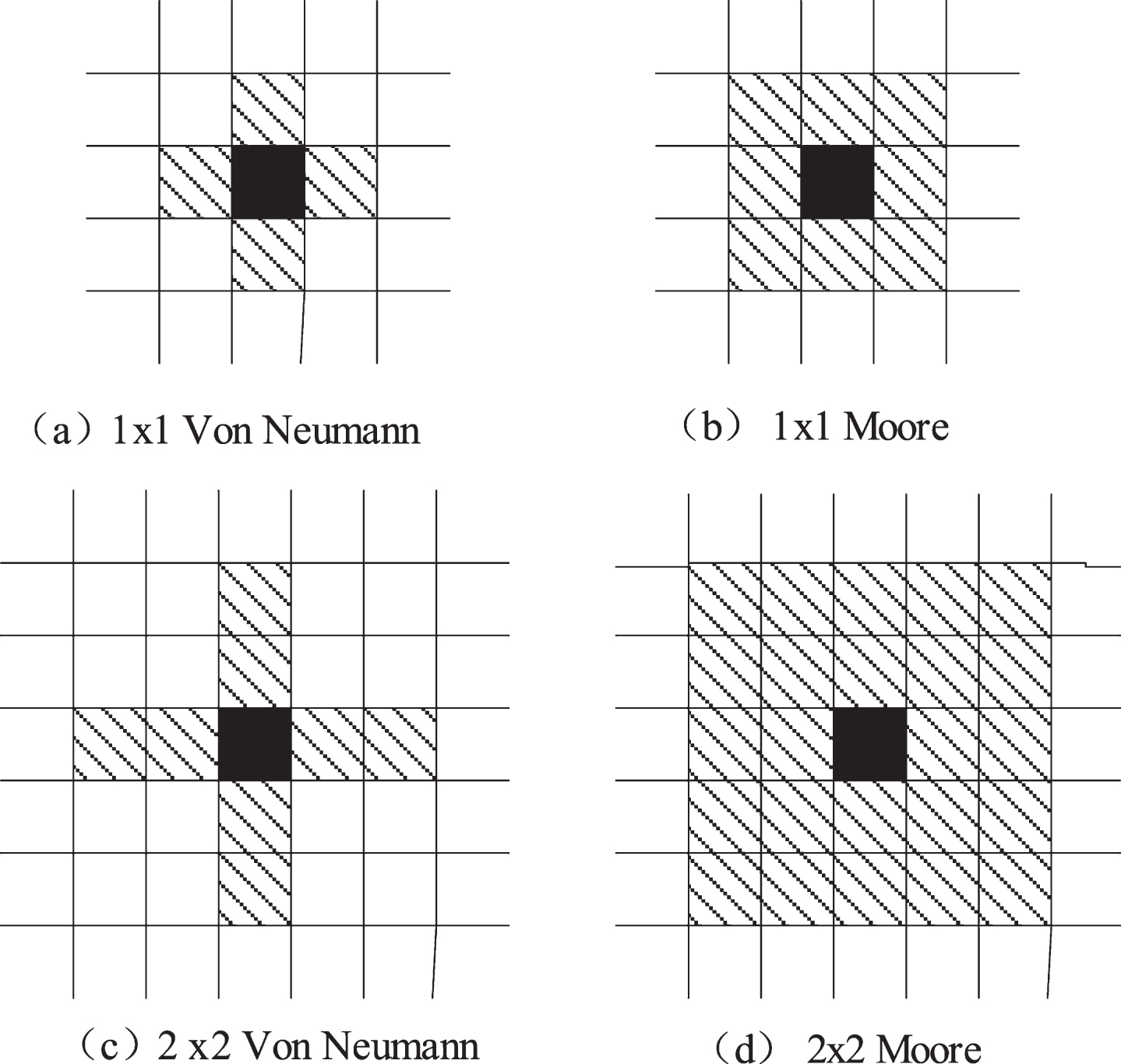
The extended cellular neighborhood.
Based on the above analysis, the neighborhood determines whether there exists knowledge collaboration relationship among members, and the cell distance reflects the strength of knowledge collaboration relationship among members. The above two factors combine to determine the value of knowledge availability among individuals.
The success of knowledge exchange between knowledge susceptible and knowledge disseminator, that is, the successful transition from knowledge susceptible to knowledge contactor, depends on the knowledge acquisition rate between them. The knowledge acquisition rate is codetermined by the knowledge learning capability of knowledge susceptible, and the disseminative capability of its neighbor knowledge disseminator, and their cell distance. The knowledge acquisition rate is positive with the knowledge learning capability of knowledge susceptible and the disseminative capability of its neighbor knowledge disseminator. On the other hand, as mentioned above, the shorter the cell distance is, the stronger the knowledge availability is. Therefore, this is a negative relationship between the knowledge acquisition rate and cell distance. We built the following function to obtain the knowledge acquisition rate
Where, fL (i,j) and gL (k,l) are respectively the knowledge learning capability and disseminative capability of knowledge susceptible L (i, j) and knowledge disseminator L (k, l).
In the most cases, the final knowledge acquisition rate of knowledge susceptible is always determined by its neighbor knowledge disseminator with biggest influence. Therefore, the final knowledge acquisition rate
Where, VL(i,j) is the neighborhood set of L (i, j).
The individual heterogeneity is embodied in that individuals have different knowledge learning capability, disseminative capability, forgetting rate and quitting rate. In order to reflect the individual heterogeneity, suppose fL (i,j) and gL (i,j) are both in accord with N (0, 1), that is, the individuals have different knowledge learning capability and disseminative capability. In addition, when knowledge contactor forgets the knowledge and become knowledge forgetter, he/her will still seek knowledge exchange with knowledge disseminator, and have a chance to turn into knowledge contactor again. Meanwhile, because knowledge forgetter has a prior contact with knowledge disseminator, knowledge forgetter has already a certain knowledge foundation for certain knowledge. Therefore, the learning capability of knowledge forgetter should be higher than its former status as knowledge susceptible. Suppose the learning capability of knowledge forgetter L (i, j) is
Based on the knowledge absorption, knowledge forgetting or judgment of knowledge value and learning cost, at the next moment, knowledge contactor can become knowledge disseminator, knowledge forgetter or knowledge quitter. The transitions depend on the individual knowledge absorption rate IL (i,j), forgetting rate RL (i,j) and quitting rate QL (i,j), which all are in accord with N (0, 1), and IL (i,j) + RL (i,j) + QL (i,j) = 1. Moreover, it should be noted when an individual turns into knowledge contactors, because of the learning reinforcement effect, its knowledge forgetting rate and quitting rate should decrease with the increase of transition times. Hence, we set the knowledge forgetting rate as
Simulations
Based on the improved CA model of knowledge dissemination in KBO, this work mainly studies the influences of the proportion of initial knowledge disseminators, distribution pattern of initial knowledge disseminators and knowledge availability among individual on the knowledge dissemination performance. The cellular space is formed by a two-dimensional array of 20 × 20 cells, that is, the KBO has 400 individuals. At the initial time of knowledge dissemination, there only exists the knowledge susceptible and knowledge disseminators. The distribution patterns of initial knowledge disseminators include the monopolistic distribution, the small group distribution and the random distribution. The neighborhood types are just the four types proposed in Section 3.3.3. The total simulation time is T = 50 . We simulate 50 times for each situation, and then make the average value as the result of each situation. The proportion of knowledge disseminators r
t
and the knowledge dissemination speed v
t
are used as the indexes to measure the knowledge dissemination performance.
Suppose the proportion of initial knowledge disseminators r0 are respectively 5%, 10%, 15%, 20%. The distribution pattern is random pattern, and the neighborhood type is 1×1 Moore. The simulation result of the impact of the proportion of initial knowledge disseminators on knowledge dissemination is shown in Fig. 3.

The impact of the proportion of knowledge disseminators on knowledge dissemination.
In Fig. 3, the proportion of knowledge disseminators r t presents an increasing trend with time. The knowledge dissemination speed v t gradually increases at the early stage of knowledge dissemination, and then it has a shift from high to low. The turning point occurs after the knowledge goes through the whole KBO. At this moment, there are most non-knowledge disseminators contacting knowledge, and then becoming knowledge disseminators or knowledge quitters, which cause the decrease of the knowledge dissemination speed. In the later stage of knowledge dissemination, the proportion of knowledge disseminators gradually shows a status of equilibrium, and from a macro view, this status of equilibrium will be sustained with time going on.
Meanwhile, in Fig. 3, we can get a conclusion that the higher the proportion of the initial knowledge disseminator, the higher the proportion of the knowledge disseminators of KBO, the faster the knowledge dissemination speed, and the earlier the knowledge dissemination equilibrium is reached. That is because with the increase of the proportion of the initial knowledge disseminator, the probability of contact among the non-knowledge disseminators and knowledge disseminators increases accordingly, thus their chances of gaining, absorbing knowledge and even becoming the knowledge disseminators increase. Additionally, as the initial knowledge disseminators are randomly distributed in KBO, the increase of the proportion of the knowledge disseminators often represents their more extensive distribution, which helps them to more quickly spread knowledge, traverse the entire KBO, and ultimately achieve the equilibrium state knowledge dissemination. It suggests that increasing the proportion of initial knowledge disseminators (such as the introducer of knowledge and trainer of knowledge) will be effective way to improve the knowledge dissemination performance of KBO, when KBO aims to spread or popularize some new knowledge or technology.
Suppose the distribution patterns of initial knowledge disseminators are respectively the monopolistic distribution, the small group distribution and the random distribution (Fig. 4). The proportion of initial knowledge disseminators is 5%, and the neighborhood type is 1×1 Moore. The impact of the distribution pattern of initial knowledge disseminators on knowledge dissemination is shown in Fig. 5.

The distribution pattern of initial knowledge disseminators.
We can draw a conclusion from Fig. 5: the distribution patterns of initial knowledge disseminators have significant influence on the knowledge dissemination performance. Specifically, the random distribution has the highest knowledge dissemination performance, the monopolistic distribution has the lowest knowledge dissemination performance, and the small group distribution falls in between. Because of the knowledge privilege and knowledge conservatism, knowledge disseminators are confined to a narrow hierarchy or a small group. Hence, the monopolistic distribution and small group distribution both limit the disseminative capability of knowledge disseminators and the possibilities to obtain knowledge of other individuals, which make the monopolistic distribution and small group distribution against knowledge dissemination. On the other hand, because of the less hierarchy and more authorization, the random distribution, which reflects the flat organizational structure of KBO, makes every individual in KBO representing the characteristic of centricity and exchanging knowledge more openly and effectively. Therefore, the random distribution of initial knowledge disseminators is most conducive to knowledge introduction and dissemination. The results enlighten us that it is an effective way for improving knowledge dissemination performance to strengthen the flat management of KBO and give members in every hierarchy and position more equal chances to spread and obtain the knowledge resource.

The impact of the distribution of initial knowledge disseminators on knowledge dissemination.
Suppose that the neighborhood types respectively are 1×1 Von Neumann, 1×1 Moore, 2×2 Von Neumann and 2×2 Moore. The proportion of initial knowledge disseminators is 5%, and the distribution pattern is random pattern. The influence of the knowledge availability among individuals on knowledge dissemination is shown in Fig. 6.

The impact of the knowledge accessibility among individuals on knowledge dissemination.
As shown in Fig. 6, the 2×2 Moore has the highest knowledge dissemination performance, and the performance of 1×1 Moore, 2×2 Von Neumann and 1×1 Von Neumann decrease in turn. It shows that the knowledge accessibility among individuals has positive influence on knowledge dissemination performance. The above four neighborhood types have different size of neighborhood space. The bigger the neighborhood space is, the higher the knowledge accessibility is, and the more individuals are involved in the knowledge exchange process. Therefore, the successful probability of knowledge dissemination subsequently increases. In particular, the neighborhood space of 1×1 Moore and 2×2 Von Neumann both consist of 8 neighbor cells, that is, each individual can have knowledge exchange with 8 neighbors in the two neighborhood types. However, as mentioned above, the knowledge accessibility not only depends on the neighborhood type, but also depends on the cell distance among individuals. The shorter the cell distance is, the higher the knowledge accessibility is. In detail, the maximum cell distance of 1×1 Moore is
In this paper, we try to study the process and rule of knowledge dissemination in KBO from the perspective of micro knowledge exchange among individuals. However, it is difficult to investigate the knowledge dissemination process and its factors, because the available data are not abundant and an uncertain time lag between the knowledge exchange and transfer. Therefore, a simulation method was used to study the knowledge dissemination in KBO as Balzat and Hanusch [23] recommended. The results obtained from the simulations are further discussed hereinafter. Firstly, this work supports the theory of knowledge value added, that is, the knowledge dissemination increases the amount of knowledge in organizations [5, 24], and this work is consistent with the conclusions of the researches [4, 9], that is, the knowledge dissemination is beneficial to the uniform distribution of knowledge in the organization. These conclusions provide a solid support for organizations to vigorously promote knowledge dissemination and sharing. Secondly, the literatures [13, 14] studied the relationships between the distribution patterns of initial disseminators and technology spillovers and knowledge diffusion, and got the similar results with our research. Moreover, compared to the above studies, this research has a significant improvement that it makes a clear comparison of the advantages and disadvantages of the three typical distribution patterns of initial disseminators, thus making this research more practical and valuable. Finally, plenty of researches used the complex network methods and empirical approaches to investigate the positive effects of knowledge exchange relationship and relationship strength on knowledge dissemination [6, 10, 25]. In this work, we skillfully introduce the CA neighborhood type and cell distance to comprehensively study the above factors. It is a helpful complement to the existing empirical works, due to the intrinsic intractability of knowledge and knowledge dissemination.
Conclusions
In this paper, we develop an improved CA model with heterogeneity to study the process and rule of knowledge dissemination in KBO. By employing the SEIR epidemic model for reference, this paper divides the members of KBO who are involved in knowledge dissemination into different types, and proposes a new description of the knowledge dissemination process from the view of epidemic spread. Considering the influences of heterogeneity on knowledge dissemination, a knowledge dissemination model based on an improved CA model with heterogeneity is developed to study the process and rule of knowledge dissemination from the perspective of micro knowledge exchange among individuals of KBO. The conclusions and management implications of this study are summarized as following:
First, the proportion of initial knowledge disseminators is positively related to knowledge dissemination performance. Therefore, when the KBO aims to introduce a new knowledge or strengthen some existing knowledge, it can effectively increase the knowledge dissemination performance by increasing the number of the initial knowledge disseminators (such as the knowledge introducer and technology trainer).
Second, the distribution patterns of initial knowledge disseminators have significant influence on the knowledge dissemination performance. The random distribution has the highest knowledge dissemination performance, the monopolistic distribution has the lowest knowledge dissemination performance, and the small group distribution falls in between. The results show that the random distribution reflecting the flat organizational structure is most conducive to the introduction and dissemination of new knowledge, and the monopoly and small group distribution impede the knowledge dissemination. Therefore, in order to eliminate the monopoly and small group phenomenon in KBO, the managers of KBO should enhance the trust and cooperation among members, simulate the knowledge sharing willingness of members, and nurture the culture of knowledge sharing and collaboration. On the other hand, the managers should also strengthen the flat management and the openness of knowledge resource. In these ways, the members of KBO can get more knowledge authorization and more opportunities to exchange knowledge.
Finally, the knowledge accessibility among individuals has a positive influence on knowledge dissemination performance. The knowledge accessibility among individuals depends on neighborhood type and the cell distance among individuals. For the whole KBO, the more and closer connection among members can bring more and deeper knowledge change. Therefore, from the view of enhancing the knowledge accessibility, the managers of KBO should adopt the performance evaluation and incentive system to improve the formal and informal knowledge exchange among members, and encourage more members to transfer knowledge. Meanwhile, the managers of KBO should also take full advantage of the knowledge exchange network among members to enrich and widen the knowledge dissemination channels, and ultimately to reduce the knowledge distance among members.
This work investigates the process and mechanism of knowledge dissemination in KBO from the perspective of micro knowledge exchange among individuals, which can help decision-makers to forecast and monitor the trend of knowledge dissemination. In the future work, we intend to develop a decision support system to monitor the introduction and diffusion of certain knowledge, in which the proposed model is embedded. However, to complete the system, there are still some problems we try to address in the future, such as the knowledge interaction strategies among individuals, the accurate quantification of individuals’ heterogeneity parameter, and the update and out of knowledge, etc.
Footnotes
Acknowledgments
This work is supported by the National Science Foundation of China (71571023, 71701027).