



Abstract
This paper presents a genetic algorithm (GA) based approach for solving a multi-objective credibilistic model (MOCM) for commercial-off-the-shelf (COTS) product selection problem subject to many realistic constraints by using an exponential membership function. To solve this problem, a fuzzy technique is utilized to handle each uncertain parameter by a credibility-based model and finds a different efficient solution by taking various shape parameters in the exponential membership function subject to all resource constraints and for each objective function, aspiration level is specified by the decision maker (DM). A real-world example is provided to represent the importance of the proposed approach with data set from the realistic situation.
Introduction
Software development has created more attention in today’s world which involves COTS software product as a selection of best fit of COTS products. It is difficult to select best fit COTS product because its deal with multiple criteria decision making procedure. Further, once require to select the availability of COTS products that satisfy the functional requirement such as cost, delivery time and quality of the system. Thus, an efficient approach is essential to select the best fit COTS product. Additionally, the COTS selection problem by considering the following challenges associated with it: (1) availability of alternative COTS components; (2) multiple COTS selection objectives; and (3) for each module, one and only one COTS component are selected. Studies have reported several optimization models for COTS product selection that facilitate in achieving different quality features and cost minimization or cost maintenance at a specified budgetary level. Several studies have also solved problems-related to COTS product selection optimization [2, 30].
In an optimization model of a COTS software product, uncertain phenomena, such as random and fuzzy phenomena, are often encountered due to many factors, including uncertainty and nondeterministic model parameters. Moreover, COTS products are indistinct and imprecise, according to linguistic terms given by DMs. In such conditions, the COTS product selection problem becomes an uncertain COTS product selection problem such as a fuzzy COTS product selection problem. The concept of fuzzy set theory, introduced by Zadeh [15], provides a highly effective method for handling imprecise data. Among real-time decision-making problems, the COTS product selection problem is more advantageous if solved using fuzzy theory, which is the subjective preference of the DM. Fuzzy models of the COTS product selection problem have been described in detail in several studies [5–7, 25].
This paper proposes a genetic algorithm (GA)-based hybrid approach for solving MOCM for COTS product selection problems by using a fuzzy exponential membership function. A fuzzy technique is most frequently used to solve a multi-objective optimization problem where DMs are required to specify the indistinct aspiration level based on their previous experience and information for finding the optimal allocation plans [8, 27]. MOCM for the COTS product selection problem is a linear, large-scale optimization problem. In the solution approach, when the fuzzy exponential membership function is used and MOCM for the COTS selection problem is converted into a single-objective problem, it become a nonlinear optimization problem with some constraints and is termed as the NP-hard problem. GA is an appropriate technique for solving NP-hard problems. It is a renowned random search and global optimization method that considers the aspects of evolution and natural selection. Moreover, GA is an appropriate method for solving large-scale nonlinear, discrete, and non-convex optimization problems because it searches for optimal solutions by simulating the natural evolution process [8, 22]. GAs are highly efficient in solving various NP-hard problems, including resource allocation [8].
Various traditional and nontraditional methods provide the solution of MOCM for the COTS product selection problem. However, traditional methods are rarely sufficient to embrace all facets of the problem. Moreover, traditional methods can create difficulty for large-scale problems (optimization software, such as Lingo and CPLEX, cannot sometimes solve large-scale problems). By contrast, nontraditional methods can provide the solution for large-scale problems. However, among various nontraditional methods, the GA-based hybrid approach provides flexibility and a large amount of information in terms of the changing shape parameters in the exponential membership function. Furthermore, it provides DMs with the analysis of the different scenarios for the allocation strategy within time.
This study employed a credibility-based chance-constrained programming approach to differentiate the fuzzy occurrence because the credibility measure has self-duality, that is, instinctive and imperative characteristics in practice and theory. The chance-constrained program can control the confidence level of chance constraints [6, 20]. Chance-constrained programming assists DMs in exploring different situations of the uncertain parameter by varying the confidence level [20].
The chance constrained programming helps to DM in exploring the different scenario of the uncertain parameter by varying the confidence level [20].
Preliminaries
Credibility theory is crucial for studying the performance of fuzzy events [17, 21]. The credibility-based chance-constrained programming approach is used for mathematical concepts, such as the expected values of a fuzzy number and the credibility measure that maintains different forms of fuzzy numbers, and this approach is used to define many realistic situations under a given confidence level for DMs. To formulate a multi-objective credibility model for the COTS product selection problem in a fuzzy environment, the expected value and chance-constrained programming approach is used [20].
Let ξ = (e, f, g, h) be trapezoidal fuzzy variable of crisp number with e < f < g < h and r be the real number, then the membership function of ξ, then expected value of ξ and the corresponding credibility measures are defined as follows [18]:
Let
Based on (2) and (3), ref [15] establishes that if ξ be a fuzzy variable and λ > 0.5, then convert fuzzy-chance constraints into crisp equivalents the relation is defined as follows [31]:
This study considered the design of a modular software system. According to the software requirement, a modular software system should perform more than one function, known as programs. Each program comprises a number of modules that are performed in a sequence. Some of these modules are common for different programs. In a software system, each module has different levels of magnitude that depend on the access rate of occurrence [9, 20].
Multi-objective optimization model
A multi-objective optimization model of the COTS product selection problem with three objectives cost, size and execution time is presented as follows [20]:
Where Z1, Z2 and Z3 indicate the fuzzy cost
In the objective function of the above model, m, n i , P and v p defines the number of modules, number of COTS products available for ith module, number of programs and probability of the use program p respectively.
In the constraints of above model,
x
ij
is represent the decision variable as the ith module is chosen for jth COTS or not.
y
i
is represent the ith constraints is active or not.
In this paper, Cost, Size, Execution time and Delivery time objectives are given in the trapezoidal fuzzy variables as
Crisp chance constraints:
In COTS-based modules of a software system, the delivery time is dependent on the delivery of all the selected COTS components. Thus, It has allowed the DM to state the particular time restriction on delivery time with confidence level more than equal to that specified by DM by using the chance-constrained programming [20].
Thus, the crisp multi-objective optimization model is as follows:
Subject to constraints:
Constraints (7) to (13).
Fuzzy membership functions, such as linear, piecewise linear, exponential, and tangent, are used to characterize the indistinct aspiration level of the DM. Among these functions, the linear membership function is used most frequently because it is defined by two fixed points, upper and lower bounds of the objective. Moreover, it is considered to be merely a violent calculation of real-world circumstances. In addition, membership functions are used to describe the behavior of uncertain values, utilization of fuzzy data, and preference. In such situations, the nonlinear membership function provides a more efficient representation of the marginal rate of the increasing membership values as a function of a model parameter than other membership functions [8, 27].
GA is one of the most adaptive optimization search methodologies which are based on natural genetics, natural selection, and Darwinian evolution theory in a biological system. It mimics the evaluating principle and chromosome processing of natural genetics [7, 27]. To determine the solution of a single optimization of MOCM for the COTS product selection problem through GA, chromosomes are first encoded according to the problem and a fitness function is defined for measuring the chromosomes. Subsequently, three operators, namely selection, crossover, and mutation, are used to generate anew population. The selection process involves forming a parent population to engender the next generation. The crossover process involves the selection of two parent chromosomes to produce a new offspring chromosome. Mutation refers to the process of randomly altering the selected positions in a selected chromosome [24, 27]. Thus, the new population is generated by replacing some chromosomes in the parent population with those of the children population to determine effective solutions for the COTS selection problem.
This section presents a GA-based hybrid approach for determining the most efficient solution for the cost, size, execution time, and delivery time objectives of the COTS product selection problem by using the exponential membership function to characterize the indistinct aspiration levels of the DM. In addition, this approach provides greater flexibility to solve multi-objective optimization problems by considering various choices of the aspiration level for each objective function. This approach optimizes each objective by maximizing the degree of satisfaction regarding cost, size, execution time, and delivery time to provide more effective assignment plans.
Steps for finding the solution of the COTS products selection problem using genetic algorithm
The step-wise description of the proposed GA based hybrid approach to find the assignment plans of the MOCM for COTS product selection problem is as follows:
Where,
(Model-III)
Subject to the Constraints
where
For example, Chromosome structure of the MOCM for COTS selection problem can be defined as follows:
It can be expressed as〈4, 2, 4, 1〉.
In this study, tournament selection was used to determine the solution of MOCM for the COTS product selection problem because of its efficiency and easy implementation. In tournament selection, N chromosomes are randomly selected from the population and compared with each other. The chromosome with the highest fitness (winner) is selected for the next generation, where as others are disqualified. This selection is continued until the number of winners is equal to the population size.
To generate a solution for the COTS product selection problem, a two-point crossover operator was used for producing the new offspring. In the two-point crossover, gene values are exchanged between two random crossover points on the two selected parent chromosomes to produce the new offspring [8, 27]. Here the crossover rate is 0.2.
To construct the threshold, population may be selected by sorting the entire population in an ascending order of their objective function values and selecting the predetermined individual strings from each category. The population is divided into four categories based on their objective function values: more than μ + 3 * σ, between μ + 3 * σ and μ, between μ and μ - 3 * σ, and less than μ - 3 * σ. Thus, the most efficient string could not be missed [26, 27].
For example, if we swap the string <1, 2, 3, 4, 5> between the second and fourth position, then the new mutate string becomes 〈1, 4, 3, 2, 5〉. Here mutation rate is 0.3.
After developing the algorithm, two cases were implemented, each with and without the mutation. In both cases, the answer converged to the efficient solution for the COTS product selection problem [26, 27].
If the obtained solution is accepted by the DM, it is then considered the ideal compromise solution, and the iteration is stopped, otherwise values of β, T, and R are changed and steps (1)– (6) are repeated until a satisfactory solution is obtained
Solve COTS product selection problem (Z k ↓ , X ↑)
selection problem do
enter matrix Z k
-|
L k = (Z k ) min = min(Z1k, Z2k, Z3k)
U k = (Z k ) max = max(Z1k, Z2k, Z3k)
Subject to Constraints
|- find the solution SOP using GA
Generation = 0;
P = Generate the initial population of
solution.
Evaluate Z(X); (Z(X) is objective
function of X.)
Generation = Generation+1;
-| Apply tournament selection;
P’=select fitness individual from
P for matting pool according to
tournament selection.
P″ = φ
Repeat (Until enough children
produced)
Select P1 and P2 from P’.
Apply the two point crossover on P1
and P2 for produced new offspring.
P″ = P∪ X child ;
Repeat
Make a threshold, to keep the
best individuals.
for X ∈ P″
Apply inversion on X.
P = P”;
Convergence criteria
A GA typically converges when no significant improvement is observed in the fitness values of the population from one generation to the next. For the NP-hard problem, GA convergence at global optima is impossible unless the optimum solution for a test data set is already known. Moreover, for a GA, the convergence criteria depend on the size of the problem.
Numerical illustration
To validate the proposed GA-based approach, the numerical illustration of MOCM for the COTS product selection problem was referred to from previous studies [9, 20] and is shown in Table 1. The COTS product selection problem is used to develop an enterprise resource planning (ERP) software system for small- and medium-sized enterprises. Moreover, COTS is referred to as an application software package (ASP). This system is a collection of ASPs compiled by a set of standard functional requirements. According to the requirements of each consumer, ASPs are characterized by the retailer to provide a set of standard functions that can be adjusted. The diagrammatic interpretation of the ERP programming framework is given in Fig. 1.

The diagrammatic structure of the ERP software.
The input data for different parameters of COTS
The mathematical formulation of uncertain multi-objective COTS selection problem for modular system is written as follows:
Objective Function:
Subject to constraints:
To evaluate above COTS product selection problem, the model is coded. It is solved by MATLAB. To convert the COTS product selection into its crisp equivalent multi-objective model, we used minimum acceptable confidence level β = 0.6, T = 11 and R = 0.82.
Table 2 gives pay-off matrix and optimal allocation of single objective functions which evaluated at the obtained solution. The corresponding values are obtained in Table 2.
The payoff matrix and COTS selection w.r.t single objective optimization problem
Thus, bound of the each objective is given as follows.
The optimal selection plans were obtained by solving the problem model-2 with respect to different shape parameters and aspiration levels given by the DM using MATLAB software.
The results are obtained by taking different measurements of aspiration levels for each combination of shape parameters shown in Table 3.
Different values of shape parameters and aspiration level
Table 4 presents computational results with different shape parameters and aspiration levels and their corresponding optimal COTS product selection plans.
Summary results of different scenario for each objective
In this study, optimal COTS selection plans were obtained by taking different shape parameters and aspiration levels in the exponential membership function by using the GA-based hybrid approach. Table 4 indicate that for (– 5, – 5, – 5) shape parameter and (0.7, 0.75, 0.85) aspiration level, COTS products for different modules are m1 → sc13, m2 → sc21, m3 → sc32 and m4 → sc43. For (– 1, – 2, – 5) shape parameter and (0.65, 0.55, 0.8) aspiration level, COTS products for different modules are m1 → sc12, m2 → sc22, m3 → sc31 and m4 → sc43. Similarly, the different values of the shape parameters and different aspiration levels results are presented in Table 4. The degree of satisfaction increased with a decrease in the shape parameter value, which provided more flexibility to the DM for taking a decision in accordance with the circumstances. This GA-based hybrid approach provided a large amount of information in terms of the changing shape parameters and aspiration levels in the exponential membership function. Moreover, this approach provided the DM with the analyses of different scenarios for the allocation strategy, compared with the weighted approach, two-phase approach, and interactive fuzzy programming approach.

Convergence to the global optimization for SOP at (– 5, – 5, – 5) shape parameter and (0.7, 0.85, 0.75) Aspiration level in case of mutation and without mutation.
Figures 2 and 3 indicate the developed algorithm converges after 100 populations and 80 iterations in cases of without mutation operator and with mutation operator. Figure 2 also provided other choices of the solution to DM as per his/her necessity.
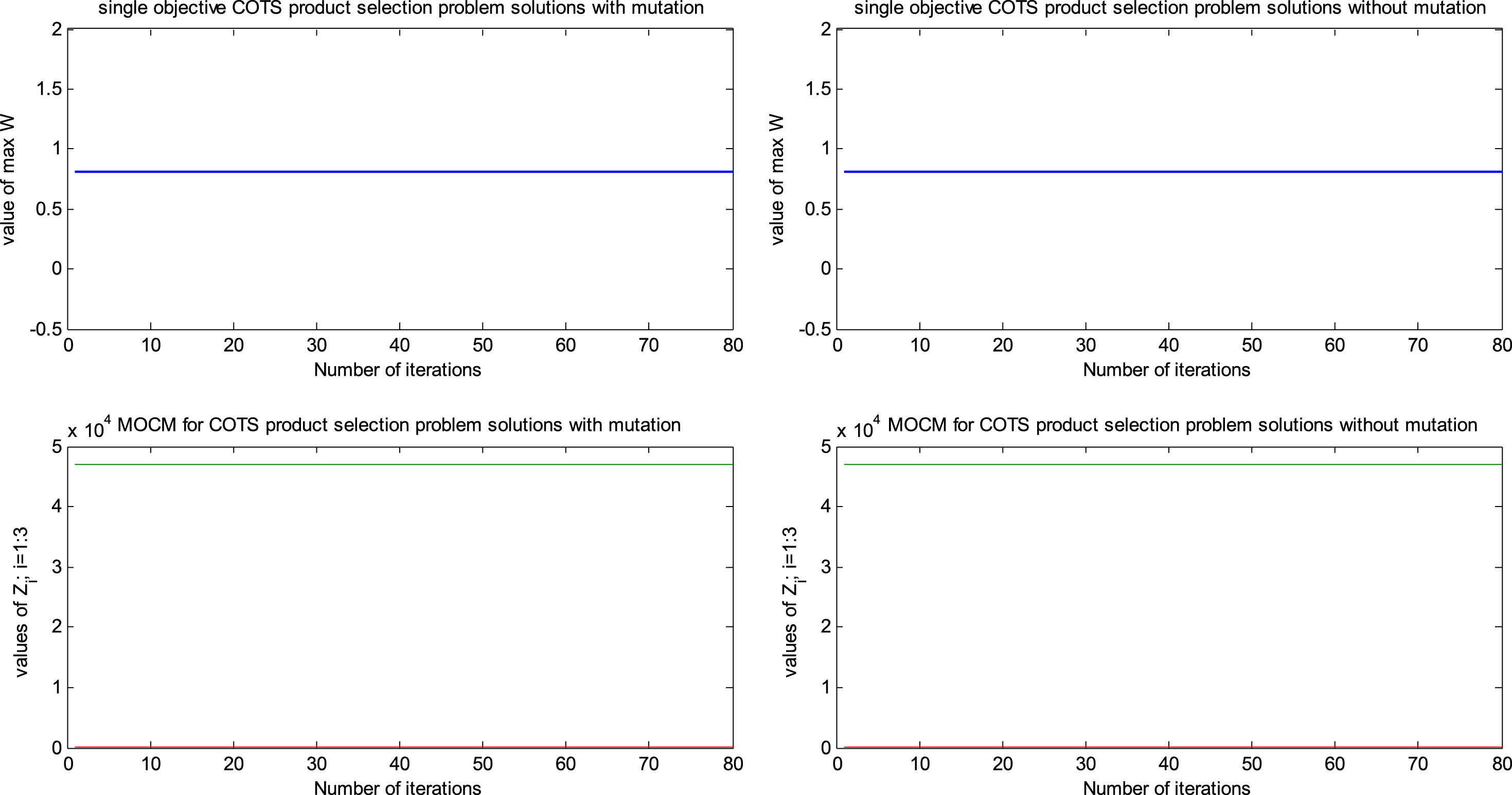
Convergence for SOP and MOCM COTS selection problem at (– 5, – 5, – 5) shape parameter and (0.7, 0.85, 0.75) Aspiration level in case of mutation and without mutation.
Figures 4 11 show that the objectives values for optimal assignment plans at different shape parameter and aspiration level in exponential membership function. These figures, indicate that values of shape parameters in exponential membership functions which enabling DM to investigate different fuzzy values of each objective function in the fuzzy judgment.
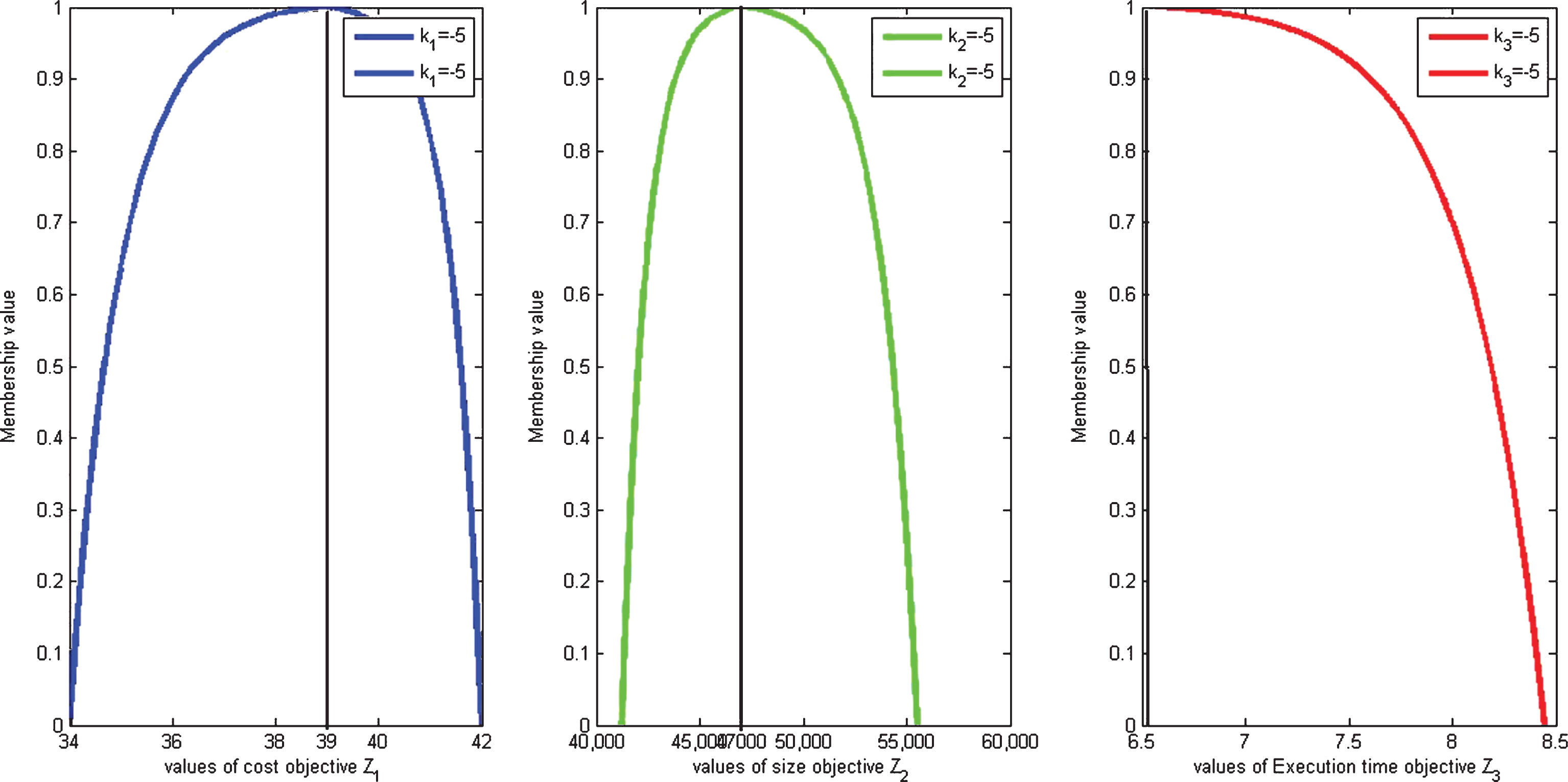
Cost, size and Execution time objective values at (– 5, – 5, – 5) shape parameter and (0.7, 0.85, 0.75).
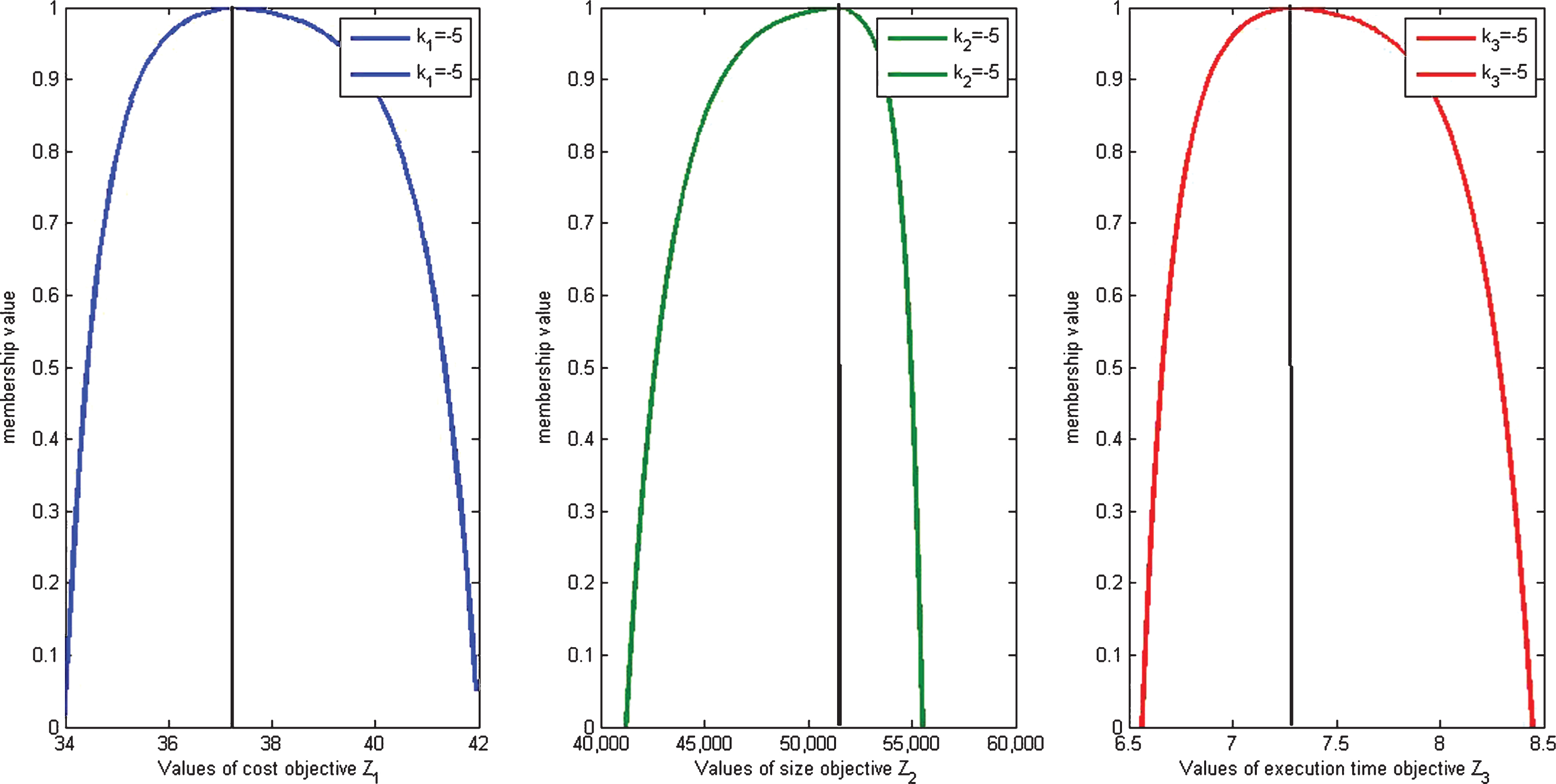
Cost, size and Execution time objective values at (– 5, – 5, – 5) shape parameter and (0.65, 0.55, 0.8).
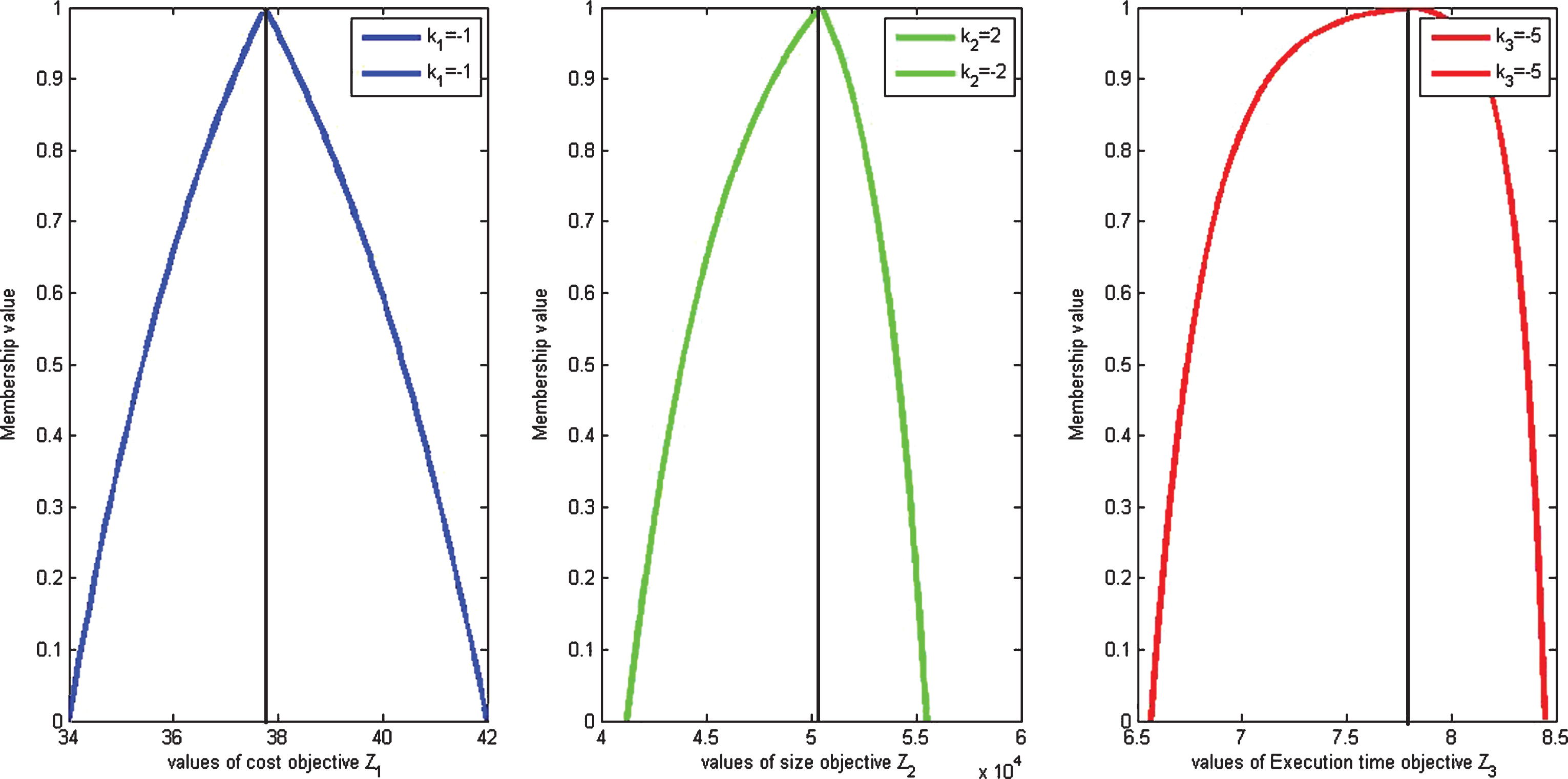
Cost, size and Execution time objective values at (– 1, – 2, – 5) shape parameter and (0.9, 0.75, 0.8).
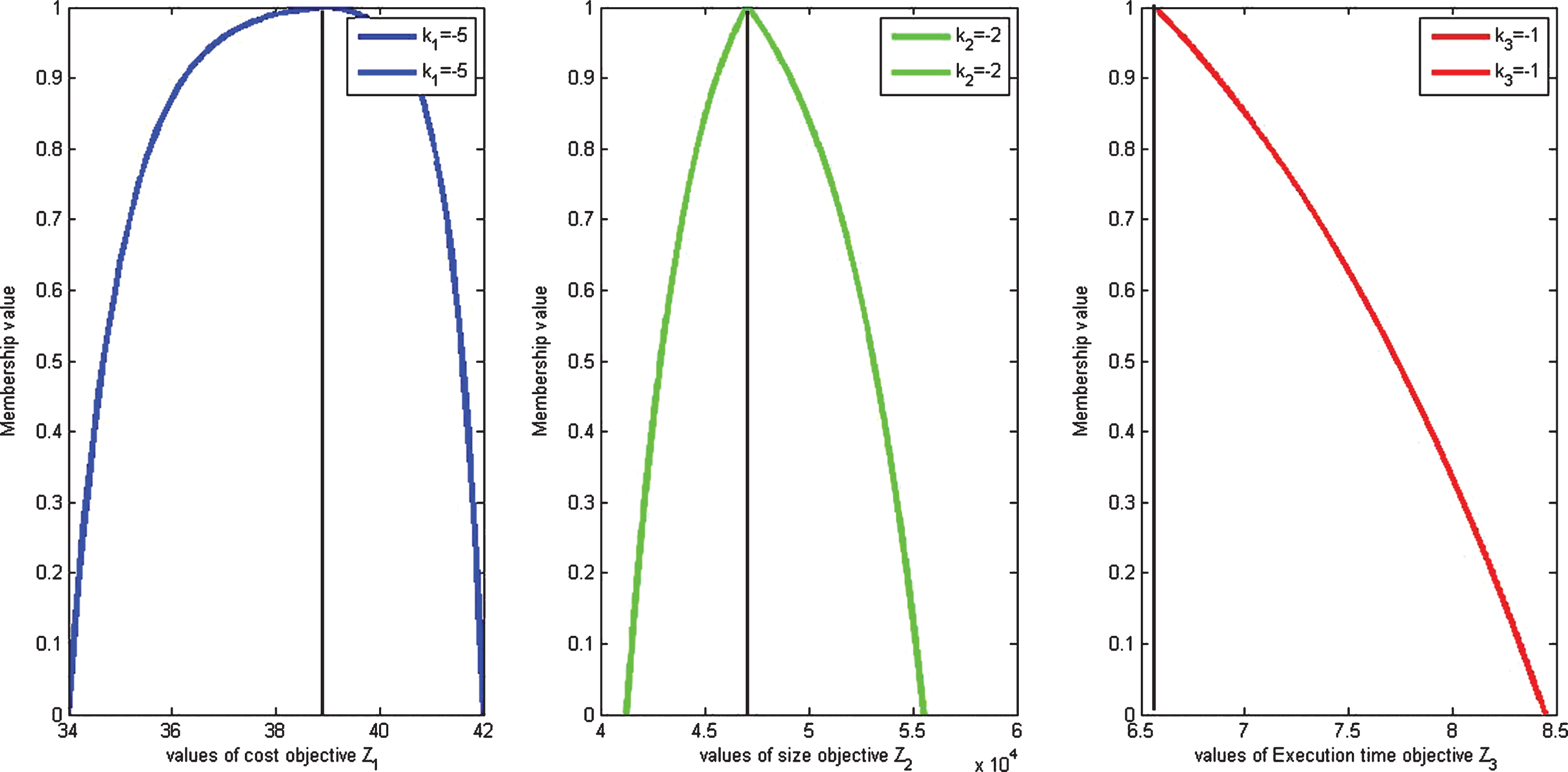
Cost, size and Execution time objective values at (– 5, – 2, – 1) shape parameter and (0.85, 0.8, 0.7).
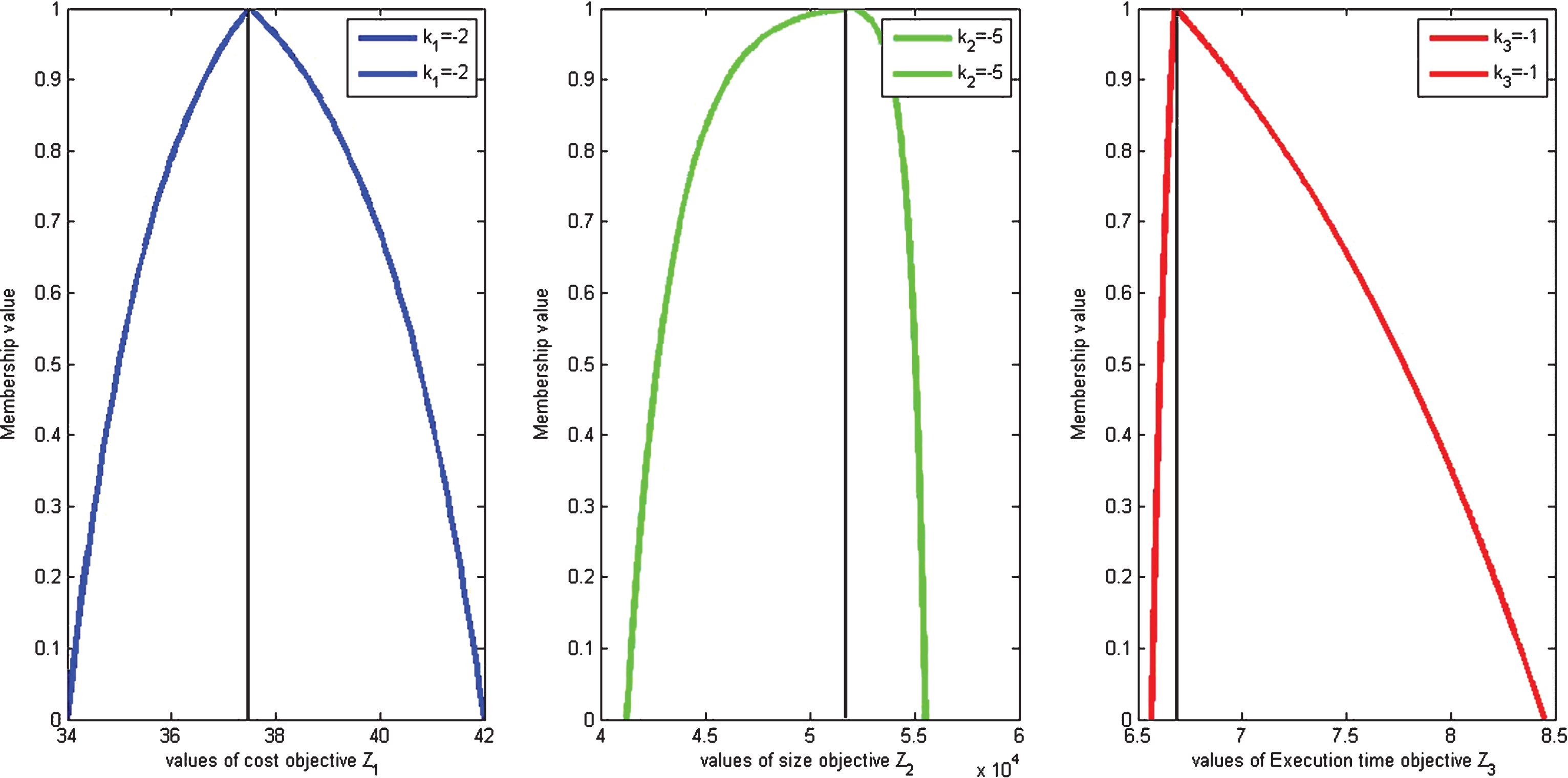
Cost, size and Execution time objective values at (– 2, – 5, – 1) shape parameter and (0.75, 0.6, 0.9).
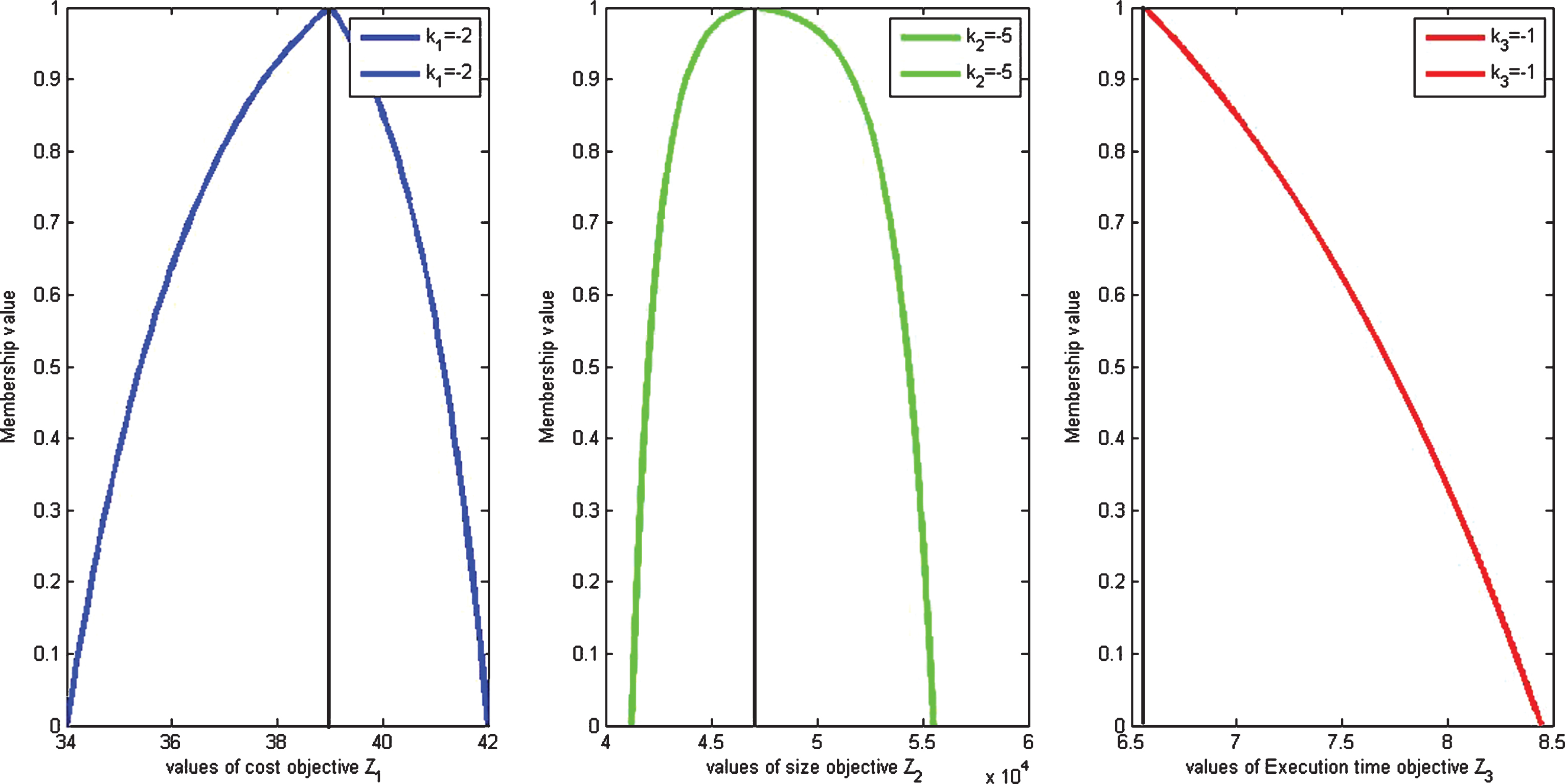
Cost, size and Execution time objective values at (– 2, – 5, – 1) shape parameter and (0.6, 0.85, 0.7).
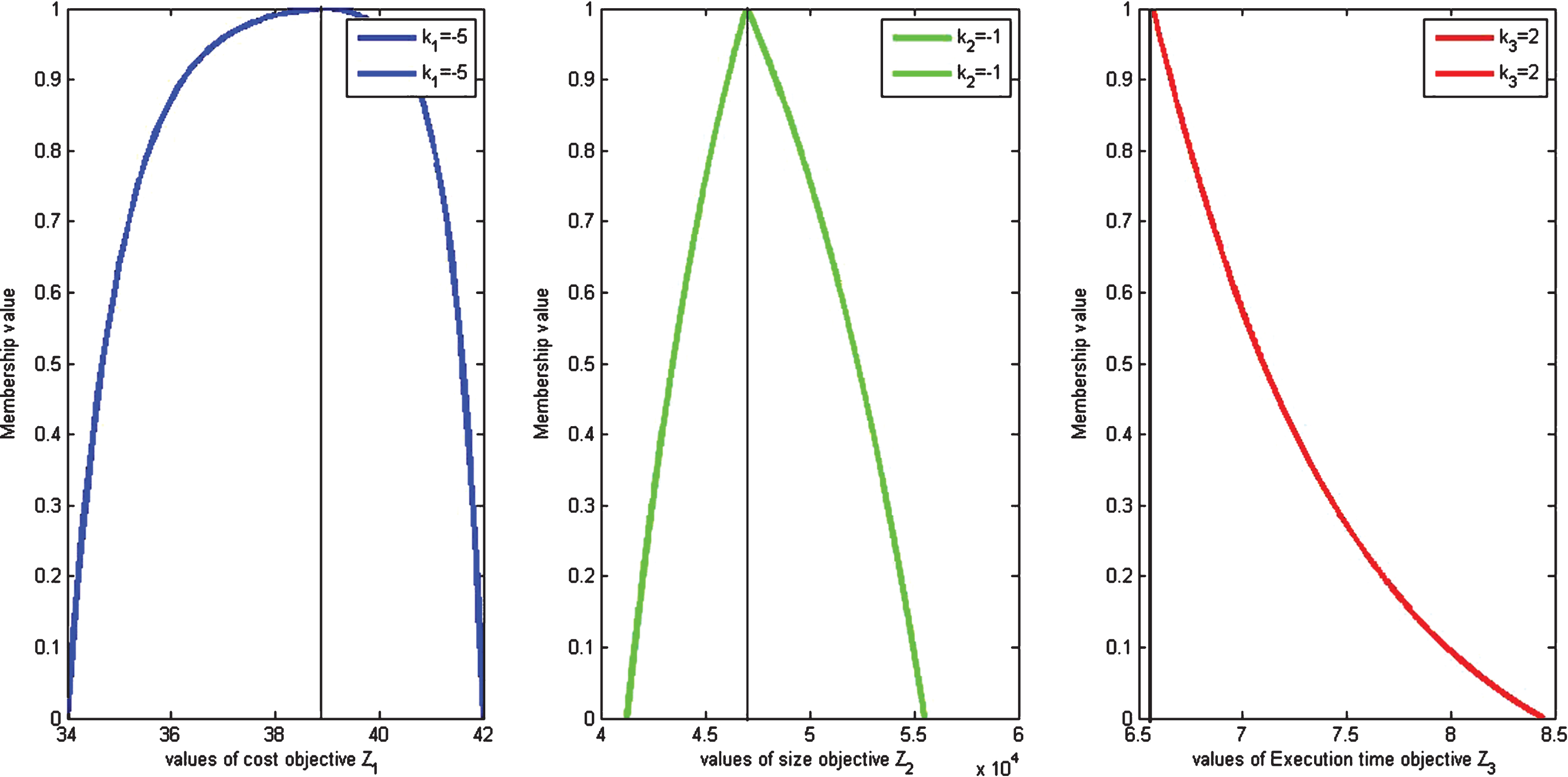
Cost, size and Execution time objective values at (– 5, – 1, 2) shape parameter and (0.85, 0.7, 0.95).
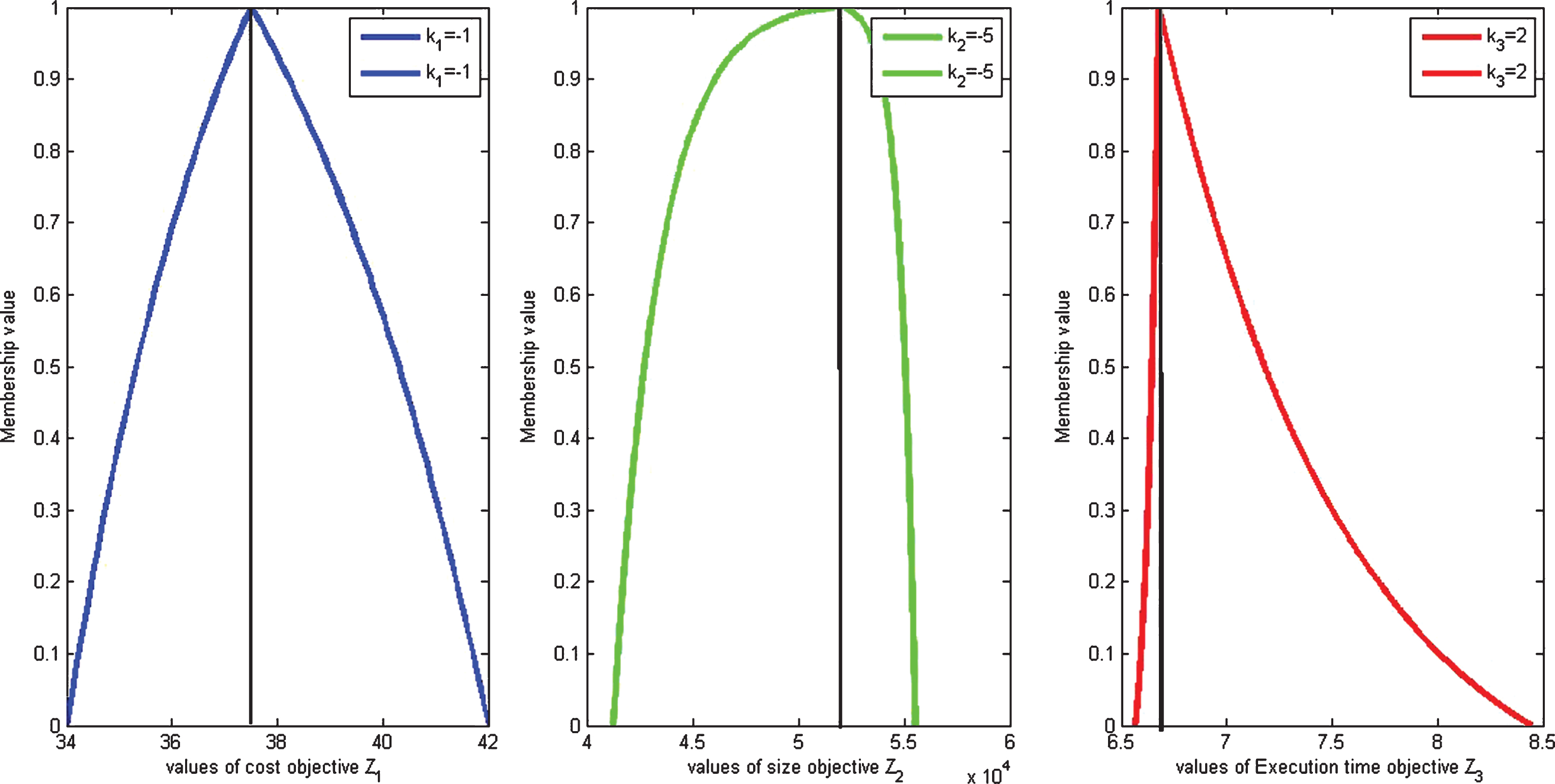
Cost, size and Execution time objective values at (– 1, – 5, 2) shape parameter and (0.6, 0.7, 0.85).
Corresponding to various choices of the shape parameters, the variations in the degree of satisfaction of the goals of cost, size, and execution time are shown in the Figures 12, 13 and 14 parameters for the MOCM for COTS products selection problem is presented.
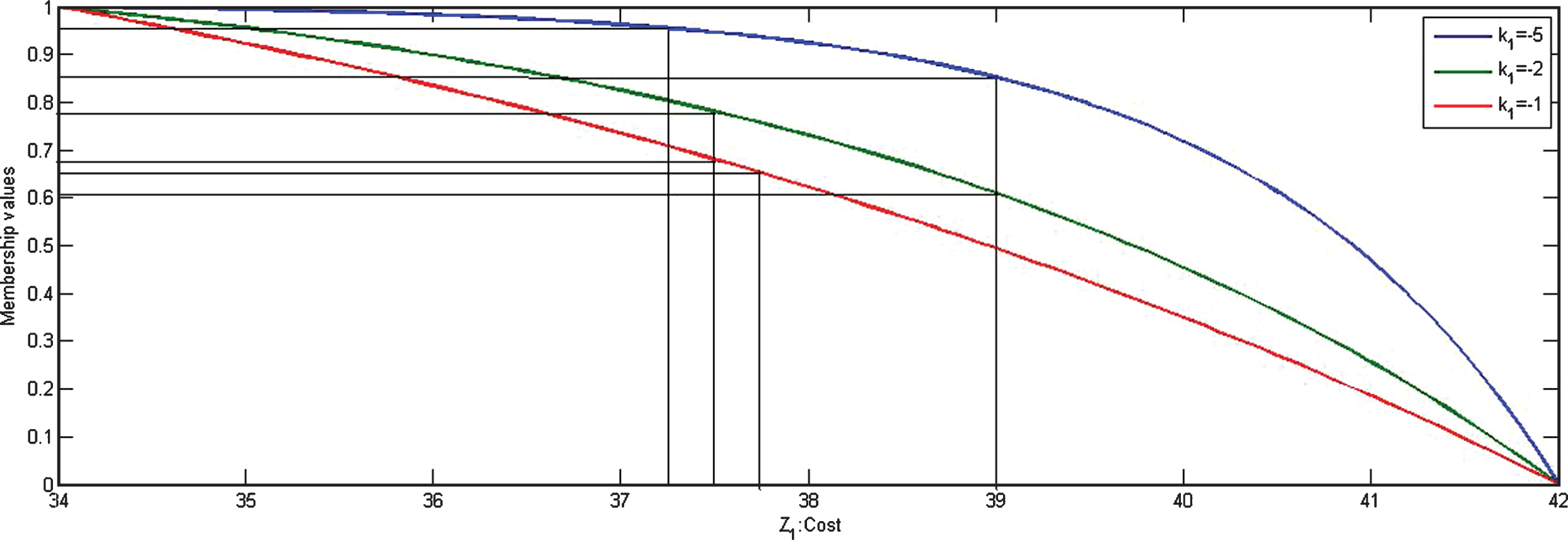
The degree of satisfaction level of the goal of cost objective.
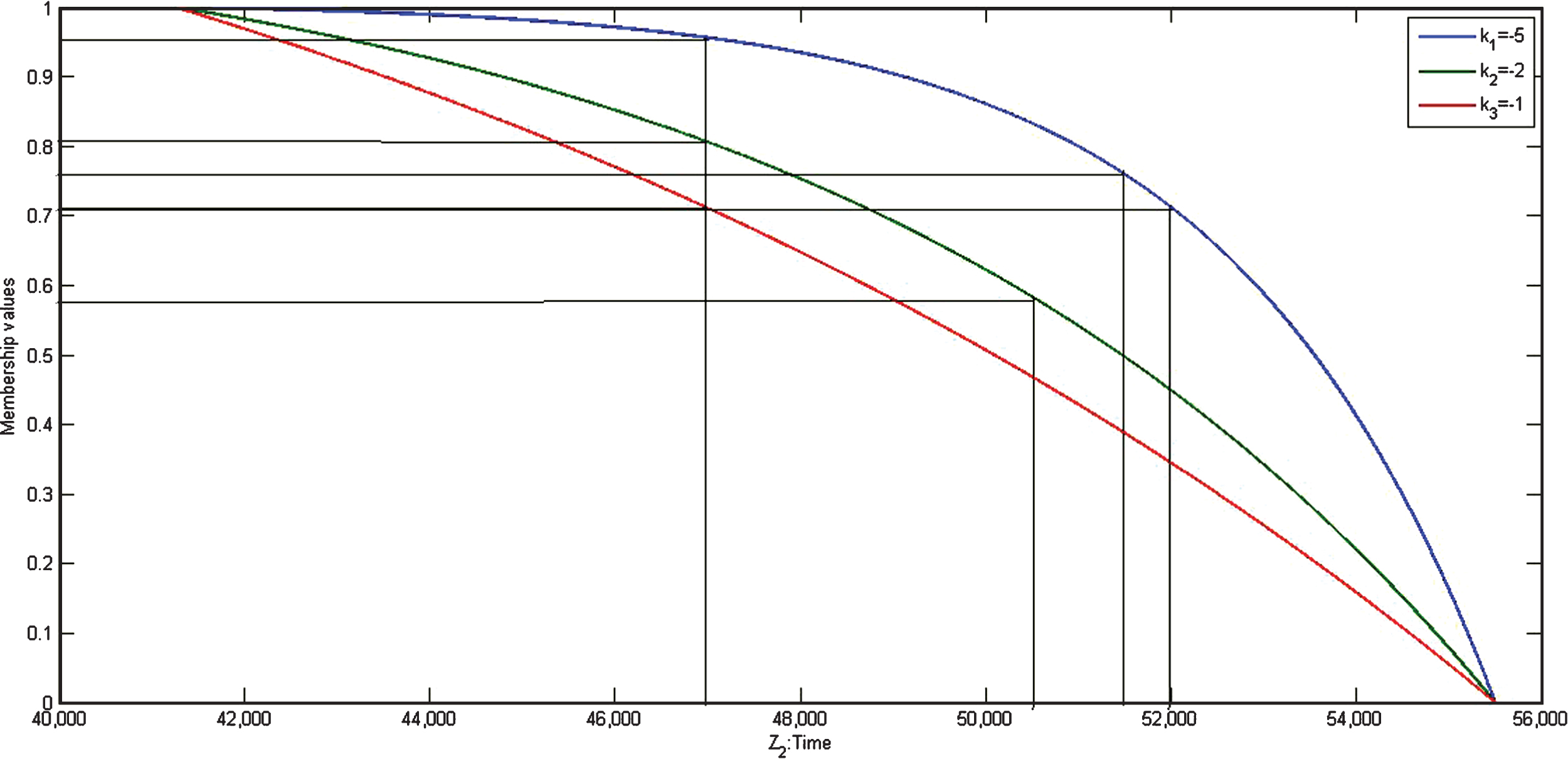
The degree of satisfaction level of the goal of execution size objective.
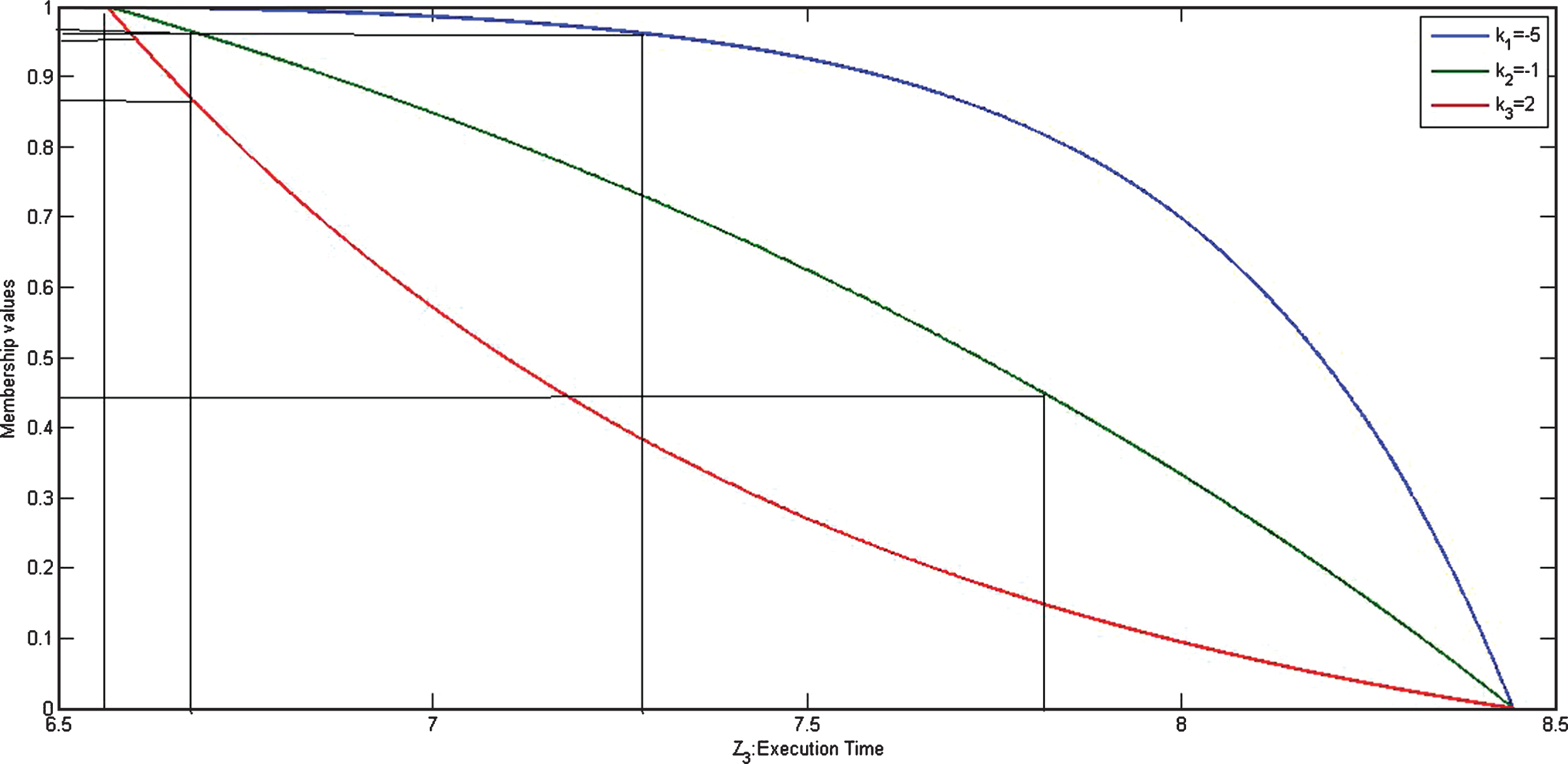
The degree of satisfaction level of the goal of time objective.
Due to the multi-objective characteristic of the problem, the achievement levels may not be large sufficient to fulfill the DM. From these figures, the advantage of using the exponential membership function with various shape.
It is clear from the Table 4 and Figures 12, 13, 14 that the GA-based hybrid approach provides flexibility and facilitates the collection of large amounts of information in terms of altering the confidence level and shape parameters in the exponential membership function and providing various scenario analyses to the DM for fuzzy allocation strategy [1, 27].
Here, we also obtain the optimal allocations by solving the problem of model-3 for β = 0.7 and β = 0.8 with respect to the different shape parameters and aspiration levels given by the DM.
Tables 5 and 6 show the assignment plans and objective values for COTS product selection problem with the different aspiration level of each objective function and different shape parameter at confidence level β = 0.7, 0.8 and 0.9. Tables 5 and 6 also show that when β is varies from 0.6 to 0.7, fluctuation in the value of each objective function is decreased for different shape parameters and aspiration levels, while β is varies from 0.8 to onwards, stability arises in each objective function value for any shape parameters and aspiration levels.
Summery results of MOCM for COTS product selection problem for β = 0.7
Summery results of MOCM for COTS product selection problem for β = 0.8, 0.9
Furthermore, this approach treated all objectives consistently. For example, in the cost and time objective assignment problem, if the DM prioritizes the cost objective in determining the allocation plan period, the solution that satisfies the cost objective function most favorably is selected by the DM. However, this method can result in an inferior satisfaction level because the performance of one objective may be compensated by the efficient performance of others. Hence, DMs can select different solutions in different situations, according to their requirements [1, 27].
In addition, if the DM is not satisfied with the obtained compromise solution, then the desired objective function can be improved as per the preference of the DM. Moreover, according to the preference of the DM, the upper and lower bounds can be changed to generate a new membership function for defining the new allocation plans.
Table 7 shows a comparison between obtained solutions by GA based hybrid approach using an exponential membership function with different approaches.
Comparison of results obtained by using different approaches
Comparison of results obtained by using different approaches
Here, we compare the working of the GA based hybrid approach used for COTS products selection problem with the other approaches, like weighted approach, two-phase approach and interactive fuzzy programming approach.
The two-phase method generates the solution according to different importance weights for each objective; however, it fails to generate the solution with a high degree of satisfaction for the objectives that are given higher relative importance. The solutions obtained using the weighted approach is reliable with the preferences of the DM. However, the obtained solutions are sometimes not acceptable by the DM when less importance is given to the objective function. Furthermore, the solution obtained using the interactive fuzzy programming approach is consistent with the preference of the DM; however, some complexity is created when the linear membership function is used [Wadata]. When large-scale problems are given, these three methods can create difficulty because optimization software, such as Lingo and CPLEX, cannot solve large-scale problems. Compared with the three aforementioned methods, the GA-based hybrid approach provides flexibility and large amount of information in terms of the changing shape parameters in an exponential membership function. Moreover, it provides the analysis of different scenarios to the DM for the allocation strategy, which is highly beneficial for the DM while taking a decision in accordance with the situation.
GA based developed hybrid approach provided the solution of MOCM for COTS product selection problem using exponential membership function easily and effectively with sensitivity analysis. Corresponding to several choices of the shape parameter with the various combinations of desired aspiration level in the exponential membership functions are describing different fuzzy utilities of the DM and also describing the behavior uncertainty in best-fit COTS selection.