



Abstract
A finite group W generated by reflections is called a finite reflection group and have been studied deeply in different important contexts such as geometry and group theory, matrix algebra and Lie Theory. In this paper we study a class of fuzzy subgroups of finite reflection groups which are called parabolic fuzzy subgroups using preferential equality. In the classical case parabolic subgroups are associated with a set of generators, each a simple reflection, indexed by elements of subsets of a fixed root system Δ. We establish a one-to-one correspondence between the class of fuzzy parabolic subgroups of W and the class of fuzzy subsets of S where S is a set of simple reflections associated with Δ.
Keywords
Introduction
Das [2] studied fuzzy subgroups by introducing an equivalence relation based on α-cuts, on the set of all fuzzy subgroups of a fixed group. This idea was developed further to study a generalization of equality of crisp subgroups. We call such an equivalence relation a preferential equality and an equivalence class of fuzzy subgroups, a preferential fuzzy subgroup, see for instance [6] and others, [4] and [9]. The importance of the study of parabolic subgroups of reflection groups cannot be over emphasized from a geometric and algebraic point of view, see for instance [3]. Also it may be desirable to look at certain reflections as being more natural than others since the geometric picture that emerges from applying the reflections in a particular sequence is esthetically more natural. see for instance Example 2.1. Hence in this paper we use the idea of preferential fuzzy subgroups to characterize certain fuzzy subgroups of finite reflection groups generated by simple reflections. We call these objects preferential fuzzy parabolic subgroups and they are in one-to-one correspondence with subsets of simple root system Δ indexing a set of simple reflections.
In Section 2, we recall some well-known facts regarding finite reflection groups, simple reflections, root systems and parabolic subgroups. In Section 3 we collect results on fuzzy subgroups such as α-cuts, preferential equality, preferential fuzzy subgroups, support and core that are essential. In Section 4 we develop ideas of fuzzy subgroups of finite reflection groups introducing notions of preferential fuzzy parabolic subgroups and characterize such objects within the context of preferential equality. Throughout we have used the example of
Finite reflection groups
All the material in this section is a summary of general results on reflection groups and mostly taken from the book “Reflection groups and Coxeter groups” by Humphreys [3].
Basic concepts
As parabolic subgroups are certain subgroups of finite reflection groups we begin with an abstract definition of a finite reflection group. Let V be a finite dimensional Euclidean space of dimension n and O (V) be the orthogonal group of V consisting of all orthogonal transformations of V, with the identity transformation denoted by e. We recall that a linear transformation R on V is called a reflection if R fixes a hyperplane H pointwise and sends a vector v orthogonal to H to its negative -v, that is, R (v) = - v and hence R (L
v
) = L
v
where L
v
is the line aligned with vector v. In this case, the reflection R is denoted by R
v
and is called the reflection generated by v. We note that R
v
is an element of order 2 in O (V) and may be described by a basic formula using an inner-product (u, v) defined on V. The image of u ∈ V under R
v
is given by
Root systems of reflection groups
We now briefly recall what are roots and root systems that are associated with finite reflection groups. These concepts are standard in Weyl group theory, in particular finite reflection groups. See, for instance [3] and [1].
We call a finite group W, a finite reflection group if it is generated by a set of reflections. Let A system of simple reflections exists for a given reflection group Any two simple systems Δ and Δ′ are conjugate in W in the sense that every β ∈ Δ′ is of the form wα for some α ∈ Δ, and Simple reflections associated with a simple root system generate W. The cardinality of any simple root system is called the rank of W.
Generation of W
In Subsection
So W can be viewed as generated by all the elements of the set S with the above specified relations. For instance, when α = β, and from the observation
In certain practical situations it may be useful to consider the reflection sα to be more suitable than sβ or vice-versa. That will be the basis for considering preferential fuzzy parabolic subgroups.
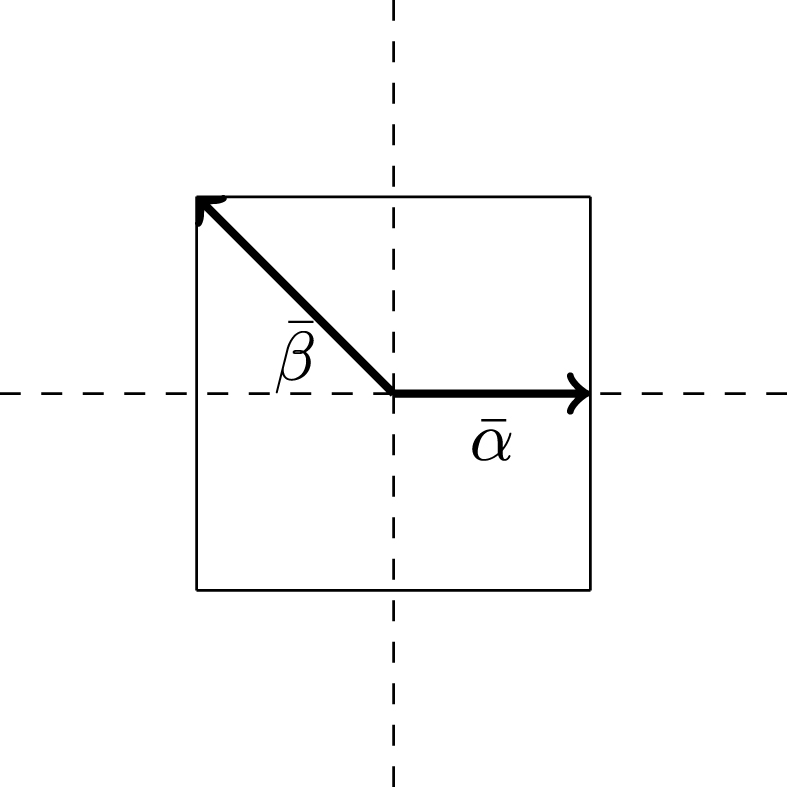
In the literature any group W generated by a system of generators satisfying relations as described above is called a Coxeter group and the pair (W, S) is called a Coxeter system. Thus a finite reflection group is a typical example of a Coxeter group. An illuminating discussion of this example is found in [8].
Parabolic subgroups of W
As in the previous Subsection
The two trivial parabolic subgroups are W∅ = {e} and W
S
= W. The effect of replacing one simple system Δ by another Δ′ on the parabolic subgroups associated with Δ and Δ′ is one of conjugacy, that is, if Δ′ = wΔ for some w ∈ W, then the parabolic subgroup W
I
is replaced by wW
I
w-1. It is clear not every subgroup of a finite reflection group is parabolic. A fortiori a non-parabolic subgroup remains the same under any simple root system. For instance a rotation subgroup of order 4 in
We now think of the power set
Fuzzy subgroups
We use
We recall from [6] the notion of preferential equality of two fuzzy subgroups μ and ν of W. This notion is an equivalence relation on
As a contra-definition we say two fuzzy subgroups are preferentially distinct if they are not preferentially equal. Thus two fuzzy subgroups are either preferentially equal or preferentially distinct. A further remark is useful and the proof is found in the samepaper [6].
Definition and basic properties
We tacitly assume unless otherwise stated that W is a finite reflection group and Δ is a simple root system in V. By specializing the general definition of a fuzzy subgroup of a group, we define a fuzzy parabolic subgroup of a finite reflection group W associated with a simple root system Δ in the following way.
We refer to Example 2.1 with
The above proposition leads to a preferential fuzzy parabolic subgroup of W as an equivalence class of fuzzy parabolic subgroups μ : W →
In this section we set up a one-to-one correspondence between the class of preferential fuzzy parabolic subgroups of W with respect to a fixed simple root system Δ with its associated set S of simple reflections and the class of preferential fuzzy subsets of S. First we briefly sketch how to generate a fuzzy parabolic subgroup from a given a fuzzy subset of the class S of simple reflections associated with a fixed simple root system Δ.
Clearly if I1 and I2 are two subsets of S of simple reflections indexed by Δ such that I1 ⊆ I2, then the parabolic subgroups W
I
1
and W
I
2
of W generated by the sets I1 and I2 respectively satisfy the natural inclusion W
I
1
⊆ W
I
2
as subgroups of W. This simple observation allows us to define a fuzzy parabolic subgroup Wμ : W →
μ = ∨ {t i χ I i : 0 ≤ i ≤ n} where χ stands for the characteristic function of a subset.
Let <I
i
> be the subgroup generated by the set I
i
in W for i = 0, 1, ⋯ n - 1. Now we define another fuzzy subset Wμ of W corresponding to μ as follows: Wμ (w) =1 if w∈ < I0 > and for i = 1, 2, ⋯ , n
It is easy to check that Wμ is a fuzzy parabolic subgroup of W.
With above construction we have the following
t i > ti′ ⇔ r i > ri′ I i = J i , and t i = 0 ⇔ r i = 0, for 1 ≤ i, i′ ≤ n .
See [5]. From (ii) above we get I i = J i if and only if <I i > = < J i > in W. Hence μ ∼ ν in S if and only if Wμ ∼ W ν in W. □
In conclusion this paper sketches a framework of how to study the fuzzy subgroups of reflection groups under preferential equality. Elements of reflection groups are linear transformations on vector spaces. Therefore the above results can be considered in the context of reflections as linear transformations of fuzzy vector spaces. Further studies are needed to work out how precisely linear transformations between fuzzy subspaces would lead to simple reflections and thereby leading to general reflections in fuzzy vector spaces.
The authors thank the National Research Foundation of South Africa (NRF) and the second author thanks RC of Rhodes University for financial support. We both thank Sithembele Nkonkobe for his contribution.