



Abstract
In this paper, a multi-item economic production quantity (EPQ) model for deteriorating seasonal products is developed with stock and promotional effort dependent demand in an imperfect production process. The promotional efforts are advertising, delivery facilities, better services, etc. The production process produces some imperfect quality units which are instantly reworked at a cost to bring back its quality to the perfect ones. Here, the rate of production is time dependent. Unit production cost is a function of production rate including the defective ones and the deterioration rate is considered as constant. The model is formulated as a profit maximization problem with space and budget constraints in the form of an optimal control problem. The total profit function with the effect of inflation and time-value of money is expressed as a finite integral over a finite planning horizon. The problem is solved using variational calculus to determine the minimum defective rates of the production process for which the total profit is maximum. Another three models are developed considering the constraints as uncertain (fuzzy, random and rough) in nature. For fuzzy model, three types of fuzzy numbers are considered. To deal with the fuzzy constraints, fuzzy possibility measure is used. Also, stochastic and rough constraints are reduced to the approximate crisp ones following chance constrained approach and rough expectation respectively. Numerical experiments are performed to illustrate the models. Also, some sensitivity analyses are performed and presented.
Keywords
Introduction
EPQ models are well established phenomena in the literature of inventory control problems. In most of the earlier published articles, it was assumed that the manufacturer produces 100% perfect quality products which is unrealistic. To overcome this type of situation, inventory practitioners considered the production reliability parameter (say ‘r’), which can achieve a value upto 100%. Recently, researchers have developed their models with the assumption that the manufacturers are highly satisfied if the value of ‘r’ reaches a maximum level and at the same time, they never allow ‘r’ to fall below a certain level. In this paper ‘r’ is considered in a different way, ‘r’ plays a role as a production reliability indicator, i.e., smaller value of ‘r’ provides better quality products.
Again, most of the earlier EPQ models are developed with infinite time horizon. However, in the present market scenarios, it is commonly observed that the items like i-Phone, i-Pad, fashionable clothes, etc., are periodically presented with new fetchers after a certain period of time. So, in reality, rapid change in product specifications motivates the customers to go for the new product. For this reason, the present model is developed with finite time horizon.
Deterioration of units is one of the most crucial factor in inventory control problems for seasonal products. Now-a-days, promotional effort (PE) plays a major role in creating a situation of high demand in the market. The promotional efforts are advertising, discount offer, delivery facilities, better services, etc. Among many factors, promotional effort policy is the more applicable issue in today’s business strategy. It is an important managerial insight to introduce a product, especially for the items newly launched in the market. This type of effort usually enhances the demand of any kind of commodities including deteriorating items. From retailer’s point of view, to reduce the number of deteriorated units, it is essential to reduce the time cycle and/or to increase the demand of the items. On the other hand, inventory is used to absorb fluctuations in demand. Generally, more stock motivates the customers to go for the product. Consequently, sufficient production with its inventory is planned in advance for the finite cycle period. Hence, for a real-life model, demand should be a function of stock and promotional effort of the business policy.
In this paper, a multi-item production inventory model for deteriorating items with imperfect production process is considered over a finite time horizon. Defective produced units are reworked at a cost to bring back their quality to the prefect ones. To increase the demand and to reduce time cycle, promotional effort of the business policy has been considered with the development of the model. Demands of the items depend on stock as well as promotional effort. Unit production cost is a function of production rate, raw material cost, labour charge, wear and tear cost and defective rate of the production process. As the economy of a country changes rigorously due to high inflation, the model is developed taking into account the inflation and time value of money. Incorporating the above mentioned realistic assumptions with space and budget constraints, the model is formulated as an optimal control problem for the maximization of total profit over the planning horizon and the optimum profit along with the optimum reliability indicator are obtained. Numerical experiments are performed to illustrate the models. The significance of some parameters on the proposed models are also pointed out.
Literature review
In imperfect production inventory models, reliability of the production process had been considered by the researchers in different approaches. Process reliability and quality improvement ware discussed first by Porteous [28] and Rosenblatt & Lee [29] in their production inventory models. They assumed that the perfect quality units are produced in the in-control state (i.e., beginning of the production process) and the imperfect quality products are produced in out-of-control state. Khouja and Mehrez [16] presented a classical inventory model and showed that the optimal production rate is smaller than the production rate which minimizes the unit production cost. After that, lot of EPQ /EMQ (Economic Manufactural Quantity) models are developed with the assumption of process reliability. In their considerations, production may be 100% perfect by introducing high quality machineries, which is unrealistic in most of the real life production systems. In reality manufacturers are highly satisfied if ‘r’ reaches a maximum level and they never allows ‘r’ to falls below a minimum level. Considering this phenomenon, recently some works have been presented by the young researchers. One can follow some notable research papers in this direction such as Sana, [34], Sarkar et al. [35], Kumar and Goswami [18] and Zhou et al. [52], etc.
Most of the production models have been formulated with infinite time horizon assuming that the demand of the items remains same for ever [3, 47, etc.]. Items in the market, such as i-phone, Tab, i-pad, hi-fi equipments, etc. are highly demandable, but normally exist in the market for a finite time and obviously these types of demands depend on time. Various types of investigations have already been made by several authors for time-dependent demand [20, 35, etc.]. According to this assumption, product specifications also remain unchanged for ever. But, in reality unprecedental development of technology has lead to rapid change in product specifications [11] with new features. As a result, lifetimes of these types of products are normally finite and demands depend on time obviously. Hence the inventory models should be developed and analyzed for a finite period of time [15, 25, etc.] with time-dependent demand. Here, we mention an excellent article- “Celebrating a century of the economic order quantity model in honor of Ford Whitman Harris” for the researchers which is published by Cardenas-Barron et al. [4].
Deterioration of units is one of the most crucial factor in inventory control problems for deteriorating items. In the literature, there are several investigations for deteriorating items such as Yadav et al. [44]; Widyadana et al. [41]; Guchhait et al. [12, 14]; Chung et al. [7]; Baten and Khalid, [1]; Tiwari et al. [39], etc. During last two decades, there had been two excellent review articles on deterioration in the literature (Goyel and Giri 2001 and Bakker et al., 2012).
The promotional effort is an important management policy in any manufacturing sector. Goyal and Gunasekaran [10] developed a production-inventory model while demand of the end customers is influenced by advertising. Szmerekovsky and Zhang [37] developed a supply chain model with price and advertising sensitive demand. Xie & Wei [42] and Xie & Neyret [43] investigated another two interesting supply chain models to obtain optimal cooperative advertising strategies and equilibrium pricing of the chain. The works of Sana [34], Cardenas-Barron and Sana [3, 5] in this area are worth mentioning.
Incorporating inflation and time value of money, an EOQ model was presented first by Buzacott [2]. After that, several researchers such as Yang et al. [45], Sarkar et al. [35], Yang [46], etc. enlightened upon the EOQ model in this direction along with different types of demand functions. In recent years, Gilding [9] and Kumar & Rajput [19] gave their efforts to develop EPQ/EMQ models with inflation and time value of money.
Today’s competitive volatile business transaction is full of uncertainty. It is an well established phenomenon in the direction of inventory and/or production-inventory policy in recent years. After introduction of fuzzy set [50], it has been well developed and applied widely in different areas of science and technology including inventory control problems [12, 25]. Recently, more particular, instuitionistic fuzzy set [51], hesitant fuzzy element [19, 52] and linguistic term set [54] get considerable attention from the researchers in this field and decision making problems. On the other hand, rough set theory was first introduced by Pawlak [30] and has been developed by some authors such as Pawlak and Skowron [31], Li [21], etc. In recent years, rough set theory has been used by the young researchers to enhance the applicability of their model in different areas for the decision making problems [14, 23].
Variational principle is a simple technique for the analysis of optimal control problems. Very few researchers have developed the production -inventory models as optimal control problems and solved using this method [34, 35]. Moreover, in most of the above models, unit production cost is assumed to be constant. In practice, it varies with production rate, raw material cost, labour charge, wear and tear cost and reliability of the production process [17]. In this investigation, unit production cost is dependent on production rate, reliability indicator, raw material, labour charge and wear-and-tear costs.
Assumptions and notations for the proposed model
The following notations and assumptions are used in developing the model.
q
i
(t) is inventory level at time t (≥0) for the i-th item. θ
i
is the deterioration rate of the i-th item. r
i
is the defective rate of the production process for i-th item. ξ
i
is the variation constant of tool/die costs. c
d
i
is the rework cost per defective item. c
h
i
is the holding cost per unit for i-th item. c3
i
is the set-up cost for i-th item. s
p
i
is the unit selling price for i-th item. a0
i
is the space required per unit for the produced items.
In this imperfect production-inventory system, N items are produced and sold. Life cycle of the items i.e., the planning horizon for the model under consideration, T is finite. Production rate increases with time i.e., P
i
(t) is the production rate at any time t for i-thitem. Ω (r
i
) is the development cost for production system at a stage with defective rate r
i
and represents as (cf. Mettas, [27] andSana, [34]):
χ
i
(t)=a
i
- b
i
e-c
i
t is the promotional effort of the i-th item. Here, a
i
, b
i
and c
i
are parameters. Demand of the i-th item depends on stock label as well as promotional effort and is of the form D
i
(t) = D0iq (t) + D1i + D2iχ (t), D0i, D1i and D2i are the parameters. Unit production cost, c
p
i
, is a function of defective rate r
i
and production rate P
i
(t) and is of the form
In the developing countries, inflation is predominant and interest rate depends on the inflation value. Thus δ = R - i, where R and i are the interest and inflation per unit currency respectively.
Mathematical formulation of the model
Here, the production system produces perfect quality as well as imperfect quality products. Imperfect units are reworked at a cost to bring back its quality to the original ones. In this production process, r
i
plays the role as a defective rate of the production process. So, smaller value of r
i
produces better quality product. Thus, the change of production and inventory level can be represented by the following differential equation:
As the production system produces N number of items, the relevant profit function, incorporating the inflation and time values of money during [0, T] is
Now we have to find the value of q
i
(t)s, i=1,2,...N, which maximize the profit function Z and obviously, q
i
(t)s must satisfy following two constraints
Now, for the optimal value of Z C , the necessary condition is the Euler-Lagrange equation. So, the problem is to find the optimal path of q (t) and P (t) for which Z C is maximized.
Here, the Euler-Lagrange’s equation for the maximum value of Z is
Using (5) and (6), we have
Now, we have to solve the Equation (8) to get the expression for q i (t) and that of P i (t). For the solution the complementary function (CF) of the Equation (8) is
Here D (
Hence, using the above equations we have,
Hence, the complete solution of the Equation (8) is CF + PI, i.e.,
Again, we have q (0) =0 = q (T) and from this we get the value of X1i and X2i as
After substituting all the values in Equation (2) we can get,
Now, putting the value of q
i
(t) and that of P
i
(t) (from the Equations (9) and (15) respectively) in the Equation (5), it can be evaluated the expression for
Here, optimum values of λ and μ are selected by trial and error method. As this profit function contains two unknowns-r1 and r2, the defective rate of the production process, we again maximize Z C with respect to r1 and r2 by a nol-linear gradient based method-GRG (Generalized Reduced Gradient) method using LINGO-14.
When both the constraints are fuzzy in nature, the above problem reduces to
Here,
Where β1 and β2 are predefined possibility levels that should be satisfied by the fuzzy constraints. Using the Lemma-1 (cf. Appendix), the problem reduces to
Now, again the augmented cost functional (Z TFN , say) can be formulate by introducing the Lagrange’s multiplier λ and μ as follows:
Proceeding as before, we get the profit function Z TFN as follows:
Here,
Proceeding as in §4.1.1, in this case, we can derive the profit function say, Z LFM .
Here,
Proceeding as before in §4.1.1, in this case also, we can derive the profit function say, Z TrFM .
When both the constraints are random in nature, the above problem reduces to
Here,
Here, Pr
S
and Pr
B
are the probabilities with which the two constraint of (25) must hold respectively. Also,
Now, as before, the augmented cost functional (Z RAM , say) can be formulate by introducing the Lagrange’s multiplier λ and μ as follows:
Proceeding as before, the profit function Z RAM can be evaluated.
When both the constraints are rough in nature, the above problem reduces to
Here,
Now, Z ROM , the functional of this model can be represented by the following equation
where
Proceeding as before, we can get the profit function Z ROM easily.
Now, all the models are solved using a gradient based optimization technique – Generalized Reduced Gradient (GRG) method (Rao, [32]) using LINGO-12 software.
The models are illustrated with two items (i.e., N = 2). The parametric values used to illustrate the crisp model are presented in Table 1.
Parametric values for crisp model
Parametric values for crisp model
Other parametric values such as B = 7850$, S = 500 units,
Optimum results for crisp model
Today’s competitive volatile market situation is full of uncertainties. Keeping this in mind, three sub models are developed with three different types of uncertain parameters and these are fuzzy, random and rough. In these models, it considered that both the constraints are uncertain in nature.
For the TFM,
Optimum results for the imprecise models
Optimum results for the imprecise models
For this model, it is considered that the random variable follow normal distribution, i.e., mean of the random variables S and B are taken as
Optimum results of ROM model
To illustrate the model numerically, the rough variables are taken as
Optimum results for different values of r1 and r2
To analyze the model perfectly, optimum results for different values of r1 and r2 are obtained and presented in Table 4 (crisp model) and Tables 5a(TFM), b(LFM), c(TrFM), 6(RAM) and 7(ROM) respectively.
Optimum results of the crisp model for different values of r1 and r2
Optimum results of the crisp model for different values of r1 and r2
Optimum results of the TFM for different values of r1 and r2
Optimum results of the LFM for different values of r1 and r2
Optimum results of the TrFM for different values of r1 and r2
Optimum results of the RAM for different values of r1 and r2
Optimum results of the ROM for different values of r1 and r2
From the obtained results presented in Table 2, it is reflected that the profit is higher than the other for λ = 2.20 and μ = 1.12. With the initial value of λ & μ, the profit is less and after a certain values of λ & μ, both the constraints are satisfied and the obtained profit is more than the previous. After that, though the constraints are satisfied, the profit is less than the profit for λ = 2.20 and μ = 1.12. Initially, with the decreasing and increasing value of λ and μ respectively, budget constraints of the problem is not satisfied. It may effect on the profit function of the model. As the profit is maximum for λ = 2.20 and μ = 1.12, further investigations are derived with these set of values for λ, μ.
Obtained results for all the uncertain models are presented in Table 3. To analyze the models perfectly, results for different values of r1 and r2 are obtained and presented in Table 4 for crisp model. It is observed that initially, the profit increases with r1 and r2, but after a certain values of r1 and r2, the profit decreases. It is also observed that, after a certain fixed value of r2, profit of the model reflects as a decreasing function with the increasing value of r1. If we plot the profit (Z C ) against the defective rates (r1 and r2) of the items, the Fig. 1, three dimensional representation of the convex profit function is obtained.

Graphical representation of Crisp model.
Being influenced on the crisp model, the results of the uncertain models are also obtained for different values of r1 & r2 and presented in Tables 5a, b, c, 6 and 7. From these tables, it is found that the nature of the profit function is similar to the crisp one. In all the cases, it is observed that initially, the profit increases with r1 and r2, but after the certain values of r1 and r2, it decreases having its convexity nature. When these are plotted graphically in a two-dimensional representation with r1 as variable against a particular value of r2, we obtained a maximum value (peak point) of the profit function for the crisp, fuzzy (TFM, LFM and TrFM), random and rough models which are observed from the Figs. 2–7 respectively. In all the cases, for the initial values of r1 and r2, profit increases but, after that these values decreases with the increase of r1 and r2. It is important to note that for the present models, the usual idea – the less defective rate reflects more profit is violated for some values of defective rates.

Profit against one defective rate for fixed values of other one.
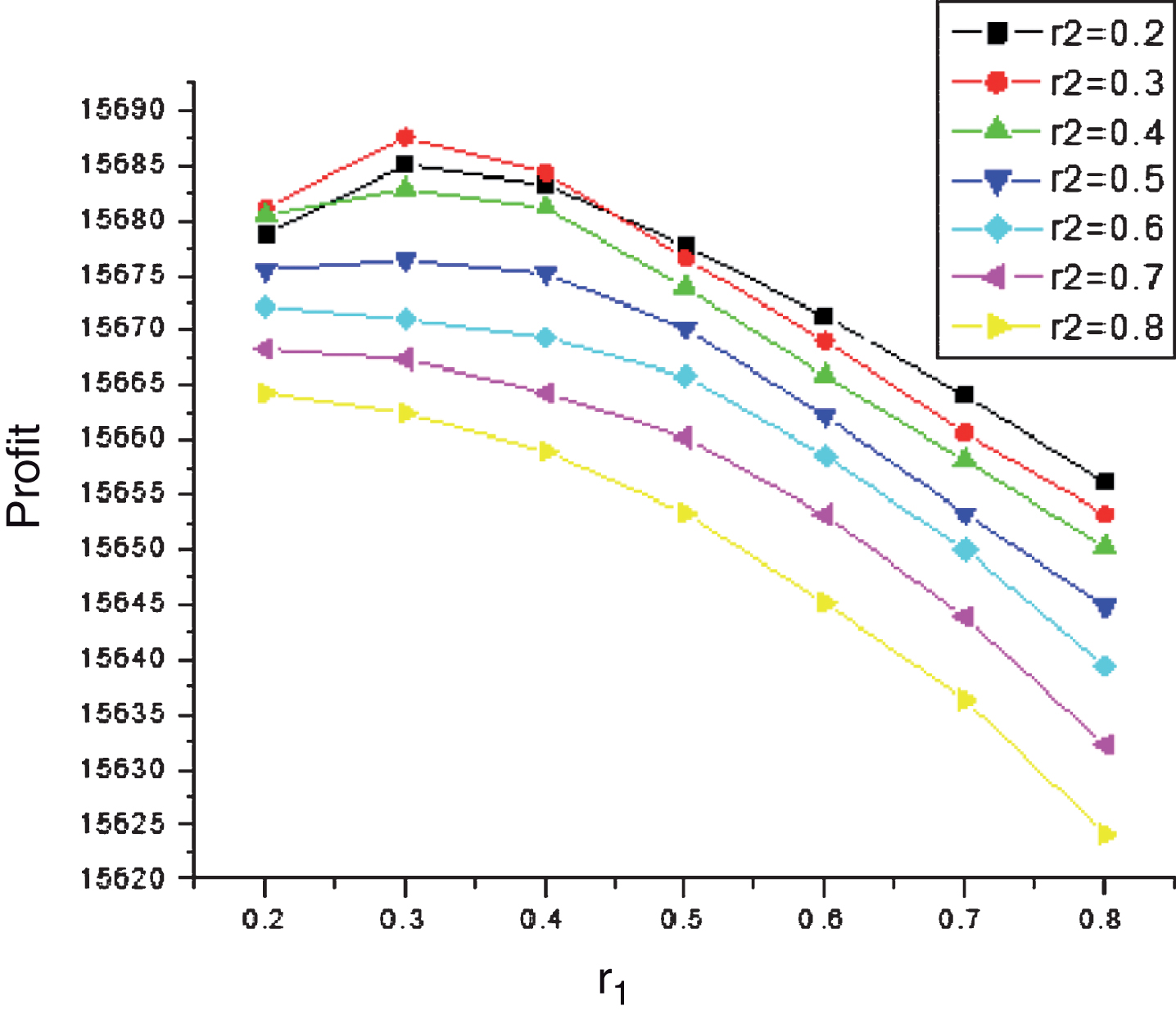
Profit against one defective rate for fixed values of other one (TFM).
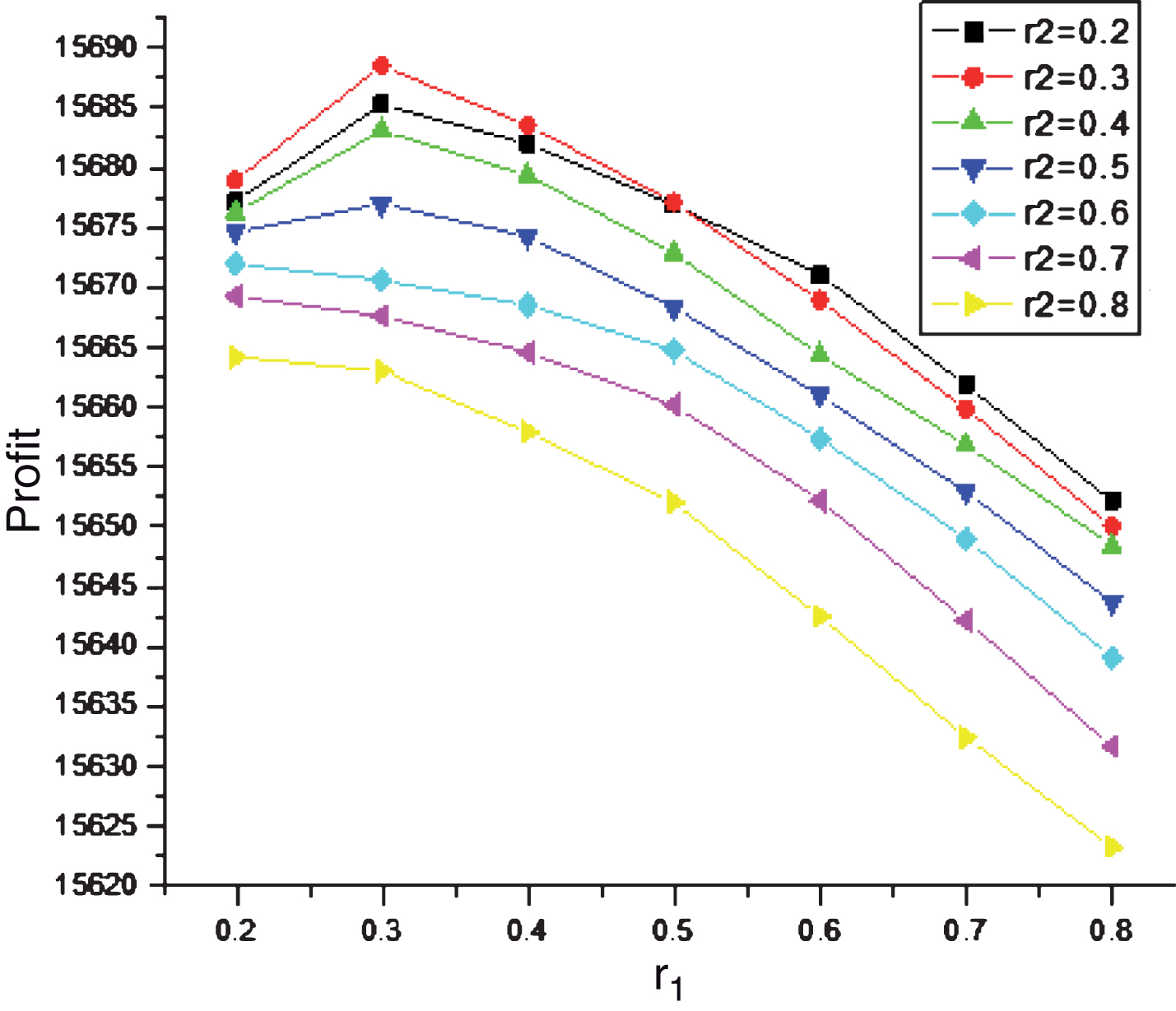
Profit against one defective rate for fixed values of other one (LFM).
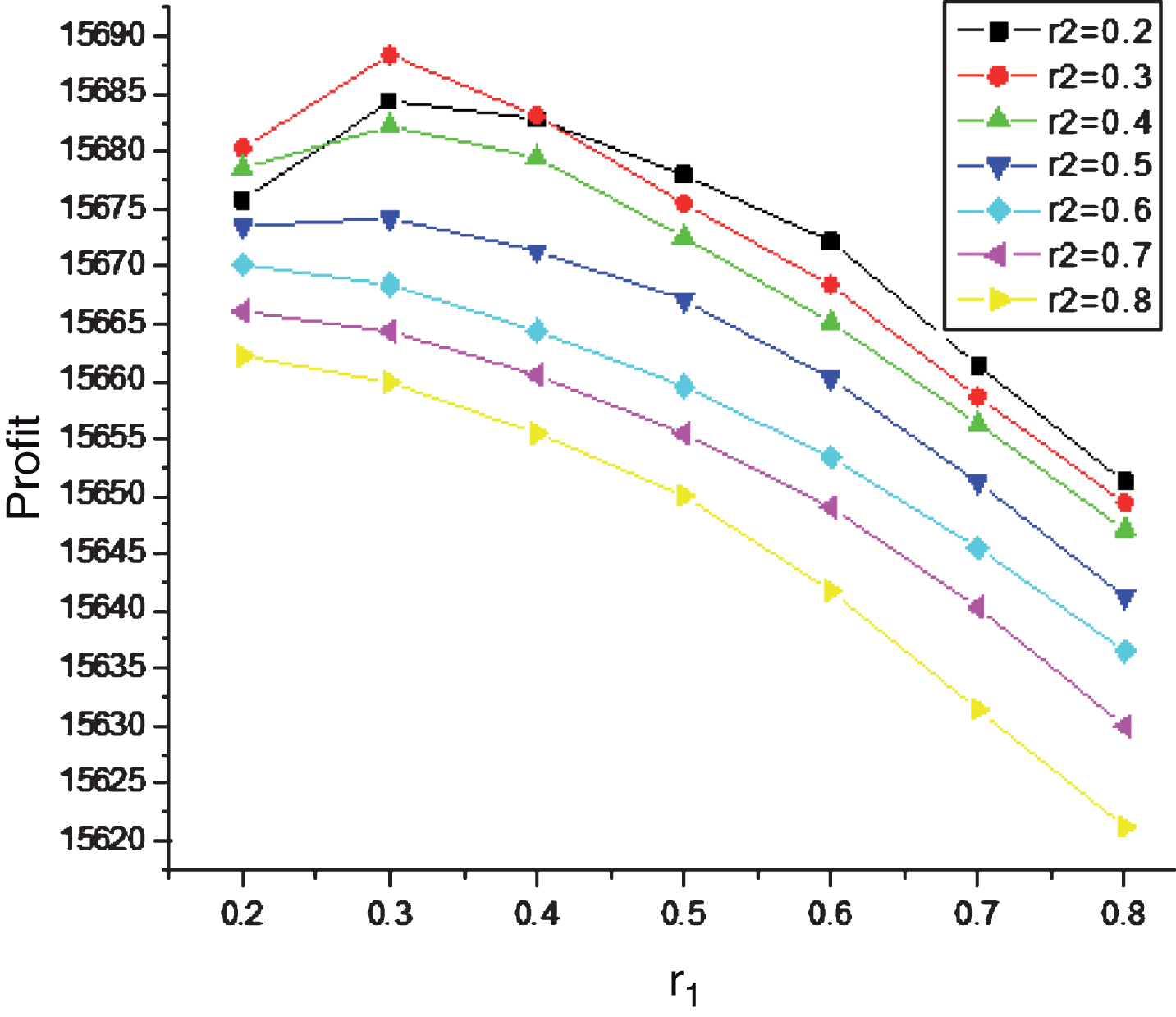
Profit against one defective rate for fixed values of other one (TrFM).
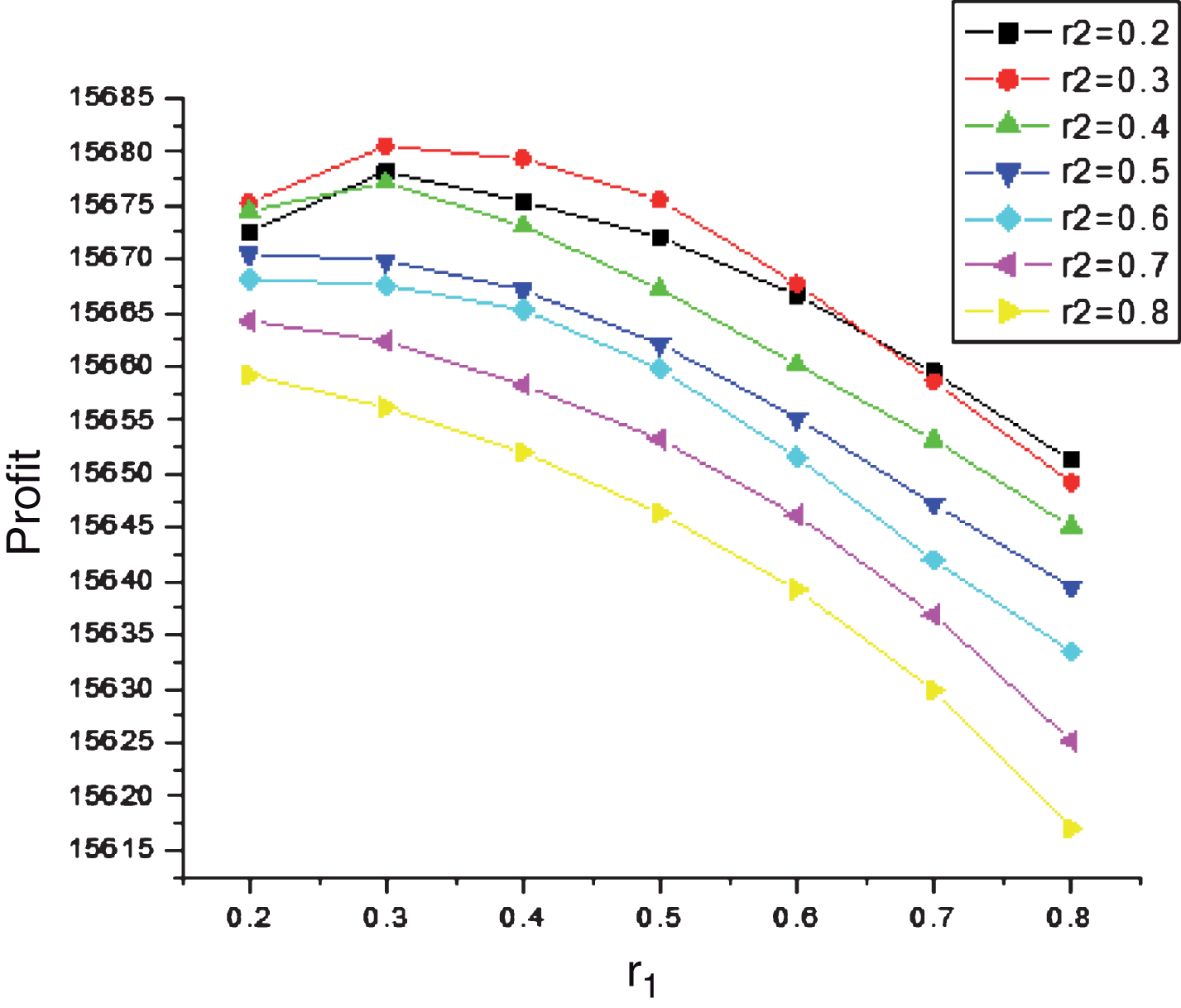
Profit against one defective rate for fixed values of other one (RAM).

Profit against one defective rate for fixed values of other one (ROM).
Again it is observed from the Table 3 that the profit is more in LFM model and less in random model. Though it is not possible to compare the the results of uncertain models or with the crisp model, yet it can be said that the profit in crisp model is more than the uncertain models. In these uncertain models, for different profit values, many factors may play their important role. From the tables, i.e., Tables 2 and 3, it is observed that the defective rates of the production process for uncertain models, i.e., the value of r1 and r2 are more than that of the crisp model and the profit may be effected by the smaller value of r1and r2.
In this section, we present a real life case for ‘Singha Plastic KGP’, a company at Kharagpur railway market, India. The plastic factory produces two types of electronic plastic toys - ‘Car’ and ‘bike’. The company regularly changes its products specification to attract the children’s attention. Naturally, the time horizon for the products is finite. Here, the production process produces perfect as well as some imperfect quality products. Imperfect units are reworked at a cost to bring back its quality to the original ones. Again, quality of the items deteriorates due to several factors like bad handling, quality of the raw ingredients, etc. To increase demand, the company imposes promotional effort (PE) such as advertising, delivery facility, better service, etc. Demands (D i ) of the items depend on stock and PE of the business policy. Unit production cost (c p i ) depends on both perfect production rate and the imperfect production process. A factory has a fixed capital for business (7850$) and a godown for storage of fixed capacity (500 units).
Now, the company wants to know the optimal production reliability indicator i.e., the defective rate of the production process which determines the production rate for the whole business so that total profit of the factory is maximized.
Here, for car and bike, the set-up costs are 50$ and 45$, raw material costs 10$ and 12$, holding costs 2$ and 2.1$ per unit, rework cost 5$ and 6$ and selling prices 60$ and 70$ respectively. Time cycle for the business is 2 years.
With these set of input data, the factory management analysed the production process following the above deductions and obtained the production reliability indicators as r1 = 0.2744 and r2 = 0.2831 for which the optimum profit of the factory is 15697.71$.
Conclusion
In this article, we have studied a multi-item EPQ inventory model. The model is developed with variable production rate, demand and also defective rate of the production process together with the production rate which are controllable. In this model, promotional effort is imposed to enhance the demands of the items. Again, the present model is developed with variational principle. It is a simple technique to optimize a function appears in an integral form. To the best of our knowledge, none has studied the multi-item production inventory model using this method. In the present investigation, considering three types uncertain constraints (fuzzy, random and rough), three sub-models have been presented and solved. In fuzzy model, imprecise parameters are reduced to the crisp one following fuzzy possibility method. In random model, it is considered that the parameters follow normal distribution with known mean and standard deviation. According to the assumption, following stochastic chance constraint approach, the constraints are reduced to the equivalent crisp constraints. On the other hand, here in the rough model, parameters are transformed to the crisp constraint following rough expectation. The present investigation reveals that the defective rate of the production process is an important factor which determines the production rate and thus determines the unit production cost and optimal profit for the production-inventory managers.
This paper can be extended to two warehouse inventory model along with different types of demands such as constant demand, time-dependent demand, etc. Further research work can also be made on the optimisation problem with other environments like intuitionistic fuzzy number (IFN), hesitant fuzzy element (HFE), linguistic fuzzy number (LFN) etc.
The limitations of the present investigation are as follows:
It is fact that investigation of an optimal control problem through variational principle is easy for derivation and computation. But, if the differential equation giving the rate of change of current stock is complicated, then it is very difficult to get the Euler-Legrange equations and their solutions. To make the investigation more realistic, we have considered the crisp, fuzzy, random and rough models with finite time horizon. But, in reality, this finite time horizon may be random, fuzzy, fuzzy-randon, fuzzy-rough, IFN, LFN, etc. In future, above considerations may be taken into account by future researchers.
Footnotes
Appendix
Let
Similarly possibility and necessity measures of
If
According to above definitions following lemmas can easily be derived.
According to Charnes and Cooper [6] & Rao [32], if all y i (i = 1, 2, . . . . , N) follow independent normal distribution, the stochastic problem stated above is equivalent to following crisp non-linear programming problem.