



Abstract
Here two-level supply chain model is considered for a deteriorating item where the retailer’s warehouse in the market place has a limited capacity. Therefore the retailer can rent a warehouse (RW) if needed with a higher cost compared to own warehouse (OW). This model includes one wholesaler and one retailer and our aim is to maximize the total profit. The demand rate in retailer is stock-dependent and in case of any shortages, the demand is partially backlogged. Retailer also introduces some promotional cost to boost the base demand of the item. It is established that if the wholesaler shares a part of promotional cost then channel profit as well as individual profit increase. The supply chain model is also considered for imprecise environment when different inventory parameters are fuzzy/rough in nature. In this case individual profits as well as channel profit become fuzzy/rough in nature. As optimization of fuzzy/rough objective is not well defined, following credibility/trust measure of fuzzy/rough event, an approach is proposed for comparison of fuzzy/rough objectives and a Particle Swarm Optimization (PSO) algorithm is used to find marketing decisions. Models are illustrated with numerical examples.
Keywords
Introduction
In the classical inventory model for deteriorating products, it is usually assumed that the warehouse has no limits in the capacity. However, in the real-life problem the situation is different. There are a number of factors which influence the optimum solution in different ways. Sometimes these factors may suggest retailers to buy more than their own warehouse (OW) capacity. In these situations, the retailers can benefit from a rented warehouse (RW).
Today’s globalized and competitive markets drive companies to become more efficient and cost-effective. Usually, supply chain (SC) members optimize local decisions without considering the impact of their decision on the other member’s performance and on the overall performance of SC [33]. Thus, a coordination mechanism may be necessary to motivate the members. SC members are dependent on each other and these members need to be coordinated efficiently by managing dependencies between each other. Jaber and Osman [15] considered a two-level supply chain with delay in payments and profit sharing. The ordering and advertising policies for a single-period commodity was presented by Chen [3] in a two-level supply chain. Wang [32] considered a two-level supply chain with multiple retailers and stochastic demand. Dong et al. [6] developed a model on multi-level supply chain.
Many researchers have discussed on inventory models for deteriorating items. Bhunia and Maiti [2] proposed a deterministic inventory model for deteriorating items with finite rate of replenishment. Mukhopadhyay et al. [27] developed an inventory model for a deteriorating item with a price-dependent demand rate. Yang [36] considered two-warehouse partial backlogging inventory models for deteriorating items under inflation. Chung and Huang [4] proposed a two-warehouse inventory model for deteriorating items under permissible delay in payments. Dye [7] developed a deterministic inventory model for deteriorating items with time-dependent backlogging rate. Lee and Hsu [19] proposed a two-warehouse inventory model for deteriorating items with time-dependent demand. Yu et al. [38] proposed a vendor managed inventory supply chain with deteriorating raw materials and products. Mishra [26] developed a deteriorating inventory model with controllable deterioration rate for time-dependent demand and time-varying holding cost.
The demand may be influenced by the amount of the product displayed on shelves. So many researchers have considered stock-dependent demand in their research. Gayen and Pal [10] proposed a two warehouse inventory model for deteriorating items with stock-dependent demand rate and holding cost. Das et al. [5] developed a two-warehouse production model for deteriorating inventory items with stock-dependent demand under inflation over a random planning horizon. Ghiami et al. [11] formulated an inventory model for a deteriorating item with stock-dependent demand, partial backlogging and capacity constraints. Prasad and Mukherjee [30] considered stock and time dependent demand for time varying deterioration rate with shortages for optimal inventory model. From the perspective of customer buying behavior, it is seen that besides stock of products other factors such as promotional cost through advertising, free gift coupon etc., also influence customers’ preferences and their purchasing decisions and hence market demand. Many researchers also have considered promotional effort dependent demand in their research. Wu [34] considered price and promotional effort dependent demand in supply chain. Giri and Sharma [12] discussed manufacturer’s pricing strategy in a two-level supply chain with competing retailers and advertising cost dependent demand. Pal et al. [29] have considered two-echelon supply chain with price and promotional effort sensitive non-linear demand. In this investigation, it is proposed to study the effects of stock and promotional cost jointly on demand.
For some products when a retailer is out of stock, the demand is lost which means the customer finds the item or a similar one in another store. Yang et al. [37] developed an inventory model under inflation for deteriorating items with stock-dependent consumption rate and partial backlogging shortages. Sarkar and Sarkar [31] proposed an improved inventory model with partial backlogging, time varying deterioration and stock-dependent demand.
There are several methods including meta heuristic algorithms in the literature to optimize the linear and non-linear problems. Inspired by the concerted actions of flocks of birds, shoals of fish, and swarms of insects searching for food, Kennedy and Eberhart [18] originally proposed particle swarm optimization (PSO) in the mid-1990s. Particle swarm optimization (PSO) can be considered one of the most important nature-inspired computing methods in optimization research. Among the most popular nature inspired approaches, when task is to optimize with complex data or information, PSO draws significant attention. Since its introduction a very large number of applications and new ideas have been realized in the context of PSO [9, 24]. But till now PSO is not significantly used to solve inventory control problems [14].
Due to rapid increasing complexities of the environment it is difficult to define different inventory parameters precisely. As a result it may not be possible to define the different inventory costs as well as the constraints precisely. For example production of an item in any manufacturing organization deeply depends on efficiency, effectiveness of the system, i.e., quality of the process output, inventory turnover ratio and so many factors related to the production process, which leads to uncertainty/ impreciseness in any production process. Impreciseness can be modelled using fuzzy, stochastic and rough variables. Kao and Hsu [17] discussed the inventory problem with fuzzy demands where back-orders are permitted. Maiti and Maiti [23] developed a model as a single/multi-objective programming problem under fuzzy constraint, where purchase cost, investment amount and storehouse capacity are imprecise in nature. Xu and Yao [35] introduces discrete and continuous random rough variables.
In this study, we consider a two-level supply chain consisting of a wholesaler and a retailer in which there is a limit in the retailer’s warehouse capacity. The retailer rents another warehouse to store the units. The item has a base demand d and another portion of demand which is displayed inventory dependent. Retailer invests some promotional cost to improve the base demand of the item. Amount of promotional cost is determined by the retailer. The product is deteriorated with a constant rate. Shortages are also considered and backlogged partially. It is established that if the wholesaler shares a part of the promotional cost, then the profit of both parties increase. Model is analyzed in imprecise environment also when different inventory costs like set-up cost, holding cost and the constant of the promotional cost function are fuzzy/rough in nature. As optimization of fuzzy/rough objective is not well defined, following credibility/trust measure of fuzzy/rough event is proposed for comparison of fuzzy/rough objectives. A Particle Swarm Optimization (PSO) algorithm and GRG method (using LINGO 14.0 software) are used to find optimum marketing decisions. Models are illustrated with numerical examples and compared.
Comparison of previous research works have shown in Table 1. The new ideas incorporated in this investigation are as follows: The joint effect of stock and promotional cost on demand is considered. The supply chain models with above demand are formulated and solved in both fuzzy and rough environments. PSO (cf. Pakhira et al. [28]) is appropriately used for optimum results. The results for PSO and LINGO are compared in crisp environment.
Comparison of Previous Research Works
Comparison of Previous Research Works
Rest of the paper is given as follows: In Section 2 assumptions and notations required to developed the model are presented. In Section 3, mathematical formulation of the model is done. Numerical illustration is made on Section 4, discussion is made on Section 5 and a brief conclusion is presented in Section 6. Some mathematical preliminaries are given in Appendix A.
The following assumptions and notations are used in this study:
It is an infinite time horizon EOQ model for retailer with constantly deteriorated items. Lead time is zero. Demand is stock and promotional cost dependent. Shortages are allowed and partially backlogged. Rate of replenishment is infinite. Two warehouses - OW and RW are considered. Sales are performed from OW and units are transferred from RW to OW by continuous release pattern. The promotional cost to boost demand is shared by both wholesaler and retailer.
Symbols ˜ and ˇ are used on the top of some of the above notations to indicate fuzzy and rough variable respectively.
Mathematical formulation
Retailer’s inventory level (OW and RW)
Considering the model, in case of having inventory at both OW and RW, the retailer uses the inventory at the RW first following continuous release pattern (cf. Fig. 1). Let I o (t) and I r (t) be the inventory level at the OW and the RW respectively. At the RW the inventory is depleted by a demand which is connected to the inventory level at the OW. Therefore, the changes of inventory level at the RW between the start of the inventory period and t r can be presented by the following differential equations:
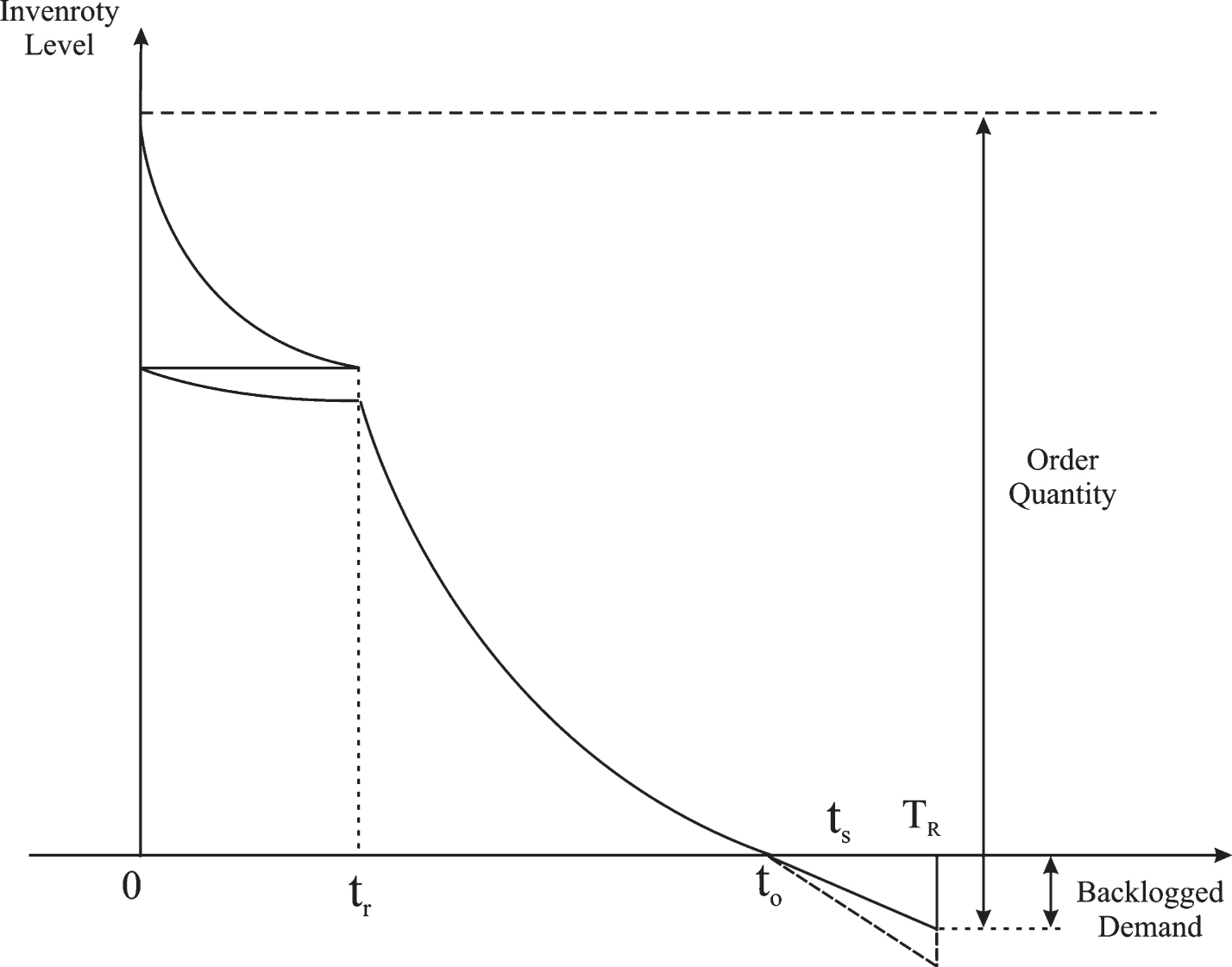
Graphical presentation of the inventory level at the RW and the OW at the retailer
While the retailer is using the inventory at the RW to meet the demand, the inventory level at the OW goes down by a constant rate of the inventory level due to deterioration as follows:
At time t r , the inventory at the RW is depleted completely and the inventory at the OW is used. The inventory level at the OW decreases due to the demand and deterioration until it reaches zero at t o . This changes of inventory level at the OW is presented by the following differential equations:
From t o to T R the system is out of stock and unmet demand is partially backlogged.
In order to solve the presented differential equations, the following boundary conditions should be considered:
By solving the differential equations in (1)-(4), the inventory levels at the OW and RW are obtained:
Equating the inventory level at the OW at t = t r from (6) and (7):
The order quantity for the retailer is the sum of the initial inventory level at the RW and OW and the total backlogged demand during one inventory period.
The length of the inventory period at the retailer is the sum of t o and t s .
The order quantity and the length of the inventory period for the wholesaler are Q W and T W respectively. We assume that T W is a multiplication of T R (i.e., T W = kT R , where k is an integer).
The order quantity for the wholesaler is equal to the inventory needed for k periods at the retailer (i.e., kQ R ), plus the amount of deterioration during the wholesaler’s inventory cycle (i.e., D W ). It should be noted that during the k-th interval, there is no inventory in the wholesaler and, after receiving Q W of product at the end of T W , Q R is sent to the retailer. Therefore there is no deterioration during this interval in the wholesaler. The order quantity for the wholesaler can be calculated as follows:
Fig. 2 illustrates the inventory level in the wholesaler. Here, one inventory period in the wholesaler consists of k retailer’s inventory periods. At the time (k - 2) T R and (k - 1) T R , the inventory level at the wholesaler drops by Q R and a constant rate of the inventory is deteriorated during the interval [(k - 2) T R , (k - 1) T R ]. The change in inventory level at the wholesaler during this interval can be presented by the following differential equation:

Graphical presentation of the inventory level at the wholesaler
Considering the inventory level at the wholesaler at (k - 1) T R which is Q R , the inventory level for the specific period will be:
In a similar way, the inventory level at the wholesaler can be obtained for the period starts at (k - 3) T R using (13), considering the boundary condition derived from (14) at t = (k - 2) T R :
In this way, the inventory level at the wholesaler during i-th interval can be calculated as follow:
Total deterioration (D R ) during the retailer’s inventory cycle is the sum of deterioration at the RW (D RW ) and at the OW (D OW ):
Hence, the total selling price per unit time for the retailer:
The retailer has different types of cost: ordering cost (A R ), purchasing, carrying, deterioration and shortage costs. The purchasing cost for the retailer is:
Total inventory carrying cost (ICC R ) during the retailer’s inventory period is the sum of carrying cost at the RW (ICC RW ) and at the OW (ICC OW ):
Deterioration cost (DC R ) at the retailer includes both deterioration at the RW and the OW:
During the shortage period, the demand is partially backlogged. There are two different types of shortage cost; one is based on per unit for the lost sale and the second is for backlogged demand which is per unit per unit of time.
Hence, the total cost per unit time for the retailer:
With the above costs, retailer spends some promotional cost (PrC) to increase the demand as follows:
Using (18), (23) and (24) the total profit per unit time of the retailer (TP R ) is:
Based on (16), the amount of the deterioration in each interval can be calculated as follows:
Therefore, the total deterioration at the wholesaler (D W ) during T W can be obtained as:
Using (12) and (26), the wholesaler’s order quantity can be calculated as follows:
Hence, the total selling price per unit time for the wholesaler:
The wholesaler has the following cost: ordering cost (A W ), purchasing, carrying and deterioration costs. The purchasing cost for the wholesaler is:
Inventory carrying cost for the wholesaler during the i-th interval is:
Hence, the inventory carrying cost for the wholesaler (ICC W ) during one inventory period (consider that there is no carrying cost during k-th interval) is:
The total deterioration cost at the wholesaler (DC W ) during T W is:
Hence, the total cost per unit time for the wholesaler:
Using (28) and (32) the total profit per unit time of the wholesaler (TP W ) is:
According to the above discussion, two cases may arise:
the wholesaler does not share any part of the promotional cost. In this case, inventory decisions are made by retailer only. i.e., only retailer’s profit is maximized to find marketing decision. the wholesaler shares a part F of the promotional cost; i.e., the wholesaler pays Fg (ρ - 1) 2d
m
and the retailer pays the remaining part (1 - F) g (ρ - 1) 2d
m
of the promotional cost. In this case, inventory decisions are made by retailer and wholesaler jointly. i.e., joint profit of retailer and wholesaler is maximized to find marketing decision.
These phenomena are termed as non-coordination scenario and coordination scenario respectively. These two scenarios are discussed separately.
In this scenario, we maximize TP R , which is a function of t r , t s and ρ. So the problem is as follows:
In this scenario, the wholesaler offers to pay a fraction (F) of the promotional cost. Then the retailer’s profit is
The wholesaler’s profit is
Here we maximize the total profit of retailer and wholesaler (TP) and TP is a function of t r , t s , ρ and k.
So the problem is as follows:
The retailer’s and the wholesaler’s profits under the non-coordination scenario are viewed as the lower bounds for the model under the coordination scenario. Let TPR′ and TPW′ be the lower bounds of retailer’s and wholesaler’s profit respectively.
true cm
(b) For the proofs of this part, readers may follow Pakhira et al. [28].
As discussed in the introduction section that in real life most of the inventory parameters are fuzzy in nature. When some of the inventory parameters are fuzzy in nature model reduces to a fuzzy model. Normally set up cost, holding cost are imprecise in nature. In this model let us consider set up costs A
R
, A
W
, holding costs h
r
, h
o
, h
W
and the constant g of the promotional cost as fuzzy numbers
Fuzzy model in non-coordination scenario
According to the above assumptions in this case individual profits and total profit of retailer and wholesaler are reduces to fuzzy numbers and represented by
Considering the fuzzy numbers
For i = 1, 2, 3
In this approach credibility measure of fuzzy event is used to compare the solutions. According to this approach X
a
dominates X
b
if Cr(
For the coordination scenario the individual profits and total profit as fuzzy numbers are represented by
In this model let us consider set up costs A
R
, A
W
, holding costs h
r
, h
o
, h
W
and the constant g of the promotional cost as rough variables
Rough model in non-coordination scenario
According to the above assumptions in this case individual profits and total profit of retailer and wholesaler are reduces to rough variables and represented by
Considering the rough variables
For i = 1, 2
In this approach trust measure of rough event is used to compare the solutions. According to this approach X
a
dominates X
b
if
For the coordination scenario the individual profits and total profit as rough variables are represented by
The model is illustrated with two sets of hypothetical data which are presented below:
c = 0.2, d = 200, g = 1.1, m = 1.2, W = 200, α = 0.05, β = 0.08, γ = 0.03, δ = 0.85, A R = 1500, A W = 2500, p W = 5, s W = p R = 8, s R = 14, h r = 1.2, h o = 0.8, h W = 0.3, c sf = 20, c sv = 0.8.
For fuzzy model: AR1 = 1400, AR2 = 1500, AR3 = 1600, AW1 = 2400, AW2 = 2500, AW3 = 2600, hr1 = 1.1, hr2 = 1.2, hr3 = 1.3, ho1 = 0.7, ho2 = 0.8, ho3 = 0.9, hW1 = 0.25, hW2 = 0.3, hW3 = 0.35, g1 = 1.0, g2 = 1.1, g3 = 1.2. All other parametric values are same as crisp model.
For rough model: AR1 = 1400, AR2 = 1500, AR3 = 1350, AR4 = 1600, AW1 = 2500, AW2 = 2600, AW3 = 2400, AW4 = 2650, hr1 = 1.1, hr2 = 1.2, hr3 = 1.05, hr4 = 1.25, ho1 = 0.8, ho2 = 0.9, ho3 = 0.75, ho4 = 0.95, hW1 = 0.25, hW2 = 0.3, hW3 = 0.2, hW4 = 0.35, g1 = 1.05, g2 = 1.15, g3 = 1.0, g4 = 1.2. All other parametric values are same as crisp model.
For the above set of assumed parametric values, for crisp model, in non-coordination scenario (NCS), TP
R
is optimized to find optimum decision for the retailer and optimum t
r
, t
s
, ρ are determined. For these values of t
r
, t
s
, ρ, TP
W
is optimized to find optimum k for the wholesaler. Again in coordination scenario (CS) optimum results are obtained by optimized TP. The value of F is taken as
Optimum Results for Experiment-1 using LINGO 14.0 software and PSO technique
Optimum Results for Experiment-1 using LINGO 14.0 software and PSO technique
Parametric study of k for Experiment-1 using PSO technique
For Experiment-1, in crisp model, total profit is optimized in CS due to sharing of different portion (F) of promotional cost between F min and F max by the wholesaler and the profits of both the parties are tabulated in Table 4. For NCS, TP R = 396.96 and TP W = 232.98. Here it is shown that if F = 0.63 < F min , where F min = 0.633 then the retailer’s profit in the CS (395.98) is less than that in the NCS (396.96). Also if F = 0.93 > F max , where F max = 0.929 then the wholesaler’s profit in the CS (232.53) is less than that in the NCS (232.98). So it is found that for F min < F < F max profit of both the parties increase to some extent. All these calculations are done by using PSO technique. The value of k is found by parametric study on k.
Values of TP R , TP W due to different F in CS for Experiment-1
For Experiment-1, in crisp model, a sensitivity analysis of c and d are presented in Table 5 following PSO technique. In both the non-coordination and coordination scenarios optimum k are obtained by parametric studies on k and optimum results are presented. Here it is shown that if c or d increases in both the scenarios (NCS and CS) then the individual profits as well as total profit of retailer and wholesaler increases.
Sensitivity Analysis of c and d for Experiment-1 using PSO technique
For fuzzy and rough models, the Experiment-1 is made using PSO technique following credibility measure and trust measure approach respectively and the results are presented in Table 6. Optimization is made by taking fuzzy objectives directly in credibility measure approach and the optimization is done for rough objectives directly in trust measure approach. In coordination scenario value of F is taken as 0.78 and in both the scenarios optimum k are obtained by parametric studies on k.
Results of Fuzzy and Rough model following PSO for Experiment-1
c = 0.18, d = 200, g = 1.27, m = 1.2, W = 180, α = 0.05, β = 0.07, γ = 0.02, δ = 0.83, A R = 1500, A W = 4000, p W = 6, s W = p R = 10, s R = 18, h r = 1.2, h o = 1.0, h W = 0.3, c sf = 8, c sv = 1.4.
For fuzzy model: AR1 = 1400, AR2 = 1500, AR3 = 1600, AW1 = 3900, AW2 = 4000, AW3 = 4100, hr1 = 1.1, hr2 = 1.2, hr3 = 1.3, ho1 = 0.9, ho2 = 1.0, ho3 = 1.1, hW1 = 0.25, hW2 = 0.3, hW3 = 0.35, g1 = 1.25, g2 = 1.27, g3 = 1.3. All other parametric values are same as crisp model.
For rough model: AR1 = 1400, AR2 = 1500, AR3 = 1350, AR4 = 1600, AW1 = 4000, AW2 = 4100, AW3 = 3900, AW4 = 4150, hr1 = 1.1, hr2 = 1.2, hr3 = 1.05, hr4 = 1.25, ho1 = 1.0, ho2 = 1.1, ho3 = 0.95, ho4 = 1.15, hW1 = 0.25, hW2 = 0.3, hW3 = 0.2, hW4 = 0.35, g1 = 1.27, g2 = 1.3, g3 = 1.25, g4 = 1.32. All other parametric values are same as crisp model.
For the above set of assumed parametric values, TP R and TP are optimized for NCS and CS respectively and optimum results obtained using LINGO 14.0 software and PSO technique are presented in Table 7 and 8 respectively. It is found that results obtained following both the techniques are almost same.
Optimum Results for Experiment-2 using LINGO 14.0 software
Optimum Results for Experiment-2 using PSO technique
All other results of Experiment-2 are almost same as Experiment-1. Sensitivity analysis of c and d for Experiment-2 using PSO technique are presented in Table 9. Results of fuzzy and rough model following PSO technique for Experiment-2 are presented in Table 10.
Sensitivity Analysis of c and d for Experiment-2 using PSO technique
Results of Fuzzy and Rough model following PSO for Experiment-2
From the above results of both the experiments, the following observations are made: It is found in all the experiments that promotional effort of the item is grater than 1. So promotional effort has a positive effect in a supply chain. It is also found that the profits for both the parties (i.e., wholesaler and retailer) increase in the coordination scenario than the non-coordination scenario for a compromise value of F, i.e, if the wholesaler bears a compromise portion of promotional cost then it is beneficial for both parties. So theoretical expected result agrees with numerical findings. An approach is proposed where fuzzy/rough objective is directly optimized without transforming it into equivalent crisp objective.
Conclusion
A coordinated SC sharing the promotional cost among the wholesaler and retailer is formulated and solved with stock and promotional cost dependent demand. For the first time, with the above demand, sharing of promotional cost between SC partners is determined for maximum channel profit. Here, a conventional PSO algorithm is presented and used for the above problem. Its results are compared with the LINGO 14.0 results. The present model can be extended to include trade credit - one or two levels, price discount, variable deterioration etc. Here, instead of continuous release pattern, bulk release system also can be used between OW and RW.
Footnotes
Appendix-A Mathematical Preliminaries
Let
On the other hand necessity measure of an event
Similarly credibility measure of an event
If
Using these definitions the following lemma can easily be derived