



Abstract
Smart city relies on the smart transportation. And the smart savings on private car pooling based on internet of vehicles will greatly facilitate the expansion of smart transportation. The paper puts forward the smart savings scheme for private car pooling, establishes the dynamic relationship of human – vehicle – road during carpooling process basing on internet of vehicles. We applied the route recommendation technology, information matching technology, information notification technology, dynamic information searching technology and collaborative route optimization technology to the carpooling system to improve the real-time, accuracy and efficiency of carpooling process in uncertain dynamic demand market and realize the smart savings on private car pooling. Finally, we take an area of Huai’an as example to verify the feasibility of the program and technologies. The experimental results show that the carpooling program (TCP) increased 40% on the private car seat utilization, saved 30.7% on the total travel cost and 38.4% on total travel time than the other existing carpooling program (TECP).
Keywords
Introduction
The problems with existing private car pooling through mobile Internet include low matching degree and operational efficiency, poor real-time, etc. Especially it is hard to meet the dynamic uncertain demand during the operation. Therefore, we put forward the smart savings scheme on private car pooling through internet of vehicles innovatively.
Currently, there are many researches on the relationship between the internet of vehicles and traffictechnology application, the main trend is vehicle route guidance in the internet of vehicle, but study on private car pooling program through internet of vehicle has not been involved in yet [1]. The paper will establish the dynamic relationship of human – vehicle – road during carpooling process basing on internet of vehicles by combining the route recommendation technology, information matching technology, information notification technology, dynamic information searching technology and collaborative route optimization technology to improve the real-time, accuracy and efficiency of carpooling process in uncertain dynamic demand market and realize the smart savings on private car pooling and then provide technical support for the development of smart transportation.
Smart savings scheme on private car pooling based on internet of vehicles
In order to realize smart savings on private car pooling based on internet of vehicles, the paper proposed the related carpooling solutions innovatively. The specific procedures are asfollows:

Smart savings scheme on private car pooling based on internet of vehicles.
Route recommendation technology for private car pooling
Smart carpooling route recommending through data mining on individuals
The data mining technology develops rapidly, by which we can find out the hidden relevance between different projects and the category features through analyzing the information in a transaction database [2]. In the carpooling user database, the valuable knowledge that may reflect the users’ carpool selection habits and preferences is hidden inside the passenger information, owner information and their carpooling records and viewing logs, etc. We could figure out this potential information by data mining technology and provide smart recommendations and route reference for carpool users, so as to save operating time and improve the success rate of carpooling.
Construction of data mining model mainly focuses on Extreme Learning Machine (ELM) algorithms. ELM is a kind of neural network learning algorithms, which is specifically simple to use, effective single hidden layer feed-forward neural networks (SLFNs) learning algorithm [3]. It has very strong adaptive capabilities for new learning samples. Using the ELM modeling method, we dealt with the carpooling process as six stages: business understanding, data understanding, data preparation, learning model, test model and information delivery, then established the smart carpooling route recommending model based on ELM. Using the data mining technology on users, the system recommends routes to users smartly when carpooling service is selected.
Smart carpooling route recommending based on individual needs
If the users are not satisfied with the recommended routes based on individual data mining, they can set their own demands, and the system will recommend routes according to individual needs again. The users need to enter a start address À, a destination address B, and the starting time span (limit the time difference within 5 minutes), then click OK. As shown in Fig. 2, in the internet of vehicles, the system considers three factors–the distance, travel time and congestion status of each route between starting point and ending point comprehensively. It suggests an optimal carpooling route C for user with Dijkstra’s algorithm, graph theory model, time calculation function with road impedance, and the method of setting weights. The specific calculation method is omitted since it is the same as route recommending algorithm for owners accepts to change route when passengers have special requirements on going through the locations S, the owners add location S in the additional conditions after entering the starting address, destination address and departure time zone, then click OK. The system will determine the route D according to the route recommendation algorithm. If the owners are not satisfied with the recommended routes above, they can set routes manually, namely the route E.

Recommended carpooling route through data mining on individuals.
Path matching
(1) Section division principle
Once the owners and passengers determined the route, the system will divide the rout into pieces of sections with certain principles, the division principles [4] are as follows: Set the start and end points released by owners and passengers as the primary section points (regional boundary point)–c1 to c
i
; intersections as secondary section points–D1 to D
i
; The locations of secondary section points are fixed, and the positions of primary section points vary with accordance with user’s start and end points; Distance between sections points is a region, therefore numbers of regions are defined; Name the defined regions as A
x
, then the owners are named from A1 to Ak, including the shared regions from A
i
to A
j
; passengers are named from B1 to B
l
, the names of shared regions keep consistent with that of the owners.
(2) Path matching degree calculation
The range of path matching degree p1 is [0, 1]. The matching degree is allocated by the portion of separate shared regions on the total number of regions [5], which is calculated as follows:
Collection of owners’ regions X = {A1, A2, …, A
i
, …, A
j
, A
k
}, collection of passengers’ regions Y = { B1, …, B
l
, A
i
, …, A
j
} , collection of shared regions Z = X ∩ Y = { A
i
, …, A
j
}
Where, M is the distance of shared region; N is the total distance; l I is the distance of region A I ; K is the number of owners’ regions; l is the number of passengers’ regions.
When matching the time for owners and passengers, the system estimated the time range for owners to arrive passengers’ start point with the time difference K by considering the road impedance and conditions gained from the vehicle network. In order to improve the matching accuracy and success rate, it is recommended to take the value of K [5, 10], in minutes. Put the time data into database, set time matching degree as P2 with the range of [0, 1], which is calculated as follows:
The estimated time for owners to reach the passengers’ point C = { C1, C2, C3, C4, C5, C6 }

Time matching diagram.
Passenger Departure Time D = {D1, D2, D3, D4, D5, D6}, Shared time E = C ∩ D = { E
i
} , 1 ≤ i ≤ 6, as shown in Fig. 3:
Where in, L is the shared time for carpooling, K is the time difference with the value [5, 10].
When releasing carpooling information, the owners need to enter the number of seats available a, and passengers need to offer the number of carpoolers c. If the owners are carpooling and the number of passengers is b, then the number of seats available is a-b. The value of carpoolers matching degree P3 depends on the relationship between a - b and c, that is a - b ≥ c, P3 = 1; a - b < c, P3 = 0.
Total matching degree calculation
Information matching degree includes matching on three aspects: path, time and the number of carpoolers and the calculation of total matching degree depends on the three matching degrees [6]. If any one of the three is 0, the total matching degree will be 0. The total matching degree P is calculated as:
Wherein, P1 is the path matching degree; P2 is the time matching degree; P3 is the matching degree on number of carpoolers; α, β, γ are given weights for each matching degree.
The survey had found that the number of carpoolers is generally 1 or 2 people; the situation for peoples more than 3 to carpool together is seldom. Therefore, the seats provided by car owners satisfy the needs of passengers generally, which has greatly reduced the effect of number of carpoolers on the total matching degree. Through the test platform of Key Laboratory of Transport and Security in Jiangsu, the optimal matching results can be achieved when the given weights for the path, time and the number of carpoolers are α = 0.3, β = 0.5, γ = 0.2.
After the users entering carpool information, the system calculates the users’ matching degree according to the weights above (0.3,0.5 and 0.2). The tests have proved that the information matched relatively well when the total matching degree is 0.7. Then we take 0.7 as the threshold value for information matching degree.
When owners began to search passengers within their information searching range, if the matching degree P ≥ 0.7, the system extracts the matching data and puts into the database, then recommends five passengers match the most to the owners. For P < 0.7, the system automatically discards the data acquisition. The methods for passengers-owners matching and recommendation are the same as above.
If not satisfied with the results feed backed by system, the user could choose to give up the matching results automatically and match manually to his requirements by setting path, time and the proportion of the number of carpoolers by himself [7]. Then the system calculates the matching degree, put matching information for which the matching degree are top five into the database and wait for the information notice.
Information release technology for private car pooling
After the route recommending, if matches successfully, the system releases related carpooling information to users about the contact information for both sides, license plate number, carpool location, expected riding time and carpool routes, etc. while notify each other whether they are willing to search and accept new carpoolers on the way [8]. At the same time, the system notifies the users with unsuccessful matching to set the proportion of each matching degree and re-match.
The PUSH technology is adopted in the internet of vehicles for carpool information notification, which is based on the Client/Server (C/S) mechanism and send information from Server to Client [9]. The push modes include polling-style, SMS and persistent connection. Carpool information notification is mainly pushed through SMS. The system sends binary messages to users’ mobile client, and the Client learns intentions from Server (carpooling system) through intercepting the SMS and parsing the content of the message, and then makes the appropriate processing.
Dynamic carpooling information searching technology for moving cars
If the vehicle still has vacancy available before departing, the owner may set the search scope for carpoolers by himself, which is defined as the buffer distance M on both sides of the route. Considering the carpooling time and fuel costs, the value range of M is [0, 1000], in meters. Passenger’s search range takes himself as the center and search a circular buffer region outwardly with radius W. W takes values of [0, 1000], in meters, and W <M. As shown in Fig. 4, area inside the tag box is the search range for owners, and shaded circular areas are search ranges for passengers. Once the search ranges are determined, search information on both sides’ ranges through the internet of vehicles to meet the dynamic carpool demand.

Information Searching range of the carpooling users.
Since there are new passengers joining beside the original carpooling route or traffic environment changes during operation, the carpool platform will consider the road impedance of the carpooling routes comprehensively and re-recommend a new route for the owners to save travel time [10, 11]. The owners decide to accept or not changing the carpool route. There are four conditions as following: 1) Without changing the route after accepting new passengers. The passengers not on the fixed route would be taken to the route firstly by another carpooler and then carpool with existing car owner; 2) The passenger requires to pass by the specific route with congested section and the owner is unwilling to change route, then the owner can only wait more time; 3) The owner changes the route after accepting the order. Then the system fine adjusts the route by integrating time, cost and traffic conditions. That is to recommend the start point for reaching the dynamic new passengers and optimal route for returning the determined route. Due to changing the route, the new passenger should pay more fees appropriately. And the extra charges will partly be compensation to existing carpool passengers and partly be compensation to the owner; 4) When the passenger has no special requirements on the travel route, the owner could fine adjust the route to save time without increasing costs too much.
The owners don’t accept to change route
Considering the cost increasing will be greater than the benefits caused by changing routes, the owners usually refuse to change routes. Based on the Internet of Vehicles, the system will match the passenger with another car owner, who will drive the passengers to the intersection of their carpool route with the owner, then they will carpool successfully.
As shown in Fig. 5, Passenger one and passenger two have the same destination, H point, the yellow route AE & GB are the owner’s individual route, the red route CE is the passenger one’s individual route, the green route FD is the passenger two’s individual route, the brown route EG is their carpool route. Based on the Internet of Vehicles, firstly the system will match the passenger one with another car owner M who will drive him to the point E, then he can carpool with the car owner. During the ride of the owner and passenger two, if the owner gets the carpooling information of passenger two recommended by the system and accepts the order, the passenger two will similarly be driven to the point F by another car owner N, and then he can car pool with the car owner. In the carpooling platform of the Internet of Vehicles, after the 2 passengers arriving at point G, they will carpool with the car owner S coming from another way, who will drive them to the destination H.

Carpooling routes diagram.
Considering the better road conditions, very little distance increasing and acceptable fuel consumption, saving the time of arrival caused by changing route, the owner will accept to change route. In this case, the owner has many routes to arrive at the starting point of the carpooling route with passengers, or to bypass the congested roads. The system calculates the shortest route distance and cost by combining graph theory with Dijkstra algorithm and distance matrix, calculates the driving time of each route by using road impedance function, and calculates the distance, time and cost with a certain weight, then recommend the optimal route to the owner [12]. The owner fine adjusts the route and goes back to the original route ultimately.
As shown in Fig. 6, the yellow route AH & MB are the owner’s individual route, the red route CI & ED are the passenger one’s individual route, the green route FJ & MG are the passenger two’s individual route, the brown route IN & JM are their carpool route, the line HCI & NFJ are fine-adjusted routes. During the ride of the owner and passenger one, if the owner gets the carpooling information of passenger two recommended by the system, and accepts the order on the device. Then the system stimulates the route to pick up passenger two for the owner and go back to the original route ultimately. In the carpooling platform of the Internet of Vehicles, after the passenger one arriving at point E, he will car pool with a car owner coming from K direction and be driven to the destination D. Similarly, after the passenger two arriving at point M, he will car pool with a car owner coming from L direction.

The fine-adjusted carpooling routes diagram.
Therein, there are many routes to be chosen from H to C, C to I. Based on an overall consideration of distance, time, cost factors; we screen each route suitable for driving [13]. The enlarged view of partial H-C-I routes is shown as Fig. 7.

The partial enlarged view of the regional routes.
According to actual situation, confirm the distance of each section and average driving cost, calculates the shortest route distance and cost among all the routes by combining graph theory with Dijkstra algorithm and distance matrix. As to the route-time selection algorithm, treats the HC as an OD pair, and treats the CI also as an OD pair, there are m random routes between each OD pair, and each route has its own traffic capacity, take the road impedance into account, because there might be sudden accidents congestion on the select route.
If there is a traffic congestion caused by sudden accident on the selected route of OD, then the congestion coefficient of the route will increase, its traffic capacity will reduce, so it will spend more time on this route.
Algorithm principle: Impedance function is:
Wherein, v
k
means car’s driving speed on the road at a certain moment; v
f
is the driving speed of Free flowing; k stands by the traffic density of the road at a certain moment; kmax is the traffic density When traffic jam. The formula between the speed, flow and density is:
Assume the length of the road is one, so the driving time of the road should be , the driving time on free condition of the road is , the driving speed can be derived as: , and the impedance function formula can be linear transformed as: , put v
k
and this k function into the q
k
:
The formula can be transformed to the equation about :
When there is no any unexpected traffic jam, that is q
k
≤ C, the solution of equation is:
Thus, the formula of calculating driving time should be:
Upon the above formula, the system can calculate the driving time of each route, and the final score of each route by weighting the distance, time, cost with 0.2, 0.3, 0.5 separately, then recommend the optimal route to the owner. The owner fine tunes the route and goes back to the original route ultimately.
Once the passengers arrive at destination, the carpooling comes over. The system will measure the travel distance for different passengers according to the pre-settled charge standards, and calculate the carpooling charge for each passenger [14].
According to the current fuel price and car’s energy consumption, the cost of private car is 0.8 yuan per kilometer that is shared by owner and passengers, so the charge standard would be settled as Table 1.
The carpool charges standards (Passengers: person; charges: yuan/km)
The carpool charges standards (Passengers: person; charges: yuan/km)
After clearance of charges, carpool users can assess their partners during this carpooling trip on the last page of client, that is to say, the owner assess the passengers, and the passengers assess the owner. The assessment levels are scaled into five grades, which are more satisfied, satisfied, general, unsatisfied and very unsatisfied. The assessment directly affects their credits, which will affect their order of priority in process of information matching for the next carpool.
Huai’an is an important central city of Northern Jiangsu, and for which the expressway network is being built as “One ring + Two vertical and one horizontal + Rays”. The paper took part of the test running area in Huai’an as an example to verify the scheme basing on the platform of Key Laboratory of Transport and Security in Jiangsu [15].
One car owner departed from the intersection of Huai Hai Road and Mei Gao Road, destined at the intersection Jian Kang Road and Cheng De Road, and the car was expected to arrive Cheng De Road at 17 : 30–17 : 35, the owner could offer four seats for carpooling. Before the vehicle departing, the system had matched four passengers for it, which located at M1, M2, M3, M4 separately and the end point was the Wanda Plaza on Xiang Yu Avenue. We take one of the passengers M1 as an example to explain the matching algorithm. M1 began carpooling at the intersection of Cheng De Road and Mei Cheng Road, and destined at the intersection of east Huai Hai Road and Xiang Yu Avenue, the riding time was 17 : 32–17 : 37, only one carpooler.
When owners and passengers open the carpool software, click the service “I want to carpool”, the system will firstly recommend routes through the personal data mining technology – extreme data machine algorithms in the internet of vehicles. not If not satisfied with the recommended results, owners or passengers may enter their own personal needs to get new recommendation from the system again or manually select the route, and then ultimately determine the route shown in Fig. 8. Routes for owners are C1D1D2D3D4D5D6C2, and routes for passengers are C3D2D3D4D5D6C4.

Carpool route map for sections of Huai’an.
The system matches users’ information after the route is determined. According to the principles of sections division, the sections are divided and named as shown in Fig. 8. C1 to C4 are primary segment points, D1 to D6 are secondary segment points.
Collection of owners’ regions X = {A1, A2, A3, A4, A5, A6}, collection of passengers’ regions Y = { B1, B2, A3, A4, A5, A6 } , collection of shared regions Z = X ∩ Y = { A3, A4, A5, A6 } .
The time expected for owners to reach the carpooling passengers’ locations C = {17 : 30, 17 : 31, 17 : 32, 17 : 33, 17 : 34, 17 : 35},passengers’ departure time D = {17 : 32, 17 : 33, 17 : 34, 17 : 35, 17 : 36, 17 : 37}, the sharedtime E = C ∩ D = {17 : 32, 17 : 33, 17 : 34, 17 : 35}.
The 4 seats available are more than 1 carpoolers, then P3 = 1.
Total matching degree , since P is greater than the threshold value 0.7, and then put the user’s data into the database from which the most recommended matching passengers on top five well be released to the owners. The matching and recommendation methods for passengers and owners are the same as above. If not satisfied with the five recommended results, they could choose to give up automatic matching and make manual matching, that is setting their own weights on path, time and number of carpoolers respectively according to personal needs, then calculates the matching degree, put the matching information of top five on matching degree into the database and make information notification. If the system had matched full passengers for the owners before departure, then the vehicles will no longer search dynamically in the process. In the internet of vehicles, since the new passengers M2, M3, M4 get involved in the system will ask the owner s’ willing to change routes. If accept to change route, the system will consider the distance, costs and road impedance comprehensively to recommend the optimal route which satisfy the four passengers’ requirements and then inform the owners the fine-adjusted routes map. For M1, M4, who’s starting point are not on the fine-adjusted route, they could be firstly taken by other drivers to the shared route, then carpool with the owners, as shown in Fig. 9.

The fine-adjusted route map.
The carpooling scheme required three private cars to fulfill the carpooling procedure for four passengers in collaboration. We calculated their costs with this scheme separately according to the charging standards, as shown in Table 2.
Passengers’ charges on this carpooling program (Distance: km; Cost: yuan)
According to the statistics information available on other carpool programs, there were two passengers per private car on average. In this case, three private cars were required to complete the carpooling process for four passengers to reach their destinations. Passenger M1 needs one car, M2 and M3 share one car, and passenger M4 need one car. We calculated each passenger’s fee on their arrival according to the charging standards, as shown in Table 3.
Passengers’ charges on other existing carpooling programs (Distance: km; Cost: yuan)
Comparison on time and charges between these carpooling schemes and other existing carpool programs (Cost: yuan; Time: min)
As seen from Table 4 and Fig. 10, for this carpool program, passengers’ costs, the total cost and the per capita cost are all less than the other existing carpool programs. For this carpool program, though the travel time for individual passenger is equal to or longer than other existing carpool programs, the overall time effect is less than the other existing carpool programs.
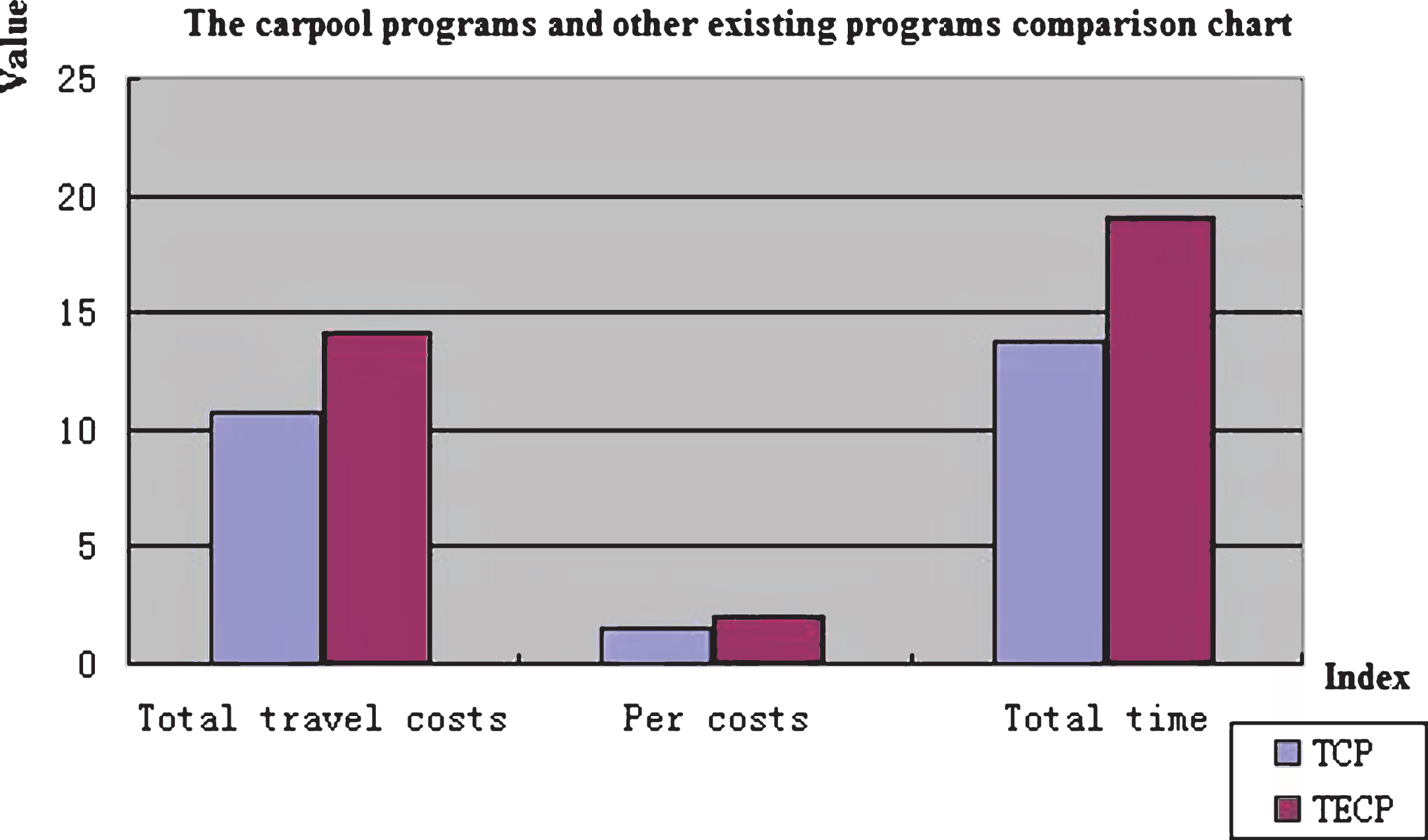
Comparison chart of the carpool programs and other existing programs.
The preliminary experiments on the example have shown that, the carpool program has four passengers rather than an average of 2 people for other existing carpool programs. The seat utilization is improved by 40%. Compared with the total travel cost of 14.10 yuan for other existing carpool programs, the total travel cost of this carpool program has saved about 30.7%, is 10.79 yuan. The total time to complete the carpool process is 13.8 min, has saved 38.4% on 19.1 min for other existing carpool programs.
Based on the background description of the private car pooling in the Internet of Vehicles, the paper has proposed the smart savings scheme on private car pooling with the technology support by internet of vehicles. Firstly, the overall scheme design and framework were introduced, and then related technologies and involved modules were stated specifically, which include route recommendation technology, information matching technology, information notification technology, dynamic information searching technology, collaborative route optimization, fee settlement and assessment, etc. Finally, it explained the application of the carpool program by taking Huai’an as the example. The experimental results have illustrated that, compared with the other existing carpool programs; it has improved 40% on the seat utilization, saved 30.5% on the total travel costs and 38.4% on the total travel time. It has increased the carpooling success rate and road utilization rate greatly, improved the traffic congestion and provide technology support for constructing the green, smart cities.
Conflict of interests
The authors declare that there is no conflict of interests regarding the publication of this paper.
Footnotes
Acknowledgments
This research was supported by Graduate Innovative Projects of Jiangsu Province in 2014 (KYLX_1059), the open fund for the Key Laboratory for Traffic and Transportation Security of Jiangsu Province (TTS2016-06), Youth Foundation of Huaiyin Institute of Technology (HGC1408), the National Natural Science Foundation of China (51408253, 51408252 and 61603420), National Natural Science Foundation of Hubei province under (2014CFB413), Jiangsu Government Scholarship for Overseas Studies (JS-2016-K009). We wish to thank the anonymous reviewers who helped to improve the quality of the paper.