



Abstract
This paper investigates the impact of service constraints on the retailer’s optimal ordering strategy under supply disruptions. Considering a single-period supply chain that consists of one supplier and one retailer, we first establish a non-binding profit function model and prove the existence of an optimal order quantity at which the retailer’s expected profit can achieve the optimal value. We then formulate the profit model with service constraints, i.e. fill rate and service level constraints, respectively. Through the analysis, we find that the expected value of the retailer’s profit is a convex function of the order quantity and there exists a unique order quantity that makes the retailer’s expected profit maximum under each service constraint. In numerical analysis we explain how the retailer can achieve the desired profit by changing the order quantity.
Introduction
With the rising trend of globalization, the supply chain has become increasingly prominent for the production system. Supply chains are complex networks composed of interdependent members with multiple conflicting objectives. A good supply chain can not only effectively reduce cost but also make a timely response to the changes from the outside world. Meanwhile, supply disruptions also attract the attentions from the practitioners and academia due to the increasing number of incidents. Economically, supply disruption risk is the probability that causes losses through lack of raw materials, spare parts required, etc., resulting in unmet demands [1]. In supply chains, supply risk exists in the supplier’s product output when it is impossible to go on caused by natural, artificial or other reasons. According to the nature of supply risk, it can be divided into risk-free (the most basic assumptions of newsvendor model), fixed risk (supply is in a linear relationship with the order), uncertain risk (shipment quantity is uncertain, assuming its outputs meet a certain random distribution). Among them, supply disruptions refer to situations where suppliers are completely unable to provide components due to intrinsic (production, manufacturing, transportation) factors or external causes (natural disaster). Supply disruption is one manifestation of supply emergencies; in addition, supply emergencies can be manifested as severe rise in prices of raw materials. It forces enterprises to purchase at higher prices in order to maintain production.
Many enterprises have experienced supply disruptions from catastrophic events that occurred in the past few years. Toyota’s brake parts supplier’s factory caught fire, causing Japan’s 18 Toyota factories’ shutdown up to two weeks in February 1997. Hurricane Mitch brought catastrophic damage to banana industry in Central America, affecting a large number of fruit wholesalers’ commercial operation in the summer of 1998. Taiwan earthquake severely hampered the basic components of the PC industry supply in 1999. The “9.11” incident destroyed a considerable part of the U.S. commercial operations in 2001. A survey for a number of companies in North America, Europe, Asia and Latin America showed that 58% of enterprises experienced a supply chain disruption and suffered some economic losses in 2008. Moreover, Aberdeen Group companies conducted a survey of nearly 180 companies and it showed that more than 80% of companies suffered supply chain disruptions in a year, and that one company even experienced an average of 12.9 times of supply disruption. All these events, whether predictable or unpredictable, invariably showed that catastrophic events disrupt the normal operation of the enterprise and endangered the relevant product or the whole supply chain services, resulting in a negative impact on the economic performance of enterprises, such as reduced productivity and low customer service level. One study of Georgia Institute of Technology showed that nearly 800 cases of supply chain disruptions brought down 33% to 40% of the stock price of related enterprises and caused an average loss for those enterprises of up to 7%, reduced sales growth by 7% and increased costs by 11%. However, although 80% of companies recognized that the risk of supply had increased, few took any risk management measures. One reason for that is the lack of a supply risk management mentoring program, resulting in these enterprises’ failure to draw up and choose an effective method to deal with the risk. So enterprises fell into passive situation in the face of supply disruptions, even to suffer heavy losses.
With the rapid development of science and technology, the pace of economic globalization becomes faster. Issues on supply chain disruptions from domestic and overseas market aroused widespread concerns in the academic and management circles and research results on this issue has multiplied. These findings have been widely applied to the production, management, finance and many other areas. This paper analyzes the research progress and research status of supply chain disruptions. We make a further study by establishing a single-period retailer’s profit model in the condition of random interruptions. We also derive the retailer’s maximum expected profit based on unconstrained and constrained cases and analyze the impact of service constraints on the retailer’s ordering strategy and his expected profits. At the same time, through several numerical examples we show that disruption lasting time affects the retailer’s order quantity and maximum expected profit.
Literature review
In recent years, supply chain disruptions attract the attention of many scholars and the study on this topic has achieved fruitful results. The following section briefly describes the literature related to this paper. Henig and Gerchak [2] proposed a periodic inspection inventory model under the condition of random supply. Parlar [3] and Antonio [4] had analyzed inventory management in (Q; r) and (s; S) strategy. Xiao and Qi [5] studied a single-period supply chain disruption and coordination that consist of one supplier and two competing retailers. Dada [6], Burke [7] and Thomas [8] further analyzed supply chain disruptions composed by a number of suppliers and one retailer. Keren [9] studied the optimal inventory management problems of single-period supply chain in the condition of random supply and fixed needs. Schmitt and Snyder [10] studied inventory management system in the presence of output uncertainty and the risk of supply disruption. Anastasios [11] proposed two suppliers’ optimal newsvendor strategy model in the framework of disruption risk management. Li et al. [12] considered an assembly system with two suppliers and one manufacturer under uncertain delivery time. Li et al. [13] studied a decentralized assembly system where the manufacturer and the reliable supplier can assist the disrupted supplier in capacity restoration. Li et al. [14] proposed decision sequence impact the supplier’s endogenous reliability enhancement. Guan et al. [15] analyzed the impact of two time-based payment contracts in an assembly system that consists of one assembler and twosuppliers.
There has been a very wide range of research about the classic single-period issues (i.e. newsvendor problem (CNV)) since the last century and a lot of these study results were applied to the service industry such as air transportation or hotel services. Newsvendor problem, i.e. single-period problem, is one of the most important research topics of supply chain management. It has long been a widespread concern in academia and industry. Porteus [16] regarded the newsvendor model as the basic stochastic inventory model, finding the optimal order quantity to balance shortages. Li et al. [17] concluded that the decision sequence can exert significant influences on the firm’s and channel’s equilibrium payoffs. Thakkar et al. [18] studied the return on investment of a newsvendor model with stochastic demand. Tomlin [19] employed a Bayesian model of supply learning and investigated the impact of supply learning on both sourcing and inventory strategies. Wu et al. [20] studied the newsboy model with shortage cost and gave the corresponding optimal order quantity. Oberlaender [21] investigated dual purchasing with exponential utility functions. The results show that dual purchasing strategy is usually the best exclusive overseas purchasing methods. The more risk-averse decision-makers are, the less they purchase overseas, as long as the purchase cost is lower than the selling price of the product at home. Grubbstrom [22] studied the customer’s need which is a composite of the update process newsvendor model. The results showed that the optimal purchase amount depends on the nature of the specific distribution. Guan et al. [23] considered a decentralized assembly system with vendor inventory liability period.
Some scholars have extended the newsvendor problem to the reverse logistics. Moritz Fleischmnn et al. [24] analyzed the reverse logistics problems caused by the product re-manufacturing. He pointed out that the reverse logistics system has the following characteristics: first, because the waste materials recovered from the consumer or end-markets are highly uncertain in terms of time, quantity and quality, it increases the complexity of the system for the high correlation in the supply chain system. Second, the recycling logistics system is not only to meet the cost and supply chain requirements but also need to consider the impact on the social environment of waste materials. This adds target diversity characteristics to reverse logistics. Third, the supply of waste products often does not meet the needs of manufacturers, resulting in a system-inherent imbalance of supply and demand. Fourth, reverse logistics is the process of recycling waste materials from the consumer to reprocessing centers and is a product assembly process from scattered consumers to a few processing centers which have a network characteristics from more to less. Neto et al. [25] proposed a new method for the optimization and evaluation of reverse logistics network based on multi-objective decision theory and data envelopment analysis theory. He considered whether the government or the firm needs to take into account the environmental impact and cost when they designed reverse logistics network.
Up to now, researches on supply chain disruptions have made a series of deep and rich-valued research results [26–36]. Note that almost all of the existing researches only consider whether the supply chain disruption would occur, without considering the time of its occurrence. In fact, disruption occurring at different points of the supply chain will have a different impact. Based on the above analysis of the literature, this paper establishes retailer’s cost model in the case of supply disruptions. We will derive the retailer’s optimal strategy and provide the guideline for firms in the presence of supply disruptions.
The remainder of the paper is organized as follows. Section 3 formulates the basic model. In Section 4, we investigate the retailer’s optimal order quantity under fill rate constraint. Section 5 presents the retailer’s optimal decision in the presence of service level constraint. The numerical analysis is conducted in Section 6. We conclude the paper in Section 7.
The model
Consider a single period supply chain where a retailer procures products from a supplier with disruption risks. We assume that the supply chain sales cycle is M, the demand for a period is a random variable X, and the order for a period is a determining variable Q. Due to the incomplete reliability of suppliers, supply disruptions may occur at any point within the interval (0, M). If the supply disruption occurs during M, the supplier is only able to offer the retailer the ordered products that the retailer actually received [37–39].
Then we began to discuss the problems of the retailer’s optimal order quantity and maximum profit. Before entering the formal discussions, for the sake of brevity, we first present the notation used in this paper as follows:
Q: the supplier’s order quantity (decisive variable).
r: the unit salvage value if the order quantity exceeds the random demand,
k: the unit shortage cost,
the unit retail price of the final product,
c: the unit wholesale price offered by the supplier,
M: the sales cycle of product,
X: the market demand (random variable),
t: greaterthan supply chain disruption time (random variable),
f(x): the density function of X,
F(x): the distribution function of X,
g (t): the density function of t,
G(t): the joint distribution function of t,
E [∏ (Q)]: the retailer’s expected profit.
Recall that the market demand is a non-negative continuous random variable X, and its density and distribution functions are f (x) and F (x). Random disruption time T is a random variable in the (0, M), and its density and distribution functions are g (t) and G (t). To avoid trivial discussion, we assume that E [t] >0. We denote the unit wholesale price, the unit retail price, the unit salvage price and the unit shortage cost as c, s, r and k, respectively. Without loss of generality, we assume r < c < s and r - s + k ≤ 0.
We first examine the retailer’s optimal order quantity without any constraints as the benchmark. In this case, we can easily get the retailer’s profit function.
Thus
Proposition 1 below reveals the retailer’s unconstrained maximum expected profit model.
(2) Optimal order quantity Q* gets from:
We can show that
Therefore ∏ (Q) is a concave function of Q.
Since ∏ (Q) is a concave function of Q, we find that Q* which meets the first-order condition is the optimal order quantity of maximized profits. Let us prove Equation (2) has a solution.
When Q = 0,
When Q is sufficiently large, we note,
We know that Equation (2) has a solution because ∂∏ (Q)/∂Q has continuity on Q.
In subsequent, we will consider the retailer’s optimal ordering strategy with the fill rate constraint. Let μ = [E (X)], and a cyclical shortages is n (Q). The satisfaction rate of the retailer is defined as
Here,
The maximum profit of the retailer can be expressed as the following optimization problems when the satisfaction rate is not lower than β0.
The equation can be further expressed as
The following Proposition 2 reveals the existence of maximum expected profit of the retailer that satisfies the constraint model.
(2) Optimal order quantity Q*, the optimal Lagrange multiplier
Thus
So
Here we use the Lagrangian relaxation method for solving optimization problems.
Therefore, we make
The profit function ∏ (Q) is concave in Q, and we observe that λ
β
(β
o
- β) is a convex function of Q, so ∏ (Q) - λ
β
(β0 - β) is a concave function. Thus Q* and
In this section, we will examine the retailer’s optimal order quantity with service level constraint. Based on [40], the service level α of the retailer is defined as
Here,
The maximum profit of the retailer can be expressed as the following optimization problems when the service level is not lower than α0.
The following proposition 3 reveals the existence of the retailer’s maximum expected profit in service level constraint model.
(2) Optimal order quantity is Q*, and the optimal Lagrange multiplier Q* obtained by first-order conditions is:
Thus
So
Similar to the method of Proposition 2, you can get Lagrange relaxation problem of the expected profit maximization in the condition of service level constraint:
Since the profit function ∏ (Q) is concave in Q, we notice that λ
α
(α0 - α) is a convex function of Q, so ∏ (Q) - λ
α
(α0 - α) is a concave function. We know that Q*, Q* is the maximum value of profit which satisfies the first-order condition. As such, a maximum value of L
α
(Q, λ
α
) exists.
To illustrate the results obtained in the previous section, we then conduct a numerical analysis. We assume that the unit sale price is s= 40, unit product salvage value is r= 5, the wholesale price is c= 15, and the unit shortage cost is k= 10. In addition to the assumed parameters, the change of the sales cycle will have some impacts on the optimal order quantity and the retailer’s maximum expected profit. Figure 1 shows the impact of the sales cycle on the retailer’s maximum expected profit under the condition that demand X follows the uniform distribution. Figure 2 shows the impact of the sales cycle on the retailer’s maximum expected profit under the condition that the demand X follows the normal distribution.

The effect of the sales cycle under the uniform distribution demand.
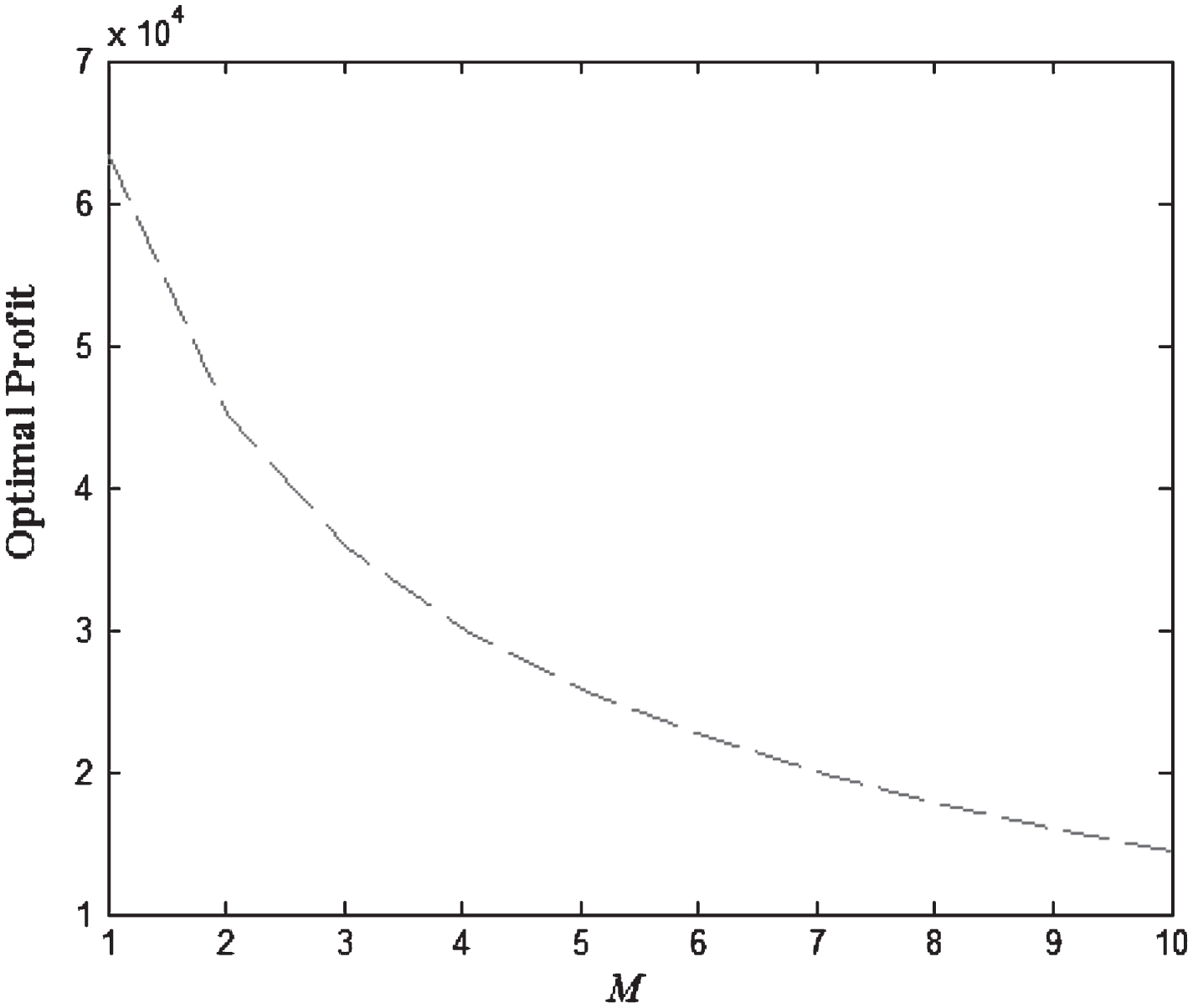
The effect of the sales cycle under the normal distribution demand.
We assume that the market demand the retailer faces follows the uniform distribution on the interval [0, 8000]. The random disruption time the retailer faces follows the uniform distribution on the interval [0, M].
Figure 1 given above clearly explains the model under the unconstrained condition. When the demand X follows the uniform distribution, the different disruption time has a different effect on the retailer’s expected profit, as shown in Table 1.
Order quantity and expected profits with the sales cycle under uniform distribution demand
Order quantity and expected profits with the sales cycle under uniform distribution demand
We assume that the market demand the retailer faces follows the normal distribution. The corresponding mean value is 4000, and the variance is 1000. The random disruption time the retailerfaces follows the uniform distribution on the interval [0, M].
Figure 2 given above clearly explains the model under unconstrained condition. The demand X follows the normal distribution and different sales cycle has a different effect on the retailer’s order quantity and expected profit, as demonstrated in Table 2.
Order quantity and expected profits with the sales cycle under normal distribution demand
Order quantity and expected profits with the sales cycle under normal distribution demand
Through the figures given above we find that during a single period the retailer’s order quantity and profit will change with the sales cycle in a different random disruption environment.
From Tables 1 and 2 we can see that no matter whether the demand X follows the uniform or normal distributions, the retailer’s order quantity decreases when the sales cycle M increases. This is because in a period when the sales cycle M rises, the risk of disruption will be higher. In this case, it would be appropriate for the retailer to reduce the ordering quantity to gain more profits.
Supply disruption may become a major concern for a buyer that the supplier can not provide products as expected. Thus it affects or even destroys the effectiveness of the entire supply chain, resulting in a negative impact on the economic performance of the downstream business. This paper established and analyzed the profit model of the retailer with supply disruption risks, providing the ordering strategy for the downstream enterprises. We mainly discussed the retailer’s profit model in a single cycle in the random disrupted environment. We examined the existence of retailer’s maximum expected profit and analyze the impact of the disruption time on the retailer’s optimal order quantity and expected profit based on unconstrained and constrained cases. Meanwhile, we showed the effects of the sales cycle on optimal order quantity and the maximum expected profit through numerical examples. We studied the impact of supply disruption cycle, trying to help retailers to decide how to deal with the mutation through inventory decisions and procurement decisions. The roles of the severity and duration of the quantity, demand changes, and supply mutation should be considered during the decision-making process of the retailer.
Conflict of interests
The author declares that there is no conflict of interests regarding the publication of this paper.