



Abstract
This paper has considered an automobile industry duopoly model with representative firms of kuaiche and taxi. The impact of product differentiation degree, market share of adaptive player and price adjustment speed of bounded rationality player on stability region and Nash equilibrium points of system have been analyzed. Numerical simulation has illustrated that product differentiation has increased the possibility of chaos, but chaos has existed not only in a fierce competitive market but also a weak competitive market. Another finding is that generally speaking, the increase of market share and product differentiation degree has increased equilibrium price of kuaiche and decreased equilibrium price of taxi. This means cash burning war strategy of kuaiche has worked. We choose different price adjustment speed to show dependence on initials only when the system is in chaos. We find suitable control factors to restrain and eliminate chaos.
Introduction
Uber is an international taxi-hailing app which has been released since 2010. While it was not allowed to enter major cities and carry out small-scale car business in China until 2014. Didi Chuxing is famous domestic software for Chinese people which covered several types such as special car, kuaiche, taxi, ridesharing and valet car. Special car with a higher price is similar to Uber, it is an extension to taxi and kuaiche service. Ridesharing and valet car are special service demands and not very common. For car service in most cities, demand exceeds supply is ordinary, kuaiche as a new network car service has been realized potential high profits and opened a cash burning war – pay high subsidies to users. To some extent, compared to gain market share, for those who want to enter the automobile service industry, losing money in the initial stage is less important. They expect to attract users to use their services, and before they spend money, competitors will first go bankrupt. Obviously, to a taxi with an approaching price and no subsidies, kuaiche has more advantage than taxi and becomes the nearest competitor to taxi.
Applying nonlinear system to duopoly game has originated from Puu [26]; under the assumption of iso-elastic demand and constant cost function, periodic and chaotic phenomena have existed in Cournot model. Before his findings, Rand (1978) have drawn attention to the complex behavior occurred in simple games. The study on existing literature classified rational behaviors into several types, such as naïve rationality, bounded rationality, adaptive expectation and bounded rationality with delay. Unlike complete rationality, these rational selections mean an equilibrium which is achieved in repeated game. Scholars use different adjustment mechanisms and output (price) as decision variable in classic game models or mixed models [5, 31]. The system transferred to chaos through period-doubling bifurcation with adjustment speed of strategy variable increasing [11, 25]. In most literatures, more researchers have focused on homogeneous commodities. For the importance of product differentiation, The effects of degree of product horizontal differentiation on Nash equilibrium of the system have been analyzed [16, 33]. While in a Cournot – Bertrand model, product differentiation degree destabilize Nash equilibrium [3, 4]. Scholars have also observed new evidences that product differentiation variable plays the role of complex system [1, 9]. If demand function and cost function have nonlinear forms, bifurcation process and strange attractors would become rich and colorful [10, 15]. Game models of bounded rationality with delay, it has been almost a consistent conclusion that the decision mechanism would expend the stability region [18, 24]. Although delay coefficient delays occurrence of chaos, it is not very obvious and fast enough. Chaos control enables an unstable status to recover an equilibrium [2, 32].
Undoubtedly, study on chaos theory, duopoly game combined with dynamic system has achieved fruitful results; researchers begin to construct more realistic economic models. Ding et al. [12] have made a utility function in two periods which needs a decision-maker to weight consumption and environmental quality. Under the assumption of selecting high-carbon energy input and low-carbon energy investment, the effect of major parameters on the energy economic system has been analyzed. Shi et al. [30] have studied different impacts of high and low consumer’s willingness-to-pay (WTP) on the stability region of the conditional equilibrium point in a remanufacturing duopoly game. Ma and Xie [23] have considered a dynamic pricing game of air conditioner market. With uncertainty demand for products, they have analyzed the stability of dynamic system. Market share has been a necessary factor scholars are interested in. Bischi et al. [7] and Bischi and Kopel [8] have introduced a dynamic market share attraction model; Fanti et al. [17] have established market share delegation contracts and shown multistability and attractors of system. Li and Ma [22] have analyzed a utility function with market share; profit in chaos is less than that in equilibrium state.
In this paper, we have investigated a dynamic game model with representative taxi firm and kuaiche firm. One has existed in traditional automotive service industry, the other is a new entrant nurtured by Internet business mode. We have introduced market share and product differentiation variable to consider possibility of price war. Chaos theory and system dynamics have been used to simulate chaos behaviors.
The paper is organized as follows: Section 2 has given the taxi duopoly model with bounded rationality and adaptive expectation. Section 3 has analyzed the fixed points and their stability of system. Section 4 has used numerical simulation to show complexity of the model. Finally, we have drawn some conclusions in Section 5.
The model
Generally speaking, private car has a clean condition and good maintenance. Compare with taxi, kuaiche gives users a better experience. Therefore they offer different services. We establish a car service game model of taxi and kuaiche. Taxi occupies major market and only pursuits maximizing profit; kuaiche as a new entrant, market share and profit maximization are two factors he considers.
The inverse demand function is p
i
= a - bq
i
- γq
j
, (i, j = k, t, i ≠ j), where i represents kuaiche, t represents taxi. p is automotive service price, q is car demand for passengers. γ ∈ [-1, 1] is product differentiation degree. When γ = -1, two services are completely complementary; when γ = 1, two services are completely replaced; when γ = 0, two services are not relevant; when γ ∈ (-1, 0), two services are partially complementary; when γ ∈ (0, 1), two services are partially replaced. Two firms have the same marginal cost c and no fixed cost. They can not decide the demand for passengers but have a certain steering capacity of price. Accordingly, the demand function which is described byprice is:
When two firms pursuit profit maximization,
Then
When kuaiche considers market share maximization, that is π
k
= 0 and
Where α ∈ (0, 1).
Under the assumption of kuaiche with adaptive expectation and taxi with bounded rationality, dynamic system equations of price decision is as follows:
Where
Substituting parameters into equations:
The fixed points and their stability
Then we get four key parameters γ, α, u, v. If they are satisfied certain conditions, E* is a dynamic equilibrium of stability. However, if some parameters such as price adjustment or product differentiation speed exceeds some region, there will be a periodic or chaotic phenomenon in taxi duopoly market.
The fixed points of nonlinear dynamic system are given by:
Where
All parameters satisfy
Where E1 is boundary equilibrium, E* is a Nash equilibrium.
Next we analyze the stability of two fixed points with Jacobian matrix.
Characteristic roots of J (E1):
Therefore E1 is a saddle point and unstable.
Jocobian matrix of Nash equilibrium E* takes the form:
Characteristic polynomial of J (E*):
Where Tr and Det are the trace and determinant of Jacobian matrix J (E*).
Because
Where
Thus, we have the following theorem 2:
The boundary curve of stability region with respect to γ in system (2) is
In this section, the main purpose is to show complex behaviors of a taxi duopoly game with heterogeneous business operation modes and differentiated products. The stability region, flip bifurcation, the largest Lyapunov exponents and strange attractors will be simulated. Market share, product differentiation, and price adjustment speed parameters will have effects on stability region. The sensitive dependence on initial values and chaos control method will also be presented. Chaos will be controlled by DFC method.
We set parameters as follows: a = 3, b = 2, c = 1. By using system (2), we get Fig. 1 which shows the stability region of Nash equilibrium with respect to v and γ. It can be seen that when γ is fixed, the system will experience stability-bifurcation-chaos with v increasing; when v is fixed, the system will experience chaos-bifurcation-stability-bifurcation-chaos with γ increasing. Figures 2 and 3 present chaos processes of Nash equilibrium price when γ= 0.5 and v= 1. Black line represents p k , blue line represents p t . The Lyapunov exponents are also drawn in figures. When v ∈ (0, 0.933), the system has invariable Nash equilibrium prices; when v ∈ (0.933, 1.157), periodic bifurcation occurs; when v ∈ (1.157, 1.4), chaos persists. The price adjustment speed v is a control variable of bounded rationality firm, the chaotic phenomenon is more obvious with its increasing. The effect of product differentiation degree on stability of system is not simple. When γ ∈ (-0.8, - 0.676) and γ ∈ (0.946, 1), chaos persists; when γ ∈ (-0.676, 0.016) and γ ∈ (0.238, 0.946), periodic bifurcation occurs; when γ ∈ (0.0.0.16, 0.238), the system has varying Nash equilibrium prices. With γ (>0) increasing, the substitution of p k and p t is strengthening, p k will increase and p t will decrease.
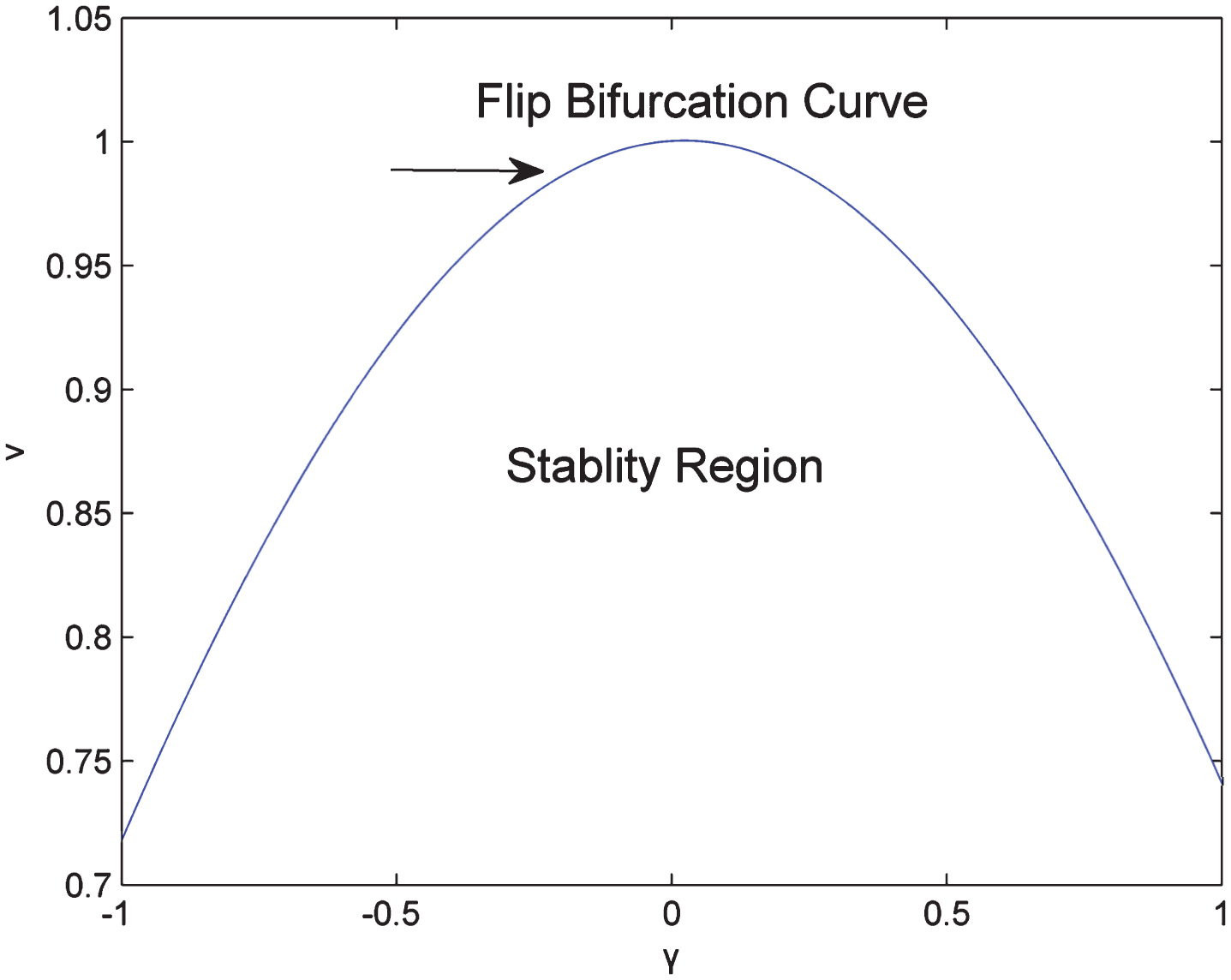
Stability region of Nash equilibrium with respect to γ and v.
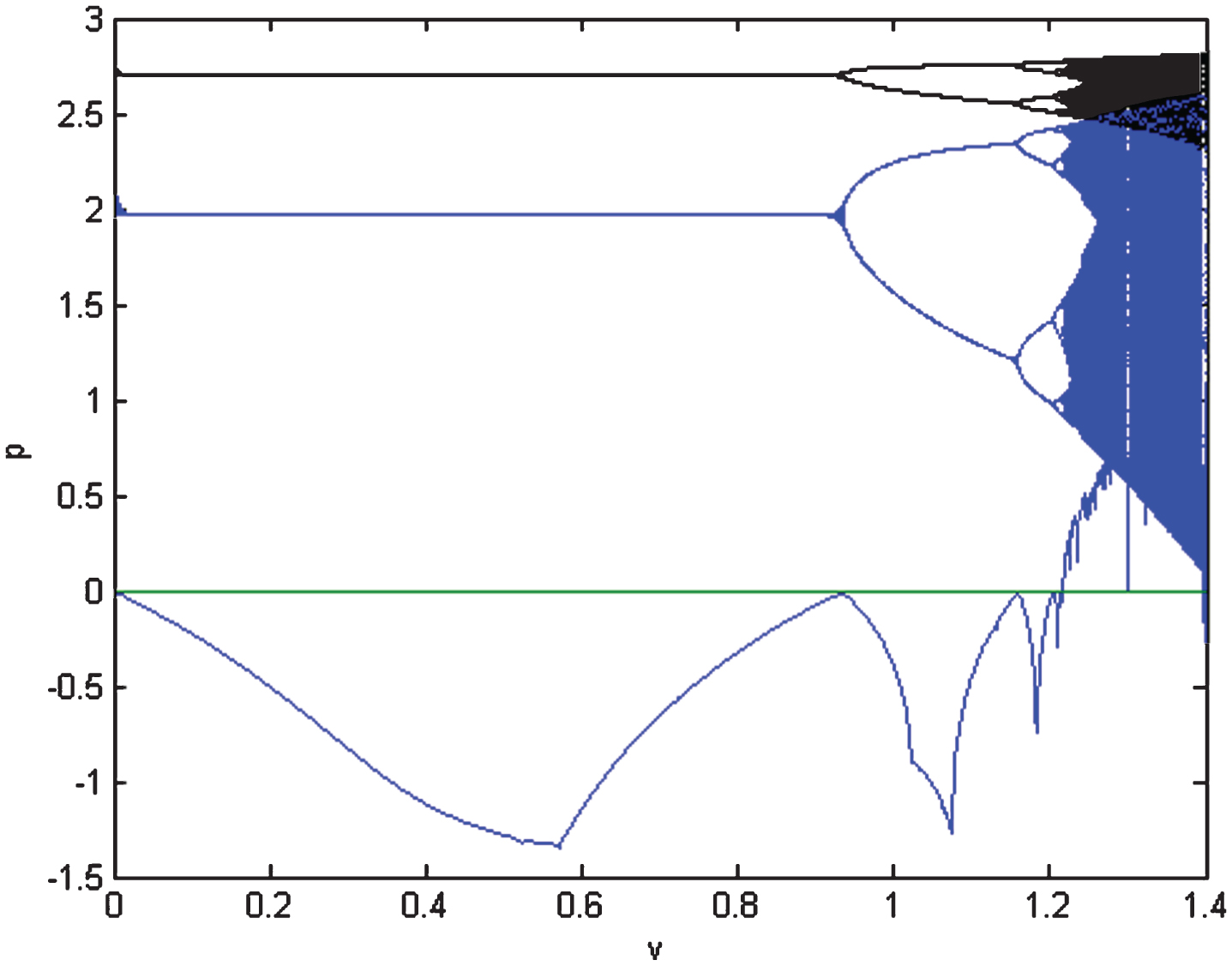
Bifurcation diagram and Lyapunov exponents for u = 0.8 and α= 0.9.
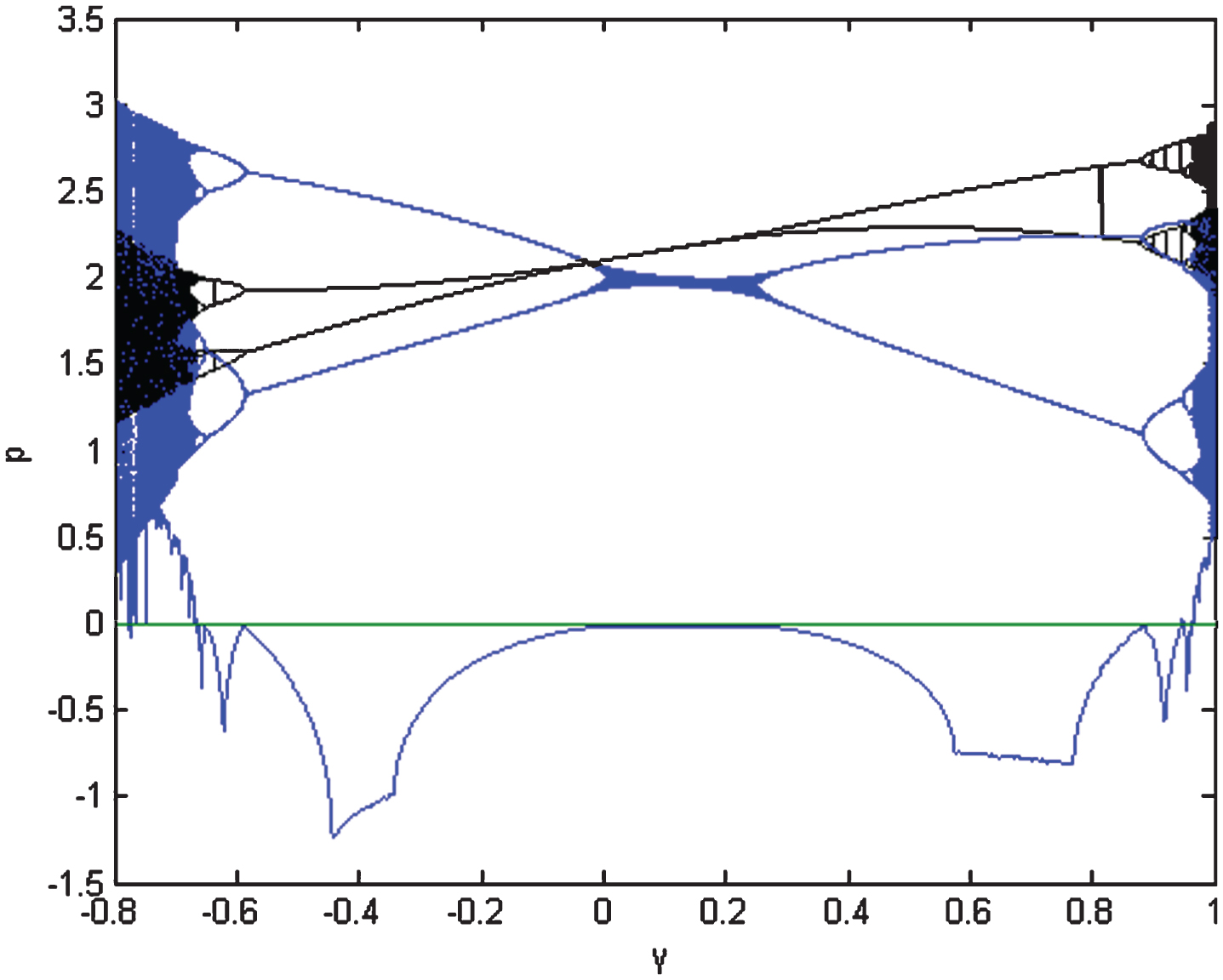
Bifurcation diagram and Lyapunov exponents u = 0.8 and α= 0.9.
Figure 4 shows strange attractors for v= 1.3. From Fig. 2, γ= 0.5 and v ∈ (1.157, 1.4), the system is in chaos.
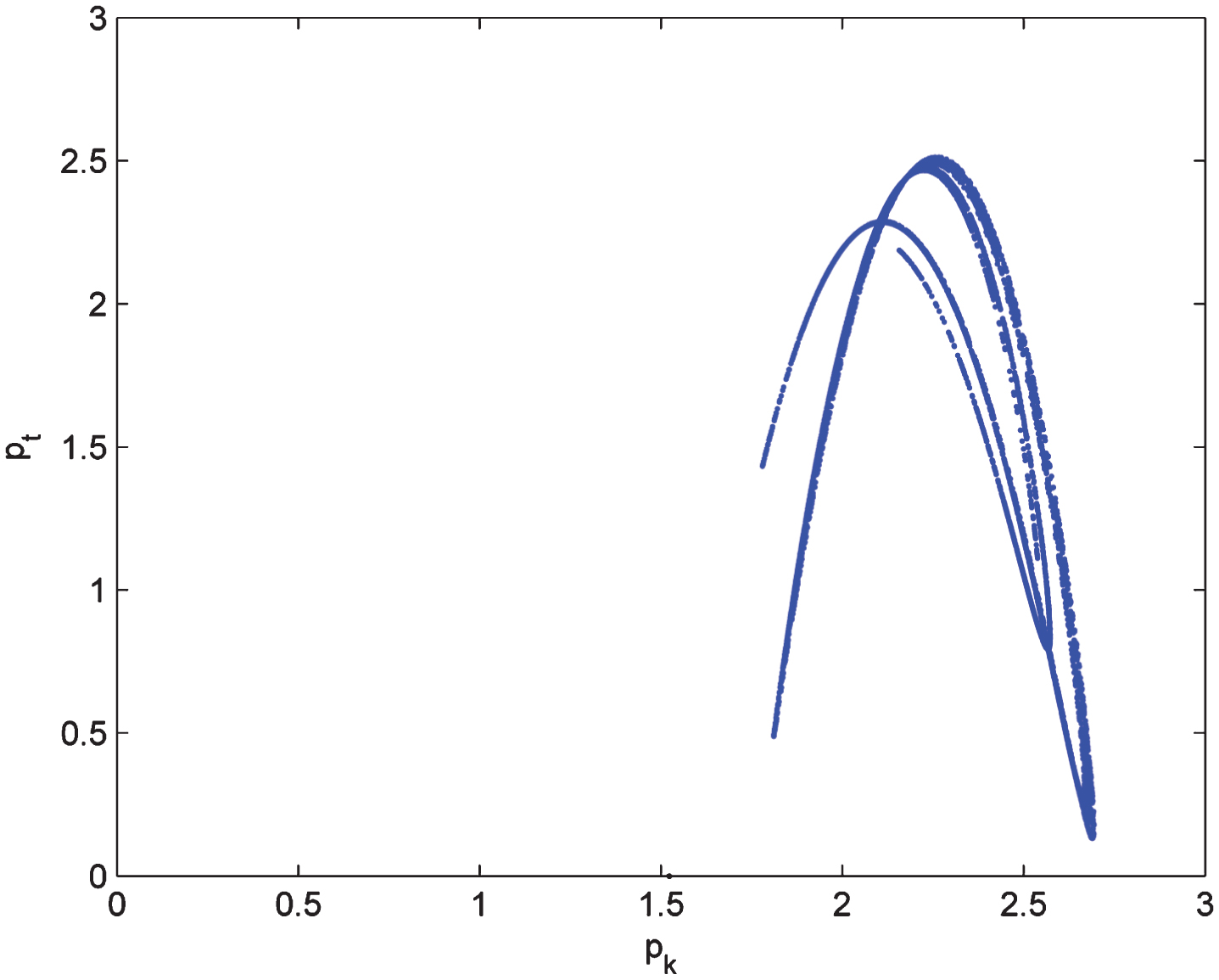
Strange attractor for v = 1.3.
Figures 5 and 6 show with other parameters fixed (a = 3, b = 2, c = 1), the effect of different α and γ on Nash equilibrium
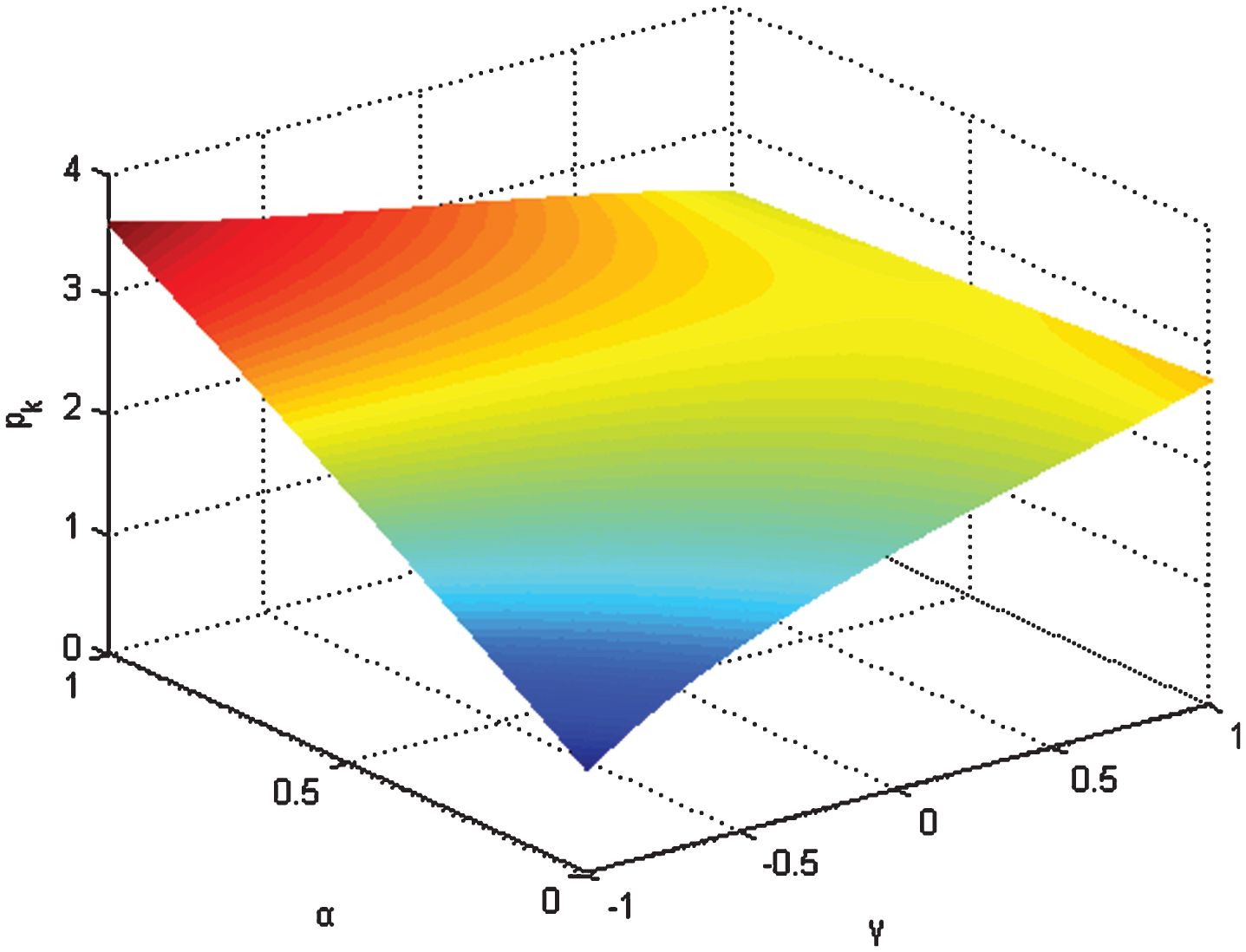
Nash equilibrium
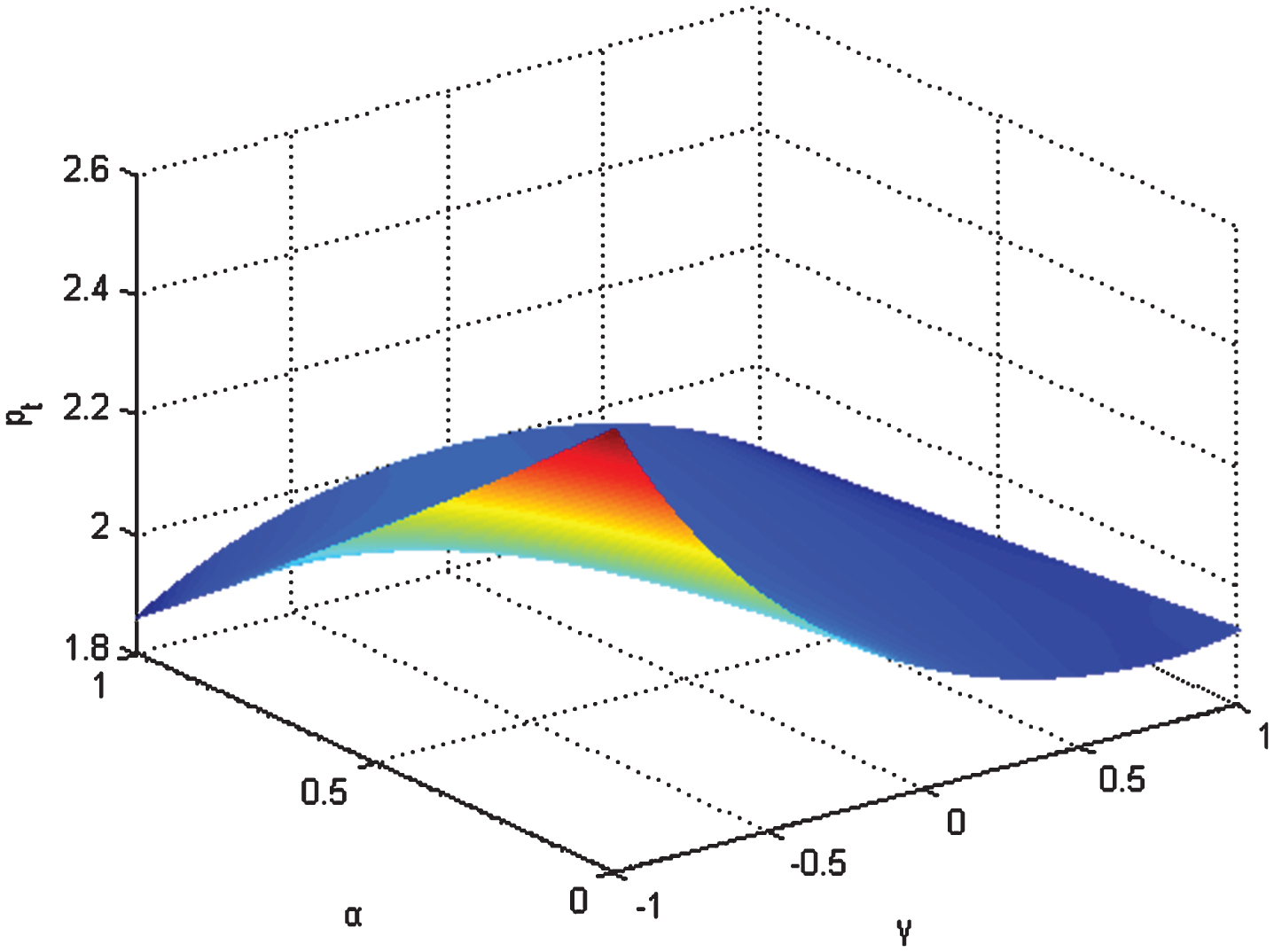
Nash equilibrium
Keeping other parameters fixed (a = 3, b = 2, c = 1, γ= 0.5 or α= 0.9), Figs. 7 and 8 present the effect of different α and γ on stability of system. With α or γ increasing, cash burning war will cause a more fierce competition between two firms, stability region of u and v is shrinking.
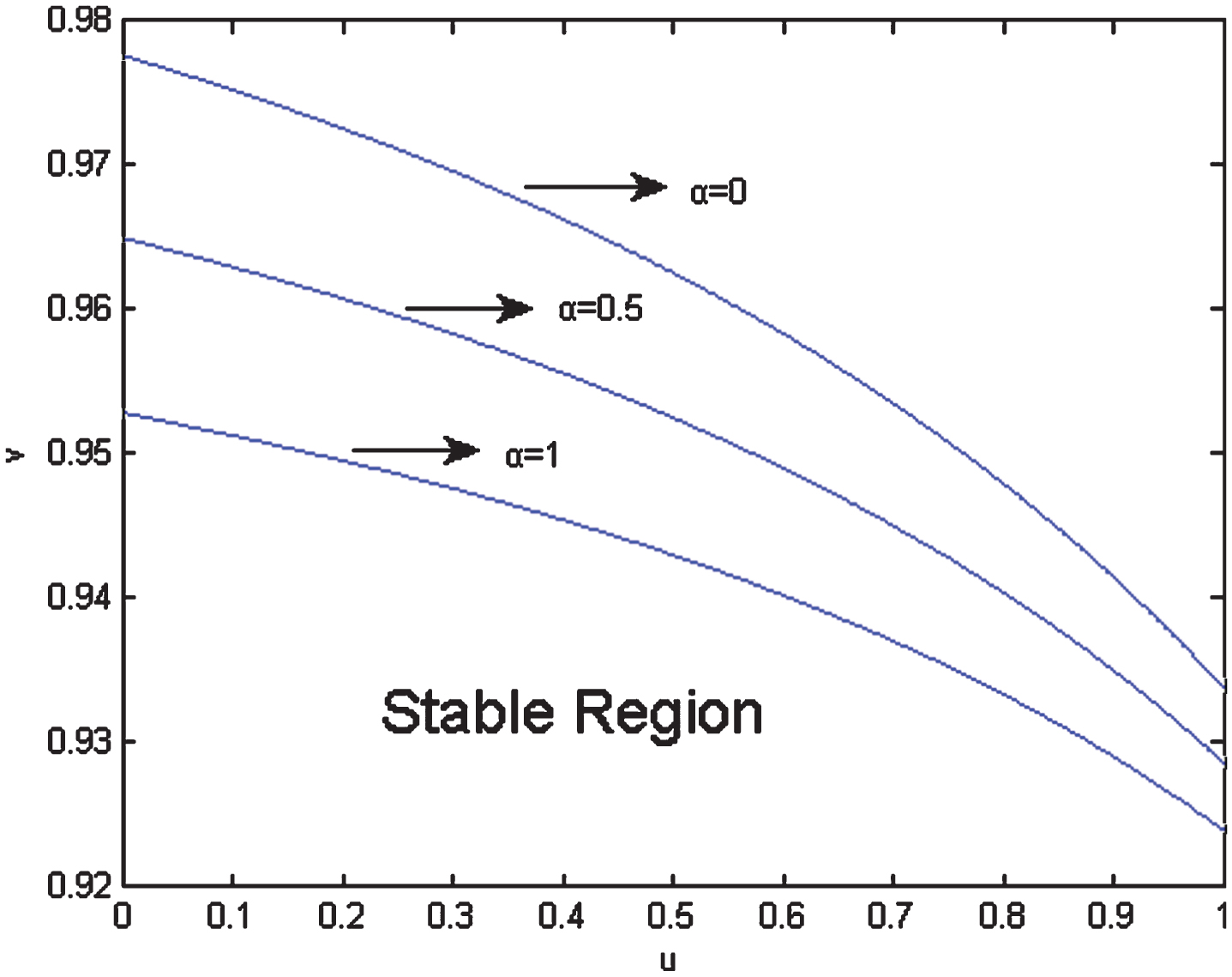
Stability region in the plane of (u, v) with different α.

Stability region in the plane of (u, v) with different γ.
Figure 9 is about the case v ∈ (0.4, 1.2), and u = 0.8. It is stability region of v, α, γ. The region with three parameters value under the surface is the stability region of system. Exceeding this region, bifurcation and even chaotic behavior will occur.
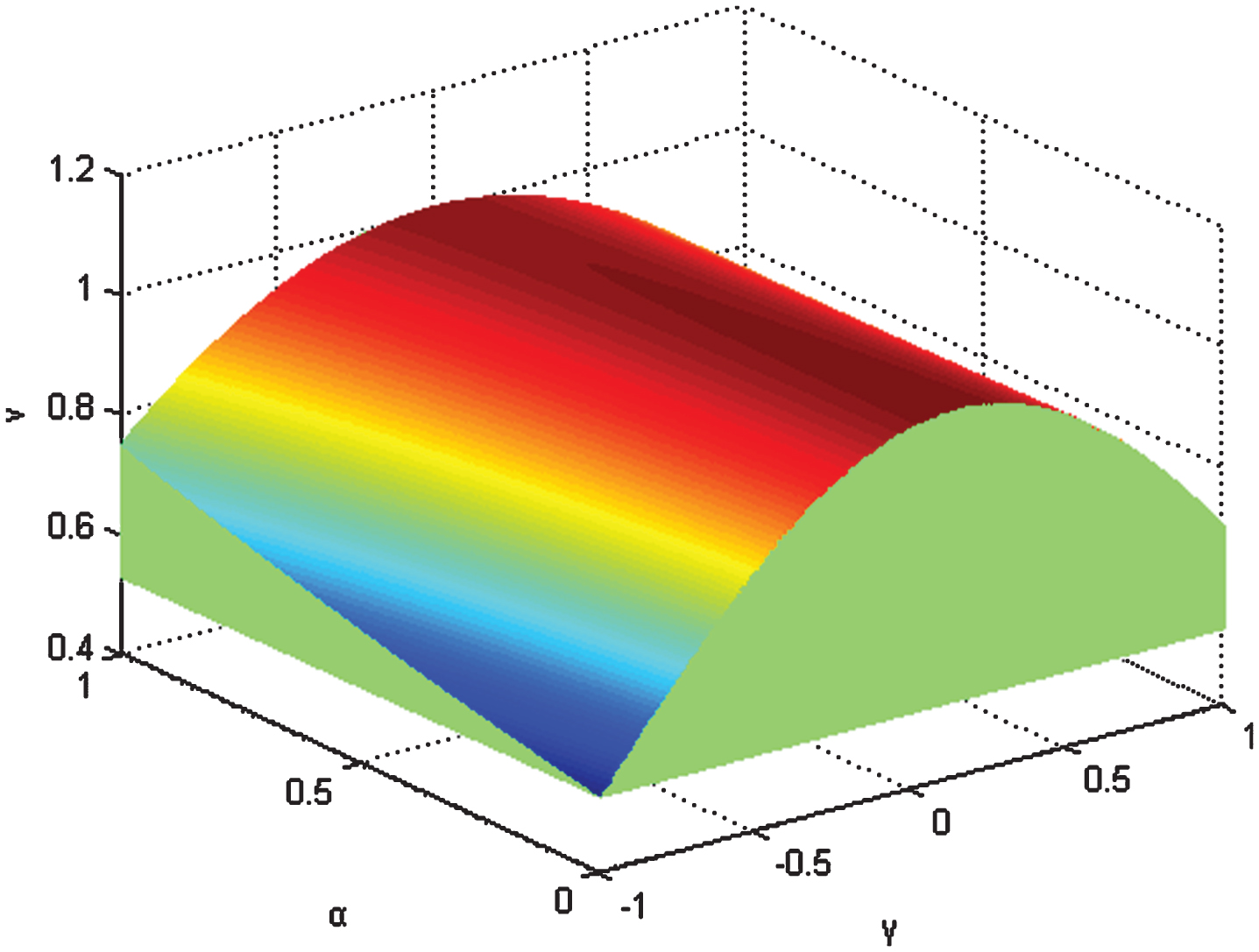
Stability region in the plane of (α, γ) when v ∈ (0.4, 1.2).
From Fig. 2, when v ∈ (0, 0.933), the system has invariable Nash equilibrium prices; when v ∈ (0.933, 1.157), periodic bifurcation occurs; when v ∈ (1.157, 1.4), chaos persists. Thus we choose three values of v and observe sensitivity of initial value.
Figures 10 to 12 is paths of p k for initial values (pk,0, pt,0) = (2, 2.2) and (pk,0, pt,0) = (2.001, 2.2). From Fig. 2, we can see v = 0.5, v = 1 and v = 1.3, the system is in stability, bifurcation and chaos situations. When v = 0.5, paths of p k show no difference in Fig. 10 and p k is an equilibrium price; when v = 1, bifurcation status gives rise to price wave which Fig. 11 shows; when v = 1.3, chaos leads to dependence on initial values of p k which Fig. 12 shows. It is an impact of inherent randomness. We observe only when v = 1.3, the tiny change of initial value will cause price violent fluctuation.
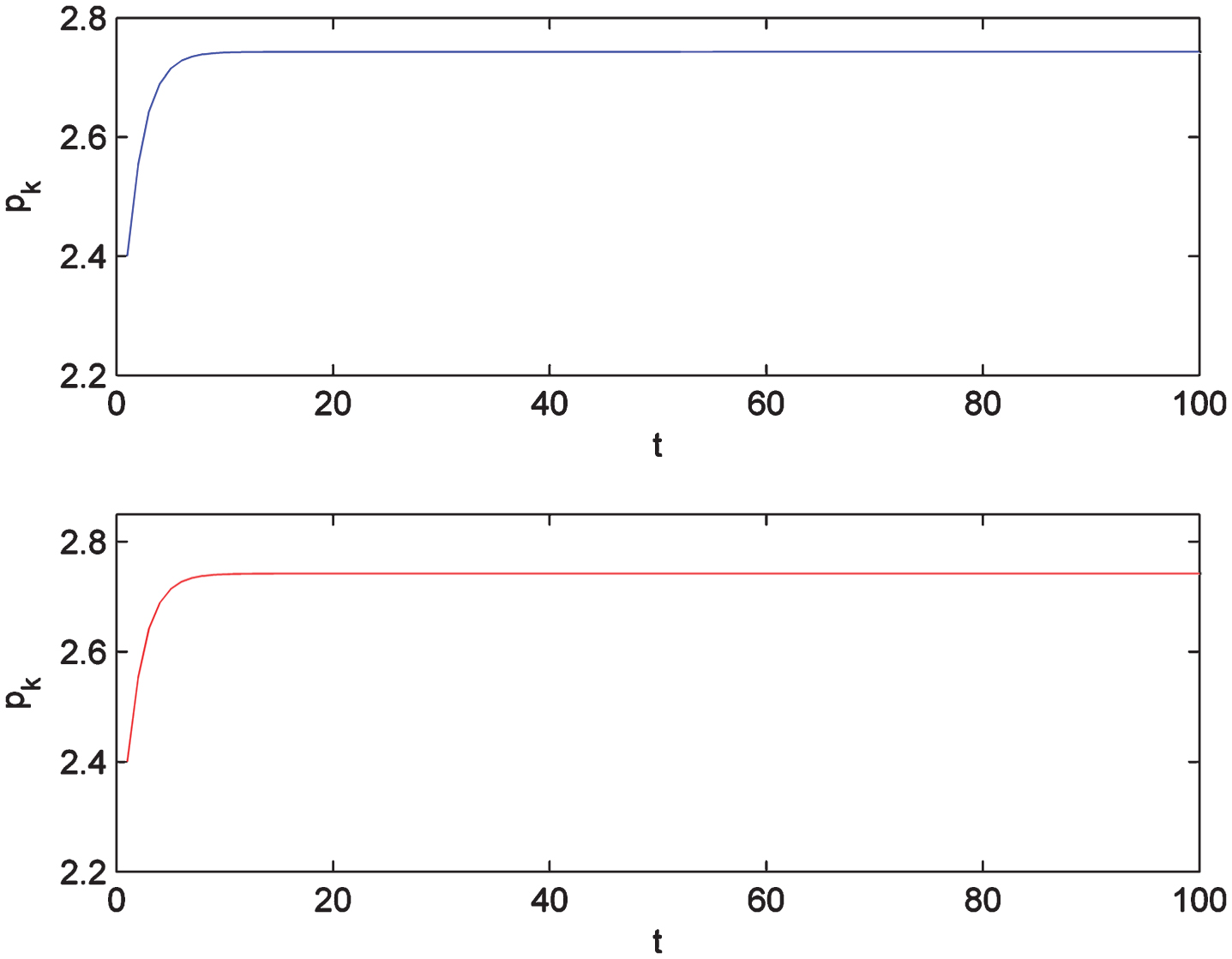
Obits of p k with v= 0.5.
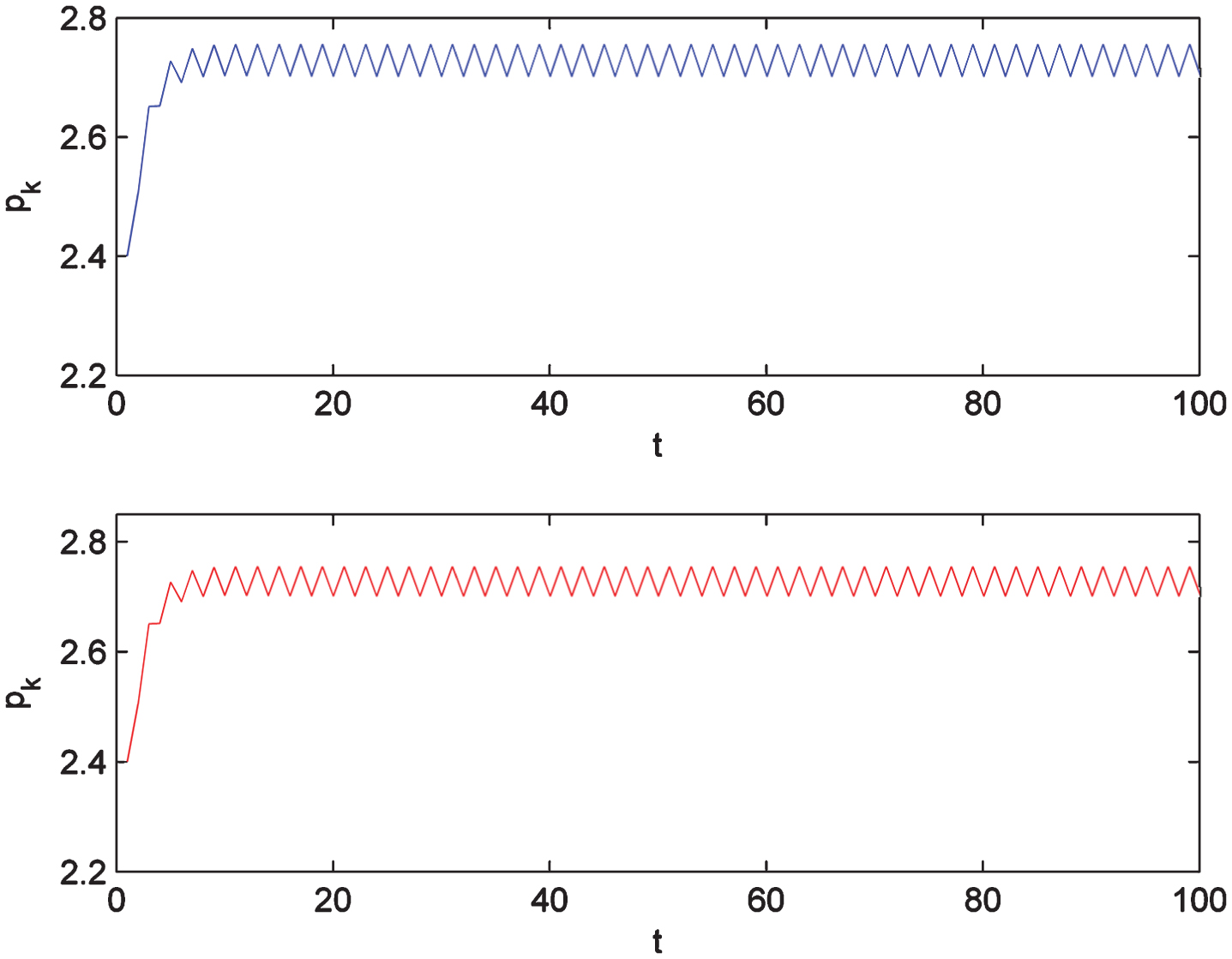
Obits of p k with v= 1.
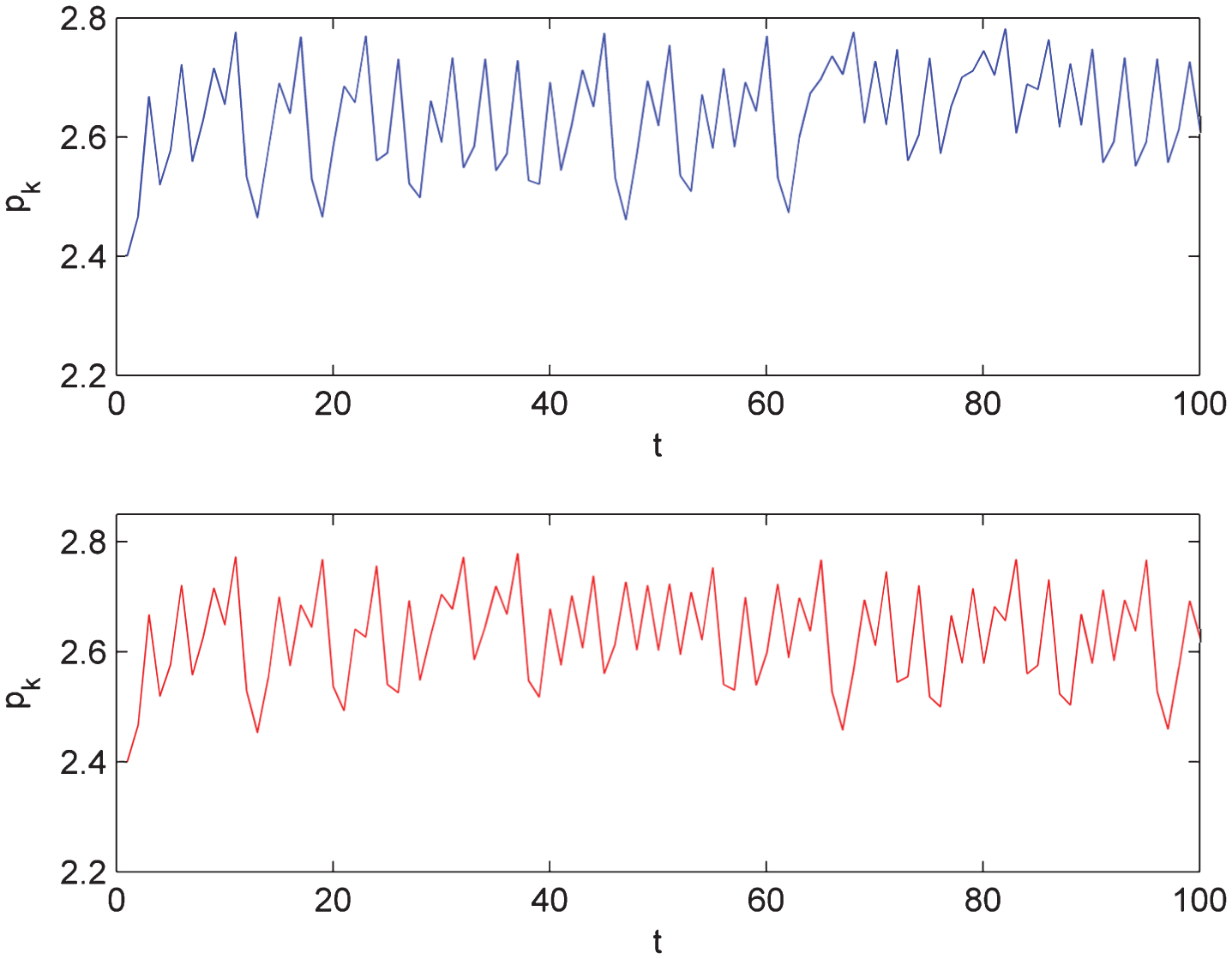
Obits of p k with v= 1.3.
Figure 13 shows the effect of a control factor k on stability of system. With this parameter, the system experiences chaos-bifurcation-equilibrium.

Bifurcation diagram with respect to control factor k.
From Fig. 13, we can see that when k ∈ (0, 0.1670), the prices of firms will keep chaos; when k ∈ (0.1670, 0.4890), the prices of firms will keep period-doubling bifurcation; when k ∈ (0.4890, 1), the prices of firms will recover Nash equilibria
When k = 0.8, Figs. 14 and 15 show chaos control cause chaos stabilize equilibrium prices; Figs. 16 and 17 show chaos control cause chaos stabilize equilibrium profits. Red line and blue line represent before and after chaos control occursrespectively.

Effect of control factor k on p k .
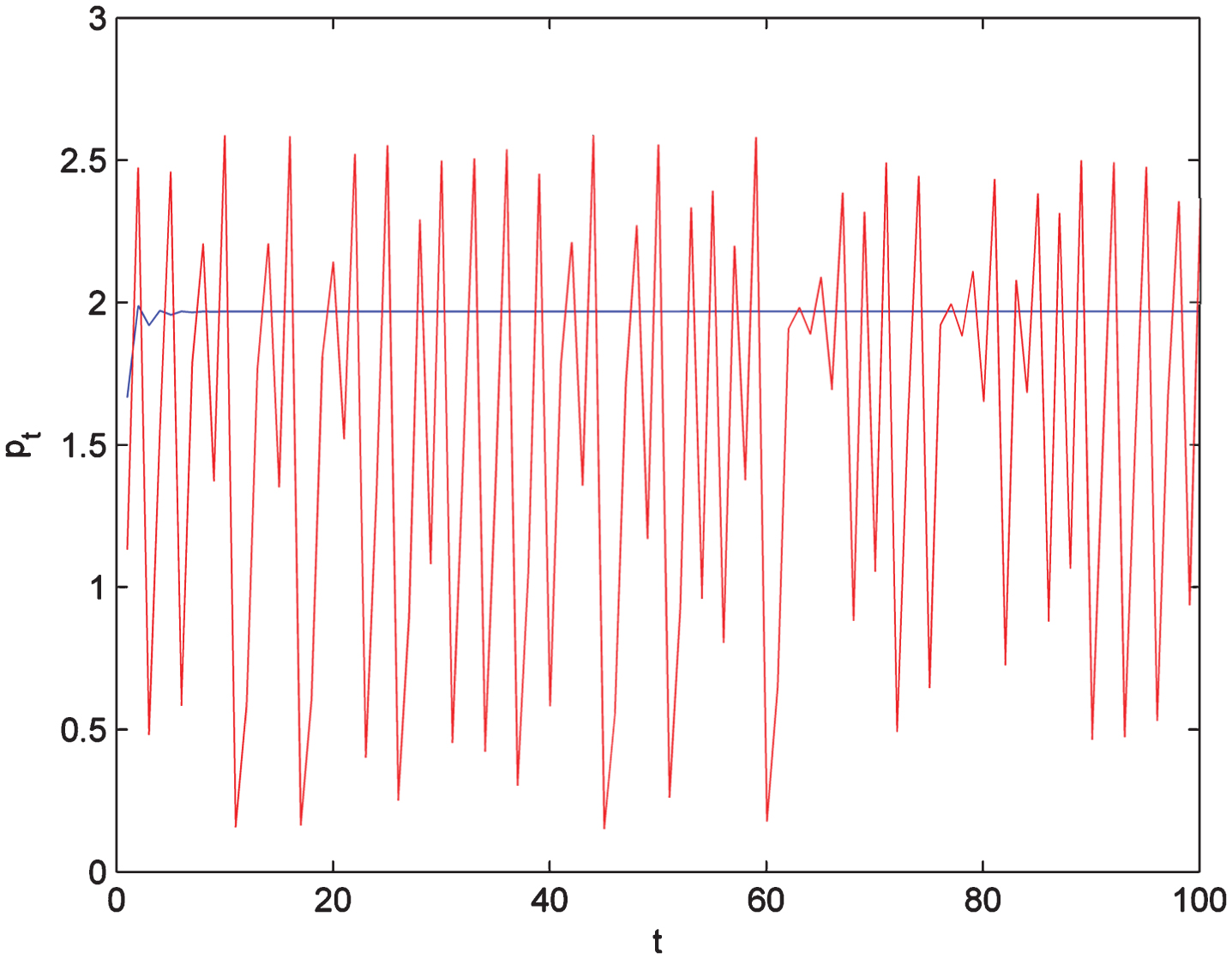
Effect of control factor k on p t .
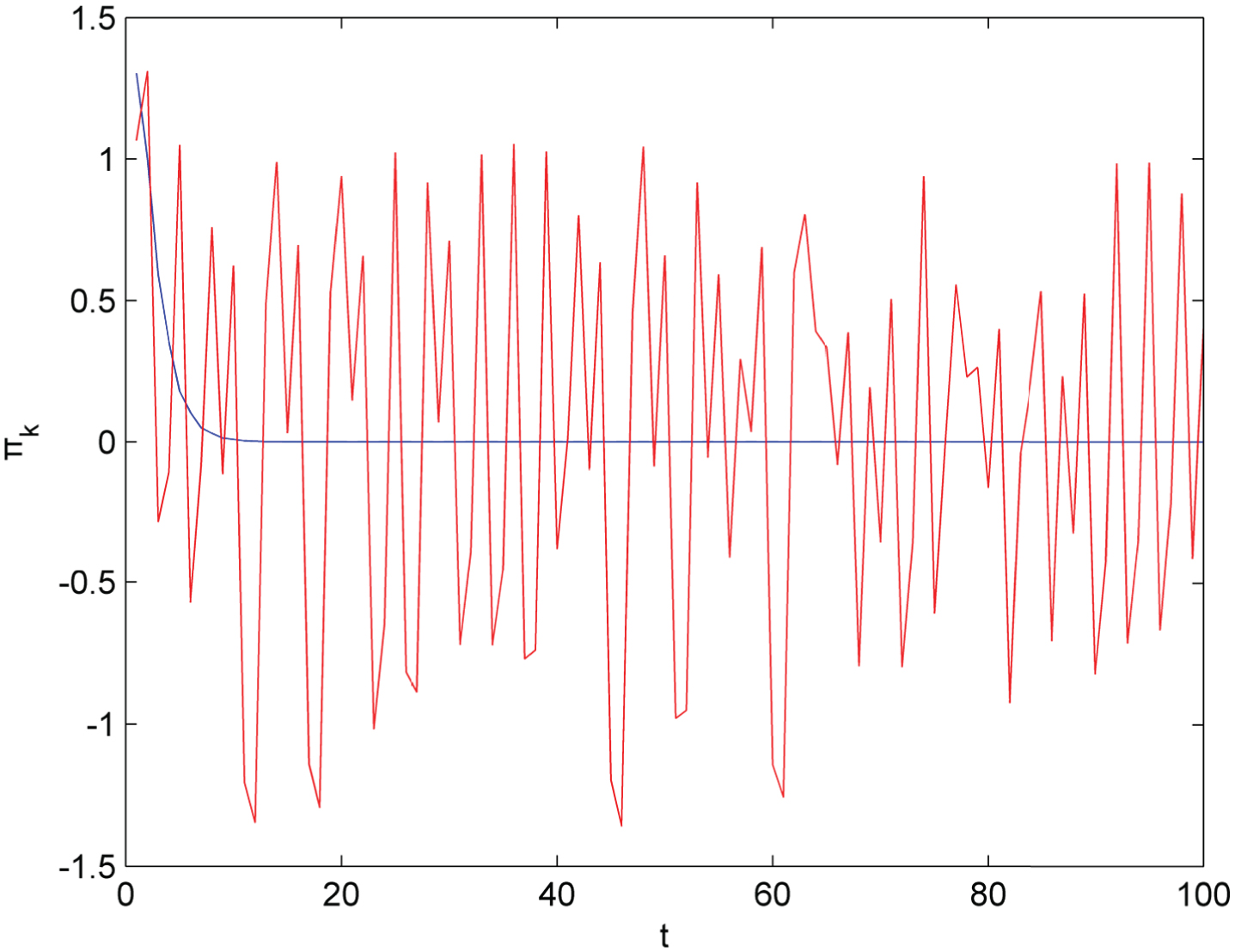
Effect of control factor k on π k .
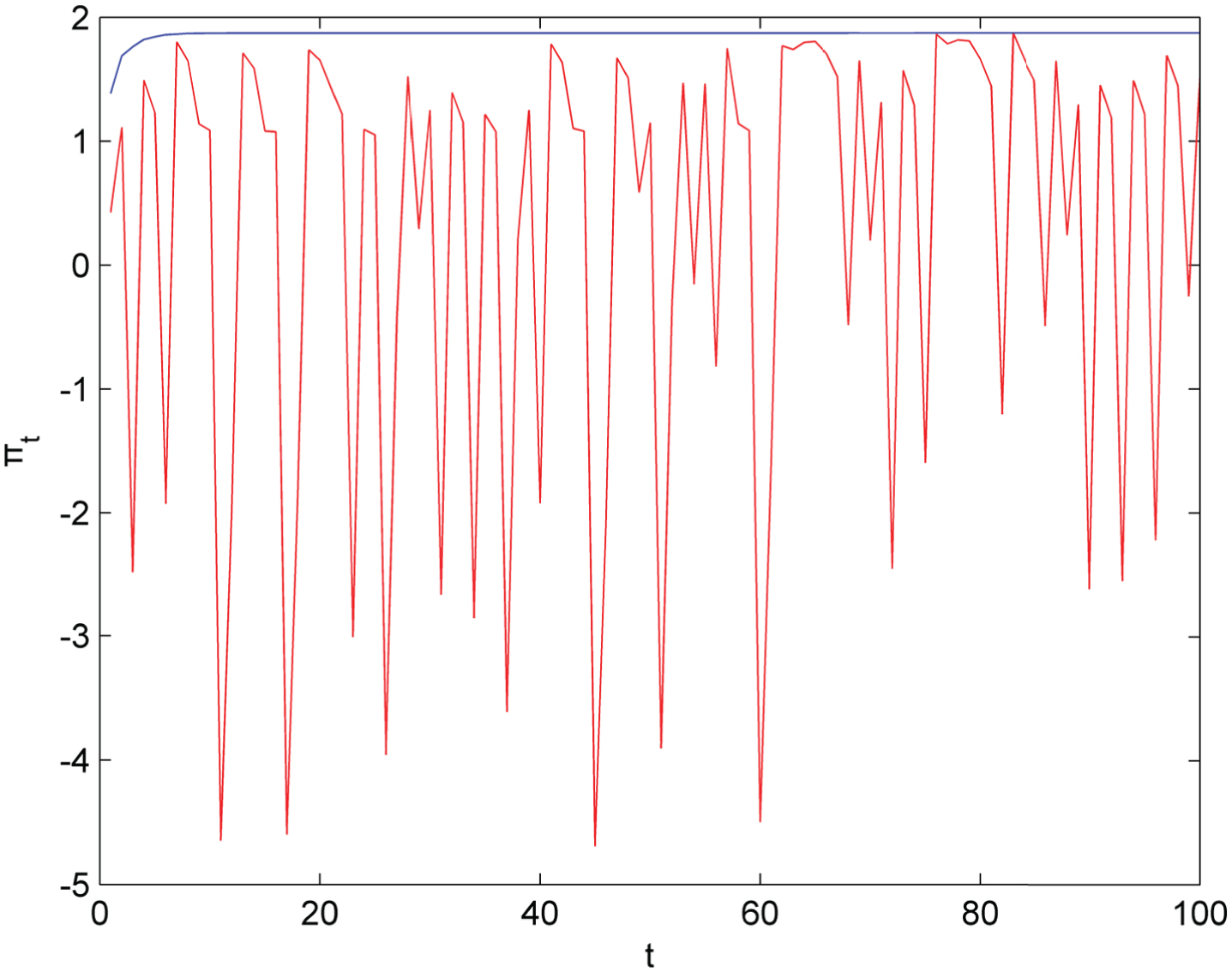
Effect of control factor k on π t .
In this paper, we choose kuaiche and traditional taxi firm to construct duopoly game model. We consider bounded rationality and adaptive players, the key factors of product differentiation degree and market share have been investigated. We use numerical simulation to show complex behaviors of two competitive firms. Moreover, with γ increasing from negative (–1) to positive (1), services of two firms have been regarded as ‘complement’ to ‘substitution’, the system experiences chaos – equilibrium – chaos process. It is illustrated that chaos occurs not only in a fierce competitive market but also in a weak competitive market. The impact of market share parameter α on the stability region and equilibrium price has also been shown. With market share of kuaiche and product differentiation increasing, price adjustment speed of taxi with bounded rationality is increasing and then decreasing. We have verified only the system is in chaos, it has dependence on initial values. Finally, we use DFC method which was first put forward by Pyragas [27] to control and eliminate chaos. The effect of this process on equilibrium price and profit has been simulated. We get the conclusion that when a potential entrant such as kuaiche who has focused more on market share exists or the product differentiation degree increases, it will decrease stability region and cause unstable situation. Another new finding is that when services of two firms is nearly to ’complementary good’ and weak competition exists, chaos can also occur.
Footnotes
Acknowledgments
The author is supported by Soft Science Research Project of Zhejiang Province (2016C35044).
Thank you for the editors of Journal of Intelligent & Fuzzy Systems and reviewers’ work and consideration.