Strong connections between the chemical characteristics of chemical compounds, materials and drugs and their topological structures have been proved by lots of previous research. For instance, they get the connections in melting point and boiling point. The chemical indices from these molecular topological structures turn out to be favorable for chemists, material and medical scientists, when they try to get the relevant chemical reactivity, biological activity and physical features. As a result, the shortage of the experiments can be covered and made up, if the conduct the study of the topological indices on the molecular structures. Meanwhile, the study can also make contributions by providing the theoretical evidence in chemical, pharmaceutical and material engineering. On the basis of graph analysis and computation derivation, some degree and distance mixing indices of some classes of Harary graphs and coronene polycyclic aromatic hydrocarbons are determined in the paper. Therefore, the study lay a theoretical foundation for the material properties.
As we see, thanks to the relevant heated research, a large number of new nano-materials, compounds and drugs are proved to exist in the world while chemical, pharmacy and material manufacture techniques are also develop in a rapid pace. Thus, the corresponding number of relevant experiments seem to be in need to test the chemical properties of the new discovered chemical matters. To some degree, it increases the researchers’ workload, but it is worthy and meaningful. Fortunately, many previous chemical based experiments have gotten some insightful conclusions. For example, there is an intrinsical and inevitable connection between topology structure of chemical molecular and their chemical characteristics, biological features and physical behaviors, like melting point, boiling point and toxicity (see Wiener [1] and Katritzky et al. [2] for more details).
As illustrated in chemistry graph theory setting, chemical molecular structures are expressed as graphs: each vertex in graph stands for an atom of molecule structure; each edge corresponds to a covalent bound between two atoms. Molecular graph, which is described above, is denoted by G = (V (G) , E (G)), where V (G) is the vertex (atom) set and E (G) is the edge (chemical bond) set. It’s important to note that all the (molecular) graphs (such as simple graphs) appeared in this paper are no loop and multiple edge. The relevant notations and terminologies without being defined in the paper can be referred to Bondy and Murty [3] for details.
We can look upon the topological index from a molecule structure as a non-empirical numerical quantity or a non-negative score function. The function is able to quantify the material structure and its branching pattern. As a consequence, it can serve as a descriptor of the molecule under experiments and find its multi applications in several chemical engineering, such as QSPR/QSAR study. Several contributions on this field can refer to Gao and Wang [5–7], Gao et al. [8–11], and Gao and Farahani [12] for more details.
There are several degree and distance mixing indices introduced in chemical and pharmacy engineering and also used to test the properties of chemical compounds. The (singly) vertex-weighted Wiener number of molecular graph G was introduced by Došlić [13] as
This index is the special case of the (general) weighted Wiener index was introduced by Klavžar and Gutman [14] which can be stated as
where is a weighting function.
Alizadeh et al. [15] introduced additively weighted Harary index (in other papers also called reciprocal degree distance) which is denoted as
Similarly, multiplicatively weighted harary index (which in some works were called reciprocal product-degree distance) was introduced as
Readers can refer to Deng et al. [16] on the result of this index.
The (singly) vertex-weighted Wiener polynomial and doubly vertex-weighted Wiener polynomial were defined by Došlić [13] which can be expressed by
and
respectively. Some conclusion on these two polynomials can be referred to Azari et al. [17].
Hamzeh et al. [18] introduced the generalized degree distance and modified generalized degree distance formulated as
and
where λ ≠ 0 is a real number. In what follows, we always say that λ ≠ 0 is a real number. Hamzeh et al. [19] determined the explicit formulas for this new graph invariant of the cartesian product, composition, join, disjunction and symmetric difference of graphs and introduced generalized and modified generalized degree distance polynomials of graphs. Their corresponding polynomials can be represented as
and
respectively. Furthermore, Hamzeh et al. [20] presented the minimum generalized degree distance of unicyclic and bicyclic graph with fixed vertex number. Pattabiraman and Kandan [21] studied the generalized degree distance of the tensor product of graphs.
Now, we present the definitions of some distance based indices which will be used in Section 3.
As the extension of the Wiener index, the modified Wiener index was introduced by Nikolić et al. [22] which was defined as
The results on modified Wiener index can be referred to Vukicevic and Zerovnik [23], Vukicevic and Gutman [24], Lim [25], Gorse and Zerovnik [26], Vukicevic and Graovac [27], and Gutman [28].
The hyper-Wiener index and λ-modified hyper-Wiener index are defined as
and
respectively. Some important contributions on hyper-Wiener index can be found in Gutman [29], Gutman and Furtula [30], Eliasi and Taeri [31] and [32], Iranmanesh et al. [33], Yazdani and Bahrami [34], Behtoei et al. [35], Mansour and Schork [36], Heydari [37], Ashrafi et al. [38], and Heydari [39].
The Harary index (which has been introduced independently by Plavšić al. [40] and Ivanciuc et al. [41] in 1993) is denoted as
and its corresponding Harary polynomial is denoted as
The second and third Harary indices are defined as
More generally, Das et al. [42] introduced the generalized Harary index denoted by
where is a non-negative integer number. The reciprocal complementary Wiener (RCW) index (raised by Zhou et al. [43]) is denoted as
where D (G) is the diameter of molecular graph G.
Finally, the multiplicative Wiener index was introduced by Gutman et al. [44] and [45] which is stated as
Correspondingly, the logarithm of multiplicative Wiener index is expressed as
Although there have been several advances in topological index of special molecular graphs, the research of degree and distance mixing indices for certain special chemical compound, materials, and drug structures are still largely limited. However, as critical and widespread chemical structures, Harary graphs and coronene polycyclic aromatic hydrocarbons are widely used in chemical, biology, medical and material science and frequently appeared in new chemical structures. For these important reasons, we present the exact expressions of degree and distance mixing indices for special classes of Harary graphs and coronene polycyclic aromatic hydrocarbons.
Degree and distance mixing indices of Harary graphs
In this section, we aim to present several degree and distance mixing indices of three classes of Harary graphs. In what follows, we always set Di = {(u, v) |u, v ∈ V (G) , d (u, v) = i} and d (G, i) = |Di|. Let D (G) be the diameter of G which denotes the longest distance in molecular graph G.
Computing the indices of Harary graph H2m,n
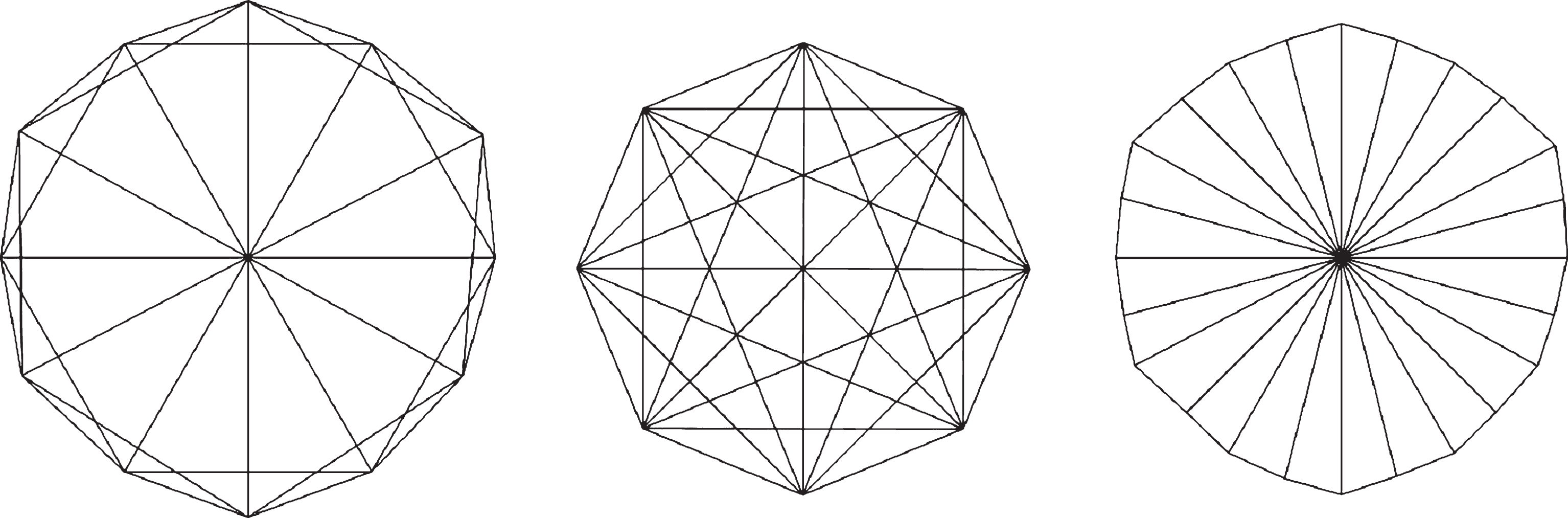
Let be two positive integer numbers, then the Harary graph H2m,n is constructed as follows: its vertices can be labelled as 1, 2, ⋯ , n - 1, n and there is an edge between two vertices i and j if i - m ≤ j ≤ i + m (where addition is taken modulo n). As an example, Fig. 1 presents the Harary graph H6,10.
The Harary graph H6,10.
Hence, Harary graph H2m,n is a 2m-regular graph with n vertices and mn edges. Our first result is stated as follows which manifested the degree and distance mixing indices and related polynomials of H2m,n.
Theorem 1.Let H2m,n be the Harary graph for , then
Proof. Since it is a regular molecular graph, all vertices of H2m,n have similar geometrical and topological properties. Thus, the number of path with distance i in H2m,n is a multiple of the number of vertices n. For instance, there are 2m paths as distance 1 in H2m,n for any v ∈ V (H2m,n) which leads d (H2m,n, 1) =2mn.
Hence, the coefficient of the first sentence of the generalized Schultz polynomial and modified generalized Schultz polynomial of H2m,n should be 4m2n and 4m3n, respectively.
According to the structure of H2m,n, for any i = 1, 2, ⋯ , n and vi, vi+m ∈ V (H2m,n), and d (vi, vi±m+j) =2 for arbitrary j ∈ {0, 2, ⋯ , m - 1} and d (H2m,n, 2) =2m. Since vivi±m, vi±mvi±m+j ∈ E (H2m,n) and d (vi, vi±m) = d (vi±m, vi±m+j) =1. It reveals that the coefficient of the second sentence of the generalized Schultz polynomial and modified generalized Schultz polynomial of H2m,n is 4m2n and 4m2n, respectively.
For vertices vi and vi+m in V (H2m,n), we deduce d (vi, vi±m) = d (vi±m, vi±2m) = d (vi±2m, vi±3m) = ⋯ = d (vi±(k-1)m, vi±km) =1 where and i ∈ {1, 2, ⋯ , n}. Therefore, d (vi, vi±dm) = d and d (vi, vi±dm+j) = d + 1 for any d ∈ {1, ⋯ , k} and j ∈ {1, 2, ⋯ , m - 1}. It implies that for any , the coefficient of the d-th sentences of generalized Schultz and modified generalized Schultz polynomials of the Harary graph H2m,n should be 4m2n and 4m3n,respectively.
It is easy to see that the diameter D (H2m,n) of the Harary graph is equal to (where i ∈ {1, 2, ⋯ , n}). For a vertex vi of H2m,n (for any i ∈ {1, 2, ⋯ , n}), the distance between vertices vi and or is equal to D (H2m,n) for any . For any vi ∈ V (H2m,n) and n is an odd integer number, we infer ; and also for an even integer number n (=2q), .
Hence, the desired results follow enumerate from all distinct shortest paths between any u, v ∈ V (H2m,n) and the definition.
Computing the indices of Harary graph H2r+1,2n
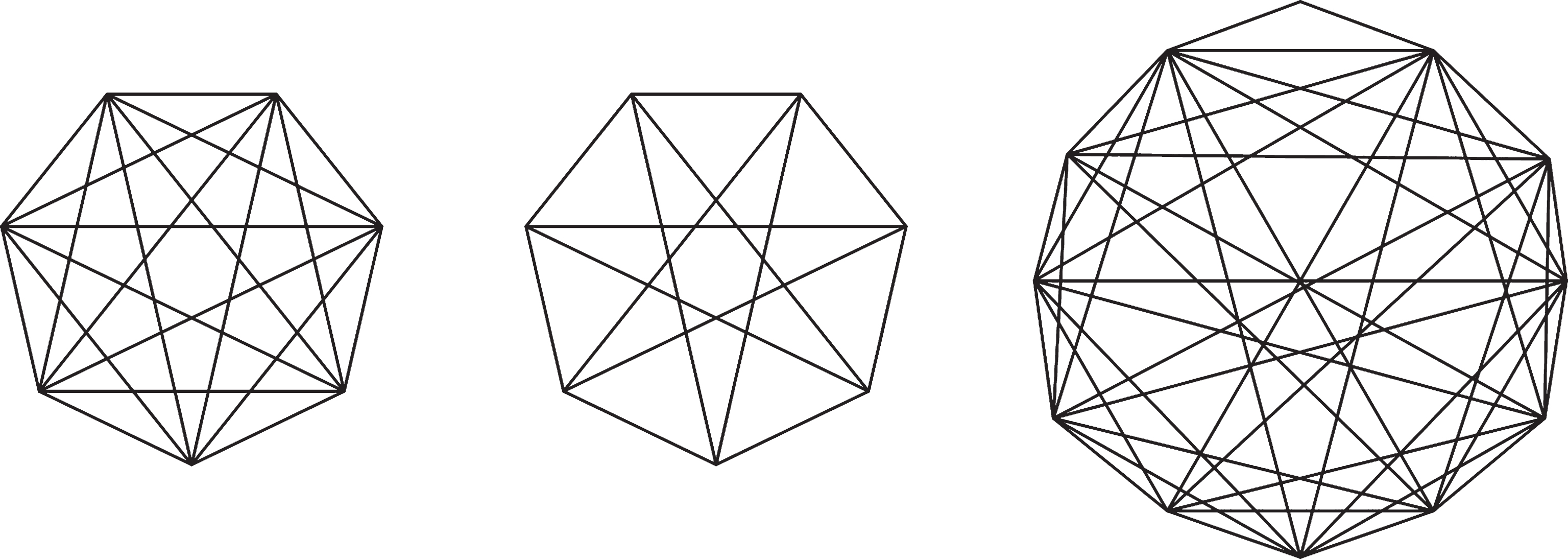
Let r and n be two positive integer numbers satisfying n ≥ r + 1. In Harary graph H2r+1,2n, there exists an edge between two vertices i and j if and only if |i - j| ≤ r or j = i + n. Hence, Harary graph H2r+1,2n has 2n vertices with degree 2r + 1, and |E (H2r+1,2n) | = n (2r + 1). Several Harary graph in this class are presented in Fig. 2 with special values of r and n.
Theorem 2.Let H2r+1,2n be the Harary graph for , then
The Harary graph H5,12, H7,8 = K8 and H3,24 = M24.
Proof. By means of the definition of Harary graph H2r+1,2n, we know that it is a 2r + 1-regular graph and for any two vertices i, j = 1, ⋯ , n, d (vi, vj) =1 if and only if i - r ≤ j ≤ i + r or |j - i| = n. Obviously, the coefficient of the first sentence in the generalized Schultz polynomial of H2r+1,2n is equal to |E (H2r+1,2n) |, i.e., D1 (H2r+1,2n) = {(u, v) |u, v ∈ V (H2r+1,2n) , d (u, v) =1} = E (H2r+1,2n).
In view of Harary graph H2r+1,2n, if i, j ∈ {1, ⋯ , n} meet |i - j| ≤ r or |i - j| = n, then vivj, vivi+n, vivi±r, and alternatively vi±rvi±r+j and vi+nvi+n±j are edges. Hence, d (vi, vi±(r+j)) = d (vi, vi+n±j) =2. It means the coefficient of the second sentence in generalized Schultz polynomials of H2r+1,2n is equal to 2n, i.e.,
By induction on d for , we check that
and alternatively the coefficient of the d + 1-th sentence in generalized Schultz polynomials of Harary graph H2r+1,2n is equal to 4n.
In terms of structure analysis, the diameter of Harary graph H2r+1,2n is equal to , and the coefficient of the latest sentence in generalized Schultz polynomials of H2r+1,2n is equal to .
Now, by enumerating all distinct shortest paths of u, v ∈ V (G) and Dd (G) for any d ∈ {1, ⋯ , D (G)}, combining with the definitions of degree and distance mixing indices, we get the desired results.
Computing the indices of Harary graph H2r+1,2m+1
In this subsection, we focus on the Harary graph H2r+1,2m+1. Let r and m be two positive integer numbers, so the vertex and edge set of the 2r + 2-regular Harary graph H2r+1,2m+1 are V (H2r+1,2m+1) = {v1, v2, ⋯ , v2m, v2m+1} and E (H2r+1,2m+1) = {vivj ∈ V (H) ||i - j| ≤ r or j = i + m or j = i + m + 1}, respectively. It is in automorphism to the complete graph K2r+3 (see Fig. 3) when m = r + 1.
Some examples of the Harary graph H2r+1,2m+1: H7,11, H3,7 and H5,7 (= K7).
Theorem 3.Let H2r+1,2m+1 be the Harary graph for , then
Proof. For any , Harary graph H2r+1,2m+1 is a regular graphs with 2m + 1 vertices and 2mr + 2m + r + 1 edges. Surely, the coefficient of the first sentence of the generalized Schultz polynomial is equal to 8 (2m + 1) (r + 1) 2.
Set Vi as the set of adjacent vertices vi ∈ V (H2r+1,2m+1) satisfies |Vi| = | {vj ∈ V (H) |i ≤ r ≤ j ≤ i + r or j = i + m or j = i + m + 1} |=2r + 2 = d (vi). By means of the structure of Harary graph H2r+1,2m+1, for any , |i - j| ≤ r or j = i + m or j = i + m + 1, we verify that vivj, vivir, virvir+j, vivi+m, vivi+m+1 ∈ E (H2r+1,2m+1) and thus d (vi, vi(r+j)) = d (vi, vijm) =2. This implies that the second coefficient of the generalized Schultz polynomial is 4r (2m + 1) (r + 1).
Moreover, for any , we get d (H2r+1,2m+1, k) =2r (2m + 1).
Finally, the coefficient of the latest sentence of the generalized Schultz polynomial is equal to
where the diameter or .
Hence, the desired result follows from the definition of topological degree and distance mixing indices.
Degree and distance mixing indices and distance based indices of coronene polycyclic aromatic hydrocarbons
In chemical, physics, nano sciences and pharmaceutics, benzenoid system is a widely appeared symmetric structure. Since molecule benzene (C6H6) is more practical in engineering applications, we consider the related structure in this section.
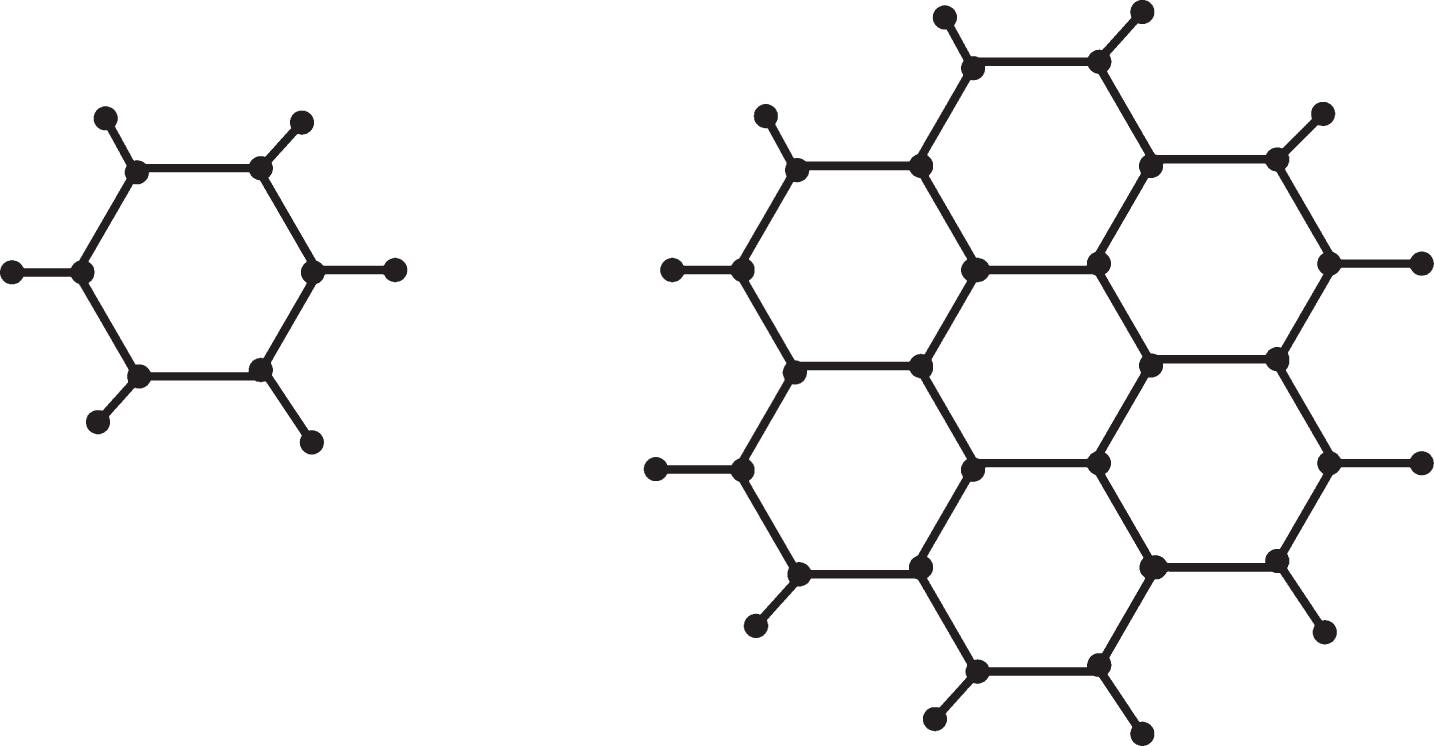
In the following contents, we discuss the structure PAH2 which is the second members of coronene polycyclic aromatic hydrocarbons (Fig. 4). This family has a structure consisting of benzene C6H6 or cycles with length six C6 by deferent compounds, and has very similar properties with circumcoronene homologous series of benzenoid Hk.
Benzene molecules C6H6 and Coronene Polycyclic Aromatic Hydrocarbons PAH2.
Our last result is stated as follows which focuses on the structure of coronene polycyclic aromatic Hydrocarbons PAH2 (or C24H12) and determines its degree and distance mixing indices and distance based indices.
Theorem 4.Let PAH2 be the second members of polycyclic aromatic hydrocarbons. Then, we have
Proof. By analyzing its structure, coronene polycyclic aromatic hydrocarbons PAH2 has 24 carbon (C) atoms and 12 hydrogen (H) atoms. Since C24H12 have 36 verices/atoms, thus, there are 630 distinct shortest paths between all vertices of PAH2.
The set V (H2r+1,2m+1) × V (H2r+1,2m+1) can be divided into nine parts according to the distance of vertex pairs. That is to say, |D1| + |D2| + ⋯ + |D9|=630. Using the definition of Ds (H2r+1,2m+1), we infer D1 (PAH2) = E (PAH2), and thus |D1| = |E (PAH2) |=42. Furthermore, there are 12 hydrogen (H) atoms . Hence, the coefficients of the first sentences of the modified Wiener, generalized Schultz and modified generalized Schultz polynomials are 12, 48 and 36, respectively. For carbon (C) atoms, we obtain
Thus, the corresponding coefficients of the first sentences of the modified Wiener, generalized Schultz and modified generalized Schultz polynomials are 42, 228 and 306, respectively.
Now, suppose d (u, v) =2, D2 (PAH2) has two partitions described as follows:
For carbon atoms:
For hydrogen atoms:
Hence, the corresponding coefficients of the second sentences of the modified Wiener, generalized Schultz and modified generalized Schultz polynomials are 48+24, 288+96, 432+72, respectively.
If d (u, v) =3, then |D3 (PAH2) |=99. And D3 (PAH2) can be divided into three subsets.
For hydrogen (H) atoms:
For paths between carbon and hydrogen atoms as distance 3:
For carbon atoms:
Hence, the corresponding coefficients of the third sentences of the modified Wiener, generalized Schultz and modified generalized Schultz polynomials are 6+36+57, 12+144+342 and 6+108+513, respectively.
If d (u, v) =4, then |D4 (PAH2) |=108 and D4 (PAH2) can be divided into three subsets.
For hydrogen (H) atoms:
For paths between carbon and hydrogen atoms:
For carbon atoms:
Thus, the corresponding coefficients of the fourth sentences of the modified Wiener, generalized Schultz and modified generalized Schultz polynomials are 6+48+54, 12+192+324 and 6+144+486, respectively.
For d (u, v) =5, |D5 (PAH2) | = | {(u, v) |u, v ∈ V (PAH2) , d (u, v) =5} |=105 and D5 (PAH2) can be divided into three subsets.
For hydrogen atoms:
For paths between C and H atoms:
For carbon atoms:
So, the corresponding coefficients of the fifth sentences of the modified Wiener, generalized Schultz and modified generalized Schultz polynomials are 12+48+45, 24+192+270 and 12+144+405, respectively.
If d (u, v) =6, then |D6 (PAH2) |=84 and we have the similarly dividing.
For hydrogen (H) atoms:
For paths between carbon and hydrogen atoms:
For carbon atoms:
Therefore, the corresponding coefficients of the sixth sentences of the modified Wiener, generalized Schultz and modified generalized Schultz polynomials are 6+48+30, 12+192+180 and 6+144+270, respectively.
If d (u, v) =7, then
|D7 (PAH2) |=66. Also, D7 (PAH2) can be divided into three subsets.
For hydrogen (H) atoms:
For paths between carbon and hydrogen atoms:
For carbon atoms:
Hence, the corresponding coefficients of the seventh sentences of the modified Wiener, generalized Schultz and modified generalized Schultz polynomials are 6+48+12, 12+192+72 and 6+144+108, respectively.
If d (u, v) =8, then |D8 (PAH2) |=42 and D8 (PAH2) can be divided into two parts.
For H atoms:
For paths between C and H atoms:
Thus, the corresponding coefficients of the eighth sentences of the modified Wiener, generalized Schultz and modified generalized Schultz polynomials are 18+24, 36+96 and 18+72, respectively.
Finally for d (u, v) =9, . Therefore, the corresponding coefficients of the last sentences of the modified Wiener, generalized Schultz and modified generalized Schultz polynomials are 12, 24 and 12, respectively.
Combining all the discussion above and applying the definitions of degree and distance mixing indices and distance based indices, we obtain the conclusion we wanted.
Conclusion
In our article, we get accurate expression for several degree and distance mixing indices of some classes of Harary graphs and coronene polycyclic aromatic hydrocarbons, by using graph analysis, distance computation, and vertex pair set dividing. The conclusion we draw from the paper contribute to making up the defect of experiments. By the way, it also lay a solid theoretical foundation for the further scientific research. Consequently, the results shows the promising application prospects in chemical, material and pharmacy engineering.
Conflict of interests
The authors declare that there is no conflict of interests regarding the publication of this paper.
References
1.
WienerH.J., Structural determination of paraffin boiling points, Journal of the American Chemical Society69 (1947), 17–20.
2.
KatritzkyA.R., JainR., LomakaA., PetrukhinR., MaranU. and KarelsonM., Perspective on the relationship between melting points and chemical structure, Crystal Growth & Design1(4) (2001), 261–265.
3.
BondyJ.A. and MurtyU.S.R., Graph Theory, Spring, Berlin, 2008.
4.
GaoW. and WangW.F., The eccentric connectivity polynomial of two classes of nanotubes, Chaos, Solitons & Fractals89 (2016), 290–294.
GaoW. and WangW.F., New isolated toughness condition for fractional (g, f, n)-critical graphs, Colloquium Mathematicum147(1) (2017), 55–66.
7.
GaoW., BaigA.Q., AliH., SajjadW. and FarahaniM.R., Margin based ontology sparse vector learning algorithm and applied in biology science, Saudi Journal of Biological Sciences24(1) (2017), 132–138.
GaoW., FarahaniM.R. and ShiL., Forgotten topological index of some drug structures, Acta Medica Mediterranea32 (2016), 579–585.
10.
GaoW., SiddiquiM.K., ImranM., JamilM.K. and FarahaniM.R., Forgotten topological index of chemical structure in drugs, Saudi Pharmaceutical Journal24(3) (2016), 258–264.
11.
GaoW., YanL. and ShiL., Generalized Zagreb index of polyomino chains and nanotubes, Optoelectronics and Advanced Materials-Rapid Communications11(1-2) (2017), 119–124.
12.
GaoW. and FarahaniM.R., Degree-based indices computation for special chemical molecular structures using edge dividing method, Applied Mathematics and Nonlinear Sciences1(1) (2016), 94–117.
13.
DošlićT., Vertex-weighted wiener polynomials for composite graphs, Ars Mathematica Contemporanea1 (2008), 66–80.
14.
KlavžarS. and
GutmanI., Wiener number of vertex-weighted graphs and a chemical application, Discrete Applied Mathematics80(1) (1997), 73–81.
15.
AlizadehaY., IranmaneshaA. and DošlićT., Additively weighted Harary index of some composite graphs, Discrete Mathematics313 (2013), 26–34.
16.
DengH.Y., KrishnakumariB., VenkatakrishnanY.B. and BalachandranS., Multiplicatively weighted Harary index of graphs, Journal of Combinatorial Optimization30 (2015), 1125–1137.
17.
AzariM., IranmaneshA. and DošlićT., Vertex-weighted Wiener polynimials of subdivision-related graphs, Opuscula Mathematica36(1) (2016), 5–23.
18.
HamzehA., IranmaneshA., Hossein-zadehS. and DiudeaM.V., Generalized degree distance of trees, unicyclic and bicyclic graph, Studia Ubb ChemiaLVII(4) (2012), 73–85.
19.
HamzehA., IranmaneshA. and Hossein-ZadehS., Some results on generalized degree distance, Open Journal of Discrete Mathematics3 (2013), 143–150.
20.
HamzehA., Hossein-ZadehS. and IranmaneshA., Minmum generalized degree distance of-vertex unicyclic and bicyclic graph, Kragujevac Journal of Mathematics35 (2013), 49–60.
21.
PattabiramanK. and KandanP., Generalization of the degree distance of the tensor product of graphs, Australasian Journal of Combinatorics62(3) (2015), 211–227.
22.
NikolićS., TrinajstićN. and RandićM., Wiener index revisited, Chemical Physics Letters333(3) (2001), 319–321.
23.
VukicevicD. and ZerovnikJ., New indices based on the modified Wiener indices, MATCH-Communications in Mathematical and in Computer Chemistry47 (2003), 119–132.
24.
VukicevicD. and GutmanI., Note on a class of modified Wiener indices, MATCH-Communications in Mathematical and in Computer Chemistry47 (2003), 107–117.
25.
LimT.C., Mass-modified Wiener indices and the boiling points for lower chloroalkanes, Acta Chimica Slovenica51(4) (2004), 611–618.
26.
GorseM. and ZerovnikJ., A remark on modified Wiener indices, MATCH-Communications in Mathematical and in Computer Chemistry50 (2004), 109–116.
27.
VukicevicD. and GraovacA., On modified Wiener indices of thorn graphs, MATCH-Communications in Mathematical and in Computer Chemistry50 (2004), 93–108.
28.
GutmanI., VukicevicD. and ZerovnikJ., A class of modified Wiener indices, Croatica Chemica Acta77(1-2) (2004), 103–109.
29.
GutmanI., Hyper-Wiener index and Laplacian spectrum, Journal of The Serbian Chemical Society68(12) (2003), 949–952.
30.
GutmanI. and FurtulaB., Hyper-Wiener index vs. Wiener index. two highly correlated structure-descriptors, Monatshefte Fur Chemie134(7) (2003), 975–981.
31.
EliasiM. and TaeriB., HyperWiener index of zigzag polyhex nanotorus, Ars Combinatoria85 (2007), 307–318.
32.
EliasiM. and TaeriB., Hyper-Wiener index of zigzag polyhex nanotubes, Anziam Journal50(1) (2008), 75–86.
33.
IranmaneshA., AlizadehY. and MirzaieS., Computing Wiener polynomial, Wiener index and hyper Wiener index of C-80 fullerene by GAP program, Fullerenes Nanotubes and Carbon Nanostructures17(5) (2009), 560–566.
34.
YazdaniJ. and BahramiA., Hyper-Wiener index of symmetric Y-junction nanotubes, Digest Journal of Nanomaterials and Biostructures4(3) (2009), 479–481.
35.
BehtoeiA., JannesariM. and TaeriB., Maximum Zagreb index, minimum hyper-Wiener index and graph connectivity, Applied Mathematics Letters22(10) (2009), 1571–1576.
36.
MansourT. and SchorkM., Wiener, hyper-Wiener, detour and hyper-detour indices of bridge and chain graphs, Journal of Mathematical Chemistry47(1) (2010), 72–98.
37.
HeydariA., HyperWiener index of C4C8(S) nanotubes, Current Nanoscience6(2) (2010), 137–140.
38.
AshrafiA.R., HamzehA. and Hossein-ZadehS., Computing Zagreb, hyper-Wiener and degree-distance indices of four new sums of graphs, Carpathian Journal of Mathematics27(2) (2011), 153–164.
39.
HeydariA., On the hyper Wiener index of hexagonal chains, Optoelectronics and Advanced Materials-Rapid Communications6(3-4) (2012), 491–494.
40.
PlavšićD., NikolićS., TrinajstićN. and MihalićZ., On the Harary index for the characterization of chemical graphs, Journal of Mathematical Chemistry12 (1993), 235–250.
41.
IvanciucO., BalabanT.S. and BalabanA.T., Reciprocal distance matrix, related local vertex invariants and topological indices, Journal of Mathematical Chemistry12 (1993), 309–318.
ZhouB., CaiX.C. and TrinajstićN., On reciprocal complementary Wiener number, Discrete Applied Mathematics157(7) (2009), 1628–1633.
44.
GutmanI., LinertW., LukovitsI. and TomovićŽ., The multiplicative version of the Wiener index, Journal of Chemical Information and Computer Sciences40 (2000), 113–116.
45.
GutmanI., LinertW., LukovitsI. and TomovićŽ., On the multiplicative Wiener index and its possible chemical applications, Monatshefte fur Chemie131 (2000), 421–427.