



Abstract
After the reform and opening up, China’s construction industry has been growing at a high speed in the vigorous development with the development of the national economy, but it also has faced a huge challenge in recent years. Aiming at the problems in the traditional engineering construction, the use of the way of collaborative design is helpful for the communication and coordination for the participation of all parties. Therefore, the construction project collaborative design and construction collaboration platform based on cloud BIM platform was established, and applied to the construction application. In the construction project collaborative design platform based on cloud, the establishment of the model, the designer’s rights management, the task management, the knowledge management, the conflict detection and elimination as well as the function of the expansion of the six parts were included, and the work flow of corresponding collaborative design and the work flow of construction simulation were put forward, the cooperative work run through the whole process of the whole construction project. Finally, through the application of specific projects, it can be seen that the collaboration platform with the combination of cloud computing technology and BIM can improve the efficiency of the design and construction and the quality of the project.
Keywords
Introduction
In 2014, China’s GDP (Gross Domestic Product) was 636463 hundred million yuan, in which, the construction industry achieved 44725 hundred million yuan, which increased by 8.9% over the previous year. In 2015, the proportion of the construction industry in China’s GDP was higher, which reflected its pillar industry status in the national economy of China [1]. However, in the past ten years, the growth rate of China’s construction industry has been continuing to decline, since 2010, it has declined from 25% to 10.9%; the downward trend has been obvious. Low efficiency and low quality in the construction industry not only have caused the development stagnation of the construction industry, but also have brought huge waste to the country [2]. The use of traditional design and construction technology makes China’s construction industry lack of stamina, and lack of adequate reform and innovation. Especially in the project implementation process, the information communication is absent, so that the construction management is not fine, the construction efficiency is low, and the construction quality is low, the problems in the implementation of the project can’t be timely feedback, so as to result in a waste of resources [3]. With the three-dimensional model of BIM as a link, the construction project collaborative design and construction collaboration mechanism of cloud BIM platform based on computing technology can be established, and the design and construction simulation tools can be used to enhance the coordination of design and construction and improve the collaborative work of parties participating in the construction, so as to reduce the problems, in this way, and the existing problems and conflicts can be timely solved, which has a very important role in promoting the development of China’s construction industry.
Related research of BIM
Basic concepts and characteristics of BIM
BIM (Building Information Model) is a new concept with the development of the economy of the construction industry and the development of computer information technology, it combines the computer aided technology with architectural design to improve the quality and efficiency of the design [4]. Compared with the traditional design drawing technology, the BIM technology is more efficient and more accurate, the design based on the computer technology runs through the implementation process of the whole project, including the design phase, construction phase and the operation and maintenance phase after the completion of construction project, which are integrated into the building model [5]. In the process of the architectural design and construction, due to the design errors and changes caused by the construction design itself or the mutual exchange, there may be a big problem in the design of the building, which has a serious influence on project progress and project quality [6]. The computer technology can be used to simulate the process of the implementation of the project on the computer, then the problems in the actual project implementation process can be found in the virtual environment, so as to achieve the prior control, improve the project schedule and quality management [7]. The three-dimensional model generated by BIM platform can also be transformed into the traditional 2D design and construction drawings, so as to be able to carry out the corresponding professional structure analysis and cost calculation according to the different professional needs of the construction, so that the professional analysts can fully consider the calculation and analysis of the construction under different conditions, so as to save the time required to complete the work [8] (Figs. 1, 2).
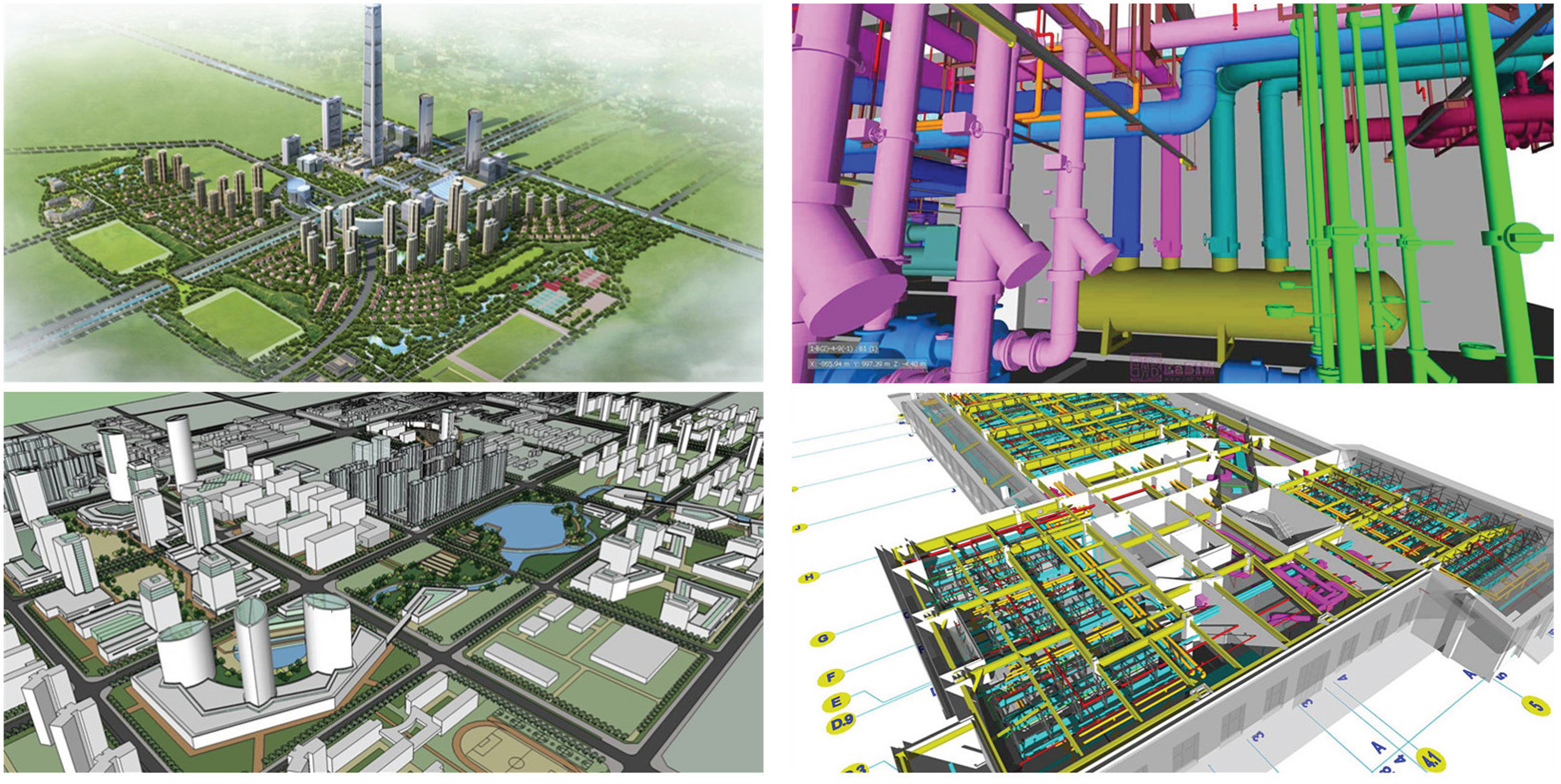
The application of BIM technology in architectural design.
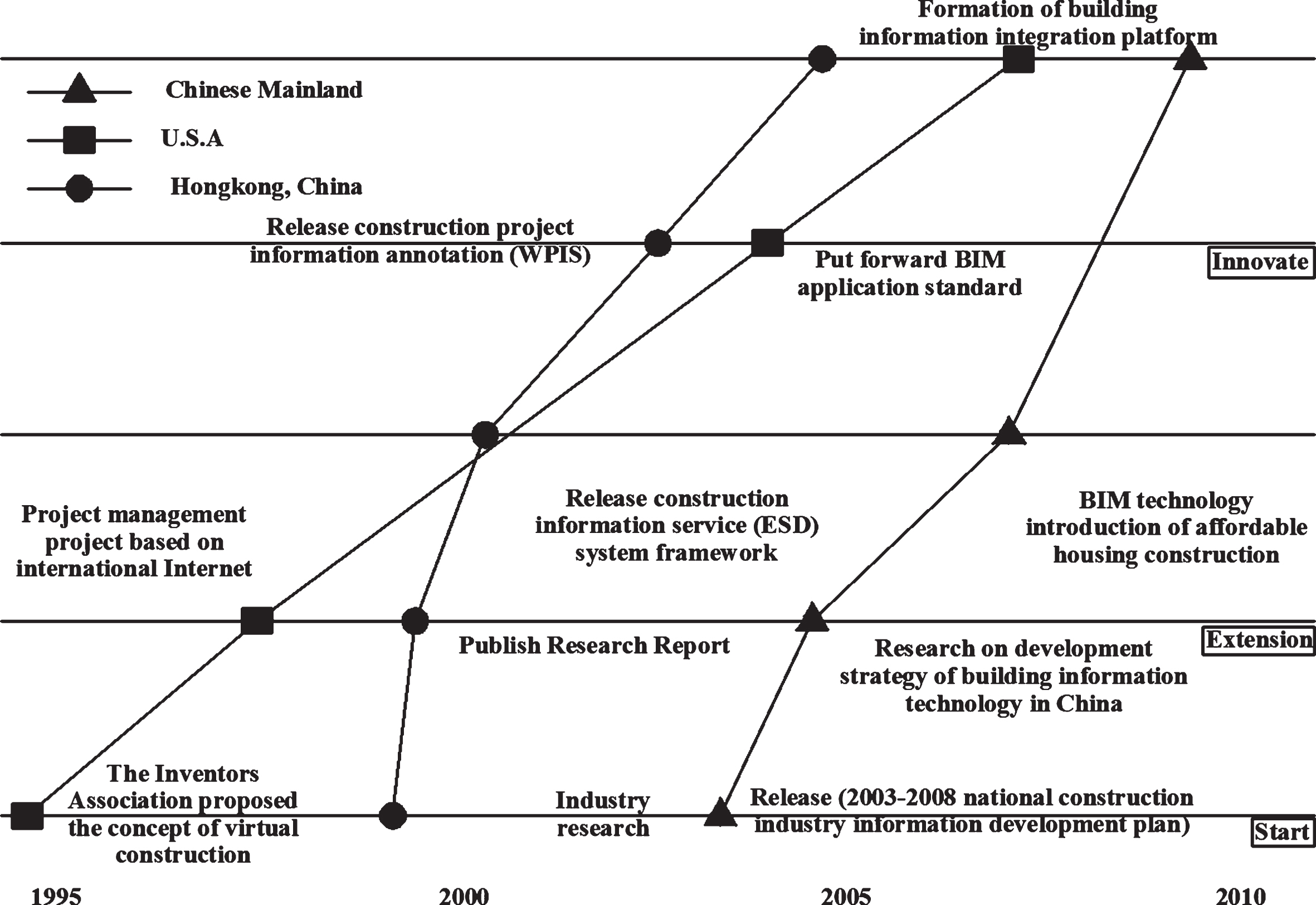
Development of BIM Technology.
At the beginning of twenty-first Century, BIM technology began to carry out a wide range of promotion. In 2002, the United States Autodesk company proposed the concept of building information model, and promoted the related engineering software of Revit based on the concept. In 2003, the United States GSA proposed the 3D-4D-BIM implementation plan, which was used to carry on the research of the application effect of model life cycle, in 2007; they released the BIM implementation guidelines for the specification for application markets. Over the next few years, BIM has developed rapidly. In 2010, Canada published the “The environment survey of BIM tools and standards”, and made a statistical summary for the relevant software [9]. Japan also carried out a larger range of promotion in this stage, and recommended the use of BIM technology in many government investment projects [10]. South Korean government requested that all public facilities projects must use the BIM technology after 2016 [11]. Today, in the United States and other developed countries, the application of BIM in construction projects has exceeded 60%. BIM technology has been widely used in the global scope, the results of which have been recognized by a large number of construction related professionals. BIM technology has been introduced into China since 2003, which has been commonly used in engineering design. After 2008, China Survey and Design Association have carried out a number of studies on it. Compared with the traditional architectural design, the use of BIM technology can no longer spend a lot of energy for drawing and the corresponding calculation, but the use of BIM platform can directly show the architectural design and its effect through the model, which is conducive to the construction of the relevant personnel to understand the space structure [12].
Related tools of BIM
There are two stages of the building design based on BIM platform, one is the basic modeling stage, and the other is the performance analysis and calculation stage based on model. At present, the software can be used for BIM core modeling is mainly as follows: Autodesk, Bentley, Nemetschek Graphisoft, Gery Technology Dassaul [13]. Among them, the more commonly used is the AutoCAD from Autodesk company, it is currently one of the most commonly used design software in China, and it can be widely used in all kinds of projects. BIM architectural design software specifically includes the construction three-dimensional model, the program design, and the architectural visualization of the three kinds of the software. Because the implementation phases of the project are different, the required software and related information data is different [14]. Different engineering profession required software also have certain difference, in terms of the structure, it can be divided into structural modeling, analysis, and construction plans deepen design of these three kinds. Among them, structural modeling software is mainly used for the construction of the structure of the building, so as to establish the main structure of the building model. Bentley Structure and Revit structure are the commonly used modeling software for civil residence and large industrial building [15] (Fig. 3).
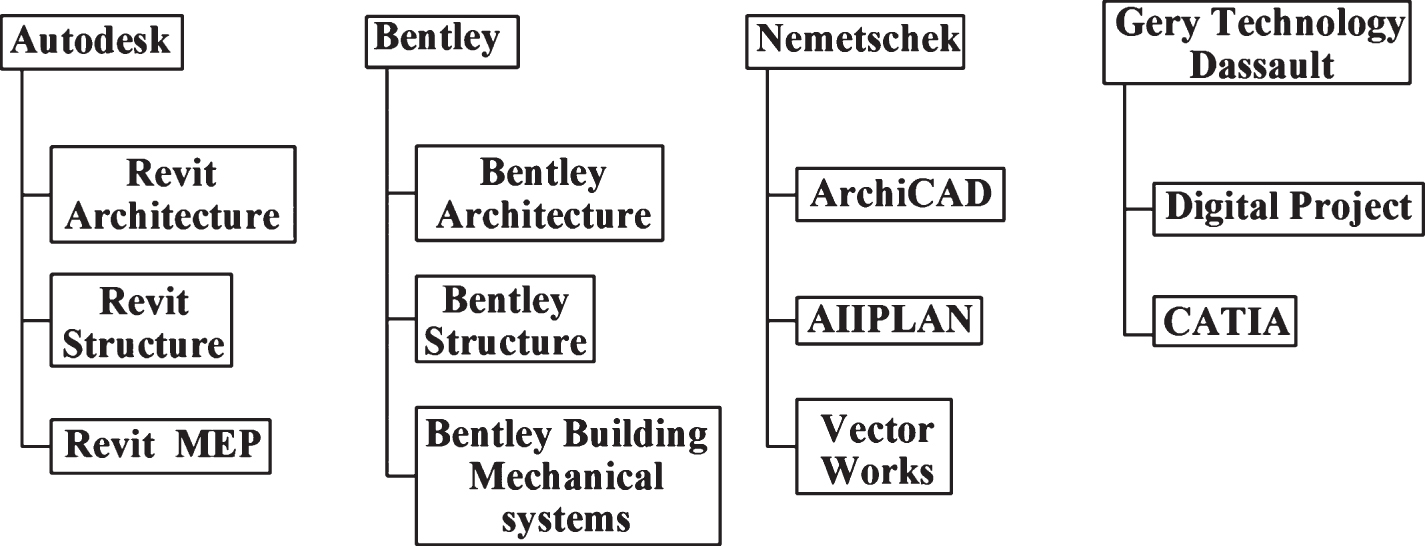
BIM core modeling software.
Organization analysis of collaborative design of construction project based on cloud BIM platform
Architectural design is generally divided into three professional directions, that is, architectural design, equipment design and structural design. In the traditional design process, the design of the overall design is usually linear, the communication among various professions is absent, the design tasks of various professions are independent and scattered, so it is often difficult to find and correct the possible conflicts and problems that may exist in the design process, this may lead to the design progress of the lag, increase the cost of design, and enhance the design risk [16]. The collaborative design of construction engineering based on BIM platform can solve these problems effectively compared with the traditional architectural design, based on the computer network technology, so that the professional designers in the team can communicate with each other in a timely manner. Although each member of the team is dispersed in time and space, the obstacles caused by the dispersion can be solved through the information communication, thus, the quality and efficiency of design are improved [17]. The collaborative design of construction project is based on the same platform, so that all parties of participation are able to access to information and communicate with each other through this platform, so as to realize real-time sharing of design information. The design party also can obtain the related suggestions through this platform and carry on the improvement and the correction for the design content [18] (Table 1).
Collaborative design project stakeholder analysis
Collaborative design project stakeholder analysis
The construction project collaborative design based on BIM platform runs through the entire life cycle of construction project, also contains all the construction parties participating in the construction, such as the owner investors, the construction unit, the designers, the material suppliers and related government departments and so on [19]. Among them, the owner is the initial release of collaborative design of demand side throughout the construction project, is also the ultimate recipient. According to the owner’s demand, the designers carry out the specific design of each profession, and the construction unit carries out the building construction according to the design scheme of the design party, then the supplier shall provide the materials and equipment to meet the design requirements in accordance with the engineering requirements, besides, government departments need to carry out the supervision and management for the design and construction of the construction project, so as to make it meet the requirements of national norms (Fig. 4).
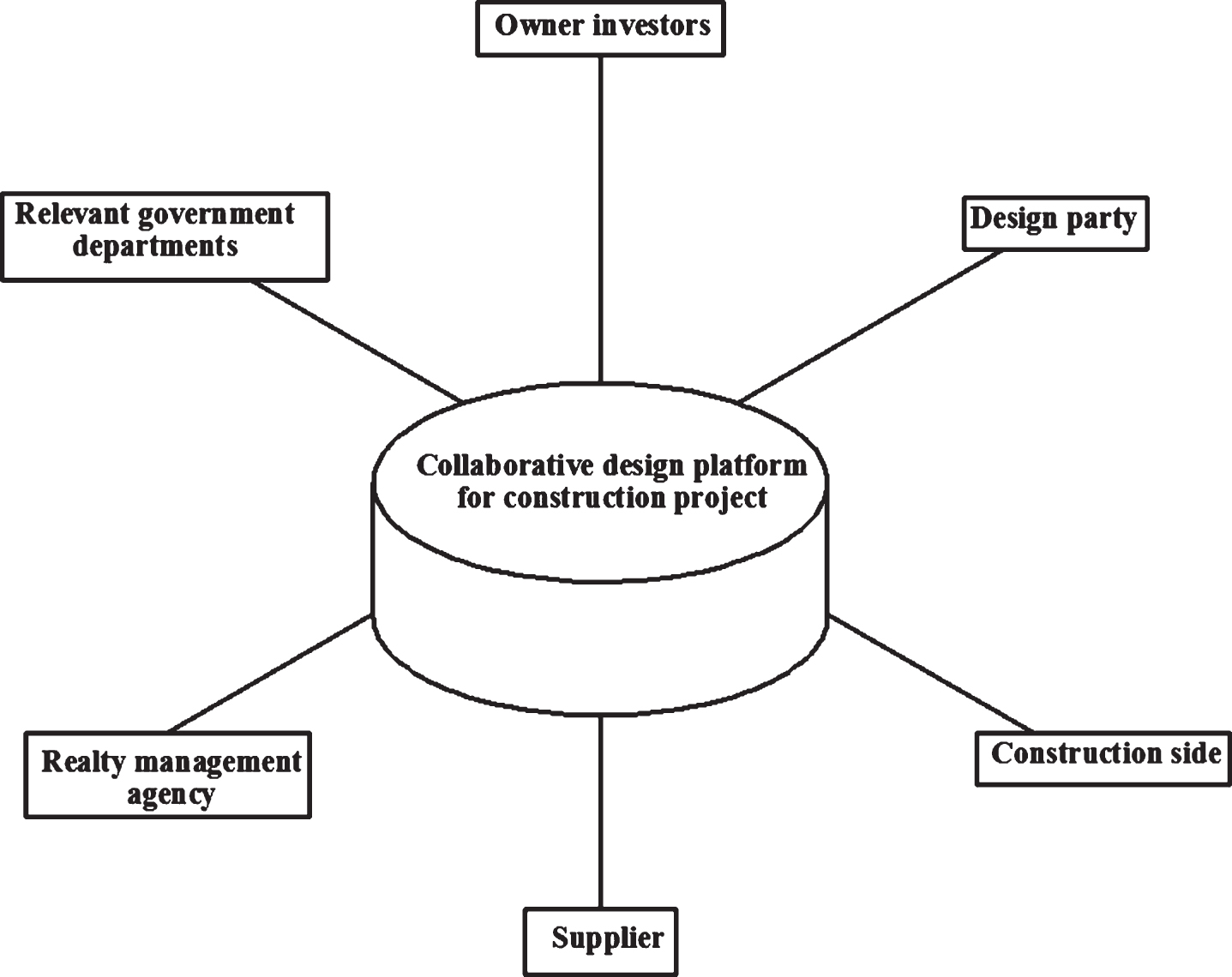
BIM core modeling software.
The design of collaborative design platform architecture based on cloud BIM is to store the related resources and software to the cloud, so that all of the design staff can carry out the three-dimensional design of the architectural structure by accessing to the cloud, and can carry out the information communication timely in the design process [20]. In order to achieve these functions, it is needed to build the whole model and knowledge database in the cloud, and improve the decision-making information database and drawing database, so as to provide the corresponding data and knowledge for the establishment of the whole platform model. The basic function modules of the collaborative platform are mainly divided into six aspects, including the BIM model establishment, the designer’s rights management, task management, knowledge management, conflict detection and elimination as well as the expansion function analysis. The framework of the basic module is shown in Fig. 5.
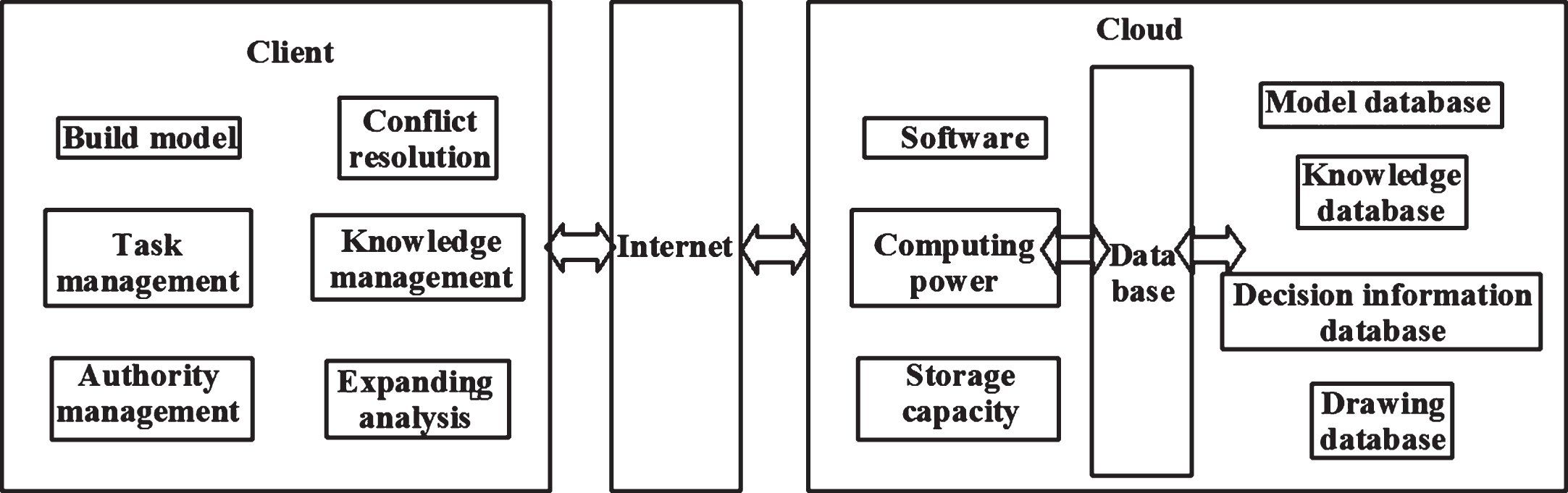
Collaborative platform architecture based on cloud BIM.
The BIM model module is the core module of the collaborative platform, and all the design activities need to be carried out on the module. Based on the three-dimensional model of the BIM model module, the corresponding results can be directly generated, and the mold closing and operation of different models can be realized. The design tasks of different professional are carried out unified arrangements by the cloud, so as to make the entire professional model format consistent, and can be carried on the mutual transformation. Whether the construction of the structure or the construction of the building can carry out the mutual use and contrast for each element, and the information they contain is integrated. When each professional model is successfully established, it can be combined with the mold, so as to establish the model of the whole building. In this whole model, all the relevant professional models can be obtained, and the information can be obtained from the model. For the design of Cloud BIM collaborative platform, graphic design can be deleted or modified, so that the whole design can be adjusted and modified in real time, so as to reduce the errors in the model.
As another core module of the collaborative platform, the task management module is responsible for decomposing the construction project design tasks and assigning to the various professional design teams. According to the characteristics of the architecture itself, the different professional tasks are divided into three categories, namely, architecture, equipment and structure. The specific professional division is divided into three categories. After the decomposition, the various sub tasks still exist the intrinsic link, which are not completely independent, the relations include three kinds: serial dependence, parallel independence and cross coupling. Eppinger design structure matrix DSM can be used to carry out the task decomposition. Assuming that there are decomposition sub task of engineering cooperative design, the i sub task is represented by T
i
, the geometric (T1, T2, ⋯, T
n
) of each sub task is represented by a matrix A(n × n), then:
In which, a ij ∈ (0, 1) (1, 2, ⋯, n).
When a ij = 0 (i ≠ j), it shows that the information of T i is not needed for the execution of the sub task T j ;
When a ij = 1 (i ≠ j), it shows that the information of T i is needed for the execution of the sub task T j ;
When a ij = 0 (i = 1, 2, …, n), it shows that the sub task T i has no need for its own information.
The design of rights management module is very important for the operation and management of the platform, which carries out the management by accessing to AC, its functions include: firstly, it can prevent the unauthorized users to access to the platform resources; secondly, the authorized users can access to system resources; thirdly, the restrictions on legitimate rights of legitimate users can be carried out, so as to prevent unauthorized access to the system resources. When there are some problems in the system of collaborative design, the conflict detection and elimination module needs to eliminate the conflict in collaborative design system. Each professional design group is mutually dependent, but there is a certain contradiction, so there is certain independence, but each other’s resources are shared and need to be integrated, which can be described based on MOP mathematical model. Assuming that there are n designers, a single designer is expressed by D
i
(i = 1, 2, …, n), the design variables are expressed in V
i
, so:
In which, X
i
∈ V
i
, the number of design targets is expressed by k
i
, the first j target is expressed by f
ij
(1, 2, …, k
i
), designers are expressed by
Compared to D i , the design goal is:
In the collaborative design of engineering project, the optimal condition for single design personnel is:
The maximum solution of the vector function of formula (5) is carried out, and a Pareto optimal solution
When the
The greatest feature of cloud BIM construction project collaborative design is the use of cloud for storage and computing, the design task of the project is carried out on the collaborative platform from the initial planning to the final completion of the whole process, including the task planning, preliminary design, mold closing, collision detection, deepening design and the final model and other steps. The flow chart is shown in Fig. 6. Compared to the process of the traditional design, each design activity is carried out simultaneously, so it is needed to carry out the communication and conflict elimination in the collaborative design process in time.
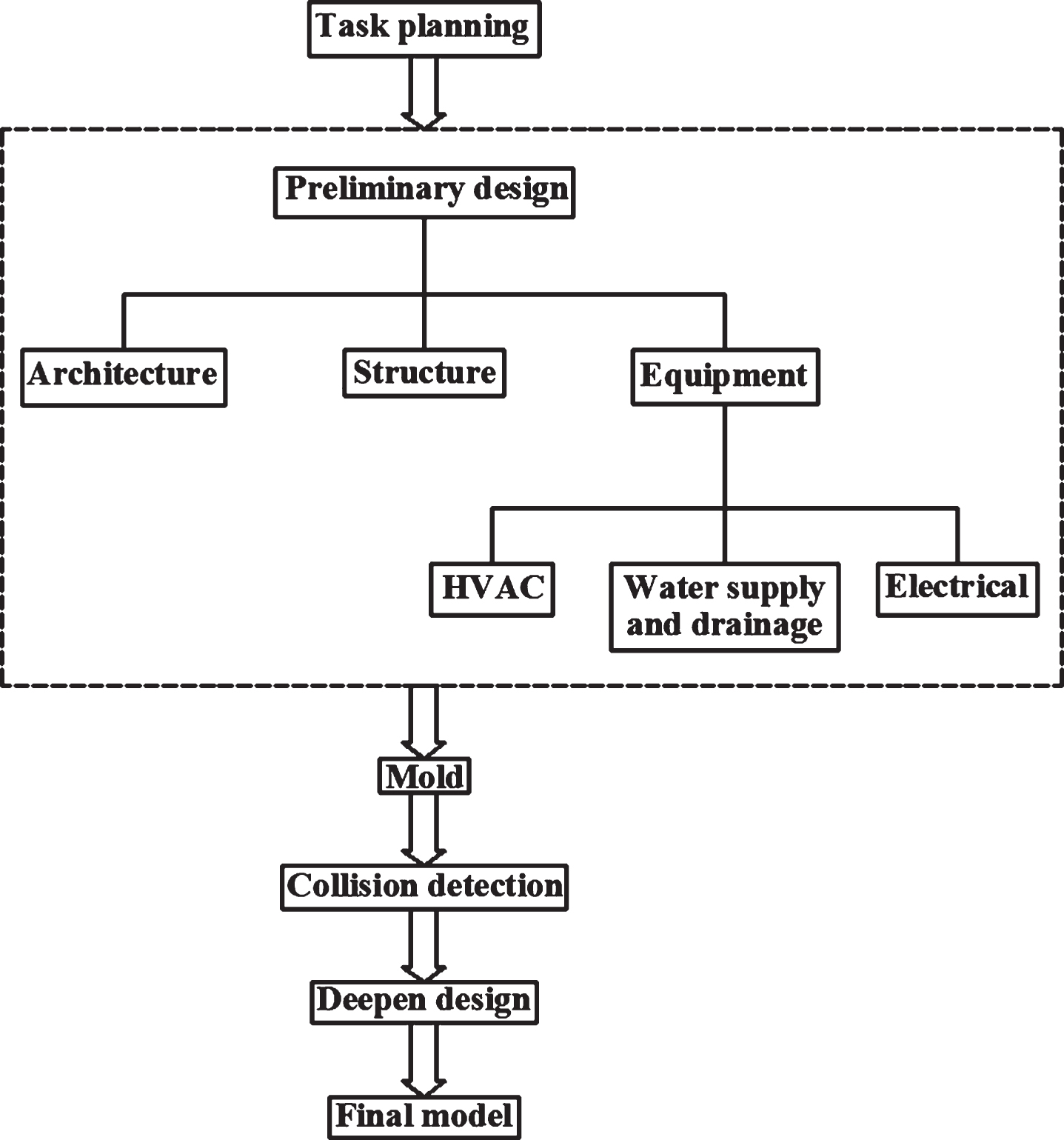
General flow of collaborative design.
In the collaborative design of construction projects, according to the relationship among different sub tasks, the decoupling of the sub tasks of the coupling relation is needed, and then the refinement and reorganization of the tasks are carried out. Prior to this, it is necessary to complete the assignment of tasks to ensure that each designer can complete the assigned task in the appropriate time. In the specific implementation process of the project design, the content and distribution of tasks need to be adjusted according to the progress of the project, so as to achieve the coordination of each task, reduce duplication of work, and thus improve the design efficiency (Fig. 7).
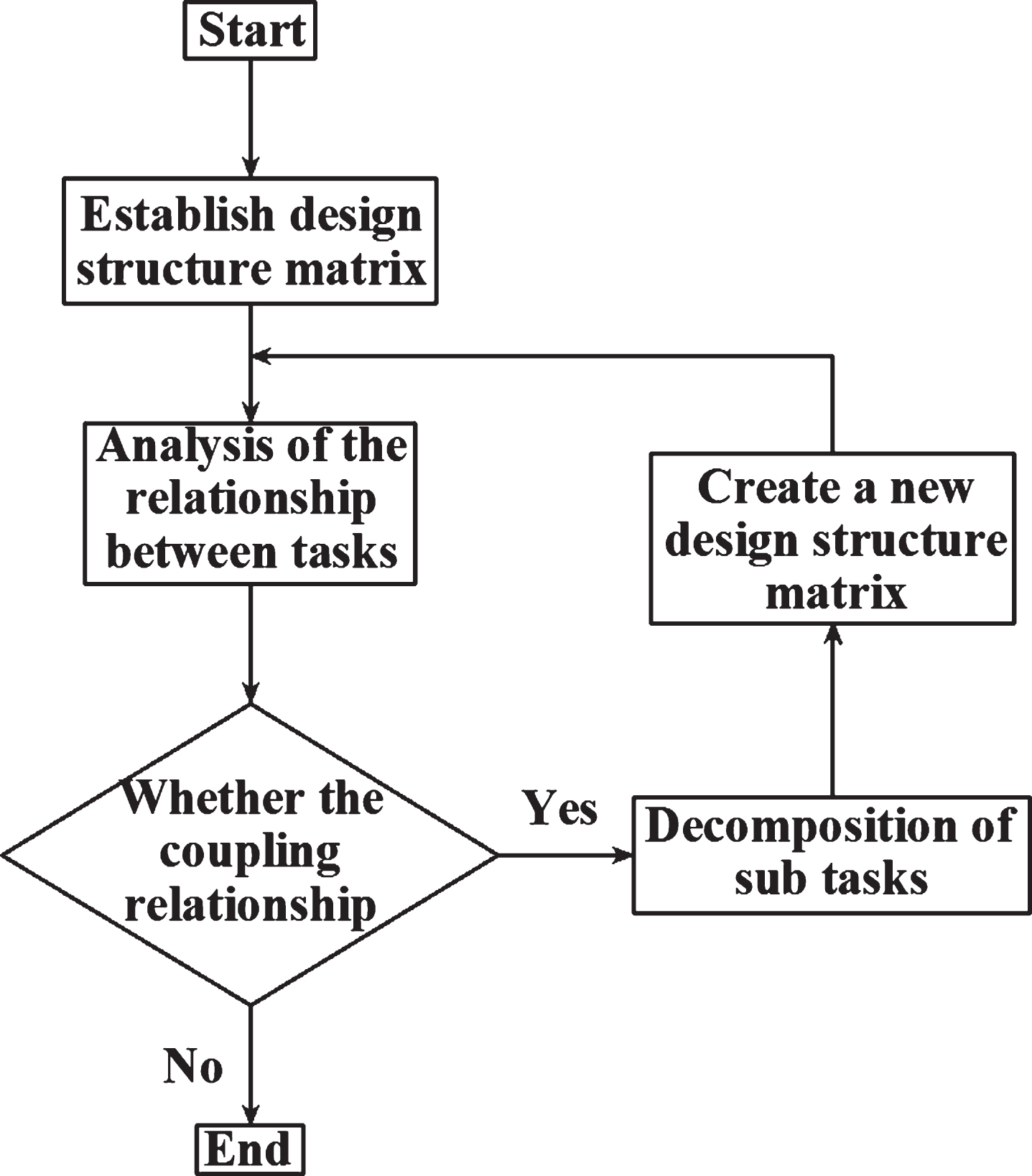
Collaborative design task planning.
The collaborative design of each specialty includes the coordination design of structure, architecture and equipment. In the traditional design process, the process generally is to complete program design, and then carry out the design of the approval, and finally carry out the preliminary design and construction drawing design, respectively. In this design process, the coordination among the various professions needs to be carried out by specialized personnel, which not only causes a waste of manpower and material resources, but also is not sufficient to communicate because of this linear relationship. Based on the use of the design platform of the construction project collaboration, the team of each design profession is parallel, their own design results can be transmitted in real time with others, and its specific process is shown in Fig. 8.
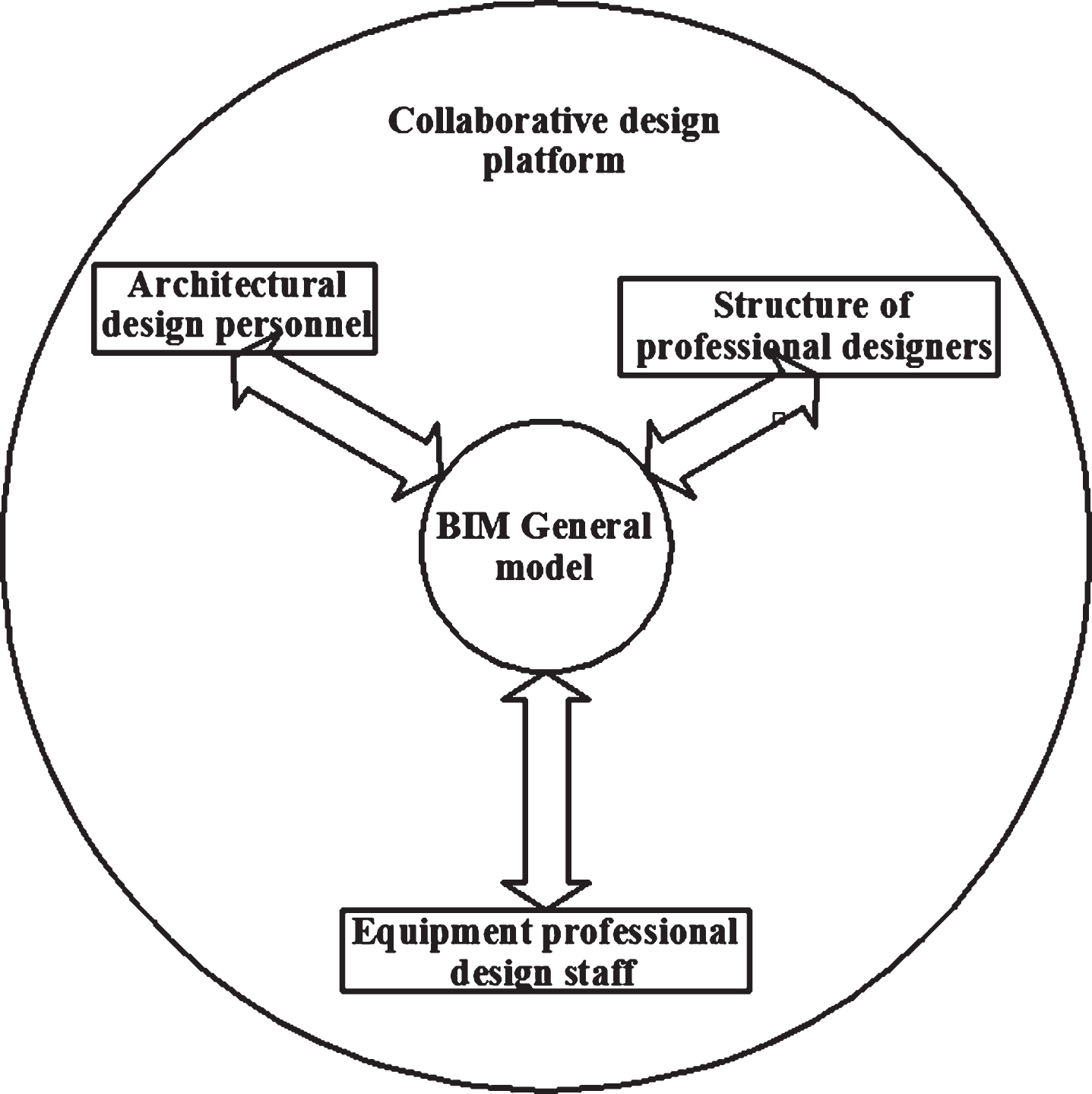
Collaborative design of each specialty.
Based on each professional design, BIM module will carry out the real-time analysis for the three professional models, so as to test that whether there is a conflict. In order to achieve and carry out collision, some modeling rules are required, including its positioning, naming, design standards and the degree of detail, etc. Only in this way, it is easier to realize the closing in real time, the three-dimensional coordinates and axis are modeled to the same file. Generally, the static conflict detection is used to carry out the conflict detection of the model, and the graphics and the image of the two aspects are carried out the detection analysis, respectively. The methods of bounding box include the axis-aligned bounding box, bounding request, the oriented bounding box and the discrete directed polyhedron bounding box (Table 2).
Comparison of characteristics of all kinds of bounding boxes
The application level of Construction information of construction engineering in China is low, and it belongs to the labor intensive industry, in the process of project implementation, it is easy to cause the information asymmetry, thus the construction quality is reduced, and the construction effect is low. The collaborative platform of the project construction based on cloud BIM platform can effectively solve this problem, including the owner, the construction side, supervision side, the design side, and the construction simulation is coordinated to the design and construction. The construction simulation is realized on the basis of the virtual reality technology. Based on the three-dimensional environment of the computer platform, the construction organization can be simulated in advance, then, according to the problems and conflicts in the process of simulation, the optimization scheme is put forward, so as to reduce the problems in the actual construction process as much as possible. Through the construction simulation, the design changes can be reduced in the implementation process as far as possible, so as to save construction costs, and effectively reduce the risk of prediction. The simulation flow before construction is shown in Fig. 9.
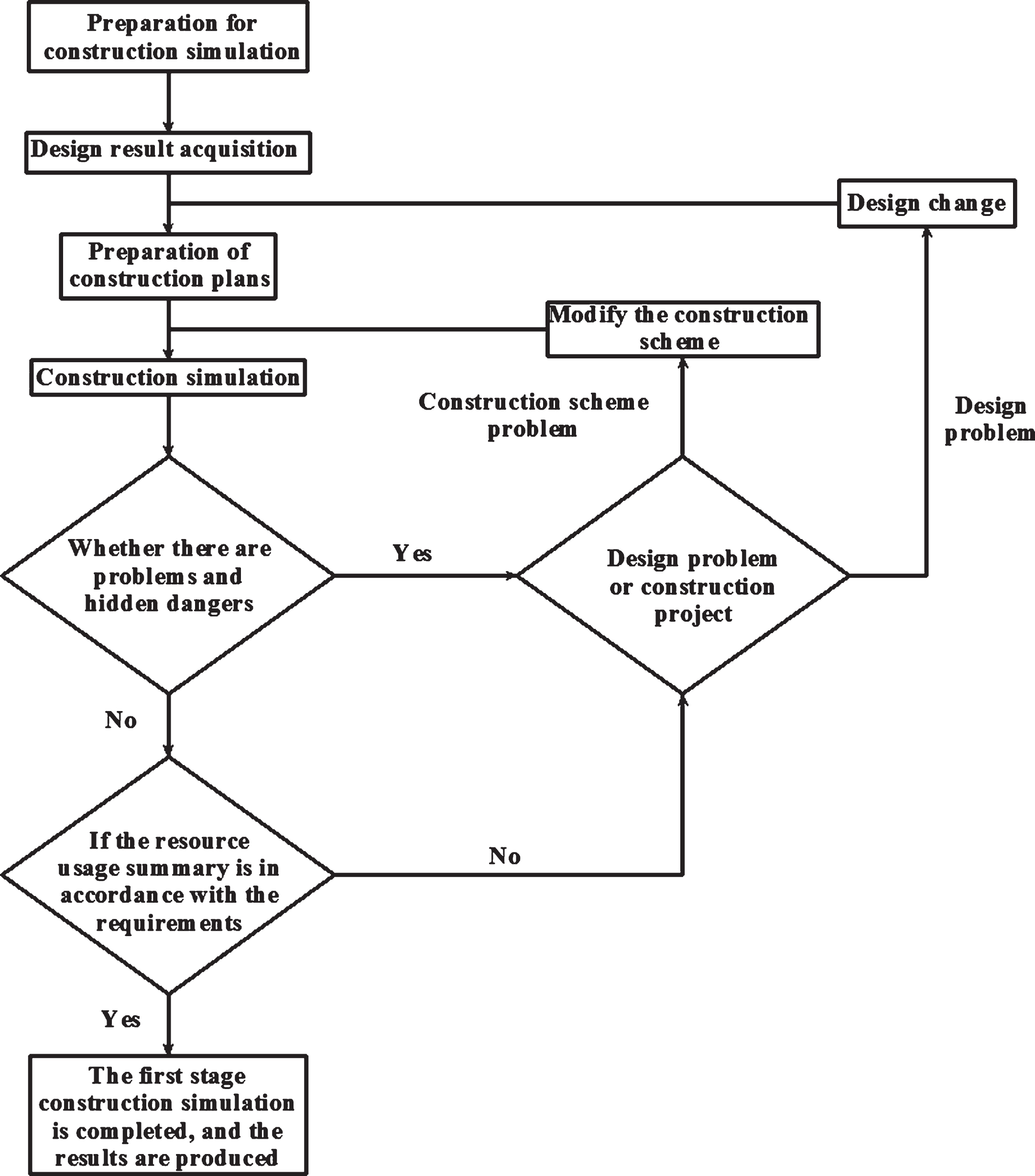
Construction simulation process before construction.
In the process of the simulation of the construction, because the designers in this phase are less, and the large problems the construction process has been basically resolved in the simulation before the construction, so problems in the design are less. But the whole simulation runs through the construction process, which is used to carry out the construction process management, so that the whole process of construction is controlled. The simulation process in the construction process is shown in Fig. 10.
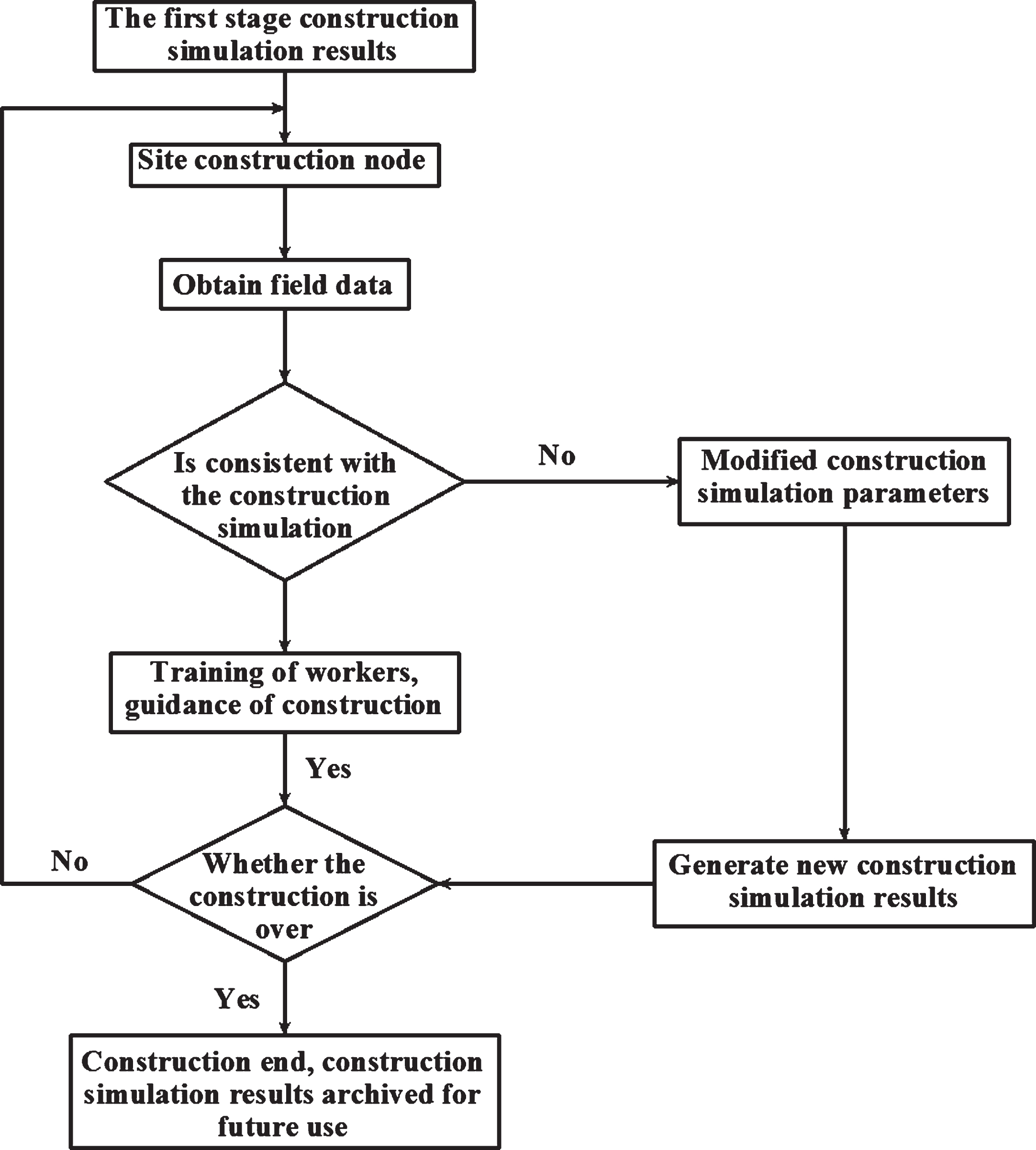
Construction simulation implementation process.
The established model was used to carry on the design of a steel structure bridge and the application based on the cloud BIM collaborative platform in the construction process, and to carry out the task planning, design collaboration, building model and monitoring conflict, construction simulation and so on, so as to verify the effectiveness of the collaborative platform. The length of the bridge was 160.2 m, and the slope of the longitudinal plane was i = 1%. The length of main bridge was 86 m, the main arch high was 14.5 m, the structure form was the rectangular cross-section steel box, the size was 1.7 m*1.1 m, the horizontal distance was 10 m. The cross section size of column bridge direction was 6 m, while the cross bridge direction was 1.1 m. The size of the steel main beam was 0.9 m*1.1 m, and the lateral spacing was 10 m. There were 37 beams in the whole bridge, and the size was 1.2 m*1.57 m, the maximum height of bracket was 0.82 m, the length was 0.8 m. All structures used the construction of cable lifting scheme. The establishment of the model based on BIM was carried out the detection of the mold and the conflict in accordance with the frequency of 1 times/week. Firstly, the design structure matrix of the project was established, the calculation formula was:
According to the task partition, the three-dimensional modeling was carried out combined with the contents of each sub task, models included abutment model, platform model, arch rib model, connecting web model, arch model column, column inclined strut model, the column model, the longitudinal middle segment model and so on. Finally, the model of each component was carried out. In addition, the conflict detection of the mold was carried out, and then the cloud technology was used to eliminate the space-time difference between the construction and design.
Finally, a real-time communication and management platform was provided for the collaborative platform, so that each participation party used the platform to access to information resources, so as to timely carry out the exchange of information. In the construction simulation before the construction, the construction simulation of the whole process of the bridge was carried out. In the construction simulation of cable suspension, some design errors were found and provided for the design unit, in the actual construction of the follow-up, the problem was effectively solved.
In order to further improve the construction efficiency and construction quality of the construction industry, the collaborative design and the construction coordination mechanism of construction project based on cloud BIM platform has a very important significance. Based on the analysis of traditional engineering construction design method, the collaborative platform was put forward, which was helpful to carry out the collaborative management of the whole process of the construction project. In order to satisfy the function of the coordinative platform, the establishment of BIM model, the permissions management, the task management, the knowledge management, the conflict detection and elimination as well as the extensions were analyzed, so as to constitute a functional integrity of the collaborative design platform. Aiming at the construction characteristics of the engineering project, the simulations of pre-construction and construction were put forward, and the working process was established. Through the analysis of the actual engineering application, it can be seen that the effect of collaborative design platform and construction collaboration platform is obvious in the project implementation process, which is helpful to carry out the task allocation and the construction of each model, the establishment of communication design model and the simulation of pre-construction, besides, it successfully solves the conflicts among them, so as to ensure the smooth completion of the project implementation.