



Abstract
The dynamic analysis of damaged steel frame structure with removal column utilizing alternative load path method was conducted in the FE software Opensees with the consideration of three random parameters including material yield strength, dead load and live load. Due the enhancement of material’s yield strength under the high strain rate condition, steel material property was gained through the cowper-symonds model. Taken the sample steel plane frames of 7-degree anti-earthquake defensive area the example, loading re-distribution was discussed after the scenarios of middle or side column removal in the first floor. In the final the dynamic yield strength amplification coefficient and the bending moment ratio of beam-ends among the direct influenced region were statistics and researched.
Keywords
Introduction
Under the extreme load condition such as earthquake or explosion, if some components can’t undertake tremendous destruction load and the key column component failure, which may cause structural progressive collapse [1, 2], namely local component failure result in a disproportionate damaged of the whole structure. Alternate load path (ALP) [3, 4] is a direct structural design method of progressive collapse resistance, which was widely used to analyze the internal force redistribution after local bear component failure to prevent disproportionate progressive collapse. The specific implementing method [5, 6] is the vertical bear component removed from the original structure. Then the redundancy of residual structure is to provide adequate alternate load path to the load redistribution by design and analysis. Alternate load path method is the essence of force transfer path change, namely the vertical load on the failure column were distributed on the upper structure of the bending framework.
According to the demolition of component method of UFC 4-023-03 [7], until the static load (such as gravity load) has been applied completed, the key component was removed. The loading sequence was truly reflecting to actual force situation of structure. The concrete implementation method includes following three steps, as shown in Fig. 1: (1) The internal force of the planned removed-components was derived from the calculation and analysis of whole static model under dead load and live dead. (2) The equivalent static analysis model with the original structure was obtained by removing failure column and applying the opposite direction internal force P0 at the original column-end. (3) The dynamic analysis was carried out by applying load vector varied with time on the failure point after dismantle components. The structure failure time is very short in general, 1/10 (t1 = T1/10) vertical fundamental period of residual structure.

Load applied method of simulation removal column dynamic effect.
The research object is a four-story and three-span the steel frame, the height of 4 m, the span of 6 m. The beam and column were made of Q235 I-steel, designed section sizes as shown in Table 1. According to the provisions of UFC 4-023-03 [7], the total floor load is 1.2D + 0.5L in collapse analysis. The dynamic analysis of removal middle and side column of the plane steel frame was respectively constructed, the column 3 and 4 as shown in Fig. 2.
Steel frame section size of seismic fortification intensity
Steel frame section size of seismic fortification intensity
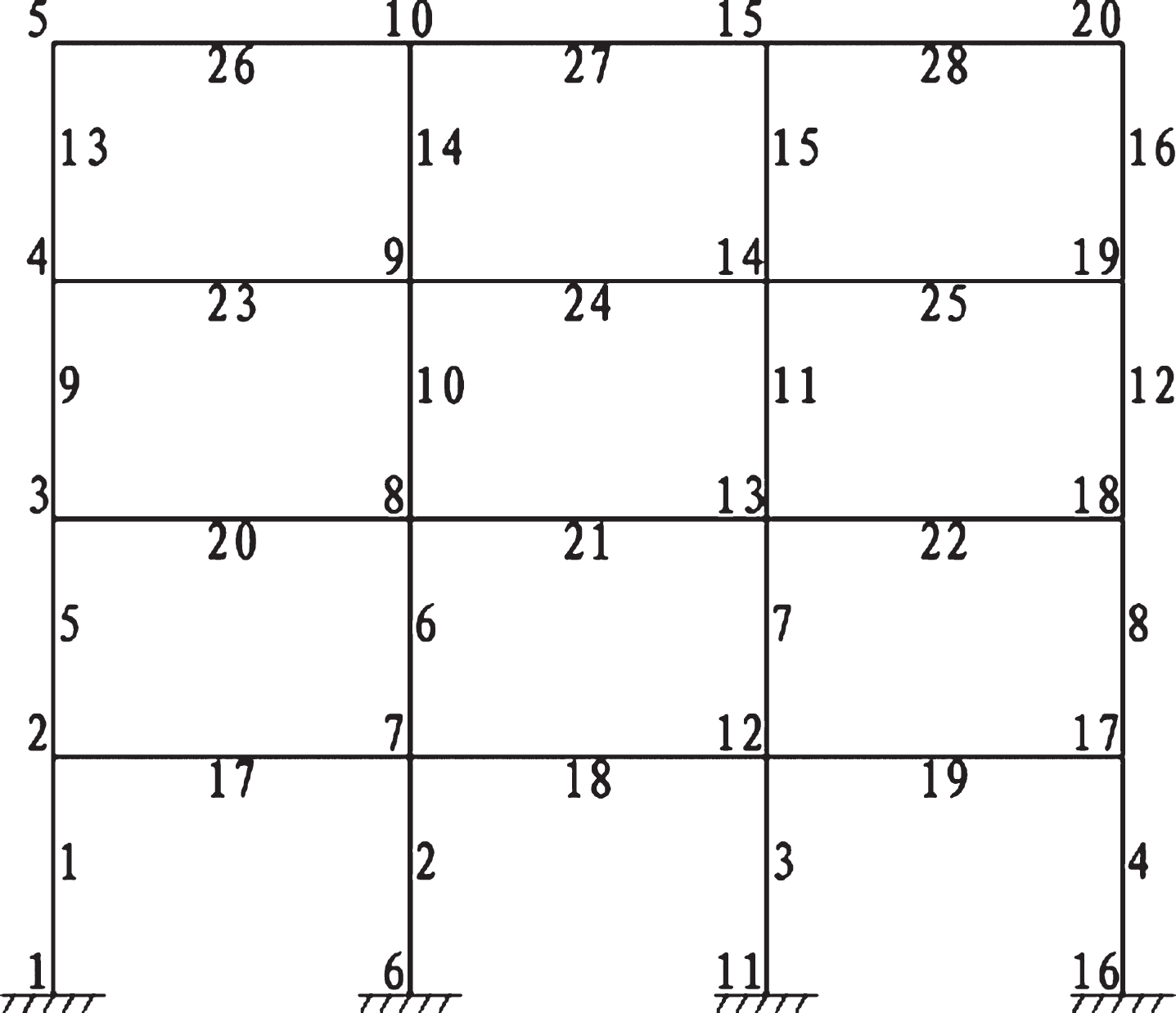
Element and node number of steel frame.
The considered random parameters are Q235 material static yield strength, dead load and live load values. The steel yield strength is assumed to obey the lognormal distribution (μ = 5.603, σ = 0.00709) based on literature [8, 9], the average yield strength (static) 272 MPa, the coefficient of variation 0.080. The reported results of the representative data showed that the dead load standard values is obey normal distribution, μ G = 1.06, δ G = 0.074. The floor live load was obeying extreme value type-I distribution in the design reference period, μ L = 0.305L k , δ L = 0.212.
Latin hypercube sampling (LHS), first put forward by McKay [10], given a mathematical expression by Stein [11], is an variance reduction techniques and an alternative monte carlo method, with wider application in the simulation, optimization and reliability computing [12]. The random sampling vector [13] is divided into two steps including generate single variable sample and order sample points. 100 groups samples were generated by using the Latin hypercube sampling method, which was named with frame section group and random parameters sample number. Steel frame section group A, B and C was respectively corresponding to the seismic fortification intensity of 6, 7, 8 degrees. The F-B-1 sample is corresponds to the steel frame designed according to the seismic fortification intensity of 7 degree, the number of the sample is the 1st group, F for frame.
A multiLinear model [14] is adopted in the simulation of the steel constitutive relations, as shown in Fig. 3. The yield strength (f y ) of Q235 is 272 MPa; the modulus of elasticity is 206 GPa; the tangent modulus of strain-hardening ranges is 1% E [15], the ultimate strength (f u ) is 447 MPa [8]. The fiber cross section model is used to the section of column and beam. The nonlinear beam-column element is introduced to consider the geometrical nonlinearity and plastic property. The coordinates of beam is choose the corotational transformation to consider catenary effect. The coordinates of column is choose the P-Δ transformation to consider the second order effect of P-Δ.
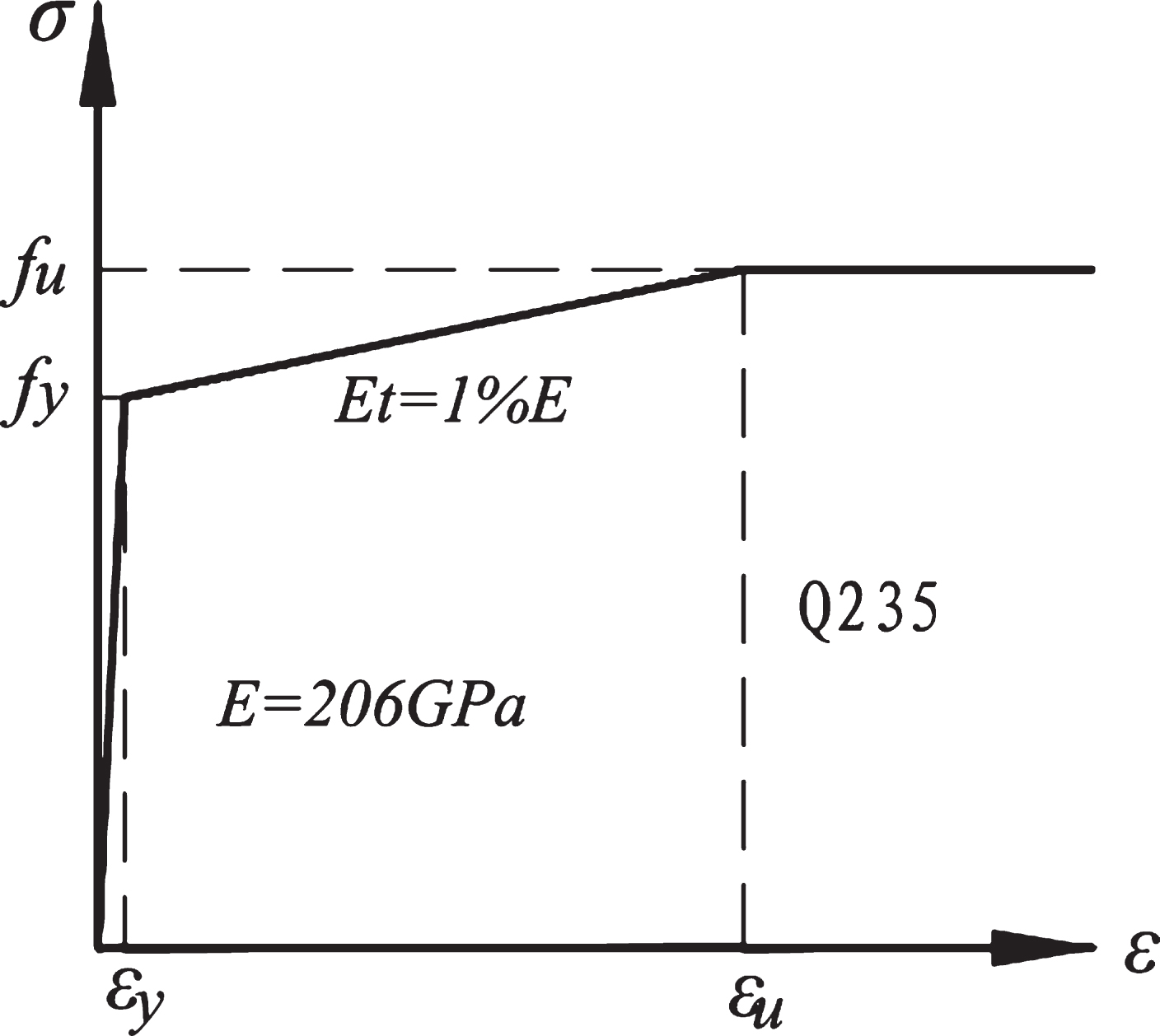
Material constitutive model.
In the process of free vibration, the building structure will present a degree of energy loss, which was known as the inherent damping [16], mainly caused from the internal friction of the structure material, nodes, non-structural components. This article adopted the simplified rayleigh damping matrix [17]:
In the cowper-symonds model, the dynamic constitutive equation [18] considering the effect of strain rate of steel was written as:
which,
Take F-B-1 as an example, (f y = 282.83 Mpa, D = 8.001 kN/m2, L = 0.579 kN/m2), the first two vertical normal periods were T1 = 1.308 s, T2 = 0.530 s by analysis on removal column 3 model. The mass damping coefficient and stiffness damping coefficient were calculated α = 0.13674 and β = 0.00240 based on formula (2) and (3).
The strain rate extreme value may appear in the direct influenced region after removal the column, namely the 2nd pan and 3rd pan, therefore the plastic strain rate were calculated by the time-derivative of upper and lower flange plastic strain of beam 18, 19, 21, 22, 24, 25, 27 and 28, as shown in Figs. 4, 5.
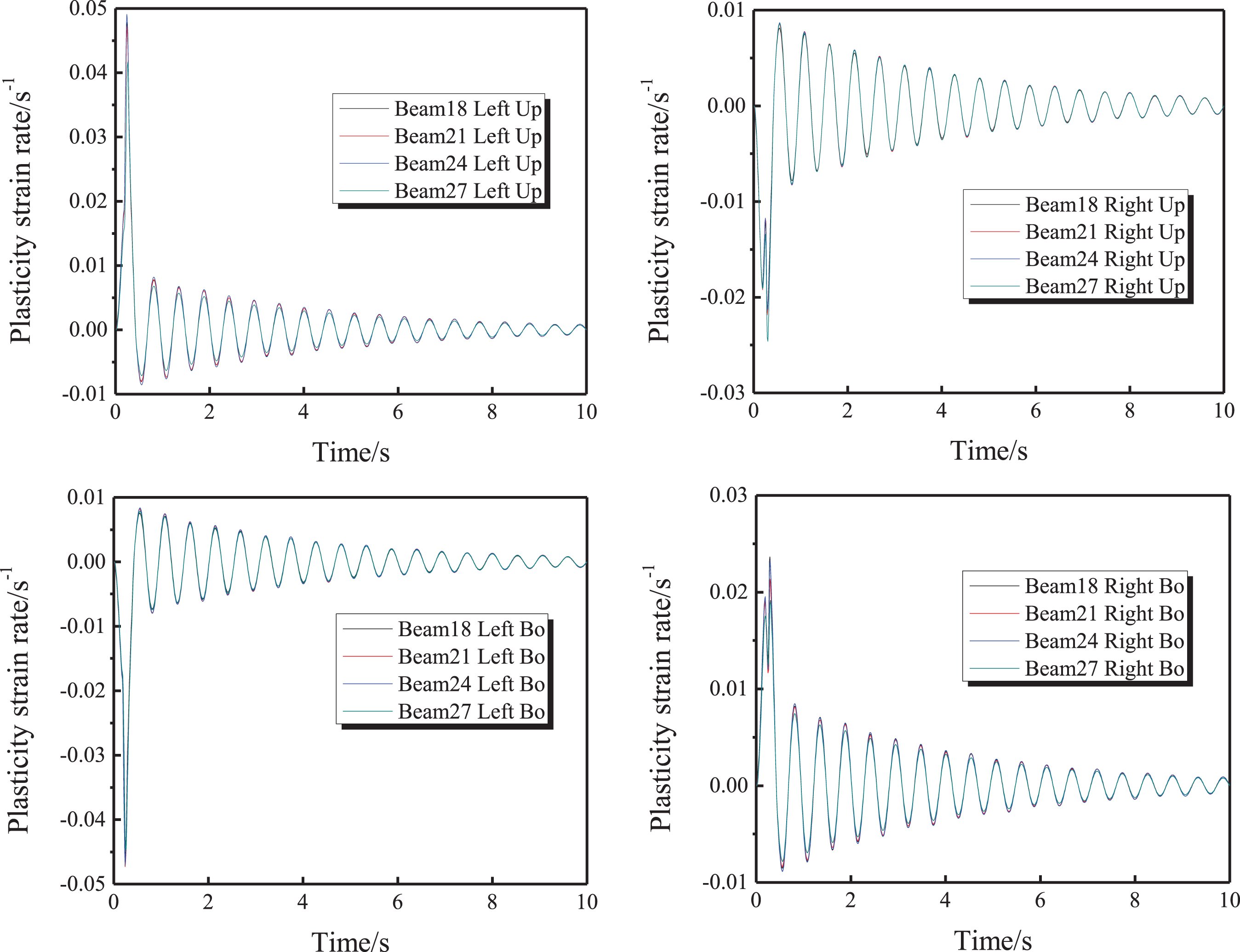
Plastic strain time-history of 2nd pan.
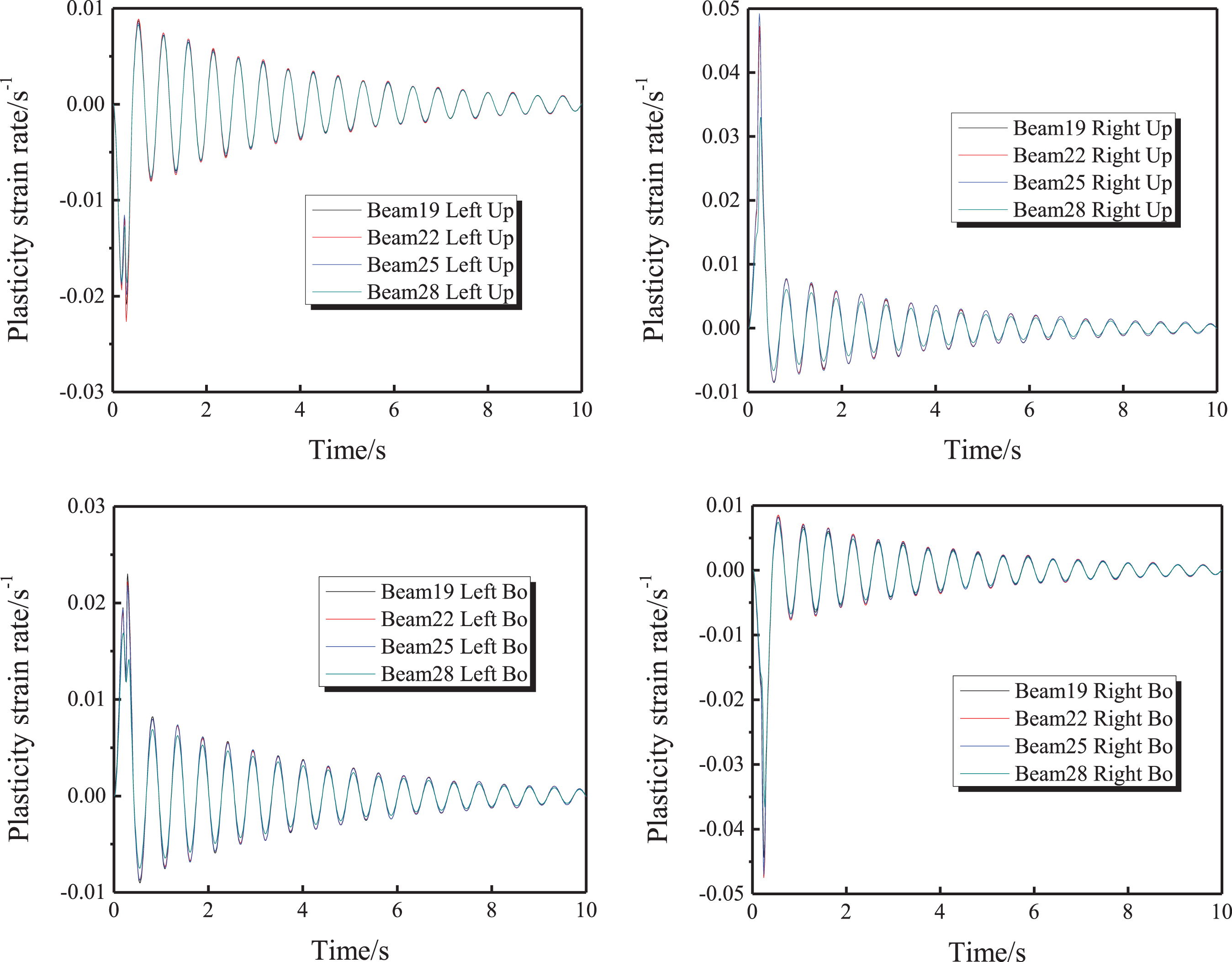
Plastic strain time-history of 3rd pan.
Table 2 for the statistics extremum of the plastic strain rate of beams in the direct influenced region: (1) At the near damaged location, plastic strain rate extremum of beam-end appeared in 0.24 s to 0.27 s, a value of 0.0330∼0.0492; At the far damaged location, plastic strain rate extremum of beam-end appeared in 0.29 s to 0.32 s, a value of 0.0141∼0.0246. (2) The plastic strain rate extremum of the near beam-end was generally higher than that of the far beam-end and earlier bear the mutation load, which shown clearly that the beam-column joints away from the damaged location was significantly influenced by dynamic effect. (3) At the beam-column joints of near damaged location, the plastic strain rate extremum appeared in the top or bottom story; At the beam-column joints of far damaged location appeared in the middle story.
Plastic strain rate extremum of beam and corresponding time
The DIF is 1.2618 by substituting the strain rate extremum of beam-column joints in the direct influenced region. The error of calculation DIF and initial assumption DIF should be less than 1e-3 based on the iterative calculation requirements. The value of DIF is 1.2673 in the case of removal middle column of F-B-1 frame.
Catenary effect
Internal force of steel beam is given priority to bending moment and shear force under the distributed load in general. The research shown that plastic joint can be formed in middle span and support of the steel beam with the increase of load and plastic rotation. Increasing axial constraint reaction force at beam-end, steel beam is an component under moment, shear force and axial tension force at the same time. With the axial force further increase and the bending moment decrease continuously in steel beam section, the steel beam was up to the whole section yield, resist external forces and load by the axial tension, be ruptured in middle span or support of the steel beam in the final. With the increase load, a flexural member was gradually transformed into the tension-flexure member, resist external forces and load rely on mainly the axial tension, namely catenary effect of steel beam.
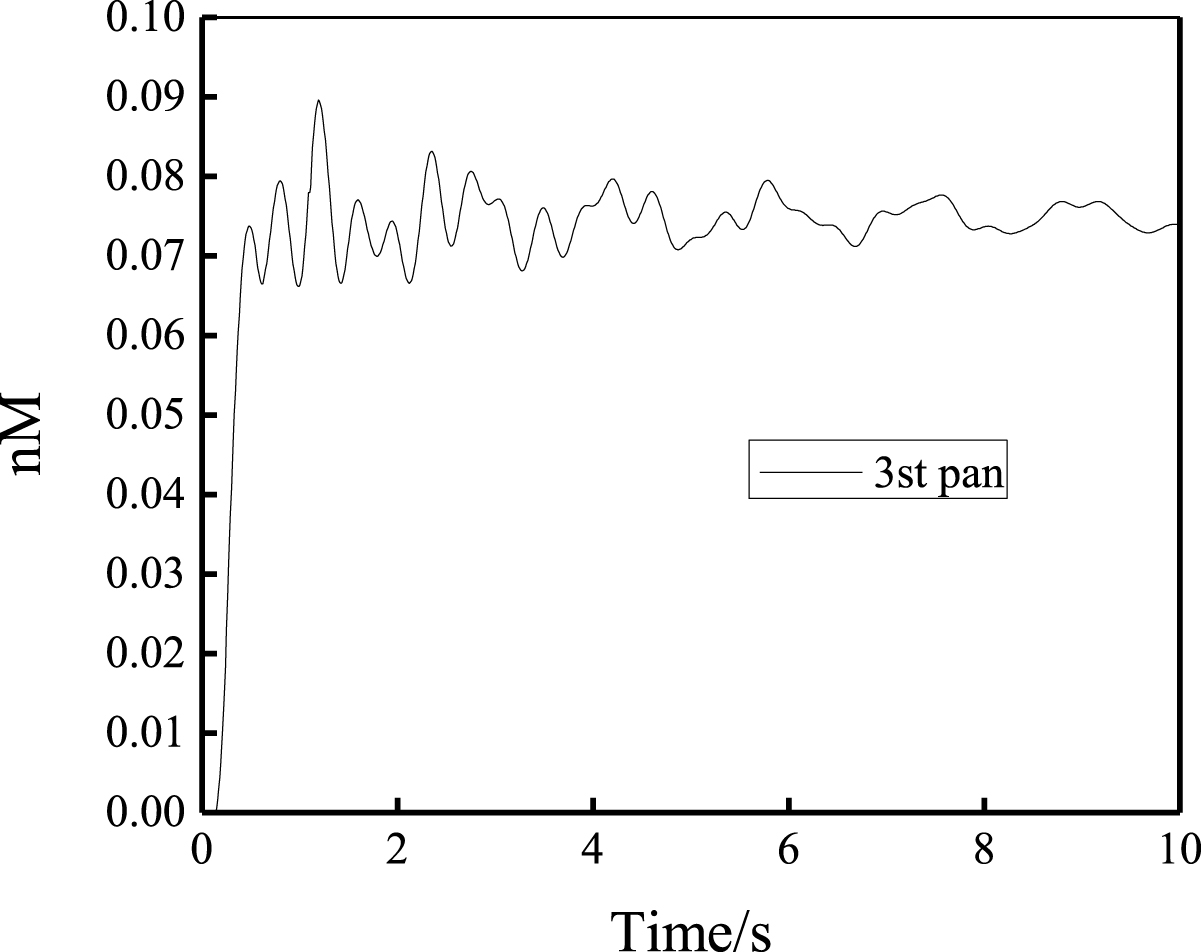
Figure 6 shown catenary effect of the 2nd pan and 3rd pan (beam 18 and beam 19) in removal middle column at first floor situation. The ratio of bending moment provided beam-end tension and total moment (N x × Δ y /M z ) is respectively 6.272% and 5.939%, appear in 1.66 s and 1.11 s. Figure 7 shown that catenary effect of the beam 19 in removal side column at first floor situation, extremum 8.962%, appear in 1.19 s.

Bending moment ratio of removal middle column.
Bending moment ratio of removal side column.
Material model of node analysis should be consistent with that of frame dynamic analysis as much as possible for node model equivalent to frame structure model. So it is necessary to extract and statistics the dynamic yield strength amplification coefficient (DIF) of each frame in the dynamic analysis. 100 groups of dynamic yield strength amplification coefficient (DIF) were arranged in ascending order, serial number as i (i ∈ [1, 100]). When DIF ≤ DIF i , the probability values of DIF is Pf = (i - 0.5)/100 (Pf ∈ [0.005, 0.995]). The logarithmic normal distribution was converted into normal distribution in drawing. The horizontal axis coordinates is the logarithm of DIF, express in DIF = 10 p form, as shown in Fig. 8.

Scattergram of dynamic yield strength amplification coefficient (DIF).
The relevant parameters of probability distribution function of DIF are shown in Table 3. The influence on the material constitutive relation of the plastic strain rate extremum of the removal middle column was similar to those of the removal side column for the same frame. As the growth of the seismic fortification level of plane steel frame, material yield strength increase caused removal column, 6 degree maximum, 7 degree second, 8 degree minimum.
Parametric statistics of dynamic yield strength amplification coefficient (DIF)
The purpose of the node analysis is to identify the relationship between the node failure probability and the performance. The beam-end internal force was used for the judgment index of node brittle failure. In this article the node bending moment value was as an judgment index of node performance, therefore it is necessary to statistics the bending moment of node in the direct influenced region in the dynamic analysis of steel frame. The beam-end moment extremum of the near and far the damaged side was extracted from each sample calculation results. The moment extremum was formalized to bending moment radtio (nM) by the section yield bending moment (M y ). The lognormal distribution parameters of bending moment ratio were shown in Tables 4 and 5. (1) The results showed that the beam-end nM average value of the far away from damaged side was greater than that of near the damaged side after removal the first floor column. The beam nM average value of 6 degree frame was greater than that of 7 degree and 8 degree frame. (2) The statistical results revealed that the nM standard deviation of the far damaged side beam-end was greater than that of the near damaged side beam-end from 6 degree and 7 degree frame. The nM standard deviation of 6 degree was the largest among three seismic grade frames. (3) The beam-end nM extremum in direct influenced region were close to each other after removed the middle or side column in same plane frame.
Parametric statistics of nM of removal middle column
Parametric statistics of nM of removal middle column
Parametric statistics of nM of removal side column
Based on the alternate load path method, the dynamic response analysis was study on the demolition first floor column of the four-story and three-span steel frame structure at the different seismic fortification zone. (1) The influence on the material constitutive relation of the plastic strain rate extremum of the removal middle column was similar to those of the removal side column for same steel frame. (2) As the growth of the seismic fortification level of steel frame, material yield strength increase caused removal column, 6 degree maximum, 7 degree second, 8 degree minimum. (3) The beam-end nM average value of the far away from damaged side was greater than that of near the damaged side after removing the first floor column. (4) The nM standard deviation of the far damaged side beam-end was greater than that of the near damaged side beam-end from 6 degree and 7 degree frame. (5) The beam-end nM extremum in direct influenced region were close to each other after removed the middle or side column in same plane frame.
Footnotes
Acknowledgments
This research is financially supported by A Project Funded by the Priority Academic Program Development of Jiangsu Higher Education Institutions (Grant No. CE02-1-18).