



Abstract
In the recent era, evolutionary meta-heuristic algorithms is popular research area in engineering and scientific field. One of the intelligent evolutionary meta-heuristic algorithms is Teaching Learning Based Optimization (TLBO). The basic TLBO algorithm follows the isolated learning strategy for the whole population. This invariable learning strategy may cause the misconception of knowledge for a specific learner, which makes it unable to deal with different complex situations. For solving the complex non-linear optimization problems, local optimum frequently happens in the generating process. To resolve these kinds of problem, this paper introduces Neighbour based TLBO (NTLBO) and differential mutation. The concept of neighbour learning and differential mutation is introduced to improve the convergence solution after each run of experiment. Neighbour learning method maintains the explorative and exploitation search of the population and discourages the premature convergence. The efficiency of the proposed algorithm is evaluated on eight benchmark functions of Congress on Evolutionary Computation (CEC) 2006. The proposed NTLBO present extensive comparative study with the state-of-the-art forms of the meta-heuristic algorithms for standard benchmark functions. The result shows that the proposed NTLBO gives the superior performance over recent meta-heuristic algorithms.
Keywords
Introduction
Hard Optimization can be characterize as problems that cannot be illuminated to optimality, or to any ensured bound, by any exact (deterministic) technique inside a sensible time limit [1]. Various issues in the hard optimization are constrained or unconstrained, mono or multi-objective, static or dynamic problems. In order to find satisfactory solutions for hard optimization problems, meta-heuristics can be used. Meta-heuristics algorithms are categorized into two different classes: Evolutionary Algorithms (EAs) [2] and Swarm Intelligence (SI) [3]. The evolutionary optimization technique does not solve the non-linear problems and also increases the computational complexity. Therefore, we need to develop new variants of meta-heuristic algorithms. In 2013, Luke [4] have identified some fundamental properties of meta-heuristic algorithms (i.e. efficiently explore the search space to find near– optimal solutions). Almost all meta-heuristic algorithms are inspired by the nature such as physics, biology or ethology and they make use of random variables. The global optimization algorithms can be classified into deterministic and probabilistic algorithms [5]. The population-based algorithms are balanced between the exploration and the exploitation of search space. The term exploitation is used to identify parts of the search space with high fitness solutions and the term exploration is important to intensify the search in some promising areas of the accumulated search experience. The most preferred population-based algorithm is teaching learning-based optimization. It is a stochastic population-based algorithm which has been proposed by Rao et al. [6] based on natural phenomenon. TLBO algorithm has empirically shown to perform well on many optimization problems. However, it may get stuck in a local optimum when solving complex multimodal problems [7]. In order to improve global performance on complex multimodal problems, this paper presents an extended version of TLBO with Neighbour Learning strategy (NTLBO) to increase the learner’s diversity of basic TLBO. The primary TLBO algorithm is improved to enhance its exploration and exploitation capacities by introducing the concept of Neighbour Learning strategy. The rest of the paper is organized as follows. In Section 2, provides a literature review of meta-heuristic algorithms and teaching learning-based optimization algorithm. In Section 3, discussion on the primary TLBO. In Section 4, discuss the proposed NTLBO. An experimental analysis of the algorithm carried out in Section 5. Section 6 concludes the paper.
Related work
Numerous researchers have done a few endeavors to overcome issues with constrained and unconstrained optimization problems to enhance the overall performance of the meta-heuristic algorithms. Various meta-heuristic techniques have been published and the most popular population based meta-heuristic algorithms are particle swarm Optimization (PSO) [8], Genetic Algorithm (GA) [9], Artificial Bee Colony(ABC) [10], Ant Colony Optimization (ACO) [11], and Differential Evolution (DE) [12]. Many other meta-heuristic algorithms have been introduced over recent years (e.g. Cat Swarm Optimization [13], Cuckoo Search [14], and monkey search [15]). One of the most dominated nature inspired algorithm is genetic algorithm (GA) that works on the Darwin principle, which states that the fittest-individual in the population will survive. The standard PSO algorithm works on the principle of the foraging behavior of a bird. An optimization algorithm based on a particular intelligent behavior of honeybee swarm is known as ABC that works on the principle of the foraging behavior of a bee. The Ant Colony Optimization algorithm works on the behavior of an ant in searching for a destination from the source and Tabu Search (TS) have been initiated as local search addressing combinatorial optimization problems [16]. The operators in TLBO and PSO are almost similar in terms of evolutionary operators i.e., (teacher and learner phase in TLBO; velocity and position updating in PSO). The least number of control parameters are incorporated in TLBO to balance the exploration and exploitation capabilities [17]. TLBO algorithm has been applied to improve the performance of multi-objective real-world engineering problem [18]. A. Naik et al. [19] introduced the concept of clustering with fuzzy c-means and hard c-means. Wang et al. [20] presented the concept of Experience Information (EI) which has reduced the complexity of problems. Cheng [21] introduced the novel TLBO based Mutagenic Primer Design that uses to search for more feasible mutagenic primers. Yang et al. [22] investigated the novel and available CI (Computation Intelligence) based method called CITLBO. Raja et al. [23] have studied the concept of tutorial training and self-learning inspired teaching-learning-based optimization (TS-TLBO) algorithm. Aich and Banerjee [24] employed the support vector machine (SVM) for advanced structural risk minimization based learning system, therefore, applied to capture the random variations in EDM responses in a robust way. Patel et al. [25] suggested the TLBO algorithm to design ultra-low reflective coating over a broad wave length-band using multilayer thin-film structures for optoelectronic devices. Sindhya et al. [26] proposed hybrid evolutionary multi-objective optimization framework has a modular structure, which can be used for implementing a hybrid evolutionary multi-objective optimization algorithm. Nasir et al. [27] addressed the novel hybrid optimization algorithms based on bacterial foraging and spiral dynamics algorithms and their application to modelling of flexible maneuvering systems. Nieto et al. [28] proposed a hybrid PSO– SVM-based model for the prediction of the remaining useful life of aircraft engines. Mirjalili, S. and Hashim, S.Z.M. [29] proposed the new hybrid population-based algorithm (PSOGSA) is proposed with the combination of Particle Swarm Optimization (PSO) and Gravitational Search Algorithm (GSA). A new hybrid PSOGSA algorithm for function optimization. Maruta et al. [30] used particle swarm optimizer, which reduced the probability of premature convergence to local optima in the PSO (particle swarm optimization) by exploiting the particle’s local social learning based on the idea of cyclic-network topology. The primary focuses of population-based optimization algorithm is to optimize the problem and evaluate the optimum global solution in the given search space with constraints, without any need of tuning the algorithm-specific performance parameters solution in the given search space with constraints, without any need of tuning the algorithm-specific performance parameters.
Primary Teaching Learning Based Optimization (TLBO)
Improper tuning of the algorithm-specific parameters either increases the computational effort or yields the local optimal solution within constraints [31]. The performance of TLBO is more promising, as compared to traditional deterministic approaches for optimization of multimodal and non-linear large scale engineering problems [32]. TLBO is simulated by using the process of teacher and learner phases (see Fig. 1). TLBO has been proposed by Rao et al. [32] to obtain best solution for complex real-world engineering problems with less cost [33]. The TLBO method is based on the effect of the influence of a teacher on the output of learners in the class [34]. The 1st phase is ‘Teacher Phase’ and the 2nd phase is ‘Learner Phase’. In teacher phase, select the best teacher, through learning from the learners and in the learner phase, learning through the interaction between the learners in a group of learning environments. In teacher phase learn from learner of the group and learner update knowledge through the interaction between the classmates, so the learner having the best fitness value is a teacher in a class environment. A good teacher benefits the whole class through sharing of knowledge. Moreover, each learner learns from current neighbor learner [35]. Assume two dissimilar teachers T1 and T2, teaching a subject with the same knowledge to the same grade level learners in two different classes. The best class represent the average marks obtained by the learners taught by teacher T1 and T2, respectively. The distribution of marks obtained by the learners of two different classes evaluated by the teachers.
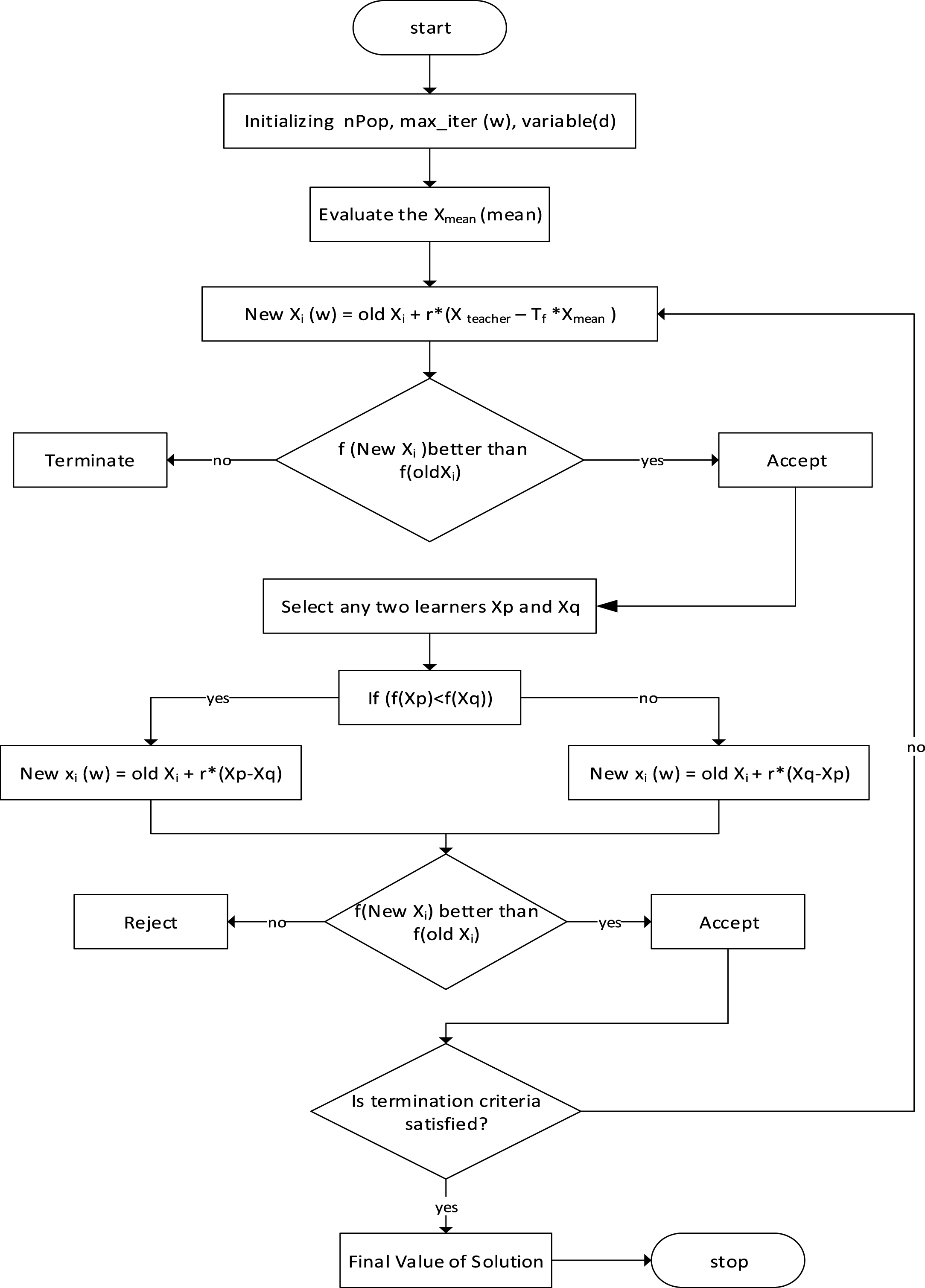
Flow chart for Teaching– Learning-Based Optimization (TLBO).
During this phase, the teacher improves the grade mean of a class as shown in Equation (1). The teacher is considered as the best solution obtained so far through an objective function. A good teacher share his or her knowledge to all learner of the class so as to improve the grade mean of the whole class. Teacher can only improve the mean of a class up to some extent depending on the capability of the class.
Here, r is the uniform random number between 0 and 1; T f is a teaching factor lies between the 1 and 2; round (x) represents rounded to the nearest integer; newX i and oldX i are the updated value and old value of learner; X teacher is the best individual of the entire population, X mean is the mean value of the current population.
In the learner phase, increase the knowledge of learners by the two dissimilar ways: one through input from the teacher and the other through mutual interaction between learners as shown in Equations (2) and (3). Each learner randomly interacts with peer learners, to achieve the goal of enhance communication grade.
Let the ith learner is Xp and randomly chosen learner is Xq p ≠ q through the mutual interaction with learners, then the updating equation of the ith learner Xp in learner phase can be described as follows [36]: Considering a population size of group is ‘nPop’, a learner communicates from a good learner who has acquired knowledge.
Where, r is a uniformly distributed random number between 0 and 1, f (X p ) and f (X q ) are the best solution of the learners X p and X q , respectively.
Framework of NTLBO
In the proposed NTLBO algorithm, nPop is the number of students in the class which are generated randomly. The neighbour learning strategy is deliberate for NTLBO to increase the exploration and exploitative capability of students as shown in Fig. 3. Neighbour learning strategy, update the learner’s knowledge before the current generation in teacher and learner phase to improve the learning capacity of learners. From previous experiments [37], we found that distinctive PC
i
esteems yielded diverse outcomes on a similar issue if a similar esteem was utilized for every one of the students in the population, diverse esteems yield the best execution for various issues.
Figure 2 presents the example of PCi assigned for a population of 10. Each learners from 1 to 10 has a PCi value ranging from 0.05 to 0.22. Moreover, to maintain the diversity of learner during each iteration, we iteratively update the old population in this framework. We empirically developed the following expression to set a PCi value for each learners as shown in Equation (4) and also random value r is assigned to each learners. If r < PCi, the random population strategy is adopted by each learners; otherwise the existing value of each learner is pass to teacher phase, as shown in Fig. 3. The complete structure of the NTLBO is shown in Fig. 4.

Each Learner’s PCi with population size of 10.

Flow chart Neighbour Learning Strategy.
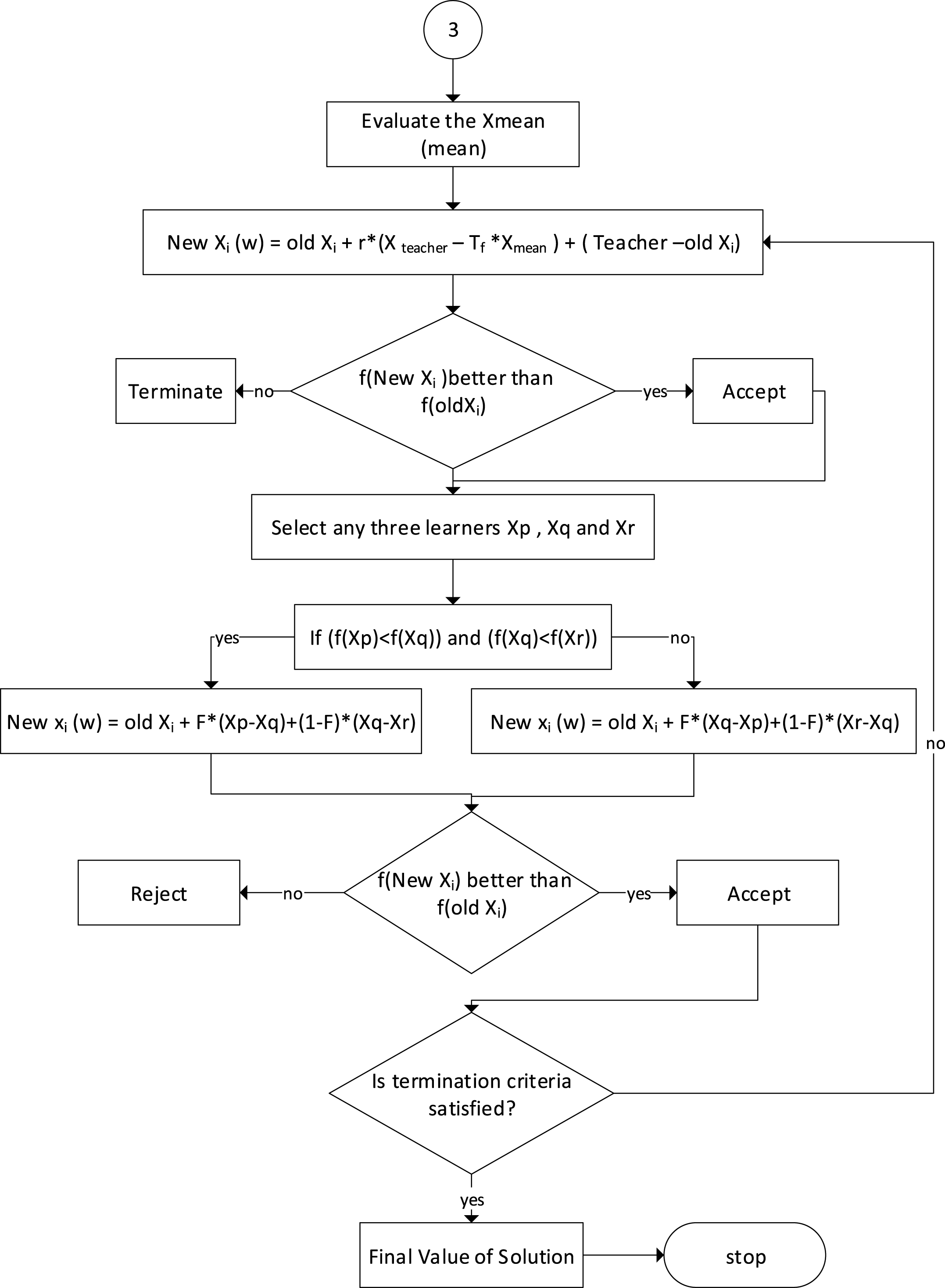
Flow chart for Neighbour Teaching Learning-Based Optimization (NTLBO).
As discuss earlier, neighbour learning strategy for each individual learners, improves knowledge through the mutual communication between neighbours. When we solved the multimodal problems, the major problem is premature convergence on the TLBO variants. Here, we try to eliminate these kinds of problems by using this neighbour learning strategy, as per the following population updating Equation (5).
In this phase, learner updates knowledge through neighbour learning by learner mean vector
Where, newX
i
and
In general strategy, each individual record their experience and these experiences can help learners to accurately find the best solution based on the behavior of learners within classes. We know that each learner is improving the knowledge based on their mutual interaction with learners as shown in Equations (8) and (9). Here, we present the concept of random selection learning strategy and differential mutation, to update the learners before the current iterative learning process. Assume that w is the iterative generator in newX i (W) and the modified value of the learner is obtained by using learner phase. Random selects three learners X p , X q , and X r , where p ≠ q ≠ r.
Learner Phase updating operation
Where, newX i and oldX i are the new and the old value of the learners, random number r lies between 0 to 1 and X p , X q and X r are the randomly picked learner.
Experimental study
The eight benchmark functions are shown in Table 1. The first two benchmark functions are the unimodal function i.e. Sphere and Rosenbrock; the next six are multimodal functions i.e. Ackley, Griewank, Rastrigin, Noncontinuous Rastrigin, Schwefel 2.26, and Weierstrass, respectively. The performance of meta-heuristic algorithm has been evaluated on eight benchmark function from Congress on Evolutionary Computation (CEC) 2006 in terms of fitness evaluation.
Benchmark functions considered in experiment D: dimension, search range
Benchmark functions considered in experiment D: dimension, search range
As we wish to test the efficiency of NTLBO on CEC 2006 [39] test functions The main objective of NTLBO algorithm is to give the best performance with respect to four other meta-heuristic algorithm viz., Genetic Algorithm(GA) [40], Particle Swarm Optimization (PSO) [3], Differential Evolution (DE) [41], and TLBO [36] with the help of maximum number of iteration (3000) and population sizes (10).
All experiments are simulated on the machine with Intel core i7 2.67 GHz processor and 6 GB RAM, Windows 8 O.S, and MATLAB environment. All functions are evaluated in 10 dimensions and 30 independent runs. The algorithm will terminate after the maximum number of iterations and independent runs have been reached.
Performance on common benchmark functions
Benchmark functions
The eight benchmark functions are shown in Table 1. The first two benchmark functions are the unimodal function i.e. Sphere and Rosenbrock; the next six are multimodal functions. The large set of benchmark function have different kind of problems such as range and dimension are listed in Table 1, to test the perfo mance of PSO variants and evolutionary algorithms.
Performance comparisons of different algorithms
The proposed NTLBO is compared with eight population based meta-heuristic algorithms viz., PSO with inertia weight (PSO-w) [42], PSO with constriction factor (PSO-cf) [43], Local version of PSO with inertia weight (PSO-w-local), Local version of PSO with constriction factor (PSO-cf- local) [44], CLPSO, ABC, modified ABC, and TLBO as shown in Table 2. For the proposed NTLBO algorithm, three tuning parameters such as inertia weight w set to be 0.3, teaching factor Tf set to be [0, 1] and the random probability Pc used in simulation. As shown in Tables 2 and 3, the best solutions evaluated for 10 dimension on eight benchmark functions with 30 independent runs in terms of mean and standard deviations. The comparisons in Table 3 shows that NTLBO algorithm has the best performance on 6 out of 8 functions particular for multimodal problems.
Comparative results of ABC, Modified ABC, PSO-w, PSO-cf, PSO– w-local, PSO– cf-local, and CLPSO over 30 independent runs
Comparative results of ABC, Modified ABC, PSO-w, PSO-cf, PSO– w-local, PSO– cf-local, and CLPSO over 30 independent runs
Source: Results of algorithms except NTLBO are taken from [45].
Comparative results of GA, PSO, DE, TLBO [45], and NTLBO algorithms with Statistical results of 30 runs obtained 30000 Function Evaluations, M: Mean of the Best Values, SD: Standard Deviation
In this experimental study, we uses eight standard benchmark functions for eight meta-heuristic algorithm. The comparison of NTLBO algorithm with seven other algorithms such as PSO and its variants, ABC and modified ABC result are available from Rao and Patel (2013) [45]. The performance of NTLBO and another algorithm is shown in Table 2.
Experiment 2
In this experiment, NTLBO result is compare within four other meta-heuristic algorithm including GA [40], particle swarm optimization PSO [3], differential evolution (DE) [41], and TLBO [36] with the maximum number of iteration of 3000 with population sizes 10 is shown in Table 3.
The comparisons are shown in Table 2, promising NTLBO gives the better solution on 6 out of 8 standard benchmark functions. In addition, NTLBO find the fittest solution for the following complex multimodal functions f3, f5, f6, f8. In Table 3 shows NTLBO outperforms the other algorithms in terms of the mean best solution, standard deviation (SD) for the global complex functions f1, f2, f3, f5, f6, f8 . for function f1, TLBO and NTLBO gives the same mean values and standard deviations. For function f2, GA algorithm mean value is the largest to another algorithm.
In Table 3 for function f3 the mean value of NTLBO is better than all meta-heuristic algorithms. The NTLBO algorithm has the relatively best performance in terms of the mean value and standard deviations for function f5, f6, f8. Figures 5 and 6 display the convergence curves of unimodal and multimodal functions for the meta-heuristics algorithms.
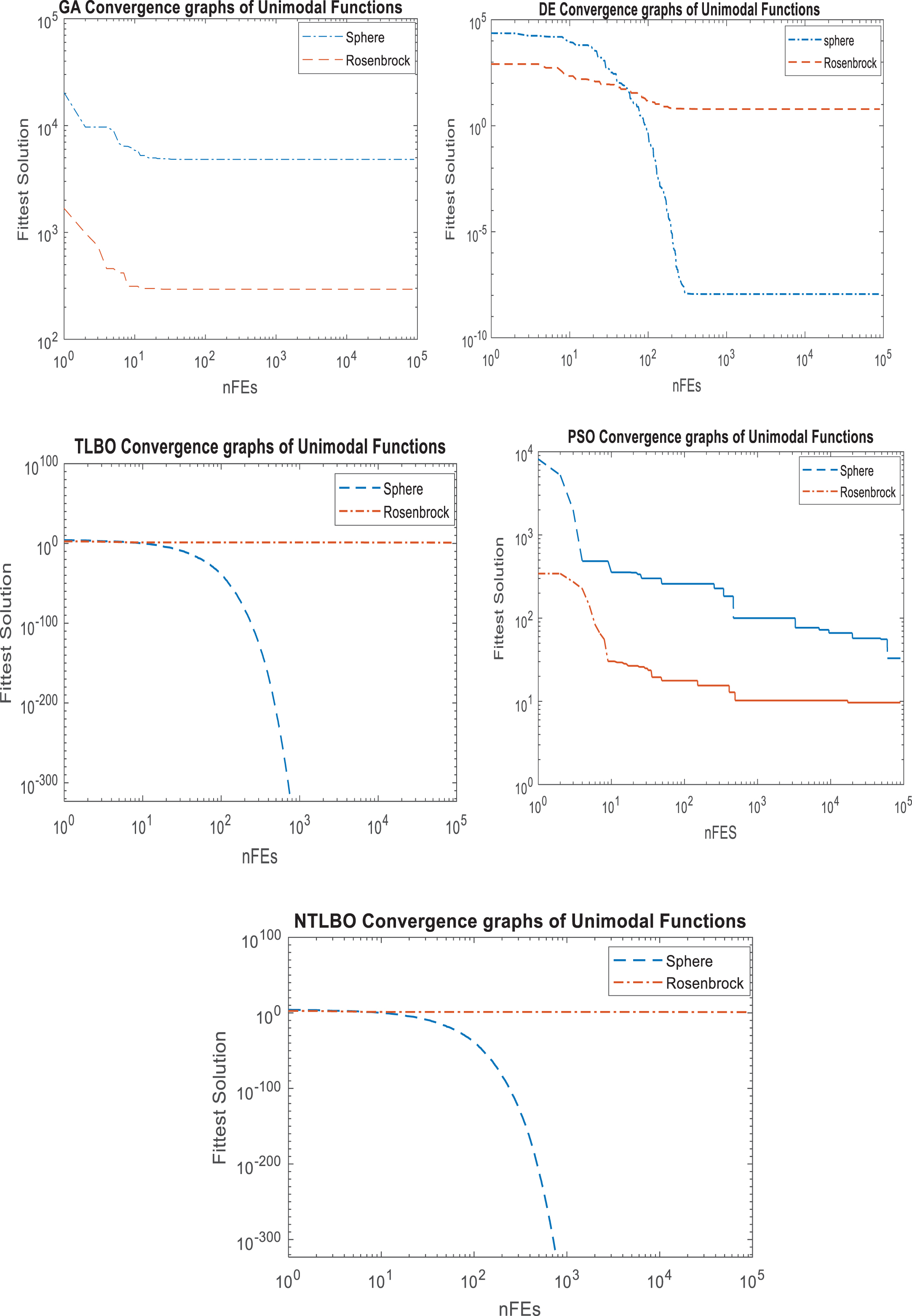
Convergence performance of unimodal basic functions.

Convergence performance of multimodal basic functions.
In this paper, we have investigated NTLBO algorithm with neighbour learning strategy and differential mutation, to overcome the imperfections of basic TLBO. The concept of neighbour learning and differential mutation has the ability to acquire a good converge solution than the previous run of experiments. Our proposed method focuses solely on the maintenance of the explorative and exploitation search of the population and discourage premature convergence. It is also effective and promising in global optimization problems. From the study of experiments, we observe that learning strategy enables the NTLBO to make use of the information in population more effectively to generate better quality solutions much faster as compared to basic TLBO and other meta-heuristic algorithms on eight benchmark functions. In order to maintain the consistency of the comparison, we evaluated the meta-heuristic algorithm on identical experimental environment. Results shows that NTLBO outperformed 6 out of 8 benchmark functions.