



Abstract
Belief merging aims to combine pieces of information from different (and possibly conflicting) sources so as to produce a single consistent belief base which retains as much information as possible. In this paper, we describe Merginator, a logic-based tool implementing three belief merging operators presented with specific characteristics that make them interesting for comparison: Δ Σ , ΔGMax and Δ ps . We describe these operators while solving a set of basic examples found in the literature that we translate into natural language to provide insights for Merginator users. We also propose two more complex consensus-seeking examples: an adaptation to the role play “Lost at Sea” and the subject of administrative response to air pollution in Hong Kong. Results show that all three operators provide a consensus to the scenarios, and Δ ps gives the most refined consensus. This demonstrates that belief merging, is a viable technique to support consensus decision-making in many domains. Merginator is open source software available at GitHub.
Keywords
Introduction
Whether in everyday life or in work environments, all individuals must choose between alternatives options that they might face. This process, called decision-making, is heavily based on the beliefs of the stakeholder. At home, work, or in social life, individuals are often involved in group decision-making, a process by which individuals collectively make a choice from a set of alternative options. In this case, when there is a group of stakeholders that have to make a decision on a certain topic involving multiple variables, they are very likely to have different beliefs that makes it difficult to reach an agreement.
Decisions made by groups are often different from those made by individuals, highlighting the need for consensus-based decision-making. Consensus is a cooperative process in which stakeholders agree to support a decision in the best interest of the whole [2].
In Artificial Intelligence, belief merging is a firmly established technique for the integration of knowledge coming from different sources. This logic-based technique is defined as the operation of combining information from a set of (possibly conflicting) belief bases obtained from different sources to produce a single, consistent belief base [18]. In this case, each belief base corresponds to the knowledge or preferences of a stakeholder. By merging these belief bases we obtain a belief base that represents the consensus of preferences, or the knowledge of the group.
Belief merging has been extensively studied in terms of postulates, which are the properties that the merging process must follow in order to produce rational results and, in terms of processes, which consist of a set of predefined steps in order to generate the results [4, 13]. Some implementations have been proposed [7]1, [19]2, with notable practical applications [8, 16].
However, there is no accessible tool for non-experts showing the usefulness of this technique. In this paper, we described such a tool, called Merginator, which implements three belief merging operators. We then compare these operators by solving a set of classical examples found in the literature. We also design two real-world scenarios in order to show the applicability of belief merging.
Merginator can serve as support for Mathematics, Logic and AI lectures, and can assist in research from these areas.
Preliminaries
Belief merging generally described in terms of propositional logic, with the major of proposals based on model theory. We consider a language
For convenience, if ψ is a formula or a set of formulae, then
A literal l is an atom or the negation of an atom.
A term D is a finite conjunction of literals such that D = l1 ∧ … ∧ l k , with l i = p j or l i = ¬ p j .
Every formula
An interpretation, state, or world is a function w from P to {1, 0}, with these two values interpreted as the classical values of True (T) and False (F), respectively. w is also extended over
The set of all possible interpretations is denoted by
K is said to be satisfiable (consistent) iff there is a model of K, i.e. iff w (K) =1 for some interpretation w. The set of models of a formula K is
Along with these classical logical concepts, we consider the following definitions [11]:
Belief merging
The integration of knowledge coming from different sources has been widely studied topic in the literature. From a logic-based scheme perspective, belief merging is used when the sources are equally reliable and at least two of them have a different opinion of the situation, i.e. the two views are contradictory. If there is no reason to consider one of the sources as the most reliable one, we must merge both views into a new one trying to retain as much information as possible of both opinions, without contradictions [11].
In this approach, the knowledge of each source of information is modelled as a belief base, which is defined as a finite set of propositional formulae representing wishes, opinions or knowledge of a source of information (e.g. agent, person, sensor) [14].
A characterization of rational belief merging is given by the following postulates [10]: Δ (E) is consistent If E is consistent, then Δ (E) = ⋀ E If E1 ↔ E2 then ⊢Δ (E1) ↔ Δ (E2) If K ∧ K′ is not consistent, then Δ (K ⊔ K′) ⊬ K Δ (E1) ∧ Δ (E2) ⊢ Δ (E1 ⊔ E2) If Δ (E1) ∧ Δ (E2) is consistent, then Δ (E1 ⊔ E2) ⊢ Δ (E1) ∧ Δ (E2)
A number of belief merging operators have been proposed in an attempt to satisfy this set of postulates [9, 22]. A belief merging operator Δ is defined as [11]:
It is common to represent the result of a fusion operator as a set of interpretations instead of belief bases. However, it is possible to obtain the formula representing the belief base from this set of interpretations, except equivalences.
Actually, belief merging operators are categorized in two main families: model-based operators and formula-based operators [13]. Merginator implements model-based operators and considers order relations between interpretations.
We can consider the following two subclasses of (model-based) merging operators [13]:
Table 1 outlines the particular characteristics of all three merging operators implemented in Merginator. Several other operators have been defined, but most of them can be considered as variants of those considered. These three operators will be defined in the next sections.
Main characteristics of Δ
Σ
, ΔGMax, Δ
ps
Main characteristics of Δ Σ , ΔGMax, Δ ps
∗Under certain conditions [1].
Δ Σ operator is defined using Hamming distance and sum aggregation functions [9].
Then the following pre-order is defined:
In other words, a valid merging of E with respect to Δ Σ is any belief base K satisfying mod (K) = mod (Δ Σ (E)).
The ΔGMax operator was the first arbitration-merging operator formally proposed in [10]. This operator also employs the notions of distance between two interpretations (Definition 4) and distance between an interpretation with respect to a belief base (Definition 5).
The Δ ps operator is a majority-based operator that, unlike previous operators, also supports inconsistent belief bases. It is not based on a classic Hamming measure distance but rather on partial satisfiability. This notion allows savings at computing the models of belief bases.
if Q
K
is a conjunction C1 ∧ … ∧ C
s
where each C
i
is a literal, then: If Q
K
is a disjunction D1 ∨ … ∨ D
r
where each D
i
is a conjunction of literals, then:
Despite Δ ps being a majority-based operator, it can be refined as an arbitration operator by computing the minimum value from the partial satisfiability of the belief bases. With this refinement, we can choose impartially the resulting interpretations, satisfying each agent as much as possible.
We use some basic scenarios to show the comparison of the results obtained by the three belief merging operators implemented in Merginator. First we show one of the most widely used scenario in the belief merging literature and then we show four basic examples, adding natural language descriptions for each.
Whilst solving these scenarios by hand can be time consuming and error-prone, by using Merginator this task is straightforward.
Motivating example
We will first describe Δ Σ , ΔGMax and Δ ps in detail by solving an example that we have called the “Hello, World!” in belief merging. Originally appeared in [20] and explained in detail in [10], this exercise is commonly used in the description of new fusion operators.
Considering the propositional variables P = {s, d, o} denoting the languages SQL, Datalog and O2, respectively, the following formulae corresponds to the belief bases of each student:
Thus, the belief profile representing the belief set of the three students is:
Additionally, Δ
ps
requires the belief bases in DNF:
Now let us consider how the three operators perform over this example.
Δ Σ operation
As a model-based operator, Δ Σ computes the Hamming-distance of each interpretation w i with respect to each belief base in order to obtain the sum of the distances of the belief profile.
Table 2 shows the set of interpretations for Example 1 with the distances between interpretations w.r.t. the belief bases, and the sum of the distances linked to each interpretation w i and the profile. Interpretations with the minimum value (marked with ∗ in the penultimate column) corresponds to the models of the Δ Σ operator result.
Belief merging using Δ
Σ
and ΔGMax
Belief merging using Δ Σ and ΔGMax
From Table 2, the lower distance dist
Σ
is 2, so using Formula (1):
Hence, using Δ Σ , Merginator recommends that the professor should teach both SQL and O2, or O2 alone to best satisfy the class.
As Δ Σ , ΔGMax computes the distance of each interpretation w i w.r.t. each belief base in order to obtain the list of distances distGMax. Given the Example 1, last column of Table 2 corresponds to the list of distances in descending order distGMax. The lowest lexicographically value (indicated with ★) is related to the interpretations corresponding to the model of the ΔGMax (E) merged belief base.
As shown in Table 2, the lowest distance distGMax is (1, 1, 0), so according to Formula \eqref ec:gmax:
Using ΔGMax, Merginator thus recommends that the professor should teach both SQL and O2 to best satisfy the class.
Δ ps operation
Given Example 1, Table 3 shows the partial satisfiability of each belief base.
Belief merging using Δ
ps
Belief merging using Δ ps
For illustration purposes, let us see the computation of the partial satisfiability for belief base Q
K
1
over interpretation w3 = {1, 0, 1}. According to Formula (4):
w3
ps
(s ∧ ¬ d) is calculated using Formula (3):
w3 ps (o ∧ ¬ d) is calculated in a similar way producing 1.
Finally, partial satisfiability of belief base Q
K
1
over interpretation w3 is:
The column labelled
Table 3 shows two interpretations resulting from the fusion: w3 and w7. Both interpretations maximize the desires of the class, however, the last column indicates that
From Table 3 the max sum is 2.33, corresponding to interpretations w3 and w7. But the min partial satisfiability from both interpretations corresponds to w3. So, using Δ ps , Merginator recommends that the professor should teach both SQL and O2 to best satisfy the class.
As expected, the result of merging depends on the chosen operator, in this case because we have used operators with different characteristics. Δ Σ result satisfies the majority of students, whereas ΔGMax and Δ ps operators have selected options that satisfy as much as possible each student. This outlines the difference between majority and arbitration subclasses and this can be seen in Merginator user interface.
The following scenarios show three examples proposed in [15], and one proposed in [1]. The first three examples can be used as a benchmark to compare results obtained by different belief merging operators. The fourth example is an exceptional case containing an inconsistent belief base.
Originally formulated using mathematical notation, we propose an intuitive meaning in natural language to solve them using the Merginator tool. Natural language translations of the first three scenarios were originally formulated in Spanish [3].
Δ ps result: Waste production, a specialist in waste management is hired, costs increase and no waste is disposed of in the lake.
Δ ps result: Patient in critical condition and surgery should be performed.
Δ ps result: Dismissal and no redundancy package.
All three operators give the same results for Scenario 1. However, in Scenarios 2 and 3, Δ ps operator produces a different result than the other operators. Only Δ ps is able to solve Scenario 3. This can give us the hint than Δ ps could be a more refined operator.
In practice, Merginator is able to solve each of these examples in less than a second on consumer hardware.
Adapted scenarios
We designed two more complex examples in order to evaluate Merginator further. Unlike the previous examples, these scenarios involve more belief bases with more variables, and are depicted in natural language.
Scenario 5 is based on the fictional yet popular role play called “Lost at Sea” [6]. We have restricted this decision-by-consensus challenge to five participants and we have enriched it with a set of rules representing the knowledge of each castaway.
Scenario 6 shows a decision-making exercise adapted from the Teaching and Learning for a Sustainable Future programme by UNESCO [21]. This exercise is about an enquiry into air pollution in Hong Kong. We include arguments for six participants discussing the causes—and possible solutions—to the air pollution.
The following items are intact and undamaged after the fire: sextant, shaving mirror, five-gallon can of water, mosquito netting, one case of U.S. Army C rations, maps of the Pacific Ocean, seat cushion (flotation device approved by the Coast Guard), two-gallon can of oil-gas mixture, small transistor radio, shark repellent, twenty square feet of opaque plastic, one quart of 160-proof Puerto Rican rum, 15 feet of nylon rope, two boxes of chocolate bars and a fishing kit.
The total contents of all survivors’ pockets are a packet of cigarettes, several books of matches, and five one-dollar bills.
In addition to these articles, there remains a serviceable rubber life raft with oars. The raft is large enough to carry the crew, but not all items. The crew includes: A former policeman A biologist A politician A computer scientist A nutrition specialist
must join their knowledge while resolving their differences in order to make the best decision about which items are essential to carry on and which ones may be left behind to increase their chances of survival.
The policeman knows the essentials on survival, so he states that water, C rations, chocolate bars are critical, along with the fishing kit and the shark repellent. Also, the shaving mirror and the can of oil-gas mixture are imperative. He believes that sextant, maps, and transistor radio are not significant, neither the opaque plastic, the mosquito netting nor the rum (because he will use the oil-gas mixture to start fire, in such a case). He thinks that if the crew choose the seat cushion then they must keep the nylon rope.
The biologist wants to keep the maps and the sextant because she is hopeful to reach land using those items. She asserts that water, C rations, chocolate bars fishing kit and shark repellent are vital. She claims that only one of the rum or the oil-gas mixture is necessary. The seat cushion and nylon rope are optional items.
The computer scientist claims that if the sextant is saved then the maps are necessary for navigation, and if the radio is saved then the opaque plastic is necessary protection. He desires to save most of the items but he is skeptical about the need to save the mosquito netting, the seat cushion and the nylon rope.
The politician wants to keep all items except the sextant, the shaving mirror and the oil-gas mixture (because the life raft is motorless).
The nutrition specialist states that items to aid survival are most valuable, so water, C rations, chocolate bars are essential, along with the shark repellent. The fishing kit will be useful for fishing, including the opaque plastic or the mosquito netting (but not both). The oil-gas mixture is necessary but the rum is not; even though rum is a good source of calories, it causes dehydration. She does not have an opinion about the other items.
s = Sextant h = Shaving mirror w = Can of water n = Mosquito netting a = U.S. Army C rations m = Maps of the Pacific Ocean c = Seat cushion o = Can of oil-gas mixture r = Small transistor radio k = Shark repellent p = Opaque plastic u = 160-proof Puerto Rican rum y = Nylon rope b = Boxes of chocolate bars f = Fishing kit
ΔGMax result: To discard the opaque plastic, but otherwise the same as Δ Σ .
Δ ps result: To keep the opaque plastic, but otherwise the same as Δ Σ .
A meeting has been called to allow stakeholders to share their different views on what should be done about the air pollution. Those invited to attend are:
An officer from the Environmental Protection Department A representative from industry A concerned mother A representative of “Friends of the Planet” A taxi-owner A doctor
The government officer proposes the change of diesel cars to petrol and to impose stricter regulations on: (1) vehicle emissions and (2) dark smoke emissions from stationary combustion sources.
The representative of the industry wants no stricter regulations, because this will lead to inflation. He is open to other alternatives, for example, to increase the education on environmental pollution. He states that the government should improve roads and streets to help in the reduction of vehicle emissions (regulation 1), and he is at complete odds on changing the sort of machines used by industries (regulation 2).
A mother who lives in the downtown area wants any strategy that could help on the improvement of the quality of her daily life. However, she likes the convenience of modern life in Hong Kong and worries about anything that might increase the cost-of-living.
“Friends of the Planet” is an environmental organization which represents environmental concerns, those who suffer the effects of pollution, and workers in Hong Kong. Its official position is to change from diesel to petrol cars, and impose stricter regulations; or to increase environmental education, reduce the number of cars on the road, improve the sort of machines used by industries and improve the design of vehicle engines.
The attitude of the taxi owner is that diesel is a cheaper and more efficient fuel than petrol or electricity. He claims that freezing the number of vehicles would result in raised costs. It is the narrow streets which trap the fumes produced by the congested traffic; the problem is the roads not the vehicles.
The doctor has detected that people have frequently suffered from respiratory illnesses over the past few years. In areas where air pollution is high, people are more likely to suffer from heart and lung diseases. He affirms that it has recently been proved that children who have inhaled large amounts of lead dust particles from vehicle fumes have a lower level of concentration resulting from the accumulation of lead in the brain. That said, he believes that all means should be taken to reduce air pollution.
p = Change diesel cars to petrol r = Impose stricter regulations i = Inflation e = Educate the public and industries c = Reduce the number of cars on the road m = Change the sort of machines used by industries d = Improve the design of vehicle engines s = Improve roads and streets
Δ ps result: Improve roads and streets, no need to change the sort of machines used by industries, and no need to reduce the number of cars on roads. Otherwise the same as Δ Σ and ΔGMax.
In Scenario 5, Δ ps and ΔGMax obtain similar results except for kipping the opaque plastic in the former and not in the latter. Intuitively, we can say that keeping the opaque plastic is a better option because the radio is kept.
In Scenario 6, Δ ps sets all variables to True or False providing a more precise result.
These pair of scenarios take an order of minutes to be solved by Merginator on a personal computer, but it will be virtually impossible to solve by hand by an expert human within that time and with no errors.
Merginator: A belief merging based software prototype
Merginator is a knowledge-based system prototype implementing Δ Σ , ΔGMax and Δ ps operators.
The prototype was developed and tested on an Alienware M17x™ laptop, with an Intel Core i7-2670QM CPU@2.20 GHz×8, 8 GB in RAM, 500 GB in HDD, Ubuntu Linux 17.04 64-bit and OpenJDK 7 64-bit. Merginator is a heavy-processing desktop application.
Operation of Merginator requires to first introduce the number of belief bases, the number of variables and the descriptions of both. Figures 2 and 3 show this process. Based on several tests, we placed a limit of hundreds in the number of bases, while the number of variables is limited to tens according to common processing power and memory. A belief profile including 20 variables takes around 87 minutes to be solved. A problem with 24 variables throws a out-of-memory exception.
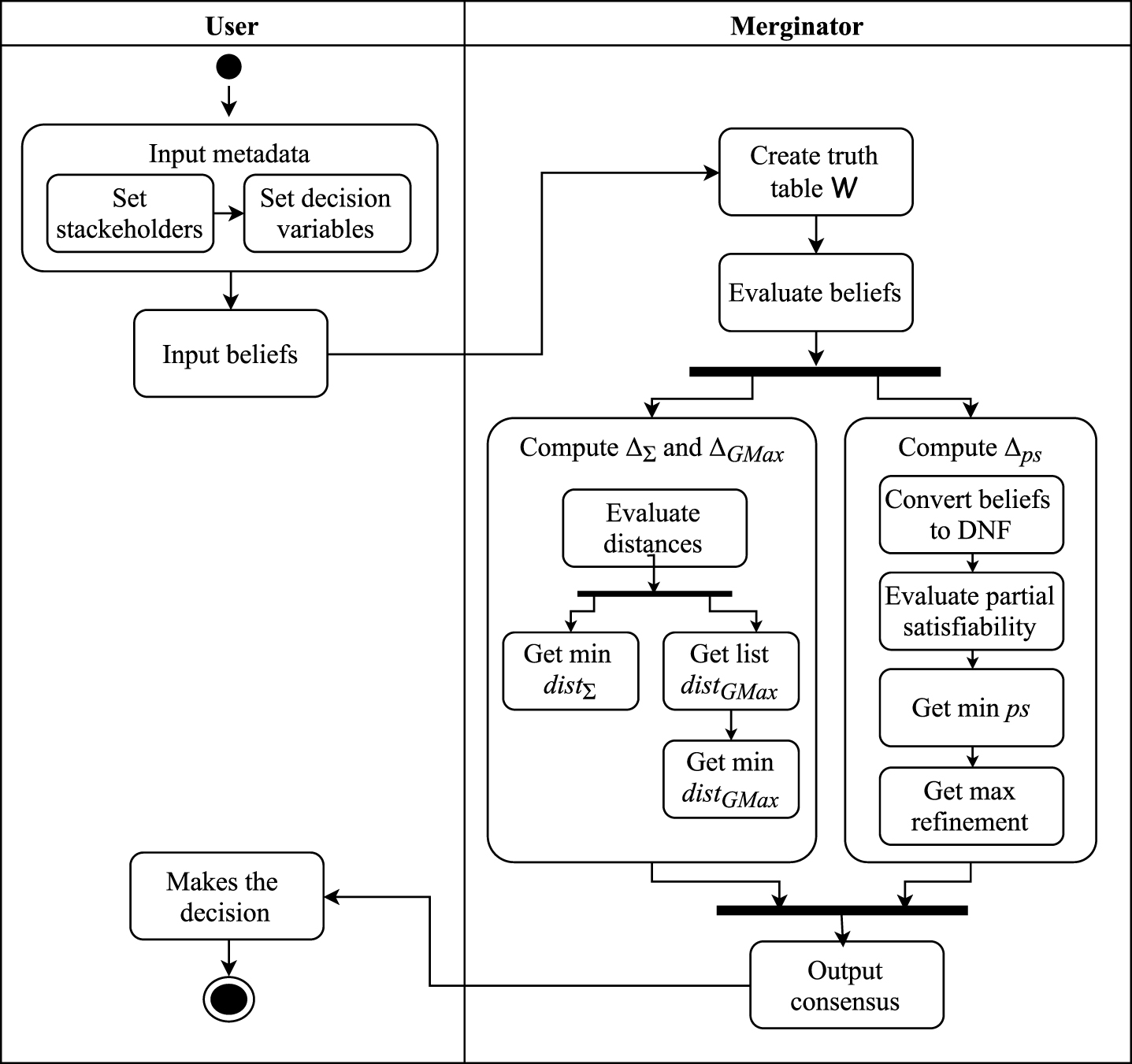
Merginator program flow.

Input values for Example 1.

Input details for Example 1.
Merginator accepts arbitrary formulae as input, although it converts all given formulae to DNF, since Δ ps requires bases in this specific format to operate. It evaluates beliefs first and then computes Δ Σ and ΔGMax concurrently along with Δ ps . Finally, it outputs detailed results and the consensus of the stakeholders. Figure 1 shows the program flow.
Figure 4 shows the Merginator main screen. The top-left toolbar includes the logical operators in ρ. The bottom-left toolbar contains all propositional variables, where each variable is represented as a single letter for ease of expression. At the centre of the window stands the belief profile editor. Each row represents an individual belief base, and each belief base is built via click-and-drop with items from both tool bars.
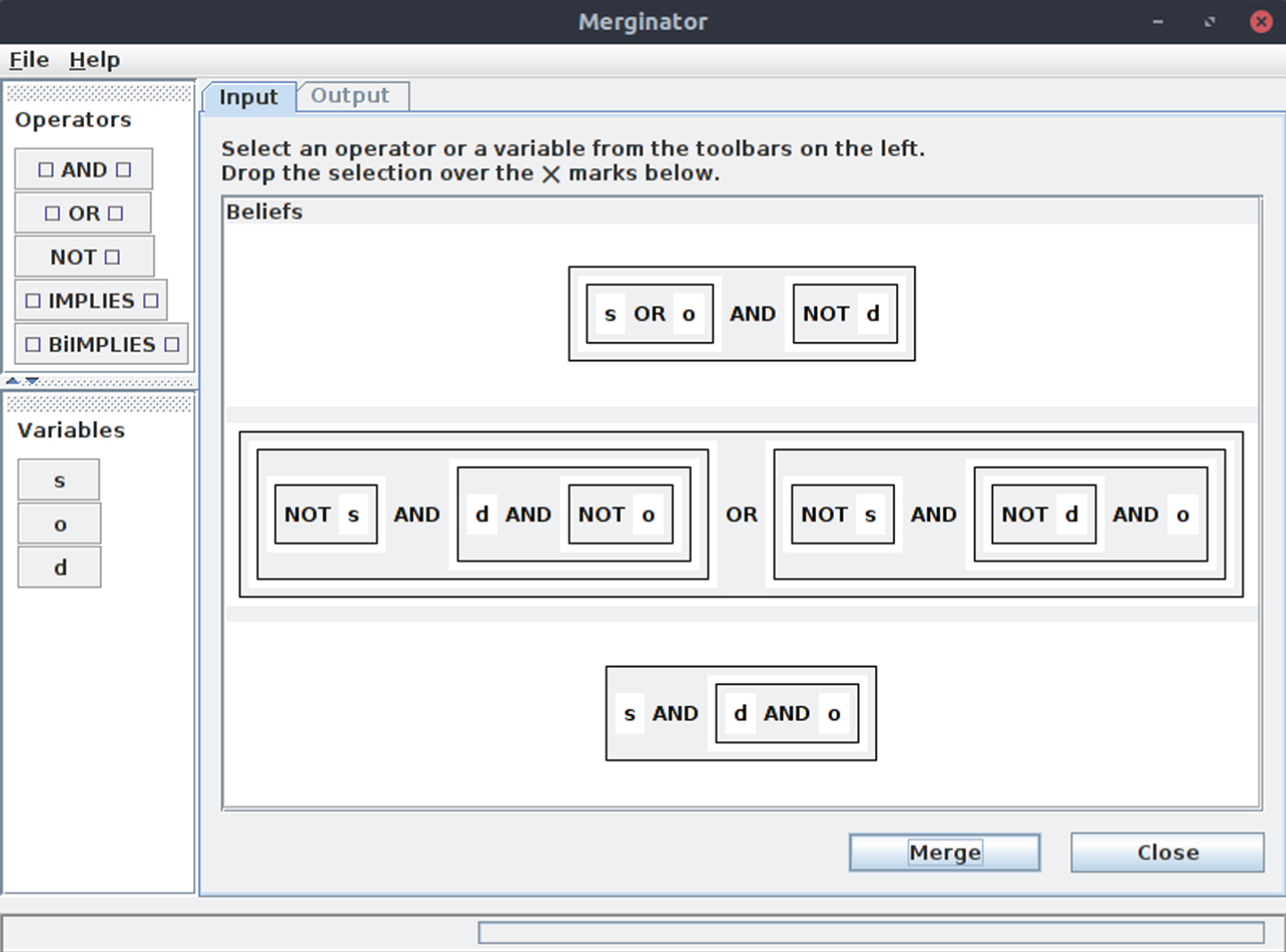
Belief bases for Example 1.
Figure 5 shows the output panel. Several details are displayed: stakeholders and variables data; belief bases; truth table with models, distances, partial satisfiability and sums of Δ Σ , refinement of Δ ps and ordered list of ΔGMax; tables with models of each operator; and the consensus of stakeholders.
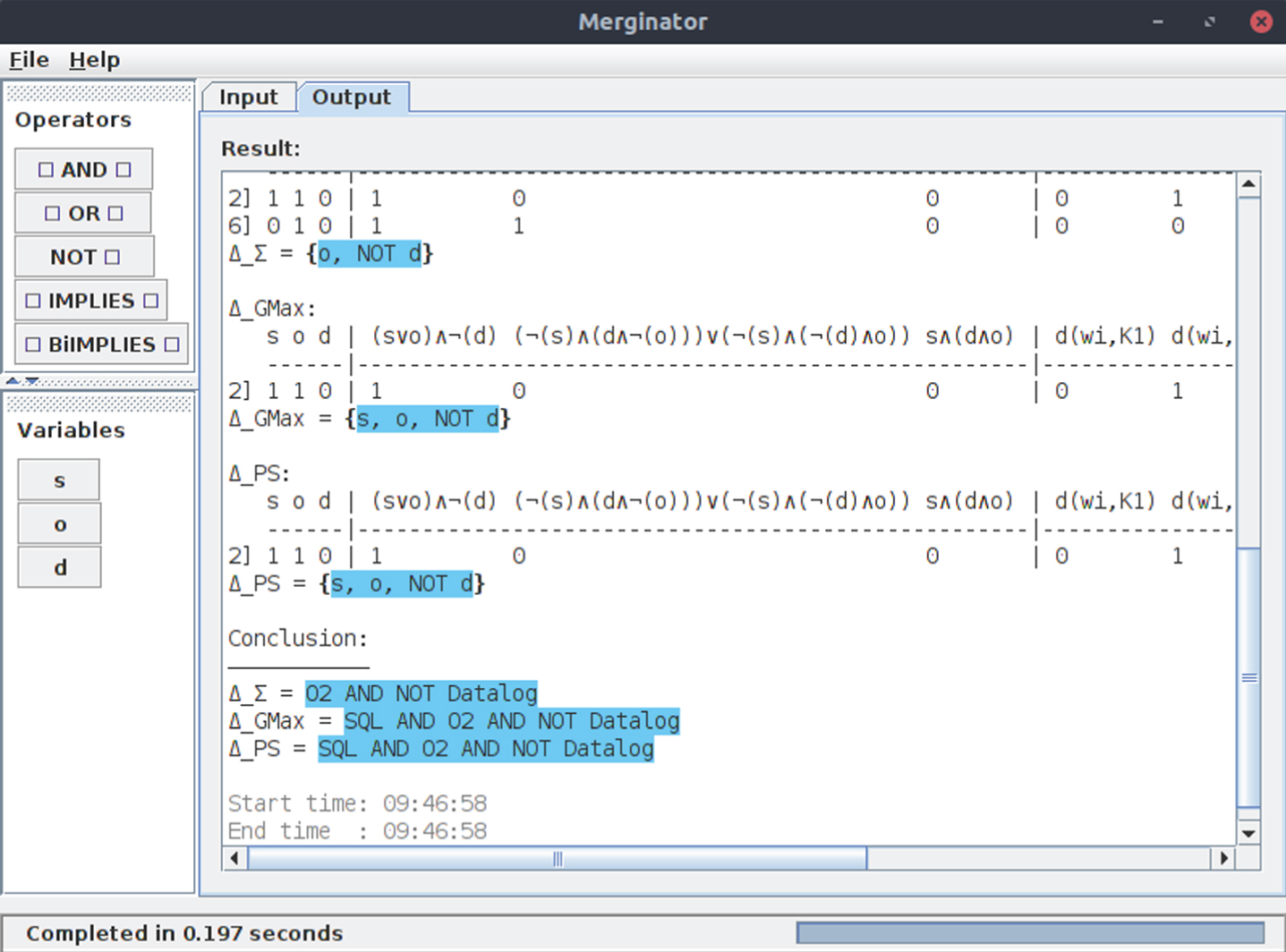
Merginator results for Example 1.
Figures 2to 5 show screenshots of Merginator solving Example 1. We solved all scenarios using Merginator, with an average time of 0.2 seconds for Scenarios 1 to 4, approximately 20 min for Scenario 5 and 3 seconds for Scenario 6.
Merginator, along with the source code, are freely available at http://github.com/chavezbosquez/merginator
Belief merging is a viable alternative to solve problems that involve making decisions.
On the one hand, we provide a natural language “translation” to Scenarios 1 to 4. There is plenty of theoretical information in the literature regarding belief merging, but that is not enough to guide an inexperienced user who is interested in applying this technique to specific problems. With the translation of four basic examples used in literature we address this issue.
We also proposed two more elaborated scenarios to show the applicability of belief merging on real-world domains. With these two examples we successfully stress-tested Merginator, a user-friendly tool developed with simplicity in mind. This tool allowed us to make a comparison against the three implemented belief merging operators.
In this sense, Δ ps differs in the first two scenarios at setting all variables and it merges inconsistent bases in the third one, which means that the refined results of Δ ps eases the consensus decision-making to the final user.
The differences in the operator’s results are noticeable in the two larger scenarios. In Scenario 5, ΔGMax and Δ ps set 13 variables out of 15, but differ in one atom. Δ Σ set 12 variables.
Scenario 6 shows a remarkable difference in results obtained by Δ ps against the other two operators. While Δ Σ and ΔGMax got same results setting 5 out of 8 variables, Δ ps sets all 8 variables in a fair consensus.
Δ ps success lies in giving lesser number of alternatives than Δ Σ and ΔGMax. The goal of Merginator is to aid a final user in the consensus-seeking task, so setting the values to True or False to at most possible variables means a more precise consensus.
We propose the modelling of more practical problems and test them in Merginator.
Conclusion
In this paper, we implemented three belief merging operators (Δ Σ , ΔGMax and Δ ps ) in a single tool suitable for non-experts, called Merginator. We evaluated our tool by solving six decision-making scenarios and one “Hello, world!” example. The first four scenarios were borrowed form the literature and the remaining two are our own proposals, representing more elaborate examples.
Merginator solved effectively all the presented problems. Analysing empirically the results of each merging operator, we can say that Δ ps is the most refined operator.
We expect that users with little experience in belief merging can get make use of Merginator and understand the overall functioning of the technique. It would be useful to have more test examples from real-world use cases to make more comparisons between the results obtained by each operator.
Further work would be to consider code optimization, the development of a complete decision support system adding a Natural Language Processing to the user interface, and the implementation of additional belief merging operators.
