



Abstract
Lithium Ion batteries usually degrade to an unacceptable capacity level after hundreds or even thousands of charge and discharge cycles. The continuously observed capacity fade data over time and their internal structure can be informative for constructing capacity fade models. This paper applies a mean-covariance decomposition (MCD) modeling method using data within moving windows to analyze the capacity fade process. The proposed approach directly examines the variances and correlations in data of interest and reparameterize the correlation matrix in hyper-spherical coordinates using angle and trigonometric functions. To improve the interpretation of the prognostics model, the mean function is obtained based on physics of failure. Non-parametric methods are used to characterize the log variance and correlation through the number of cycles and time lags between capacity measurements, respectively. A numerical example is used to illustrate the superiority of the proposed method in prediction performance.
Keywords
Introduction
Lithium Ion batteries attract increasing attentions due to their high energy density and long lifetime. They are widely used in renewable power generation systems, aerospace systems, electric vehicle, etc. The failure of batteries could lead to the degraded performance or total failure of the system in some cases. Therefore, the diagnosis and prognostic of the performance and health condition of the lithium ion batteries becomes of great interests. Capacity, the maximum amount of electric charge that a fully charged battery can deliver, is one of three major performance indicators with the internal resistance and self-discharge. The lifetime of a battery is defined to end when its capacity reaches the 80% of the initial capacity in general. The loss of active Lithium ions during the micro-electrochemical reaction inside the battery during charge/discharge process causes the capacity fade. The uncertainties occurring during the chemical reactions result in the difficulties of the estimation of capacity fade under cycling usage. A variety of approaches to capture the randomness of the capacity fade are reported in recent literature, which can be categorized into data-driven and hybrid methods. Data-driven methods use the available and historical information to statistically and probabilistically derive decisions, estimates, and predicts the health and reliability [1]. Extensive work in the field of machine learning has been adopted for modeling batteries performance, such as Support vector machines (SVMs) [2–5], Relevance vector machines (RVMs) [6, 7], k-nearest neighbor (kNN) [8], Artificial neural network (ANN) [9–15]. The concept of entropy from the information theory is also used to model the battery capacity [16, 17], which would be effective to capture the information with non-standard cycling usage. Data-driven methods provide good fitted parsimonious models and accurate prediction, but it could be difficult to associate physical understanding to the variable in these models.
With development of sensing techniques, more physical understanding of batteries degradation mechanisms have been obtained. The physical failure mechanism can be utilized to assess battery reliability and predict the life time of batteries. Thus the hybrid method of data-driven and physics of failure is a significant interest in prognostic and health management. For example, based on the relationship between the terminal voltage and state of charge, model-based filter methods are developed to estimate the capacity of lithium ion batteries which are tested in closed circuits [18–26]. The formation, growth, and repair of solid electrolyte interface (SEI) are the main reason for losing active lithium ions [27–29], which occur during the electrochemical reactions of charge/discharge process. From the electrochemical viewpoint, the analytic models of capacity fade are studied [37, 38]. Due to the complexity of the chemical analysis, the uncertainties have not been well investigated. There is also some literature studying the lithium ion battery capacity from the degradation viewpoint. The degradation models aim to capture the factors that might affect the capacity of batteries. One of the major challenges of modeling degradation is to describe the uncertainties. Bayesian theory and statistical inference are used to model the uncertainties of the degradation [30–36]. Based on the understanding in [35] about the longitudinal and between-sample uncertainties, this paper proposes a mean-covariance decomposition model to model these two types of uncertainties. The chemical analysis of SEI formation is used to formulate the basic model so that the result can have clear physical interpretation.
The remaining of this paper is organized as follows. Section 2 introduces the proposed mean-covariance decomposition modeling method. Section 3 reviews the analytic model of capacity and non-parametric models of log variance and correlation, followed by Section 4 where the analysis of the experiment illustrates the performance of the proposed method. Section 5 is the conclusion and future work.
Mean-covariance decomposition method
Mean-covariance decomposition in repeated measurements
In repeated measurements analysis, the observations of the same performance are obtained at certain time points. That is, the measurements y i = (yi1, yi2, ⋯, y im i ) T collected from the ith subject, i = 1, 2, ⋯, observed at time t i = (ti1, ti2, ⋯, t im i ) T . Under the assumption that y i ∼ MVN (μ i , Σ i ) where μ i = (μi1, μi2, ⋯, μ im i ) T and Σ i = D i R i D i are the mean and covariance matrix for the ith subject. D i = diag (σi1, σi2, ⋯, σ im i ) is the diagonal matrix with the standard deviation of the jth observation, σ ij , j = 1, 2, ⋯, m i . Then it is a natural and feasible idea to model the mean and covariance individualy [39]. The common modeling approaches of the mean μ are generalized regression models. For modeling the covriance Σ, there are two major difficulties: high dimensionality and positive definite constraints. To avoid these two difficulties, the concept of unconstrainted parameterization is applied to model the covariance matrix. Pinheiro et al. [40] summarized five unconstrained parameterizations of a covariance matrix, from which the Cholesky decomposition methods attract interets due to its high computation efficiency and easy interpretation of entities of the decomposed matrix. Pourahmadi [41] proposed the model of mean-variance-correlation based on the Cholesky decomposition of the covariance matrix, see Equation (1). Entities of the matrix T are interpreted as the auto-regression coefficients. In the framework of this mean-covariance decompostion, approaches to improve the interpretation of parameterization of covariance matrix with various forms of the Cholesky decomposition are explored. For example, Smith et al. [42] and Chen et al. [43] interpreted the entities of the decomposition matrix as one-step predictive coefficients and random effects coefficients, respectively.
The mixed effects model in [35] can be simplified as Equation (2), where y
i
represent the measurements of the ith subject, X
i
and Z
i
are the covariates, and the errors are ɛ
i
following MVN (0, σ2I). α and β
i
are the fixed and random effects related parameters, respectively.
Under the assumption that β
i
∼ MVN (0, Σ
b
), the measurements can be described in the form of y
i
∼ MVN (X
i
α, Σ
i
) with
For the covariance matrix Σ
i
of y
i
, it can be decomposed as D
i
R
i
D
i
based on the Cholesky decomposition, where D
i
represents a diagonal matrix of variances and R
i
is the corresponding correlation matrix. Since the correlation matrix is positive definite and symmetric with off-diagonal entities between -1 and 1, R
i
can be future decomposed as
In Equation (6), X i are the covariates that are used to model the mean of the measurements. Under the assumption that repeated measurements follow a multivariate normal distribution, repeated measurements of various samples can be the mean of this multivariate distribution. The selection of X i might mainly depend on the analytic model of the degradation process. For the battery capacity degradation, it is a natural idea that covariates could be selected from the factors affecting SEI formation during the electro-chemical reaction, such as the number of cycles, charge and discharge rate, temperature, etc. These factors are also good candidates of Z i , the covariates of the log variance of the jth observations. The correlation between measurements y i and y j decays over the time difference between the measurements. Thus W ijk should include time varying covariates that depends on time t ik and t ij as it is capturing the correlation between the responses at these two measurement time.
Parameters estimation
Moving-window scheme
It is evident that the strength of the “impact” that one measurement has on another measurement will depend on average decay as a function of their corresponding time lag in the time sequence. For a relatively slow degradation process, such as lithium ion battery capacity fading, the previous observations have a weak effect on the current observation and might distort the prediction. The moving-window method is to use information from the most recent observations to predict the future values. Models based on a large window provide the less accurate information along the perturbation direction, while those based on a small window are effective to obtain the pertinent information of perturbation direction. However, the small moving window might not be robust with high noise level [48]. The optimal length of a moving window in this paper is determined using the prognostic performance in the term of the mean absolute deviation (MAD) based on one-step-ahead predicted value and actual observed value. The core of calculating MAD of one moving window is to use a constant size of historical data to predict the next one value and obtain the residual. The details of the four-steps of determining moving window length can be found in [35]. Moreover, the moving-window scheme with the constant length simplifies the modeling of the correlation which is the function of the difference between the measured time being the same for a certain length of the moving window.
Parameters in mean-variance-angles function
For each moving window, parameters in Equation (6) are estimated through balancing the measurement fit and the model complexity. The basic form of functions of mean, log variance, and angles for correlations can be obtained from the physical understanding and empirical functions. For example, the chemical analytic model from [29, 37] can be referred as the basic model of mean, which is discussed in Section 3.
Lithium Ion battery capacity fade model
Section 2 describes the mean-covariance decomposition modeling method to analyze the battery capacity fade of Lithium ion batteries, where the basic models of the models of mean, log variance, and angles for correlations are expected to extract from the physical failure model or empirical model. This section reviews one of the recent major analytic models of formation and growth of solid electrolyte interphase (SEI) that causes the battery capacity fading in the cycling usage.
Mean function
The chemical degradation mechanism has been widely recognized as one of the main causes of losses of active lithium ions, especially the SEI formation. The capacity fading analysis models based on chemical degradation mechanism attract interests. This paper develops the basic form of the mean function by incorporating the chemical degradation model in [37]. The four scenarios of active lithium ion losses are combined: SEI formation at the first cycle, SEI thickness growth on the original surface, SEI formation due to crack propagation, and SEI thickness growth on the cracked surface, see Equation (7).
Due to the lack of physical understanding of log variance and correlation of the capacity degradation process, the log variance
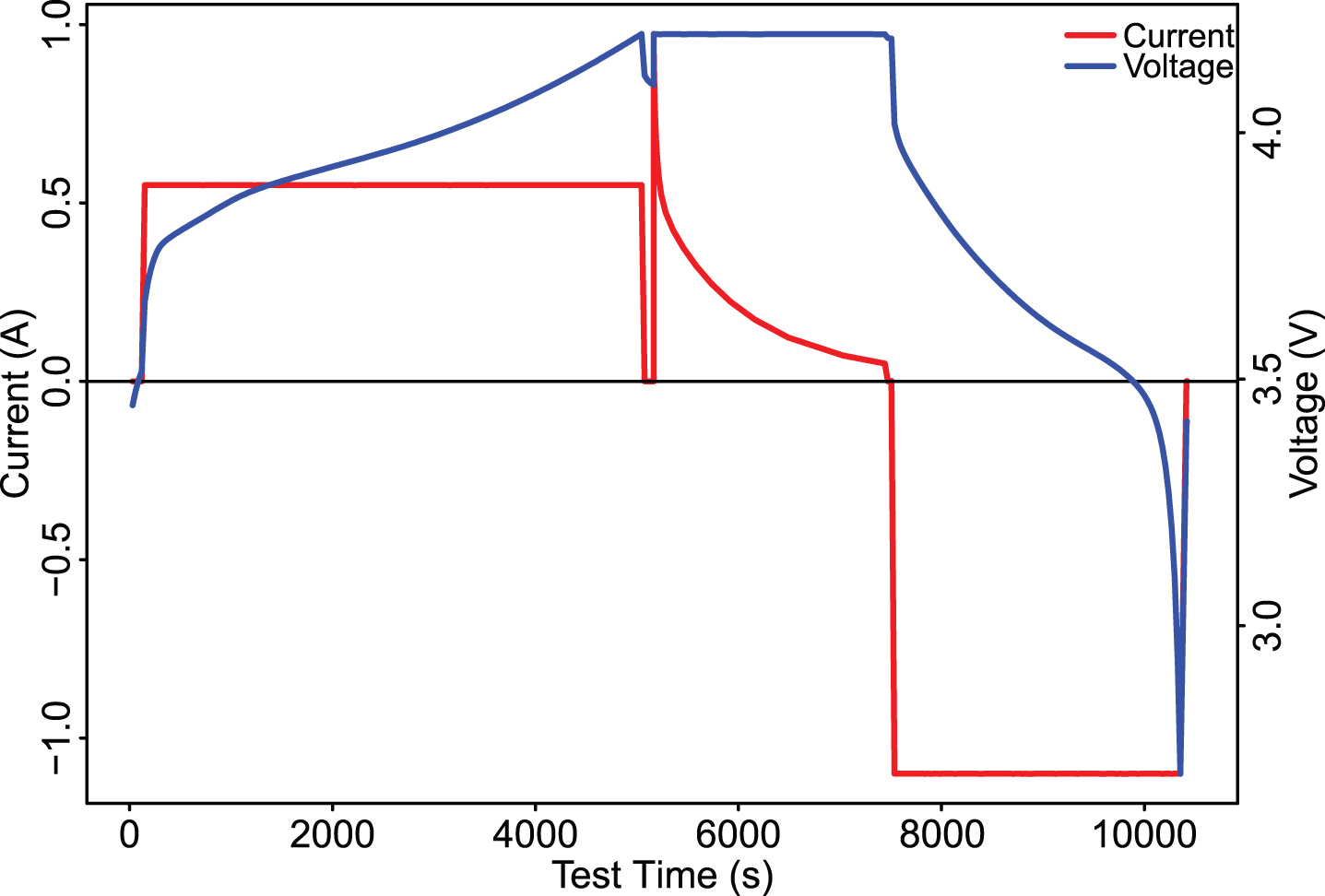
The profile of voltage and current in a charge/discharge cycle.
Experimental data
This section presents the cycling test and the result analysis using the proposed mean-covariance decomposition modeling method. Four lithium ion batteries, CS2_35, CS2_36, CS2_37, and CS2_38, are tested in room temperature under constant-current-constant-voltage (CCCV) charge/discharge profile. The cycling test is conducted with the following setting: 1) the constant current charge rate is 1C; 2) the cutoff voltage is 4.2 V; 3) The voltage is 4.2 for the constant voltage charge; 4) the discharge rate is 1C; 5) the discharge cutoff voltage is 2.5 V. Typical voltage and current of a Lithium ion battery cell during a charge/discharge cycle are shown in Fig. 1. Table 1 and Fig. 2 summarize the experimental results where the capacity fade profile over cycles is reported.
Summary of experiment data
Summary of experiment data
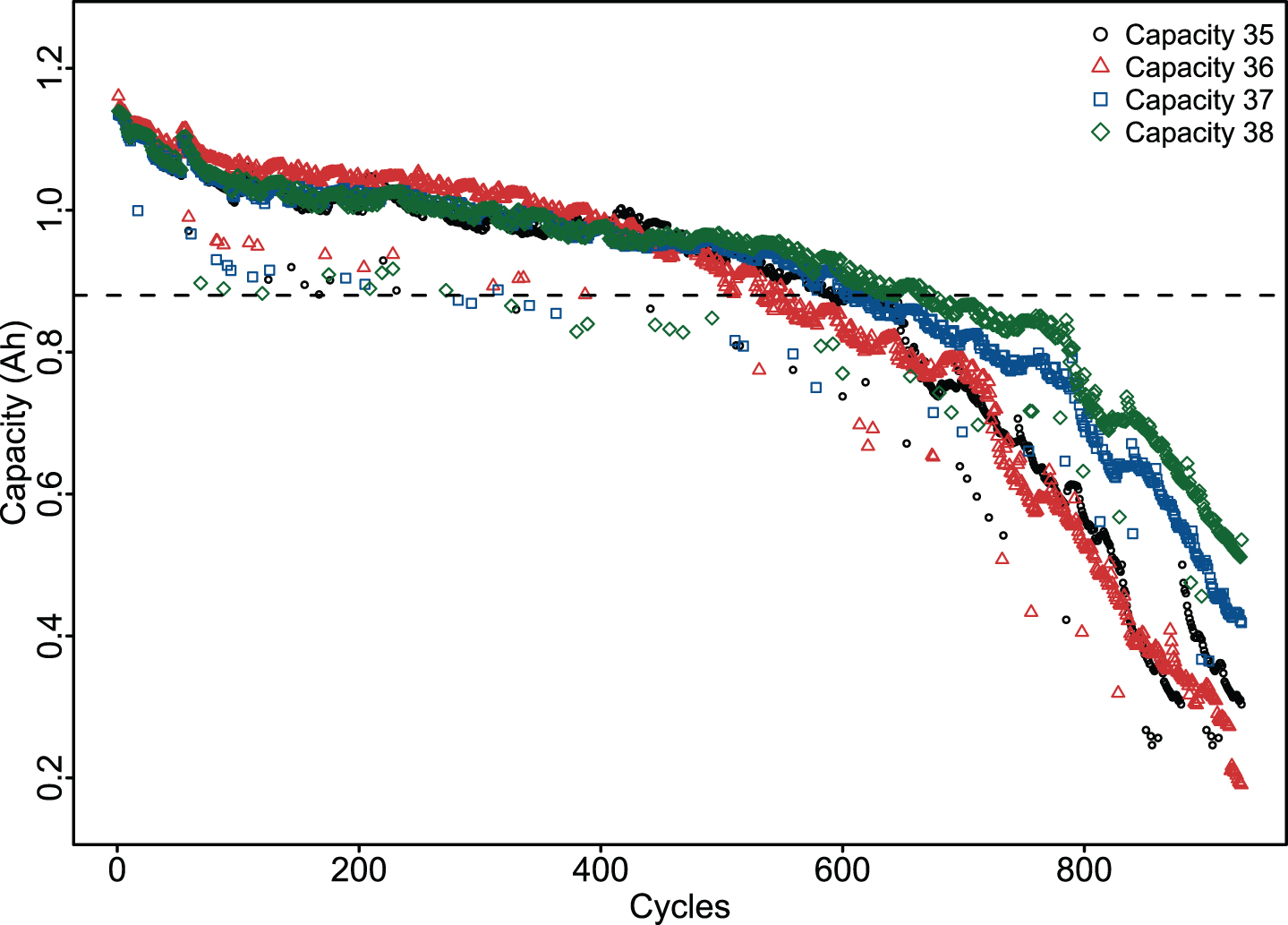
The capacity fade of tested batteries over cycles.
Modeling the mean of capacity
Factors that affect the electrochemical reactions during the charge/discharge process are natural candidates of covariates of the mean and covariance functions. As discussed in Section 3, the basic form of the mean function is a polynomial function of the number of cycles under a CCCV charge/discharge profile at a constant temperature. Based on the basic form of the mean function discussed in Section 3, the cubic function of the number of cycles is selected to model the mean by balancing the measurement of fit and measurement of complexity, see Equation (9) and Fig. 3. Parameters are determined by balancing the residuals and test errors. The training data and test data in this work is 80% and 20%. The root-mean-square error (RMSE) of this predicted model is 0.0147.
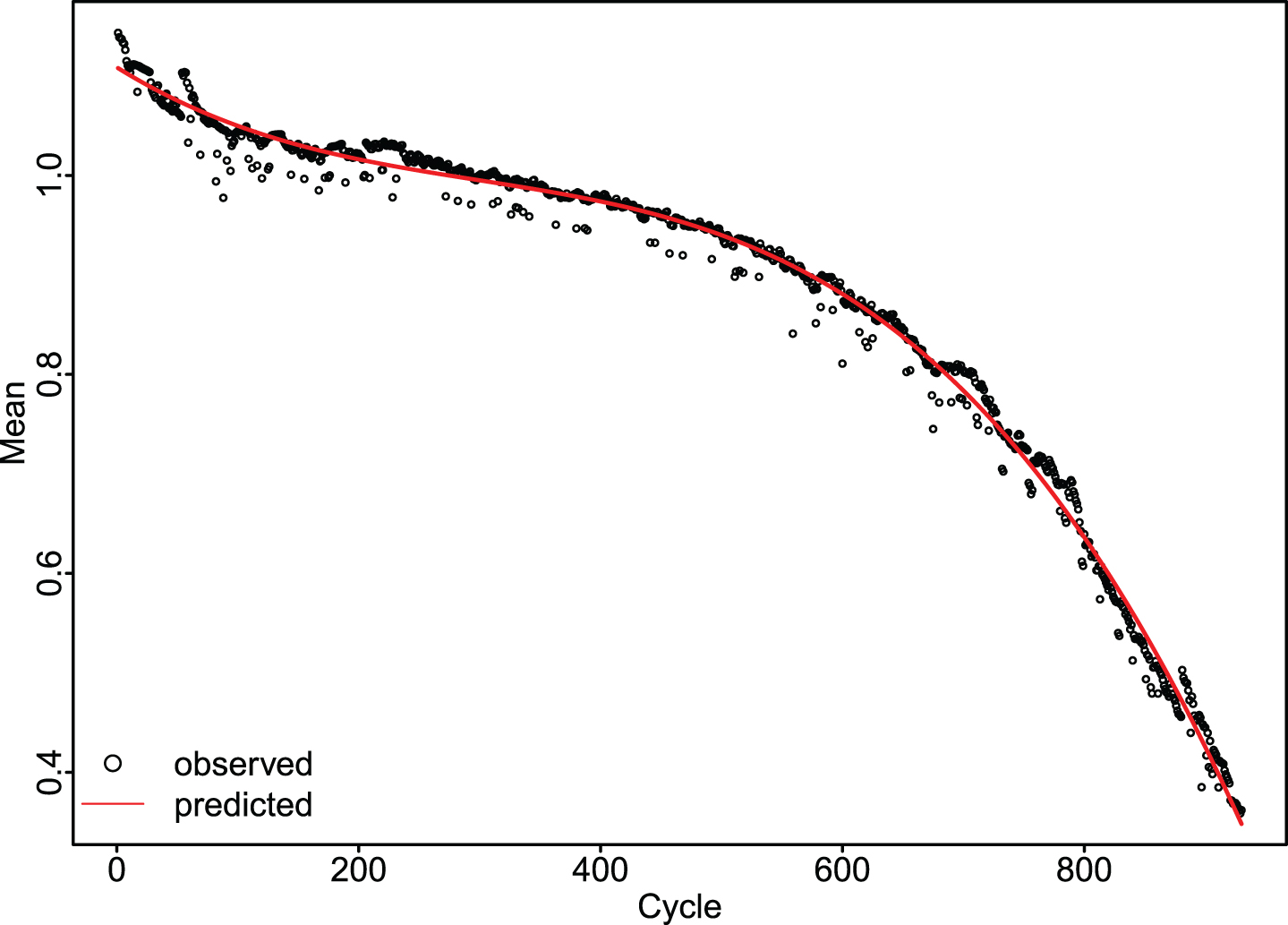
The prediction model for the mean.
The variance of measurements at each cycle and their correlations are obtained based on the Chelosky decomposition, based on Equations (3) and (4). The prerequisite of the Chelosky decomposition of the correlation matrix is that this matrix is symmetric and positive definite. However, a correlation matrix based on the historical data is not always non-negative definite due to missing data, noises and linearity of components. A broken correlation matrix with some negative eigenvalues with small absolute values can be fixed. A simulation-based method is used to create a positive definite matrix out of a broken correlation matrix, where the small negative eigenvalues are replaced by normally distributed random variables with the mean of 0 and small variance [53]. Based on Equation (6), the log variance and angles φ ijk can be obtained, see Figs. 4 and 5.
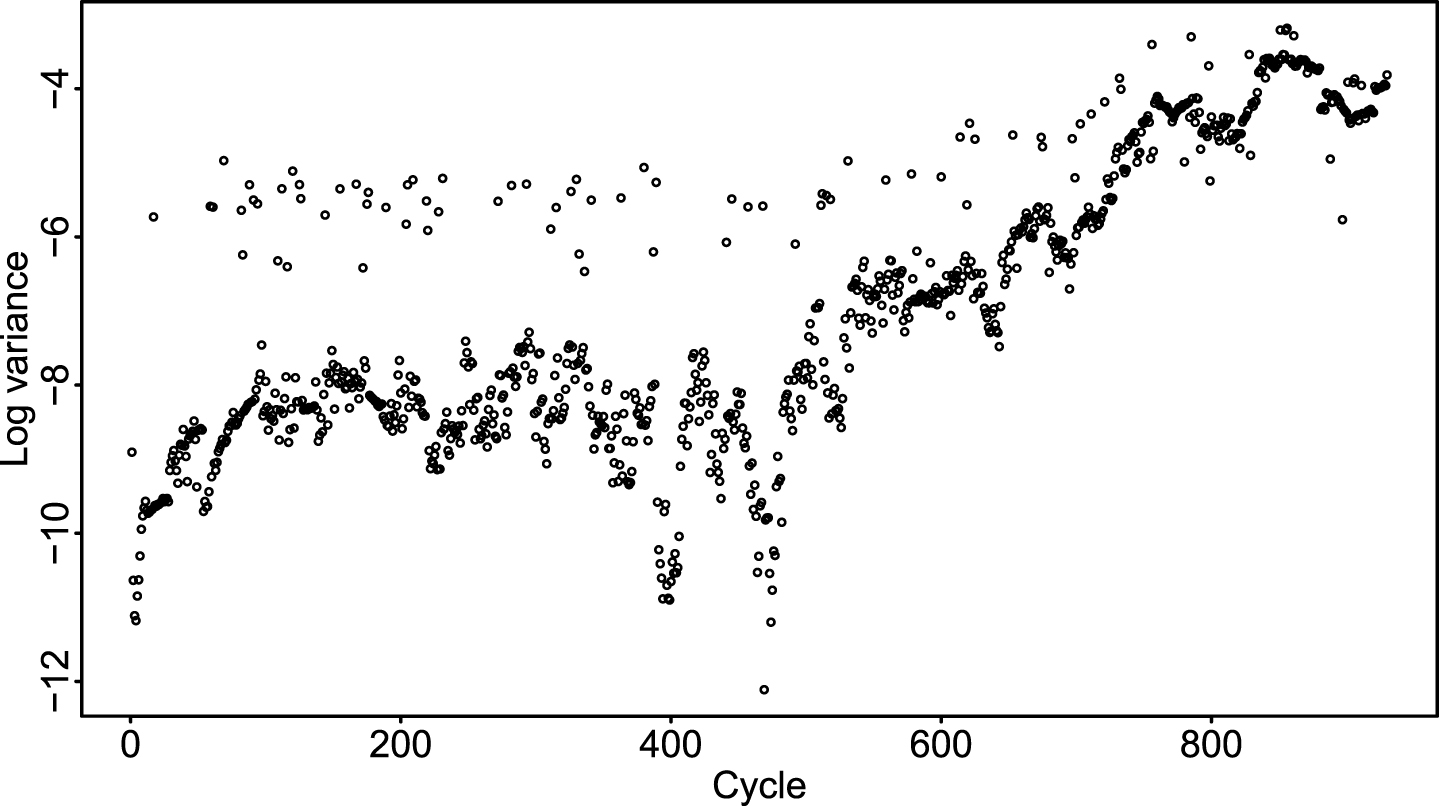
The log variance versus the number of cycles.
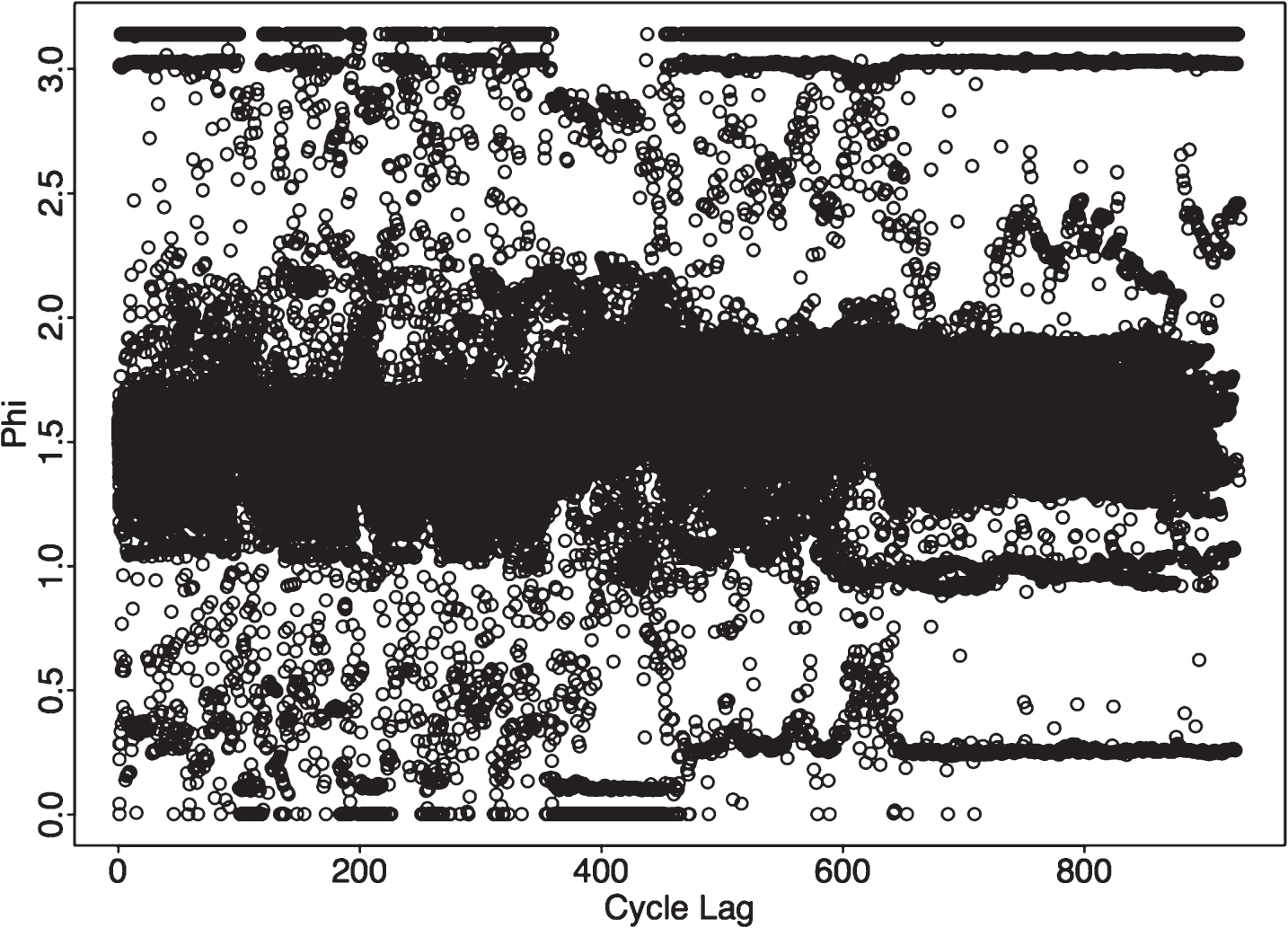
The angles versus the cycle lag.
For the log variance function, the number of cycles is also a natural choice. The angle function has a unique relationship with the entities of the correlation matrix. Thus the cycle-lag, the time difference between measurements, is selected as the covariate of the angle function. Statistical tests are implemented to demonstrate the statistical significance of the selected covariate to the log variance and angle function for correlations. It is difficult to detect equality of variance since only one observation for the log variance is available. To investigate the variance of the log variance over cycles, the bootstrapping method is employed to generate samples. The bootstrapping samples of any three batteries capacity observations are randomly sampled from four batteries, and log variances of three capacity observations at each cycle are calculated. The ANOVA assumptions of homoscedasticity and residual normality in the log variance are checked. It can be concluded that these two assumptions are violated with significant p-values, see Table 2 check. In addition, sample sizes of the angle functions over cycles are unbalanced due to which the one-way AVONA test is too sensitive to inequality of variances and non-applicable. Therefore, the nonparametric test of Friedman test is employed considering its robustness in dealing with non-normality, heterscedasticity, and outliers. The null hypothesis of the Friedman test is assigned as that there are no differences between the predictive variables. If p-value is significant, it can be concluded that at least 2 of variables are significantly different from each other. The results of Friedman tests over log variance and angle functions for correlations are shown in Table 3 fried, where p-values for both log variance and angles are significant. We can reject the null hypothesis of tests for both log variances and angles. It can be concluded that the number of cycles is statistically significant to log variance and cycle lags are statistically significant to angles.
Assumptions of equality of variance and residual normality for the log variance
Friedman test of log variance and angles for correlations
As discussed in Section 1, the MAD is the performance index of the length of the moving window. Considering the end cycle of life, the optimal size of moving-window of the proposed method is 46 with the minimum mean absolute deviation (MAD), 1.215e - 06, while that of the mixed effects model is 195 with MAD of 0.0014 [35], see Fig. 6. Compared the MAD of various lengths of moving window of the proposed method and the mixed effects model, it can be concluded that a smaller amount of historical data to predict future values for the proposed method than mixed effects model needs and the accuracy of prediction is improved with a lower MAD. When taking all the available test data into account, the deviation of the prediction based on the mixed effects model increases due to high variance, see Fig. 6.
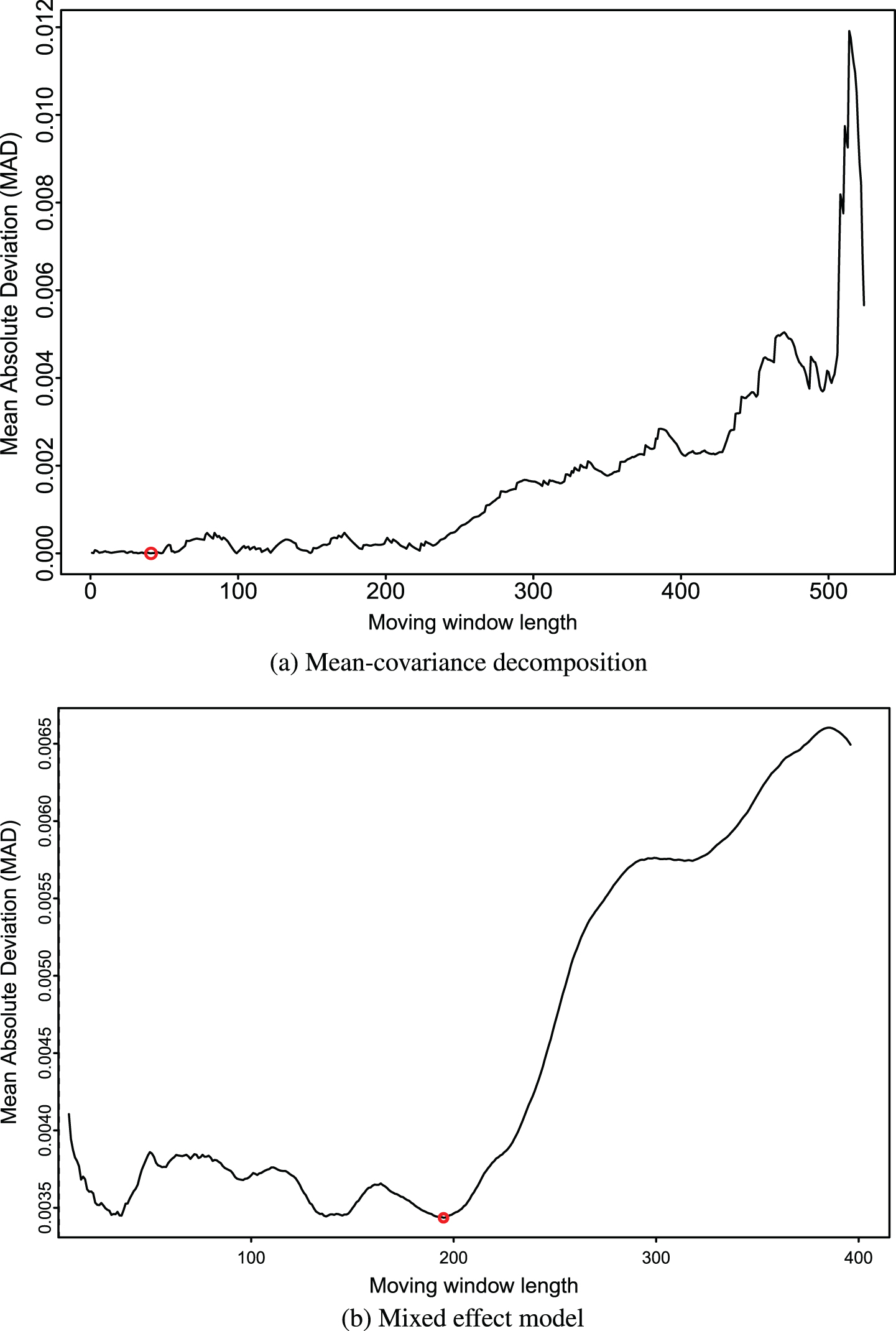
The optimal moving window of mean-covariance decomposition and mixed effect model.
Within a moving window, SVM regression with ∊-regression is used to model the log variance and angles [54]. The number of cycles and cycle lag are selected as the candidat inputs of kernel functions for the SVM regression of log-variances and angles, according to the statistical test result in Section 4.2.2. Without losing generality, polynomials of the number of cycles are considered as the inputs of kernel functions of the log variance function, while polynomials of cycle lags are considered as the inputs of kernel functions of angles. Figures 7 and 8 show SVM regression models of the log variance and angles of one of moving windows (495-540) and their prediction performance in terms of root mean square error (RMSE).
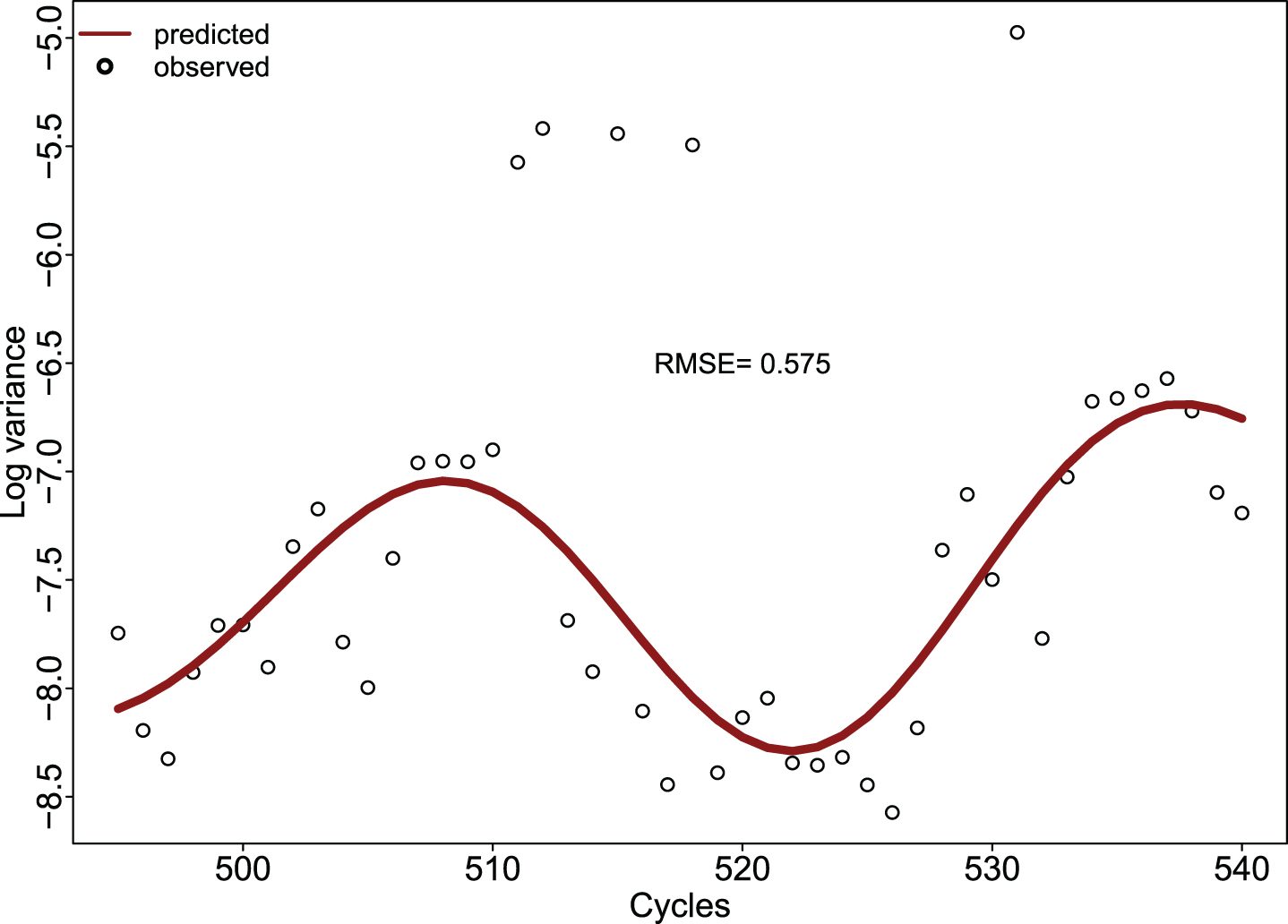
The actual and predicted log variance.
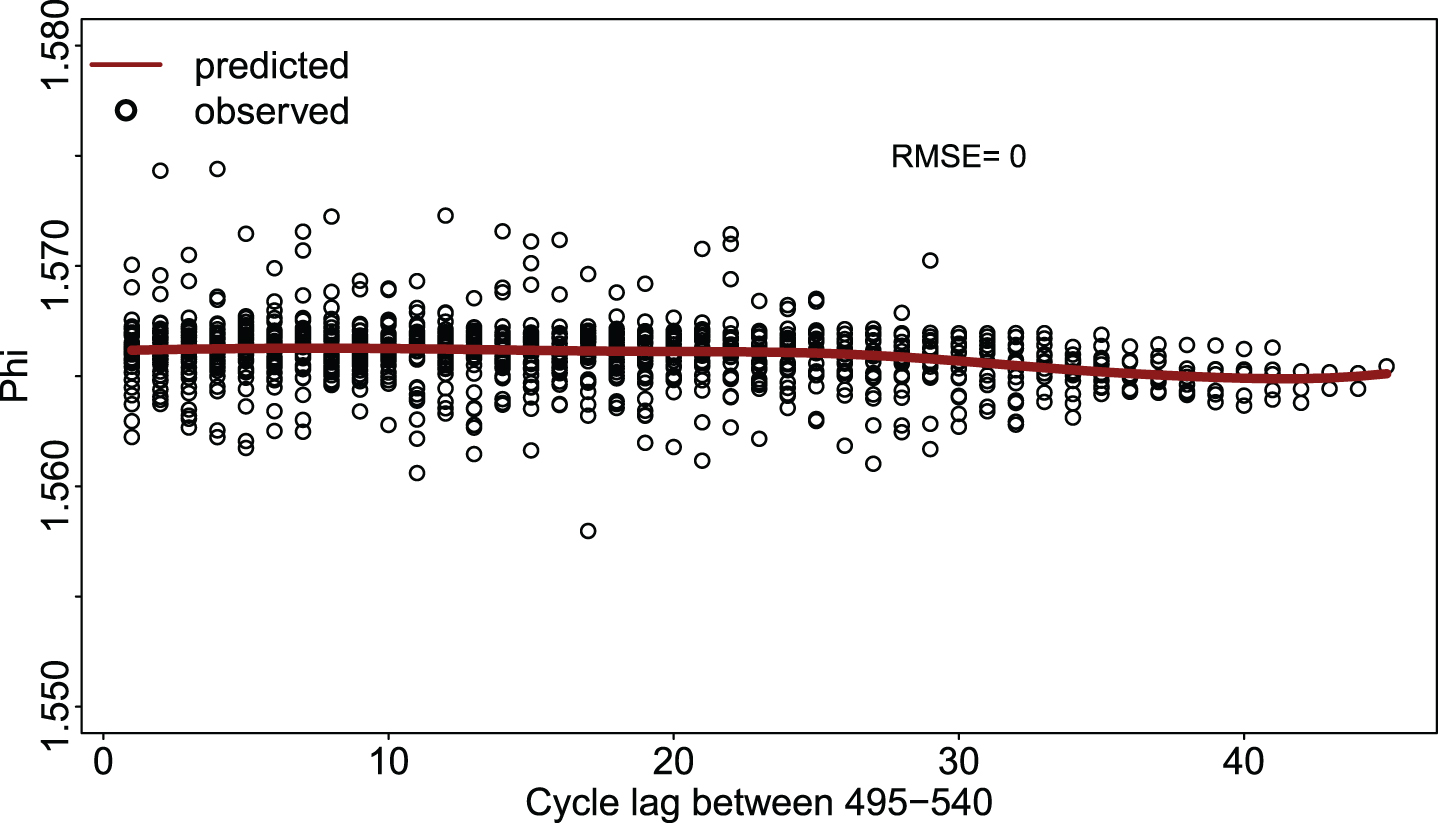
The actual and predicted angles versus the cycle lags.
To have a better understanding of the cycle to failure estimation, the mean-covariance decomposition model with the optimal moving window length of 46 is used to predict the capacity around the last cycles. Considering the end life cycles shown in Table 1, data of the first 540 cycles is used to predict the cycle to failure at which the capacity of batteries is less or equal to 80% of the initial capacity. The prediction based on the proposed method uses based on the optimal window. That is, the predictions of the capacity at cycle 541 is predicted based on the historical capacity data at cycle 495 to 540, and that at cycle 542 relies on 496 to 541, and so on. The prediction of future values is provided in the form of a multivariate normal distribution, where each variate, the prediction of the capacity, follows a normal distribution. The predicted capacity and the 90% confidence interval are shown in Fig. 9, where capacity measurements of CS2_35, CS2_36, CS2_37, and CS2_38, the means of both MCD and mixed effect model are demonstrated. To compare the prediction performance of MCD and mixed effect model, the average width of 90% confidence interval of 0.058, while that of the mixed effects model is 0.064. That is, the prediction based on mean-covariance decomposition method is more accurate compared with that of the model proposed in [35].

Performance comparison of the proposed method and the mixed effects model.
Given the number of cycles, the capacity can be simulated under the MCD model for a large number of iterations. By counting the percentage of the simulated capacities less than the specified failure threshold, i.e., 0.88 Ah, cycle to failure distribution can be obtained, see Fig. 10, where the average of observed cycle to failure of four batteries is 623. It turns out that the mean of the cycle to failure is 635 and the standard deviation is 14.3.
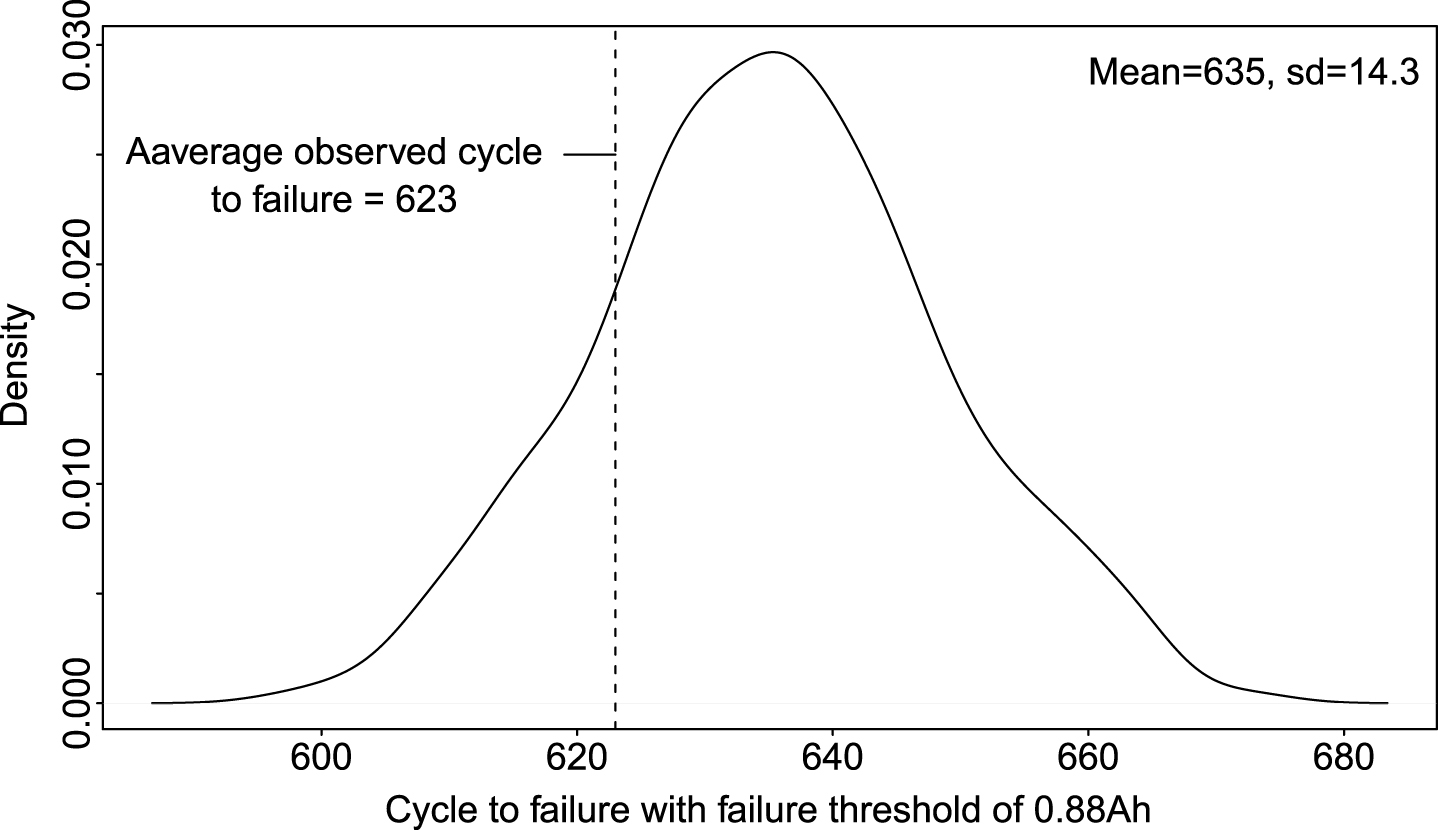
Cycle to failure estimation and the observed average cycle to failure with D F = 0.88Ah.
A mean-covariance modeling method is proposed to model the longitudinal and between-sample uncertainties. Through the covariance matrix of the multivariate normal distribution of the repeated measurement, mean-covariance decomposition can effectively deal with unbalance data through decomposed covariance matrix and the time-vary random effects. With the characteristics of the correlation matrix, a trigonometric function is used to reparameterize the correlation matrix, which can reduce the time-varying factors of the correlation matrix. To improve the interpretation of the degradation model, the analytic model from the electrochemical viewpoint is employed as the basic form of the mean function. For the slow degradation process, the moving-window scheme is used to include the most recent information for predictions. Within the optimal moving window, the parameters in the mean-covariance models are estimated through balancing the goodness-of-fit of the capacity data and the model complexity. Compared with the mixed effects model, the proposed method needs fewer historical data with the moving window with smaller length, which improves the accuracy of the prediction. The cycle to failure can be easily obtained through simulations.