



Abstract
Distance and similarity measures have recently been investigated in-depth within the context of hesitant fuzzy sets. By analyzing the existing studies concerning distance measures for hesitant fuzzy sets, we find that they have some limitations. To address the flaws, this study develops some novel distance measures for hesitant fuzzy sets, including the normalized Euclidean distance measure, the Hausdorff metric distance measure, the normalized generalized distance measure, and their corresponding weighted distance measures. The proposals of this study not only hold many ideal characteristics but also do not consider the lengths of hesitant fuzzy elements as well as the arrangement of their possible values. To deal with the situations where both of the universe of discourse and the weight of element are continuous, some continuous hesitant fuzzy distance measures are also investigated. Based on the relationship between distance measure and similarity measure, some novel similarity measures for hesitant fuzzy sets can be further deduced from the proposed distance measures. Finally, two numerical examples are given to demonstrate the applicability and validity of the proposed hesitant fuzzy distance measures.
Introduction
The fuzzy set theory [1] is an important tool to handle fuzzy uncertainty. Since its appearance, the theory of fuzzy sets has attracted much attention of both researchers and engineers, and achieved a great success in various fields [2–6]. Over the past decades, many higher order extensions such as the Atanassov’s intuitionistic fuzzy set [7], the interval-valued intuitionistic fuzzy set [8], the type-2 fuzzy set [9], and the fuzzy multiset [10] have been consecutively developed to better express the vague and imprecise information. However, in real decision making problems, it may be hard for decision makers to establish the degree of membership of fuzzy set due to lack of knowledge and data, the time pressure or some other reasons. In view of this, Torra and Narukawa [11] and Torra [12] recently introduced the concept of hesitant fuzzy set. Compared with the other extensions of fuzzy set above, the hesitant fuzzy set theory permits the membership having a few possible values, which can reflect the hesitancy of human more objectively.
In recent decades, many researchers have paid attention to this topic because of its advantages over fuzzy set and other extensions [13]. In order to generate a combined piece of information under hesitant fuzzy environment, various information aggregation functions or operators have been intensively investigated and applied to tackle decision making problems. Tan et al. [14] proposed a family of hesitant fuzzy Hamacher operators and applied them to develop a new technique for hesitant fuzzy multicriteria decision making problems. Ai et al. [15] developed some dependent hesitant fuzzy aggregation operators for aggregating hesitant fuzzy information. Qin et al. [16] developed several hesitant fuzzy aggregation operators based on Frank operations. Inspired by the power aggregation, Tang [17] proposed a hesitant fuzzy Hamacher power weighted average operator. Liao and Xu [18] proposed some quasi hesitant fuzzy operators to deal with decision making. In addition, a few classical decision making methods have been proposed for decision making with hesitant fuzzy formation, such as the hesitant fuzzy VIKOR method [19], the hesitant fuzzy TODIM method [20], and the hesitant fuzzy TOPSIS method [21]. Bisht and Kumar [22] proposed a fuzzy time series forecasting method based on hesitant fuzzy sets. With the use of hesitant fuzzy preference relation, Xu et al. [23] developed a consensus model for the water allocation management. Meng and An [24] developed a group decision making model with hesitant fuzzy preference relations. The analysis above demonstrates that hesitant fuzzy set has been a successful technique to address uncertain and vague information in practical decision making.
Studies have also been performed on distance and similarity measures for hesitant fuzzy sets as well. As two powerful concepts in lots of disciplines of science and engineering, distance measure is an important tool for distinguishing the difference between two fuzzy objects, whereas similarity measure provides the degree of similarity between them. The two measures are usually identified as two complementary concepts and have been widely investigated in the fuzzy set theory [25–27]. They have recently been investigated within the hesitant fuzzy environment. Motivated by the ideal of the ordered weighted distance measure [28], Xu and Xia [29] proposed a number of hesitant ordered weighted distance measures and hesitant ordered weighted similarity measures. As an extension of the work in Xu and Xia [29], Peng et al. [30] developed a generalized hesitant fuzzy synergetic weighted distance measure, and investigated its some desirable properties and special cases. Under the assumptions that the values in hesitant fuzzy elements are arranged in a descending/increasing order and two hesitant fuzzy elements under consideration have the same length, Xu and Xia [31] defined some distance measures for hesitant fuzzy information and then studied their properties in detail. Zhou and Li [32] proposed some similarity measures for hesitant fuzzy sets, and then a similarity measure-based method was introduced for multiple attribute decision making under hesitant fuzzy environment. After introducing the concept of hesitancy degree of hesitant fuzzy set, Li et al. [33, 34] developed several distance and similarity measures for hesitant fuzzy sets, and applied them to solve multiple criteria decision making with hesitant fuzzy information. By taking the hesitancy indices of hesitant fuzzy sets into account, Zhang and Xu [35] proposed two new methods to measure distances and similarities for hesitant fuzzy sets, and a novel similarity measure-based hesitant fuzzy clustering algorithm was further developed for classifying objects with hesitant fuzzy sets. Zeng et al. [36] developed several novel distance and similarity measures between hesitant fuzzy sets by taking into account the hesitance degree of hesitant fuzzy sets and discussed their applications in pattern recognition as well. Although the aforementioned distance and similarity measures for hesitant fuzzy sets possess many merits, some of them still have following limitations:
These existing distance and similarity measures are based on two assumptions: 1) the possible values in a hesitant fuzzy element are arranged in an ascending/increasing order; and 2) the numbers of possible values in two hesitant fuzzy elements are the same. The first assumption can be satisfied easily. However, regarding to the second one, the numbers of values in different hesitant fuzzy elements may be different. In fact, in most situations the second assumption does not hold. The distance measures proposed in Refs. [29–32] do not satisfy such fundamental property as triangle inequality. Following the conventional axiomatic definition of distance measure [37], triangle inequality is a fundamental and desirable property. Thus these distance measures are less well justified theoretically.
From the above analysis, it is necessary to re-consider the distance and similarity measures for hesitant fuzzy sets, which forms the motivation of this study. To do this, we first carry out an analysis of existing studies concerning distance measures of hesitant fuzzy sets. Then, a new axiomatic definition of distance measure for hesitant fuzzy sets is defined and some novel distance measures for hesitant fuzzy sets are developed. Considering the situations where both of the universe of discourse and the weight of element are continuous, we present some continuous hesitant fuzzy distance measures. Based on the relationship between distance measure and similarity measure, some novel similarity measures for hesitant fuzzy sets can be further obtained. Finally, two numerical examples are given to demonstrate the applicability and validity of the proposals.
The rest of this study is organized as follows: Section 2 reviews some key concepts concerning hesitant fuzzy sets. In Section 3, an analysis of existing distance measures for hesitant fuzzy sets is conducted. Section 4 proposes several novel hesitant fuzzy distance measures and discusses their special cases as well as properties in detail. The continuous hesitant fuzzy distance measures are developed in this section as well. Section 5 investigates the applications of the proposed distance measures. We conclude this study in Section 6.
Preliminaries
In this section, we briefly review some basic concepts of hesitant fuzzy sets and some axiom definitions of distance and similarity measures for hesitant fuzzy sets.
To facilitate, the hesitant fuzzy set is often expressed simply by mathematical symbol in Xu and Xia [29, 31].
Distance is a powerful concept in lots of disciplines of science and engineering. It is often desirable that the distance be a metric. Takahashi [37] gave the conventional axiomatic definition of distance measure as follows:
Nonnegative: d (A, B) ≥ 0 and d (A, B) = 0 if and only if (iff) A = B; Symmetric: d (A, B) = d (B, A) and Triangle inequality: d (A, B) + d (B, C) ≥ d (A, C).
Xu and Xia [29] put forward the axiomatic definition of distance measure for hesitant fuzzy sets.
0≤ d (A, B) ≤ 1; d (A, B) = d (B, A); and d (A, B) = 0 iff A = B.
Additionally, Li et al. [33] modified this axiomatic definition as follows:
0≤ d (A, B) ≤ 1; d (A, B) = d (B, A); d (A, B) = 0 iff A = B; d (A, B)+ d (B, C) ≥ d (A, C); and If A ≤ B ≤ C, then d (A, B) ≤ d (A, C) and d (B, C) ≤ d (A, C).
As a complementary concept of distance measure, Xu and Xia [29] defined the axiom of similarity measure for hesitant fuzzy sets, as shown below:
0≤ s (A, B) ≤ 1; s (A, B) = s (B, A); and s (A, B) = 0 iff A = B.
Distance measure is an important tool for distinguishing the difference between two objects. For two hesitant fuzzy sets A ={ h A (x i ) } and B ={ h B (x i ) } over X, Xu and Xia [29] introduced the hesitant normalized Hamming distance, Euclidean distance and generalized hesitant normalized distance. Here we just enumerate one as a representation (see Ref. [29] for more others):
Assume that the weight of element x
i
∈ X is ω
i
such that 0 ≤ ω
i
≤ 1 for i = 1, …, n and
It is quite clear that d g (A, B) is the mean of distances between all hesitant fuzzy elements of hesitant fuzzy sets A and B. Viewing from this point, Zhou and Li [32] investigated several new distance measures for hesitant fuzzy sets based on the Hamming distance, the Euclidean distance, L p metric and exponential operations.
In addition, Peng et al. [30] presented a generalized hesitant fuzzy synergetic weighted distance (GHFSWD) measure for hesitant fuzzy sets.
where λ > 0, ρ : (1, 2, …, n) → (1, 2, …, n) is a permutation function such that
We can find that the aforementioned distance measures are value-based distance measures for hesitant fuzzy sets. In fact, the numbers of possible values of different hesitant fuzzy elements may be different. When we apply these hesitant distance measure formulas to calculate the distance between hesitant fuzzy sets, the calculations of the distance measures are actually done in spaces with different dimensions. Such results are usually incomparable. To address this matter, Li et al. [33] considered the hesitant fuzzy elements h (x) on x as the points in the same space by extending the hesitant fuzzy elements uniformly, and proposed some new distance measures for hesitant fuzzy sets. We just enumerate one as a representation below(see Ref. [33] for more others):
h = 1, 2, …, t, the generalized hesitant normalized distance between A g and A h by extending hesitant fuzzy elements uniformly is defined as:
where λ > 0, hAgσ(j) (x i ) and hAhσ(j) (x i ) are the jth values in hAg(x i ) and hAh(x i ), respectively, hfilneg
and l i = max f ∈ I { l Afi }, I = { 1, 2, …, t }. In addition, l Afi is the number of values in h Af (x i ).
If the weight ω i of each element x i ∈ X is considered, Li et al. [33] further proposed the following generalized hesitant weighted distance:
The common characteristic of the distance measures in Refs. [29, 33] is that only the difference between the values of different hesitant fuzzy elements is considered, the difference between the numbers of values of the hesitant fuzzy elements is not taken into account. This will lead to unreasonable results. In order to overcome this drawback, Li et al. [34] and Zeng et al. [36] recently introduced a new concept of hesitance degree of hesitant fuzzy element, and based on which they presented some new distance measures for hesitant fuzzy sets that take both the difference of the values and that of the numbers into account. We just enumerate one as a representation here (see Ref. [34, 36] for more others):
Similarly, considering the weight ω i of each element x i ∈ X, Li et al. [34] and Zeng et al. [36] proposed the following generalized hesitant weighted distance:
Although these distance measures have lots of merits, some of them still have several drawbacks.
Two assumptions have to be satisfied before these existing distance measures are applied to calculate the distance between two hesitant fuzzy sets: 1) the possible values in a hesitant fuzzy element are arranged in an ascending/increasing order; and 2) the numbers of possible values in two hesitant fuzzy elements are the same. As to the first assumption, it is easy to be satisfied. However, to satisfy the second one, all hesitant fuzzy elements with different lengths should be converted into those with the same length before their distance is calculated by using these existing distance measures. To carry out such conversion, Xu and Xia [29] developed the optimistic and pessimistic strategies by filling the shorter hesitant fuzzy element with some artificial values until both of the shorter and longer ones have the same length. In real applications, the rationality of the conversion strategies deserves further verification. On the other hand, the renewed hesitant fuzzy elements deriving from the strategies have changed the original information of the initial hesitant fuzzy elements. Based on the conventional axiomatic definition of distance measure [37], triangle inequality is a fundamental and desirable property. However, the existing distance measures proposed in Refs. [29, 32] do not satisfy such fundamental property. Thus these existing distance measures are less well justified theoretically.
From the above analysis, it is necessary to re-investigate the distance measure for hesitant fuzzy sets. In what follows, we will propose some novel distance and similarity measures for hesitant fuzzy sets, which can circumvent the above-mentioned drawbacks.
Before developing the novel distance measures, we first define a new axiomatic definition of distance measure for hesitant fuzzy sets.
The property (5) in Definition 4 is considered under the circumstance where the comparison laws developed in Zhou and Li [32] and Farhadinia [38] are used to compare hesitant fuzzy sets. When other comparison laws (eg., [29, 31]) are used, even the hesitant distance measures proposed in Li et al. [33] will not satisfy this property. On the other hand, the development of comparison laws for hesitant fuzzy sets is still an active research topic and each of existing comparison methods has its own merits. It is not convincing to define the axiomatic definition of hesitant distance measure depending on just one of these comparison methods. Hence, in what follows, we modify the axiomatic definition of hesitant distance measure by relaxing the property (5) in Definition 4.
Boundedness: 0 ≤ d (A, B) ≤ 1; Symmetric: d (A, B) = d (B, A); Triangle inequality: d (A, B) + d (B, C) ≥ d (A, C); and Conditional reflexivity: d (A, B) = 0, iff h
A
(x
i
) = h
B
(x
i
), and l
Ai
= l
Bi
= 1.
Where l Ai and l Bi are the numbers of values in h A (x i ) and h B (x i ).
Notice that the property (4) in Definition 11 is stricter than the one in Definition 4. As hesitant fuzzy sets are an extension of fuzzy sets and are not precise values, it is reasonable that even two hesitant fuzzy sets are equivalent their distance is not equal to zero. Only when two hesitant fuzzy sets are reduced to two equivalent fuzzy sets, does their distance satisfy the property (4).
In the following, we propose some new distance measures for hesitant fuzzy sets, which possess ideal characteristics and relax the two assumptions aforesaid.
The normalized Euclidean distance between A and B is defined as:
The Hausdorff metric distance between A and B is defined as:
From Definition 12, we have:
ThenormalizedgeneralizeddistancebetweenAandBisdefinedas:
Regardingtod g ,letλ = 3,thenweobtain:
whereλ ≥ 1, h Aj (x i ) ∈ h A (x i ) (j = 1, 2, …, l Ai ) and h Bk (x i ) ∈ h B (x i ) (k = 1, 2, …, l Bi ), and l Ai and l Bi are the numbers of values in h A (x i ) and h B (x i ).
In particular, if λ = 1 and λ = 2, then will be reduced to and, respectively.
From Definition 12, we can find that all combinations of possible values in two hesitant fuzzy elements are considered in the proposed distance measures. The two assumptions on the existing distance measures are clearly relaxed. An example is employed to illustrate the proposed distance measures.
The above distance calculation process does not consider the lengths of hesitant fuzzy elements of the two hesitant fuzzy sets as well as the arrangement of their possible values. All the combinations of h Aj (x i ) and h Bk (x i ) (j = 1, 2, …, l Ai ; k = 1, 2, …, l Bi ; i = 1, 2, …, n) are handled in the above distance measures.
To prove the above theorem, we firstly present a relevant lemma.
We can reason from Definition 12 that:
Then, Property (3) is equivalently transformed into the following inequality:
which can be further converted into:
i.e.,
Since the following equation holds:
on the condition that 1≤ λ ≤ + ∞, we can reason from Lemma 1 that . Therefore, Property (3) is verified.
If h A (x i ) = h B (x i ), and l Ai = l Bi = 1, then A and B are reduced to two equivalent fuzzy sets. It is obvious that d g (A, B) = 0, which reflects that Property (4) in Theorem 1 holds.
Thus, we complete the proof of Theorem 1. □
According to Equation (2) in Definition 6, we obtain
hrule
As l
i
= l
Bi
, then the following equation holds:
Thus, which completes the proof. □
In fact A is a fuzzy set but can be seen as a special hesitant fuzzy set.
From Equation (16), we get
Based on Equation (2) in Definition 6, we have
We can find that .
Suppose that the weight of element x
i
∈ X is ω
i
such that 0 ≤ ω
i
≤ 1 for i = 1, dots , n and
hrule
hrule
The weighted Euclidean distance between A and B is defined as:
The weighted Hausdorff metric distance between A and B is defined as:
The generalized hesitant weighted distance between A and B is defined as:
Specially, for the cases of λ = 1 and λ = 2,
The weighted distances d ωh (A, B), d ωe (A, B), d ωhd (A, B), and d ωg (A, B) between the hesitant fuzzy sets A and B also satisfy the properties (1)-(4) in Theorem 1. The proof is similar to that of Theorem 1 and thus we omit it here.
The distance measures proposed above are discrete. To deal with the situations where both of the universe of discourse and the weight of element are continuous, we present the following continuous hesitant distances.
Assume that the weight of x ∈ X = [a, b] is ω (x) such that 0 ≤ ω (x) ≤ 1 and
hrule
hrule
Hesitant fuzzy decision matrix
Results obtained by the generalized hesitant weighted distance
In the special cases where λ = 1, 2, we can obtain a continuous weighted Hamming distance:
and a continuous weighted Euclidean distance:
With the use of the traditional Hausdorff metric, we can get a continuous weighted Hausdorff distance:
Based on the relation between distance and similarity measures, the following property holds.
On the basis of Property 2, the corresponding similarity measures can be deduced from the proposed distance measures.
In this section, two numerical examples are solved by the proposed distance measures to demonstrate their applicability and validity. The first example relating to the evaluation of energy policy is taken hfilneg
hrule
from Xu and Xia [29]. The second one is adapted from the first one and is investigated to further validate our proposed hesitant fuzzy distance measures.
Therefore, we can select the best alternative based on the distances between each alternative and the ideal solution. By using the generalized hesitant weighted distance proposed in this paper as shown in Definition 12, we can obtained the hesitant weighted distances between each alternative and the ideal solution, and the ranking order of the five alternatives as presented in Table 2 and Fig. 1.
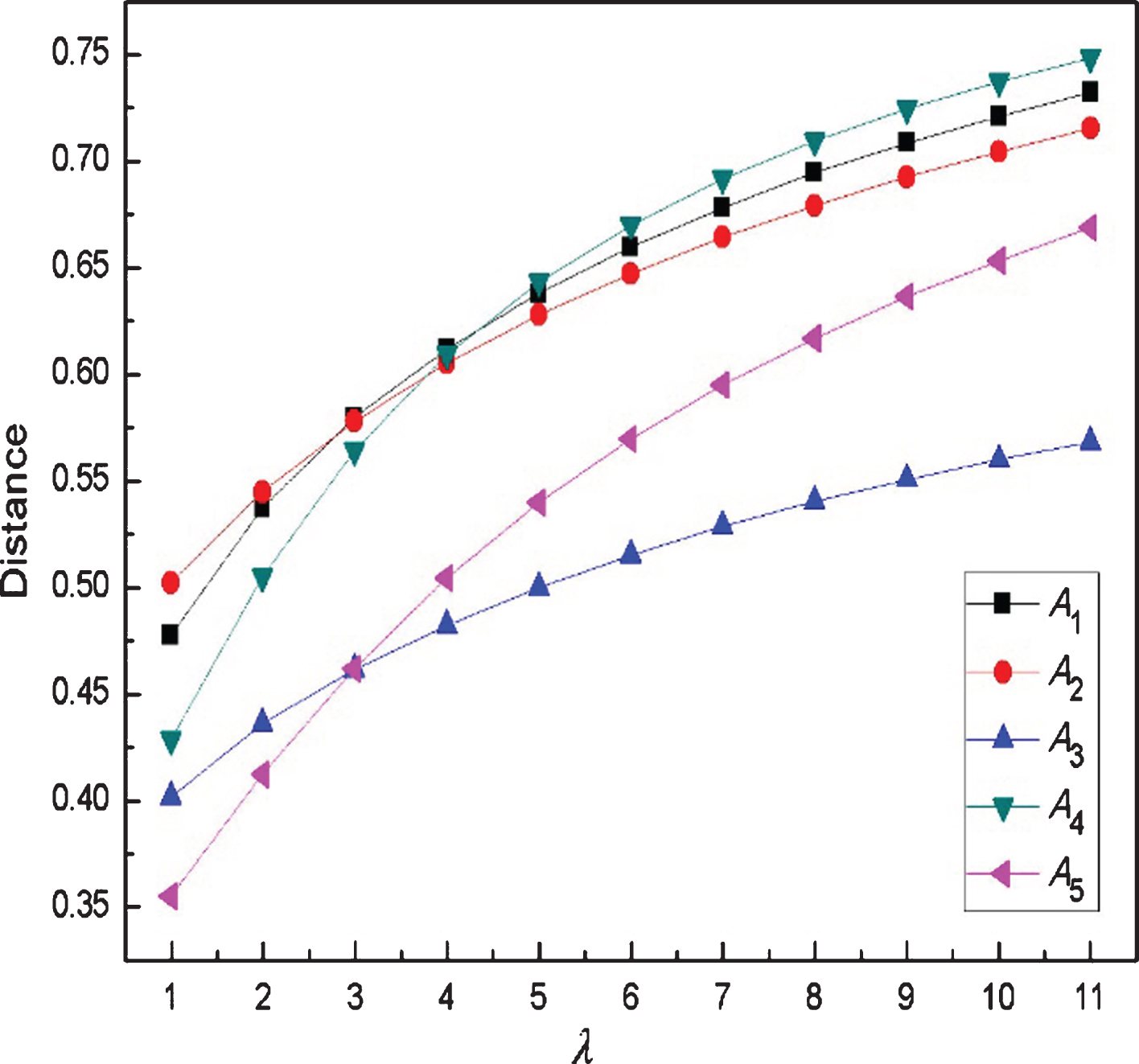
Movement of distance values of the five energy projects with a variation in λ.
Results obtained by the generalized hesitant weighted distance
From Table 2 and Fig. 1, we can find that the ranking order of the alternatives is dynamically changing with the increase of the parameter λ. In the cases where λ ∈ [1, 3], the ranking order is A5 ≻ A3 ≻ A4 ≻ A1 ≻ A2 and the best choice is A5, while in the cases where λ ∈ (3, + ∞) the ranking order is A3 ≻ A5 ≻ A2 ≻ A1 ≻ A4 and the best choice becomes A3. Besides, the distance values between each alternative and the ideal solution increase with the increase of the parameter λ. From the above analysis, we can conclude that the proposed distance measure can provide the decision makers more choices with different given values of the parameter based on the risk attitudes of decision makers.
Comparing the results presented in Table 2 with those in Ref. [29], we find that the distance values obtained by the proposed distance measure are the same as those by the generalized hesitant weighted distance of Xu and Xia (see Table 2 in Xu and Xia [29] for details). But this cannot show that the method proposed in this paper is the same as that of Xu and Xia. This is duo to the fact that the above ideal solution A* is a fuzzy set. In this situation the distance values obtained by the two methods are the same, which has been discussed in Section 4. In the following, another numerical example adapted from the above one is solved by the two methods to illustrate this issue.

Movement of distance values of the five energy projects with a variation in λ.
Results obtained by the generalized hesitant weighted distance d g (A, B)
The results of applying the two methods to this example are shown in Table 3 (or Fig. 2) and Table 4 (or Fig. 3), respectively. Comparing the results presented in Table 3 and Fig. 2 with those in Table 4 and Fig. 3, we find that the distance values obtained by the two methods are completely different, which demonstrates their differences. More importantly, it is easier for the results shown in Table 3 and Fig. 2 to distinguish the differences between different alternatives, compared with those listed in Table 4 and Fig. 3. The curves in Fig. 2 can easily make a clear distinction between the inferior alternative set {A1, A2, A4} and the superior alternative set {A3, A5}, while it is very hard for the curves in Fig. 3 to make a such distinction. From the ranking orders of the alternatives in Tables 3 and 4, it is clear to see that the solution generated by our method is more stable than that obtained by the method of Xu and Xia. The above analysis demonstrates the efficiency of our proposed method and reflects its strength.
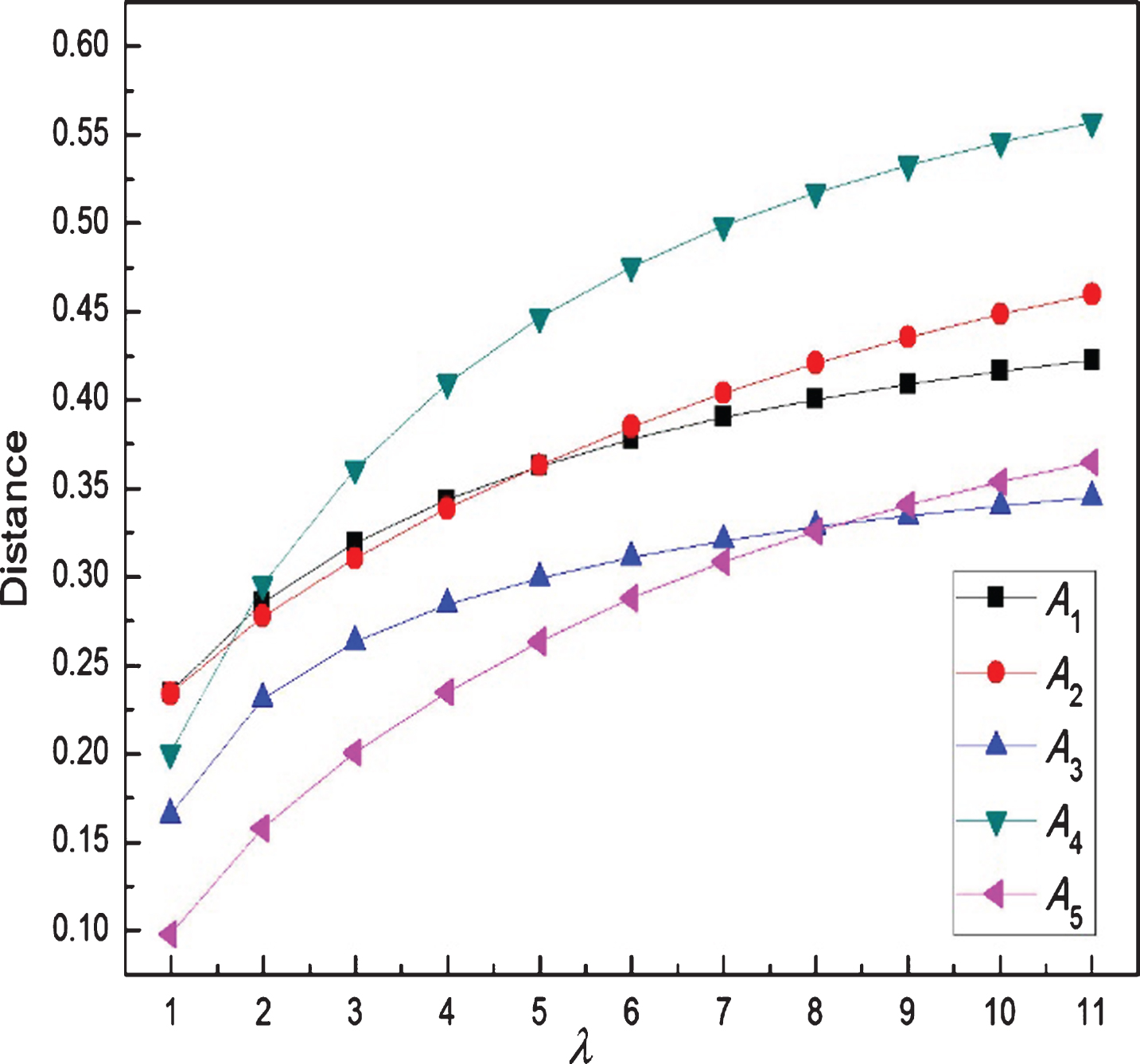
Movement of distance values of the five energy projects with a variation in λ.
This study proposes some novel distance measures for hesitant fuzzy sets. The proposals relax the assumptions that the lengths of hesitant fuzzy elements of two hesitant fuzzy sets should be equivalent and the arrangement of possible values of hesitant fuzzy elements should be considered. Besides, the proposed distance measures satisfy such fundamental property as triangle inequality. Finally, two numerical examples taken from a previous work by Xu and Xia [29] are chosen to demonstrate the applicability and validity of the developed hesitant fuzzy distance measures.
The proposed hesitant fuzzy distance measures are implemented and applied to energy policy evaluation. In future work, we will apply the proposals to other domains, such as cluster analysis [40], fault diagnosis [41], green supplier selection [17], and investment evaluation [42] to broaden their applicability.
Footnotes
Acknowledgments
This research was supported by the Foundation for Innovative Research Groups of the National Natural Science Foundation of China (No. 71521001), the National Natural Science Foundation of China (Nos. 71601066, 71501056, 71501054, and 71303073), the Humanities and Social Science Foundation of Ministry of Education in China (Nos. 16YJA630075, 16YJC630093 and 13YJC630030), and the Foundation of North Minzu University (No. 2013XYS07).