



Abstract
The early warning classification plays an important role in the emergency management of cluster supply chain. This paper proposed the high-dimensional datastream evolutionary clustering algorithm of early warning classification for cluster supply chain emergency based on cloud model. It solved the bottleneck problem of early warning classification of cluster supply chain emergency with the high-dimensional datastream and composite uncertainty characteristics. The cloud model generation algorithm of early warning summary is used to generate the early warning summary data based on the multiple data fusion method. The evolutionary datastream clustering algorithm of early warning classification is used to dynamically forecast the harming degree of cluster supply chain emergency based on time decaying model and sliding window model. Compared to other similar algorithms, the algorithm proposed in this paper increased the classification accuracy by 92.6% while reduced operation time by 66.7%. The algorithm can provide more accurate decision supports for design and implementation of emergency preplan of cluster supply chain emergency. The feasibility of this algorithm has been demonstrated by multiple experiments conducted on the algorithm.
Keywords
Introduction
In recent years, supply chain emergencies occur frequently [6, 23], from the Ericsson mobile phone market share plunged event caused by chip supply disruption to a number of plants shutdown events caused by the Chrysler supplier bankruptcy; from Sanlu milk powder incident to Mengniu “poison feed” incident, Red Bull “stimulant” incident and so on. These events have caused a huge impact on node enterprises of supply chain, the masses of the people and society, and even made the supply chain rupture and collapse [14, 57]. The implementation of early warning classification decision management of cluster supply chain emergency can not only reduces the loss of cluster supply chain, but also strengthens the relationship between the cluster supply chain upstream and downstream enterprises, and improves the level of informational and intelligent management for the whole cluster supply chain. It also satisfies the needs of cluster supply chain emergency management and conforms to the trends of modern market competition.
The cloud theory has been proposed for the randomness and fuzziness of uncertainty, and it is the innovation and development for the membership function concept of fuzzy theory [4, 33]. Cloud model theory is the core of cloud theory, which can solve the problem of knowledge representation in data mining [11, 49]. A clustering algorithm of invasive weed optimization (IWO) and KM based on the cloud model solved the problems of the K-means (KM) for excessively depending on the initial guess values and easily getting into local optimum [15]. A quantum-behaved particle swarm optimization clustering algorithm based on cloud model [37] and a combinatorial clustering algorithm of cloud model and a novel fuzzy hybrid quantum artificial immune [39] have been proposed to solve the stochastic problems. The comprehensive evaluation cloud model of air quality was developed to improve the accuracy and robustness of the warning system [29]. The cloud model-set pair analysis method was used to a novel hazard assessment algorithm for a biomass gasification station [13]. Wang Z.X. put forward an early warning method of sudden events based on the cloud model [60].
The density-based data stream clustering algorithm was composed of an online algorithm that generates summary data and an offline algorithm that generates the clusters by using the summary data [2, 47]. A data stream clustering method was used to group similar data points based on a decentralized bottom-up self-organizing strategy in a multi-agent system [3]. The MuDi-Stream clustering method was developed with four main components [1]. A fast density-based data stream clustering algorithm [28] and an adaptive density data stream clustering algorithm [43] were proposed with cluster centers self-determined for mixed data. SVStream data stream clustering algorithm was based on support vector domain description and support vector clustering [9]. A high dimensional data stream clustering algorithm incorporates dimension reduction into the stream clustering framework [45]. A fast data stream clustering evolutionary algorithm can estimate k automatically from data in an online fashion [19]. The incremental clustering (IC) algorithms were proposed to discover clusters efficiently [24, 34].
The optimization methods were researched within machine learning-based classification system for early warnings [21, 54]. Xu Y. researched the warning classification problems of university public crisis by an improved fuzzy topsis based on alpha level sets [58]. The probabilistic neural network statistical model and self-organizing map statistical model were developed in biological early warning systems [32]. The earthquake disaster grade prediction model based on big data fuzzy clustering algorithm [8] and the coal security forewarning model based on pca-ar and k-means clustering algorithms [22] were researched. The inventory early-warning model of supply chains was researched based on rough sets and BP neural network [16]. The risk evaluation based on improved multi-level fuzzy comprehensive evaluation method, risk assessment index system, design and control mechanism of risk system have been studied for cluster supply chain [18]. The clustering algorithms for risk classification were studied in complex systems [12, 40]. Bi W.J. processed a big data clustering algorithm for the classification system of customer churn [52].
Li H.K. analyzed same level across-chain inventory collaboration mechanism on cluster supply chains [17]. Shen J.Q. studied cluster supply chain collaborative procurement model optimization and simulation implementation based on agent [26]. Xue X. put forward enterprise service composition method for cluster supply chain [55]. Yan B. studied replenishment decision making and coordination contract of cluster supply chain in a centralized VMI and TPL system [7]. A optimization and parallel allocation method of cross-chain orders was put forward based on Lagrange algorithm for cluster supply chain [53]. Wang Y. analyzed cluster supply chain risk: a formation mechanism perspective [56]. Wang S.S. established risk assessment index system of cluster supply chain [48]. Gao B.H. put forward an inventory strategy with emergency order in cluster supply chain [5]. Li L. researched control mechanism of cluster supply chain risk system [31]. Wei H.S. evaluated cluster supply chain risk base on improved multi-level fuzzy comprehensive evaluation method [18].
It is the key problem in emergency management that the early warning grades of cluster supply chain emergency are divided quickly and effectively. It plays an important role in the effective implementation of the emergency preplan. At present, for the bottleneck problem of high-dimensional datastream characteristics and the composite uncertainty characteristics including fuzziness and randomness, the research results on the early warning classification of cluster supply chain emergency have not yet been reported. This paper proposes the high-dimensional datastream evolutionary clustering algorithm of early warning classification for cluster supply chain emergency based on cloud model. It can dynamically predict the harming degree of cluster supply chain emergency in order to providing more accurate decision supports.
This paper is organized as follows. Section 2 presents the early warning index system of cluster supply chain emergency. Section 3 details the early warning summary data structure and the cloud model generation algorithm of emergency early warning summary. Section 4 details the decision-making method of emergency early warning classification based on datastream clustering algorithm. Section 5 presents the simulation experiments of emergency early warning classification and clustering quality evaluation.
Early warning index system of cluster supply chain emergency
The outbreak of cluster supply chain emergency may cause imbalances of early warning indicators. The comprehensive supply chain crisis can be triggered by passing and extension. Therefore, the establishment of an early warning index system is required. The early warning index system of cluster supply chain emergency is shown in Table 1.
Emergency early warning index system
Emergency early warning index system
The early warning indexes of cluster supply chain emergencies have the composite uncertainty characteristics which contains both fuzziness and randomness. Cloud model theory can better describe the fuzziness, randomness and the coupling between the two [25, 50]. For the high-dimensional datastream characteristics of early warning indexes in cluster supply chain emergencies [59], this paper uses the cloud model generation algorithm of emergency early warning summary to carry out multi-data fusion processing on the early warning index data of clustering supply chain emergencies, by which the early warning summary data of cluster supply chain emergencies are generated.
Early warning summary data structure
The data of early warning index datastream arrive in order in the form of blocks X1, X2, ⋯ , X i , ⋯. Each data block contains l data points, namely X i (xi1, xi2, ⋯ , x il ). Each data point is a q dimensional vector.
Cloud model generation algorithm of emergency early warning summary
The cloud model has expectation Ex, entropy En and hyper entropy He digital features [36, 44]. The qualitative concept can be described by expectation Ex in numerical domain space. It reflects the cloud gravity center of the cloud drop group for this concept. Entropy En is a comprehensive measurement of fuzzy degree and probability for qualitative concepts. It embodies the margin of both This and That of qualitative concepts. The uncertainty measurement of entropy can be described by hyper entropy He. It refers the cohesion of all point’s uncertainties for the concept in numerical domain space, namely the condensation degree of cloud droplets. The size of the hyper entropy indirectly represents the dispersion degree and the thickness of the cloud [10, 46].
Reverse cloud generator is a transforming model from the quantitative values into qualitative concept. Based on a month of accurate data of the early warning indicators for cluster supply chain emergency, namely (xi1, xi2, ⋯ , x
in
), the digital characteristics (Ex
i
, En
i
, He
i
) of cloud model to represent the qualitative concept are obtained by multiple data fusion algorithm. The multiple data fusion algorithm of emergency early warning indicators is as follows. The sample x
ij
is used as input data. According to Equation (1), the sample mean value is obtained.
According to Equation (2), the absolute central moment of a first order samples is obtained.
According to Equation (3), the sample variance is obtained.
According to Equation (4), the expectation value is obtained based on the sample mean value.
According to Equation (5), the entropy value is obtained based on the expectations value.
According to Equation (6), the hyper entropy value is obtained based on the sample variance and entropy value.
where n is the number of days in a month, and i is the serial number of emergency early warning indicator for cluster supply chain, namely i = 1, ⋯ , 27.
In this paper, using the idea of adjacent cloud merging in the jump strategy of concept granularity ascension, the multidimensional cloud merging algorithm is proposed based on the high-dimensional datastream and composite uncertainty characteristics of early warning indicators for cluster supply chain emergency. The multidimensional cloud digital characteristics of all emergency early warning indicators in each risk dimension are merged respectively to extract early warning summary data of each supply chain early warning indicators. The extracting algorithm of early warning summary data is as follows. The digital characteristics of p dimensional cloud for early warning indicators, namely CD
i
(Ex
i
, En
i
, He
i
) (i = 1, 2, ⋯ , m), and the cloud important degree vector, namely η = (η1, η2, ⋯ , η
m
)
T
, According to Equation (7), matrix is obtained based on the digital characteristics of cloud.
According to Equation (8), vector
where 1
j
is p dimensional unit column vector that the jth element is 1, the rest of the elements are 0.
According to Equation (10),
where U is the region of variable value corresponding with jth dimension of ithp dimensional cloud CD
i
, i = 1, 2, ⋯ , m; j = 1, 2, ⋯ , p. According to Equation (11), According to Equations (12), (13) and (14), r
x
, r
h
and r
η
vectors are obtained.
where operator ⊗ represents Hadamard product. According to Equation (15),
where operator 〈• , • 〉 represents Euclidean inner product. According to Equation (16), the digital characteristics of merged cloud, namely CD (Ex, En, He), are obtained.
For each of the supply chain in the cluster supply chain, the digital characteristics of early warning indicator merged clouds for the three risk dimensions are calculated respectively, and are input respectively into multidimensional positive normal cloud generator to get the center cloud droplets of three risk dimensions, which are used as 3 dimensional emergency early warning summary data of cluster supply chain.
In this paper, the evolutionary datastream clustering algorithm of emergency early warning classification is adopted based on time decaying model and sliding window model. The algorithm can dynamically generate early warning grade intervals of cluster supply chain emergency, and dynamically forecast the harming degree of cluster supply chain emergency.
Related to the definition
where λ is a weight value expressing the importance degree of historical data, t
i
is the moment when key point r
i
is generated, and t is the current moment. The weight value of key point is defined as:
where
where W i , W j respectively express the weights of r i , r j clusters, which contain the degree of dense and time factor of the cluster. ɛ is weight control threshold and ɛ < 1.
This paper proposes the evolutionary datastream clustering algorithm of early warning classification for cluster supply chain emergency based on time decay model and sliding window model. The algorithm contains two parts of online layer algorithm and offline layer algorithm.
Online layer algorithm is designed by the improved Stream algorithm based on k-means algorithm. The early warning summary data of cluster supply chain emergency are used as sample data. The sample data are clustered by online layer algorithm. The clustering results are input data of offline layer algorithm. Input: Early warning summary datastream DS. Output:C: The k × q dimensions matrix is constituted by values of all center points c
j
. S: The matrix S is constituted by s
j
, d
j
, n
j
, t
j
values and the f
j
values of all key points. f
j
expresses whether or not the key point is merged. The clustering procedure of online layer algorithm is as follows. At t moment, emergency early warning summary data of l supply chains are clustered by k-means algorithm to get k mass centers of 1 level with weight values. After the similar calculation is repeated by H time, namely window length, k × H mass centers of 1 level with weight values are obtained. The k × H mass centers of 1 level with weight values are again clustered by k-means algorithm to get k mass centers of 2 level with weight values, which are stored in the matrix C. s
j
, d
j
, n
j
, t
j
values of each 2 level mass center are calculated, which are stored in the matrix S.
Clustering results of online layer algorithm are input in real-time into offline layer algorithm. Offline layer algorithm is repeatedly used to merge clusters, in order to obtaining accurate clustering results. Input:λ: The parameter is input by user to set data attenuation rate, where λ > 0 is required. ɛ: The scope of weight ratio for the two merged clusters is allowed by user, where 0 < ɛ < 1 is required. C, S: The Output results of online layer algorithm. Output: The set of the merged clusters. The clustering procedure of offline layer algorithm is as follows. Values of c′ are the midpoints of coordinate vectors of center points c0iand c
j
.
The emergency early warning classification is studied based on the operational data of MN retail cluster supply chain. The simulation experiment platform for MATLAB R2012b is adopted in the experiment, under experimental environment for Windows 7 operating system,CPU Inte12.5 GHz,4 GB memory.
Simulation experiment of emergency early warning classification
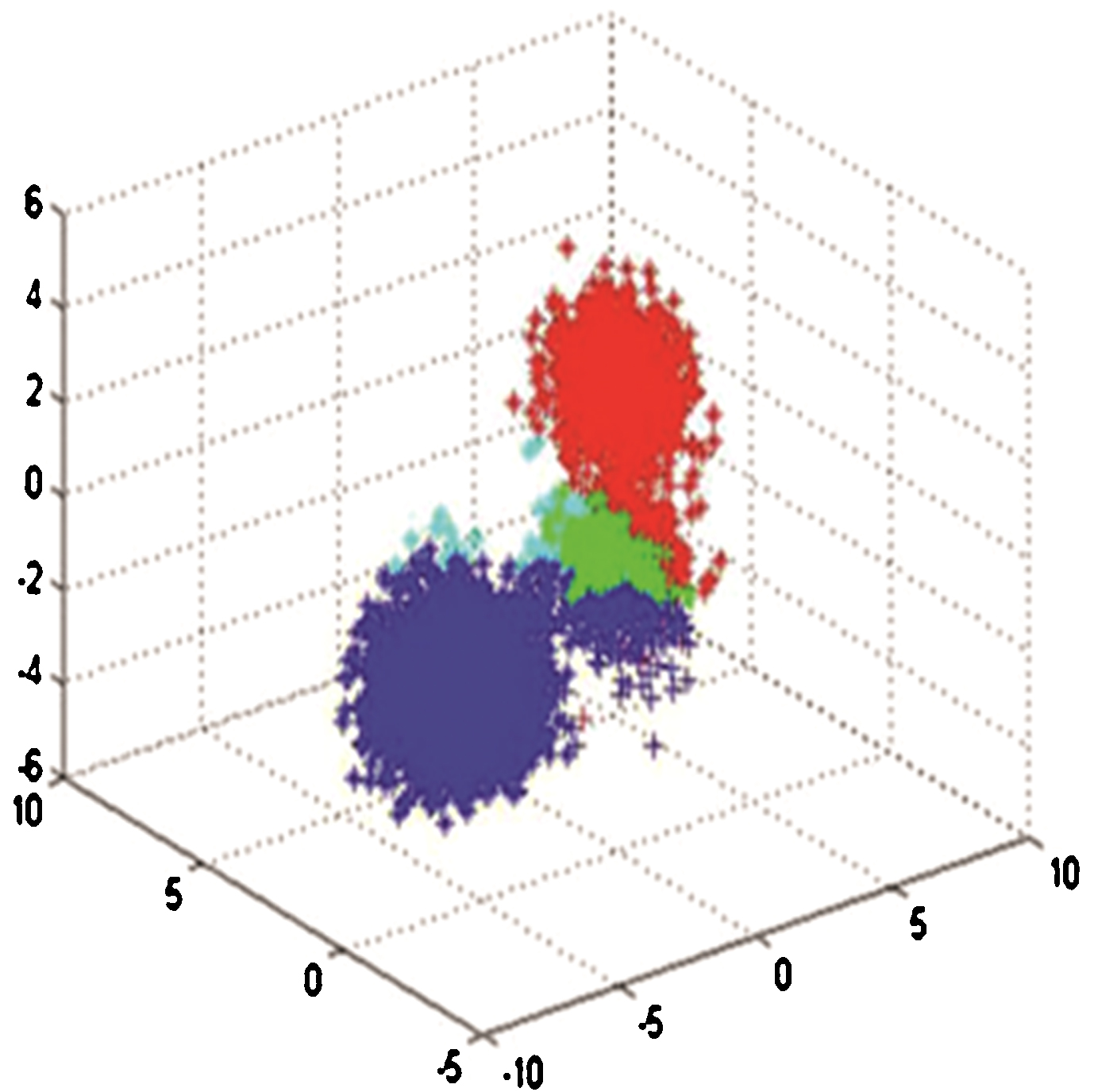
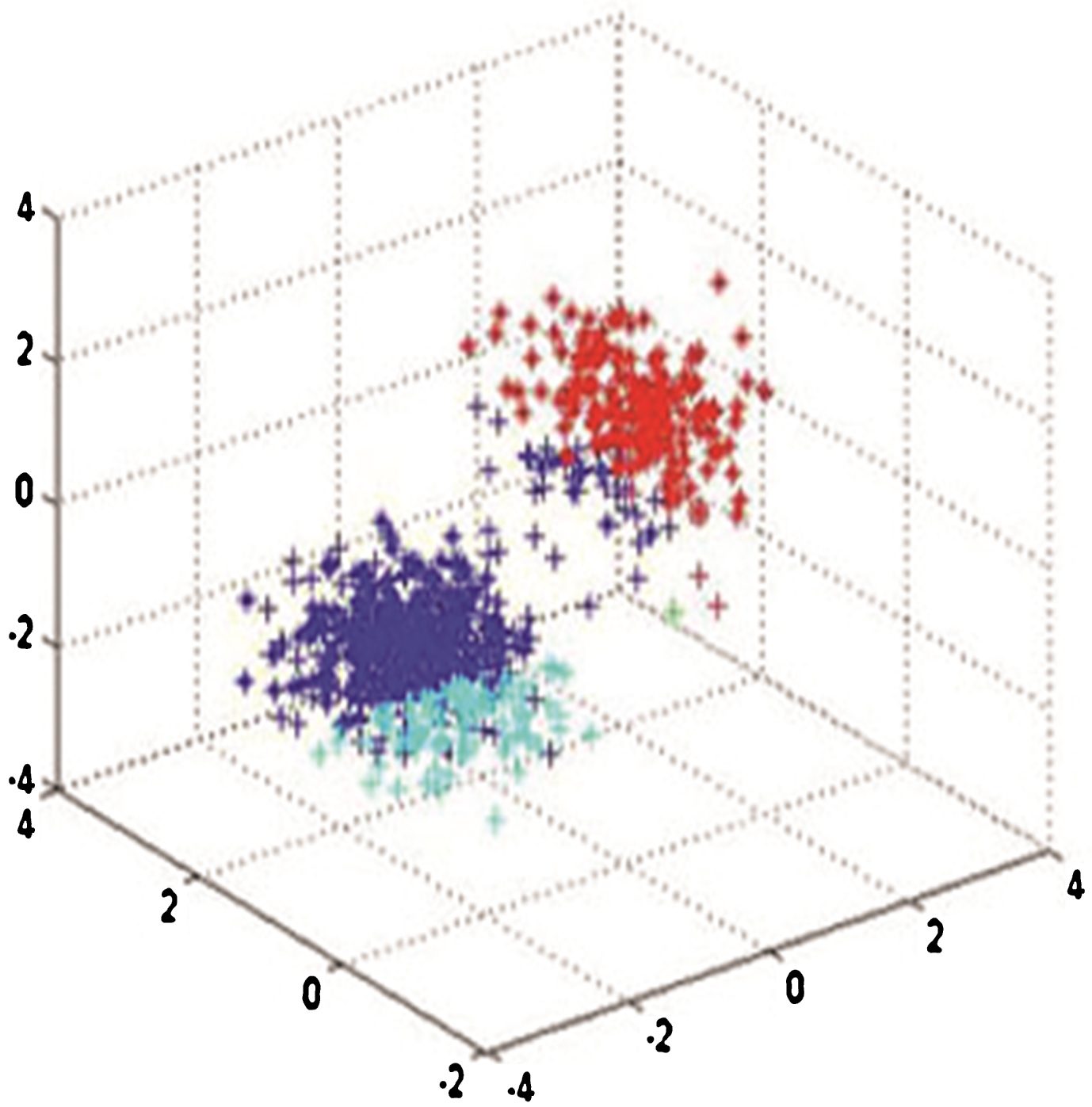
The evolutionary datastream clustering algorithm of early warning classification for cluster supply chain emergency is realized by the program under MATLAB R2012b. In online layer, emergency early warning summary data of 30 supply chains from 1 month to 12 month are clustered respectively by k-means algorithm. The clustering results are named as 1 level mass centers with weight values. 1 level mass center data from 1 month to 12 month are clustered by k-means algorithm. The clustering results are named as 2 level mass centers with weight values. In offline layer, the history clustering results are dynamically updated according to the clustering results of online’s real-time output. Datastream clustering results of early warning classification for cluster supply chain emergency of year 2013 are shown in Fig. 1. Results of year 2014 are shown in Fig. 2. These results suggest dynamic changes of the datastream clustering results of early warning classification for cluster supply chain emergency.
Clustering results of 2013 early warning classification.

Clustering results of 2014 early warning classification.
According to 2013 datastream clustering results of early warning classification for cluster supply chain emergency, the early warning intervals of cluster supply chain emergency are divided into 3 levels. The scope 1 marked by red belongs to the category of special major degree. The scope 2 marked by green belongs to the category of major degree. The scope 3 marked by blue belongs to the category of more serious degree. According to 2014 datastream clustering results of early warning classification for cluster supply chain emergency, the early warning intervals of cluster supply chain emergency are divided into 2 levels.
Datastream clustering results of early warning classification for cluster supply chain emergency of year 2015 are shown in Fig. 3. The early warning intervals of cluster supply chain emergency are divided into 3 levels. The scope 1 marked by red belongs to the category of special major degree. The scope 2 marked by blue belongs to the category of more serious degree. The scope 3 marked by cyan belongs to the general category. The current emergency early warning summary data marked by red circle is compared with emergency early warning intervals of year 2015. At the current moment, emergency early warning grade belongs to special major emergency early warning level for cluster supply chain.
The decision of emergency early warning grade.
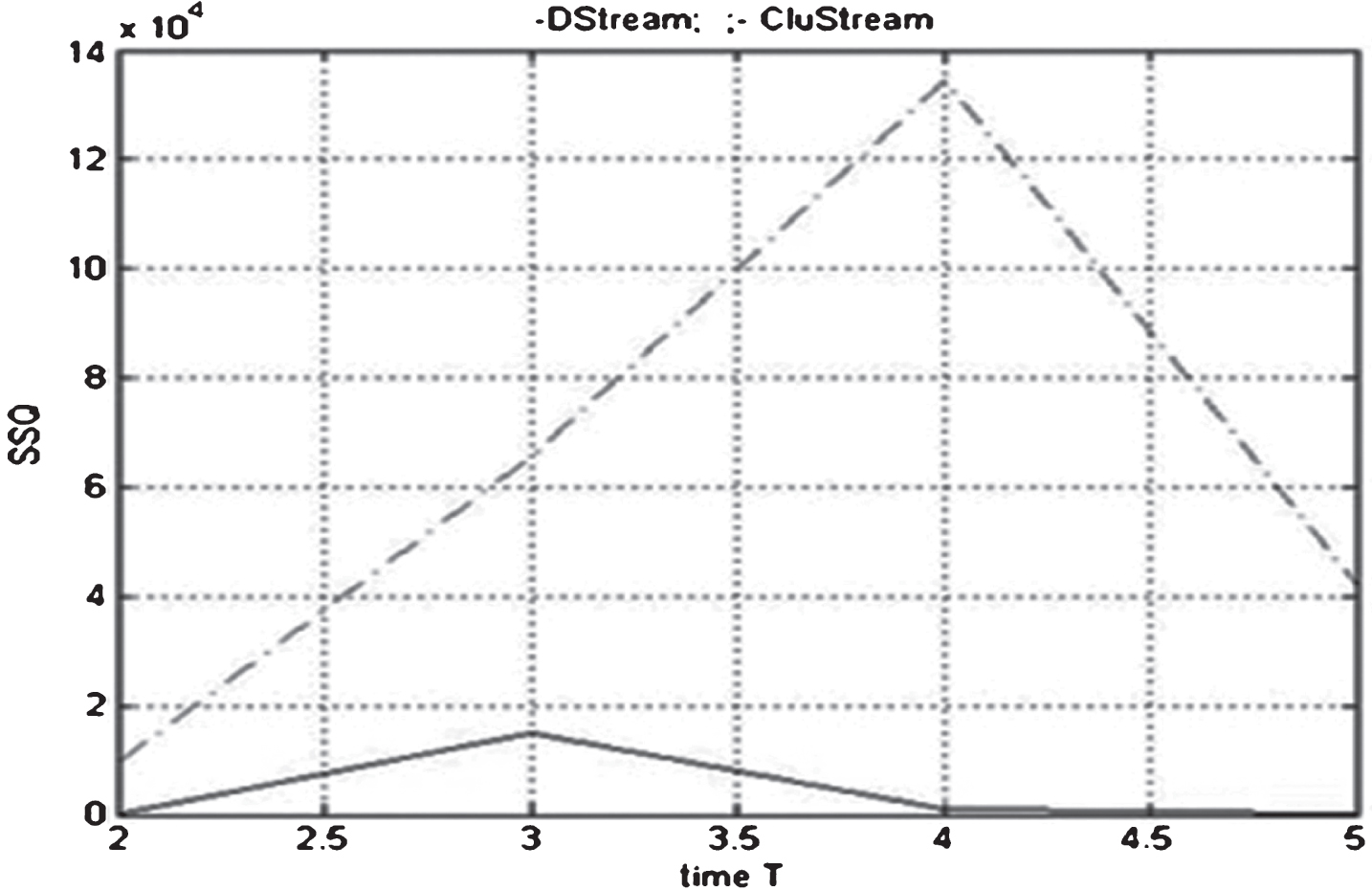
In this paper, the evolutionary datastream clustering algorithm of early warning classification for cluster supply chain emergency is named as DStream algorithm, which is based on the cloud model generation algorithm of early warning summary, time decay model and sliding window model. CluStream algorithm is used as comparison algorithm [42, 51]. The datastream clustering quality evaluation of early warning classification for cluster supply chain emergency is shown in Fig. 4. The performance comparison of the two algorithms is shown in Table 2. Clustering result qualities are evaluated by the ratio of distance squares sum SSQ and dynamic clustering correlation coefficient ρ. The results in Fig. 4 and Table 2 demonstrate that clustering effect of DStream algorithm is better than CluStream algorithm for the high-dimensional datastream and composite uncertainty characteristics of early warning classification for cluster supply chain emergency. The clustering effects of DStream algorithm have higher stability. Compared to CluStream algorithms, the DStream algorithm increases the classification accuracy by 92.6% while reduces operation time by 66.7%. The advantages of multiple data fusion and dynamic Data mining are embodied in the DStream algorithm.
Clustering quality evaluation of early warning classification.
The performance comparison of algorithms
The warning classification decision management system of cluster supply chain emergency is a complex system. The risk monitoring parameters have obvious composite uncertainty characteristics including fuzziness and randomness. The parameters change rapidly over time. This paper proposes the high-dimensional datastream evolutionary clustering algorithm of early warning classification for cluster supply chain emergency based on cloud model. The high-dimensional early warning indicator parameters of cluster supply chain emergency are fused to generate evaluation indicator clouds. The evaluation indicator clouds are merged into multidimensional center cloud droplets based on cloud computing algorithms. The center cloud droplets are as the composite uncertainty recovery small sample of the high-dimensional datastream. The generated data cloud droplets of warning summary carry important information about the original data at the conceptual granularity. The problem of evolutionary datastream clustering is considered based on time decay model and sliding window model. The datastream clustering algorithm of emergency early warning classification is a hierarchical evolutionary datastream clustering algorithm. The algorithm can dynamically generate early warning grade intervals of cluster supply chain emergency, and forecast in real time the harming degree of cluster supply chain emergency, in order to improving accuracy of emergency early warning classification and reducing the operation time and the storage space occupied. The operating safety and economic benefit of cluster supply chain are further improved.
Footnotes
Acknowledgments
This work is supported by Beijing Natural Science Foundation (No. 9162002, 9102005) and the Humanities and Social Sciences Foundation Project of Ministry of Education of China (No. 09YJA630003).