



Abstract
With the progress of modern society, human knowledge explodes, which calls for more convenient, faster and more effective methods of education. In this research, we focus on the construction of the computer aided intelligent tutoring system based on a new teaching model, and its influence on teachers’ teaching self-efficacy. Firstly, on the basis of the actual demand of ICAI system, the theoretical basis and development principle of intelligent tutoring system were expounded, and the system construction of student model and teacher model was studied. Secondly, the implementation of the quantitative assessment of cognitive ability and the teaching strategy base in DCB-ITS student model were studied and the implementation of the intelligent tutoring system was analyzed. Finally, in order to test the efficiency of the system, we carried through an empirical study. A survey to 209 college teachers was conducted, the results show that teachers who make use of the intelligent tutoring system during the teaching activities report higher scores of teaching self-efficacy, which indicates that compared with the traditional teaching model, the computer aided intelligent teaching model is of great help for teachers in making them feel more confident about teaching effectively.
Introduction
Computer assisted instruction is a modern educational teaching tool, born with more and more popular Internet applications, which subverts old teaching concepts and a single teaching model, and is a new concept of computer research [1]. With the development of society and the higher requirement of the quality of talents, it is necessary to make computer assisted instruction more popular [2]. Generally speaking, computer assisted instruction means putting all the courses in one computer. And in the course, students must study in a certain order. Although auxiliary teaching can save human resources, the shortcomings are also prominent. It is a course that requires students to understand unilaterally, and computers can’t communicate with students [3]. Moreover, the courseware is completed once, so there is no way to change the courseware in the later stage [4]. However, with the continuous improvement and popularization of Internet technology, the application of artificial intelligence has achieved great success in the field of human-computer interaction, bringing new vitality to computer assisted instruction. Today’s computer assisted instruction has been able to network and interact more strongly [5].
The use of computers in the field of education began in 1950. At that time, courseware was produced using linear programming software, in which, students can obtain new knowledge through systematic tutorials and then achieve the purpose of teaching [6]. It was not until 1960 that computer assisted instruction started to become formal, and courseware programming became a branching structure programming system [7]. The new teaching system has changed the form of teaching in the past, and the purpose of interaction with students can be achieved by using the question and answer methods. After the students answer the questions, the system judges the students’ mastery of the course content and runs the branch program from the student’s mistakes [8]. This interactive curriculum structure, in a sense, can be said to teach students in accordance with their aptitude.
The development of artificial intelligence technology is of great help to computer assisted instruction. In 1970, the technology was developed. Computer assisted instruction became artificial intelligence assisted instruction, making different kinds of artificial intelligence education systems applied in teaching activities [9]. Now, the computer assisted instruction, which is called ITS, has been able to replace famous teachers with artificial intelligence technology, and to some extent is even more advantageous than human teachers [10]. The advantage of ITS is that it focuses on the simulation level of artificial intelligence technology and the powerful computing power of computer. The characteristic of intelligent teaching is that it can provide differentiated education for students, and can be customized individually according to the students’ knowledge, so as to achieve the goal of human-computer interaction [11]. Therefore, ITS can be said to be a good teacher who understands knowledge, students and educational methods.
The two most important participants of the teaching process are teacher and student [3]. Previous studies have mostly focused on the impact of computer assisted instruction on the student side [1], the impact on teacher side has not been fully studied. Since the computer assisted instruction tool is of great help to teaching process, gives teachers more teaching options and positively influences their sense of being effective. It is necessary to find out the influencing mechanism. How does the computer assisted instruction tool exert influence on teaching process, and which part of the process is mainly influenced. Since the task of teaching is the combination of teaching technique and teaching art, and computer assisted instruction tool has freed teachers from preparing teaching material and other routine work which makes teachers pay more attention to the art part of teaching process and teaching results, and thus makes them feel more confident about teaching. In the last part of this study, whether or not the computer assisted instruction tool for teaching actually helps to boost teacher’s confidence, in other words, teaching self-efficacy is empirically tested.
Computer aided intelligent tutoring system based on DCB-ITS
The implementation principle of ICAI system
The general teaching activity refers to the communication activity between the teacher and the students at the knowledge level. In this activity, the teacher is responsible for providing information and receiving feedback, and students are responsible for feeding back information, thus constituting a teaching system. In fact, ITS technology is derived from ICAI, and to some extent, there is no difference between them [12]. DCB-ITS system can provide differentiated education for students, and of course, artificial intelligence computer aided instruction can also undertake this task. The system has been able to select different teaching contents for students according to the knowledge and information provided by the students.
The purpose of intelligent computer assisted instruction is to educate and coach students at different levels of knowledge so as to achieve individualized education [13]. So, although there are many versions of ICAI teaching model, they can be divided into four important parts: knowledge storage, teacher model, student model, and human-computer interaction.
The schema diagram for computer assisted instruction is shown below:
Student model
The student model can simulate students at different levels of knowledge according to certain procedures. Its function is to determine the students’ mastery of the relevant knowledge by analyzing the feedback information given by the students to the topic given by the computer, and then give the teaching model in accordance with their aptitude [14]. The following are common student models:
Overlay model: what is called coverage is all the knowledge systems contained in the computer. Overlay model can detect students’ knowledge surface through artificial intelligence, and then find the difference between the student’s knowledge and the knowledge covered by the model. Then the difference is what the computer is going to teach the students [15]. That is to say, the student’s knowledge surface is included in the expert knowledge surface, and the computer’s task is to make the student’s knowledge level reach the expert level.
Deviation model: the characteristic of this model is that the error information of student feedback can be described as the deviation in the knowledge base, so as to establish the student model. A bias library of deviation model is built because the overlay model can’t correct the students’ error. The library contains as many errors as possible in the student model, in order to correct the student’s corresponding knowledge errors [16]. Although many types of error handling have been included, the forms of the error are varied and can’t be all contained in the model. The deviation system can’t identify the type of deviation that does not exist in the library, so that a computer model must be used to calculate and analyze the information which can’t be recognized by the system [17].
Teacher model
This module is also called the instructor module. In fact, the ICAI system is more anthropomorphic, and can judge students’ knowledge independently through the feedback of students, so as to teach students in accordance with their aptitude, judge the students’ learning situation, continually test students’ learning, and then help students grasp the weakness of knowledge and correct mistakes [18]. This model of ICAI can understand the degrees of students’ learning, then analyze them according to their progress, and then change the course and content as well as the way of education. Therefore, the model must have comprehensive information exchange functions, teaching research, education methods and knowledge reserves advantages, as well as the selective application of teaching patterns and strategies, and so on.
Knowledge base module
Knowledge module: computer domain experts input quantitative knowledge and teaching behavior into the computer in a computer acceptable form, and establish a database combining teaching knowledge and educational strategy. In the content of teaching knowledge, a certain amount of knowledge is stored so that it can be expressed in declarative language, and there are also methods for the application and training of such knowledge [19]. ICAI pays particular attention to teaching rules that help students master and train the required knowledge. That is to say, the model includes all the relevant knowledge and the application concept of dealing with relevant knowledge. In ICAI, in addition to the requirements of the general knowledge base of the expert system, special attention should be paid to the following aspects: in the process of system teaching, the level of knowledge and teaching methods are accepted by students can be adopted. Moreover, the teaching of knowledge must be systematic and continuous, and students must be provided with a complete knowledge system and a correct knowledge application system.
System design
System overall structure design
In the system, the B/S architecture is adopted, and the architecture diagram is shown:
The system can be used both in campus networks and the internet. By deploying such a system, users do not have to download any programs and can operate directly on a web page as long as they can use basic network connections. And later system maintenance will not be very complicated. The Web server function is to provide users with actionable pages and to preserve the customer operation data, thus to facilitate the needs of users after the day. And these functions are implemented mainly through two functions, the client layer and the business control processing layer [20]. The function of firewall is to protect user’s operation data from hacker’s malicious program attack.
Functional design
In functional implementation, in addition to managing the system, computers play multiple roles, such as teachers and students. In practice, there must be curriculum, assessment, knowledge coverage, and human-computer interaction model. In the implementation model, the courseware should cover all file formats and information forms. And because of the content of the courseware, a separate category should be created. In this separate category, two different attributes of the preservation of different courseware types and the way of use should be added.
In practice, first of all, a test category must be created, including the question bank and the content of the test paper. Then, it is a professional test. The information contained in the examination questions is: examination questions, categories, creator, questions, attributes, questions, acceptance difficulty, student rights and so on. In the composition of the test paper, the question can be chosen from the question bank through the attribute.
The establishment of a knowledge encyclopedia requires different attributes as well as a separate category. Its attributes include subject information, encyclopedia name, build time, browse, type of account, number of downloads, and so on.
Modules that need to create categories also include human-computer interaction modules. The information category includes the ID of the interactive information, the delivery of the information, the recipient of the information, the creation time of the information, and the timely delivery of the information. Such information must be immediate, accepted on social software, and searchable. And in the search, the receiver is a computer.
The most important users of the computer aided instruction system are teachers and students, and they are the main beneficiaries of the system. The audiences of the computer aided instruction system are generally the one who needs to learn the knowledge and the teacher in school, and these two types of people are basic users. In addition, there are administrators and members of the system. The administrator’s task is to maintain the system and to ensure the safe operation of the system, while the task of members is to supervise the user. The function of the system module is divided into 3 grades, and the main functional information of each grade is shown in Table 2:
Computer assisted instruction system business object analysis table
Computer assisted instruction system business object analysis table
Computer-aided teaching system module function analysis table
The operation of the teacher class is on the public level, and the authority is the highest, too. It can be seen that the design of the teacher class is among the common classes.
Database is the most important step in the system design. In the design, the accurate input and output of data should be ensured, so as to help the teaching system achieve graphical assistance. Therefore, the database must be designed to meet the operating rules of the system, which will affect the whole system in the course of operation, degree of flow, operation smoothness and operation efficiency. In the construction of database, reasonable structure and operability are very important.
The function of database implementation is to enable users to browse, use, save and search data smoothly, which has certain requirements for the construction and construction of data. The general operation data of artificial intelligence graphics aided instruction system is to process the text data. In this system, Microsoft SQL Server 2.0 is used as the background database. Microsoft SQL Server 2.0 is an operating system used by most companies on most computers, which comes with graphics processing functions inside, for example, the switch function of the database, the access and management function of the database, and the parser used for interactively executing the Transat-SQ statement and graphic inquiry, etc. SQL Server 2.0 is a kind of analysis software that can provide complete e-business data processing function for enterprises and users, and the processing speed is very fast. SQL Server 2.0 is an operating system based on the Internet data background, which provides a complete data processing solution for Web users. Moreover, the use of this database is very high, and the processed data is compatible with any text information, so that the security performance of the data is guaranteed.
E-R diagram analysis.
This system can cover three types of entity operations: User, course files, and Integrableware. The system relates to two contact types: the User can operate all courseware under the permissions Courseware, which is defined as U-C; and the relationship between course documents and integrable ware is similar, defined as C-I. The E-R diagram of the system entity is shown in Fig. 7.
Key technologies and implementation of the system

E-R analysis.
The judgment and evaluation of the knowledge level in the student model: the famous experts in the field of psychology divide the teaching activities into three modules: areas of cognitive competence, motor skills and emotion. According to the degree of difficulty of different intelligence levels, cognitive ability is divided into six factors: acquisition; cognition; use; think; synthesis: assessment.
In building a student model, after accurate data representation and standard testing of cognitive abilities, through computer high-level language programs, 6 criteria for assessing students’ cognitive ability have been made in the system.
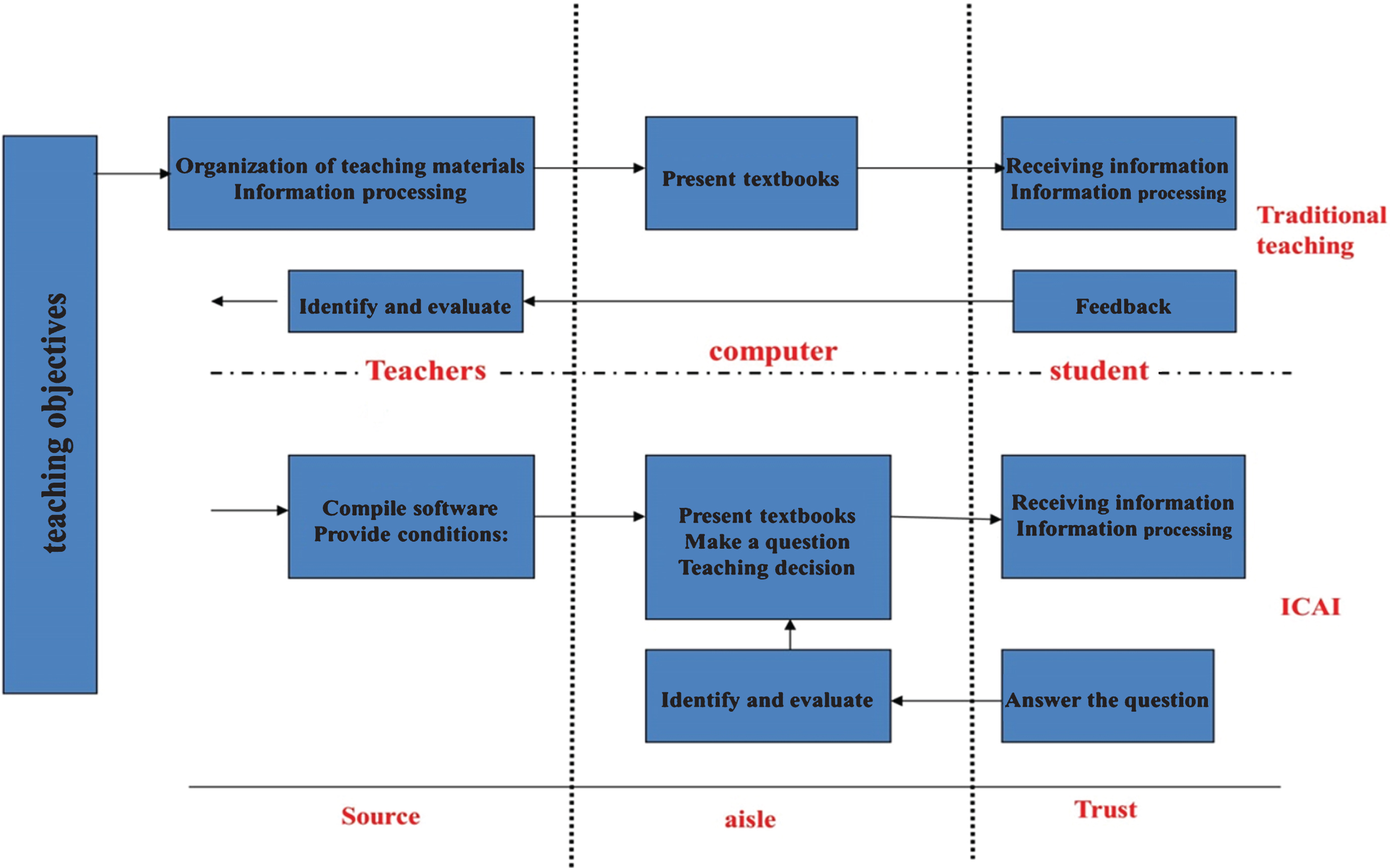
Traditional teaching system and computer –aided teaching system.

Computer –aided teaching model.

Overlay model.
g1 = “acquisition of basic grammar and textual meaning”; g2 = “cognition of basic grammar and textual meaning”; g3 = “application of basic syntax semantics in simple programming”; g4 = “program design capability”; g5 = “the correct use and basic debugging of the program”; g6 = “design capabilities for complex programs”.
g1 = 0.12,g2 = 0.13,g3 = 0.16,g4 = 0.18,g5 = 0.20,g6 = 0.21.
From the cognitive ability target, the weight matrix is:

Perturbation or buggy model.
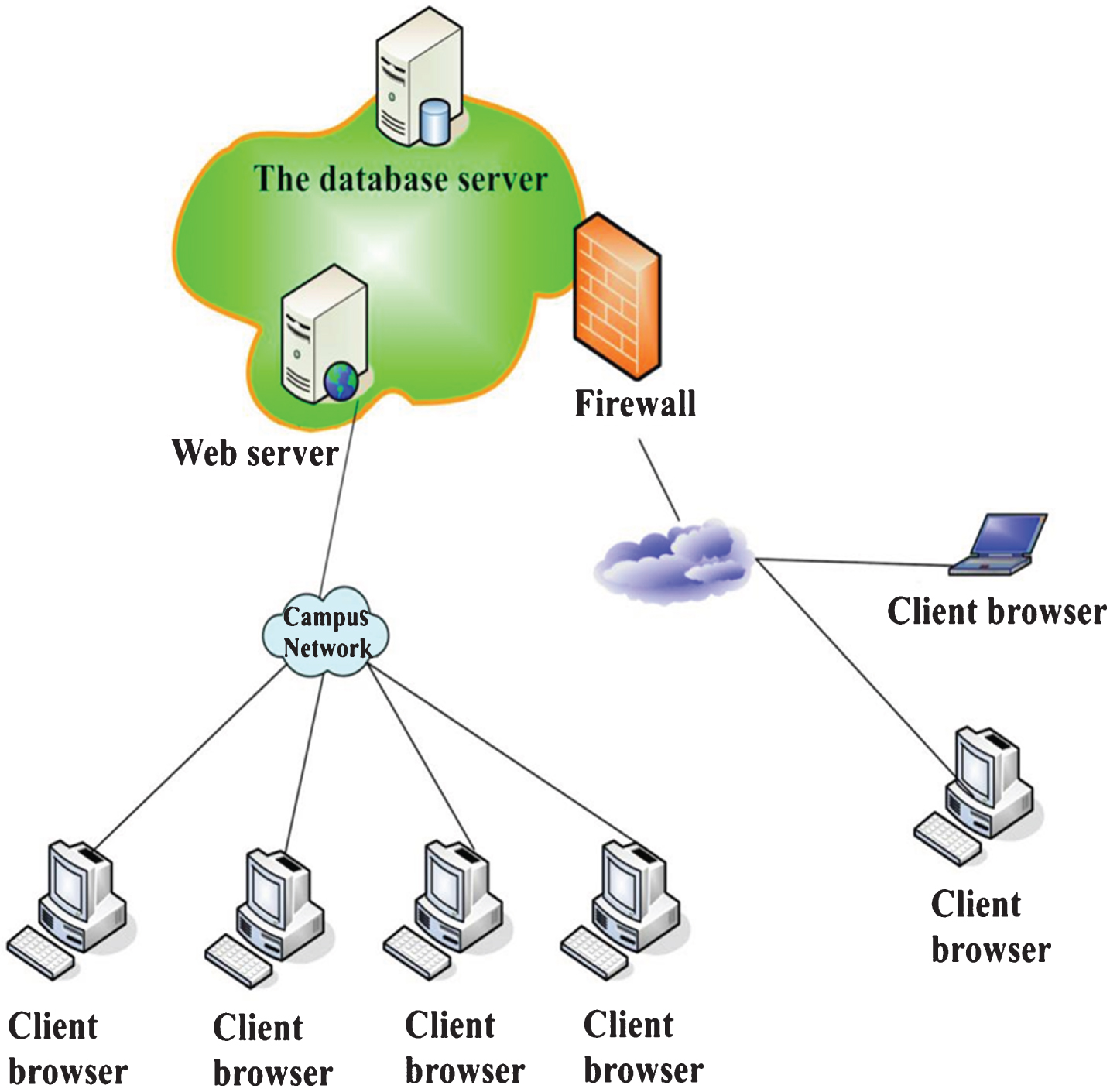
System overall structure design.

Operation area model chart.
The capability value matrix is obtained:
Calculated:
Q = G•P = 0.12×90+0.13×90+0.16×92+0.18×80+0.20×82+0.21×78 = 84.4. Then, A, B, C, D can be obtained.
A = 100.00, B = 66.67, C = 33.33, D = 0.00
According to the Q value, the grade of cognitive ability is determined, and the cognitive model is constructed by using the corresponding data structure.
Because of the different levels of students, the teaching methods are different within the unit. The teaching strategy is obtained by computer analysis: the form is 1F…… AND…… THEN…… For example, in the PASCAL language Simple Programming teaching process, its teaching objective is: basic statements are used synthetically for sequential structures, selection structures, and cyclic structure programming. The teaching rules are as follows:
1F <the basic concept of level value > = poor;
THEN<the system carries on the concept explanation, the example teaching >;
1F<basic concept horizontal value > = pass;
AND<the level of application of basic grammatical semantics > = poor;
THEN<review concepts and do grammar exercises >;
1F<the level of application of basic grammatical semantics > = pass;
AND<simple programming level values > = poor;
THEN<it is recommended to focus on programming exercises >;
1F<the level of application of basic grammatical semantics > = good;
AND<simple programming capability level > = good;
AND<the ease of content of the next lecture > = the same;
THEN<explain the next item and speed up the progress >;
Design implementation
The courseware used in the teaching and the data information used to describe the student cognitive model are stored on the Server side. Teachers can use Client to manage the course files in the cloud. Students who want to study must access to Server at the Client where multimedia equipment is available and the teacher passes. At the end of a learning cycle, the data from the student will be assigned by the program and then differentiated through a cognitive model. The supervisor is connected to the Server through the Client at the training facility and coaches and monitors the entire teaching process.
Establishment of cognitive model: the importance of ICAI is to teach differentiated education after the analysis of different data of students in the course of learning through cognitive model. The terminal will give different cognitive models according to the students’ knowledge level, and generally there are three grades of high, middle and low. Even though the teaching is the same, there are three grades because of the differences in cognitive models. When students complete a cycle of content, in order to help the cognitive model of judgment, the system will give students a certain amount of questions, and give the next course of study through the student’s answer. The implementation of computer intelligent teaching: the experts in related fields design the scheme of the system, and implement the teaching of ICAI system in an intelligent way. In this system, the corresponding rule base, fact base (learning history record) and reasoning implementation mechanism are organized, as shown in the following figure.
The influence of computer aided intelligent tutoring system on teacher’s teaching self-efficacy
Research design
The concept of self-efficacy derives from the social cognitive theory [21]. It refers to as a belief about what a person can do and how well he or she can do it [22, 23] use the concept of self-efficacy in the context of IT utilization, and defined computer self-efficacy as one’s belief in his/her ability to apply computer technology to help completing more tasks. Based on the extant literature about self-efficacy, we built the actual measurement of teacher’s teaching self-efficacy and designed the questionnaire according to the college teaching context. The questionnaire is designed as a self-report type making use of 7 Likert scale measurement tool in which Score 1 means “strongly disagree” and Score 7 means “strongly agree”. Through the test, we can obtain the actual level of ones self-efficacy.

ICAI intelligent implementation method.
In order to find the perfect testee, we got in touch with the head of human resources department of a research university. The university was under the process of undergraduate teaching reform then, taking computer technology as essential way of enhancing the teaching effectiveness. Under the help of HR staff, we went to the School of Mathematics and the School of Foreign Language, which are both responsible for the teaching tasks to all the undergraduates in the university. We conducted a survey and a experiment to test the influencing effect of the intelligent tutoring system.
Research hypothesis: teachers who make use of the computer aided intelligent tutoring system report higher level of teaching self-efficacy compared with teachers who teach with traditional methods.
First of all, in order to test the effect of intelligent tutoring system on teachers’ teaching self-efficacy precisely, we carried out a pretest to minimize the error. We made a self-report test about teaching self-efficacy to all the 209 teachers in those two schools, and selected 114 teachers with the scores 3 or 4 (the self-efficacy score of them are approximately at the same level). And then, we evenly divided them into two parts to participate in the experiment at the same time.
We conducted a survey separately to the front-line teachers in two main time points: the time before using the intelligent tutoring system when we conducted the pretest, and the time after one of the groups using the intelligent tutoring system. The selection of independent variables: in the experiment, the two teaching models were independent variables: independent variable X1: computer aided intelligent teaching model; independent variable X2: traditional teaching model. And the dependent variable was: the scored teachers’ teaching self-efficacy.
Experimental implementation steps
This experiment is divided into two parts. Teachers of the first part made use of the intelligent tutoring system, and the second part remained in traditional teaching. Before the experiment, we first test the significance of difference between these two parts. If the difference is none significant, we carried out the next step, and if the difference is significant, we regroup the two parts, to make sure these two groups are at same average level of self-efficacy before the experiment.
And then, these two groups were instructed to teach with different method mentioned above. After teaching for one whole semester, we tested the significance of difference between these two parts again to verify the actual difference of these two groups with regard to teachers teaching self-efficacy.
After this test, the teachers’ self-efficacy scores were recorded, and then the averages grade for all the teachers were recorded as
The Z test is a method for testing the difference significance between
P and |Z| relationship table
P and |Z| relationship table
The theoretical value and actual value are compared, and the related event probability is calculated. The conclusion is drawn according to the Z values and the significance of difference.
According to Table 4, the value of the pre-test Z is calculated:
Test group and control group pre-test data
Test group and control group pre-test data
Z = –0.611, because |Z|= 0.611<1.99, the difference between the two groups at the pre-test stage is not obvious.
Test group and control group after test data
Z = 5.26, because |Z|= 5.62 >1.99, the difference between the two groups after the experiment is very obvious. From the above comparison, it can be seen clearly that computer assisted instruction tool, the intelligent tutoring system is of great help in enhancing teachers’ teaching self-efficacy.
With the continuous development of computer assisted technology and the maturity of artificial intelligence, the teaching mode of computer aided instruction is becoming more and more intelligent. In this paper, the implementation principle of ICAI system was introduced and analyzed. And ICAI system can be divided into four main components: knowledge base, student model, teacher model and man-machine interface. Then the frame structure of intelligent tutoring system was designed, and the corresponding modules were built; after that, the basic functions of teaching and learning in the computer aided intelligent teaching platform, the intelligent tutoring system, were realized.
At the same time, the empirical research we conducted proves that with the help of the system, teachers who teach in the new model feel more confident about teaching effectively and widening their teaching area, in other words, the intelligent tutoring system can significantly improve college teachers’ teaching self-efficacy. The finding of this research has expanded application field of ICAI system technology from high school or lower level of education to higher education. It also verifies that ones self-efficacy can be positively influenced by information technology, enriching research in related fields.