



Abstract
Aiming at the problem that the active queue management algorithm can not explicitly control the queue length and the relationship between throughput and delay, a fuzzy information control algorithm based on Active Queue Management for digital substation communication network congestion is proposed. After packet grouping is entered into the router cache queue, the packets that first enter the cache area of the router are preprocessed, and the data packet is processed fairly by using the geometric distribution function. The combination of Smith predictive control and adaptive fuzzy control is used to compensate the network delay of packets, eliminate the negative impact of time delay on active queue jitter and delay jitter, and control congestion according to fuzzy rules intelligently. The experimental results showed that the proposed algorithm can maintain smaller queue oscillations, especially when the network conditions change. It can effectively eliminate the impact of time delay on queue jitter and delay jitter, and improve the overall performance of the network.
Introduction
The smart grid is the latest trend in the development and transformation of the energy industry in the world, which represents the direction of the future development of the power grid. As one of the important components of the smart grid, the importance of communication is becoming more and more important, and more and more problems are produced [1]. Network congestion is one of the most important problems with the development of communication network in digital substation. Since the problem arises, some experts and scholars have not interrupted the research. It has been a hot topic in the field of smart grid research [2]. There are many reasons for network congestion: for example, a large number of storage space in the network is occupied, the bandwidth available in the link cannot meet the current needs, the factors that have not been considered when designing the network congestion control mechanism, and the intentional destruction of some network users. When the network is congested, the performance of the whole link will be worse than before, and packets sent by the sending end can’t be in time or can’t reach the receiver. When the sender receives a ACK response to the receiving end, it will exceed the timeout retransmission time. c When congestion is serious, it can also paralyze the entire network and is unable to use. In the current digital substation communication network, we cannot avoid the occurrence of congestion. It is needed to control by a certain way to minimize the possibility of congestion. In this case, the research on congestion control has important theoretical significance and application value.
There are a lot of domestic scholars have achieved many achievements in network congestion information control algorithms, such as Shi et al proposed the network congestion control algorithm based on caching interaction. Through the use of routers in the network cache, it dynamically expands the buffer size and controls the transmission rate of the data packet logically. At the same time, combined with the existing network congestion control algorithm, the packet transmission rate threshold is dynamically adjusted to smooth the burst traffic and alleviate the network congestion [3]. The queue jitter of this algorithm is very large. After generating or reducing burst traffic, it will take a long time to reach steady state and stable time. Wen et al. Proposed a congestion control algorithm based on improved congestion traffic allocation. After the measure of energy consumption and transmission delay of all paths, the path of a number of low energy consumption is chosen, to detect congestion in the network area through the method of setting threshold and forecast, once the congestion occurs, it uses the way of rational redistribution of traffic to enable nodes to recover faster from congestion and ensure that the data of congestion area can be transferred to non congested area as quickly as possible [4]. The algorithm has less queue jitter and effectively improves the link utilization, but increases the data packet loss rate at the same time. Qiu et al proposed a congestion control algorithm with the ability to predict and self adjust. It is used to predict network congestion by fuzzy neural network controller and real-time prediction based on queue length in buffer. Before the congestion occurs, the sending rate is controlled by restraining the transmission rate of the input terminal, and adjusting the transmission rate dynamically by combining the incremental and decreasing parameters [5]. This algorithm is more effective for deadlock and global synchronization, but the link utilization rate is low and the delay is increased. Huang et al proposed a congestion control algorithm based on substream packet loss differentiation and sharing bottleneck. It dynamically adjusts congestion window by detecting the bottleneck of network neutron traffic sharing, and makes full use of network resources at non shared bottleneck links. When multipath transmission control protocol is applied to heterogeneous networks, packet loss differentiation mechanism is introduced to avoid wasting network resources due to non congestion packet loss [6]. This algorithm effectively reduces the packet loss rate, but performs poorly on the performance of queue jitter and average delay time.
Material and methods
Active queue management algorithm based on pretreatment
Congestion detection method
The delay jitter in the digital substation communication network generally refers to the difference between the time delay of the current time and the average delay of the network link. The congestion in the network can be judged by the change of the delay jitter and the queue length of packet grouping. It is assumed that the bandwidth of the link in the communication network is fixed value
The data traffic in the communication network of digital substation has mutagenicity. To calculate the time delay jitter, we must first calculate the average delay value. The average delay avg _ d is calculated by weighting factor Wd.
The value of the delay jitter j _ d is as follows:
In the network transmission, the time delay fluctuation determines the size of the delay jitter. The time delay jitter determines the quality of the network QoS. In order to ensure the network QoS, the queue length and the sending rate are balanced.
The real-time queue length in the buffer time assuming m router is L
m
, L max is the maximum length of the buffer to store data packets, by using Formula (1) to (3) to calculate the delay and jitter of delay jitter, if the calculated delay jitter is zero, It shows that the size of the queue length at every moment of packet grouping arrival in the cache area is fixed. So the transmission rate is v
t
, which is also fixed value and the transmission rate must be less than the transmission rate of the link. If the delay jitter is not zero, it indicates that the actual queue length reaches the buffer in the unceasing change, in order to control the sending rate to burst in a short period of time and control the network congestion, this algorithm will recalculate the queue length. If the recalculated queue length is smaller than L max/2, it indicates that the arrival rate is larger than the transmission rate. Digital substation communication network is a dynamic real-time transmission mode, burst at any time arrival will cause the router queue length buffer packet increases. At this point, it needs to adjust the transmission rate of packets as follows:
The transmission rate v
m
of the m time is generally adjusted by the delay jitter obtained from the difference between the current time delay and the difference of the preceding time delay.
Where, Lm-1 represents the real-time queue length in the m - 1 moment of the router cache, and vm-1 represents the transmission rate of the m - 1 time. The transmission rate of the packet can be increased to:
The maximum bandwidth of a network link is C″, and the maximum transmission rate of packet cannot exceed the bandwidth C″ of the network link. If the delay jitter of the network link is greater than zero, the queue length and the calculated is greater than L max/2, it can be determined as the network has occurred congestion, then the use of preprocessing algorithm [7], geometric distribution function hit algorithm [8] and the complex curve function algorithm [9] obtained the corresponding packet loss probability; when the delay jitter of the network link the queue length is less than zero, while the calculated is less than L max/2, then to reduce the sending rate of source packets:
Assuming that the network link bandwidth is C″, there are N sending ports at the source end of the link to send TCP streams, and one sending ports to send UDP streams. The destination ends have N receivers receiving TCP streams, and one receiver to accept UDP streams. b
i
is the packet size of router buffer i, p
i
is the total packet loss probability, b is the total size of all enter the router buffer packets (hypothesis there are N packets into the router cache), h
i
is the matching probability (h
i
= b
i
/b), τ is the delay TCP traffic, x
i
is the source transmission rate of traffic II, r is the packet loss probability for composite curve function algorithm. Because the hit probability accords with the Bernoulli probability model [10], assuming k packet was hit, then the hit probability is
The total packet loss probability is obtained from the direction that cannot be hit by a geometric distribution function. Assume that there are i arbitrary packets in the network link into the router cache, then any probability of a packet being hit is (1 - r) (1 - h
i
), after the n hypothesis, the first n - 1 have been hit, the n was not hit, then the probability of the occurrence is
Assuming that the network is in full link state at the time, x0 represents the source end transmission rate of the UDP traffic at this time. x1 indicates the source port transmission rate of the first TCP stream, and the transmission rate of each TCP stream is equal to that of the source port. Then:
From the above, the number of TCP adaptive traffics in the router cache is Nb1 = b - b0 = b (1 - h0). Assuming that the packet loss rate of the compound curve function is r,
Among them, max p represents the critical value of the network from mild congestion to severe congestion.
On the geometric distribution function for the hit algorithm of packet loss probability, the size of the TCP adaptive stream p p that enters the router cache is basically zero, to protect the adaptability of TCP traffic, and the fairness between various types of streams in modern communication networks is well enhanced [11].
Network congestion is detected mainly in the digital substation communication network by detecting the average queue length of packet packets, it combines the preprocessing algorithm and the geometric distribution function hit algorithm to get the packet loss probability of packets, and carries out the implementation of the corresponding packet loss strategy. The algorithm mentioned above has greatly improved in avoiding global synchronization, preventing deadlock, and continuous full queuing [12], but because max p is a fixed value, if the value is too large will make use of network congestion in mild severe packet loss strategy when the network congestion, continued in the light load state, resulting in a tremendous waste of cyber source; if the value is too small to make congestion control is too conservative, the dropping probability is smaller, the router cache queue is overtraffic, resulting in network performance is greatly reduced. In view of the network delay data packet, it uses an adaptive fuzzy control algorithm for active queue management algorithm based on fuzzy logic, combines Smith predictive control with adaptive fuzzy control, eliminates the negative impact on active queue jitter and delay jitter of the ring, and intelligent controls the congestion based on fuzzy rules (as shown in Fig. 1) [13–17].
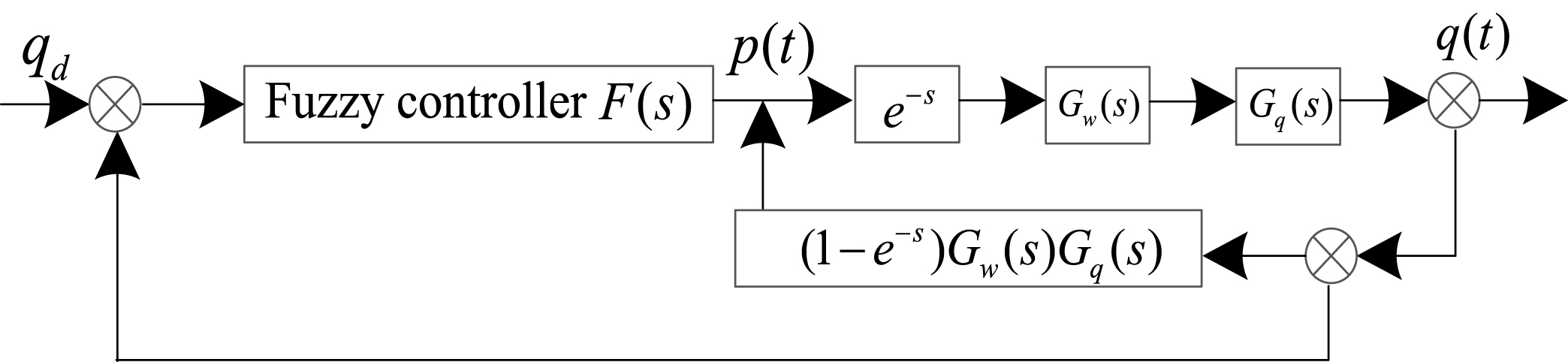
Fuzzy Smith system structure.
Among them, q
b
represents the queue length, p (t) represents a dynamic marking probability, q (t) represents the target queue length, F (s) represents fuzzy controller, e−s represents the pure time delay, G
w
(s) represents the transfer function of the sending window, G
q
(s) represents the transfer function of buffer queue length, (1 - e−s) G
w
(s) G
q
(s) represents the Smith compensation function. In the actual substation communication network, the instantaneous queue length in the router can be obtained in real time. When Q
r
is chosen as the expected queue length, the instantaneous queue length deviation e (*) and the deviation rate Δe (t) can be expressed as follows:
e (t) and Δe (t) are selected as the input of the fuzzy controller. These two inputs can strictly reflect the dynamic characteristics of the queue length change in the router. In fuzzy control system, E and Ec are used to represent their corresponding linguistic variables, respectively. Output is chosen as Δp (t) of dropping probability, and its linguistic variable in fuzzy system is Dp. In the fuzzy set, the more the elements in the set, the more precise control, but the amount of calculation will increase exponentially. In order to better respond to the speed of processing, based on the expert knowledge and experience of the designer, balance control precision and computation, the set of fuzzy sets for E and Ec here were [NB (negative big), NS (negative small), ZE (zero), PS (positive small), PB (positive big)], for the convenience of calculation, the membership degrees of the fuzzy sets are all triangular functions, Q E is queue length of the quantized domain. The control rules of the fuzzy controller are given by using Table 1.
Control rules for fuzzy controllers
According to the fuzzy rules above, the relationship between the input and output of the fuzzy system can be expressed as follows:.
Among them, y−η represents the central value of the fuzzy set of the “then” part of the η fuzzy rule, and u l (e) represents the membership function of the fuzzy set η.
For two-dimensional fuzzy controller, its control parameters include quantization factor k
e
, k
c
and the scale factor k
u
. When the network parameters change, the gain of fuzzy logic controller can be adjusted to counteract the influence of the change. When the number
Among them, OV and RT are the overshoot and rising time of the system response, respectively. The deviations of OV* and RT* are RT* and e RT , respectively. When the number of network connections increases, the overshoot will increase. At the same time, the control behavior should be increased. Otherwise, the control behavior should be reduced. When the link capacity increases, the overshoot will decrease, so the control behavior should be reduced. The correction rules for specific parameters are as shown in Table 2. The changing intervals of these rules are [- c i , c i ] and [- d, d], in which Δc i and Δd denote the increase or decrease of c i and d,respectively.
Regulation rules of ratio coefficient
The Δc
i
and Δd can be calculated by the above rules and the simplified fuzzy reasoning, so the parameters of the fuzzy controller can be adjusted according to the formula as follows:
Among them,
Among them,
He control amount can be calculated from the control increment of the k time:
In the evaluation of congestion control algorithm, the following performance indicators were compared to evaluate the performance of the algorithm: the average queue length, queue jitter, throughput, packet loss probability and queuing delay. The queue length is basically proportional to the queuing delay. In general, network latency is composed of two parts: transmission delay DTimei′ and queuing delay ETimei′. The “dumbbell” topology is used in the simulation, the transmission delay is generally unchanged, and the queuing delay on the bottleneck link is mainly observed. The transmission delay of the packet in the network is constantly changing, and the queue length jitter affects the queuing delay and the transmission delay of the whole packet. For some substation communication real-time services, the effect of queue jitter on QoS is more obvious. The queue jitter should be reduced as far as possible, and formula for calculating queue jitter by standard variance is as follows:
Among them, n′ is the total number of packets that are transmitted within the sampling time.
Among them, DD represents the queue jitter,
Effective throughput is another important indicator of the performance of the evaluation queue. Effective throughput refers to the total byte of all the actual data transmitted through the queue in the unit time (sampling frequency), rather than the total byte of all the packets. As the following formula:
Where, df represents the total byte of the unit time transmission, and t′ represents the sampling time.
Packet loss rate will reflect the actual loss of algorithm packets, and the utilization rate of links is directly related to the efficiency of network transmission. They are all important evaluation indicators. As the following formula:
Where, the DB represents the packet loss rate, g represents the bytes discarded by the queue, h represents the byte of the queue. LL represents link utilization, f′ represents the bytes sent by the bottleneck link, and e′ represents the maximum bytes that the bottleneck link allows to send.
In order to balance throughput and delay, achieve high throughput transmission and maintain smaller queuing delay, a custom evaluation parameter c′ is set. The parameter is the ratio of effective throughput to queuing delay in unit sampling time. The larger the c′ value, the better the algorithm. It means that the throughput is larger under the same throughput or with the same delay.
The method of taking the average value is adopted for the overall evaluation of the algorithm, and the formula is as follows:
The network congestion control algorithm for interactive cache queue based on jitter is very large from the experimental results. After increasing or reducing burst traffic, it will reach steady state only after 80 s, and the stability time is relatively short, 130 s to 175 s achieves a relatively stable state. The instantaneous performance of the algorithm is poor. It dynamically adjusts the congestion window by detecting the sharing bottleneck of the network neutron traffic. The average queue length and jitter of the corresponding queue are relatively large, the average queue length is 500pkts, and the jitter is 380pkts. The average queue length of the network congestion fuzzy control algorithm based on active queue management is 410, which is very close to the expected queue length. The jitter of the queue is only 50, indicating that the algorithm is stable and robust. The minimum queue jitter based on improved congestion traffic allocation congestion control algorithm is 100.85. The queue length of the algorithm under burst traffic is changed as shown in Fig. 2.
Queue length of different algorithms under burst traffic.
The average packet loss probability of the network congestion control algorithm based on cache interaction, the network congestion control algorithm based on improved congestion traffic allocation and the network congestion control algorithm with self adjustment ability is lower. The packet loss probability of the network congestion fuzzy control algorithm based on active queue management is the least, and the basic stability is about 2%. The packet loss probability of the burst traffic algorithm is shown in Fig. 3.
The packet loss rate of different algorithms under burst traffic.
Analysis of the results of the burst traffic experiment
Table 3 showed that the average queue length of the network congestion fuzzy control algorithm based on active queue management is the closest to the expected queue length, and the error is minimal; compared with other algorithms, the queue jitter and average delay time is minimum and the evaluation parameters of the highest; it is proved that fuzzy congestion control algorithm based on active queue management with fuzzy control mechanism can effectively control queue length and jitter in the burst traffic experiment, balance the relationship between throughput and delay, and improve the performance of the algorithm as a whole. Because the concept of fuzzy control mechanism is introduced, the network congestion fuzzy control algorithm based on active queue management is superior to other network congestion control algorithms in queue shaking, link utilization, average delay, average packet loss probability and overall evaluationparameters.
Because of no congestion control mechanism, the non response traffic cannot reflect the network congestion, which makes some algorithms fail. Although the current UDP traffic in the network only accounts for 10% –20%, the non response traffic is an important research topic to ensure network stability. In the experiment, 50 sets of FTP connections are also set as background traffic. In the 80 s, 50 groups of UDP connections are opened to send CBR traffic, and all UDP connections are closed at 240 s. UDP connections are also divided into 5 categories according to the delay. The results of the non response traffic experiment are shown in Table 4.
Analysis of experimental results of non response traffic
Analysis of experimental results of non response traffic
The results of different congestion algorithms in the non response traffic experiments are summarized in Table 4, and the following conclusions are obtained.
The average queue length and the expected length error of the network congestion fuzzy controlalgorithm based on active queue management is small; compared with other algorithms, minimum average delay, it has the lowest queue jitter and average delay, and the highest evaluation parameter, effective throughput and link utilization rate. It is proved that the proposed algorithm is stable,timeliness and effective for non response flow control, and ensures high throughput and link utilization.
Analysis of the results of the short life traffic experiment
Analysis of the results of the short life traffic experiment
From Table 5, the results of different algorithms in short life traffic experiments are summarized, and the following conclusions can be obtained.
The average queue length and expected length error of congestion control algorithm based on cache interaction is less than that of congestion control algorithm based on sub-traffic packet loss and shared bottleneck.; compared with the other algorithms it has the minimum queue jitter and average delay and the maximum packet loss rate. In terms of the overall evaluation parameters, the effective traffic throughput, link utilization and evaluation parameters of the network congestion fuzzy control algorithm based on active queue management are the largest. It is proved that the fuzzy congestion control algorithm based on active queue management has improved the queue length, queue jitter and overall performance under short lifetime traffic compared with other network congestion control algorithms.
The performance of the proposed network congestion control algorithm based on active queue management is verified by experiments. Three experimental results clearly showed that the algorithm can effectively control and stabilize the queue length in the expected queue, and the jitter of the queue is relatively small; by introducing the fuzzy control mechanism, it ensures the throughput and delay time to reach equilibrium, and optimizes the shortcomings of the network congestion control algorithm of the original queue management, it is proved that the improved algorithm has the advantages of high efficiency, robustness and stability.
Three experimental results showed that compared with other relative algorithm of network congestion control algorithms, the proposed algorithm has been improved the performance parameters and improved the defects of timeliness and efficiency of the performance of network congestion control algorithm based on active queue management, which has good timeliness and efficiency.
Conclusions
With the further research and application of active queue management algorithm, most of the algorithms are rely on intuitive heuristic design, which is blind and one-sided. Most algorithms do not analyze the algorithm itself in a comprehensive and systematic way. Aiming at the problem that the active queue management algorithm can not explicitly control the queue length and the relationship between throughput and delay, a fuzzy control adaptive virtual queue algorithm is proposed. The algorithm is implemented in network simulator NS2, and the stability and robustness of the network congestion fuzzy control algorithm based on active queue management is verified through experiments compared with other algorithms. Aiming at the problem that the active queue management algorithm cannot update the reasoning rules dynamically, the fuzzy control mechanism is introduced into the active queue management algorithm, and an active queue management is proposed. The experiment proves that the network congestion fuzzy control algorithm based on active queue management has a timeliness and effectiveness in updating the rules.