



Abstract
Inclusion of renewable energy resources with existing conventional generation resources summons revisit to optimization methods used in the field of generation scheduling. The Unit Commitment problem in itself is a highly convoluted problem governed by complex time varying constraints. It gets even more complicated when additional constraints are added due to inclusion of renewable generation backed up by battery storage system. An effort has been made in this paper to improve the model for solving the Unit Commitment problem of conventional thermal generation in conjunction with renewable energy based generation system with storage. A hybrid artificial intelligence based multiple stage solution methodology is envisaged to provide a techno-economical optimal solution to the problem. The proposed methodology provides economically better solution to the Unit Commitment problem of ten thermal generators when integrated with battery supported wind and solar generation. The overall operational cost gets reduced due to integration of renewable resources which gets further reduced by incorporating battery with a novel optimized charge/discharge scheduling technique.
Keywords
Introduction
The advancements in green energy technology have taken hikes during last three decades, even though the increasing energy demand across the world can’t be met alone by renewables in coming future [1]. This critical aspect warrants an optimal generation scheduling scheme, where conventional thermal generation works in conjunction with renewable energy resources (RERs) in order to satisfy prevailing demand.
The Wind Energy Resource (WER) and Solar Energy Resource (SER) are preferred over other RERs as they are more sustainable, cleaner and cheaper [2–5]. The wind speed and solar radiation alter significantly over 24 hours leading to intermittency in output power of RERs. This intermittent nature brings in load dispatch problems in the Grid. This problem can be circumvented up to an extent by implementing Battery Energy Storage (BES) in conjunction with RERs [6]. The battery storage is preferred over other storage systems as it has demonstrated its dominance due to techno-economic benefits involved in high storage applications[7–13].
The Unit Commitment Problem (UCP) is a highly intricate non-linear optimization problem steered by multiple constraints. Combinations of the variety of available generation resources need to be designated optimally in order to achieve the overall optimized cost of generation while meeting the prevailing demand. The problem becomes more complex when RERs with BES are imbibed in UCP model [14, 15].
In order to solve the complex UCP, three cases have been conceived in this paper. In Case One, the prevalent demand gets satisfied by only thermal generation. In Case Two, the demand gets satisfied by thermal generation in conjunction with RERs (without battery). In Case Three, the demand gets satisfied by thermal generation in conjunction with BES integrated RERs. In the third case, the BES integrated RERs generation scheduling is interwoven asa co-optimization problem.
Problem formulation
The objective of the study is to obtain most economical operating schedule of thermal generation for all the three cases narrated above. The operating costs of RERs and BES are neglected. Thus the objective function of the problem is to minimize the overall operating cost of thermal generation for 24 hours in this new environment [14, 15].
Where,
U ih is the ON/OFF status of the i th unit at h th hour.FC i (P ih ) is the fuel cost of i th unit with power output (P ih ) at the h th hour and SC i is the start-up cost of i th unit.
FCi is a quadratic polynomial with coefficients a
i
, b
i
and c
i
. It is represented by Equation (2).
SC
i
is given by Equation (3).
Where,
H
sc
is the hot start-up cost, C
sc
is cold start-up cost. Cs
i
is cold start-up hours,
The particulars of thermal generators and day ahead load profile is given in Appendix 1 and Appendix 2 respectively.
The constraints of UCP considered here are as follows.
(i) Power Balance Constraint
The power balance constraints for Case One, Case Two and Case Three are given as Equations (4a), 4(b) and 4(c) respectively.
Where,
P
ih
is the thermal generation (MW) of i
th
unit at h
th
hour, Prer
h
is the hourly generation from RERs (MW),
(ii) Spinning Reserve Constraint
(iii) Generation Limit Constraint
(iv) Minimum up time Constraint
(v) Minimum down time Constraint
(vi) Initial Status
It is the initial down time status that is required to be considered in the first hour of scheduling. The data regarding thermal generating units and load profile is taken from [14, 15].
In RERs model the hourly wind power generation can be calculated from Equation (9) [14, 15].
Where,
V3, V2 and V1 are the Cut out, rated and Cut in speeds respectively, for the wind turbine [17]. Vw
h
is wind speed in Hovsore (Denmark), the turbine height is taken as 80 meters [16]. The function ξ (v
w
h
) determines wind to energy conversion. Pw
n
is the rated power of wind generation plant taken as 500 MW. ξ (v
w
h
) can be expressed by Equations (10–12) [14, 15].
Where,
k
o
and k1 are constants given as Equations (10–11).
The hourly solar power output can be calculated by Equations (13–14) [14, 15].
Where,
s
h
is the hourly forecasted solar radiation, sstd. is solar radiation in standard environment taken as 1000 W/m2 and R
s
is the cut-in radiation point set as 150 W/m2 [14, 15]. P
sn
is maximum generation capability of solar system taken as 500 MW. The data regarding radiation is provided in Appendix 3. The total available hourly RERs power output can be represented as Equation (15).
Prer
h
is optimally utilized for Case Three as Equation (16).
Where,
The Lead-acid battery model has been considered whose charging and discharging are explained with the help Equations (17–24) [18, 19].
The State of Charge (SOC) of battery during charging process is given as Equation (17).
Where,
is the hourly self-discharge rate taken as 0.02%. C
b
is battery capacity taken as 200 MWh. Δh is taken as 1.η
h
is charge efficiency factor given as Equation (18).
Where,
y, z and I0 are the parameters depending upon working conditions of battery. The battery charging current
The battery discharge process is computed as expressed in Equations (20–21).
Where,
P h BD is battery power discharged to the Grid.
Meanwhile, the charged quantity of the battery is subjected to following constraints [18, 19].
and,
Where,
k = 1 for charging and k = 0 for discharging.
Where,
DOD is Depth of Discharge, taken as 30% [18, 19].
The battery terminal voltage
Where,
A four stage solution methodology is formulated for solution of UCP. In First stage, the ON/OFF schedule of thermal generators is obtained by Priority List Method (PLM). In second stage, the Economic allocation of load among thermal generators is done by Particle Swarm Optimization Technique with Time Varying Acceleration Coefficients (PSO_TVAC). The combination of PLM with PSO gives better results as against the other techniques used in solving thermal UCP [20]. In Case Three, the hourly generation from RERs is calculated and load demand is updated by subtracting hourly RERs generation from day-ahead load profile, which again gets satisfied by stage one and stage two processes. In fourth stage, BES integrated RERs generation scheduling involving charge/discharge of battery is solved as a co-optimization problem.
An incremental cost based novel analytical method is devised to solve this co-optimization problem. The BES integrated RERs hourly generation schedule is subtracted from the day-ahead load profile to obtain updated load profile. It can be explained from the below Fig. 1.
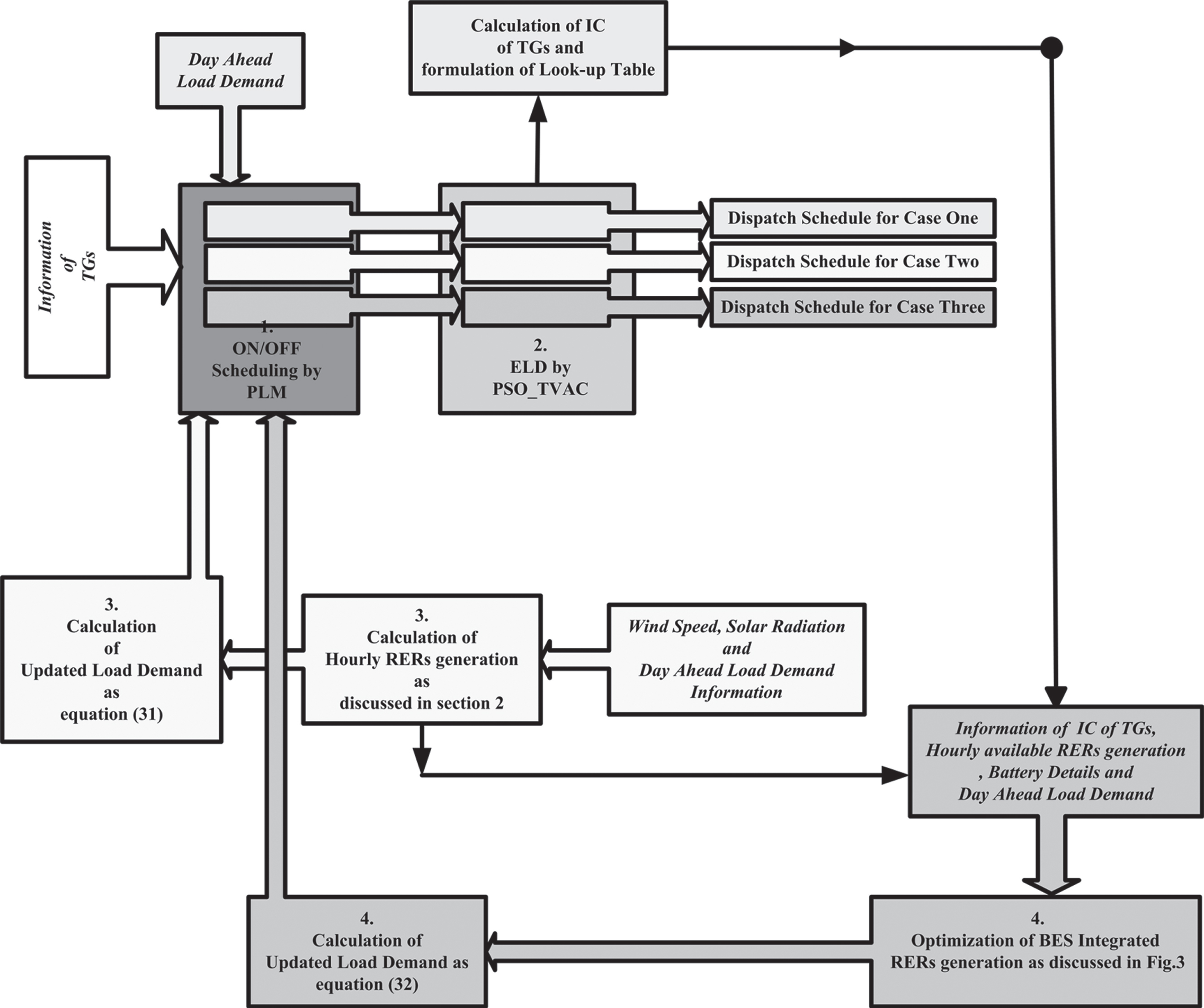
Schematic representation of solution methodology.
The initial priority vector is obtained as Equation (25) [21].
This initial priority vector is updated with the help of the pseudo code as Fig. 2 [21].
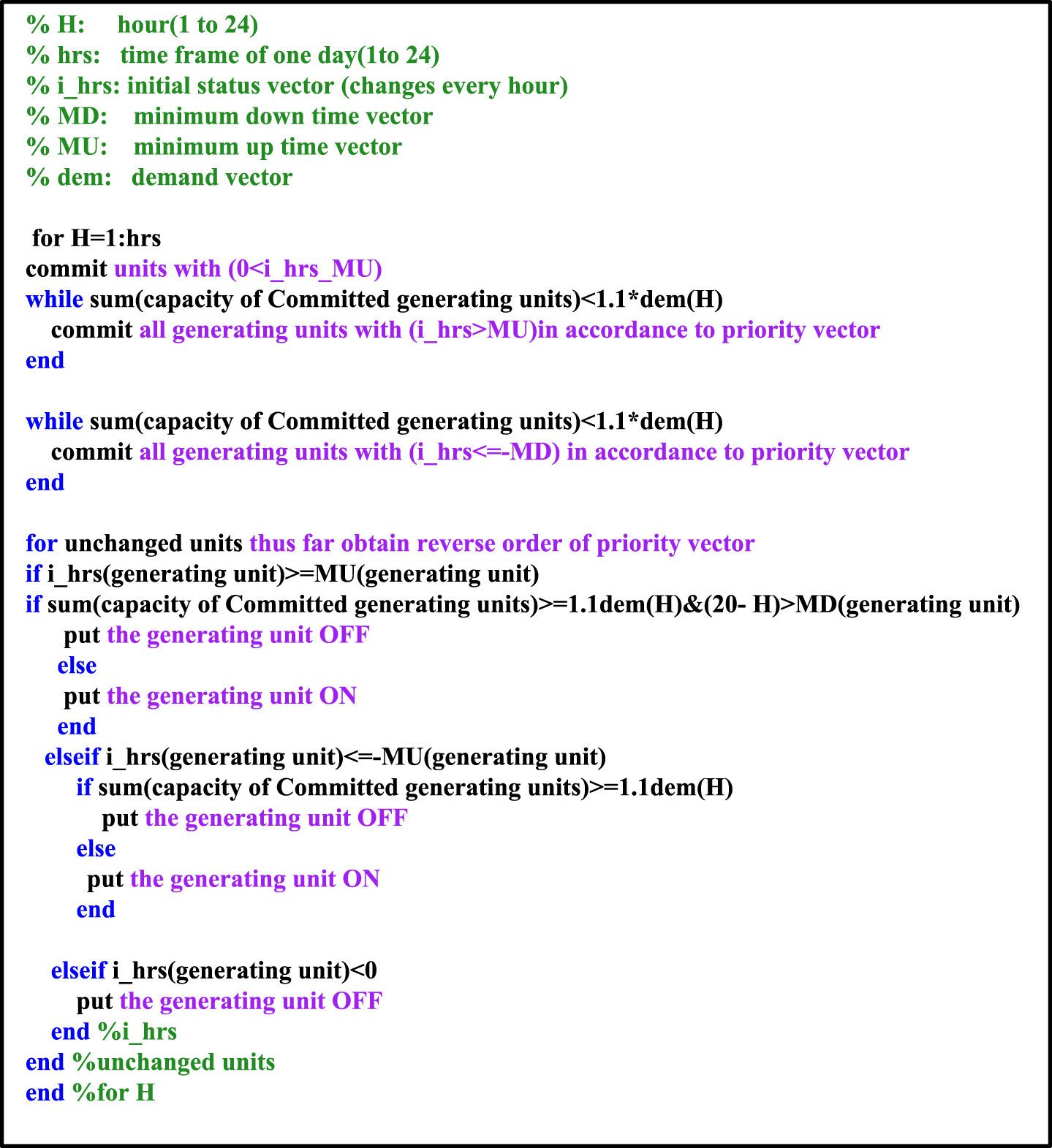
Pseudo Code.
The PSO_TVAC can be expressed as Equations (26–30) [22]. The velocity and position updates of particle are given as Equations (26–27). The linearly varying ω and acceleration coefficients c _ 1 and c _ 2 are given as Equations (29–30).
Where,
The velocity limits and PSO_TVAC parameters are taken as [22].
Hourly RERs generation is calculated as discussed in section 2. The updated hourly demand () gets updated as Equation (31).
The stage four optimization process is explained with the help of Fig. 3 and Equation (32). From the Fig. 3 the information about renewable power direct dispatch to grid (
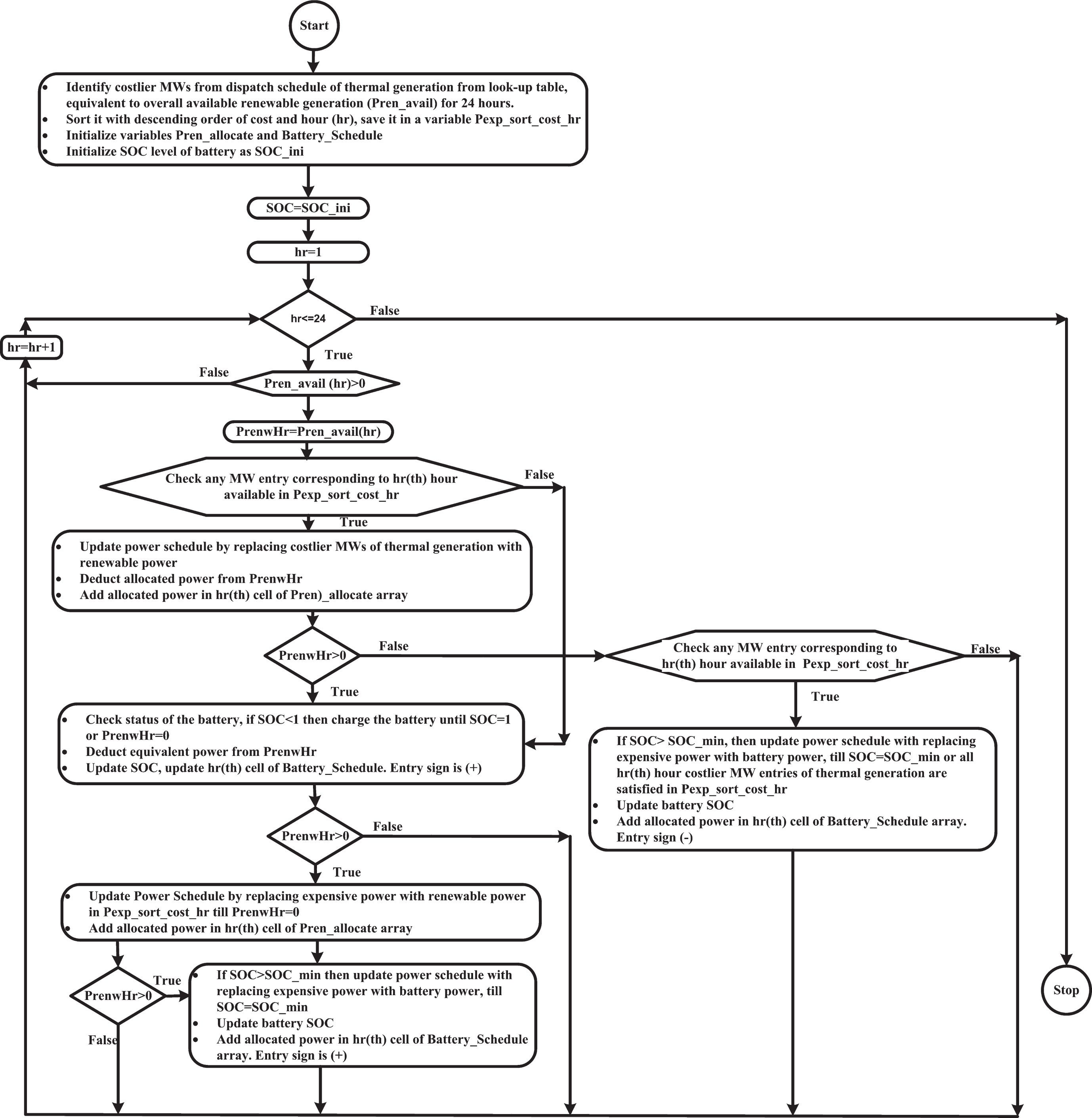
Optimization of BES Integrated RERs Generation Scheduling.
The is satisfied by stage one and stage two processes to obtain final dispatch schedule for Case- Three.
The ON/OFF and dispatch schedules obtained from stage one and stage two for all the three cases are shown in Fig. 4. The ON thermal generators are indicated as symbol “G” and corresponding MWs generation is given adjacent to it.

ON/OFF and Dispatch status of Thermal generators.
There are three rows associated with every hour, the first row indicates the prevalent demand satisfied by only thermal generation. The second row indicates the prevalent demand getting satisfied by thermal generation along with RERs. The third row indicates the demand getting satisfied by thermal generation in conjunction with BES integrated RERs.
The comparison of generation costs for all the three cases and the result obtained from co-optimization process are given in Tables 1 and 2 respectively.
Comparison of Generation Costs for all the three cases
RERs direct dispatch and battery charging/discharging schedules
The hourly available RERs generation is shown in Fig. 5.
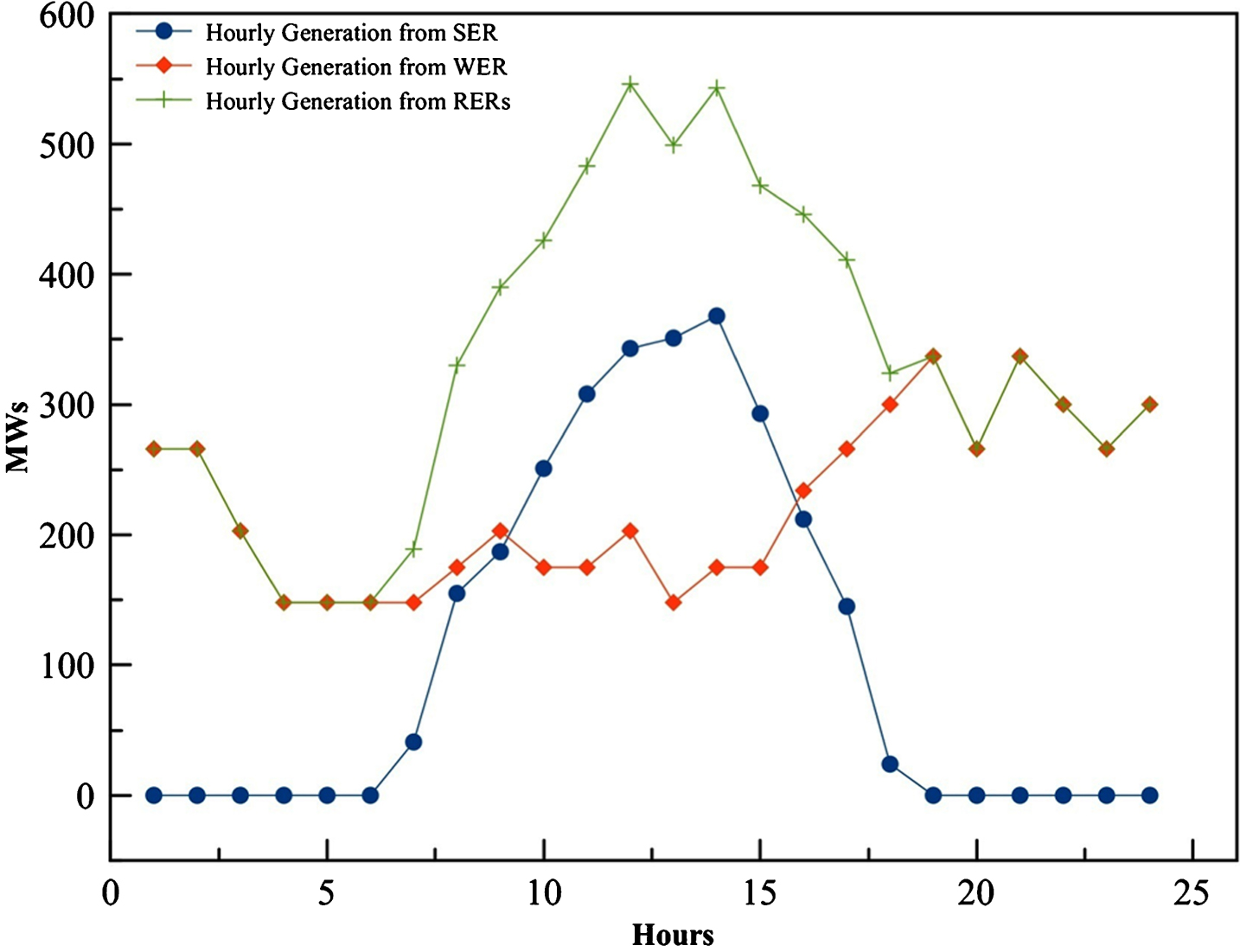
Hourly Generations from RERs (Case Two).
The optimized generation scheduling of RERs is shown in Fig. 6.
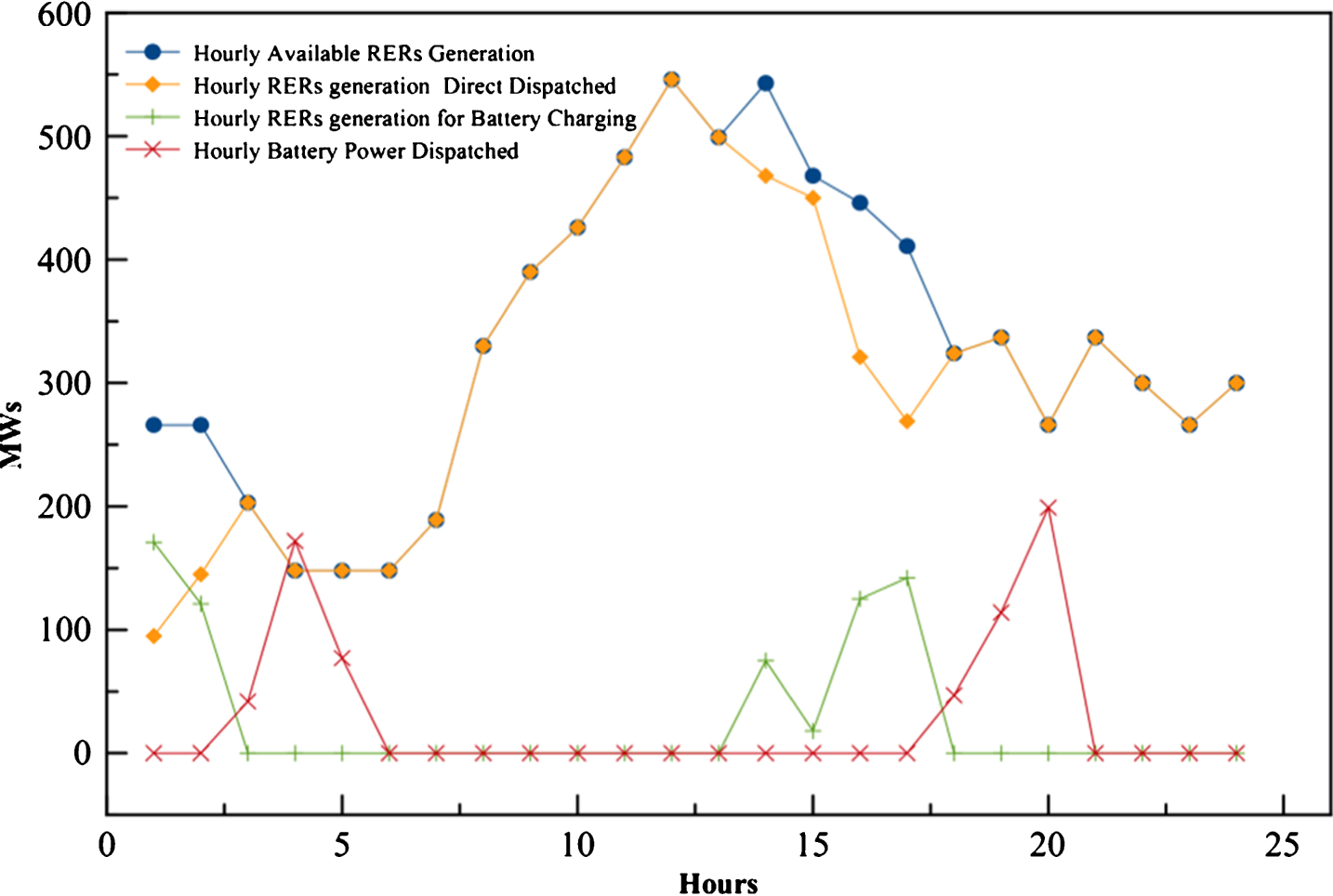
Hourly Generation from BES integrated RERs (Case Three).
The hourly updated SOC of battery is shown in Fig. 7.

Hourly SOC level of Battery.
The thermal generation schedules obtained from stage two for all the three cases satisfying the corresponding load demands are shown in Fig. 8.
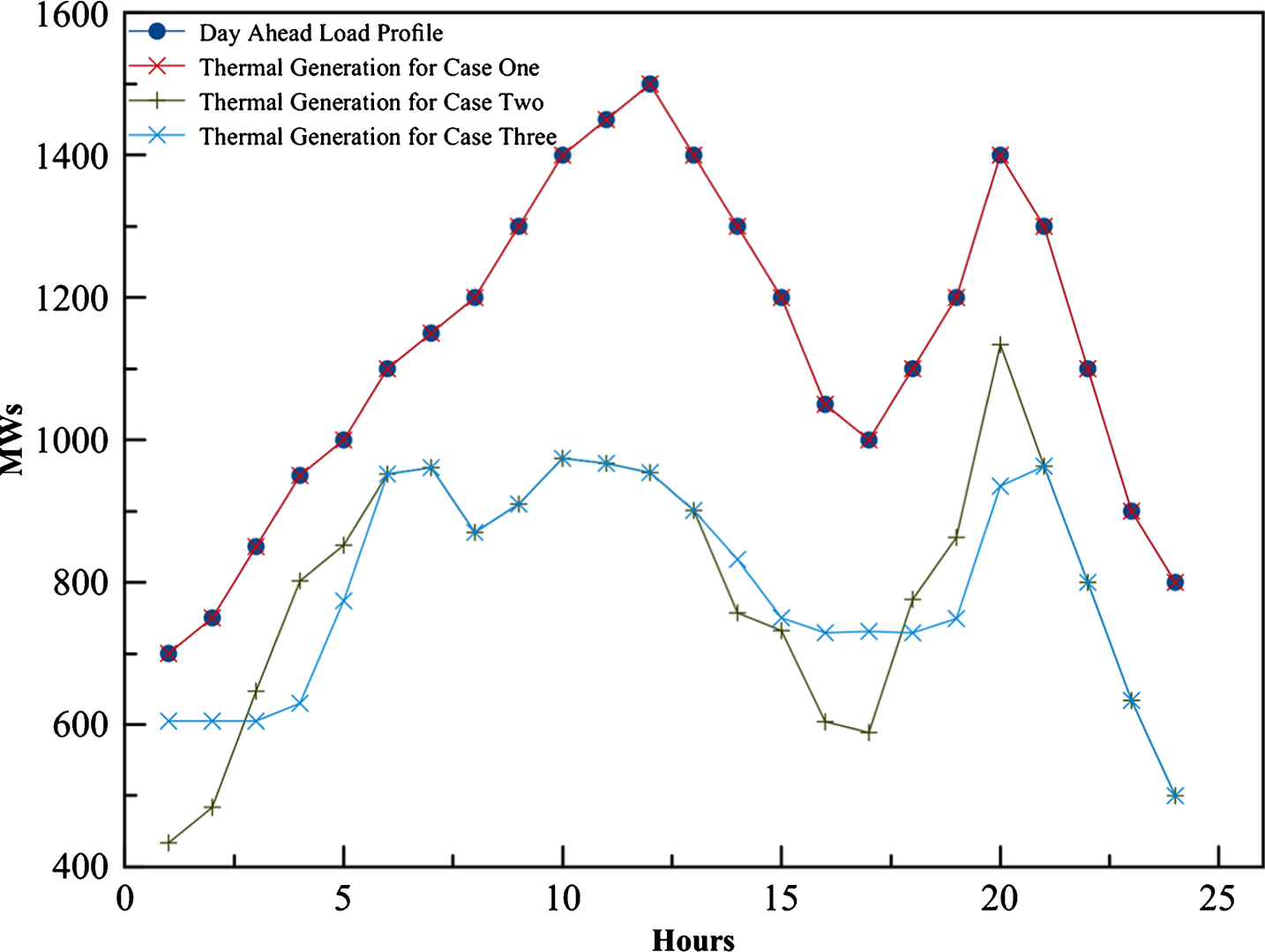
Thermal Generation for all the three cases.
The convergence of the proposed method for all the three cases is shown in Fig. 9.
It is evident from Fig. 4 that out of ten available thermal generators nine contributed to cater the prevalent demand for Case One, five thermal generators are sufficient to cater the demand for Case Two and only three thermal generators are required to cater the demand for Case Three.
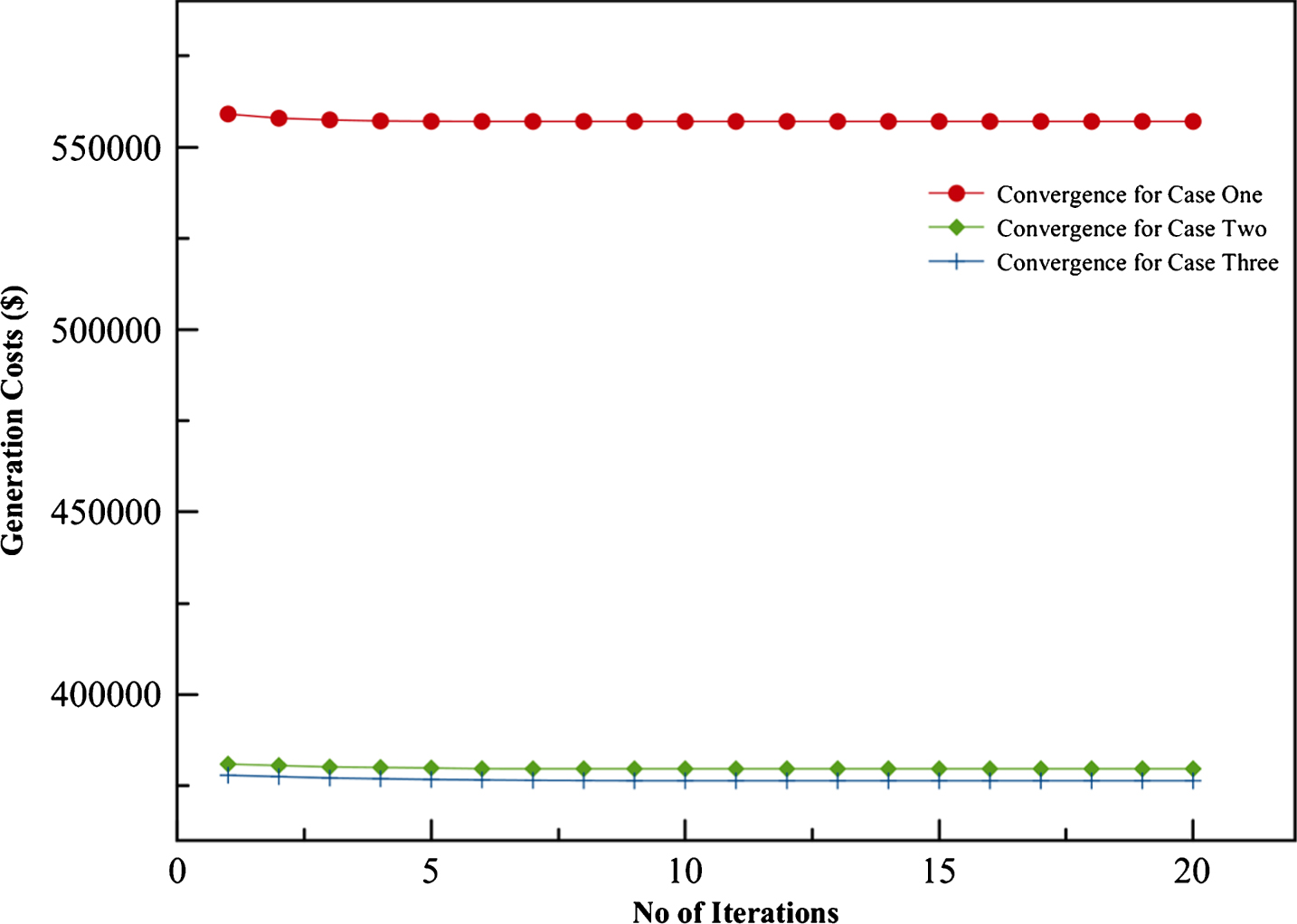
Convergence for all the three cases.
It is culminated in Table 1 that the overall operational cost of thermal generation is minimum for Case Three. The peak load shavings achieved from Case Two and Case Three are shown in Fig. 8. The proper scheduling of battery with RERs for Case Three has provided the lowest operational cost for thermal generation as the expensive thermal generation is relieved by battery power during peakload hours.
The entire study has been carried out in MATLAB environment with system specifications as 4 GB RAM, Intel core processor. The execution time of the program is 45 seconds.
A widely accepted PSO technique with time varying acceleration coefficients, hybridized with classical Priority List Method and analytical method based on incremental cost of thermal generators has been considered in this paper for obtaining optimal solution for thermal generation Unit Commitment Problem in mixed generation environment. The study has been carried out for ten thermal generating units with inclusion of nearly 30% renewable generation with battery storage. The inclusion of RERs resulted in saving of
Footnotes
Appendices
Acknowledgments
The authors would like to acknowledge Technical Education Quality Improvement Program (TEQIP), IET, Lucknow, APJAKTU, for funding this research.