



Abstract
Expansion planning of distribution system is the most significant tool which deal with the continuous increasing load demand. The main motive of the expansion planning is the minimization of the investment and operation cost of distribution network equipment which consider the installation/reinforcement cost of substation, feeders and Distribution Generation. In this paper, price and load uncertainties are taken in to expansion planning which gives the robust and reliable expansion planning. These uncertainties are molded as Normal Probability Distribution Function. By using Monte Carlo Simulation uncertainties are added in to planning. A 72 bus (Kian-pars Ahvaz 11 KV a practical distribution network in Iran) distribution network is used for case study of expansion planning. This multistage dynamic expansion planning problem is resolved by the Quantum Particle Swarm Optimization. The proposed algorithm is compared with the standard Particle Swarm Optimization and results shows the superiority of proposed algorithm over PSO.
Introduction
This document provides instructions for style and Distribution System Expansion Planning (DSEP) answers the services to be mounted and/or reassembled so that the distribution system fulfils the predicted load requirement at the lower cost and satisfy all operational and technical constraints in the particular planning horizon while ensuring the consumer reliability and power quality standards. The main tasks of distribution companies for DSEP is to fulfill electricity load increment at the lowermost cost and consumers’ reliability desires with a level of satisfaction. The size, place, and proper time of the reconfiguration and/or integration of power distribution system apparatus is determined by the DSEP problems [10].
Distributed Generation (DG) is the newest options to deal with the DSEP. The operating characteristics of modern power system modifies due to integration of DGs, and have noteworthy economic and technical benefits such that DGs can reduce the complications in expansion planning of distribution system, reduction in losses, improving voltage profile, flattering of peak and increase reliability. Distributed generation technologies are generally flexible in terms of size, operation and expandability, besides, their use in a distribution network clues to elasticity in the charges of power and the effectiveness of power system [11].
Expansion planning of the distribution system is explained in two types: Static methodology that consider one planning perspective and decides the type, place and size of novel apparatus which should be extended or/and connected to the distribution network. In simple way, All expansion planning necessities are decided in one scheduling time duration. Multistage methodology which describes the optimum position, type and volume of investment/ upgradation, as well as the best suitable time period to perform this type of investment expenses, so that the growing load requirement is always adapted by the distribution network in an ideal manner. Multistage method states to enlargement of the power system in succeeding strategies over a number of phases, demonstrating the regular way of progress in enlargement [3].
A literature review of research problems and models of the distribution network is presented in [2]. For finding out the DG equivalence to a distribution system, a reliability model is presented in [3] for planning in a competitive environment. In [4] ant colony system (ACS) is combined with the conventional distribution network load flow algorithm is used to resolve the planning problems. A literature survey of DGs types, technologies and their application are reported in [5] and dynamic programming genetic algorithm is consider to explain the expansion planning problem in [6]. Multistage expansion planning by integrating DGs is solved by using genetic algorithm and optimum power flow method in [7]. The investment and operating cost of the feeders, substation and DGs are consider in [7–11], which have the main objective of total cost minimization. A multi objective structure is explained for distribution system expansion planning using Shuffled frog leaping and Hybrid PSO in [8]. OPF using fuzzy satisfying method & global based harmony search algorithm (HSA) are described in [9]. By implementing DGs in DSEP in existence of price of and load uncertainties is presented [10]. In [11], integrated dynamic DSEP along with renewable & non-renewable DGs is presented. In [12] Unit Commitment (UC) and multistage expansion planning for distribution network with the help of Artificial Bee Colony optimization is reported. Dynamic behavior of the system with the help of Imperialist competitive algorithm for multistage expansion planning is explained in [13]. Considering uncertainties, islanding condition, & all alternatives in distribution system planning are presented in [14] using GA. A mathematical dynamic model for long term DSEP is presented in [15] which gives optimal value of all distribution network designs parameters. Integration of DGs of peak cutting in expansion planning is described in [16] which focus on the total cost of investment and operation minimization. Significance and comparison of quantum PSO and conventional PSO is described in [17, 18]. In [19] a mathematical model is described for expansion planning which contain distributed power using Quantum Particle Swarm Optimization). A new method to determine optimal values of switched and fixed capacitors in distribution network based on real coded genetic algorithm (RCGA) is explained in [20]. In [21], a better description of quantum PSO and it’s improved version with memory and single stage searching approach for interminable optimization complications is given which shows it’s superiority on Particle Swarm Optimization (PSO).
A dynamic multi objective model with incorporating DGs is described in [22] which optimizes the cost and fulfillment of technical constraints. The optimal placement and sizing schemes for DG installation is given in [22, 23] and binary decision variables are used to give optimal planning decisions in the optimization technique. In [24] a dynamic expansion planning methodology for active distribution network in the presence of demand and DG’s uncertainties is described by using GA. A new DSEP methodology with incorporating renewable DGs solar photovoltaic, wind, biomass and their uncertainties with intermittent and schedulable power production patterns is described in [25]. By considering DGs and storage units with the help of modified PSO algorithm is explained in [26] for DSEP. Feeder reconfiguration for distribution system with incorporating different models of renewable DGs solar photovoltaic panels, wind turbines, fuel cells etc. is proposed in [27] and solved by decimal coded QPSO. A new reactive power optimization model is explained in [28] with incorporating DG penetration with the help of QPSO and differential evolution QPSO. A new dynamic methodology for DSEP with DG integration and Total capital cost of network planning minimization is given in [29]. A long term practical eco-environmental DSEP model with fuel cell and non-renewable DG is presentedin [30].
In [31] a new model for electric distribution system expansion with incorporating DG Micro Gas turbines by using Dynamic Ant Colony Search Algorithm (DACSA). In [32] multistage DSEP is addressed integrating energy system storage using PSO as an optimization technique to decrease the planning cost. In [33] GA is used as an optimization technique to obtain the optimal planning for a real network of Zanjan Regional Electrical Company (ZREC). Active DSEP is presented using released capacity analysis in [34] with the help of optimally deployed PV system to calculation of incremental capacity and deliver power for distribution grid. A complete DSEP framework for long term is presented in [35] from the viewpoint of local distribution companies, including DG substations, feeders and capacitors, controlled and uncontrolled (smart) PEV charging and demand response alternatives. A bi-level module is demonstrated in [36] considering electrical power systems and natural gas with bi-directional energy conversion with the help of improved binary PSO and the interior point method.
In previous research papers the DSEP problem is solved by many heuristic and mathematical optimization techniques which were solved with and without DG integration, with and without uncertainties of DGs, load and price. In proposed paper this expansion problem is answered by the Quantum Particle Optimization (QPSO), which provides the better expansion solutions for distribution system in comparison to other optimization techniques in terms of high convergence speed, less controlling parameters and less complexity. QPSO has only one tuning parameter to converge to solution to the global optimum, so QPSO is used in present paper to provide an effective, economical and optimal expansion planning by considering price and load uncertainties with DG incorporation. In proposed problem, DG(renewable) uncertainties i.e. penetration level, solar radiation, wind speed etc. Because if we consider DG uncertainties then problem becomes more complex and difficulties in obtain optimal planning solutions.
In this paper, DG integrated DSEP by taking price and load uncertainties is described. The main motive of this planning is the minimization of the total cost of the investment and operation. This planning is conveyed in two phases. In first phase, planning is conveyed without taking DG units. For that we have consider the three levels of load profile as low, medium and high. In second phase, proposed planning is conveyed in the existence of the DGs. In this planning price and load uncertainties are molded as normal Probability Distribution Function (PDF) to provide robust and flexible planning. Uncertainties are inserted in to planning with the help of Monte Carlo Simulation (MCS). The proposed expansion planning optimization problem is solved by the QPSO. A 72 bus (Kian-pars Ahvaz 11 KV a practical distribution network in Iran) distribution network is used for case study of expansion planning.
Problem formulation
Objective function
The core motive of the distribution system expansion planning in this research paper, is the minimization whole cost of investment and operation. This expansion planning problem is nonlinear, constrained and mix integer optimization programming which can be described in objective function as follows:
Where TC is the total cost which is the summation of the C
inv
and C
opr
. Term C
inv
denotes the yearly investment cost of the new components should be installed /expanded and it is described as:
Where ‘λ’ is the capital recovery factor which convert all cost in to per year,
‘ λ’ is described as follows:
Where ‘α’is interest rate and “k” is the lifetime of the projects in year. Another term in total cost is C
opr
represents the operating cost of distribution network which mainly varies the power that bought from the system and the power produced by DGs. It is defined as:
Where T
t
represents the time period of the load level in hours,
The proposed expansion planning is subjected to following constraints: voltage limit constraint: Vmin ⩽ V ⩽ Vmax substation apparent power constraint: feeder power transfer capacity constraint: DG capacity constraint: Radial structure constraint: radial condition of the network should be satisfied otherwise proposed planning is discarded. In this planning, DGs are owned by the utility not by the independent power producers.
Power flow formulation using DGs
Backward-Forward power flow method is used in this planning, which contains two steps backward swept and forward swept. In backward swept the transferred power over the lines and bus voltages are calculated by following equation (5) and (6) respectively.
In first iteration losses are not considered and transferred power through lines and ending buses are presented. Where
In forward swept the current in first bus and branches are indicated, and after it currents in branches are calculated by (7):
Where
Where Zn represents the nth branch impedance and ‘e’ denotes the convergence criteria for algorithm.
In this problem installed buses with DGs is demonstrated as PQ or PV buses. For modeling of PV buses compensation techniques are required and PQ buses are considered as negative load in problem, power flow formulation described in [15] integrating DGs is used in given expansion planning problem.
The chief motive of this expansion planning is the minimization of the whole cost of investment and operation of substation, feeders and DGs, while meeting the operational and technical constraints with fulfillment of load demand. This planning is a multistage dynamic planning which carried out in two phases. In first phase, an optimal planning in which all equipment required for demand fulfillment are installed and planning horizon is denoted,dividing it into periods. In second phase, new loads are connected to the network which is considered as demand growth and new component are mounted in system to supply new loads. The proposed planning is solved by the QPSO for all planning horizon to represent the finest proposal to supply the load demand with minimum cost toconsumers.
In power system the load and prices are variable in nature due to their uncertainties, which mostly effect the planning. So for flexible and robust planning, we considered the Price and load uncertainties which are molded as normal PDF, and inserted into the planning problem using MCS. The flow chart of the proposed planning procedure is given in Fig. 1.
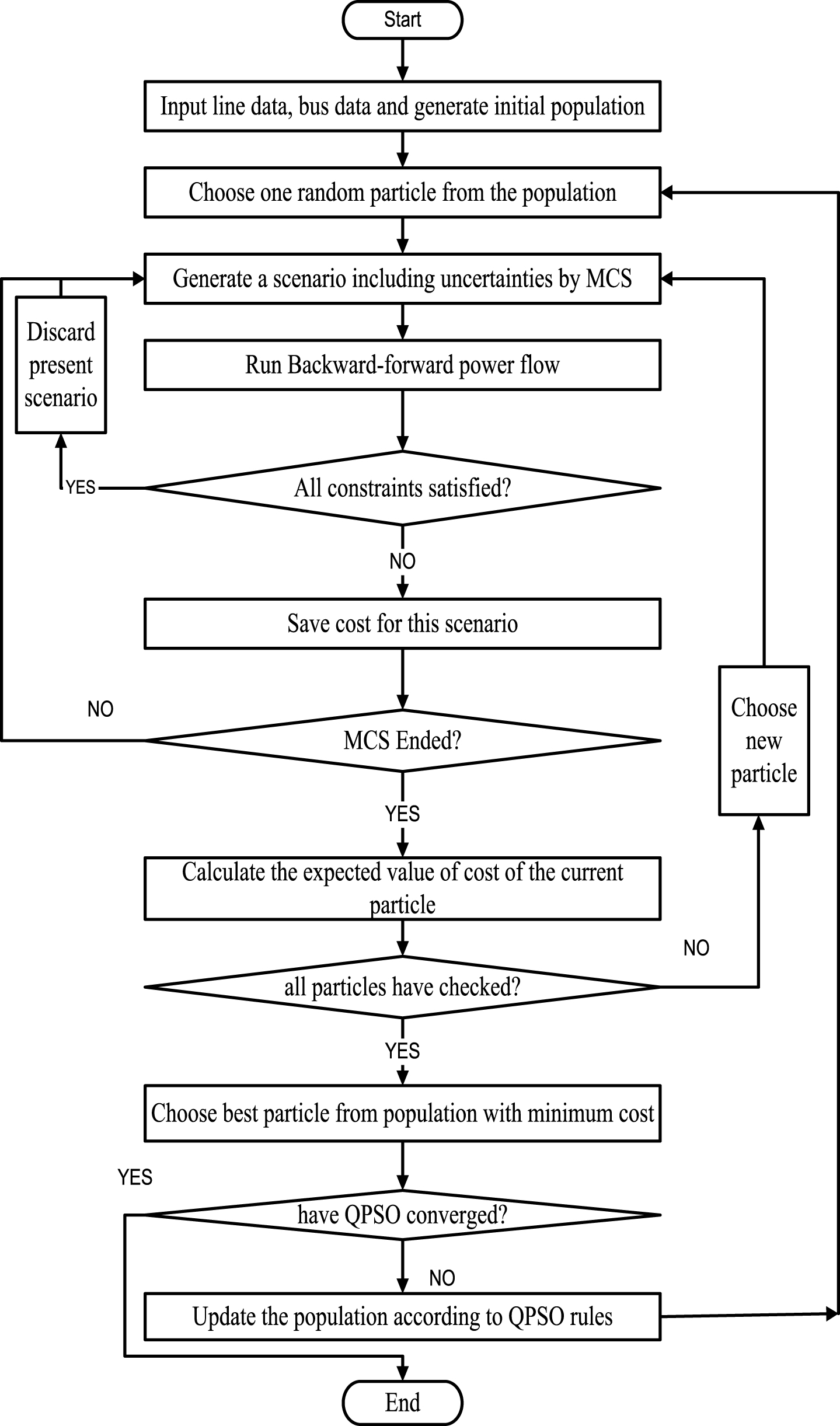
Flow Chart of proposed expansion planning.
In 1995, Kennedy and Eberhart suggested PSO whose key idea is imported from the bird swarm behavior’s study. PSO cannot congregate to global optimum solution but it is easy to implement to solve optimization problem. Therefore, to improve the PSO convergence speed, quantum behavior features have been presented in PSO update approach which derived from the quantum potential well model. QPSO [19, 21] uses only one displacement update formula and not use any velocity updating formula, so QPSO reduce the complexity of the PSO algorithm with better convergence speed. The QPSO is superior than PSO in terms of global searching performance because in quantum space particle search all feasible solutions.
In QPSO procedure, the wave function Ψ (x,t) denotes the particle’s state, and solution of Schrodinger equation in the space of PDF at some point, gives the position equation particle using the MCS.
QPSO evolution equations are following:
Where r is random number which gives a value between [0,1], ‘d’ shows the particle dimension and ‘M’ denotes the particles’ number in the population. P
n
(t), P
gd
(t) shows current best position and global best position respectively at t iteration, of particle n. M
best
denotes the average of all best position in population of particles, α is the contraction expansion coefficient, that is governing factor for the convergence speed of QPSO algorithm. α Varies according to the situations and it is calculated as following:
Where β decrease from m to l linearly iterative and Tmax denotes maximum number of iteration. The function rand() is allotted at a definite probability 1 or –1.
QPSO algorithm is used to solve real continuous optimization problems and does not provide better solution for discrete space optimization problems. By using the behavior and specific memory function of quantum particle swarm to trace the current position and regulate the search approach dynamically.
Load level and energy cost
Load level and energy cost
Technical/cost parameters
The proposed method is evaluated on a practical and large distribution network, the Kian-pars Ahvaz 11 KV network (a practical distribution network in Iran) for case study which is shown in Fig. 2. The proposed practical network consists a substation, 72 buses and 72 feeders among which feeder no 1 to 24 are the double circuit lines and remaining feeders 25 to 72 are the single circuit lines. These single circuit feeders can be expanded to the double circuit lines in expansion planning. The capacities of DGs are taken as 1, 2, 3 or 4 MW which can be installed to the buses according to the load demand at the black dotted points assumed as candidate points shown in the Fig. 2. The five new buses 73 to 77 are considered new load points which are taken as a demand growth and these are added to the existing network over three time period of 10 years each. The 72 bus data is given in the [20] and other data for new feeders and loads is given in [10]. The rate of interest on the planning cost is taken as 12.5%.
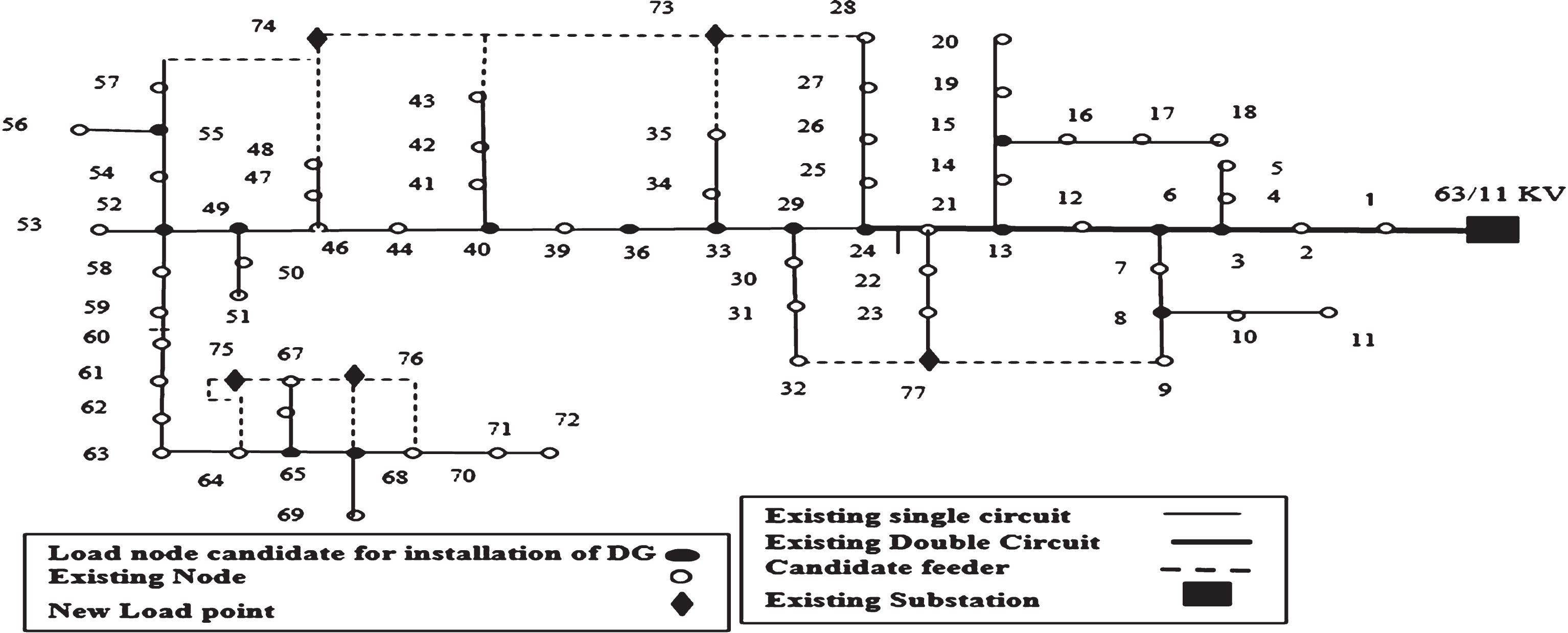
63/11 KV Kian pars Ahvaz 72 Bus distribution network.
The expansion planning carried out in two phases for comparison purpose and to understand the effect of uncertainties and DGs on planning. In first phase planning without considering uncertainties and in next phase planning with uncertainties consideration is performed. These each phases are further performed without and with DGs. The load information of 72 bus network is given in [10] and standard deviation is 10% of normal PDF. The QPSO factors are: number of particle = 10; signal to noise ratio = 20; number of bit = 10. The proposed algorithm run repeatedly until it can find a global optimal solution and best solution is picked up as absolute solution.
Expansion planning without considering uncertainties
In this section, price and load uncertainties in to planning are not considered. Proposed planning is performed in to three phases. In first phase the bus no 72 & 73 are connected to the existing network, bus no 74 & 75 are connected in to the system and at the last bus no 77 is added to the network in second and third phase respectively. This planning is performed with and without DG which is shown in the Table 3 and voltages of buses are shown in the Table 4.The expansion cost of planning is demonstrated in the Table 5. The results shows that by integration of DGs, voltage profile and the system performance is greatly enhanced.
Expansion planning for 72 bus distribution system
Expansion planning for 72 bus distribution system
*B65 = at bus 65.
Voltage of buses
Expansion planning cost
The cost results demonstrates that DG can reduce the expansion cost and the cost of the network losses. Expansion planning results shows the significance reduction in expansion cost and losses cost with DGs in comparison to withoutDGs.
This segment of the planning is carried out with uncertainties consideration under the same Circumstance as described in previous section. The planning is performed in three phases like previous section with and without DGs. The resulted planning and the voltages of the buses are shown in Table 3 and Table 4 respectively. The expansion planning cost is demonstrated in the Table 5, which describes that with DGs integration the voltage profile and system performance is improved and planning cost & network losses are reduced. The cost of planning and losses with DGs is lower than the without DGs. The superiority of QPSO over PSO in terms of Cost and loss reduction is compared in Table 6. These results of planning signifies the advantages of the DGs in distribution network in terms of system performance, voltage profile improvement, reliability etc. Convergence graph for PSO and QPSO is shown in Fig. 3 for 72 bus distribution system. The convergence graph Fig. 3 shows that QPSO optimizes the problem with high convergence speed in less number of iterations than PSO takes to optimize. It is also cleared from the convergence graph in Fig. 3 that QPSO gives the better results (lower expansion cost) than the PSO with higher convergence.
Comparison of the uncertainty effects on the expansion planning
Comparison of the uncertainty effects on the expansion planning
*EC = Expansion Cost.

Convergence graph of PSO and QPSO for 72 bus network.
This paper proposed a model for distribution system expansion planning in the existence of price and load uncertainties with integration of DGs, which minimize the operational and investment cost of substations, feeders, DGs and energy purchasing from market. This module satisfy the voltage limit, DG capacity, substation capacity, feeder transfer capacity and radial configuration constraints appropriately. QPSO algorithm is used as a solution tool in this multistage expansion planning. 72 bus distribution system is used for case study of uncertainties impact and DG integration in expansion planning. The price and load uncertainties are molded as normal PDF and inserted by Monte Carlo simulation. The result of DG integration demonstrates improvement in voltage profile and system performance, reduction in expansion planning cost as well as losses. Proposed QPSO algorithm results demonstrates the superiority over PSO in terms of high convergence and provides better optimal solution in less number of iteration.