



Abstract
Numerous Fuzzy segmentation techniques have been proposed in the literature for Image segmentation. This paper proposes a new Novel Intuitionistic Fuzzy C-means (S-IFCM) incorporated with Spatial information to reduce noise/outliers influence. This new clustering algorithm uses City-block distance to compute the rank between two pixels. Yager’s type fuzzy complement is used to compute non-membership and further hesitation degree is calculated. The new intuitionistic membership obtained is incorporated with spatial information of image for robustness to noise. Experiments are performed on various noisy images including MRI brain image, to assess the performance of the proposed algorithm. Comparison is done with existing hard, fuzzy and intuitionistic methods on the basis of entropy based segmentation accuracy and validity index. Experimental results show the effectiveness of the proposed method in contrast with other conventional methods.
Introduction
Image segmentation is one of the key techniques in image processing. Segmentation divides an image into subdivisions based on the information available in the image such as pixel intensity, energy, entropy, mean, variance, threshold value etc. Clustering is one of the processes which can be used for the segmentation of image. A wide range of unsupervised clustering methods are available for image segmentation. K-means is a hard clustering algorithm, where each item is assigned with either 0 or 1 membership. This algorithm works well when the data is completely separated, but fails when the data is vague and there are overlapping clusters. In image the information available is blurry and due to this it cannot be divided into separate classes. Hard clustering techniques cannot be considered as a powerful tool for image segmentation.
Fuzzy clustering and its derivatives are considered to be more powerful tools for segmentation of an image [1, 2]. FCM, a soft clustering algorithm is an effective tool for partitioning the data, where each data is associated to several clusters thereby providing more information about the original image than other crisp or hard clustering method. But the similarity metrics used in FCM does not perform well in the presence of noise or outliers. Its poor results are due to inclusion of Euclidean distance and failure to include spatial contextual information [3]. To improve the segmentation, Gong et al. has given FCM incorporated with local information and kernel metrics. Cai et al. [4] have given a conventional FCM algorithm which considers a factor for similarity considering local and spatial details of image. Spatial information with fuzzy membership function was incorporated in a spatial FCM by Chuang et al. [5].
In FCM, objects are associated with membership degree. The definition of non-membership was missing in FCM. Atanassov [6] introduced “Intuitionistic fuzzy sets” that consider the hesitation in the membership function which is defined as uncertainty, arises due to gap between membership and non-membership. Chaira [7] has given Intuitionistic Fuzzy C-means (IFCM) incorporating intuitionistic fuzzy entropy (IFE) in the energy function for segmentation of medical images. IFCM is less reactive to noise in contrast with fuzzy clustering. Robust Intuitionistic Fuzzy C- means (IFCM-σ), defined by Kaur [8], incorporated local details of the cluster and used T-sai distance as a similarity metrics. It gave improved results over normal data distribution to subclasses as compared to IFCM but did not perform well for image segmentation. Chaira [9] in the definition of IFCM used Sugeno function for calculation of hesitation degree of intuitionistic fuzzy sets. All the basic IFCM algorithms have taken Euclidean distance as a similarity metrics. A major disadvantage of Euclidean distance is that it cannot efficiently calculate complex shapes [10]. Therefore some researchers have used robust distance measure such as city-block, chebyshev known as L p norms (0 < p < 1) [11, 12] to substitute the Euclidean distance.
Lack of spatial information is one of the disadvantages of IFCM in image segmentation. Combination of membership and spatial contextual features produces more consistent regions compared to other methods. Huang et al. [13] has presented intuitionistic Fuzzy c -means with neighborhood properties of image.
In this paper, a new spatial intuitionistic Fuzzy C-means using City-block distance as a similarity metrics is proposed. City-block distance uses the rectangular coordinate system and mathematically simple as compared to Euclidean distance [14, 15]. This distance uses L1 norm and can be used to measure linear as well as non-linear data. Yager’s non-complement is used for calculation of hesitation degree by computing the non-membership degree. New membership is defined using spatial information of an image. Results for image segmentation are improved by spatial information. The presented algorithm shows robustness against noise, giving improved outputs in contrast to other conventional methods.
The rest of this paper follows the given format. The Section 2 overviews the previous work followed by proposed algorithm in Section 3. Experimental results on various datasets and related discussion is given in Section 4. Section 5 presents the concluding remarks.
Related work
An image I consisting of N pixels is considered, each pixel x ∈ I having some pixel intensity x i is in gray level. The number of cluster(c) is set to c ≥ 2.
Fuzzy C-means
Fuzzy C-Means (FCM) is one of the most widely used clustering method, which intend to segment the given image,
In the FCM approach, the segmentation process can be described as the minimization of an energy function given below in Equation (1)
FCM is a technique initialized by defining the membership matrix with the random value ranging between 0 and 1 with the condition of Equation (2) and updating the membership and centre iteratively as
We use ∈ as a concluding criterion which lies between 0 and 1. The iteration will stop till the
Noise could not be separated from the image by the standard FCM. Chuang et al. [5] presented FCM which incorporated, information related to the spatial properties of the image.
In this technique, it usually works as FCM, where originally center and membership function are defined as Equations (3) and (4). Later, membership function is updated with spatial information of the image, corresponding to the local window. In this neighborhood pattern (called the window) of 5×5 was taken which slides over entire image pixel by pixel and replace the average of the membership with in the window to the center pixel. This was considered as the spatial function p
ij
.
The spatial property of an image measures the scale with which pixels under consideration of the local window represent the similarity. This function helps to reduce the noise from the image.
Further, this information is incorporated with the membership function to compute the spatial membership function as
Here s and t defines the weight associated with fuzzy membership and spatial membership. Equation (6) defines the new spatial membership with information related to the degree of belongingness.
The energy function of the SFCM is defined including spatial membership function as
The functions are iteratively determined unless difference between two successive objective functions is lower than any defined tolerance ε or till the number of iterations is completed. However, membership constraint of FCM does not let spatial FCM to separate noise from the image entirely.
Atanassov [6] defined Intuitionistic Fuzzy Sets (IFS), as a finite set includes the non-membership function along with the membership function. The mathematical representation of IFS is:
Attanassov introduced third parameter hesitation degree defined as degree of uncertainty which arises due to gap between membership and non-membership.
π
I
(x) defines the hesitation degree of x for set I as:
Now with π
I
(x), the intuitionistic fuzzy set is represented as:
The traditional FCM clustering algorithm segments the dataset I by the process of minimization as in Equation (1).
The iterative process of FCM, gives the measure of membership value of pixel x j ∈ I.
Further, Yager’ s intuitionistic fuzzy complement N (x) is used to define the non-membership value in the set I
Hesitation degree of IFCM is calculated as
In [9] hesitation degree is being calculated using sugeno intuitionistic fuzzy complement which is represented as
Further intuitionistic membership is calculated as:
Chaira [7] has defined Novel Intuitionistic Fuzzy c-means used for the process of medical image segmentation. The energy function of IFCM was given as:
In Equation (17), the first part defines the refined energy function of standard FCM using intuitionistic fuzzy set theory. The second part of the energy function defines the intuitionistic fuzzy entropy (IFE) with the goal of maximizing the good points in the cluster.
IFE gives the difficulty of an intuitionistic fuzzy set, where N is the total number of pixels.
The given modified cluster center for intuitionistic fuzzy set:
So the final value of intuitionistic membership and center is obtained till the maximum number of iterations or
Non uniformity in the noise present, distribution of intensity and other imaging artifacts usually worsens the outcomes of standard clustering algorithms. Therefore including the spatial contextual information along with the intuitionistic fuzzy sets of IFCM will improve the results while segmenting an image.
The suggested algorithm is formulated below:
Conventional FCM algorithm cluster the feature vector by minimizing the objective function and initialize the membership matrix and center of S-IFCM using the city block distance as the similarity metrics.
City block distance can be recursively calculated by considering a small neighborhood of 4 data points at a time [12]. The city block distance can be explained by considering two points on a xy space. The distance between two points will be equal to the smallest sum of x horizontal distance and y vertical distance. This is also termed as Manhattan distance, where we go around the blocks instead of cutting through it, as represented in Fig. 1. Three different cityblock distances; all have the shortest distance of 8 from A to B.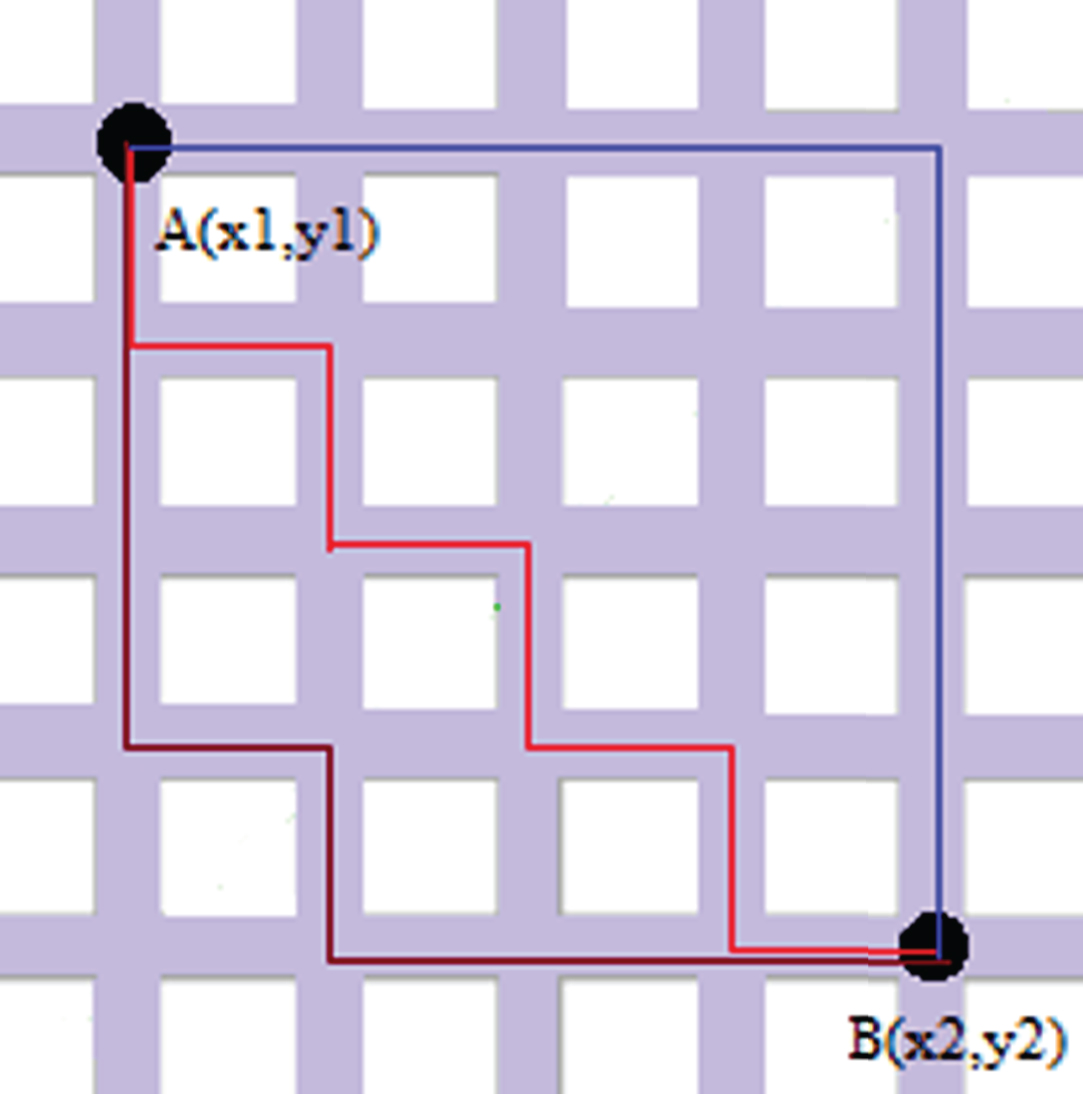
After initializing the membership and center by running conventional FCM, further non-membership is calculated. Using Yager’s intuitionistic fuzzy complement, non-membership function V
ij
of S-IFCM is calculated. It is a fuzzy negation defined as degree to which a data point does not belong to particular cluster.
Thus with help of this, IFS of an image I is defined as
Hesitation degree is calculated as
The Intuitionistic Membership function ofS- IFCM is calculated as:
Further the spatial intuitionistic membership function incorporating the neighborhood information of the pixel under consideration is calculated
Here r and s are weights, given to control the degree of influence of intuitionistic membership and spatial membership.
A second part of objective function is defined as Intuitionistic fuzzy Entropy (IFE) aims in maximizing the selection of good pixels in a cluster.
The new energy function of S-IFCM is calculated as
Repeat the steps Equations (26)–(31) till the maximum number of iterations or
In this section, the proposed algorithm is evaluated on various natural and medical images embedded with different level of noise to display the efficacy of the presented algorithm in context of the robustness to noise. The algorithm is analyzed qualitatively and quantitatively. The images are displayed showing the representation of segmented regions and the robustness against noise and quantitatively results are analyzed in terms of validity of clustering and efficiency of segmentation using entropy based validity index.
The value of r = 1, s = 1 and spatial window considered is 5×5. In [5] it has been discussed that change in the value of r and s can change the results by giving more strength to spatial feature or intuitionistic membership. The value of α = 0.7, used to calculate the non-membership of intuitionistic fuzzy sets, maximum iterations are set to 200 and ε= 0.0001. To prove the efficiency of the proposed technique, comparison is done with K-means, FCM, SFCM, IFCM, IFCM-sugeno, IFCM-σ.
Segmentation on natural images
Our first experiment is Fig. 2 which shows the natural image of cameraman with 256×256 pixels. The image is corrupted by Gaussian noise (1%) as shown in Fig. 2(ii). The number of clusters defined is 3. Figure 2(iii) shows the results of Kmeans, with lot of noise in all the three segments. Figure 2(iv) shows the execution results of FCM, which is also insensitive to noise and showing image with presence of noise in all the segments. Figure 2(v) shows the result of SFCM showing better result as compared to FCM due to presence of spatial information incorporated with membership function of FCM. Figure 2(vi) represents the result of IFCM showing the presence of noise but less as compared to FCM due to presence of hesitation degree which defines the gap between membership and non-membership, Fig. 2(vii) represents the result of IFCM-sugeno with more noise than IFCM, Fig. 2(viii) represents the segmentation results IFCM-σ which incorporates local information of data and Fig. 2(ix) represents the result of our proposed algorithm (S-IFCM). Segmentation results of cameraman (256×256). (i) Original Image (ii) Image aaded with Gaussian (0.01) noise. (iii) Segmentation results of Kmeans. (iv) Segmentation results of FCM (v) Segmentation results of SFCM (vi) Segmentation results of IFCM (vii) Segmentation results of IFCM with Sugeno hesitation (viii) Segmentation results of IFCM-σ (ix) Segmentation result of proposed technique S-IFCM (5×5 spatial window).
The results exemplifies that the proposed technique performs better, with better robustness to noise and proper segmentation giving much clearer image as compared to other methods.
Our second experiment is Fig. 3(i) shows the natural image of coins with 246×300 pixels. The image is corrupted by salt & pepper noise (1%) as shown in 3(ii). The number of clusters defined is 2. This picture is taken because of background simplicity due to which clustering results can be better analyzed and robustness of the algorithm against noise can also be better illustrated. Segmentation results of coins image (246×300) (i) Original Image (ii) Image corrupted with Salt & Pepper (0.01) noise. (iii) Segmentation results of Kmeans. (iv) Segmentation results of FCM (v) Segmentation results of SFCM (vi) Segmentation results of IFCM (vii) Segmentation results of IFCM with Sugeno hesitation (viii) Segmentation results of IFCM-σ (ix) Segmentation result of proposed technique S-IFCM with (5×5 spatial window).
Figure 3(iii)-(ix) represents the result of Kmeans, FCM, SFCM, IFCM, IFCM-sugeno, IFCM-σ, S-IFCM. Figure 3(v) represents better result because of Spatial information incorporated with FCM but due to use of Euclidean distance as a similarity measurement, the noise cannot be removed to much extent. Figure 3(ix) represents the result of the proposed method S-IFCM, largely preserves the original segmentation results and the noisy points are removed from the image.
Figure 4 represents the Magnetic Resonance Image of Cerebral tissue, required to be split-up in four segments as white matter, gray matter, cerebrospinal fluid and background. This is an intricate case of medical image segmentation where we need to separate these tissues as the white matter is intervened with gray matter. The number of segments taken for partition is 4. Figure 4(i) shows the originalimage. Segmentation results of MRI cerebral tissue (250×200) (i) Original image (ii) Segmentation results of Kmeans. (iii) Segmentation results of FCM (iv) Segmentation results of SFCM (v) Segmentation results of IFCM (vi) Segmentation results of IFCM with Sugeno hesitation (vii) Segmentation results of IFCM-σ (viii) Segmentation result of proposed technique S-IFCM with (5×5 spatial window).
Figure 4(ii)-(viii) shows the segmentation results of Kmeans, FCM, SFCM, IFCM, IFCM-sugeno, IFCM-σ and S-IFCM. The results illustrate that proposed clustering technique performs well as compared to other clustering techniques in terms of robustness to noise, contrast, and giving better edge details.
Figure 5 is a MRI image of cerebral brain tissue which is corrupted with 0.01 speckle noise. Medical images are distorted due to various imaging artifacts and instruments imperfections. Figure 5(i) represents the original image and Fig. 5(ii) represents the corrupted image. Segmentation results of MRI cerebral tissue (250×200). (i) Original Image (ii) Image corrupted with Speckle noise (0.01). (iii) Segmentation results of Kmeans. (iv) Segmentation results of FCM (v) Segmentation results of SFCM (vi) Segmentation results of IFCM (vii) Segmentation results of IFCM with Sugeno hesitation (viii) Segmentation results of IFCM-σ (ix) Segmentation result of proposed technique S-IFCM with (5×5 spatial window). Performance Analysis of Clustering Techniques
Figure 5(iii)-(ix) represents the results of segmentation produced after Kmeans, FCM, SFCM, IFCM, IFCM-sugeno, IFCM-σ and S-IFCM. The results illustrates the proposed algorithm is more robust to noise with better definition of two different matters of the cerebral tissue. Incorporating spatial information with the membership function improves the results in S-IFCM. S-IFCM contains the little noise in clustered image but maintains the edge details as compared to other techniques.
Quantitatively results are analyzed on the basis of cluster validity index. The images taken for evaluation does not have ground truth value, so we have used partition coefficient (V
PC
) and partition entropy (V
PE
) as validity indices [1]. These can be used for internal quality evaluation. These parameters can be used as representative functions for fuzzy partitions. The partition coefficient can be calculated as
Here μ represents membership matrix of clustering technique. N represents number of data items to be clustered. Maximizing V
PC
leads to better clustering result. The second parameter, partition entropy is represented as
Entropy based Evaluation E of Clustering Techniques
In order to measure the accuracy of segmentation in the images without ground truth labeling, an objective based on the criteria of the entropy present in segments [16] is defined. This evaluation criterion was in general used for the segmentation performance evaluation. The entropy for region r is defined as
The expected region entropy of segmented image is given as
The layout entropy is defined as
The evaluation function E is the sum of expected region entropy and the layout entropy is given as
The comparison results of noisy images are represented in Table 2. It can be analyzed from the values that the proposed clustering technique (S-IFCM) is showing better results compared to SFCM, IFCM, IFCM-sugeno, IFCM-σ.
Intuitionistic approach with different measures of hesitation degree shows better result as compared to widely used FCM. In this paper, a new approach to robust image segmentation using intuitionistic fuzzy set theory has been provided. In the proposed technique, we have integrated the spatial features of image with intuitionistic approach keeping in mind Yager’s method for calculation of non-membership function and further hesitation degree is calculated. In this algorithm, the similarity metrics used is with L1 norm termed as City-block distance because of its simplicity and diversity over linear and non-linear data. The suggested algorithm produces improved result in contrast with other algorithm for images that have been degraded by various types of noise. The output observed in this paper shows that Robust Spatial Intuitionistic FCM is a fruitful method for constructing image segmentation algorithm.
The improvements in the results are obtained due to use of intuitionistic fuzzy set theory with spatial information of image and considering more number of uncertainties in the image datasets than only membership function of fuzzy sets. In summary, our technique could offer good definition to image segmentation and can be used on intricate images such medical images and SAR images.