



Abstract
Invariant feature extraction under diverse illuminations is challenging for face recognition. Related face recognition techniques consider that illumination effect is predominant in low frequencies and involve various methods to segregate high frequency information. However, high frequency feature extraction results in loss of salient features that degrades performance. Thus, objective of this work is to extract illumination normalized robust facial features for face recognition under high illumination conditions. First, a new illumination normalization framework is proposed in which homomorphic filtering (HF) is applied for reducing illumination effect along with contrast enhancement and intensity range compression in face images. Then, illumination deviations are annulled by using reflectance ratio (RR), which yields appropriate texture smoothing and edge preservation. Further, selective feature extraction by discrete wavelet transform (DWT) is performed on HF and RR based face images that discards noise effect. It outcomes in illumination normalized significant facial features, on which subspace analysis (Principal component analysis) is performed to generate small size feature vectors for classification (k-nearest neighbour classifier). Experimental results on benchmark databases such as CMU-PIE, Yale B and Extended Yale B database, demonstrates that proposed face recognition technique yields high performance under diverse illuminations as compared to existing techniques.
Keywords
Introduction
Automatic face recognition (FR) is prevalent in the domain of pattern recognition because of its practical and widest range of applications in security, surveillance, e-commerce and law enforcements [28]. A real time face recognition system is capable of identifying a person’s identity without individual’s attention and requisite of special hardware devices which are essential in other recognition/identification system such as finger print, iris etc. Increasing demand in other applications such as in authentication and computer based human interaction have drawn significant attention of researchers towards this problem from past three decades. Face recognition methods under precise environmental variations are popular [12, 24], but their performance degrades under any environmental deviations. There are many deviations that affect the recognition accuracy of a real time FR system such age, expressions, illumination and pose deviations. However, illumination deviations can make face recognition problem very challenging. Under high illumination variations, visual appearance of a face image drastically changes and bring intra personal variations. Thus, the crucial challenge for face recognition is to develop face recognition system under varying illumination conditions. Numerous methods exist in literature [1–3, 25–27] that broadly grouped FR techniques under illumination deviations into three categories [29] as follows:
First category comprises, face recognition techniques based on illumination invariant feature selection and face representation. Shashua et al. proposed Quotient image (QI) [18], where bootstrap set is produced by using three distinct illuminations deviations based face images. However, recognition accuracy of this technique degrades significantly when test set and bootstrap set are misaligned. Self-quotient image (SQ) [23], is another face recognition technique under this category where face image is evaluated by the division operation on its smoothed version. But, this method lacks capability of preserving salient features. Gradient face (GF) [27], is a light intensity invariant face illustration for face recognition under high illuminations. In this technique, gradient domain is utilized for extracting illumination insensitive features. This gives more discrimination in features as retrieved in pixel domain. Weber face (WF) is based on Weber’s law where light intensity variations in face images are divided by the background which normalizes illumination deviations [22]. However, both GF and WF shows poor performance under high illumination variations due to cast shadow effects. An extended representation of WF is proposed as patch based WF (PWF) and weighted PWF (wPWF) in [25] where patch based statistics were utilized for the evaluation of illumination robust multi scale features. While extracting such features self-shadows becomes significant that affects performance. Another approach for reducing illumination effect is to minimize energy of large scale facial features [19]. In discriminative multi-layer illumination insensitive feature extraction (DMI) technique large scale components are used to decompose multi-layer features [26]. The shortcoming of this technique is that a vigilant selection for layer weights is desirable so that useful facial features are not lost while extracting illumination insensitive features.
Second category consists of, human face modeling based techniques for face recognition under high illumination deviations. These techniques consider that light intensity deviations are induced in face images when illuminations from different directions are exposed to them [1, 8]. Georghiades et al. [8] presented a light intensity cone model to generate face images under different illuminations with fixed pose. Another face representation is given by Basri and Jacobs [1] as spherical harmonic model, where a subspace in nine distinct dimension is utilized to approximate illumination variations of Lambertian face surface. The shortcoming of these techniques is that acquisition of face images is tough for a larger database under diverse lightings.
Elementary preprocessing and light intensity normalization techniques for face recognition are categorized in third category. The traditional techniques such as logarithm transform and histogram equalization (HE) are predominant [9]. These are global preprocessing techniques but considerably not effective in annulling high illumination deviations. Light intensity normalization, using discrete cosine transform (DCT) based high frequency coefficients selection, in logarithm domain was proposed by Chen et al. [3]. However, annulling low frequency coefficients results in loss of important features for face recognition. Recently, DCT based fuzzy filter [21] and adaptive thresholding in DCT domain [14] is presented for enhancing recognition accuracy but their performance degrades on large database. Discrete wavelet transform domain (DWT) based illumination normalization technique for face recognition is proposed by Du and Ward [6]. This technique is based on preprocessing in wavelet domain on approximate and details frequency sub bands that yields accurate recognition accuracy in low and moderate illumination conditions only. However, this technique is inefficient in reducing high illumination deviations. Normalization of illumination and occlusion deviations by dual tree complex wavelet transform (DTCWT) and sparse representation for face recognition is also used recently in [16], but its resultant performance is poor with extreme illumination deviations.
Homomorphic filtering (HF) based face recognition techniques are also popular under this category for compensating illumination variations [5, 9]. Light variations are reduced by high pass filtering process in HF. However, homomorphic filter [9], is not efficient in selecting robust features for face recognition under very high illumination deviations. Therefore, a sub face image based homomorphic filtering is proposed in [5], where a face image is divided into two halves and then each half of the face image is processed by homomorphic filter [5]. Based on difference of gaussian filter (doG) and histogram equalization another modification of HF is proposed in [7]. This helps in normalizing illumination differences but the performance of this technique is limited due to database dependent parameter selection. Moreover, under extreme light intensity variations, the recognition accuracy of this technique drops. Thus, an efficient technique for normalizing illumination deviation is necessary for face recognition.
The problem is defined as, to annul varying illuminations in face images and choose robust features for face recognition to enhance performance. In this work, a new framework for illumination normalization is proposed based on homomorphic filtering and reflectance ratio. During the process of homomorphic filtering high frequency components such as texture and edges are often truncated when cutoff frequency is not selected appropriately which in turn affects the accuracy of face recognition system. In proposed approach, the high pass filter parameters are set in accordance with neighborhood window size of reflectance ratio. This helps in reducing illumination effect along with appropriate smoothing and edge preservation. Then, high frequency coefficients in DWT domain from illumination invariant face images are discarded. It supports in reducing noise effect and further enhancement. The subsequent illumination normalized face images contain all useful information for face recognition. A high recognition accuracy retrieved on large face database under extreme illumination deviations proves the efficacy of proposed approach. The important points of attraction in this work are mentioned as: A new framework for illumination normalization based on HF and RR (HFRIN) framework. HFRIN based selective feature extraction using an orthogonal wavelet in DWT domain (SFDWT).
The remaining work is structured in following manner. The preliminary description about HF, RR, DWT, Principal component analysis and k- nearest neighbor is explained in Section 2. The proposed HFRIN framework, selective feature extraction by DWT, block diagram and algorithmic description along with parameter selection is presented in Section 3. Experiments and comparisons with state of art face recognition methods are given in Section 4. The conclusion is presented in Section 5.
Preliminaries
Homomorphic filtering (HF)
Homomorphic filtering is a process in which frequency domain based high pass filtering is performed to reduce light intensity variations and enhance reflectance component and it is based on illumination reflectance model [11]. An illumination reflectance model represents a face image by a function f (a, b) as expressed in Equation (1), where i (a, b) and r (a, b) denotes illumination and reflectance component respectively.
The Variations in illumination are slow spatial deviations and related to low frequencies in a face image whereas reflectance component varies abruptly particularly at the edges. Thus, segregation of these component is essential for facilitating frequency domain processing. This is performed by treating Equation (1) with logarithm transform as given in Equation (2). The basic process of homomorphic filtering is illustrated in Fig. 1 and explained as:
Homomorphic filtering [11].
There is a common assumption that deviations in light intensities are negligible but reflectance component deviates abruptly among two adjacent grey levels in a face image [27]. Based on this assumption when the ratio of a picture element (pixel) intensity to its neighboring picture element intensity is evaluated then their illumination components are annulled. It leaves behinds only their reflectance components and indicates that the ratio of their reflectance components remains same. But, under high illumination deviations pixel intensities varies abruptly. Therefore, the intensity of a picture element is divided by the average picture element intensity of its local neighborhood (NW) and is defined as reflectance ratio [15] in Equation (8). The f (m, n) represents a picture element at some spatial location (m, n) and γ is the normalization parameter.
An illustration of reflectance ratio (RR) is given in Fig. 2. When reflectance ratio is evaluated for every picture element in a face image, it results in discarding illumination effect. The parameter NW is selected in accordance with the parameters of homomorphic filter. An optimum selection of neighborhood window size in reflectance ratio outcomes in significant edge preservation and smoothing of texture too. Therefore, extensive experiments are performed on different databases for the selection of appropriate neighborhood window size as mentioned in Section 3.4. Reflectance ratio.
Discrete wavelet transform is performed to analyze facial features in various frequency sub bands. Thus, significant facial features can be retrieved in DWT domain for face recognition. A signal f (z) in DWT is a combination of scaling function φ (z) and wavelet function ψ (z) at different decomposition level [11]. Then signal f (z) at decomposition level y can be defined as:
In Equation (9), f (z) is decomposed at level-1that yields low and high frequency coefficients c y (x) and d y (x) respectively. Proceeding in same manner, DWT decomposition on two dimensional image signal, yields various frequency components at different scale. At level one it gives one approximation (low) frequency coefficient and three detail (high) frequency coefficients. The subsequent decomposition at next levels, yield more discriminating low and high frequency coefficients. In this work, robust features are extracted using DWT by applying an orthogonal wavelet filter as explained in Section 3.2.
Principal component analysis was used for automatic face recognition by Turk et al. [20] where face images are represented as image vectors with some weights. These image vectors are created in a lower dimension subspace which they called eigen space and face images corresponding to their respective weighted image vectors are termed as eigen face. In PCA, first a training image space (x = [1 ⋯ X]) is formed, where each face image ix=[1⋯X] is represented as column vector and concatenated in an array.
The covariance matrix from this image space is evaluated as given in Equation (10) where ν is the mean of images. The dimension of this covariance matrix (N × N) is reduced to a small subspace in accordance with Turk and Pentland method (N × N >> M > M′) [20]. The eigen vectors and eigen values evaluated in this lower dimension subspace are further utilized to calculate projection matrices for training and test face images. Then training and test feature vectors in this eigen space are utilized for performing classification using k-nearest neighbor.
The size of training and test feature vectors on different databases is mentioned in Section 4.1, Section 4.2 and Section 4.3.
The classification step in automatic face recognition is used to allocate pertinent class labels to test images. In the proposed work, k-nearest neighbor classifier (k-NNC) [4], is utilized for classification as it can be efficiently deployed for a large face database. Moreover, k-NNC is easy to implement and the strength of proposed FR technique is validated without bias of a classifier.
It is a supervised learning technique where the closest distance between test and training feature vectors is evaluated. Then, class of test images is assigned by majority voting from nearest distance of k neighbors. Different distance measures can be utilized to calculate the smallest distance between test and training feature vectors. Cosine angle distance measure is utilized to evaluate the closest distance between test and training vectors in this work. The percentage recognition rate is then evaluated by determining the percentage of correctly identified class labels to the over-all number of test face images.
Algorithm description of proposed illumination normalization framework and selective feature extraction (HFRIN SFDWT) based face recognition technique
As aforesaid, illumination variations cause huge difference in face images of a person. This difference is considerably higher as compared to other person’s face image. The intrapersonal image difference due to illumination deviations are much higher than interpersonal image difference and affect recognition accuracy of a face recognition system. The proposed face recognition scheme aims to solve this problem by utilizing homomorphic filtering and reflectance ratio based illumination normalization framework. The selective feature extraction in DWT domain further helps in segregating those frequency coefficients that cause noise effect. This is illustrated by the block diagram in Fig. 3. Block diagram of proposed illumination normalization by HFRIN framework and selective feature extraction based on DWT for face recognition.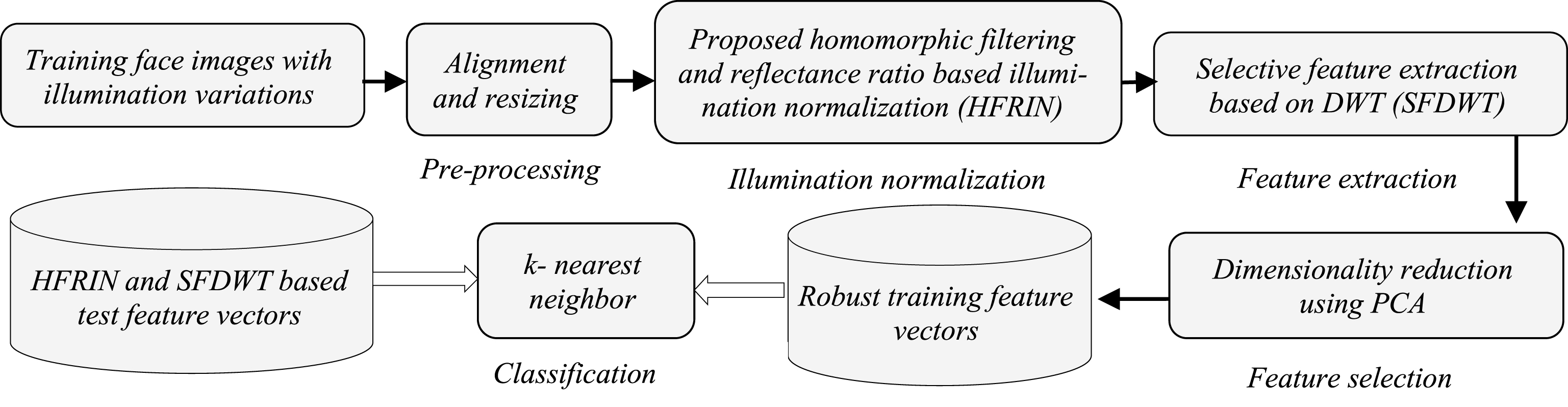
The HFRIN based illumination normalization is divided in two stages. First, homomorphic filtering is utilized for enhancing facial image features then reflectance ratio is evaluated to diminish illumination effects. In homomorphic filtering process [11, 17], the frequency components which are responsible for noise and aliasing are suppressed by applying high pass filtering function H(y,z). But, it requires a vigilant selection of cutoff frequency D0, so as to not ward off other high frequency components (texture, edges etc.) salient for face recognition. Fanet al. [7] implemented a difference of gaussian bandpass pass filtering function for selecting frequency components in the range of low and high cutoff frequencies. Histogram equalization is further applied for improving contrast. However, this technique is dependent on the selection of two cutoff frequency parameters that plays a significant role in suppressing illumination component and enhancing reflectance component respectively. More so, optimum selection of low and high cutoff frequencies for illumination normalization along with preserving essential facial feature information is challenging.
A fair idea is, to select cutoff frequency D0 appropriately using butterworth high pass filter, such that boundaries are not distorted. A proper selection of D0 sustains intrinsic facial feature information. This results in enhancement of reflectance component. At this stage, low frequency components responsible for illumination effects, still persist. Such illumination disparities are normalized by reflectance ratio that helps in discarding gradually varying illumination component. The evaluation of local mean around an appropriate neighborhood size in reflectance ratio gives appropriate smoothening and sharpening of edges. The overall effect of illumination normalization by HFRIN framework results in reduction of illumination deviations with preservation of salient face image information for face recognition. The framework of proposed illumination normalization framework based on HFRIN is illustrated in Fig. 4. Illumination normalization using Proposed HFRIN framework.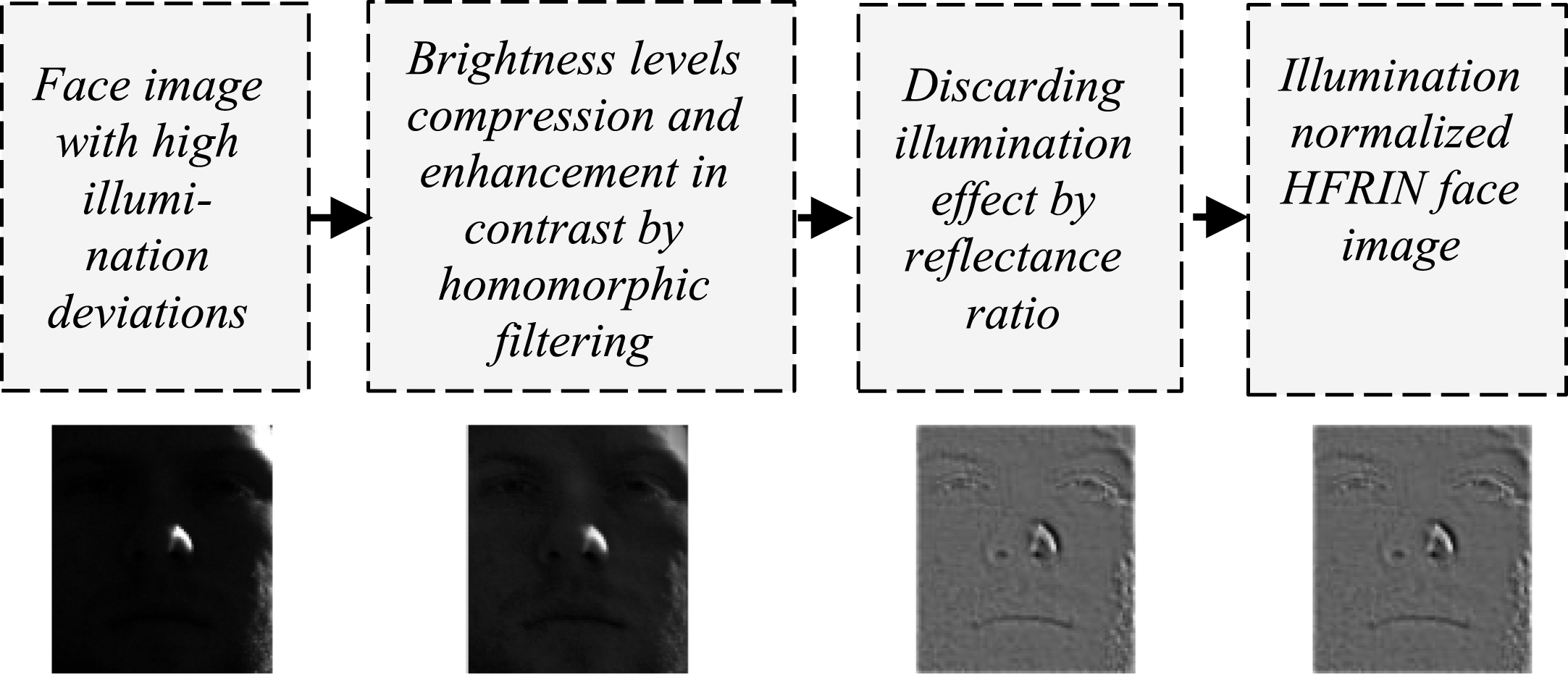
In this work, DWT is used to obtain various frequency coefficients related information of HFRIN face images. The feature extraction based on DWT at decomposition level-1 results in high scale features and small scale features. The approximation sub bands are high scale features of a face image and represents global information. The facial features information in three different directions is obtained by using small scale features [11].
The consequence of face image decomposition by DWT is that, appropriate features can be extracted for face recognition. This is established by selecting approximation sub bands, from HFRIN framework based face images and discarding detail sub bands. It outcomes in elimination of further noise effect and contrast enhancement of reflectance component in HFRIN face image as shown in Fig. 5. The choice of a suitable wavelet with appropriate vanishing moments is essential in enhancing the performance of a face recognition system [13]. An orthogonal wavelet filter with few vanishing moments along with small support size influences the performance. In SFDWT based experiments on HFRIN face images, symlet8 wavelet filter is used. As a result of HFRIN-SFDWT based robust feature extraction the original face image size is reduced to 64×64 from 128×128. This small size feature vector space have salient facial features for subspace analysis and classification. Illustration of SFDWT from HFRIN framework.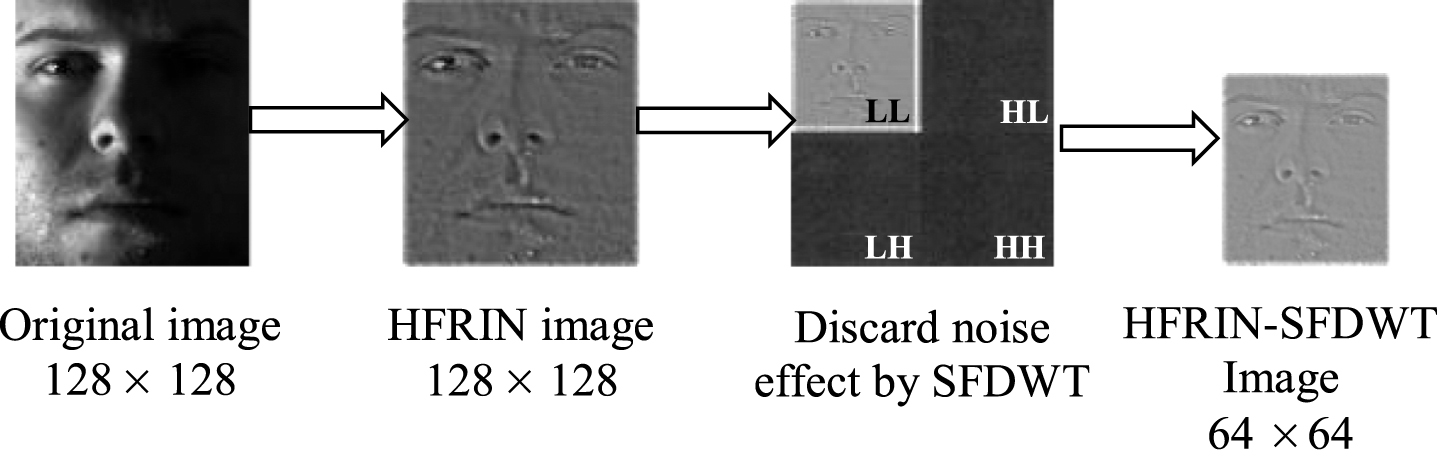
The algorithm description of proposed HFRIN-SFDWT based face recognition method is summarized as: Select initial cutoff frequency D0 for high pass filtering using Butterworth filter. Accomplish contrast enhancement and intensity range compression by HF. Evaluate reflectance ratio for annulling illumination deviations on HF based face images using a low value of NW. Choose appropriate value of NW and D0 for preservation of facial features (edges and texture). Reject noise effect by discarding high frequency coefficients using SFDWT. Construct lower dimension subspace (eigen space) using PCA. Repeat the above process for creating HFRIN-SFDWT test features from test face images under extreme illumination deviations. Assign class labels to test images using k-NNC and evaluate recognition accuracy.
Parameter selection
The segregation of illumination and reflectance component does not happen strictly in fourier domain during homomorphic filtering process [11, 17].
It is highly dependent on selection of appropriate parameters which is conferred from Fig. 4 also. Different settings for selecting these parameters are used by various researchers [5, 17]. In this work, the selection of parameters D0 in homomorphic filtering and NW in reflectance ratio is made in accordance with HFRIN framework. Therefore both parameters are analyzed separately on different values using Yale B and CMU-PIE databases as mentioned:
Selection of cutoff-frequency D0
Recognition rates (%) using different values of D0 at NW =3 × 3 in proposed HFRIN-SFDWT FR technique on Yale B and CMU-PIE database
Recognition rates (%) using different values of D0 at NW =3 × 3 in proposed HFRIN-SFDWT FR technique on Yale B and CMU-PIE database
Recognition rates (%) using different values of D0 at NW =11 × 11 in proposed HFRIN-SFDWT FR technique on Yale B and CMU-PIE database
Recognition rates (%) of proposed HFRIN-SFDWT face recognition technique on different values of NW at D 0 = 150 on Yale B and CMU-PIE database
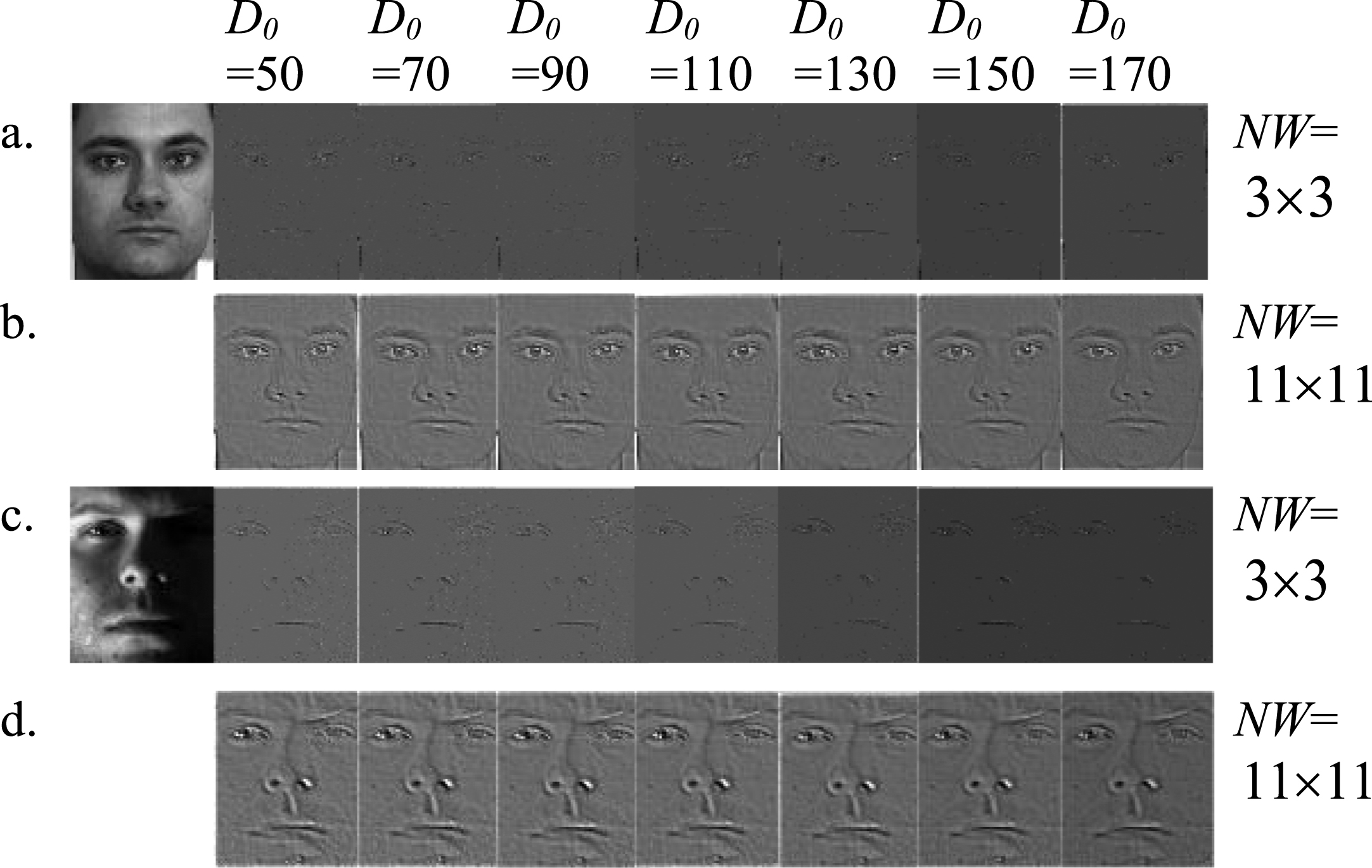
a) and c) Single sample face image from CMU-PIE and YaleB database and their corresponding illumination normalized face images using different values of D 0 (50 to 170) at NW =3 × 3 b) and d) Illumination normalized images using different values of D 0 (50 to 170) at NW =11 × 11 in proposed HFRIN framework.
The parameter selection for NW is carried out in proposed HFRIN framework on its different values ranging from 3 × 3 to 13 × 13. The D0 and n are set to 150 and 2 respectively. The recognition rates at 3 × 3 are lowest on Yale B and CMU-PIE database as tabulated in Table 3. This is because with low value of neighborhood window size, edge preservation is less. However, in subset 3 of Yale B, accurate recognition accuracy is achieved due to less illumination variations in this subset. With increase in the neighborhood window size, recognition accuracy increases in all subsets of Yale B and CMU-PIE as feature preservation enhances as illustrated in Fig. 7.
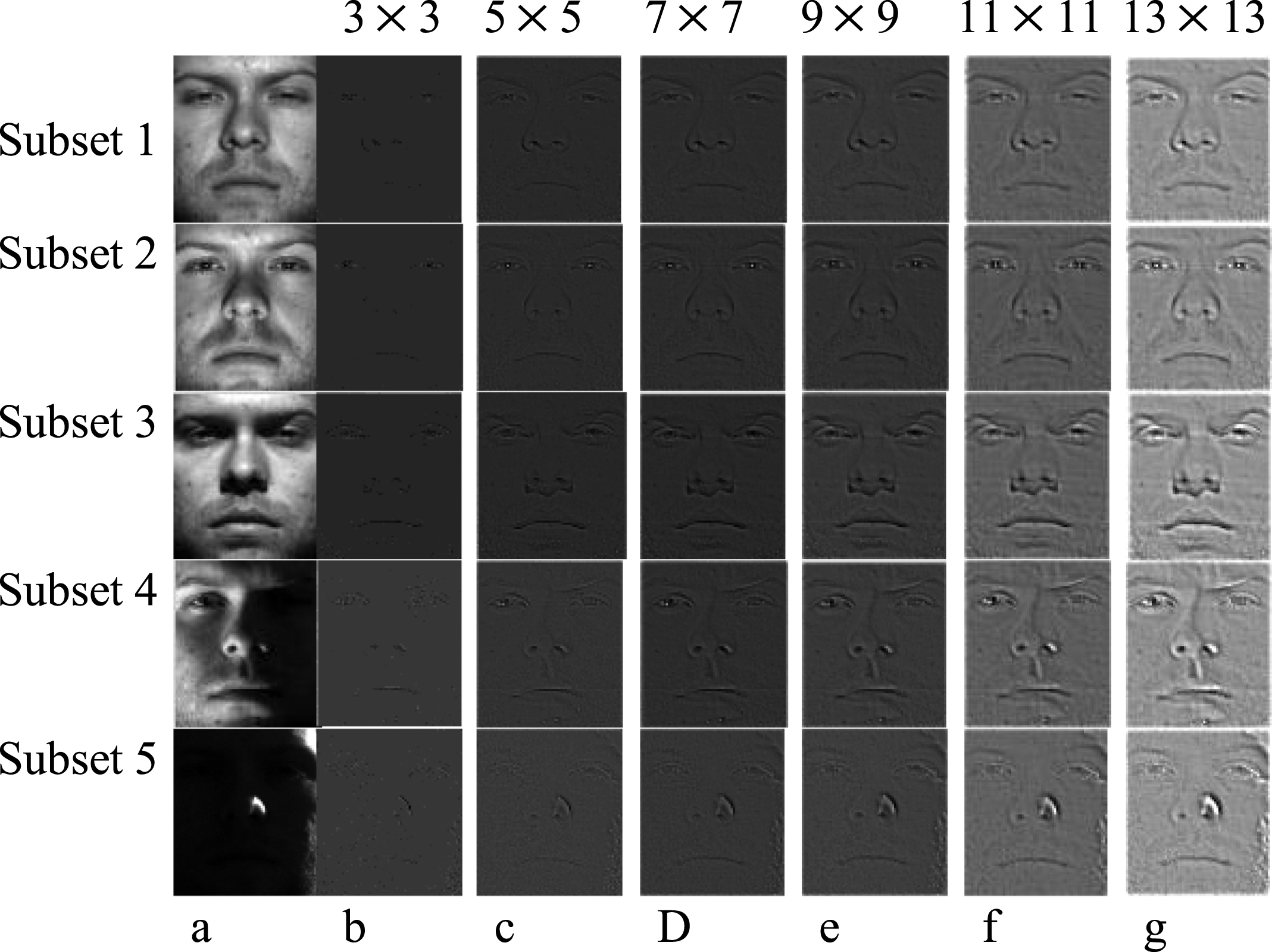
col. a) Sample face images of Yale B database b) to g) Illumination normalized face images by proposed technique on different values of NW and D0 = 150.
It is inferred from Table 3, that optimal value of NW is achieved at 11 × 11 with D0 at 150.
The proposed HFRIN-SFDWT based FR technique is examined extensively on Yale B, extended Yale B and CMU-PIE face databases in MATLAB 7 environment using Intel i3, 1.4 Ghz CPU with 4 GB RAM. Several experiments are performed on these databases to validate following two points: a) The selected parameters in HFRIN framework can be useful for various databases under varying illumination deviations. b) The illumination normalized HFRIN-SFDWT features contains valuable information for face recognition.
Experimental results on Yale B
Yale B database comprises, images of 10 subjects having 9 poses with 64 illumination conditions (9 × 64 × 10). Face images with illumination deviations with frontal pose are considered only, for present investigation. These images are grouped in accordance with angle of light intensity direction such that subset 1 comprises 7 images (0°–12°), subset 2 to 5 comprises 12 (13°–25°), 12 (26°–50°), 14 (51°–77°) and 19 (above 77°) images respectively. The original face image size in Yale B database is 640 × 480 which is resized to 128 × 128. Experiments are performed using different training and test subsets to assess the robustness of proposed approach.
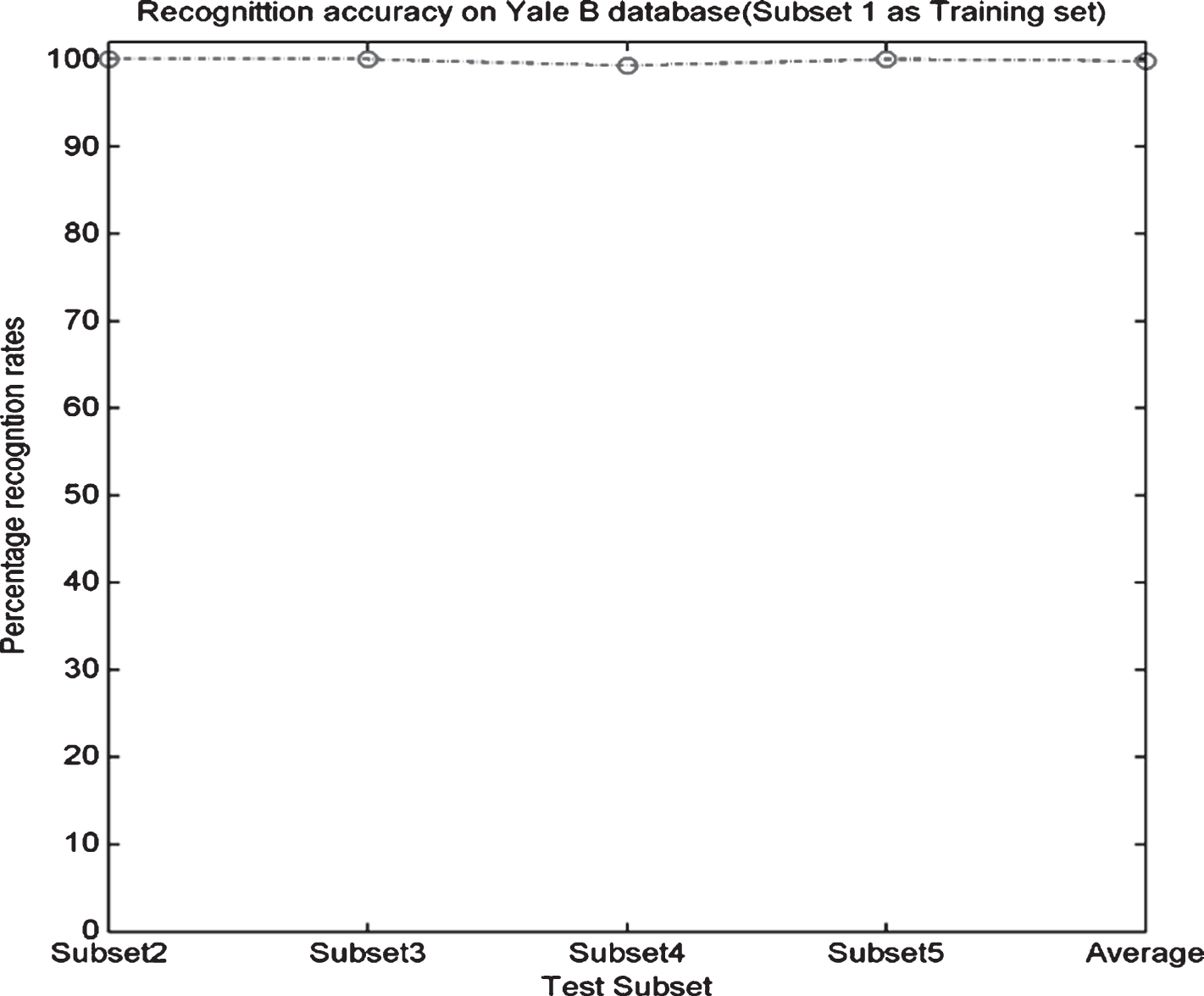
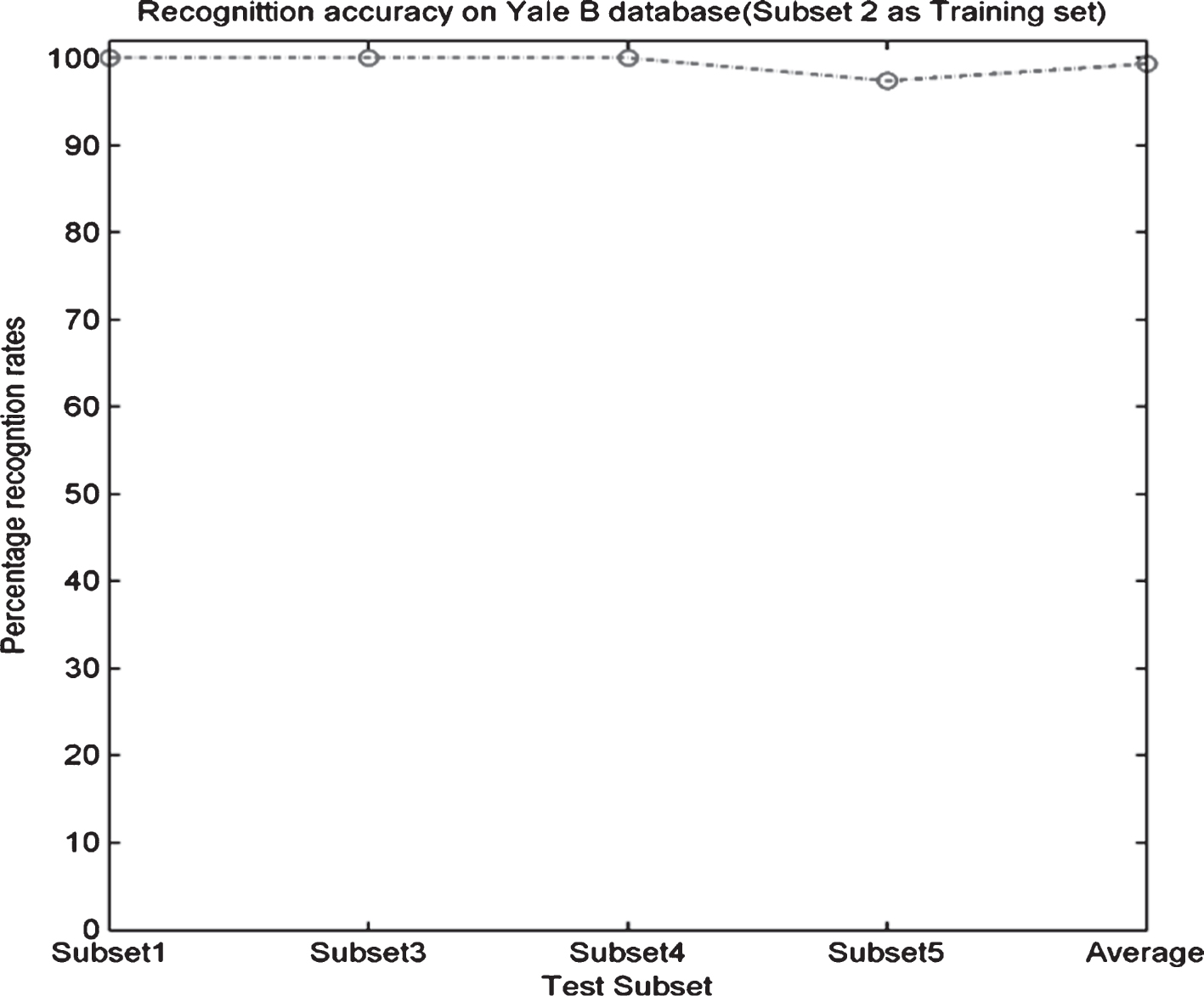
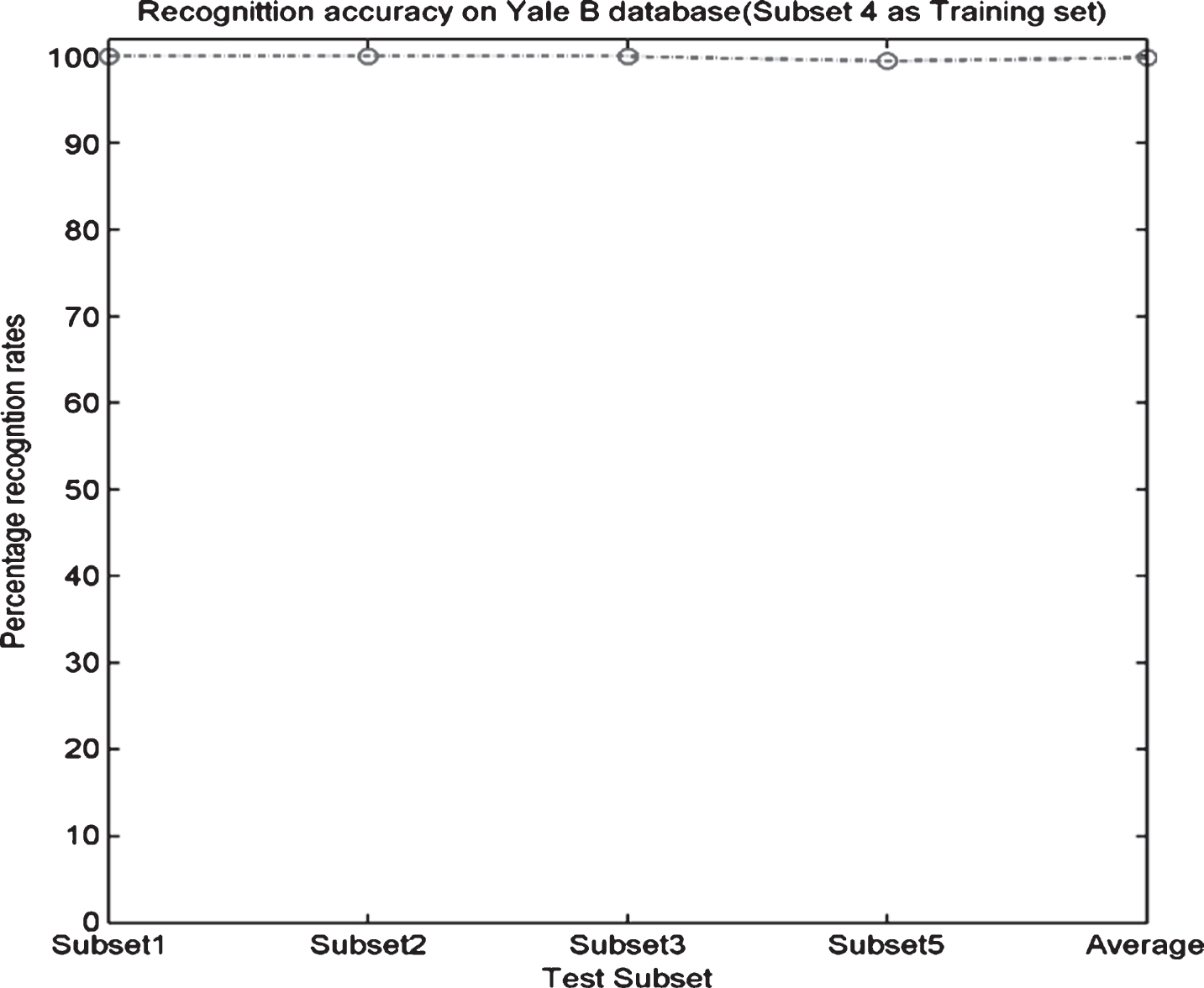
The face images on Yale B database are illustrated in Fig. 8. It is observable that illumination normalization and feature preservation is achieved using proposed approach. This is further demonstrated by performance graphs as shown by Figs. 9 to 12. The recognition rates as illustrated in Fig. 9 are obtained using subset 1 as training subset and remaining subsets for testing. The training and test feature vector size of HFRIN face images by SFDWT is reduced to 4096×70 and 4096×150 respectively, which is compact to 40×70 and 40×150 in eigen subspace. Accurate recognition accuracy on subset 2 and subset 4 is achieved but subset 5 yields 99.29% when subset 1 is used for training. This is because subset 5 comprises face images with high illumination conditions. Similar results are also obtained when subset 2 and subset 4 are used for training as shown by performance graphs in Figs. 10 and 11.
Illumination normalized face images by proposed HFRIN SFDWT FR technique on Yale B and CMU-PIE database a) and c) Original images b) and d) Illumination normalized images. Recognition rates on Yale B database using proposed approach (Subset 1 is used as training set). Recognition rates on Yale B database using proposed approach (Subset 2 is used as training set). Recognition rates on Yale B database using proposed approach (Subset 4 is used as training set).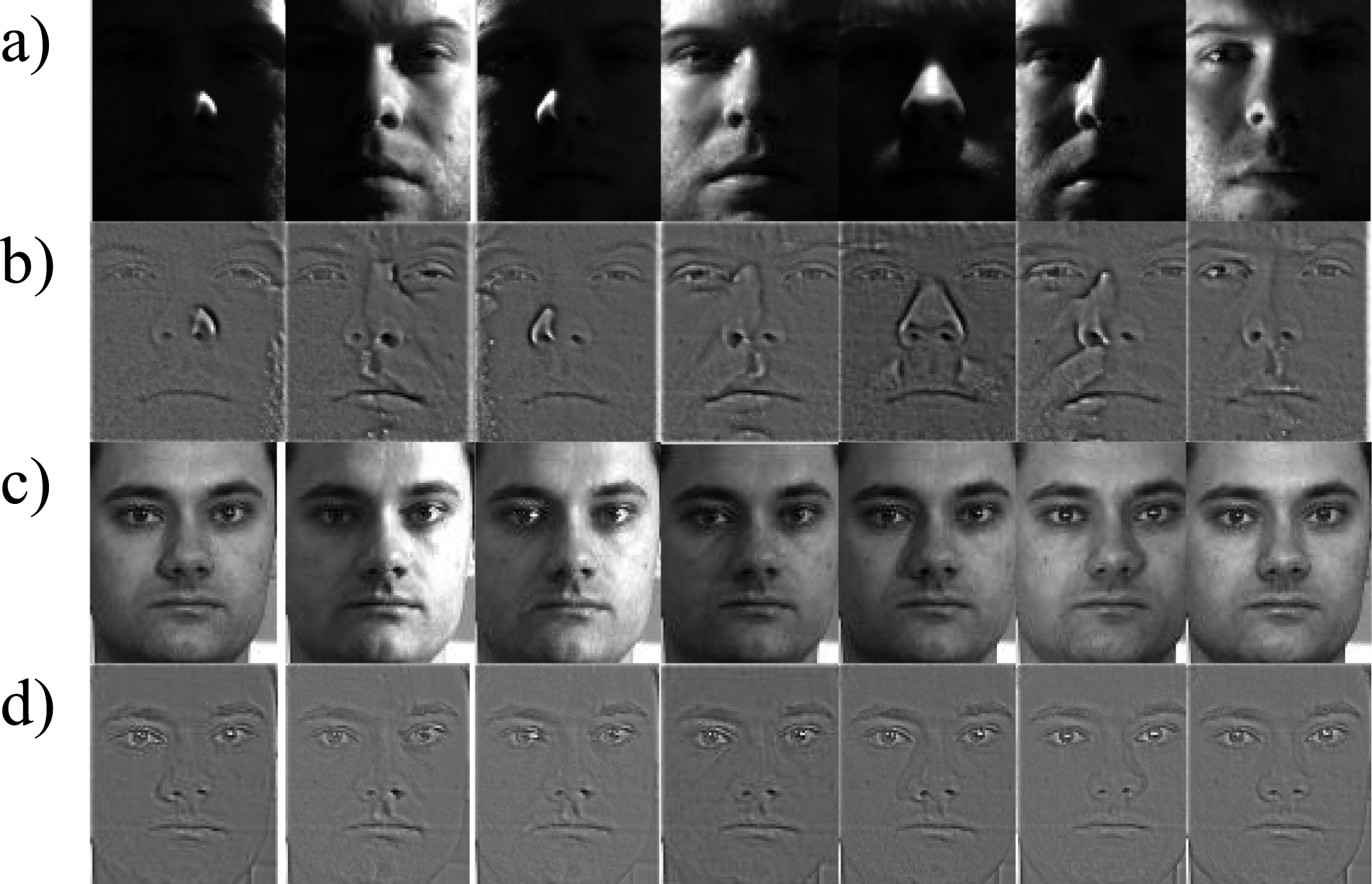
However, 100% accuracy is achieved on all subsets when subset 5 with high illuminating condition is used for training as shown in Fig. 12. Recognition rates on Yale B database using proposed approach (Subset 5 is used as training set).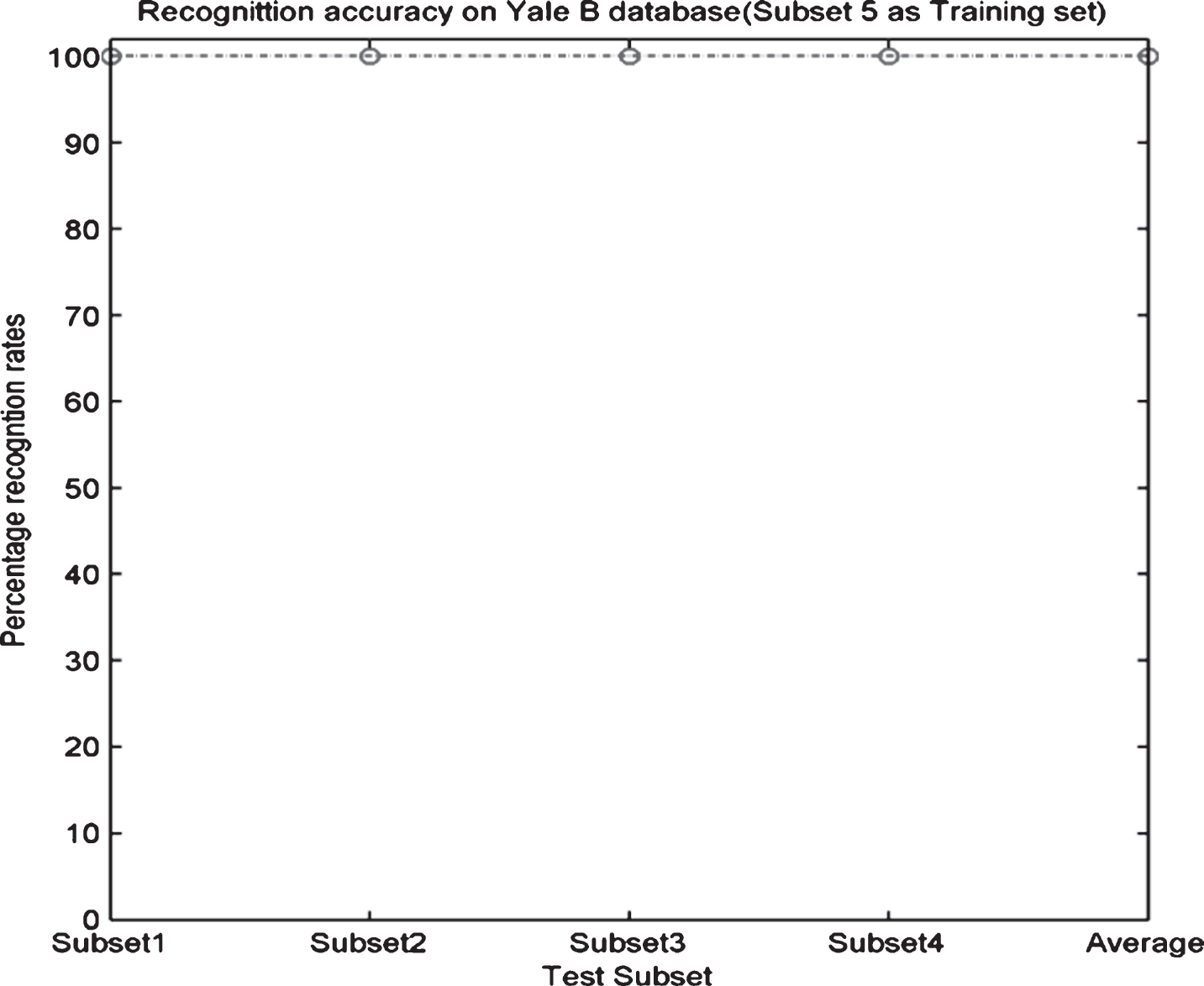
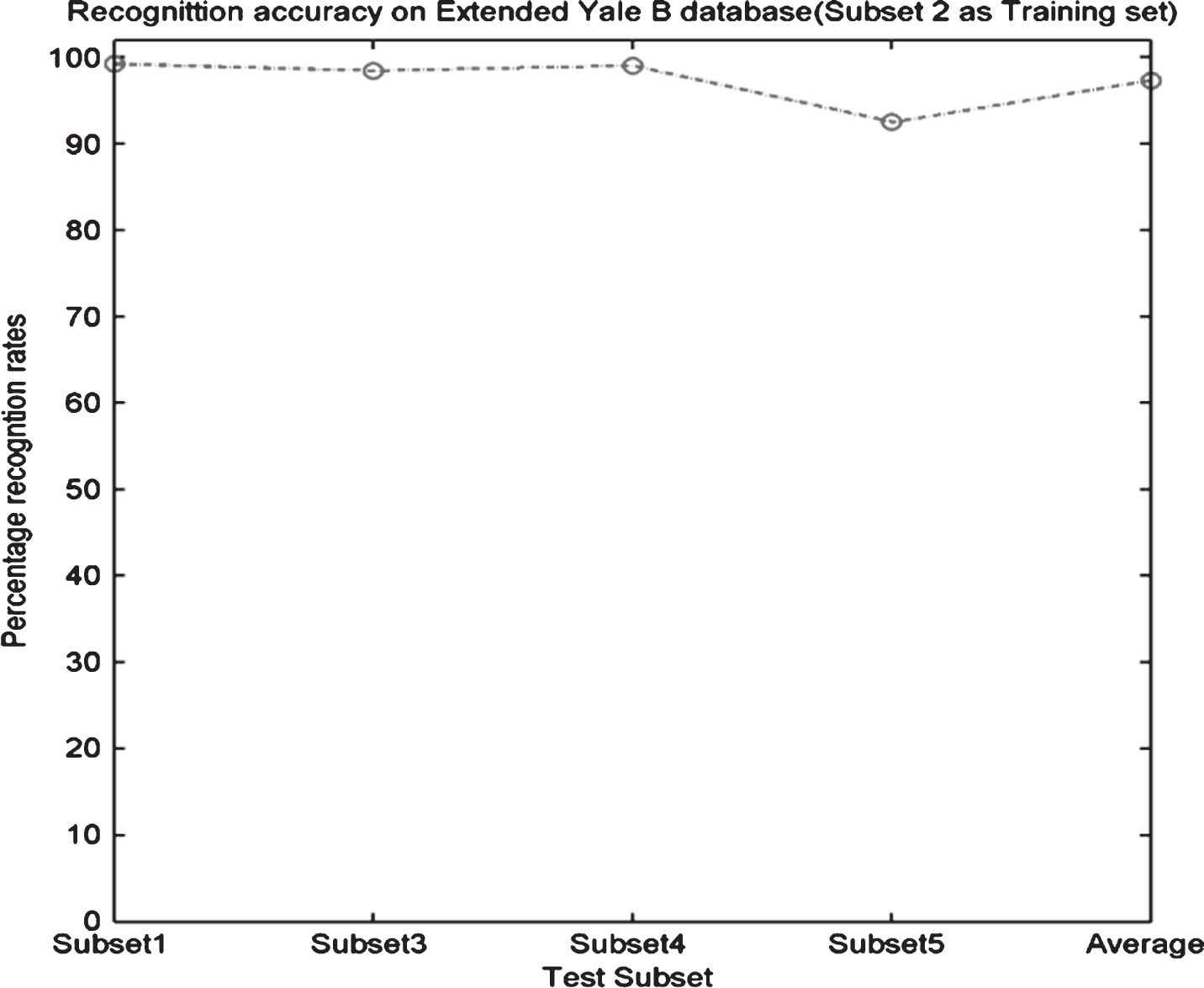
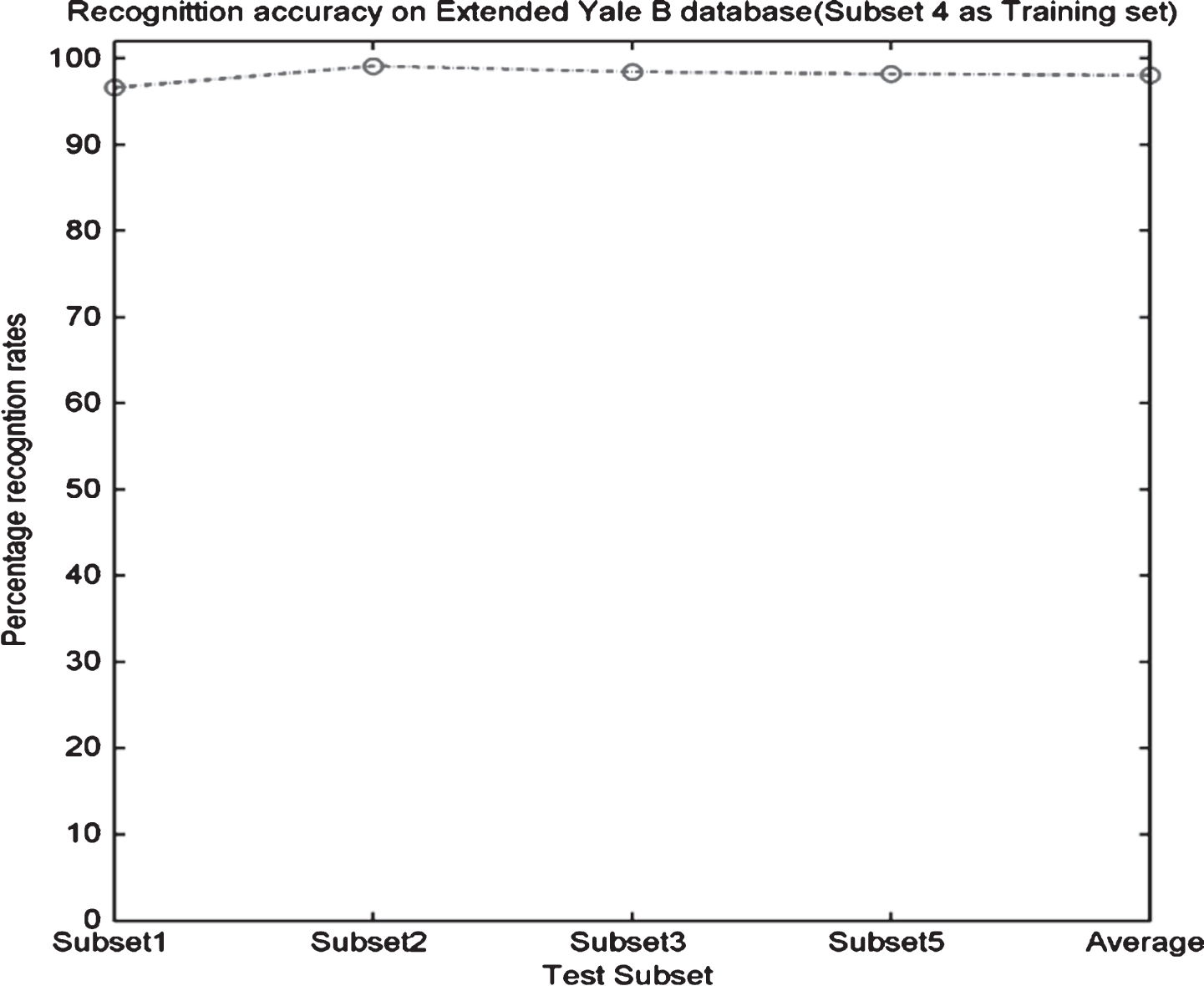
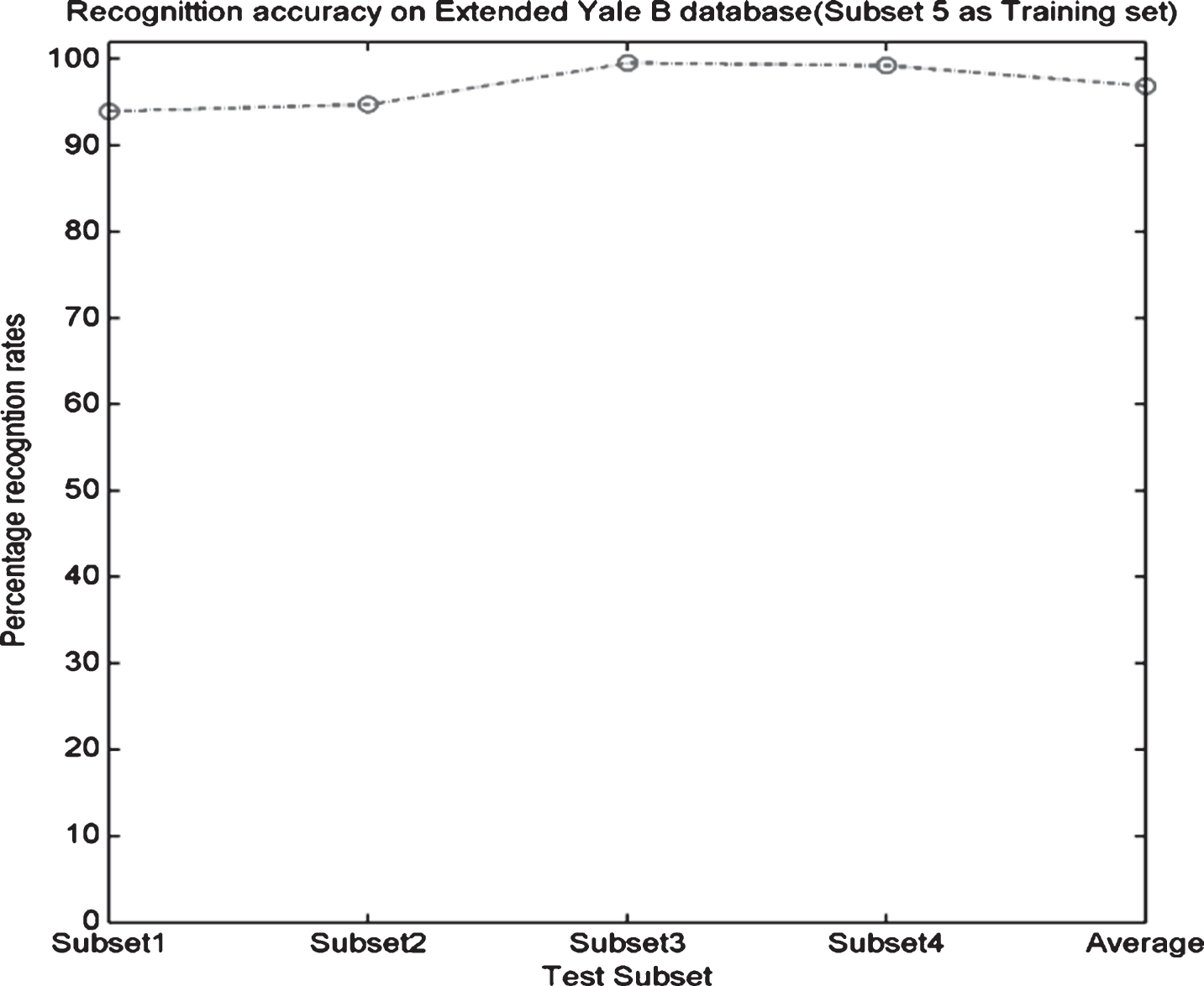
An enhanced version of Yale B database is Extended Yale B database with additional subjects and identical illumination and pose conditions. Total thirty eight subjects together with ten subjects of Yale B database exists in this database. Here also, face images with frontal pose are considered (2432 face images) for experiments. Various experiments on this database are performed to confirm the strength of proposed approach on a larger database. In HFRIN-SFDWT subspace, the training and test feature vector size is 4096×266 and 4096×722 respectively, when subset 1 is used for training and subset 5 for testing. The eigen space additionally compact their sizes to 150×266 and 150×722. The 100% recognition rates on subset 2 and subset 3 are obtained whereas 98.49% and 95.56% accuracy is obtained on subset 4 and subset 5 respectively as illustrated by performance graph in Fig. 13. The recognition rates are also obtained using subset 2, subset 4 and subset 5 as training subsets. In the second set of experiments, subset 2 is used for training and remaining subsets are used for testing purpose. The average recognition rate is above 97% with highest recognition rate of 99.24% on subset 1. The remaining test subsets yield more than 92% accuracy on each subset as shown in Fig. 14. The above experiments are continued for investigating performance using subset 4 and subset 5 as training subsets which contain face images under more challenging illumination conditions. It is revealed by Figs. 15 and 16 also that proposed method continued to achieve high reconition accuracy under all set of poor illumination deviations. Recognition rates on extended Yale B database using proposed approach (Subset 1 is used as training set). Recognition rates on extended Yale B database using proposed approach (Subset 2 is used as training set). Recognition rates on extended Yale B database using proposed approach (Subset 4 is used as training set). Recognition rates on extended Yale B database using proposed approach (Subset 5 is used as training set).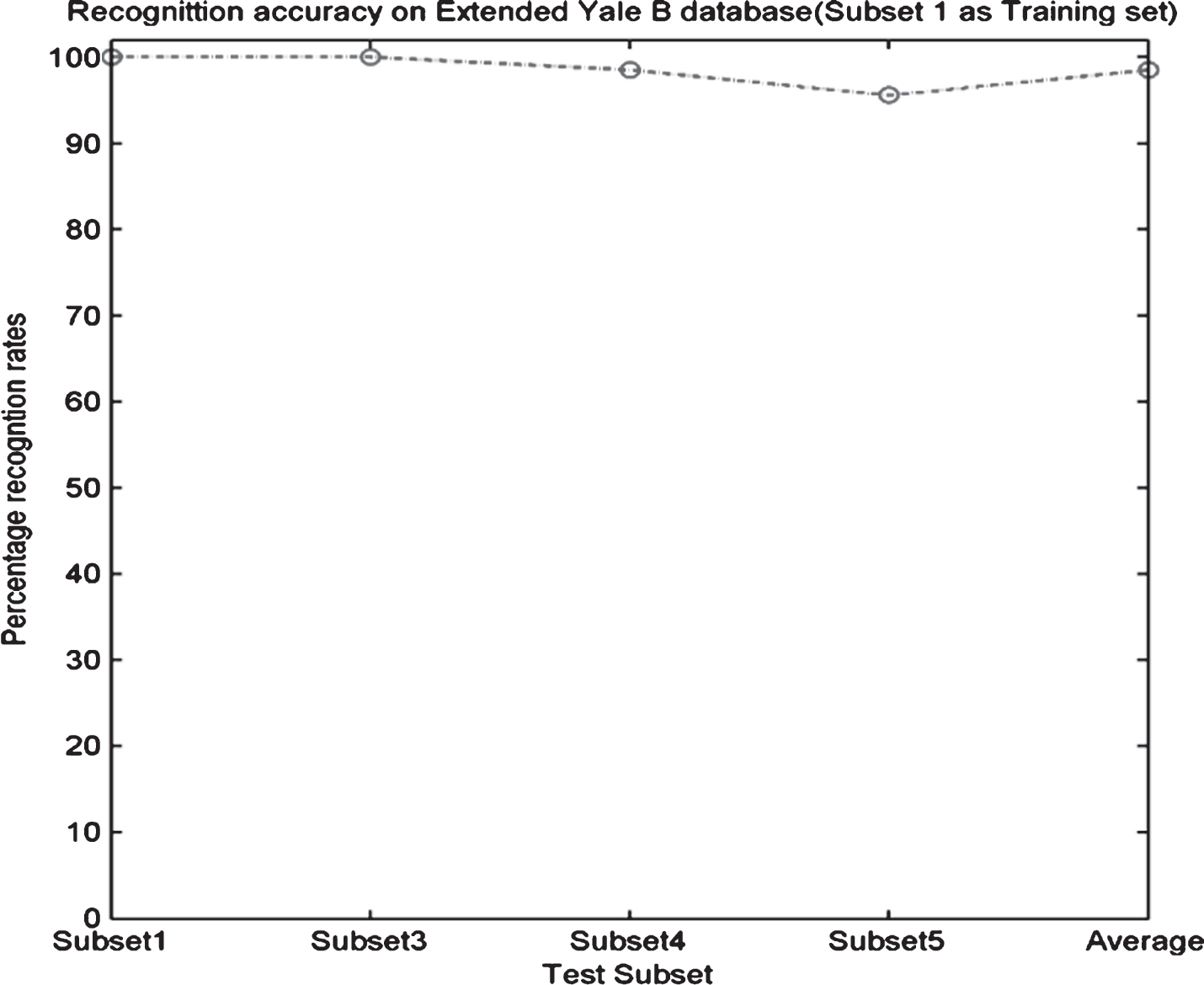
CMU-PIE database is a very large face database and comprises 41,368 face images. There are sixty eight subjects with deviations in pose, illumination and expressions. For experimental analysis under distinct illumination deviations, face images with twenty one illumination deviations (C27 subject) with front pose are employed. The test set and training set consists of twenty and single face images respectively.
Recognition rates of different face recognition techniques
Recognition rates of different face recognition techniques
*–indicates percentage recognition rates not available.
The effectiveness of proposed HFRIN-SFDWT based face recognition technique is proved by comparing with different state of art face recognition techniques on Yale B, extended Yale B and CMU-PIE database as tabulated in Table 4.
The recognition rates on Yale B database are compared with linear subspace [1], cones cast [8], cones attached [8], Histogram equalization [9], Homomorphic filtering [9], Log-DCT [3], Wavelet normalization [6], Gradient face (GF) [27] and Weber face (WF) [22]. It is evidently noticeable from Table 4 that accurate recognition accuracy is achieved with proposed FR technique on subset 3 and subset 5. This credits to the better illumination conditions in subset 3. However, under bad illumination conditions in subset 5, the proposed approach is also superior.
In subset 4, recognition accuracy is also highest as compared to other FR techniques under extreme illumination deviations. The performance of WF [22], Patch WF (PWF) [25], wPWF [25], DTCWT-sparse [16] and DMI [26] are tested against proposed HFRIN-SFDWT approach on extended Yale B database. As compared to other techniques, HFRIN-SFDWT achieves 100% on subset 3 whereas 98.49% recognition rate is obtained on subset 4 of extended Yale B database. This proves the fact that proposed approach is capable of retrieving all significant face image information under high illumination conditions. Under extremely high illumination variations of subset 5 also, high recognition rate is attained, except when compared to DMI [26]. However, with variations in layer weights and without discriminant filter in DMI, recognition rates are lower [26] than proposed approach. Moreover, the average recognition accuracy of proposed technique is higher than all compared state of art techniques.
The recognition rates of HFRIN-SFDWT based illumination normalization technique for face recognition on CMU-PIE database is compared with log-DCT [3], GF [27] and WF [22]. Accurate recognition accuracy obtained using proposed FR technique demonstrates the best feature selection capability under varying illumination conditions on CMU-PIE database. The proposed technique on this database is also compared with a recently developed adaptive non-symmetric fuzzy activation based extreme learning machine (ANF-ELM) for face recognition [10]. However, proposed technique outperforms this recently developed FR using ELM as tabulated in Table 4. The salient points of proposed illumination normalization technique for face recognition via HF and RR in DWT domain are summarized as: HF is utilized for enhancement of reflectance component of an image with efficient selection of filter parameters in accordance with RR. The RR is capable of extracting illumination normalized face images. The appropriate size of NW is effective in yielding appropriate smoothing of texture and preservation of edges. The feature extraction using SFDWT is capable in further enhancement and reduction of noise effect.
Thus, proposed approach is efficient in retrieving robust illumination normalized facial features in low dimensional subspace for face recognition under high illumination conditions. This fact is validated by achieving high recognition rates as compared to various state of art techniques on Yale B, extended Yale B and CMU-PIE database.
Conclusion
A new face recognition technique under low to high illumination deviations is proposed in this work. The intensity range compression and contrast enhancement of face images is first achieved by homomorphic filtering. Then illumination deviations are discarded by reflectance ratio with simultaneous preservation of salient features which is done by selecting optimum neighborhood window size in accordance with cutoff frequency of butter worth filter. Thus proposed HF and RR based illumination normalization (HFRIN) is effective in normalizing low to high illumination conditions on face images. More so, the selective feature extraction in DWT domain (SFDWT) by discarding noise effect yields significant facial features for face recognition. The HFRIN-SFDWT based robust features in eigen space facilitate high recognition accuracy which is demonstrated by experiments and comparisons with existing techniques.