



Abstract
With the development of intelligent vehicles, in-vehicle security and privacy receive considerable attention from researchers and drivers. The data stored in a vehicle control unit (VCU) may contain privacy-sensitive content, which may be exposed to unauthorized devices or attackers due to the structural problems of the in-vehicle network. To overcome this problem, data can be encrypted with the target module’s key before being transmitted to the in-vehicle network. However, this may lead to another efficiency problem.
In this study, we propose a model that adopts the proxy re-encryption (PRE) scheme to the in-vehicle network. This is called privacy-enhancing in-vehicle network key management (PINK). In the proposed model, the data stored in the VCU is encrypted with a master key. In addition, when the stored data is requested by a node, it is transformed into a ciphertext that can only be decrypted with the node’s key using the PRE scheme. Moreover, for the case in which a special group of nodes request the data several times, simultaneously, a group-based key management scheme i provided. Further it is demonstrated using simulations that the proposed PINK scheme can be efficiently applied to the in-vehicle network.
Introduction
In the near future, the in-vehicle network is expected to be one of the key technologies for intelligent vehicles. Using the in-vehicle networks, many electronic control units (ECUs), driver-aiding devices, and vehicular accessories can internally exchange various data via serial buses [1]. In addition, this data is processed by applications such as advanced driver assistant system and many other sophisticated applications [2]. This type of data can include private information as well as a vehicle is considered to be closely related to person’s personal life. However, the structural problems of the in-vehicle network can cause such data to be leaked when portable or communication devices, which are connected to an outer network are used.
The in-vehicle network consists of a vehicle control unit (VCU), several nodes, and buses. The VCU is a powerful on-board computer, which receives commands from the remote operator and relays them to the vehicle. The VCU has a processor as well as memory and storages; thus, it can store the data created by the nodes and that transmitted from the outside via the communication modules. Nodes constitute an in-vehicle network that includes ECUs, modules, and portable devices that are plugged in the on-board device (OBD) ports. Furthermore, the devices that communicate using wireless channels such as Bluetooth and Zigbee are capable of participating in the in-vehicle network.
For the original model of the VCU, all the data stored in it is not encrypted. Thus, when the requested data is broadcasted to the nodes via the bus, it can get delivered to a portable device plugged in the OBD port. In addition, if the wireless communication devices participate, the raw data can be exposed to the wireless channel, and an adversary may eavesdrop on the transmitted data. Furthermore, if the VCU is compromised, the stored data can be exposed, and the privacy-sensitive data can be abused by attackers.
To solve these problems, the following solutions can be considered:
A key shared only between the VCU and all the valid nodes is prepared. Further, the data is encrypted with the shared key before it is stored in the VCU. When a node requests for this data, it is broadcasted and decrypted at the destination. Each node and the VCU have their own keys, and the data is encrypted with the VCU’s key before it is stored in the VCU. When a node requests for this data, it decrypted and encrypted with the node’s key by the VCU. Consequently, the required data is broadcasted and decrypted at the destination.
For the first solution, when a node is withdrawn or attached, the shared key should be updated for the forward and backward secrecies [3]. In addition, the key should be changed due to other reasons, such as the key being compromised. When the key is changed, the encrypted data in the VCU should be decrypted and re-encrypted with the new key, which forms a tremendous computational overhead.
The efficiency problem may get resolved using the second solution. However, in this case, it takes too long to decrypt the stored file, encrypt it with another key, and decrypt it again at the final node. If the data in the VCU is required for an urgent purpose, these procedures may cause computational overhead and time delay, thereby causing more severe problems.
In this study, these possible problems are resolved using a proxy re-encryption (PRE) scheme to store data in the VCU and to deliver it to each node when requested. In the PRE scheme for the in-vehicle network model used in this study, the entire data is encrypted with a master key, which is kept solely by the VCU. In addition, when the stored data is used by a node, it is first re-encrypted by a proxy and is transformed to another ciphertext that can be decrypted with the node’s key. Note that there are no decryption and encryption procedures in the re-encryption process performed by the proxy; thus, it time required for re-encryption in this case is less as compared that in the second solution.
If the PRE scheme is adopted to the in-vehicle network, the data is not only stored in the VCU but also delivered to each node, safely and efficiently. However, with the use of PRE, a new efficiency-related problem can occur. For example, if the data is required by several nodes simultaneously, many versions of the encrypted data should be created, which may cause higher computational cost and more time delay. To solve this problem, a group-based key management scheme is proposed in this study.
In this study, this structure of the in-vehicle network is called privacy-enhancing in-vehicle network key management (PINK). The remainder of this study is organized as follows. The related works are discussed in Section 2, and the in-vehicle network and the PRE scheme are introduced in Section 3. Further, the main algorithm of the PINK scheme is proposed in Section 4, and this proposed scheme is analyzed with simulation results in Section 5. Finally, this study is summarized in Section 6.
This study focuses on designing concrete processes for the PINK scheme and demonstrating using simulations that they can be adopted to the in-vehicle network. The work is the extended version of a short conference paper [4].
Related works
Most research works on this topic focus on the lack of the security while addressing the security and privacy issues of the in-vehicle network, and propose various security solutions [2, 6]. However, one of the most important aspect of a secure network is key management, which has been rarely addressed by any study. In this section, the related works are listed and their limitations are summarized.
Basically, for the in-vehicle network, the messages are broadcasted and not encrypted. Thus, the ECUs and devices connected to the network can access the transmitted data [2, 7]. Using this property, various researchers highlighted these vulnerabilities and tried providing security solutions against attacks. However, most of the security solutions focused on authentication [8, 9] or availability [5]. Moreover, privacy issues in the data transmitted through the in-vehicle network are rarely addressed.
Enck et al. demonstrated the possibility of privacy infringement by observing data transmission via the controller area network (CAN) bus [10]. Further, Rouf et al. highlighted that tire pressure information can be eavesdropped in the tire pressure monitoring system (TPMS) using experiments [11]. Moreover, Checkoway et al. proved that attack on the in-vehicle network can be conducted not only locally but also remotely [12]. To solve the problems, Schweppe et al. provided schemes for guaranteeing the security and privacy of data in the in-vehicle network by proposing a new message broadcast policy [13]. However, these schemes cannot accomplish the privacy problem because the data delivered via the CAN bus are plaintexts.
Groll et al. [14] proposed a key management scheme for the in-vehicle networks. For security and efficiency, they suggested a method that divides the components for the in-vehicle network into trusted and untrustworthy groups, and employs a symmetric key shared by only the trusted group for encrypting and decrypting the privacy-sensitive data. However, they did not consider the key update issue during the joining and removal of devices. This is a critical issue because removable vehicular accessories that have been connected to the in-vehicle network may expose the shared symmetric key.
This study addresses the confidentiality of the data stored in the VCU, which has the main storage for the shared data of the devices in the in-vehicle network. For an efficient management, the PRE scheme is adopted for encrypting the shared data, and a new key management scheme is provided.
Preliminaries
In-vehicle network
In this section, the structure of the in-vehicle network is described briefly. For better understanding, an example of CAN is provided, which is the most popular type of in-vehicle network. Further, the security and privacy issues in the CAN are highlighted.
Structure of in-vehicle network
As shown in Fig. 1, the in-vehicle network is composed of a gateway, more than 70 ECUs, various devices, and buses [7]. ECUs are embedded devices that monitor a vehicle’s state with various sensors and allow the powertrains to take actions with actuators. The ECUs are composed of specific modules, such as engine control, transmission control, and oil supply control. For the inputs, not only is the data measured by each sensor but the signals from other devices are also used to determine the actions.
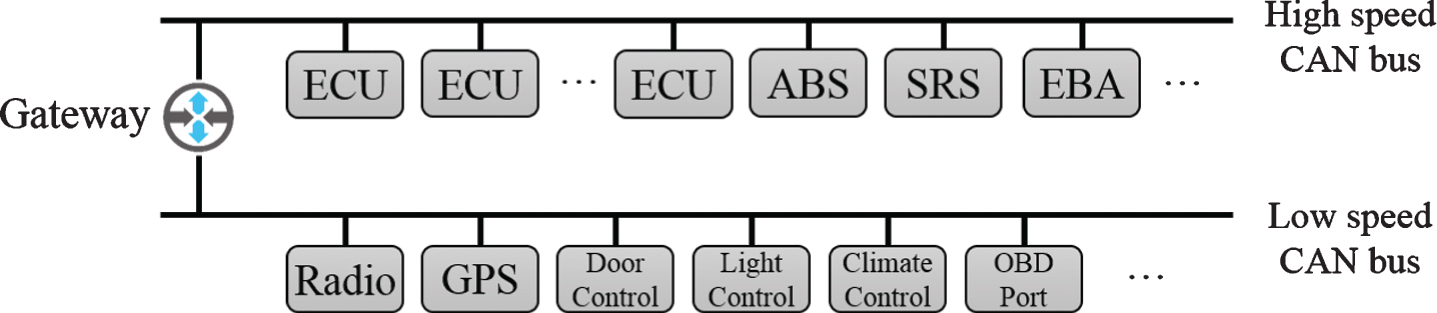
Example of Controller Area Network (CAN).
As shown in Fig. 1, there are two types of buses: high-speed and low-speed CAN buses. The devices on the high-speed bus, whose speed is about 500 kb/s [2], are time-critical modules, such as engine control module and brake control module; while the devices on the low-speed bus are less time-critical. When a signal is sent from a module, it is broadcasted to not only other modules on the same bus, but also the ones on the other bus via the gateway.
Figure 2 shows a data frame for CAN 2.0B. The CAN was developed in the early 1980s; thus, it has been updated and modified by many researchers. Nowadays, the CAN 2.0A and 2.0B protocols are adopted to the vehicles, in which the data frame in the CAN 2.0B protocol is an extended version of the one in the CAN 2.0A protocol (i.e., in the data frame of CAN 2.0A, there is no extended identifier field in the arbitration field of 18 bits size).

CAN 2.0B Frame.
As discussed in the previous section, the CAN data frame is broadcasted to all the modules via buses. Therefore, every module in the in-vehicle network can receive the CAN data via the bus. Thus, if a portable device is plugged in the OBD port, or if a malicious device is connected to the in-vehicle network, they can read the broadcasted data.
As shown in Fig. 2, there is no field related to confidentiality or authentication, which may allow various security and privacy attacks. The data is not encrypted; thus, all the nodes in the in-vehicle network can sniff the broadcasted frames. If such frames contain privacy-sensitive data, and a malicious device is plugged in the OBD port, the privacy of the driver may be infringed. Koscher et al. demonstrated that adversaries can discover many functions of selected ECUs [5].
Proxy re-encryption
PRE is a scheme that enables a proxy to transform a ciphertext that can be decrypted by one user into another ciphertext that can be decrypted by another user without decryption [15]. A plaintext is not revealed in the process of PRE; thus, the confidentiality of the ciphertext is preserved. It is observed that the PRE scheme is based on public key cryptography. The basic concept of the PRE scheme is shown in Fig. 3.

Proxy Re-Encryption.
Let pk A and sk A be Alice’s encryption and decryption keys and let pk B and sk B be the ones for Bob. Note that sk A and sk B are kept only by Alice and Bob, respectively. Moreover, for a message M, let {M} pk X be an encrypted version of M that can be decrypted with sk X , where X ∈ {A, B}.
Conventionally, to allow Bob to decrypt {M} pk A , Alice first decrypts with sk A and encrypts with pk B , or may employ a third party, which is called proxy. In terms of the latter case, Alice first splits sk A between Bob and the proxy, {M} pk A is partially decrypted by the proxy and is finally decrypted by Bob [16–18]. However, this approach requires Bob to have an additional secret key for every delegation that he accepts [19]. To accomplish this, the PRE scheme is proposed.
The concept of the PRE scheme is as follows. First, there are four parties: a delegator (Alice), a delegatee (Bob), a key distributor, and a proxy. The aim of the key distributor is generating and distributing keys which include various participants’ keys (pk X and sk X ) and the re-encryption key (rk). As shown in Fig. 3, let us consider the case that Alice delegates the access authority of the message M to Bob. The aim of the proxy is to re-encrypt {M} pk A to {M} pk B using only rk without decryption.
The PRE scheme was first proposed by Blaze, Bleumer, and Strauss [20], the PRE scheme has received considerable attention, and many researchers have proposed more developed PRE schemes. Generally, the PRE scheme can be categorized into two types: unidirectional PRE and bidirectional PRE. The bidirectional PRE scheme allows the users to re-encrypt the ciphertext many times, while the unidirectional PRE allows that only once. The first one proposed is bidirectional PRE. However, the bidirectional PRE scheme has a few shortcomings: the delegation in the scheme is transitive and the delegator’s secret key can be completely recovered if the proxy and the delegate collude. Due to these problems, secure storages employ the unidirectional PRE schemes [21]. In the proposed scheme, we also use the unidirectional PRE because the re-encrypted data can no longer be re-encrypted again.
The unidirectional PRE scheme has been developed by many researchers since the time it was first proposed. In [21–24], the authors addressed a chosen-plaintext attack for the unidirectional PRE scheme, and proposed solutions for preventing such type of attack. Furthermore, in [19] and [25], the authors pointed out the possibility of the chosen ciphertext attack on the unidirectional PRE scheme, and developed new PRE schemes, which are based on public key and identity, respectively. In addition, Chow et al. proposed a new efficient unidirectional PRE scheme secure against the chosen ciphertext attack [26].
Generally, a unidirectional PRE scheme is composed of seven functions:
In this section, the PINK scheme is proposed. First, the system architecture is proposed, and then the concrete file encryption and decryption schemes based on the PRE are proposed. Finally, a group-based key management scheme for efficient data delivery is proposed.
System architecture
Figure 4 shows the basic architecture of the proposed scheme. The scheme is composed of a VCU with a shared storage, a proxy, a key distributor, a gateway, and various nodes including ECUs. All the components are connected to the buses. The shared storage stores all the data collected by the nodes or various information generated by the vehicle. Among the data in the storage, the privacy-sensitive ones are encrypted with a master encryption key, pk M , which is kept only by the VCU and the key generator. Note that the encrypted data in the VCU can be decrypted with the master decryption key sk M .

Basic Architecture of PINK.
Each node has its own encryption key and decryption key. For a node n, let pk
n
and sk
n
be its encryption and decryption keys, respectively. Further, a proxy collects all the encryption keys that include pk
M
, which will be used for generating the re-encryption key. Note that
When
In addition to the unicast way, this study proposes a multicast data transmission. Let us assume that nodes n1, n2, ⋯, n
t
shares a group encryption key pk
g
and a group decryption key sk
g
. Further, when these t nodes requests data
Now, we describe the detailed procedures for the proposed scheme, which is composed of five procedures: system initialization, participant registration, withdrawal, data storing, and data loading. To implement our scheme, we employ a unidirectional PRE scheme proposed by Chow el al., which is secure against well-known possible attacks including the chosen ciphertext attack [26].
System initialization
When the system is initialized or reset, the values and functions that are used for the PRE scheme are determined. The description is as follows:
The key generator first chooses two large primes p and q that satisfy q ∣ (p - 1), and selects a generator The key generator determines four hash functions The key generator broadcasts The VCU chooses a secret key The VCU transmits its secret key sk
M
to the proxy securely. In addition, each node sends its public key to the proxy. Note that these keys are used for generating the re-encryption key.
After the system initialization process, all the components have the shared parameters, the shared functions, and their own public and secret keys.
Joining and revocation of participant
When an additional node is plugged to the in-vehicle network, the device receives the shared parameters and determines its secret and public keys. Moreover, when the device is removed forever, the system should let the device not participate the in-vehicle network. The descriptions of these processes are as follows:
When a node (let the node be n) is plugged, the vehicle checks its validity. If there is no problem, the key generator transmits Using the parameters, the node chooses its secret key The node sends its public key to the proxy via the bus.
All the participants except the removed node deletes the removed node’s public key. The key distributor removes the re-encryption key related to the removed device.
When being plugged, if a device joins an exist group, then in the above joining process, a step for receiving the group public and private keys is added. Further, in the revocation process, if the removed device was in a group, then the group key is updated and shared by the remaining participants. We will address the group key management in Subsection 4.3.
Storing data
In this scheme, when a node such as ECU, sensor, and communication device creates data and stores to the shared storage in the VCU, the data need security, and then they are encrypted with the master public key pk
M
. For this, the node encrypts the data with a master public key pk
M
= (pkM,1, pkM,2). The detailed process for encrypting message The node chooses The node picks ω ∈ {0, 1} ℓ1 and computes The node computes The node computes s = u + r · H3 (D, E, F) mod q, and outputs the ciphertext The node sends
Decryption by the VCU
The VCU may use the data stored in itself. In the VCU, the ciphertext is in the form The VCU checks if If the above equation is established, the VCU computes
The VCU checks if the equation
Loading data
Now, let us consider the case of loading data from the shared storage. If the data is not encrypted, the participants may use it as is. However, if encrypted, the following procedures are in operation.
When a node n requests to receive data The key distributor picks h ∈ {0, 1} ℓ0 and π ∈ {0, 1} ℓ1, then computes v ← H1 (h, π). The key distributor computes The key distributor determines the re-encryption key The proxy checks if If the equation is true, the proxy computes When (E′, F, V, W) arrives in node n, it computes (h ∥ π) ← W ⊕ H2 (V1/skn,2) and Node n checks if
These are eight steps with complex calculations, thus, the procedure for loading data can be a time-consuming task. If the stored data is loaded in real time, the verification steps can be skipped.
Group-based key management
There may exist a group of nodes that requests the VCU to send the same data simultaneously. If the group requires the same data multiple times, the loading data procedure discussed in Subsection 4.2 may prove inefficient. To overcome this problem, this study proposes a group-based key management scheme.
Let
A new node can join the in-vehicle network. Moreover, there may exist a node in the in-vehicle network that will be revoked. For these cases, the group key should be changed because of the forward and backward secrecies [3]. To update the group key, the key distributor first generates the new group secret and public keys and encrypts them with each node’s public key. Note that this encryption process is repeated for each remaining member of the group.
With this process, the operation cost for data transmission must be reduced if a special group of the nodes requests the same data simultaneously multiple times. In addition, only the nodes in the new group can receive the updated group key; thus, only the group members can receive the data even when group membership changes.
Simulations
In this section, we demonstrate that the proposed PINK scheme can be efficiently applied to the in-vehicle network using the simulation. We measured the time for loading data, which was introduced in 4.2.5. In this scheme, time for loading data is the major concern, because the node should be able to use the data in the VCU as fast as possible.
In terms of the simulation environment, we employ SHA-512 hash function for determining four functions H1, H2, H3, and H4, and determine p as a prime number with 1024 bits. In addition, the simulation is the results of experiment on Ubuntu, 2.4 GHz Intel Core i5, and 8 GB DDR4 RAM environment.
Figure 5 indicates the simulation result for the measuring time for data decryption. We first set the data sizes from 8 bytes to 16 bytes because the size of can message is between 8 and 16 bytes according to Fig. 2. As Fig. 5 (a), the time for data decryption is under 3 ms, this is sufficiently short time for applying the in-vehicle network. In addition, we conduct the simulation for decrypting data whose size is between 1 KB and 1 MB. Although it takes more than 1 second when the data size is over 20 KB, this PINK scheme can be used because almost data for the in-vehicle network are small.

Time for Data Decryption.
In existing in-vehicle networks, data is stored and transmitted without being encrypted. Moreover, during data transmission, it is broadcasted to the bus and exposed to all the participants of the in-vehicle network. Therefore, using a portable device, which is plugged to the vehicle, or a communication module, the privacy-sensitive data can be leaked.
In this study, we proposed the application of the PINK scheme to the in-vehicle network. The privacy-sensitive data is encrypted by the master key using the PINK scheme before being stored in the VCU. Thus, only the VCU can see the encrypted data in the storage. In addition, with the PRE scheme, the data transmitted through the bus can be decrypted only at the target node. Moreover, with a group key, the VCU can securely multicast the encrypted data to a group of participants. Thus, the data can be transmitted securely and efficiently.
Footnotes
Acknowledgments
This research was partly supported by the National Research Foundation of Korea (NRF) grant funded by the Korea government (MSIP) (No. 2017R1C1B5018116), and the Sookmyung Women’s University Research Grants (1-1603-2018).