



Abstract
In this paper, a novel multisignature scheme based on chaotic maps is proposed. The purpose of multisignatures is to manage the complexities of a document signed by numerous signatories. The chaotic system is an encryption method proposed in recent years that has received widespread attention in the field of cryptography. This paper first examines the methods of multisignatures and chaotic maps, and then proposes a multisignature scheme that was designed using chaotic maps. During the processing of a multisignature scheme, to authenticate the precision of the received document, the signatory must first obtain the signed document, and then utilize the characteristics of chaotic maps to recover the original document. If the recovered document is meaningful, this indicates that no errors exist in the signature, thus the signatures are valid and the document can be signed. If the recovered document is not sufficiently clear, signing is denied. At present, because no relevant literature exists that has proposed utilizing chaotic maps to establish a multisignature system; this paper aims to develop a novel research method.
Introduction
Digital signatures were first proposed by Diffie-Hellman [39] in 1976, and the procedure can be explained as follows: Signatory A uses a secret key to sign document M (i.e. plaintext), producing the signature S. Signatory A uses the Internet to publicly transfer the document and signature (M, S) to receiver B. Next, receiver B uses a public key to restore the received signature S to document M. If the public key verifies the signature, the signature is effective; otherwise, it is regarded as an ineffective signature.
After 1978, several schemes on the technology of digital signatures were proposed in succession; most schemes were based on the RSA or ElGamal algorithms [1, 35]. By 1993, David [15] conducted a comprehensive review of the state of the art of digital signatures, and recommended that research efforts in digital signatures should be directed toward smart card applications. Digital signatures have been able to replace traditional signatures precisely because they possess two primary functions: Validation and integrity: a valid signature ensures that the message content has not been tampered with. Authenticity: similar to traditional handwritten signatures, a digital signature confirms the identity of the originator of the digital document.
Thus, digital signatures are equivalent to handwritten “signatures” in everyday life; when documents with official effect are digitally signed, the signer need not fear forgery or document tampering. In reality, a digital signature is a text string composed of a combination of 0 and 1 character. Digital signatures are currently used in areas such as e-mail, office automation (OA), electronic data interchange (EDI), and electronic fund transfers [12, 43].
The definition of multisignature [9] is: “Many signatories (signers) sign a document together.” Just as a single digital signature can be used for the processing and presenting for review of general official documents, a multisignature extends digital signature technology for the implementation of official electronic documents. Conventional multisignature methods are mostly based on the ElGamal or RSA methods. The concept of a multisignature method was first proposed jointly by Itakura and Nakamura [18] in 1983; its purpose was to develop OA. The practice was to establish the hierarchical relationship between users in advance and to build on the extended RSA method. The disadvantage was that the signing order was fixed according to the hierarchical relationship; during the signing process, this resulted in message expansion. Subsequently, in 1988, Okamoto [37] incorporated one-way functions and overcame some of the weaknesses of the Itakura-Nakamura scheme to propose a multisignature. However, the signature and verification processes of Okamoto’s scheme were overly complex, and the scheme was thus impractical. Therefore, in 1989 Harn and Kiesler [21] proposed a multisignature scheme based on the RSA system. Their procedures during the signature and authentication phases were simpler and more practical, and were an improvement on Okamoto’s scheme; they considered the obstacle of message expansion and solved the weaknesses of the Itakura-Nakamura scheme. The Harn-Kiesler digital multisignature scheme employed the RSA cryptosystem because RSA is a widely known, one-to-one bijective public key cryptosystem. Thus, it was a “good candidate” well suited for the development of digital signatures, and was able to circumvent the obstacles that had hampered past methods; notably, it allowed numerous signatories to sign without causing message expansion. Harn continued to successively develop other multisignature frameworks [22, 23]. The digital multisignature scheme proposed by Ohta and Okamoto [19] in 1991 required two phases of loops and possessed the complication that signatories could not confirm whether those who should have signed before had already signed. Subsequently, in 2000, Mitomi and Miyaji proposed two schemes based on the discrete logarithm problem and integer factorization, respectively [33]. In 2010, Harn also proposed an identity-based RSA digital multisignature scheme [24]. Because multisignatures are better suited for modern electronic operations than conventional signature schemes, several different multisignature schemes have been proposed [14, 40].
Since the 1990 s, chaotic systems [7, 25] have been used in secure communication protocol designs. In recent years, chaotic-map-based cryptosystems have been proven to be superior to conventional cryptosystems that utilize the point multiplication computations of modular exponentiation and elliptic curves. These cryptosystems also possess several similar mathematical characteristics, such as semi group and commutative properties. Chaotic maps employ the designs of symmetric encryption protocol [8, 42] and hash functions [5, 30]. Recently, chaotic systems have also been used for digital signatures [16] and key management [17, 44].
From the perspective of the current processing of official documents, this paper assumes the signing process of a request for approval to be: “those in lower positions sign first and those in higher positions sign later.” The assumption of signing according to a fixed sequence, level by level, is in line with the process of handling official documents. Therefore, in the proposed multisignature scheme, this paper combines the advantages of several multisignature schemes for the signature processing of official electronic documents.
This scheme utilizes the characteristics of multisignatures and chaotic maps. Therefore, some relevant characteristics of multisignatures and chaotic maps are introduced in Section 2. In Section 3, the proposed multisignature scheme is described. The security of this scheme is analyzed in Section 4, and comparisons are made with other schemes in Section 5. The final section presents the conclusion.
Preliminaries
In this section, the fundamental concept of multisignatures and a few characteristics of chaotic maps are briefly introduced.
ElGamal multisignature scheme
Notations
First, we list some notations in Table 1.
Notations description
Notations description
Parameter settings
In a network system, assume a set of n signatories exists, {U
i
, 1 ≤ i ≤ n}. Let p be a large prime number and let e be a primitive element (mod p). Each signatory Ui selects a secret key x
i
, and a public key y
i
. By using x
i
and e, the value of y
i
can be obtained. The formula for deriving y
i
is y
i
= e
x
i
p
The system publishes the values of (p, e, y
i
), but retains all x
i
as secret keys that are not to be published.
Secondly, assume each user in a set of t users {Ui1, Ui2, …, U it } must sign the same document M (0≤M≤p–1). This scheme requires an issuer to be responsible for document preparation and to determine the signing order of each signatory.
Signature phase
Firstly, the issuer uses a public key encryption procedure to encrypt document M as a ciphertext pair Randomly select a number g, with g satisfying 0 ≤ g ≤ p - 1. Let Find ciphertext pair
After the ciphertext pair
Subsequently, the issuer combines the signing order list, ciphertext, and the random numbers
The first signatory Ui1 receives the information sent by the issuer, immediately decrypts the ciphertext pair
Signing order list (taking the jth signatory as an example):
Derive w i j .
From the aforementioned three formulas, find the value of (Q1, Q2, W).
Similarly, the jth signatory U
i
j
encrypts document M into the ciphertext pair
Authentication phase
After the j + 1th signatory receives the message of the jth signatory, the signatory authenticates the partial multisignature [(Q1, Q2, W) , (r, v)] according to the authentication procedure.
Authentication procedure (with the jth signatory as an example):
If the aforementioned authentication is established and U
i
(j+1)
also agrees to sign this document, then he can generate the following in accordance with the signing order list: {(U
i
1
, U
i
2
, …, U
i
t
), [ Signatory U
i
t
sends the multisignature to receiver R. Receiver R decrypts the ciphertext, and authenticates whether document M is precise and effective.
To enable secure conversations between two different users, Professors Harn and Kiesler [21] of the University of Missouri proposed a multisignature scheme based on a modified RSA public key cryptosystem (i.e. an extended RSA scheme).
The Harn-Kiesler scheme is characterized by the use of the well-known RSA public key cryptosystem; in this highly efficient scheme, every user participating in the signing is provided with secure data and digital signatures. Any number of signatories is permitted to sign the same document, and the signature is secretly delivered to the receiver. Regardless of how large the number of signatories is, the length of the ciphertext generated by the signatories remains constant. However, the limiting condition of this scheme is that the signing order list must be predetermined by the issuer; this practice prevents the complication of message expansion.
From the perspective of the current processing of official documents, the signing process of a request for approval should be that those in lower positions sign first and those in higher positions sign later; this is in line with the process of handling official documents. Therefore, the assumption of presenting a document for signing in a certain fixed sequence, level by level, is in line with the process of handling official documents.
RSA is a widely known, one-to-one public key cryptosystem. Therefore, it is a good candidate for generating digital signatures, and has also solved the past deficiency of message expansion due to an increase in the number of signatories. This paper thus referenced the concept of Harn et al. [21–24] in the generation of the signing procedure, and proposed a digital multisignature scheme suitable for the processing of official electronic documents according to this concept.
Characteristics of chaotic maps
In this section, the definition and relevant characteristics of chaotic maps are introduced.
Following Definition 1, the relation of T
n
(x) is defined as:
Here, the formula can be used to obtain the characteristic equation, as follows:
Then, (14) can be used to obtain two different solvable equations:
Therefore,
The Chebyshev polynomial possesses the two following key properties: The semigroup property: The chaotic property:
Where the frequency n > 1, the Chebyshev polynomial map is: T
n
(x): [–1, 1] ⟶ [–1, 1]; the frequency n is a chaotic map’s constant density
To enhance the property, Zhang [13] proved that the semigroup property was preserved as the time interval defined by the Chebyshev polynomial (-∞ , + ∞), as follows:
This paper uses chaotic maps to design a novel digital multisignature scheme.
Notations
This multisignature method enables every signatory to review and sign a document, and further uses a ring network to deliver the document to the next signatory. Each signatory performs verification before performing the action of signing. The notation assumptions of this protocol are shown in Table 2.
Notations description
Notations description
All the cryptosystems whose security is based on factorization need strong primes. As defined by Gordon [11], Ogiwara [27] and Laih et al. [2], a prime p is called a strong prime if p satisfies the following conditions: There exist two large primes p1 and p2 such that p1 | p - 1 and p2 | p + 1. There exit two large primes r1 and s1 such that r1 | p1 - 1 and s1 | p1 + 1. There exit two large primes r2 and s2 such that r2 | p2 - 1 and s2 | p2 + 1.
The prime that meets the above conditions is called a strong prime.
The multisignature scheme proposed in this paper, based on chaotic maps, can be subdivided into the phase descriptions of the initialization phase and signature and authentication phase.
Firstly, the system delivers the document intended for signature through the ring network to individuals who must sign the document, according to the position of each signatory in the signing order list. The first signatory is designated as the issuer of the document. The document is first signed by the issuer, and the multisignature is progressively performed according to the sequence of the network. Here, each signatory U i is required to first complete the preprocessing of the signature. The performed steps can be summarized as follows:
if T0 (M) =1, T1 (M) = M, then
Assume that a document M is to be signed by t individuals {U i , 1 ≤ i ≤ t}, where U1 is specified as the issuer of the document and U1 signs the document first. Each signatory first performs authentication of the signature, according to the signing order list specified by official documents, to determine whether the previous signature is valid. Then, signatories use their own secret keys to perform the task of signing the document and deliver the document to the next signatory through the ring network to complete the entire multisignature. The authentication and signature phase can be divided into five steps:
If M is meaningful, this indicates no errors exist in the authentication of U1, and the second signatory U2 accepts this signature; otherwise, it is rejected. If the second signatory agrees to sign, the signature S1 of the first signatory is used to sign. The formula for signature calculation is:
Signatory U i then delivers signature S i to Ui+1.
Finally, the signatory delivers signature S t to the receiver U R . If the system has the issuer as the receiver, the issuer may, according to the aforementioned authentication steps, recognize that signing of the official document has been completed. The issuer can then grant approval to issue and implement the document according to the specifications of official document processing, followed by archiving of the document according to procedure.
The multisignature scheme based on chaotic maps proposed in this paper is not limited regarding the number of signatories. Specifically, for each signed official document, the t + 1th signatory can be determined by the tth signatory according to the procedure of official document signing and personal authority. This multisignature scheme is also a true signature; that is, the receiver can also perform confirmation independently, upon receiving the signature, and does not require an intermediate moderator. Thus, communication on both sides can utilize the proposed multisignature scheme to establish a secure multisignature operating system.
A multisignature is secure when, in the event that deceit or fraud occurs during the process of handling multiple signatures, the cheater can be identified, and various types of attacks can be prevented to ensure the security of the scheme. This section analyzes the security of the multisignature scheme proposed in this paper, and performs a step-by-step, in-depth explanation from the perspectives of theory, the security of multisignature schemes, and its ability to prevent multiplicative attacks.
This framework is established on the basis of computational security
This framework proposes a new multisignature scheme that was designed using chaotic maps. In the theory of cryptography, the difficulty of solving chaotic maps is equivalent to the difficulty of the generalized discrete logarithm problem and is a computationally secure problem. Because the secret key d i of each signatory is only under the possession of the producer himself, and it would be highly difficult to be obtain d i using the public key e i , no one is able to forge the signature. Similarly, a signatory cannot repudiate a signature; the existence of the signature effectively proves that the signatory’s secret key made the signature.
Additionally, in the initialization phase of this framework, each signatory must select two strong prime numbers p and q and keep them confidential. The product of the two large prime numbers p × q can be made public, which is similar to the traditional RSA scheme and possesses a similar level of security. Thus, the security of this framework is established on the difficulty of the factorization problem, and is classified as computationally secure.
This framework possesses recoverability
The authentication of the multisignature scheme proposed in this paper was intended to restore the obtained signature S to the original document M. In the following, it is proved that because this scheme possesses the characteristic of the composition rule, it enables the authentication of signatures to have recoverability.
2. Assuming that in the chaotic map established by document T d (M), the roots of the characteristic polynomial f (x) = x2 - T d (M) x + 1 =0 are β and β-1, whereas β + β-1 = T d (M) = α d + α-d.
3. Because the relation β + β-1 = α d + α-d exists, the two solutions β = α d and β = α-d can be obtained [42]. Therefore, the recoverability of the document can be divided into two solutions for further analysis:
Case 1: When β = α
d
,
Case 2: When β = α-d,
4. Furthermore, because the two keys d and e are mutually inverse,
This proves that this multisignature scheme possesses recoverability.
Because the familiar RSA cryptosystem is characterized by the multiplicative property, as shown in Fig. 1, it is vulnerable to multiplicative attacks during the generation of digital signatures.
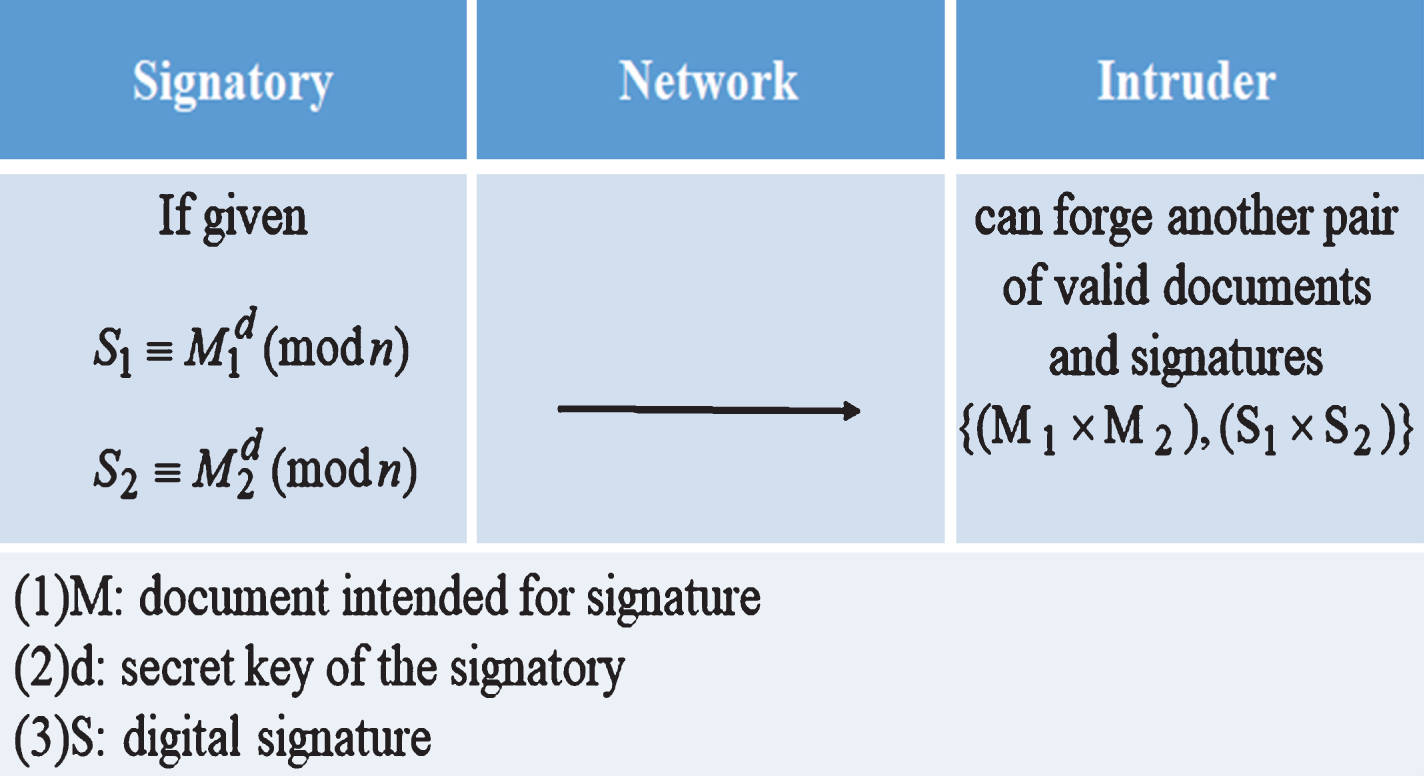
Characteristics of the multiplicative property.
The proposed digital multisignature scheme is established using chaotic maps. Because the chaotic cryptosystem itself is nonmultiplicative, this scheme can avoid multiplicative attacks. This can be expanded to avoid modular inverse attacks and chosen-plaintext attacks. Therefore, this scheme is more secure than multisignature schemes established using the RSA system.
Overall, according to the aforementioned security analysis, it can be found that a multisignature scheme based on chaotic maps can defend against attacks by individuals with harmful intentions and achieve a favorable effect of confidentiality.
Existing multisignature schemes are mostly designed using public key cryptosystems. However, public key cryptosystems at the present stage require time-consuming factorization computation, modular exponentiation, or elliptic curve point multiplication. Several expert scholars have attempted to develop more efficient cryptographic techniques and schemes, and chaotic maps are a new type of technique proposed in recent years for the development of public key cryptosystems. The computation of chaotic maps has been proven to possess mathematical characteristics similar to those of modular inverse and elliptic curve point multiplication computations; chaotic map schemes are clearly more efficient than other schemes.
Items of functionality are expressed here, and Table 3 is used to show the functionality between related plans, described as follows:
Can avoid multiplicative attacks
Can avoid modular inverse attacks
Can avoid chosen-plaintext attacks
Can avoid replay attacks
Computation and communication costs are low
Possesses recoverability
Comparison with other relevant mechanisms
Comparison with other relevant mechanisms
In the past, research on public key cryptosystems has only discussed schemes based on RSA or ElGamal. Cryptosystems based on chaos theory are gradually gaining attention, which proves that they possess crucial value.
This paper proposed a multisignature scheme based on chaotic maps; at present, no relevant studies have proposed such a scheme, and this paper thus provides a new research direction. The security and effectiveness of this scheme are superior to those of conventional public key cryptosystems; the proposed scheme can avoid the vulnerabilities and shortcomings of other schemes, including multiplicative attacks, modular inverse attacks, and chosen-plaintext attacks. Therefore, the security of the scheme proposed in this framework can be affirmed.
Footnotes
Acknowledgments
The authors would like to thank the Ministry of Science and Technology of the Republic of China, for financially supporting this research under Contract No. MOST 106-2221-E-145-002-.