



Abstract
Bicycle-sharing systems are commonly established at geographically dispersed locations to create their rental service networks. To provide customers with flexibility and convenience, bicycle-sharing systems commonly allow them to pick up bicycles from one station and return them to a different one. However, allowing customers to return their rented bicycles to different stations can possibly lead to an imbalance in the bicycle rental network. One of the approaches to overcome the bicycle imbalance problem is to apply dynamic pricing to motivate consumers to return the rented bicycles to stations without a sufficient number of bicycles. This study developed a constrained dynamic pricing model to address the bicycle imbalance problem. Moreover, this study aimed to maximize the total revenues over a planning horizon through dynamic pricing strategies. We identify some necessary conditions for optimal sale prices. Using these conditions, we develop a heuristic algorithm based on linear programming and an evolutionary algorithm to efficiently produce comprise solutions. The proposed model and solution procedure were applied to analyze the bicycle system in Taiwan. Sensitivity analyses were also conducted to investigate the effects of various system parameters.
Introduction
The reasons for people’s preference for bicycles as their transportation mode vary considerably [16]. With regard to public policy, cycling is considered a sustainable transport mode, which decreases greenhouse gases as well as noise and air pollutions given that considerably few people travel by car. Cycling also decreases traffic congestion and the potential risk of traffic accidents and fatalities. For private individuals, cycling benefits include increased physical activity levels, increased opportunity to spend quality time with friends and family, and decreased traffic congestion when moving around urban areas. In addition, cycling can solve the last mile problem for users who seek connections to public transit networks.
The increasing popularity of cycling has encouraged several organizations to join the bicycle rental business. To increase market share and competitiveness, many bicycle rental companies establish multiple rental branches at geographically dispersed locations to create their bicycle rental networks. Leveraging their rental networks, these companies allow customers to pick up bicycles from one station and return them to a different one. This service model provides customers flexibility and convenience and can enhance the competitiveness of the rental company. However, allowing customers to return their rented bicycles to different stations can possibly lead to an imbalance in the bicycle rental network. Specifically, stations with low demands will probably accumulate a surplus of idle bicycles, whereas stations with high demands will possibly experience a bicycle shortage [25]. The potential imbalance of supply and demand at the bicycle stations can probably result in lost sales at stations experiencing relatively high demands and under-utilization of assets at stations experiencing relatively low demands.
Bicycle firms can overcome the imbalance problem using the supply or the demand management approaches to improve service quality or profits. Supply management approaches mainly aim to rebalance the bicycle system through bicycle repositioning planning that balances the available supply with anticipated demands. The repositioning planning problem includes the resource deployment problem, which determines fleet levels for all branches, and the transportation operation problem, which anticipates the required resource transfers among branches. Over the years, several works related to bicycle and car rental problems have proposed mathematical models to deal with transfer planning problems. These studies aimed to focus on minimizing travel costs and times ([2, 4]), minimizing unsatisfied demands ([13, 21]) or minimizing both of them ([6, 27]). The mathematical models in the literature are established in terms of linear programming models ([1, 23]), integer or dynamic programming models ([8–10, 26]) and queuing models ([11, 22]).
The repositioning problem is generally considered non-deterministic polynomial-time (NP)-hard; thus, many researchers applied meta-heuristic algorithms or develop heuristics to solve their proposed models ([15, 29]). These approaches are not guaranteed to produce the exact optimum solutions. However, they can produce compromise solutions or acceptable optimums within reasonable computational times. Accordingly, when problems have substantial computational complexities and are computationally intractable (such as NP-hard problems), these approaches are usually considered given that accurately solving such type of problems can take an exponential amount of computation time [24]. Yaghini and Khandaghabadi [29] developed a genetic algorithm and simulated annealing-based algorithms to deal with a dynamic fleet-sizing problem. Sayarshad and Ghoseiri [23] applied the simulated annealing approach to deal with a railcar fleet-sizing problem. Oliveira et al. [15] presented a relax-and-fix-based algorithm to study a vehicle-reservation assignment problem.
Several researchers have dealt with the repositioning problem in terms of supply management approaches ([7, 30]). In addition to supply management methods, demand management approaches can be used to balance demand and supply. However, to the best of our knowledge, few researchers have attempted to overcome the problem using the demand management approaches. The application of price discounts has been viewed by many industries as one of the effective demand management tools to balance demand and supply. For example, in the car rental industry, Hertz offers 10% to 30% car rental discounts during different seasons. In general, high price discounts result in high demand levels. On the contrary, low price discounts or price surcharges result in low demand levels. Therefore, rental companies should view their pricing strategies as a revenue enhancement tool and as a key weapon to address the demand management problem.
Problems associated with pricing planning for service capacity are discussed primarily in the study of revenue management. However, the application of revenue management to the control of perishable capacity mainly focuses on whether to accept or reject incoming booking reservations ([3, 28]) and rarely discuss the pricing and balancing problem of bicycle-sharing systems. Consequently, the literature currently lacks a model that can simultaneously consider the decisions related to the determination of rental prices for the closed rental bicycle system. This study developed a constrained mathematical model, which uses dynamic pricing to balance the bicycle status across the bicycle stations. We aim to maximize the total profit over a planning horizon through dynamic pricing. We find some necessary conditions for sale prices to be the extreme points of the objective function. Using these conditions, we develop a heuristic algorithm, which is based on linear programming, and an evolutionary algorithm to solve the proposed model. The proposed model and solution procedure were applied to the analysis of actual cases in Taiwan. Sensitivity analyses were also conducted to investigate the effects of various system parameters.
Model description and Formulation
A bicycle rental company aims to create a pricing plan for its rental business over M branches in T planning periods. D
i
docking poles are available at Branch i, and at all branches, and the minimum and maximum durations are one and K rental periods, respectively. We suppose that the number of bicycles initially allocated at Branch i at the start of period-1 is v1i and that no bicycle is on lease at the start of period-1. The fleet size of the bicycles, S, is the sum of bicycles allocated at all branches at the start of the planning horizon. Therefore,
The company allows customers to pick up bicycles from one station and return them to a different one. To distinguish the different request types, we use symbols (t, i, j, k) to denote the rental type for k periods at the start of period t at Branch i and the bicycle return to Branch j at the end of period t + k - 1. The number of rental requests for each rental type (t, i, j, k) is assumed to be price dependent and follows a known deterministic function d
tijk
(p), where d
tijk
(p) is a non-increasing function and d
tijk
(p) p is a concave function of sale price-p. In each period, the company determines the price to be set for each rental type. On each planning period, the company operates the rental business through determining rental prices to control the inventory level of bicycles at each branch. The minimum sale price for the k rental periods is assumed to be
For each period, we assume that the sequence of events proceeds as follows: rental requests and then bicycle returns. In each period, the company first decides the rental prices for all branches. The company can predict the number of rental requests that will be made based on the relationship between price and rental requests. All customers are assumed to return their rented bicycles to their destination branches at the end of the due period.
The following parameters and variables are used to develop our model.
Notation:
[K:] maximum number of rental periods,
[M:] number of branches,
[T:] number of planning periods,
[S:] total number of bikes,
[(t, i, j, k):] a demand for renting a bicycle at Branch-i at the start of period-t and returning the object at Branch-j at the end of period-t+k-1,
[D ij :] number of docking poles at Branch-i,
[d tijk (p):] requests for rental type (t, i, j, k) when the sales price is set at p,
[
[S:] fleet size.
[v ti :] number of bicycle available at Branch-i at the start of period t,
[p tijk :] rental fee for rental type (t, i, j, k).
The purpose is to maximize the total profit over T operational periods through determining p tijk and v ti .
For Branch-i in period t, when price p tijk is offered for rental type (t, i, j, k), d tijk (p tijk ) units of rental requests are rented out. Below, we use symbol x tijk to stand for d tijk (p tijk ). In this case, the revenue from rental type (t, i, j, k) is x tijk p tijk . Let PR denote the total expected revenues over all planning periods. Thereafter, we can express PR as Eq.(1).
Bicycle capacity, S, remained constant over all periods. For t ≥ 2, all bicycles may not necessarily be stocked in the company branches given that some of them are on lease. The total bicycle inventory includes the sum of bicycles available at all branches at the start of the period and the ones on lease. For period t ≥ 2 and the maximum rental period K = 1, given that all bicycles are returned in the same period, the sum of the bicycles remaining at all branches at the start of a period should be equal to the fleet size, S. Therefore, for K = 1, we have constraint (2).
For period t ≥ 2 and the maximum rental period K > 1, the number of bicycles available at all branches at the start of the period is
The total number of bicycles stocked at a station cannot exceed its total docking poles. Accordingly, we have constraint (4).
The number of bicycles to be leased out at any branch at any period cannot exceed the available bicycles at the branch; thus, we require constraint (5).
Bicycles available in the morning of period t at Branch i, v ti , minus the number of bicycles rented plus the number of returned ones is level vt+1,i. Hence, v ti and vt+1,i have the following relationship.
Rental fee for k-rental periods cannot be lower than
The purpose is to maximize the profit of the firm over T operational periods through determining decisions p tijk , v ti and x tijk . We refer to the mathematical model in the form of maximizing the PR subject to constraints (2)-(7) as Model-1.
Modeling Analysis
In model M1, the unknown decision variables include p tijk , v ti , and dependent variables x tijk . To reduce the number of variables, we will express the recursive function v ti in terms of the known parameter v1i and decision variable x tijk .
Proof: The assertion holds for t = 2 and t ≤ K since from (6) we have
Assume the assertion holds for t - 1, we have
Thus, the assertion of equation (8) holds. For t = K + 1, By (6) and (8), we have
Thus, the assertion of Eq.(9) holds for t = K + 1. Using the same logic, by induction, we can show that
Thus, we have completed the proof of Lemma 1.
Proof: For 2 ≤ t ≤ K, substituting equation (8) into constraint (3), we have
Since
Thus, the right-hand side of Eq. (14) becomes
Note
Then, it is clear that the sum of second, third, fourth and fifth terms is zero. The remining term in the right hand side of (3) is
Substituting constraints (8) and (9) in constraint (4), we can express constraint (4) by constraints (18), (19) and constraint (5) by constraints (20) to (22).
Combining equations (18)-(22) and Lemma 2, we can reduce variable v ti in Model-1 and can re-express Model-1 as the form of maximizing PR subject to constraints (7) and (18-22). We refer to this model as Model-2 and show Model-2’s Lagrangean function below.
Lagrangean function:
The Lagrangean function of the problem L (
where
where λ ti , γ ti and η tijk are the Lagrange multiplier associated with the above constraints.
Remark 1: L1 and L2 can be rearranged as (27) and (28), respectively.
Proof: First, we have ∂2PR/∂p
tijk
∂pt′i′j′k′ = 0 if p
tijk
≠ pt′i′j′k′. In addition, given that the modeling assumption results in a negative
Proof: The solution space is convex because the constraints are all linear. Combining this constraint and Lemma 3 with concave objective function, then we have completed the proof.
Lemma 4 implies that the resulting stationary point yields a global constrained maximum. The Karush-Kuhn-Tucker (KKT) conditions are derived as follows:
In these cases, the first derivative of the Lagrangian function with respect to
The last term of L2 in constraint (28) is the result when λ sj is replaced with γ sj in constraint (39).
The KKT condition system may not be easy to solve. To reduce the complexity, we denote the following three sets: Ω1 (), Ω2 (), Ω3 (), in which Ω1 () = {(t, i) |λ ti = 0, ∀ t, i}, Ω2 () = {(t, i) |γ ti = 0, ∀ t, i}, Ω3 () = {(t, i) |η tijk = 0, ∀ t, i, j, k}, respectively. According to the values of the three sets, by (36)-(38), we can set u ti = 0 for (t, i) ∉ Ω1 (), w ti = 0 for (t, i) ∉ Ω2 (), and h tijk = 0 for (t, i, j, k) ∉ Ω3 (η), and eliminate constraints (36)-(38). We propose a hybrid evolution method based on linear programming and genetic algorithm (GA) to produce the values of Ω1 (), Ω2 () and Ω3 (). The encoding scheme and decoding method are as follows.
Chromosome = (θ1, θ2, ⋯, θ2TM+TMMK) in a population is expressed by an integer string over [0, 9]. Suppose that, for example, a chromosome for a case of T = 2, M = 2 and K = 1 is generated as
We use the values of (θ1, θ2, ⋯, θ16) to judge whether the value of λ1,1, λ1,2, ⋯, η2,2,2,1 is zero or not. The n-th parameter is set to zero if its encoding value is θ n ≤ σ, where σ is a prespecified parameter. For example, suppose that we set the value of σ in the above case at σ = 8. Then, we have Ω1 () = {(1, 2), (2, 1), (2, 2)}, Ω2 () = {(1, 1), (1, 2), (2, 1)} and Ω3 () = {(1, 1, 1, 1), (1, 2, 1, 1), (2, 1, 1, 1), (2, 1, 2, 1), (2, 2, 2, 2)}. Accordingly, λ ti = 0 for (t, i) ∈ Ω1 (), γ ti = 0 for (t, i) ∈ Ω2 (), and η tijk = 0 for (t, i, j, k) ∈ Ω3 (). In addition, we have u ti = 0 for (t, i) ∉ Ω1 (), w ti = 0 for (t, i) ∉ Ω2 (), and h tijk = 0 for (t, i, j, k) ∉ Ω3 ().
Elimination of nonlinear constraints (36-38). The parameters of λ
ti
, γ
ti
, η
tijk
, u
ti
, w
ti
and h
tijk
provide the characteristics of either λ
ti
= 0 or u
ti
= 0, γ
ti
= 0 or w
ti
= 0, and η
tijk
= 0 or h
tijk
= 0. Therefore, λ
ti
u
ti
= 0, γ
ti
w
ti
= 0, and η
tijk
h
tijk
= 0. Constraints (36) to (38) can, thus, be withdrawn. We refer to the result as the KKT1 system. Solving KKT1 system. The KKT1 system is a linear formulation, except for the term ∂L (
Model-3:
Subject to constraints (30) to (35).
The solution to Model 3 must be a feasible solution to the original problem. The value of G in (41) depends on the value of chromosome . If the objective value, G, converges to an extremely small number, Then the result is reported; otherwise, the chromosomes are renewed based on the standard GA operator to update the set of Ω1 (), Ω2 (), and Ω3 (); step 1 is repeated to improve the solution quality.
The solution procedure applies the mathematical programming approach, and performs the evolution and refinement of the GA to obtain solutions. The solution procedure can also confirm global constrained maximum when a solution to Model 3 leads to G = 0, and all parameters λ ti , γ ti , η tijk , u ti , w ti and h tijk are non-negative.
Proof: The result follows since constraints (30) to (35) and ∂PR/∂p tijk are all linear. Thus, we have completed the proof.
The case of x
tijk
= a
tijk
- b
tijk
p
tijk
is a typical demand type, where a
tijk
is the demand scale and b
tijk
is the price elasticity. It is a linear function of p
tijk
. Linear programming can be used to solve Model 3 to obtain optimal solution. The formulation of ∂L (
where
The right-hand side of Eqs. (42-53) is zero if (t, i, j, k) is not in the specified range in each equation. These formulas are omitted to save space. For example, ∂L (
In this section, we perform quantitative tests to discuss the rental prices for an actual bicycle rental case. The testing data for all cases in all problem types are from A-bike Company in Taiwan. The solution procedure was coded in Visual C++ programming language to solve test problems and to perform the sensitivity analyses. All tests were implemented on an Intel(R) Core2 Quad CPU 2.4 GHz notebook computer with 1.95 GB RAM and were terminated if the execution time exceeded 4 hours.
Problem description
The case discussed in this section consists of M = 35 rental stations near Mass Rapid Transit stations, which are obtained from A-bike Company in Taiwan. The locations of these bicycle rental stations are numbered 1-35 in Fig. 1.
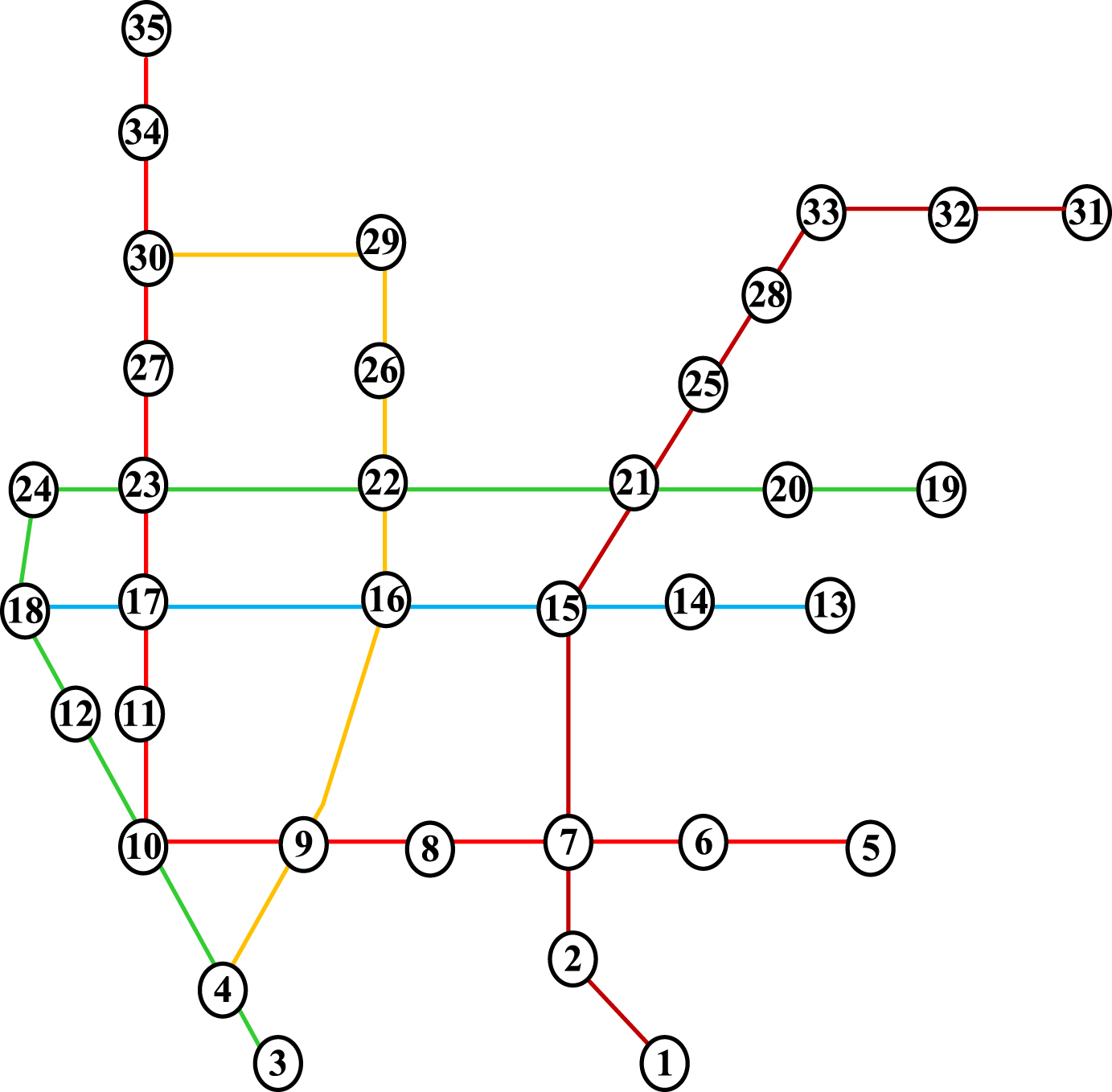
Locations of bike stations.
A-bike Company charges NT$20 per hour for the first 4 hours and NT$20 per hour (a half period rental) when the rental and return stations are the same. For each 30-minute block, the company charges NT$10 for the first 4 hours, NT$20 for the next 4 hours, and NT$40 for more than 8 hours. We divide a day into T = 12 equal time periods, each having two hours. Table 1 shows the number of bicycle docking piles for the 35 stations.
Number of docking poles
The values of the required parameters were estimated as follows. The numbers of initial bicycles at the start of period 1, v1i, were set at the entire value of 0.8D i (Table 2).
Number of initial bikes
The minimum rental prices were set at NT$1 for all rental types. The demand markets for the company are assumed to follow a price dependent linear function d
tijk
(p
tijk
). The values of a
tijk
were set at a
tijk
= α
t
β
ijk
D
i
, in which parameters α
t
are the time-variant scales and parameters β
ijk
are the location and rental length-variant scales. The value of α
t
is set at 0.1 for t = 1, 2, 3 and 12; 0.8 for t = 4, 9 and 10; 0.7 for t = 5; 0.6 for 6 ≤ t ≤ 8; and 0.4 for t = 11. The value of β
ijk
was randomly generated over [0.004, 0.08] for k = 1, [0.004, 0.06] for k = 2, and [0.004, 0.035] for k = 3 under
Five types of problems were designed, and seven cases were generated for each problem type. The number of bicycle stations is set to five for Problem type 1 and 35 for Problem types 3-5. For Problem type 2, the number of bicycle stations is incremental from 5 to 35. The values of all parameters in all cases of all the problem types are the same as that set in the previous section, except for the following changes.
In Problem types 1 and 3, we change the number of initial bicycle incrementally from 0.85
Computational results
Problem types 1-2 were used to evaluate the performance of the proposed solution procedure. To confirm the solution, we use the Lingo global solver to identify the global maximum for all instances. We use HS to stand for the proposed heuristic approach. The computational results confirm the following: The Lingo global solver can produce feasible solutions within 4h CPU time for problem instances, in which the number of stations is not larger than 15. Among these results, the Lingo global solver could only confirm global optimums for all cases in Problem type 1. For Problem type 1, Columns 4 and 7 of Table 3 show that the HS produces nearly the same solutions as those of the Lingo global solver. These solutions indicate that the HS and the Lingo global solver can produce optimal solutions for small size problems. In addition, Columns 6 and 10 reveal that the performance of the HS is better than that of the Lingo global solver in terms of computational times. For Problem type 2, Columns 4 and 7 of Table 4 show that the solution gaps between the HS and the Lingo global solver are extremely close for the first three cases. These results corroborate that the HS can produce solutions in less computational time similar to those generated by the Lingo global solver in 4-hour CPU time limit for a middle-size problem. From testing cases 4-6 of Problem type 2 and all testing cases in Problem types 3-5, we affirm that the Lingo global solver can no longer produce feasible solutions within 4-hour CPU time limit. However, the HS can still solve the problem within a reasonable CPU time (see Tables 4-7). Therefore, the proposed HS method can be applied to solve large-scale problems, which cannot be solved by the Lingo global solver within reasonable time limits.
Computational results for Problem type 1
Computational results for Problem type 1
Computational results for Problem type 2
Computational results for Problem type 3
Computational results for Problem type 4
Computational results for Problem type 5
Sensitivity analyses were performed to investigate the impact of the initial located bicycles, v1i, and demand coefficients a
tijk
and b
tijk
on the computational results. We use initials RS = PR/S and ST = SD/S to represent the average rental revenue per bicycle and the average leased frequency per bicycle, respectively, where SD is the total number of biked rented out. Problem types 1 and 3 investigates the impact of allocated number of bicycles on the computational results. The effects of the number of initial bicycles on the computational results are displayed in Tables 3 for small-scale problems (Problem type 1) and in Table 5 for large-scale problems (Problem type 3). From Columns 9 and 10 of Table 3 and Columns 7-8 of Table 5, the values of RS and ST decrease as the number of allocated bicycles, v1i, and total number of bicycles, S, increases. Columns 4 and 5 of Table 5 shows that the revenues and number of bike rented out (SD) increase as the number of initial bicycles increases. This phenomenon fits the general cognition that considerable capacities can produce substantial sales and revenues. However, the results of Problem type 1 verify that this phenomenon does not always hold. Column 4 of Table 3 shows that the revenues increase as the number of initial bicycles increases. However, when the value of v1i reaches Problem type 2 investigates the impact of the number of bicycle stations on the computational results. As shown in Columns 4 and 10 of Table 4, the revenues and the values of ST have increasing tendencies when the number of bicycle stations increases. The reason may be that bicycle stations in a big bicycle network can cover more demands compared with those having few bicycle stations. Problem type 4 investigates the impact of parameter a
tijk
on computational results. In this case, the total number of bikes is 1329. Columns 4, 7, and 8 of Table 6 show that the revenues, RS, and ST increase as the values of a
tijk
increase. In addition, we affirm that the average rental price (AR) also increases with the values of a
tijk
. Problem type 5 investigates the impact of price elastic on the computational results. Columns 4, 7, and 8 of Table 7 show that the revenues and RS decrease with the price elastic. The reason may possibly be the negative impact of price elasticity on demand.
Conclusion and Future Work
This study develops a constrained mathematical model to solve a rental pricing problem for bicycle rental companies. Our results confirm that the solutions to the KKT system of equations are the optimal sale prices. We develop a heuristic algorithm, which is based on mathematical programming, and an evolutionary algorithm to efficiently solve the problem. Computational results validate that the proposed approach can find optimal solutions for small-scale problems and can produce solutions that the Lingo global solver cannot produce feasible solutions within a reasonable CPU time. Sensitivity analyses were also conducted to investigate the effects of various system parameters.
In this study, we propose a demand management approach to balance the bicycle levels among the bicycle networks. The supply management approach based on the bicycle transfer of rental companies is also an efficient approach to balance the bicycle levels. Simultaneously adapting the two approaches to balance bicycle systems is also possible. To analyze this case, we should reformulate the mathematical model and develop new methods to solve the problem. This study is complex, hence will be further studied.